

Paper Menu >>
Journal Menu >>
 American Journal of Anal yt ical Chemistry, 2011, 2, 258-261 doi:10.4236/ajac.2011.22031 Published Online May 2011 (http://www.SciRP.org/journal/ajac) Copyright © 2011 SciRes. AJAC Studies on the Components of Essential Oil of Zanthoxylum armatum by GC-MS Amran Waheed, Shahid Mahmud, Mubeen Akhtar, Tanzeela Nazir Applied Chemistry Research Centre PCSIR Laboratories Complex, Lahore, Pakistan E-mail: [email protected] Received December 16, 2010; revised April 28, 20 1 1; accepted April 29, 2011 Abstract The essential oil of Zanthoxylum armatum was extracted through hydro distillation and analyzed by GC-MS. Hydrocarbon fraction (17.35%) of the oil was much lower and oxygenated compounds comprised fairly high portion of essential oil (39.21%). Percentages of monoterpenes and sesquiterpenes found were 47.33% and 10.83% respectively. Oxygenated monoterpenes comprised major profile of chromatogram of essential oil of Zanthoxylum armatum i.e. 37.23% where as monoterpene hydrocarbons were 10.09%. Alcoholic percentage was much higher i.e. 26.76% and 15-hexadecanoloide (6.58%) the only cyclic ester was found in relatively high percentage. Keywords: Essential Oil, Zanthoxylum armatum, Gas Chromatography-Mass Spectrometry (GC-MS) 1. Introduction Family Rutaceae is a large botanical family [1] which comprises about one hundred and fifty genera [2] dis- tributed in tropical and temperate region of the world [3-5]. From economic point, Rutaceae is an important family. Zanthoxylum armatum locally known as timber [6-9] is a wild species which is native to Laran Pass in Dir, Murree, Saidpur, Hazara, Kalapani, Jhelum and Swat valley. Hard thorny dense tree [10] of Timber is nor- mally available on banks of Lilly streams and rivers. The fruits and seeds are employed as an aromatic tonic in fever, dyspepsia, carminative, stomachic, anthelmintlc and expelling roundworms [11-13].The volatile oil is employed as an antidiarrehal, antiseptic, deodorant and anticataerhal [14-16]. The oil has a good tenacity and is appreciated for its fixative qualities. Almost all parts of the plant are aromatic and hence, supposed to possess essential oil. The essential oil composition can provide much more knowledge regarding the medicinal proper- ties and active constituents of this plant [14].The phar- maceutical companies generally use timur fruit for mak- ing different types of toothpaste [17]. An examination of literature shows that a lot of work has been done on essential oils of family Rutaceae [18-20] but work on the essential oil of this species is very few [12,16,21].The present study deals with the chemical analysis of essential oil of wild collected timber seeds and is part of our screening programme of Pakistan wild aromatic flora. 2. Metarials and Method 2.1. Extraction of Essential Oil The mature seeds of Zanthoxylum armatum, was col- lected from Balakot Mansehra (N.W.F.P Pakistan) and crushed for hydro distillation. The essential oil was ex- tracted from distillate with diethyl ether: hexane mixture (1:3 v/v). Solvent mixture was removed by vacuum dis- tillation. 2.2. Gas Chromatographic Analysis Gas chromatographic analysis was carried out on Shi- madzu GC-14A chromatograph equipped with flame ionization detector fitted with 25 m × 0.22 mm (id.) SE-30 capillary column at carrier gas flow rateof 2 ml/min with split ratio was 1:100 and sample size 0.2 l. The column temperature was programmed at 70˚C for 4 min. with 4˚C/min rise to 220˚C while detector and injector temperature were maintained at 300˚C and 220˚C re- spectively. Percentage composition of individual com- ponents was calculated on the basis of peak area using Shimadzu C-R4A chromatopac electronic integrator. 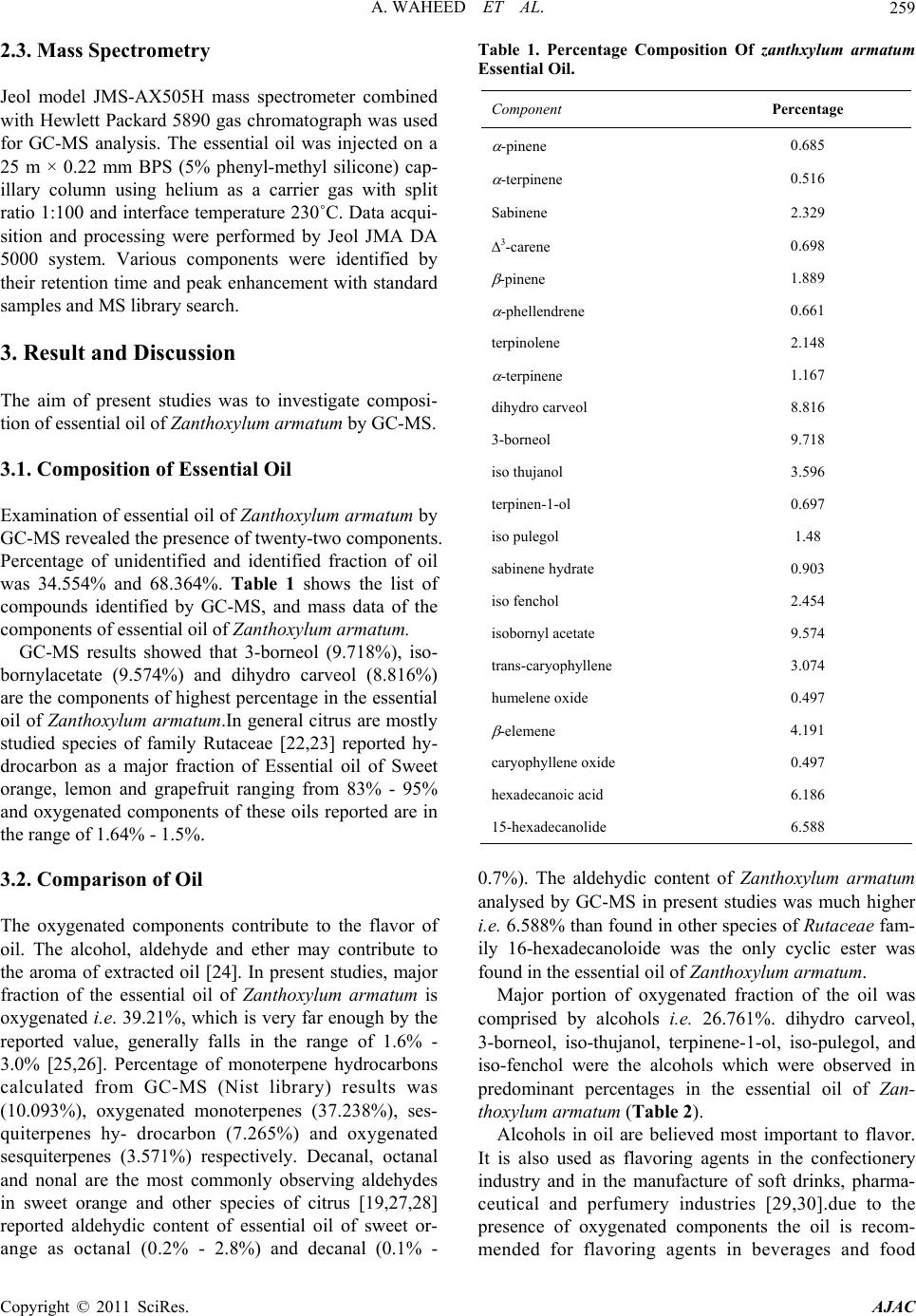 A. WAHEED ET AL.259 2.3. Mass Spectrometry Jeol model JMS-AX505H mass spectrometer combined with Hewlett Packard 5890 gas chromatograph was used for GC-MS analysis. The essential oil was injected on a 25 m × 0.22 mm BPS (5% phenyl-methyl silicone) cap- illary column using helium as a carrier gas with split ratio 1:100 and interface temperature 230 ˚C. Data acqui- sition and processing were performed by Jeol JMA DA 5000 system. Various components were identified by their retention time and peak enhancement with standard samples and MS library search. 3. Result and Discussion The aim of present studies was to investigate composi- tion of essential oil of Zanthoxylum ar m atum by GC-MS. 3.1. Composition of Essential Oil Examination of essential oil o f Zanthoxylum armatum by GC-MS revealed the presence of twenty-two components. Percentage of unidentified and identified fraction of oil was 34.554% and 68.364%. Table 1 shows the list of compounds identified by GC-MS, and mass data of the components of essential oil of Zanthoxylum armatum. GC-MS results showed that 3-borneol (9.718%), iso- bornylacetate (9.574%) and dihydro carveol (8.816%) are the components of highest percentage in the essen tial oil of Zanthoxylum armatum.In general citrus are mostly studied species of family Rutaceae [22,23] reported hy- drocarbon as a major fraction of Essential oil of Sweet orange, lemon and grapefruit ranging from 83% - 95% and oxygenated components of these oils reported are in the range of 1.64% - 1.5%. 3.2. Comparison of Oil The oxygenated components contribute to the flavor of oil. The alcohol, aldehyde and ether may contribute to the aroma of extracted oil [24]. In present studies, major fraction of the essential oil of Zanthoxylum armatum is oxygenated i.e. 39.21%, which is very far enough by the reported value, generally falls in the range of 1.6% - 3.0% [25,26]. Percentage of monoterpene hydrocarbons calculated from GC-MS (Nist library) results was (10.093%), oxygenated monoterpenes (37.238%), ses- quiterpenes hy- drocarbon (7.265%) and oxygenated sesquiterpenes (3.571%) respectively. Decanal, octanal and nonal are the most commonly observing aldehydes in sweet orange and other species of citrus [19,27,28] reported aldehydic content of essential oil of sweet or- ange as octanal (0.2% - 2.8%) and decanal (0.1% - Table 1. Percentage Composition Of zanthxylum armatum Essential Oil. Component Percentage -pinene 0.685 -terpinene 0.516 Sabinene 2.329 3-carene 0.698 -pinene 1.889 -phellendrene 0.661 terpinolene 2.148 -terpinene 1.167 dihydro carveol 8.816 3-borneol 9.718 iso thujanol 3.596 terpinen-1-ol 0.697 iso pulegol 1.48 sabinene hydrate 0.903 iso fenchol 2.454 isobornyl acetate 9.574 trans-caryophyllene 3.074 humelene oxide 0.497 -elemene 4.191 caryophyllene oxide 0.497 hexadecanoic acid 6.186 15-hexadecanolide 6.588 0.7%). The aldehydic content of Zanthoxylum armatum analysed by GC-MS in present studies was much higher i.e. 6.588% than found in other species of Rutaceae fam- ily 16-hexadecanoloide was the only cyclic ester was found in the essential oil of Zanthoxylum armatum. Major portion of oxygenated fraction of the oil was comprised by alcohols i.e. 26.761%. dihydro carveol, 3-borneol, iso-thujanol, terpinene-1-ol, iso-pulegol, and iso-fenchol were the alcohols which were observed in predominant percentages in the essential oil of Zan- thoxylum arm a t um (Table 2). Alcohols in oil are believed most important to flavor. It is also used as flavoring agents in the confectionery industry and in the manufacture of soft drinks, pharma- ceutical and perfumery industries [29,30].due to the presence of oxygenated components the oil is recom- mended for flavoring agents in beverages and food Copyright © 2011 SciRes. AJAC 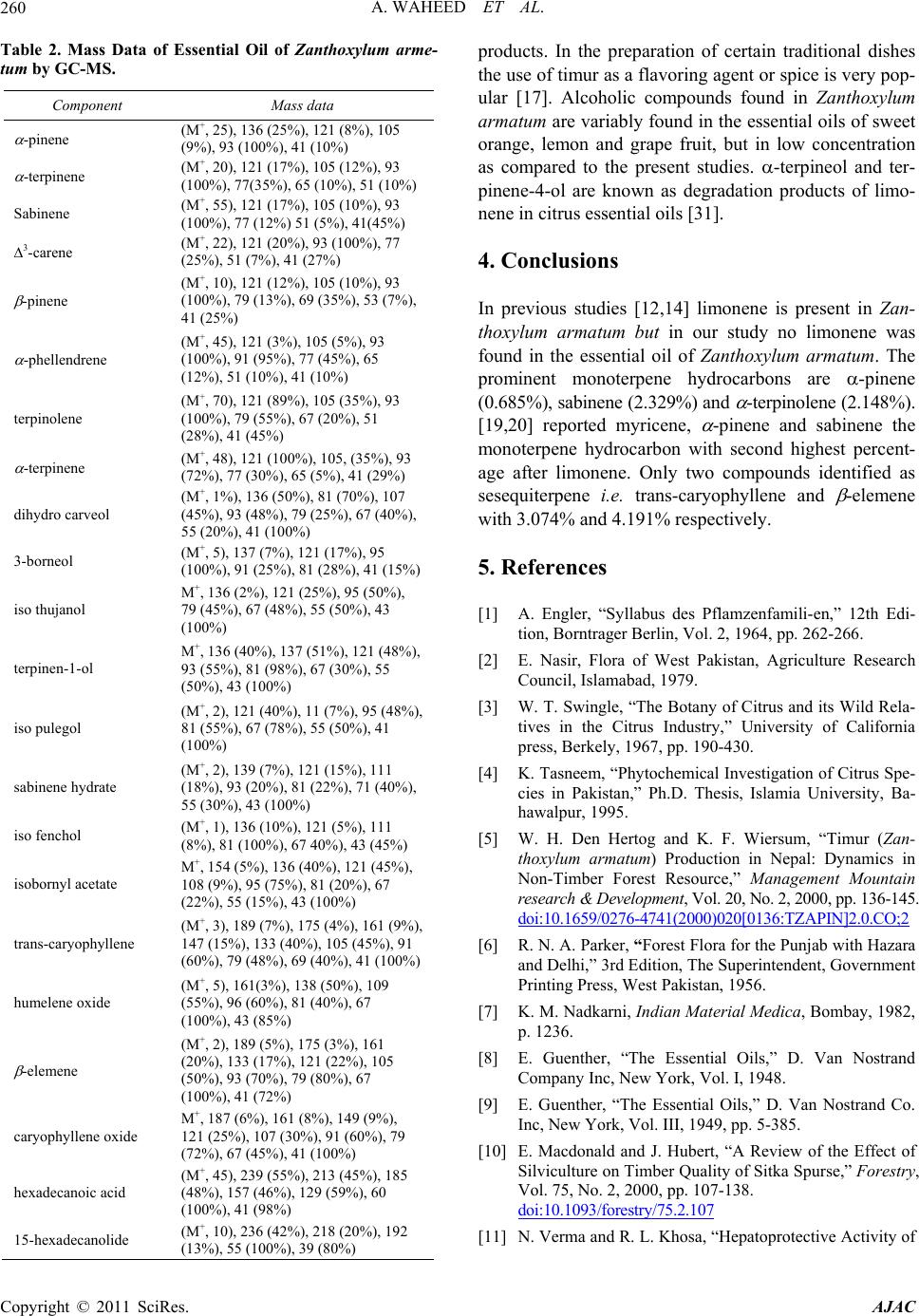 A. WAHEED ET AL. 260 Table 2. Mass Data of Essential Oil of Zanthoxylum arme- tum by GC-MS. Component Mass data -pinene (M+, 25), 136 (25%), 121 (8%), 105 (9%), 93 (100%), 41 (10%) -terpinene (M+, 20), 121 (17%), 105 (12%), 93 (100%), 77(35%), 65 (10%), 51 (10%) Sabinene (M+, 55), 121 (17%), 105 (10%), 93 (100%), 77 (12%) 51 (5%), 41(45%) 3-carene (M+, 22), 121 (20%), 93 (100%), 77 (25%), 51 (7%) , 41 (27%) -pinene (M+, 10), 121 (12%), 105 (10%), 93 (100%), 79 (13%), 69 (35%), 53 (7%), 41 (25%) -phellendrene (M+, 45), 121 (3%), 105 ( 5%), 93 (100%), 91 (95%), 77 (45%), 65 (12%), 51 (10%), 41 (10%) terpinolene (M+, 70), 121 (89%), 105 (35%), 93 (100%), 79 (55%), 67 (20%), 51 (28%), 41 (45%) -terpinene (M+, 48), 121 (100%), 105, (35%), 93 (72%), 77 (30%), 65 (5%), 41 (29%) dihydro carveol (M+, 1%), 136 (50%), 81 (70%), 107 (45%), 93 (48%), 79 (25%), 67 (40%), 55 (20%), 41 (100%) 3-borneol (M+, 5), 137 (7%), 121 (17%), 95 (100%), 91 (25%), 81 (28%), 41 (15%) iso thujanol M+, 136 (2%), 121 (25%), 95 (50%), 79 (45%), 67 (48%) , 55 (50%), 43 (100%) terpinen-1-ol M+, 136 (40%), 137 (51%), 121 (48%), 93 (55%), 81 (98%), 67 (30%), 55 (50%), 43 (100%) iso pulegol (M+, 2), 121 (40%), 11 (7%), 95 (48%), 81 (55%), 67 (78%), 55 (50%), 41 (100%) sabinene hydrate (M+, 2), 139 (7%), 121 (15%), 111 (18%), 93 (20%), 81 (22%), 71 (40%), 55 (30%), 43 (100%) iso fenchol (M+, 1), 136 (10%), 121 (5%), 111 (8%), 81 (100%), 67 40%), 43 (45%) isobornyl acetate M+, 154 (5%), 136 (40%), 121 (45%), 108 (9%), 95 (75%), 81 (20%), 67 (22%), 55 (15%), 43 (100%) trans-caryophyllene (M+, 3), 189 (7%), 175 (4%), 161 (9%), 147 (15%), 133 (40%), 105 (45%), 91 (60%), 79 (48%), 69 (40%), 41 (100%) humelene oxide (M+, 5), 161(3%), 138 (50%), 109 (55%), 96 (60%), 81 (40%), 67 (100%), 43 (85%) -elemene (M+, 2), 189 (5%), 175 (3%), 161 (20%), 133 (17%), 121 (22%), 105 (50%), 93 (70%), 79 (80%), 67 (100%), 41 (72%) caryophyllene oxide M+, 187 (6%), 161 (8%), 149 (9%), 121 (25%), 107 (30%), 91 (60%), 79 (72%), 67 (45%), 41 (100%) hexadecanoic acid (M+, 45), 239 (55%), 213 (45%), 185 (48%), 157 (46%), 129 (59%), 60 (100%), 41 (98%) 15-hexadecanolide (M+, 10), 236 (42%), 218 (20%), 192 (13%), 55 (100%), 39 (80%) products. In the preparation of certain traditional dishes the use of timur as a flavoring agent or spice is very pop- ular [17]. Alcoholic compounds found in Zanthoxylum armatum are variab ly found in the essential oils of sweet orange, lemon and grape fruit, but in low concentration as compared to the present studies. -terpineol and ter- pinene-4-ol are known as degradation products of limo- nene in citrus essential oils [31]. 4. Conclusions In previous studies [12,14] limonene is present in Zan- thoxylum armatum but in our study no limonene was found in the essential oil of Zanthoxylum armatum. The prominent monoterpene hydrocarbons are -pinene (0.685%), sabinene (2.329%) and -terpinolene (2.148%). [19,20] reported myricene, -pinene and sabinene the monoterpene hydrocarbon with second highest percent- age after limonene. Only two compounds identified as sesequiterpene i.e. trans-caryophyllene and -elemene with 3.074% and 4.191% respectively. 5. References [1] A. Engler, “Syllabus des Pflamzenfamili-en,” 12th Edi- tion, Borntrager Berlin, Vol. 2, 1964, pp. 262-266. [2] E. Nasir, Flora of West Pakistan, Agriculture Research Council, Islamabad, 1979. [3] W. T. Swingle, “The Botany of Citrus and its Wild Rela- tives in the Citrus Industry,” University of California press, Berkely, 1967, pp. 190-430. [4] K. Tasneem, “Phytochemical Investigation of Citrus Spe- cies in Pakistan,” Ph.D. Thesis, Islamia University, Ba- hawalpur, 1995. [5] W. H. Den Hertog and K. F. Wiersum, “Timur (Zan- thoxylum armatum) Production in Nepal: Dynamics in Non-Timber Forest Resource,” Management Mountain research & Development, Vol. 20, No. 2, 2000, pp. 13 6- 145. doi:10.1659 /0276-4741(2000)020[0136:TZAPIN]2.0.CO;2 [6] R. N. A. Parker, “Forest Flora for the Punjab with Hazara and Delhi,” 3rd Edition, The Superintendent, Government Printing Press, West Pakistan, 1956. [7] K. M. Nadkarni, Indian Material Medica, Bombay, 1982, p. 1236. [8] E. Guenther, “The Essential Oils,” D. Van Nostrand Company Inc, New York, Vol. I, 1948. [9] E. Guenther, “The Essential Oils,” D. Van Nostrand Co. Inc, New York, Vol. III, 1949, pp. 5-385. [10] E. Macdonald and J. Hubert, “A Review of the Effect of Silviculture on Timber Quality of Sitka Spurse,” Forestry, Vol. 75, No. 2, 2000, pp. 107-138. doi:10.1093 /forestry/75.2.107 [11] N. Verma and R. L. Khosa, “Hepatoprotective Activity of Copyright © 2011 SciRes. AJAC  A. WAHEED ET AL. Copyright © 2011 SciRes. AJAC 261 Leaves of Zanthoxylum armatum DC in CC14 Induced Hepatotoxicity in Rats,” Indian Journal of Biochemistry & Biophysics, Vol. 47, No. 2, April 2010, pp. 124-127. [12] M. Tiwary, S. N. Naik, D. K. Tewary, P. K. Mittal, S. Yadav, “Chemical Composition of the Essential Oil of Zanthoxylum armatum DC (Rutaceae) against Three Mosquito Vector,” The Journal of Vector Borne Diseases, Vol. 44, No. 3, 2007, pp. 198-204. [13] N. K. Kalia, B. Singh and P. Sood, “A New Amide from Zanthoxylum armatum,” Journal of Natural Products, Vol. 62, No. 6, 1999, pp. 311-312. doi:10.1021/np980224j [14] S. Bhattacharya and K. Zaman, “Essential Oil Composi- tion of Fruits and Leaves of Zanthoxylum nitidum Grown in Upper Assam Region of India,” Pharmacognosy Re- search, Vol. 1, No. 3, 2009, pp. 148-151. [15] S. Bhattacharya, K. Zaman and P. K. Haldar, “.Antibacterial Activity of Indian Zanthoxylum Nitidum,” Asian Journal of Pharmaceutical and Clinical Research, Vol. 2, No. 1, 2010, pp. 30-34. [16] J. Neetu, S. K. Srivastava, K. K. Aggarwal, S. Ramesh and K. Sushil, “Essential Oil Composition of Zanthoxy- lum Armatum Seeds from Northern India,” Flovour and Fragrance Journal, Vol. 16, No. 6, 2001. [17] C. P. Kala, A. N. Farooquee and U. Dhar, “Traditional Uses and Conversation of Timur (Zanthoxylum Armatum DC) through Social Institutions in Uttaranchal Hima- laya,” India Conserv a ti o n So c iety , Vol. 3, No. 1, 2005, pp. 224-230. [18] J. F. Kefford and B. V. Chandler, “The Chemical Con- stituent of Citrus Fruit,” Academic Press, New York, 1970, pp. 92-93. [19] A. Sattar, S. Mahmud and S. A. Khan, “Composition of the Monoterpenes of the Peel Oils of Oranges Kinoows and Lemons,” Pakistan Journal of Scientific and Indus- trial Research, Vol. 29, No. 3, 1986, pp. 196-198. [20] I. Haque, “Composition of Essential Oil from Kinnow Peels,” Journal of the Chemical Society of Pakistan, Vol. 11, 1989, pp. 54-55. [21] W. S. Peter, M. Helga and T. M. Phan, “Constituents of the Essential Oil from the Fruits of Zanthoxylum Rhet- soides Drake from Vie tnam and from the Ariel Parts of 2 Alatum Roxb from India,” Flovour and Fragrance Jour- nal, Vol. 14, No. 4, 1999. [22] P. E. Shaw and R. L. Coleman, “Quantitative Composi- tion of Cold-Pressed Orange Oil,” Journal of Agricultural and Food Chemistry, Vol. 22, No. 5, 1974, pp. 785-787. doi:10.1021/jf60195a039 [23] P. E. Shaw, “Review of Qualitative Analysis of Citrus Essential Oils,” Journal of Agricultural and Food Chem- istry, Vol. 27, No. 2, 1979, pp. 246-257. doi:10.1021/jf60222a032 [24] M. G. Chisolam, M. A. Wilson and G. M. Gaskey, “Cha- racterisation of Aroma Volatile in Key Lime Essential Oils(Citrus aurantifolia Swimgle),” Flavor and Fra- grance Journal ,Vol. 18, No. 2, 2003, pp. 106-115. [25] K. Uchida, A. Kobayashi and T. Yamanishi. “The Com- position of Oxygenated Compounds in the Pee Oil of Fukhuara Oranges,” Journal, Agricultural Chemical So- ciety of Japan, Vol. 58, 1984, pp. 691-694. [26] H. Sugisawa, M. Yamamoto, H. Taura and N. Takagai, Nippon Shokuhin Kogyo Gakkaishi, Vol. 36, 1989, pp. 455-462. [27] R. J. Braddock and J. W. Kesterson, “Quantitative Anal- ysis of Aldehydes, Esters, Alcohols and Acids from Cit- rus Oils,” Journal of Food Science, Vol. 41, No. 5, 1976, pp. 1007-1010. doi:10.1111/j.1365-2621.1976.tb14377.x [28] J. W. Kesterso, R. Hendricks on and R. J. Braddock, Uni- versity of Florida Institute of Food and Agricultural Sci- ences, Bulletin749, 1971. [29] F. M. C. Gamara, L. S. Sakanaka, E. B. Tanbourgi and F. A. Cabral, “Influence on the Quality of Essential Lemon (citrus aurantifolia) Oil by Distillation Process,” Brazil- ian Journal of Chemical Engineering, Vol. 23, No. 1, 2006, pp. 147-151. doi:10.1590/S0104-66322006000100016 [30] C. Siharat, L. Nirush, S. Umarat, T. Amornnat, N. Anong- nad, S. Nadathaganya and Kanjan, “Acute and Subcronic Toxicity Study of Water Extracted from Rots of Citrus Aurantifoila Swingle in Rats,” Journal of Science and Technology, Vol. 29, No. 3-4, 2007, pp. 125-139. [31] C. A. Slater, W. T. Watkins, “Citrus Essential Oil: Che- mical Transformations of Lemon Oil,” Journal of Agri- cultural and Food Chemistry, Vol. 15, No. 10, 1964, pp. 657-664. doi:10.1002/jsfa.2740151001 |