

Paper Menu >>
Journal Menu >>
 American Journal of Anal yt ical Chemistry, 2011, 2, 243-249 doi:10.4236/ajac.2011.22029 Published Online May 2011 (http://www.SciRP.org/journal/ajac) Copyright © 2011 SciRes. AJAC Ultrasound-Assisted Emulsification Dispersive Liquid-Liquid Microextraction Based on Solidification of Floating Organic Droplet for Separation of Trace Gold Prior to Flame Atomic Absorption Spectroscopy Determination Sayed Zia Mohammadi1,2, Mohammad Ali Karimi1,3, Ali Shiebani4, Laleh Karimzadeh2 1Payame Noor University, Te hran, Iran 2Department of Chemistry, Payame Noor University, Kerman, Iran 3Department of Chemistry & Nanoscience and Nanotechnology Research Laboratory (NNRL), Faculty of Sciences, Payame Noor University, Sirjan, Iran 4Department of Chemistry, Islamic Azad University, Yazd Branch, Yazd, Iran E-mail: [email protected] Received January 3, 2011; revised January 16, 2011; accepted January 17, 2011 Abstract In the present work, a ultrasound-assisted emulsification dispersive liquid-liquid microextraction based on solidification of floating organic droplet method has been developed as a sample preparation method prior to flame atomic absorption spectrometry determination of trace amounts of gold in the standard, wastewater and river water samples. In the proposed method, 1-dodecanol and 5-(4-dimethylamino-benzylidene) were used as extraction solvent and chelating agent, respectively. Several factors that may be affected on the ex- traction process, such as type and volume of the extraction solvent, ionic strength, pH of the aqueous solu- tion, extraction temperature and extraction time were studied and optimized. Under the best experimental conditions, the calibration curve exhibited linearity over the range of 8.0 ng·mL−1- 3.0 µg·mL−1 with a corre- lation coefficient of 0.9978 and detection limit based on three times the standard deviation of the blank sig- nal was 1.5 ng·mL−1. Eight replicate determinations of 0.2 and 1.0 g·mL−1 of gold gave a mean absorbance of 0.051 and 0.253 with relative standard deviations of ±2.3% and ±1.5%, respectively. Finally, the devel- oped method was successfully applied to the extraction and determination of gold ions in a silica ore, waste- water, river water and standard samples and satisfactory results were obtained. Keywords: Ultrasound-Assisted Emulsification, Microextraction, Solidification, Floating Organic Droplet, Preconcentration, Gold Determination, Silica Ore 1. Introduction Gold belongs to the group of elements which occur on the Earth in very low natural contents. The concentration of gold in the natural waters is extremely low and is in the range of 0.05 - 0.2 ng·mL−1 in seawater and river water, respectively [1]. It is well known that gold is one of the most interesting micro amount elements due to its significant role on biology, environment and industry. It could be used as a drug in the supervised therapy of ar- thritis and cancer [2] in the forms of different Au(I) and Au(III) compounds, or in radiotherapy of cancer in the form of radioactive isotope 198Au. Also, it could be very toxic for human, animal and plants and account as a pol- lutant, because of its inhibiting effect upon the activity of many enzymes and its preventing effect upon the DNA separation [2]. Numerous methods such as, spectrometric methods [1], UV-Vis spectrophotometry [2,3], electro- thermal atomic absorption spectrometry [4], inductively coupled plasma combined with optical emission spec- trometry [5,6] or mass spectrometry [7] and flame atomic absorption spectrometry (FAAS) have been proposed for  S. Z. MOHAMMADI ET AL. 244 the determination of gold in different environmental samples. However, most of aforementioned methods except to FAAS involve a greater cost and increased in- strumentation complexity, limiting its widespread appli- cation to routine analytical works. FAAS is still being used because it combines a fast analysis time, a relative simplicity and a cheaper cost. All of these features have been responsible for its broad utilization in the determi- nation of trace elements in different samples [8-10]. However, trace level determination of gold by FAAS is difficult due to lower levels of gold than detection limit of FAAS and effects of the matrix components [9]. To overcome these limitations on the determination of gold by FAAS, separation-enrichment techniques including solid phase extraction (SPE), cloud point extraction, liq- uid–liquid extraction (LLE), coprecipitation, etc. [11-17] have been used by the researchers around the world. For many decades, the most common methods for the performing of the analytical separation were LLE. LLE is time-consuming and needs to large amounts of toxic organic solvents. These shortcomings have led to the development of the new cost-effective methods with special emphasis on resolving the mentioned difficulties and detecting analytes at very low concentrations. Re- cently, efforts have been directed towards miniaturiza- tion of the LLE procedure by reducing of the amount of organic solvent and leading to the development of liq- uid-phase microextraction methods. Liquid-phase mi- croextraction (LPME) was introduced by Jeannot and Cantwell in 1996 [18], however, the major disadvantage of LPME is time-consuming. Efforts to overcome of this particular limitation led to the development of dispersive liquid–liquid microextraction (DLLME) method [19]. In this method, an appropriate mixture of extraction and disperser solvent are used. The surface area between the extraction solvent and sample solution are infinitely large because a cloudy solution can be formed. Therefore, the extraction equilibrium can reach quickly. The method has attracted much attention due to their advantages such as fast analysis, low consumption of organic solvent and simplicity [20,21]. However, the extraction solvent is limited in solvents, which should have higher density than water, such as chlorobenzene, chloroform, tetrachlo- romethane and carbon disulfide, and all of them are toxic and environment-unfriendly. The application of ultrasounic-assisted radiation in the LLE methods (USALLE) has been reported by Luque de Castro and Priego-Capote [22,23]. They also success- fully applied ultrasound-assisted emulsification (USAE) for the first time to determine some polar and non-polar compounds in solid plant samples [24]. High extraction efficiency in a short period of time is the main advantage of the USALLE. Regueiro et al. applied a miniaturized approach to USALLE by using a micro volume of or- ganic phase to provide the advantage of both DLLME and USALLE [25]. They successfully applied ultra- sound-assisted emulsification microextraction (USAEME) to determination of some emergent contaminants and pesticides in environmental waters. Fontana et al. applied this method for determination of polybrominated flame retardants in water samples [26]. They demonstrated that USAEME is an efficient, simple, and rapid as well as cheap extraction technique prior to the GC analysis. Recently, a new mode of liquid-phase microextraction based on solidification of floating organic droplet (LPME-SFO) was developed [27,28]. In this method, no specific holder, such as the needle tip of micro syringe, the hollow fiber and polychloroprene rubber tube, is re- quired for supporting the organic micro drop due to the using of organic solvent with low density and proper melting point. Furthermore, the extractant droplet can be collected easily by solidifying it in the lower temperature. However, the extraction time was somewhat long, thus it cannot satisfy the demand of fast analysis. Recently, Xu and co-workers in 2009 [29] combined the advantages of the two methods (DLLME and LLME- SFO) and develop a new method named dispersive liq- uid–liquid microextraction based on solidification of floating organic droplet (DLLME-SFO). In this method, the enormous contact area between the organic droplets and sample solution is beneficial for the fast mass trans- fer from the aqueous phase to the organic phase. Accord- ingly the analysis time is shortened greatly. Moreover, the transfer of the solidified phase from aqueous phase can be carried out easily. Pourreza [30] and Afzali [31] reported that 5-4-dime- thylamino-benzylidene (rhodanine) is suitable as a sensi- tive and selective reagent for gold. Therefore, rhodanine was selected as chelating agent in the present work. The aim of this work is combination of USAEME with SFO and developing a new method as name USAEME- SFO for the determination of trace gold in river water and wastewater samples. All main factors were investi- gated and optimized. The USAEME-SFO method was evaluated by analyzing Certified Reference Materials and spiked samples. 2. Experimental 2.1. Instrumentation A SensAA GBC (Dandenong, Australia) atomic absorp- tion spectrometer equipped with deuterium background correction and gold hollow cathode lamp was used for absorbance measurements at wavelength of 242.8 nm. The instrumental parameters were adjusted according to Copyright © 2011 SciRes. AJAC  S. Z. MOHAMMADI ET AL.245 the manufacturer’s recommendations. Acetylene flow rate and burner height were adjusted in order to obtain the maximum absorbance signal, while aspirating the analyte solution. A Metrohm 692 pH meter (Herisau, Switzer- land) was used for pH measurements. An ultrasonic bath with temperature control (FALC instruments S.V.l Tre- viglio, Italy) model LBS2 was used to assist the emulsi- fication process of the microextraction technique. 2.2. Reagents and Solutions All chemicals were analytical-reagent grade (Merck, Darmstadt, Germany) and were used without previous purification. The laboratory glassware was kept over- night in a 1.4 mol·L−1 HNO3 solution. Before using, the glassware was washed with de-ionized water and dried. Stock solution of gold at a concentration of 1000.0 μg·mL−1 was prepared by dissolving an appropriate amount of HAuCl4·3H2O (Merck) in double distilled water. The working reference solutions were obtained daily by stepwise dilution from stock solution. A 0.05% (w/v) solution of 5-(4-dimethylamino-benzylidene) (Rho- danine) (Mer- ck) was prepared by dissolving it in etha- nol. The solutions of alkali metal salt (1% w/v) and var- ious metal salts (0.1% w/v) were used to study the inter- ference of anions and cations, respectively. 2.3. USAMEM-SFO Procedure All standards and samples were prepared for analysis according to the following procedure. Eight mL of each sample was placed in a screw cap glass test tube. To each test tube, 1 mL of 0.1 mol·L−1 phosphate buffer (pH 3), 100 µL Rhodanine 0.05% in ethanol and 1 mL of 10% (w/v) NaCl were added. Then, 25.0 µL 1-dodecanol was injected into each solution and all samples were soni- cated for 10 minutes at 42˚C in ultrasonic bath. As a re- sult, oil-in-water emulsions of 1-dodecanol in water were formed. After centrifuging at 4000 rpm for 4 min, the organic solvent droplet was floated on the surface of the aqueous solution due to low density below water. Then, the sample vial was put into an ice bath for 5 min, at this time the floated solvent was solidified because of low melting point (24˚C). Then, the solidified solvent was transferred to a conical test tube. The extractant in the test tube was washed by iced water for 2 times, and the water in the vial was drawn out by a syringe. The solidi- fied organic solvent melted quickly at room temperature. Prior to analysis of gold by FAAS, the extractant was mixed with 0.5 mL of dimethyleformamid. 2.4. Sample Preparation In order to test the reliability of the proposed USAMEM- SFO procedure for extraction and determination of gold in the real samples, two Canadian Certified Reference Materials Project (CCRMP) and a silica ore sample (Muteh gold mine, Isfahan, Iran) were analyzed. For this purpose, 200.0 mg of CCRMPs and 1.00 g of silica ore sample were taken and dissolved completely in a mixture of nitric acid, hydrochloric acid and HF (2:6:1) with heating. The solutions were cooled, diluted and filtered. Then, the filtrates were made to 50.0 mL with deionized water in a volumetric flask. River water and wastewater samples were collected in acid leached polyethylene bottles. River water sample was collected from Shahdad (Kerman, Iran) and waste- water samples were collected from copper factory in Sarcheshmeh area (Kerman, Iran) and Bahonar copper factory in Kerman. The only pretreatment was acidifica- tion to pH 2 with nitric acid, which was performed im- mediately after collection, in order to prevent adsorption of the metal ions on the flask walls. The samples were filtered before analyses through a cellulose membrane (Millipore, Bedford, MA, USA). 3. Results and Discussion 3.1. Type and Volume of the Extraction Solvent Selection of the extraction solvent is important in the optimization of USAEME-SFO conditions. It should have low solubility in water, high affinity to analytes, lower melting point than room temperature and lower density than water. In this work, 1-undecanol and 1-dodecanol were selected as extraction solvent, and their extraction efficiency were studied. The results were shown that both of solvent are suitable for extraction of gold. 1-undecanol is more expensive than 1-dodecanol (DOD), therefore DOD was selected as the extraction solvent in the subsequent experiments. The effect of the DOD volume on the extraction efficiency was also in- vestigated. Therefore, some experiments were performed with different volumes of DOD (15.0 - 50.0 µL) as the extraction solvent and keeping the other variable con- stant. The results are shown in Figure 1. It was observed that the maximum extraction efficiency was obtained at the volume range of 20.0 to 50.0 µL of DOD. Thereby, 25.0 µL DOD was used as extraction solvent in the sub- sequent experiments. 3.2. Effect of pH on the USAEME-SFO Procedure The pH plays a unique role on the metal-chelate formation and the subsequent extraction. Therefore, the effect of pH on the USAEME-SFO extraction of gold was studied in Copyright © 2011 SciRes. AJAC  S. Z. MOHAMMADI ET AL. 246 10 30 50 70 90 110 10 2030 40 50 Volume o f extraction solvent (L) Recovery (%) Figure 1. Effect of the extraction solvent volume (DOD) on the USAEME-SFO extraction of gold. Conditions: Au(III), 8.0 g; Buffer with pH 3, 1 mL; NaCl 1% (w/v); Extraction time, 10 min; Extraction temperature, 42˚C. the pH range of 1 - 9 and keeping the other variable con- stant. The results are shown in Figure 2. As can be seen in Figure 2, the highest extraction efficiency of gold was obtained at the pH range of 2.5 - 3.5. Therefore, pH 3 was selected for the further experiments. 3.3. Effect of the Extraction Temperature Temperature affects organic solvent solubility in water as well as the emulsification phenomenon. Thus, this affects the mass-transfer process and the extraction efficiency. To determine the influence of the extraction temperature, 8.0 mL aqueous solution containing 8.0 μg of gold was extracted at different temperatures ranging from 30˚C to 60˚C. The results are shown in Figure 3. It was observed that the highest extraction efficiency was obtained at the range of 40˚C - 45˚C. Hence, 42˚C was used for further experiments. 3.4. Effect of the Extraction Time In USAEME, the extraction time is defined as interval time between the injection of the extraction solvent and the starting of centrifuge. Effect of the extraction time was examined in the range of 5 to 20 min and keeping the other variable constant. The results are shown in Figure 4. It was observed that the highest extraction 10 30 50 70 90 110 0123456789 pH Recovery (%) 10 Figure 2. Effect the pH of sample solution on the USAEME- SFO extraction of gold. Conditions were the same as Figure 1 except to pH. 10 30 50 70 90 110 25 30 35 40 45 50 55 60 65 Extraction temperature ( C) Recovery (% ) Figure 3. Effect of the extraction temperature on the USAEME-SFO extraction of gold. Conditions were the same as Figure 1 except to extraction temperature. 30 40 50 60 70 80 90 100 110 051015 20 25 Ex tr actio n time (min ) Reco v er y (%) Figure 4. Effect of the extraction time on the USAEME- SFO extraction of gold. Conditions were the same as Figure 1 except to extraction time. efficiency was obtained at 7.5 - 12.5 min. Based on these observations; an extraction time of 10 min was used for further experiments. 3.5. Effect of Ionic Strength In the extraction methods, the solubility of many analytes in aqueous solutions decreases with increasing ionic strength due to salting out effect. For investigating the influence of the effect ionic strength on the USAEME- SFO extraction of Au(III) ion, sodium chloride solution was used in the concentration range of 0.25% to 2.5% (w/v). The results were shown that the highest recovery percent of gold ion was obtained at 0.75% - 1.25% NaCl concentration. Below or above this concentration range, a decrease on the extraction efficiency was observed. Therefore, 1% NaCl concentration was used in the sub- sequent experiments. 3.6. Interference The efficiency of the USAEME-SFO procedure in the extraction and preconcentration of gold ions were also studied in the presence of various cations and anions. In order to, interference ions in different interference-to- analyte ratios were added to a solution containing 8.0 µg Copyright © 2011 SciRes. AJAC 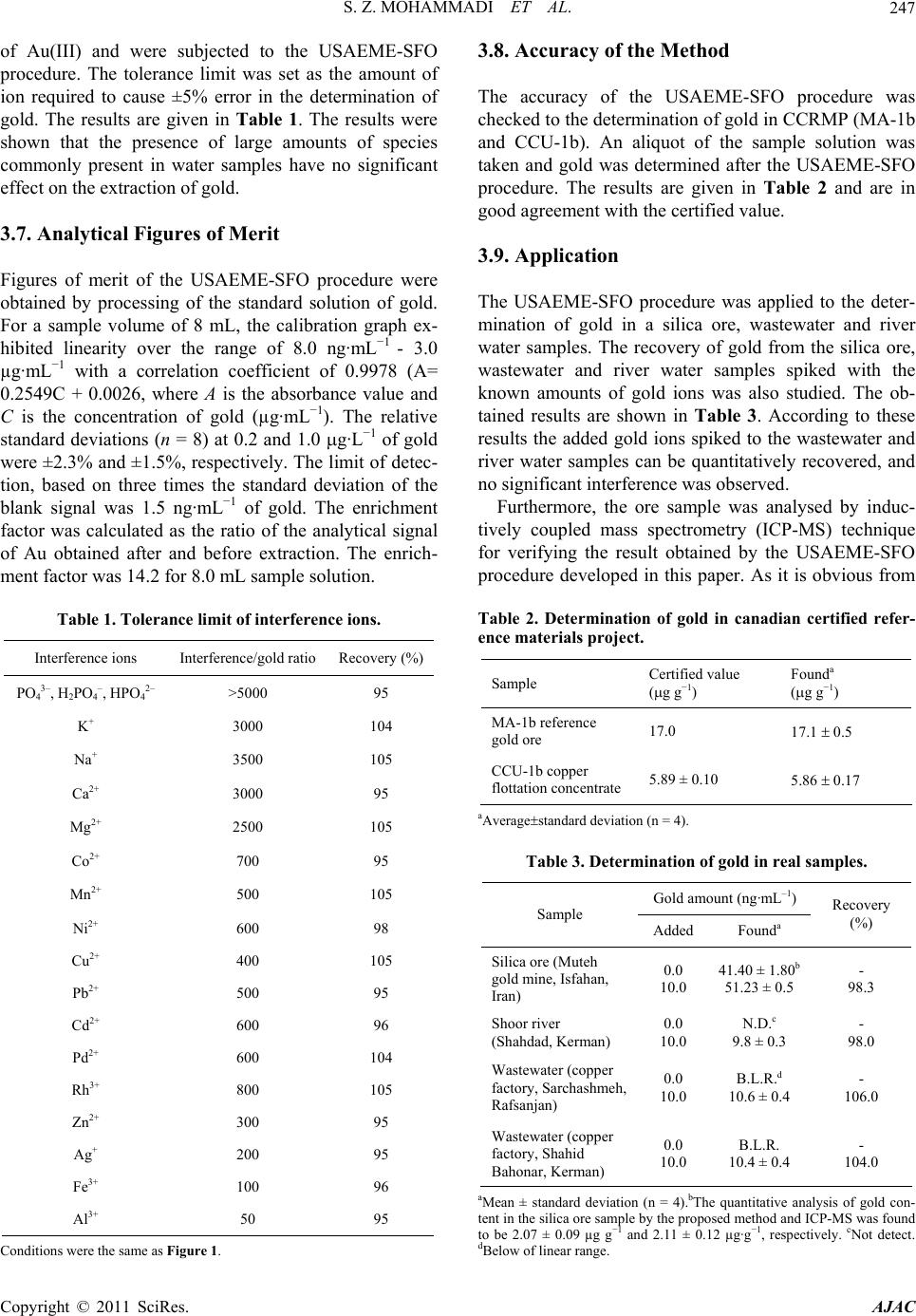 S. Z. MOHAMMADI ET AL.247 of Au(III) and were subjected to the USAEME-SFO procedure. The tolerance limit was set as the amount of ion required to cause ±5% error in the determination of gold. The results are given in Table 1. The results were shown that the presence of large amounts of species commonly present in water samples have no significant effect on the extraction of gold. 3.7. Analytical Figures of Merit Figures of merit of the USAEME-SFO procedure were obtained by processing of the standard solution of gold. For a sample volume of 8 mL, the calibration graph ex- hibited linearity over the range of 8.0 ng·mL−1 - 3.0 µg·mL−1 with a correlation coefficient of 0.9978 (A= 0.2549C + 0.0026, where A is the absorbance value and C is the concentration of gold (µg·mL−1). The relative standard deviations (n = 8) at 0.2 and 1.0 g·L−1 of gold were ±2.3% and ±1.5%, respectively. The limit of detec- tion, based on three times the standard deviation of the blank signal was 1.5 ng·mL−1 of gold. The enrichment factor was calculated as the ratio of the analytical signal of Au obtained after and before extraction. The enrich- ment factor was 14.2 for 8.0 mL sample solution. Table 1. Tolerance limit of interference ions. Interference ions Interference/gold ratio Recovery (%) PO43–, H2PO4–, HPO42– >5000 95 K+ 3000 104 Na+ 3500 105 Ca2+ 3000 95 Mg2+ 2500 105 Co2+ 700 95 Mn2+ 500 105 Ni2+ 600 98 Cu2+ 400 105 Pb2+ 500 95 Cd2+ 600 96 Pd2+ 600 104 Rh3+ 800 105 Zn2+ 300 95 Ag+ 200 95 Fe3+ 100 96 Al3+ 50 95 Conditions were the same as Figure 1. 3.8. Accuracy of the Method The accuracy of the USAEME-SFO procedure was checked to the determination of gold in CCRMP (MA-1b and CCU-1b). An aliquot of the sample solution was taken and gold was determined after the USAEME-SFO procedure. The results are given in Table 2 and are in good agreement with the certified value. 3.9. Application The USAEME-SFO procedure was applied to the deter- mination of gold in a silica ore, wastewater and river water samples. The recovery of gold from the silica ore, wastewater and river water samples spiked with the known amounts of gold ions was also studied. The ob- tained results are shown in Table 3. According to these results the added gold ions spiked to the wastewater and river water samples can be quantitatively recovered, and no significant interference was observed. Furthermore, the ore sample was analysed by induc- tively coupled mass spectrometry (ICP-MS) technique for verifying the result obtained by the USAEME-SFO procedure developed in this paper. As it is obvious from Table 2. Determination of gold in canadian certified refer- ence materials project. Sample Certified value (g g−1) Founda (g g−1) MA-1b reference gold ore 17.0 17.1 0.5 CCU-1b copper flottation concentrate 5.89 ± 0.10 5.86 0.17 aAveragestandard deviation (n = 4). Table 3. Determination of gold in real samples. Gold amount (ng·mL–1) Sample Added Founda Recovery (%) Silica ore (Muteh gold mine, Isfahan, Iran) 0.0 10.0 41.40 ± 1.80b 51.23 ± 0.5 - 98.3 Shoor river (Shahdad, Kerman) 0.0 10.0 N.D.c 9.8 ± 0.3 - 98.0 Wastewater (copper factory, Sarchashmeh, Rafsanjan) 0.0 10.0 B.L.R.d 10.6 ± 0.4 - 106.0 Wastewater (copper factory, Shahid Bahonar, Kerman) 0.0 10.0 B.L.R. 10.4 ± 0.4 - 104.0 aMean ± standard deviation (n = 4).bThe quantitative analysis of gold con- tent in the silica ore sample by the proposed method and ICP-MS was found to be 2.07 ± 0.09 µg g−1 and 2.11 ± 0.12 µg·g−1, respectively. cNot detect. dBelow of linear range. Copyright © 2011 SciRes. AJAC 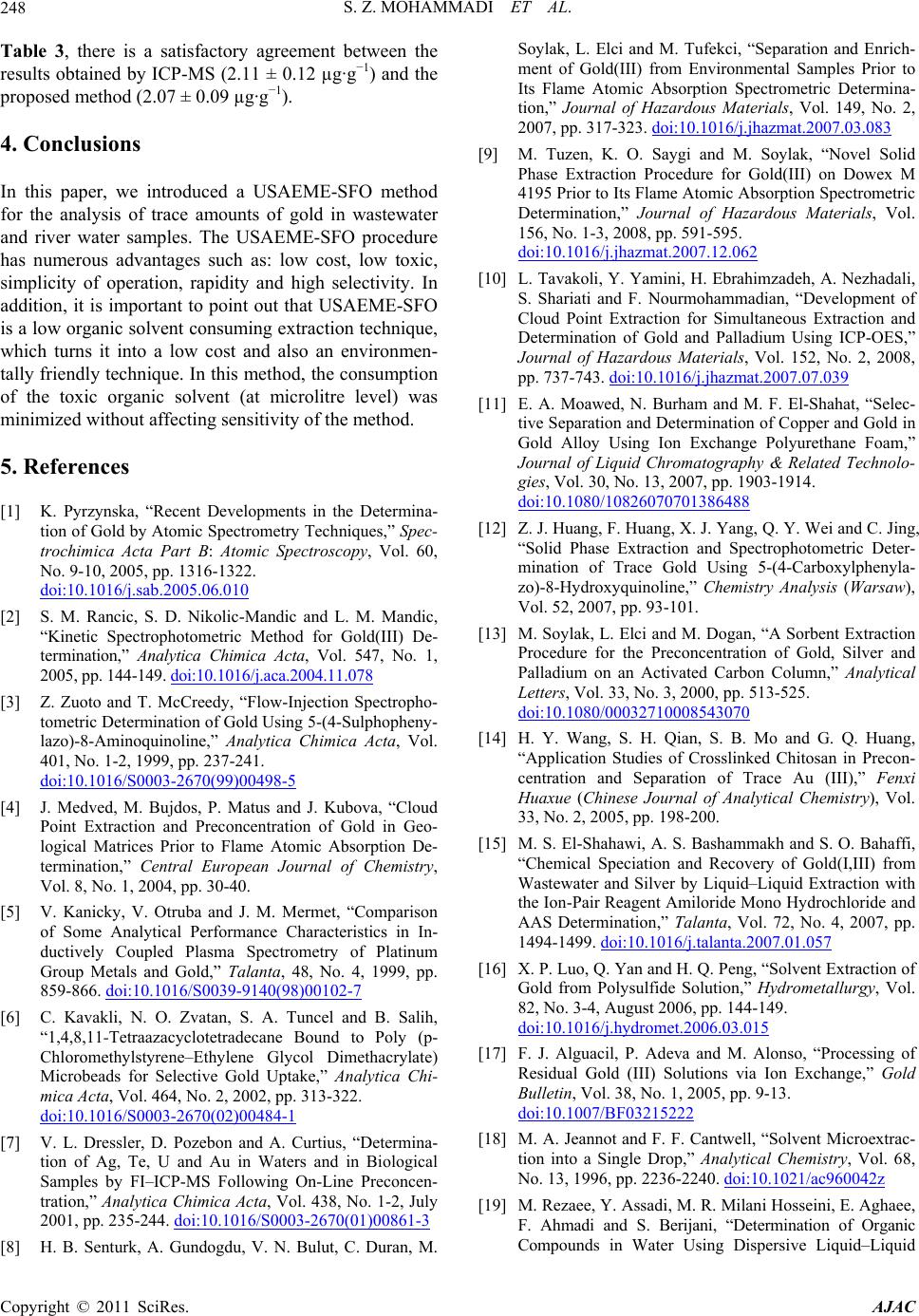 S. Z. MOHAMMADI ET AL. 248 Table 3, there is a satisfactory agreement between the results obtained by ICP-MS (2.11 ± 0.12 µg·g−1) and the proposed method (2.07 ± 0.09 µg·g−1). 4. Conclusions In this paper, we introduced a USAEME-SFO method for the analysis of trace amounts of gold in wastewater and river water samples. The USAEME-SFO procedure has numerous advantages such as: low cost, low toxic, simplicity of operation, rapidity and high selectivity. In addition, it is important to point out that USAEME-SFO is a low organic solvent consuming extraction technique, which turns it into a low cost and also an environmen- tally friendly technique. In this method, the consumption of the toxic organic solvent (at microlitre level) was minimized without affecting sensitivity of the method. 5. References [1] K. Pyrzynska, “Recent Developments in the Determina- tion of Gold by Atomic Spectrometry Techniques,” Spec- trochimica Acta Part B: Atomic Spectroscopy, Vol. 60, No. 9-10, 2005, pp. 1316-1322. doi:10.1016/j.sab.2005.06.010 [2] S. M. Rancic, S. D. Nikolic-Mandic and L. M. Mandic, “Kinetic Spectrophotometric Method for Gold(III) De- termination,” Analytica Chimica Acta, Vol. 547, No. 1, 2005, pp. 144-149. doi:10.1016/j.aca.2004.11. 078 [3] Z. Zuoto and T. McCreedy, “Flow-Injection Spectropho- tometric Determination of Gold Using 5-(4-Sulphopheny- lazo)-8-Aminoquinoline,” Analytica Chimica Acta, Vol. 401, No. 1-2, 1999, pp. 237-241. doi:10.1016/S0003-2670(99)00498-5 [4] J. Medved, M. Bujdos, P. Matus and J. Kubova, “Cloud Point Extraction and Preconcentration of Gold in Geo- logical Matrices Prior to Flame Atomic Absorption De- termination,” Central European Journal of Chemistry, Vol. 8, No. 1, 2004, pp. 30-40. [5] V. Kanicky, V. Otruba and J. M. Mermet, “Comparison of Some Analytical Performance Characteristics in In- ductively Coupled Plasma Spectrometry of Platinum Group Metals and Gold,” Talanta, 48, No. 4, 1999, pp. 859-866. doi:10.1016/S0039-9140(98)00102-7 [6] C. Kavakli, N. O. Zvatan, S. A. Tuncel and B. Salih, “1,4,8,11-Tetraazacyclotetradecane Bound to Poly (p- Chloromethylstyrene–Ethylene Glycol Dimethacrylate) Microbeads for Selective Gold Uptake,” Analytica Chi- mica Acta, Vol. 464, No. 2, 2002, pp. 313-322. doi:10.1016/S0003-2670(02)00484-1 [7] V. L. Dressler, D. Pozebon and A. Curtius, “Determina- tion of Ag, Te, U and Au in Waters and in Biological Samples by FI–ICP-MS Following On-Line Preconcen- tration,” Analy tica Chimica Acta, Vol. 438, No. 1-2, July 2001, pp. 235-244. doi:10.1016/S0003-2670(01)00861-3 [8] H. B. Senturk, A. Gundogdu, V. N. Bulut, C. Duran, M. Soylak, L. Elci and M. Tufekci, “Separation and Enrich- ment of Gold(III) from Environmental Samples Prior to Its Flame Atomic Absorption Spectrometric Determina- tion,” Journal of Hazardous Materials, Vol. 149, No. 2, 2007, pp. 317-323. doi:10.1016/j.jhazmat.2007.03.083 [9] M. Tuzen, K. O. Saygi and M. Soylak, “Novel Solid Phase Extraction Procedure for Gold(III) on Dowex M 4195 Prior to Its Flame Atomic Absorption Spectrometric Determination,” Journal of Hazardous Materials, Vol. 156, No. 1-3, 2008, pp. 591-595. doi:10.1016/j.jhazmat.2007.12.062 [10] L. Tavakoli, Y. Yamini, H. Ebrahimzadeh, A. Nezhadali, S. Shariati and F. Nourmohammadian, “Development of Cloud Point Extraction for Simultaneous Extraction and Determination of Gold and Palladium Using ICP-OES,” Journal of Hazardous Materials, Vol. 152, No. 2, 2008, pp. 737-743. doi:10.1016/j.jhazmat.2007.07.039 [11] E. A. Moawed, N. Burham and M. F. El-Shahat, “Selec- tive Separation and Determination of Copper and Gold in Gold Alloy Using Ion Exchange Polyurethane Foam,” Journal of Liquid Chromatography & Related Technolo- gies, Vol. 30, No. 13, 2007, pp. 1903-1914. doi:10.1080/10826070701386488 [12] Z. J. Huang, F. Huang, X. J. Yang, Q. Y. Wei and C. Jing, “Solid Phase Extraction and Spectrophotometric Deter- mination of Trace Gold Using 5-(4-Carboxylphenyla- zo)-8-Hydroxyquinoline,” Chemistry Analysis (Warsaw), Vol. 52, 2007, pp. 93-101. [13] M. Soylak, L. Elci and M. Dogan, “A Sorbent Extraction Procedure for the Preconcentration of Gold, Silver and Palladium on an Activated Carbon Column,” Analytical Letters, Vol. 33, No. 3, 2000, pp. 513-525. doi:10.1080/00032710008543070 [14] H. Y. Wang, S. H. Qian, S. B. Mo and G. Q. Huang, “Application Studies of Crosslinked Chitosan in Precon- centration and Separation of Trace Au (III),” Fenxi Huaxue (Chinese Journal of Analytical Chemistry), Vol. 33, No. 2, 2005, pp. 198-200. [15] M. S. El-Shahawi, A. S. Bashammakh and S. O. Bahaffi, “Chemical Speciation and Recovery of Gold(I,III) from Wastewater and Silver by Liquid–Liquid Extraction with the Ion-Pair Reagent Amiloride Mono Hydrochloride and AAS Determination,” Talanta, Vol. 72, No. 4, 2007, pp. 1494-1499. doi:10.1016/j.talanta.2007.01.057 [16] X. P. Luo, Q. Yan and H. Q. Peng, “Solvent Extraction of Gold from Polysulfide Solution,” Hydrometallurgy, Vol. 82, No. 3-4, August 2006, pp. 144-149. doi:10.1016/j.hydromet.2006.03.015 [17] F. J. Alguacil, P. Adeva and M. Alonso, “Processing of Residual Gold (III) Solutions via Ion Exchange,” Gold Bulletin, Vol. 38, No. 1, 2005, pp. 9-13. doi:10.1007/BF03215222 [18] M. A. Jeannot and F. F. Cantwell, “Solvent Microextrac- tion into a Single Drop,” Analytical Chemistry, Vol. 68, No. 13, 1996, pp. 2236-2240. doi:10.1021/ac960042z [19] M. Rezaee, Y. Assadi, M. R. Milani Hosseini, E. Aghaee, F. Ahmadi and S. Berijani, “Determination of Organic Compounds in Water Using Dispersive Liquid–Liquid Copyright © 2011 SciRes. AJAC  S. Z. MOHAMMADI ET AL. Copyright © 2011 SciRes. AJAC 249 Microextraction,” Journal of Chromatography A, Vol. 1116, No. 1-2, 2006, pp. 1-9. doi:10.1016/j.chroma.2006.03.007 [20] A. P. Birjandi, A. Bidari, F. Rezaei, M. R. M. Hosseini and Y. Assadi, “Speciation of Butyl and Phenyltin Com- pounds Using Dispersive Liquid–Liquid Microextraction and Gas Chromatography-Flame Photometric Detection,” Journal of Chromatography A, Vol. 1193, No. 1-2, June 2008, pp. 19-25. doi:10.1016/j.chroma.2008.04.003 [21] J. Xiong and B. Hu, “Comparison of Hollow Fiber Liquid Phase Microextraction and Dispersive Liquid–Liquid Microextraction for the Determination of Organosulfur Pesticides in Environmental and Beverage Samples by Gas Chromatography with Flame Photometric Detec- tion,” Journal of Chromatography A, Vol. 1193, No. 1-2, 2008, pp. 7-18. doi:10.1016/j.chroma.2008.03.072 [22] M. D. Luque de Castro and F. Priego-Capote, “Analytical Applications of Ultrasound,” Elsevier, Amsterdam, 2006 [23] M. D. Luque de Castro and F. Priego-Capote, “Ultra- sound-Assisted Preparation of Liquid Samples,” Talanta, Vol. 72, No. 2, 2007, pp. 321-334. doi:10.1016/j.talanta.2006.11.013 [24] J. A. Perez-Serradilla, F. Priego-Capote and M. D. Luque de Castro, “Simultaneous Ultrasound-Assisted Emulsifi- cation−Extraction of Polar and Nonpolar Compounds from Solid Plant Samples,” Analytical Chemistry, Vol. 79, No. 11, 2007, pp. 6767-6774. doi:10.1021/ac0708801 [25] J. Regueiro, M. Llompart, C. Garcia-Jares, J. C. Gar- cia-Monteagudo and R. Cela, “Ultrasound-Assisted Emulsification–Microextraction of Emergent Contami- nants and Pesticides in Environmental Waters,” Journal of Chromatography A, Vol. 1190, No. 1-2, May 2008, pp. 27-38. doi:10.1016/j.chroma.2008.02.091 [26] A. R. Fontana, R. G. Wuilloud, L. D. Martinez and J. C. Altamirano, “Simple Approach Based on Ultrasound- Assisted Emulsification-Microextraction for Determina- tion of Polibrominated Flame Retardants in Water Sam- ples by Gas Chromatography–Mass Spectrometry,” Journal of Chromatography A, Vol. 1216, No. 1, 2009, pp. 147-153. doi:10.1016/j.chroma.2008.11.034 [27] M. R. K. Zanjani, Y. Yamini, S. Shariati and J. A. Joِnsson, “A New Liquid-Phase Microextraction Method Based on Solidification of Floating Organic Drop,” Analytica Chi- mica Acta, Vol. 585, No. 2, March 2007, pp. 286-293. doi:10.1016/j.aca.2006.12.049 [28] S. Dadfarnia, A. M. Salmanzadeh and A. M. H. Shabani, “A Novel Separation/Preconcentration System Based on Solidification of Floating Organic Drop Microextraction for Determination of Lead by Graphite Furnace Atomic Absorption Spectrometry,” Analytica Chimica Acta, Vol. 623, No. 2, August 2007, pp. 163-167. doi:10.1016/j.aca.2008.06.033 [29] H. Xu, Z. Ding, L. Lv, D. Song and Y. Q. Feng, “A Nov- el Dispersive Liquid–Liquid Microextraction Based on Solidification of Floating Organic Droplet Method for Determination of Polycyclic Aromatic Hydrocarbons in Aqueous Samples,” Analytica Chimica Acta, Vol. 636, No. 1, March 2009, pp. 28-36. doi:10.1016/j.aca.2009.01.028 [30] N. Pourreza and S. Rastegarzadeh, “Simultaneous Deter- mination of Gold and Palladium with 5(p-Dimethylami- no-Benzylidene) Rhodanine by Using the H-Point Stan- dard Addition Method in Micellar Media,” Analytica Chimica Acta, Vol. 437, No. 2, June 2001, 273-280. doi:10.1016/S0003-2670(01)00988-6 [31] D. Afzali, A. Mostafavi and M. Mirzaei, “Preconcentra- tion of Gold Ions from Water Samples by Modified Or- gano-Nanoclay Sorbent Prior to Flame Atomic Absorp- tion Spectrometry Determination,” Journal of Hazardous Materials, Vol. 181, No. 1-3, September 2010, pp. 957- 961. doi:10.1016/j.jhazmat.2010.05.106 |