

Paper Menu >>
Journal Menu >>
 American Journal of Anal yt ical Chemistry, 2011, 2, 217-222 doi:10.4236/ajac.2011.22026 Published Online May 2011 (http://www.SciRP.org/journal/ajac) Copyright © 2011 SciRes. AJAC Investigation of Distribution for Trace Lead and Cadmium in Chinese Herbal Medicines and Their Decoctions by Graphite Furnace Atomic Absorption Spectrometry Hanwen Sun, Lixin Li Key Laboratory of Analytical Science and Technology of Hebei Province, College of Chemistry and Environmental Science, Hebei University, Baoding, China E-mail: [email protected] Received February 16, 2011; revised March 7, 2011; accepted March 15, 2011 Abstract Lead and cadmium in herbal medicines are highly toxic to living organisms even in low concentrations. An effective method is developed for analysis of trace lead and cadmium in Chinese herbal medicines and their decoctions by graphite furnace atomic absorption spectrometry (GFAAS). The effects of analytical condi- tions on absorbance were investigated and optimized. A water-dissolving capability for Pb and Cd was in- vestigated, and the contents of different species in five Chinese herbal medicines and their decoctions were analyzed. The content ratios (kow) of n-octanol-soluble Pb or Cd to water-soluble Pb or Cd were evaluated, and the distribution of Pb and Cd in water decoction at stomach and intestine acidities was developed, in the first time. The contents of water-soluble Pb and Cd, n-octanol-soluble Pb and Cd, and their content ratios were related with the kind of medicine and the acidity of the decoction. The proposed method has the advan- tages of simple operation, high sensitivity and high speed, with 3 σ detection limits of 4.2 pg for Pb and 0.1 pg for Cd. Keywords: Distribution, Lead, Cadmium, Herbal Medicines, Decoctions, Graphite Furnace Atomic Absorption Spectrometry 1. Introduction Chinese herbal medicine has been used as a form of treatment for a multitude of ailments ranging from acute infections to chronic fatigue. Study on the trace elements in Chinese herbal medicine can provide science provi- dence for pharmacology and toxicology. Lead has well- documented toxic effects on plants, animals, and micro- organisms. Cadmium exposure can produce a wide vari- ety of acute and chronic effects in humans, leading to a build-up of cadmium in the kidneys that can cause kidney disease. Some cases of intoxication with Pb and Cd re- sulting from the ingestion of Chinese herbal medicines have been reported [1,2]. Therefore, the analysis of trace Pb and Cd in herbal medicines and their decoctions is very important for pharmacological and toxicological evaluations. A series of atomic spectrometric methods were re- ported for the determination of Pb and/or Cd in herbal medicines. Atomic absorption spectrometry is the ana- lytical technique, most employed for metal analysis due to its low interference level and reasonable sensitivity. A pre-concentration flow injection analysis–flame atomic absorption spectrometry (FAAS) method was reported for determination of Pb content in medicinal plants with the limit of detection (LOD) of 19 µg·L–1 [3]. A solid sampling–FAAS method was used for determination of Cd and Pb in medicinal plants, relative standard devia- tions (RSDs) were below 10% (n = 5) and LODs were 0.1 µg·kg–1 and 12 µg·kg–1 for Pb and Cd, respectively [4]. To increase method sensitivity graphite furnace atomic absorption spectrometry (GFAAS) was frequently used to determine heavy metals for the quality control in herbal medicines. Several GFAAS methods had been reported with higher sensitivity, such as for the determi- nation of Pb in Chinese herbal medicine with the LOD of 0.1 μg·kg–1[5], and for the determination of Pb and Cd in Chinese crude drugs with the LOD of 11.6 pg and 2 pg [6], and 6 μg·kg–1 and 0.208 μg·kg–1 [7] for Pb and Cd, respectively. GFAAS was utilized to the determination 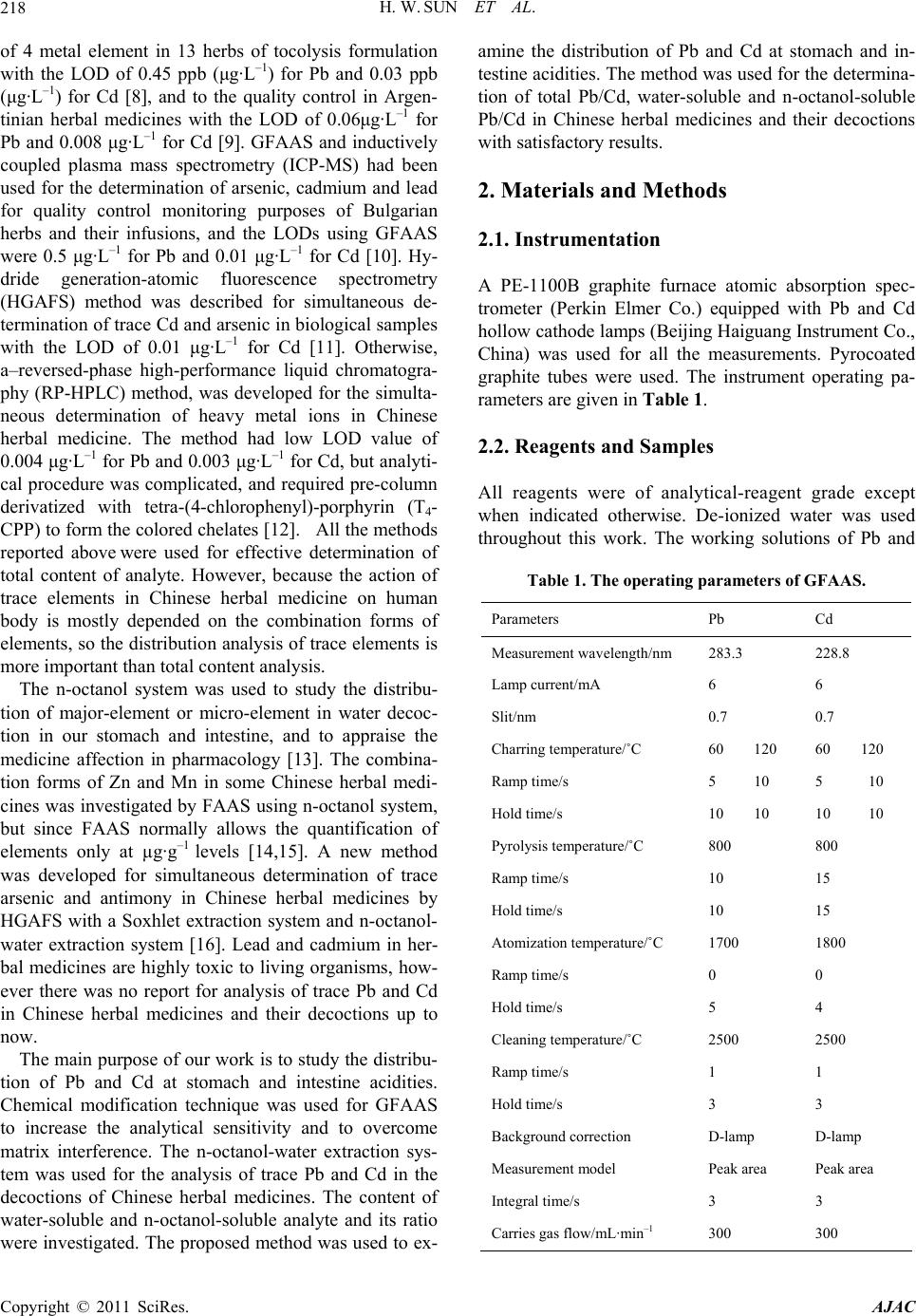 H. W. SUN ET AL. 218 of 4 metal element in 13 herbs of tocolysis formulation with the LOD of 0.45 ppb (μg·L–1) for Pb and 0.03 ppb (μg·L–1) for Cd [8], and to the quality control in Argen- tinian herbal medicines with the LOD of 0.06μg·L–1 for Pb and 0.008 μg·L–1 for Cd [9]. GFAAS and inductively coupled plasma mass spectrometry (ICP-MS) had been used for the determination of arsenic, cadmium and lead for quality control monitoring purposes of Bulgarian herbs and their infusions, and the LODs using GFAAS were 0.5 μg·L–1 for Pb and 0.01 μg·L–1 for Cd [10]. Hy- dride generation-atomic fluorescence spectrometry (HGAFS) method was described for simultaneous de- termination of trace Cd and arsenic in biological samples with the LOD of 0.01 μg·L–1 for Cd [11]. Otherwise, a–reversed-phase high-performance liquid chromatogra- phy (RP-HPLC) method, was developed for the simulta- neous determination of heavy metal ions in Chinese herbal medicine. The method had low LOD value of 0.004 μg·L–1 for Pb and 0.003 μg·L–1 for Cd, but analyti- cal procedure was complicated, and required pre-column derivatized with tetra-(4-chlorophenyl)-porphyrin (T4- CPP) to form the colored chelates [12]. All the methods reported above were used for effective determination of total content of analyte. However, because the action of trace elements in Chinese herbal medicine on human body is mostly depended on the combination forms of elements, so the distribution analysis of trace elements is more important than total content analysis. The n-octanol system was used to study the distribu- tion of major-element or micro-element in water decoc- tion in our stomach and intestine, and to appraise the medicine affection in pharmacology [13]. The combina- tion forms of Zn and Mn in some Chinese herbal medi- cines was investigated by FAAS using n-octanol system, but since FAAS normally allows the quantification of elements only at µg·g–1 levels [14,15]. A new method was developed for simultaneous determination of trace arsenic and antimony in Chinese herbal medicines by HGAFS with a Soxhlet extraction system and n-octanol- water extraction system [16]. Lead and cadmium in her- bal medicines are highly toxic to living organisms, how- ever there was no report for analysis of trace Pb and Cd in Chinese herbal medicines and their decoctions up to now. The main purpose of our work is to study the distribu- tion of Pb and Cd at stomach and intestine acidities. Chemical modification technique was used for GFAAS to increase the analytical sensitivity and to overcome matrix interference. The n-octanol-water extraction sys- tem was used for the analysis of trace Pb and Cd in the decoctions of Chinese herbal medicines. The content of water-soluble and n-octanol-soluble analyte and its ratio were investigated. The proposed method was used to ex- amine the distribution of Pb and Cd at stomach and in- testine acidities. The method was used for the determina- tion of total Pb/Cd, water-soluble and n-octanol-soluble Pb/Cd in Chinese herbal medicines and their decoctions with satisfactory results. 2. Materials and Methods 2.1. Instrumentation A PE-1100B graphite furnace atomic absorption spec- trometer (Perkin Elmer Co.) equipped with Pb and Cd hollow cathode lamps (Beijing Haiguang Instrument Co., China) was used for all the measurements. Pyrocoated graphite tubes were used. The instrument operating pa- rameters are given in Table 1. 2.2. Reagents and Samples All reagents were of analytical-reagent grade except when indicated otherwise. De-ionized water was used throughout this work. The working solutions of Pb and Table 1. The operating parameters of GFAAS. Parameters Pb Cd Measurement wavelength/nm 283.3 228.8 Lamp current/mA 6 6 Slit/nm 0.7 0.7 Charring temperature/˚C 60 120 60 120 Ramp time/s 5 10 5 10 Hold time/s 10 10 10 10 Pyrolysis temperature/˚C 800 800 Ramp time/s 10 15 Hold time/s 10 15 Atomization temperature/˚C 1700 1800 Ramp time/s 0 0 Hold time/s 5 4 Cleaning temperature/˚C 2500 2500 Ramp time/s 1 1 Hold time/s 3 3 Background correction D-lamp D-lamp Measurement model Peak area Peak area Integral time/s 3 3 Carries gas flow/mL·min–1 300 300 Copyright © 2011 SciRes. AJAC 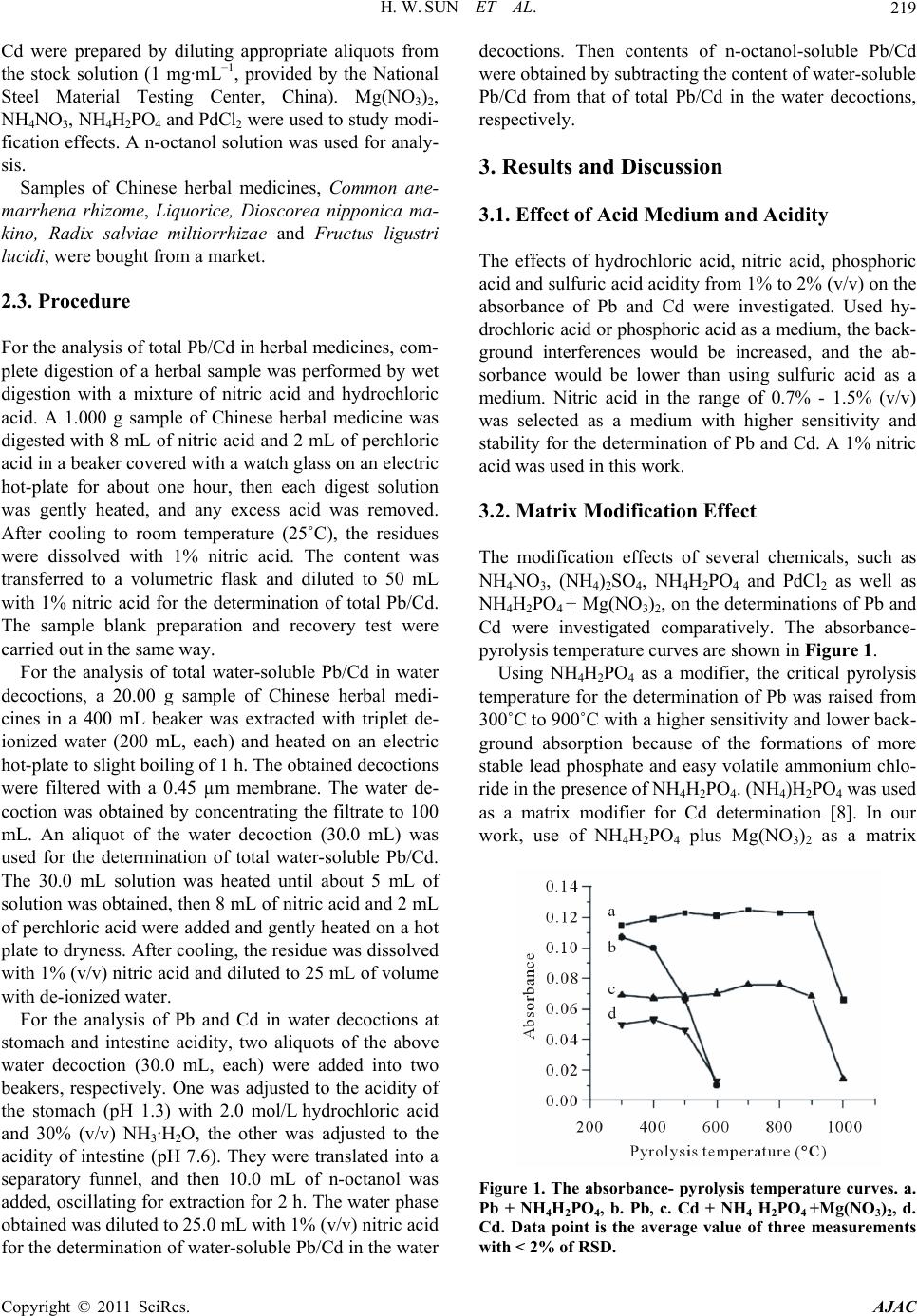 H. W. SUN ET AL.219 Cd were prepared by diluting appropriate aliquots from the stock solution (1 mg·mL–1, provided by the National Steel Material Testing Center, China). Mg(NO3)2, NH4NO3, NH4H2PO4 and PdCl2 were used to study modi- fication effects. A n-octanol solution was used for analy- sis. Samples of Chinese herbal medicines, Common ane- marrhena rhizome, Liquorice, Dioscorea nipponica ma- kino, Radix salviae miltiorrhizae and Fructus ligustri lucidi, were bought from a market. 2.3. Procedure For the analysis of total Pb/Cd in herbal medicines, com- plete digestion of a herbal sample was performed by wet digestion with a mixture of nitric acid and hydrochloric acid. A 1.000 g sample of Chinese herbal medicine was digested with 8 mL of nitric acid and 2 mL of perchloric acid in a beaker covered with a watch glass on an electric hot-plate for about one hour, then each digest solution was gently heated, and any excess acid was removed. After cooling to room temperature (25˚C), the residues were dissolved with 1% nitric acid. The content was transferred to a volumetric flask and diluted to 50 mL with 1% nitric acid for the determination of total Pb/Cd. The sample blank preparation and recovery test were carried out in the same way. For the analysis of total water-soluble Pb/Cd in water decoctions, a 20.00 g sample of Chinese herbal medi- cines in a 400 mL beaker was extracted with triplet de- ionized water (200 mL, each) and heated on an electric hot-plate to slight boiling of 1 h. The obtained decoctions were filtered with a 0.45 µm membrane. The water de- coction was obtained by concentrating the filtrate to 100 mL. An aliquot of the water decoction (30.0 mL) was used for the determination of total water-soluble Pb/Cd. The 30.0 mL solution was heated until about 5 mL of solution was obtained, then 8 mL of nitric acid and 2 mL of perchloric acid were added and gently heated on a hot plate to dryness. After cooling, the residue was dissolved with 1% (v/v) nitric acid and diluted to 25 mL of volume with de-ionized water. For the analysis of Pb and Cd in water decoctions at stomach and intestine acidity, two aliquots of the above water decoction (30.0 mL, each) were added into two beakers, respectively. One was adjusted to the acidity of the stomach (pH 1.3) with 2.0 mol/L hydrochloric acid and 30% (v/v) NH3·H2O, the other was adjusted to the acidity of intestine (pH 7.6). They were translated into a separatory funnel, and then 10.0 mL of n-octanol was added, oscillating for extraction for 2 h. The water phase obtained was diluted to 25.0 mL with 1% (v/v) nitric acid for the determination of water-soluble Pb/Cd in the water decoctions. Then contents of n-octanol-soluble Pb/Cd were obtained by subtracting the content of water-soluble Pb/Cd from that of total Pb/Cd in the water decoctions, respectively. 3. Results and Discussion 3.1. Effect of Acid Medium and Acidity The effects of hydrochloric acid, nitric acid, phosphoric acid and sulfuric acid acidity from 1% to 2% (v/v) on the absorbance of Pb and Cd were investigated. Used hy- drochloric acid or phosphoric acid as a medium, the back- ground interferences would be increased, and the ab- sorbance would be lower than using sulfuric acid as a medium. Nitric acid in the range of 0.7% - 1.5% (v/v) was selected as a medium with higher sensitivity and stability for the determination of Pb and Cd. A 1% nitric acid was used in this work. 3.2. Matrix Modification Effect The modification effects of several chemicals, such as NH4NO3, (NH4)2SO4, NH4H2PO4 and PdCl2 as well as NH4H2PO4 + Mg(NO3)2, on the determinations of Pb and Cd were investigated comparatively. The absorbance- pyrolysis temperature curves are shown in Figure 1. Using NH4H2PO4 as a modifier, the critical pyrolysis temperature for the determination of Pb was raised from 300˚C to 900˚C with a higher sensitivity and lower back- ground absorption because of the formations of more stable lead phosphate and easy volatile ammonium chlo- ride in the presence of NH4H2PO4. (NH4)H2PO4 was used as a matrix modifier for Cd determination [8]. In our work, use of NH4H2PO4 plus Mg(NO3)2 as a matrix Figure 1. The absorbance- pyrolysis temperature curves. a. Pb + NH4H2PO4, b. Pb, c. Cd + NH4 H2PO4 +Mg(NO3)2, d. Cd. Data point is the average value of three measurements with < 2% of RSD. Copyright © 2011 SciRes. AJAC  H. W. SUN ET AL. Copyright © 2011 SciRes. AJAC 220 . modifier made the critical pyrolysis temperature of Cd raised from 400˚C to 800˚C, and obtained higher sensi- tivity than NH4H2PO4 alone. Thus, the optimum pyroly- sis temperature of 800˚C was chosen for the determina- tion of Pb and Cd in the presence of the modifiers. The effects of modifier amounts on the sensitivity were investigated. The sensitivity increased obviously with the increase of the modifier concentration from 0 to 200 μg. The result showed that the best sensitivities were achieved using 100 μg NH4H2PO4 and 120 μg NH4H2PO4 + 5 μg Mg(NO3)2 for the determination of Pb and Cd , respectively. Plateaus of the atomization tem- perature were observed over 1700˚C - 2000˚C using NH4H2PO4 and NH4H2PO4 + Mg(NO3)2 modifiers, re- spectively. Therefore, the optimal atomization tempera- tures were selected as 1700˚C for Pb and 1800˚C for Cd. In addition, the “maximum power” and gas stop modes were used for the determination of Pb and Cd in order to obtain high sensitivity. 3.3. Linearity, Detection Limit and Precision The calibration graph was linear up to 70 µg·L–1 for Pb and up to 4 µg·L–1 for Cd. Linearity relation between absorbance (A) and concentrations (C) can be described by a regression equation: for Pb, A = 454.802C – 2.600, and for Cd, A = 37.068C – 0.123, with a correlation co- efficient of > 0.999. The detection limit calculated ac- cording to the IUPAC rules on the basis of 3σ criterion for 11 replicate measurements of the blank signal was 0.21 µg·L–1 for Pb and 0.005 µg·L–1 for Cd (4.2 pg Pb and 0.1 pg Cd for sampling 20 µL solutions). For 1 g sample and 50 mL final solution, the method LOD was 10.5 µg·kg–1 for Pb and 0.25 µg·kg–1 for Cd. The relative standard deviation (RSD, n = 7) was 1.54% for Pb at 40 ng·mL–1 level and 2.4% for Cd at 0.4 ng·mL–1 level. It is indicated that the proposed method has good linearity, high sensitivity and precision, and can permit the accu- rate detection of trace Pb and Cd in herbs and their de- coctions. 3.4. Determination of Pb and Cd in Herbs and Their Decoctions A water decoction is the one used for people to treat dis- ease, and the content of Pb and Cd in the water decoction was the actual contribution to the toxicity. The prepara- tion of water decoctions and determination of total Pb/Cd in herbs and total water-soluble Pb/Cd in water decoc- tions were carried out according to the method described in the procedure. The results are listed in Table 2. The contents of Pb in the five herbs were higher than for Cd in the same herbs. Though the content of total Pb in Common anemarrhena rhizo me was the highest in the five herbs, but the content of water-soluble Pb was the lowest. In contrast, the contents of total Pb in Liquorice was the lowest, but the contents of water-soluble Pb were near to that in Common anemarrhena rhizome. It was indicated that the dose of trace element taken in human body could not be evaluated with total content of the element in herb. The practical feasibility of the proposed system was tested on the five kinds of Chinese herbal medicines. Since standard reference materials with certified Pb and Cd values were not available, the selectivity and accu- racy of the method were tested by a standard spiking method. The recovery test was carried out in the same way for spiked samples in the range of 0.15 - 10 µg·g–1 for Pb, and 0.01 - 0.2 µg·g–1 for Cd (each added content nears real content in the sample). The recoveries of ana- lyte from Common anemarrhena rhizome, Liquorice, Dioscorea nippon ica makino, Rad ix sa lviae miltio rrh izae and Fructus ligustri lucidi were 98.6, 99.3, 96.9, 102 and 98.4% for total Pb, and 97.3, 98.7, 95.8, 97.7 and 98.9% for total water-soluble Pb, and 97.9, 100, 99.3, 98.8 and 96.9% for total Cd, and 98.9, 97.3, 98.6, 101 and 98.5% for total water-soluble Cd, respectively. The data showed that recovery was in the range of 95.8% - 102% for Pb and 96.9% - 101% for Cd. The relative standard devia- tions (R.S.D., n = 3) were in the range 1.7% - 3.4%, demonstrating the general reproducibility of this method Table 2. Determination of total Pb/Cd and total water-soluble Pb/Cd in herbs and their decoctions ( n = 3). Sample Total Pb (µg g–1) Total Cd (µg g–1) Total water- soluble Pb (µg·g–1) Total water- soluble Cd (µg·g–1) Dissolving ratio Pb Cd (%) (%) Common anemarrhena rhizome 9.29 0.19 0.17 0.01 1.83 5.26 Liquorice 1.54 0.15 0.18 0.01 11.7 6.04 Dioscorea nipponica makino 4.77 0.14 0.38 0.03 7.97 21.4 Radix salviae miltiorrhizae, 4.94 0.19 0.25 0.02 5.06 10.5 Fructus ligustri lucidi 5.11 0.21 1.21 0.02 23.7 9.52 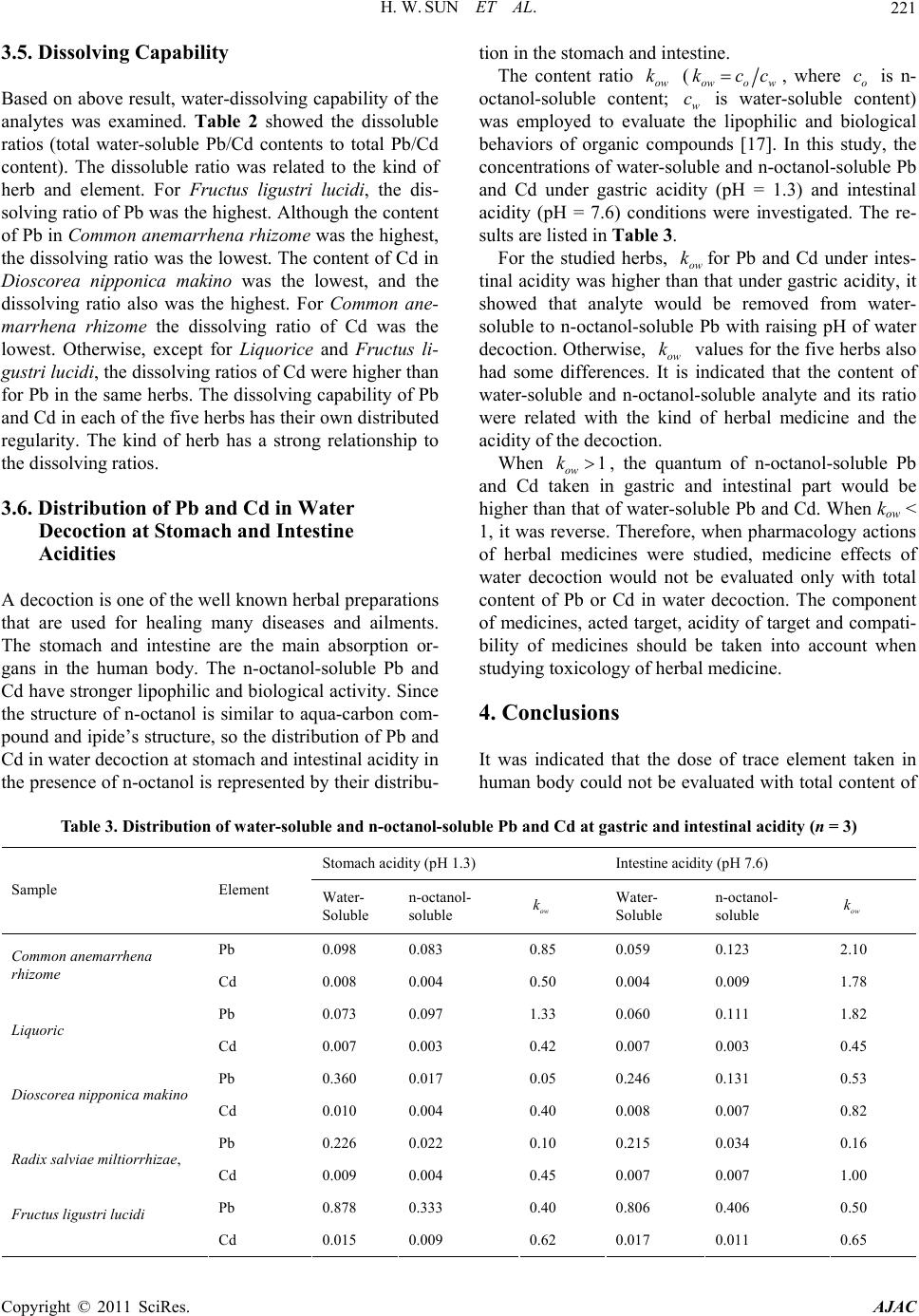 H. W. SUN ET AL. Copyright © 2011 SciRes. AJAC 221 3.5. Dissolving Capability Based on above result, water-dissolving capability of the analytes was examined. Table 2 showed the dissoluble ratios (total water-soluble Pb/Cd contents to total Pb/Cd content). The dissoluble ratio was related to the kind of herb and element. For Fructus ligustri lucidi, the dis- solving ratio of Pb was the highest. Although the content of Pb in Common anemarrhena rhizome was the highest, the dissolving ratio was the lowest. The content of Cd in Dioscorea nipponica makino was the lowest, and the dissolving ratio also was the highest. For Common ane- marrhena rhizome the dissolving ratio of Cd was the lowest. Otherwise, except for Liquorice and Fructus li- gustri lucidi, the dissolving ratios of Cd were higher than for Pb in the same herbs. The dissolving capability of Pb and Cd in each of the five herbs has their own distributed regularity. The kind of herb has a strong relationship to the dissolving ratios. 3.6. Distribution of Pb and Cd in Water Decoction at Stomach and Intestine Acidities A decoction is one of the well known herbal preparations that are used for healing many diseases and ailments. The stomach and intestine are the main absorption or- gans in the human body. The n-octanol-soluble Pb and Cd have stronger lipophilic and biological activity. Since the structure of n-octanol is similar to aqua-carbon com- pound and ipide’s structure, so the distribution of Pb and Cd in water decoction at stomach and intestinal acidity in the presence of n-octanol is represented by their distribu- tion in the stomach and intestine. The content ratio ow (kowo w kcc, where o is n- octanol-soluble content; w is water-soluble content) was employed to evaluate the lipophilic and biological behaviors of organic compounds [17]. In this study, the concentrations of water-soluble and n-octanol-soluble Pb and Cd under gastric acidity (pH = 1.3) and intestinal acidity (pH = 7.6) conditions were investigated. The re- sults are listed in Table 3. c c For the studied herbs, ow for Pb and Cd under intes- tinal acidity was higher than that under gastric acidity, it showed that analyte would be removed from water- soluble to n-octanol-soluble Pb with raising pH of water decoction. Otherwise, ow values for the five herbs also had some differences. It is indicated that the content of water-soluble and n-octanol-soluble analyte and its ratio were related with the kind of herbal medicine and the acidity of the decoction. k k When , the quantum of n-octanol-soluble Pb and Cd taken in gastric and intestinal part would be higher than that of water-soluble Pb and Cd. When kow < 1, it was reverse. Therefore, when pharmacology actions of herbal medicines were studied, medicine effects of water decoction would not be evaluated only with total content of Pb or Cd in water decoction. The component of medicines, acted target, acidity of target and compati- bility of medicines should be taken into account when studying toxicology of herbal medicine. 1 ow k 4. Conclusions It was indicated that the dose of trace element taken in human body could not be evaluated with total content of Table 3. Distribution of water-soluble and n-octanol-soluble Pb and Cd at gastric and intestinal acidity (n = 3) Stomach acidity (pH 1.3) Intestine acidity (pH 7.6) Sample Element Water- Soluble n-octanol- soluble ow k Water- Soluble n-octanol- soluble ow k Pb 0.098 0.083 0.85 0.059 0.123 2.10 Common anemarrhena rhizome Cd 0.008 0.004 0.50 0.004 0.009 1.78 Pb 0.073 0.097 1.33 0.060 0.111 1.82 Liquoric Cd 0.007 0.003 0.42 0.007 0.003 0.45 Pb 0.360 0.017 0.05 0.246 0.131 0.53 Dioscorea nipponica makino Cd 0.010 0.004 0.40 0.008 0.007 0.82 Pb 0.226 0.022 0.10 0.215 0.034 0.16 Radix salviae miltiorrhizae, Cd 0.009 0.004 0.45 0.007 0.007 1.00 Pb 0.878 0.333 0.40 0.806 0.406 0.50 Fructus ligustri lucidi Cd 0.015 0.009 0.62 0.017 0.011 0.65 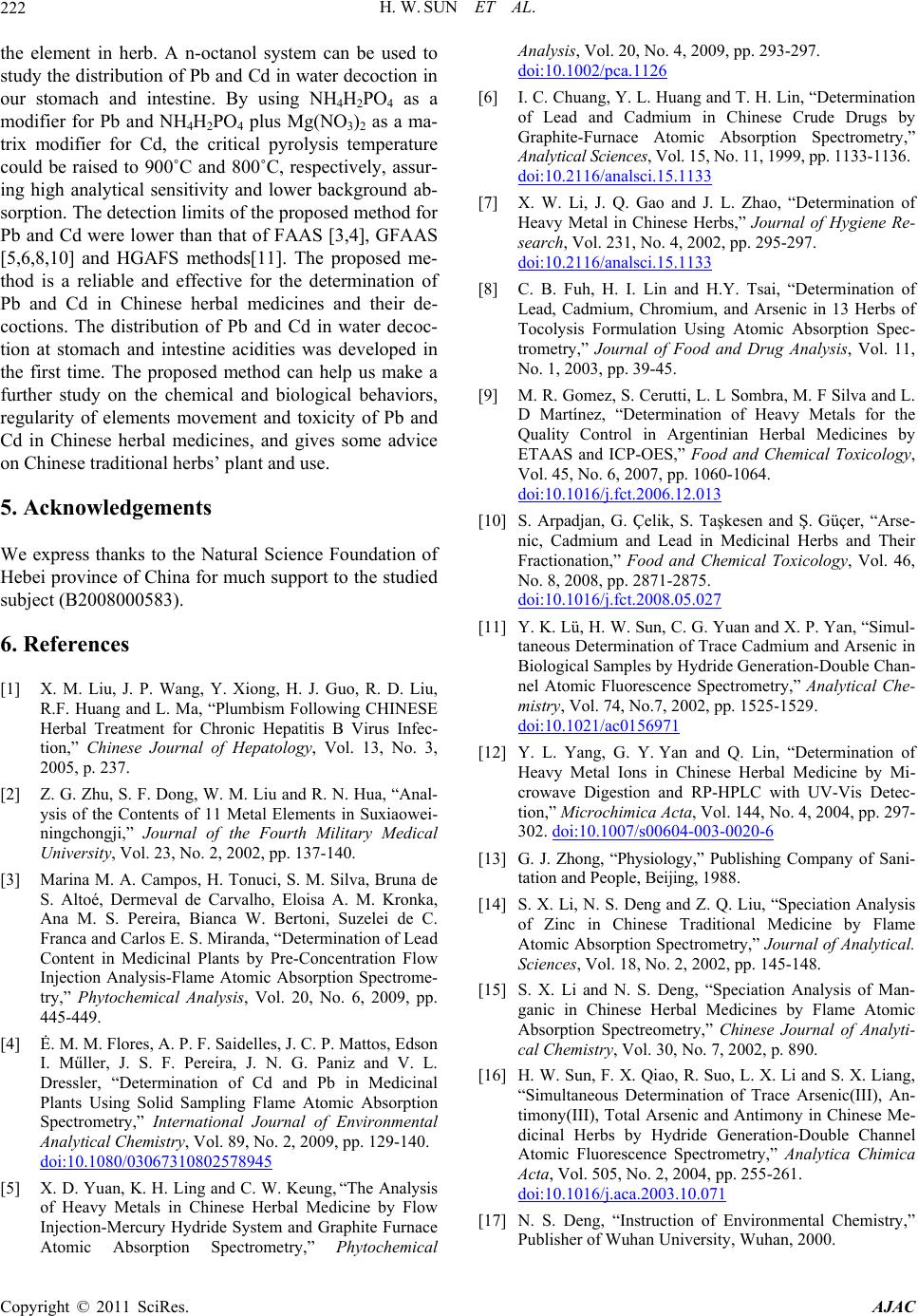 H. W. SUN ET AL. Copyright © 2011 SciRes. AJAC 222 the element in herb. A n-octanol system can be used to study the distribution of Pb and Cd in water decoction in our stomach and intestine. By using NH4H2PO4 as a modifier for Pb and NH4H2PO4 plus Mg(NO3)2 as a ma- trix modifier for Cd, the critical pyrolysis temperature could be raised to 900˚C and 800˚C, respectively, assur- ing high analytical sensitivity and lower background ab- sorption. The detection limits of the proposed method for Pb and Cd were lower than that of FAAS [3,4], GFAAS [5,6,8,10] and HGAFS methods[11]. The proposed me- thod is a reliable and effective for the determination of Pb and Cd in Chinese herbal medicines and their de- coctions. The distribution of Pb and Cd in water decoc- tion at stomach and intestine acidities was developed in the first time. The proposed method can help us make a further study on the chemical and biological behaviors, regularity of elements movement and toxicity of Pb and Cd in Chinese herbal medicines, and gives some advice on Chinese traditional herbs’ plant and use. 5. Acknowledgements We express thanks to the Natural Science Foundation of Hebei province of China for much support to the studied subject (B2008000583). 6. References [1] X. M. Liu, J. P. Wang, Y. Xiong, H. J. Guo, R. D. Liu, R.F. Huang and L. Ma, “Plumbism Following CHINESE Herbal Treatment for Chronic Hepatitis B Virus Infec- tion,” Chinese Journal of Hepatology, Vol. 13, No. 3, 2005, p. 237. [2] Z. G. Zhu, S. F. Dong, W. M. Liu and R. N. Hua, “Anal- ysis of the Contents of 11 Metal Elements in Suxiaowei- ningchongji,” Journal of the Fourth Military Medical University, Vol. 23, No. 2, 2002, pp. 137-140. [3] Marina M. A. Campos, H. Tonuci, S. M. Silva, Bruna de S. Altoé, Dermeval de Carvalho, Eloisa A. M. Kronka, Ana M. S. Pereira, Bianca W. Bertoni, Suzelei de C. Franca and Carlos E. S. Miranda, “Determination of Lead Content in Medicinal Plants by Pre-Concentration Flow Injection Analysis-Flame Atomic Absorption Spectrome- try,” Phytochemical Analysis, Vol. 20, No. 6, 2009, pp. 445-449. [4] Ė. M. M. Flores, A. P. F. Saidelles, J. C. P. Mattos, Edson I. Műller, J. S. F. Pereira, J. N. G. Paniz and V. L. Dressler, “Determination of Cd and Pb in Medicinal Plants Using Solid Sampling Flame Atomic Absorption Spectrometry,” International Journal of Environmental Analytical Chemistry, Vol. 89, No. 2, 2009, pp. 129-140. doi:10.1080/03067310802578945 [5] X. D. Yuan, K. H. Ling and C. W. Keung, “The Analysis of Heavy Metals in Chinese Herbal Medicine by Flow Injection-Mercury Hydride System and Graphite Furnace Atomic Absorption Spectrometry,” Phytochemical Analysis, Vol. 20, No. 4, 2009, pp. 293-297. doi:10.1002/pca.1126 [6] I. C. Chuang, Y. L. Huang and T. H. Lin, “Determination of Lead and Cadmium in Chinese Crude Drugs by Graphite-Furnace Atomic Absorption Spectrometry,” Analytical Sciences, Vol. 15, No. 11, 1999, pp. 1133-1136. doi:10.2116/analsci.15.1133 [7] X. W. Li, J. Q. Gao and J. L. Zhao, “Determination of Heavy Metal in Chinese Herbs,” Journal of Hygiene Re- search, Vol. 231, No. 4, 2002, pp. 295-297. doi:10.2116/analsci.15.1133 [8] C. B. Fuh, H. I. Lin and H.Y. Tsai, “Determination of Lead, Cadmium, Chromium, and Arsenic in 13 Herbs of Tocolysis Formulation Using Atomic Absorption Spec- trometry,” Journal of Food and Drug Analysis, Vol. 11, No. 1, 2003, pp. 39-45. [9] M. R. Gomez, S. Cerutti, L. L Sombra, M. F Silva and L. D Martínez, “Determination of Heavy Metals for the Quality Control in Argentinian Herbal Medicines by ETAAS and ICP-OES,” Food and Chemical Toxicology, Vol. 45, No. 6, 2007, pp. 1060-1064. doi:10.1016/j.fct.2006.12.013 [10] S. Arpadjan, G. Çelik, S. Taşkesen and Ş. Güçer, “Arse- nic, Cadmium and Lead in Medicinal Herbs and Their Fractionation,” Food and Chemical Toxicology, Vol. 46, No. 8, 2008, pp. 2871-2875. doi:10.1016/j.fct.2008.05.027 [11] Y. K. Lü, H. W. Sun, C. G. Yuan and X. P. Yan, “Simul- taneous Determination of Trace Cadmium and Arsenic in Biological Samples by Hydride Generation-Double Chan- nel Atomic Fluorescence Spectrometry,” Analytical Che- mistry, Vol. 74, No.7, 2002, pp. 1525-1529. doi:10.1021/ac0156971 [12] Y. L. Yang, G. Y. Yan and Q. Lin, “Determination of Heavy Metal Ions in Chinese Herbal Medicine by Mi- crowave Digestion and RP-HPLC with UV-Vis Detec- tion,” Microchimica Acta, Vol. 144, No. 4, 2004, pp. 297- 302. doi:10.1007/s00604-003-0020-6 [13] G. J. Zhong, “Physiology,” Publishing Company of Sani- tation and People, Beijing, 1988. [14] S. X. Li, N. S. Deng and Z. Q. Liu, “Speciation Analysis of Zinc in Chinese Traditional Medicine by Flame Atomic Absorption Spectrometry,” Journal of Analytical. Sciences, Vol. 18, No. 2, 2002, pp. 145-148. [15] S. X. Li and N. S. Deng, “Speciation Analysis of Man- ganic in Chinese Herbal Medicines by Flame Atomic Absorption Spectreometry,” Chinese Journal of Analyti- cal Chemistry, Vol. 30, No. 7, 2002, p. 890. [16] H. W. Sun, F. X. Qiao, R. Suo, L. X. Li and S. X. Liang, “Simultaneous Determination of Trace Arsenic(III), An- timony(III), Total Arsenic and Antimony in Chinese Me- dicinal Herbs by Hydride Generation-Double Channel Atomic Fluorescence Spectrometry,” Analytica Chimica Acta, Vol. 505, No. 2, 2004, pp. 255-261. doi:10.1016/j.aca.2003.10.071 [17] N. S. Deng, “Instruction of Environmental Chemistry,” Publisher of Wuhan University, Wuhan, 2000. |