

Paper Menu >>
Journal Menu >>
 Journal of Materials Science and Chemical Engineering, 2014, 2, 9-15 Published Online October 2014 in SciRes. http://www.scirp.org/journal/msce http://dx.doi.org/10.4236/msce.2014.210002 How to cite this paper: Pędzich, Z., Grabowski, G., Saferna, I., Ziąbka, M., Gubernat, A., Szczerba, J., Bućko, M.M. and Kot, M. (2014) The Abrasive Wear of Non-Oxide Structural Ceramics in Wet Environment. Journal of Materials Science and Chemical Engineering, 2, 9-15. http://dx.doi.org/10.4236/msce.2014.210002 The Abrasive Wear of Non-Oxide Structural Ceramics in Wet Environment Z. Pędzich1, G. Grabowski1, I. Saferna1, M. Ziąbka1, A. Gubernat1, J. Szczerba1, M. M. Bućko1, M. Kot2 1Department of Ceramics and Refractory Materials, AGH-University of Science and Technology, Krakow, Poland 2Department of Machine Design and Technology, AGH-University of Science and Technology, Krakow, Poland Email: [email protected] Received July 2014 Abstract Silicon carbide and silicon nitride are recognized as phases with very good mechanical properties. Many parts of machines and mechanical devices are made of these materials. Particulate compo- sites basing on both mentioned phases have significant potential of properties improvement. The aim of presented work was to check the difference in wear behavior when materials surfaces were attacked by hard, loose particles in wet environment (pulp). Investigations were performed on silicon carbide, silicon nitride and two composites on their matrices. The basic performed test was the Miller Test according to ASTM Standard. The detail microstructural and mechanical characte- rization of investigated materials was done. Residual stress state caused by coefficients of thermal expansion mismatch was calculated using FEM approach. The second phases for composites were selected to introduce the compressive stress state into the matrix phase. Comparative studies of abrasive wear of “pure” phases and composites performed showed differences between dominat- ing wear mechanisms. Tests results proved that the influence of the second phase presence in the materials was significant for the wear rate. Keywords Abrasive Wear, Miller Test, Silicon Carbide, Silicon Nitride, Residual Stress 1. Introduction The exploitation of many mechanical devices consists in the movement of different parts which are very often exposed on the action of loose hard particles. This may cause many problems according to destruction of surface quality and tightness of part connections. The intensive wear rate in relatively small areas could destroy even big and complicate devices. Ceramic materials are very promising from this point of view. They can offer very good mechanical properties, especially hardness and stiffness which are very important for wear resistance improve- ment. Additionally, the proper phase composition of ceramic matrix composites can produce in the matrix com- pressed stresses caused by the mismatch of thermal expansion coefficients of constituent phases [1] [2]. Such stresses could act additionally as toughening mechanism [3] [4] and also improve the abrasive wear resistance.  Z. Pędzich et al. 10 Generation of mentioned stress state is considered as important factor of strength a fracture toughness improve- ment. Presented work investigated the role of residual stresses in composites for abrasive wear susceptibility. 2. Experimental Methods 2.1. Starting Powders Materials investigated in this work were fabricated utilizing commercially available ceramic powders: SiC powder-Starck UF-15; Si3N4 powder-Starck Grade M11 AB168322; TiB2 powder-Starck Grade F-A AB134577. Additionally, some ceramic powders were used as sintering additives for silicon nitride: Y2O3-Starck Grade C-A AB134554 and Al2O3-TM-DAR Taimei Chemical. Silicon carbide was sintered with addition of amorphous bo- ron Fluka cat. No. 15580 and carbon introduced as phenolic resin Novolak produced by Nowa Sarzyna (Poland). Four different types of materials were prepared; silicon carbide, silicon carbide/titanium diboride composite, silicon nitride and silicon nitride/silicon carbide composite. In the paper they are described respectively as: SC, SCTB, SN and SNSC. 2.2. Preparation of Sinters Silicon carbide powder was prepared for sintering by addition of 0.5% of amorphous boron and 3% of carbon introduced as the phenolic resin into SiC powder [5] [6] and homogenized by 24 hour mixing in ball mill using 10 mm SiC balls. Sintering of SC samples was conducted in hot-press (Thermal Technology) with graphite heating element, in argon atmosphere, under the pressure of 25 MPa, at 2150˚C with 1 hour soaking time at the maximum temperature. Sintered bodies of SC were 10 mm high and 75 mm in diameter. These dimensions were also achieved for the rest of investigated materials samples. Silicon carbide/titanium diboride composite (SCTB) powder was prepared by mixing of TiB2 powder with SiC and sintering additives in the same condition as SiC powder. The volumetric ratio of silicon carbide to tita- nium diboride was 90:10. Sintering conditions of SCTB material was the same as SC one. Silicon nitride powder (SN) was prepared for sintering by addition of sintering aids-3% of Y2O3 and 4.6% of Al2O3 [7]. Homogenization of powders was conducted in the ball mill using the same parameters and conditions as for preparation SiC powder. The composite silicon nitride silicon carbide powder SNSC was prepared in the same way. The volumetric ratio of silicon nitride to silicon carbide was 90:10. Sintering of SN and SNSC samples was conducted in Thermal Technology hot-press with graphite heating element, in argon atmosphere, under the pressure of 25 MPa, at 1650˚C with 1 hour soaking time at the maxi- mum temperature. After sintering apparent densities of samples were determined by hydrostatic weighing. Relative densities were calculated for each sample as the ratio of apparent density to the theoretical one. Theoretical densities were calculated using the producers values for individual phases and the authors knowledge about phase content of materials. Samples for wear tests were cut using Struers equipment. The residual stress state in sintered bodies caused by the mismatch of thermal expansion coefficients of con- stituent phases was calculated using Taya model [8]. 2.3. Mechanical Properties Characterization Basic mechanical properties of sintered bodies were determined using commonly used methods. The data for strength σ analysis were collected from the four-point bending tests made on 45 × 4 × 3 mm bars (Zwick- Roel Z2.5). For each material type 5 samples were tested. Hardness was measured using indenter with Knoop’s geo- metry. The applied load was 9.81 N in each case. The mean value of HK was calculated from 10 independent measurements. The fracture toughness KIc was determined by the Vickers indentation method, based on Niihara calculation model and Palmqvist crack model, using Nanotech MV-700 equipment. The load for KIc calculations was 98.1 N. The mean value of KIc was calculated from 5 independent indentations. Microstructural observa- tions of worn surfaces were performed with SEM equipment of Nova Nano 200 produced by FEI. 2.4. Miller Test The abrasive wear susceptibility in water suspension of hard particles (slurry) was determined utilizing partially the Miller Test [9] which is usually predicted determine abrasive properties of slurry in relation to particular 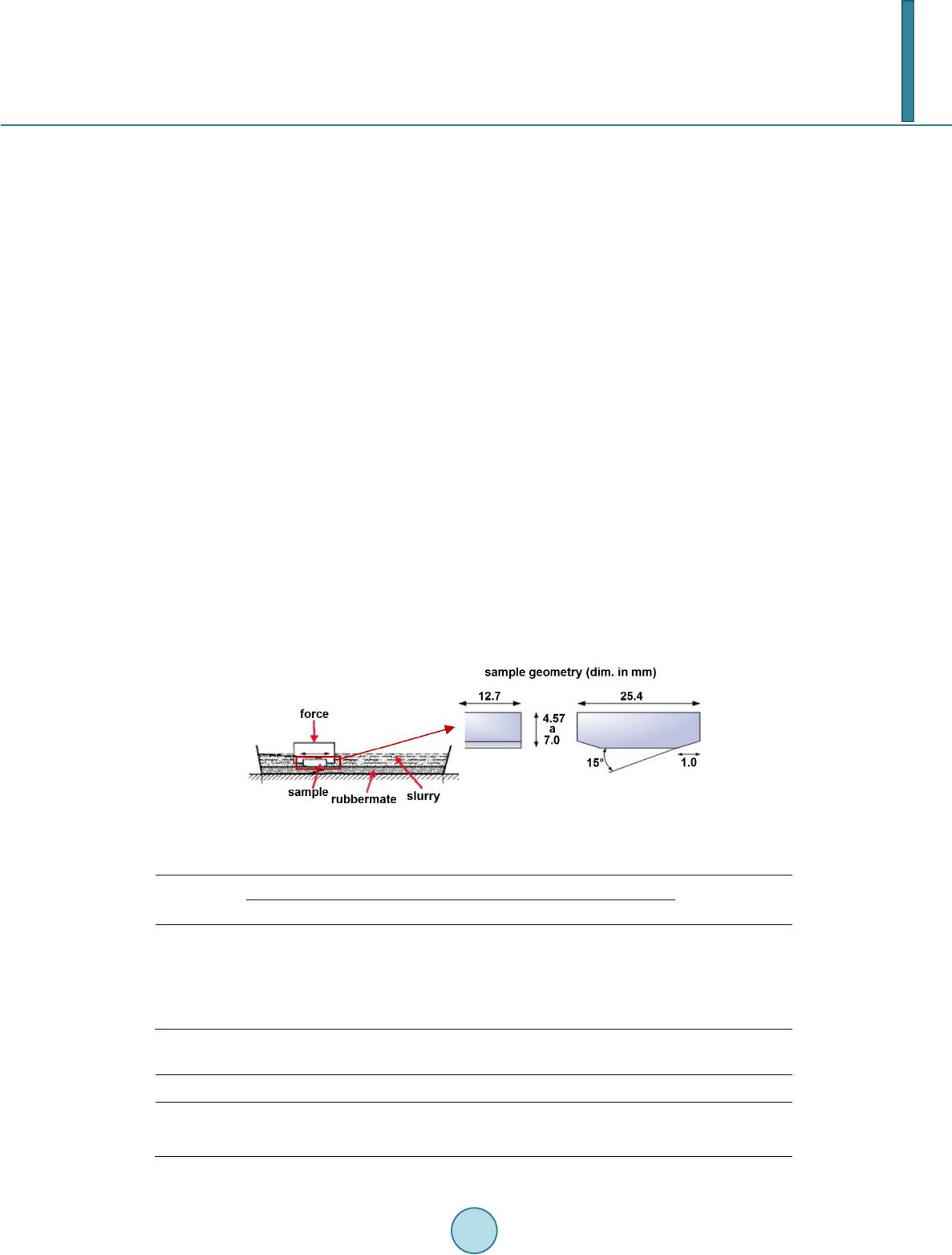 Z. Pędzich et al. 11 material (Miller Number). The Nova Werke AG apparatus was utilized. In presented paper authors established the slurry parameters and made tests with the same slurry for different materials. The slurry content was 200 g of distilled water and 200 g of SiC 80 (with the grain size ranging in 160 - 200 micrometers). The test duration was 6 hours for each material. Two different samples were tested for each material type. Actually, authors de- termined the Slurry Abrasion Response of Materials (SAR Number). The wear kinetics was calculated as VLR Number (volume loose rate) from diagrams of wear prepared after each 2 hours of test according to procedures described in the standard (Figure 1). 3. Results Table 1 summarizes density and porosity data of all investigated materials. Theoretical values of densities for each materials were calculated taking into account the real content of main phases and also the amount of sintering additives (carbon and boron for SiC basing materials and alumina and yttria for Si3N4 basing materials). All of them were relatively good densified, porosity was limited to the closed one only. It is worth to noticed that composites were better densified than pure matrices phases. The residual stresses values state in composites were collected in Table 2. In both composites the dispersed phase caused compressive stresses in the matrix due to their higher coefficient of thermal expansion when com- pared to the matrix. Such stress state could be an important factor for mechanical properties (strength an fracture toughness) improvement. The mean values of stresses in investigated composites were distinctly (more than 500%) different. Silicon carbide matrix was compressed with mean value exceeded 250 MPa. In comparison, silicon nitride one was compressed “slightly” with the mean pressure of less than 50 MPa. Data from Table 3 illustrated that such state of stresses influenced distinctly strength and fracture toughness of composites. The improvement of SCTB parameters compared to SC was noticeable in opposition to SN and SNSC pair. Results of wear test were collected at Table 4 and Table 5. In Table 4 the volumetric wear of all investigated materials was collected. Measurements were made after each 2 hours of test duration. Results indicate that all materials worn out in monotonous way as it is clearly illustrated in Figure 2. Figure 1. The Miller Test apparatus diagram and the sample geometry [10]. Table 1. Densities and porosity of sintered samples. Sample Density Total por., % ± less than 0.005 Theor., g/cm3 Apparent, g/cm3, ±0.01 Relative, % ± less than 0.005 SC 3.210 3.105 96.73 3.27 SCTB 3.304 3.270 97.90 2.10 SN 3.296 3.195 96.82 3.18 SNSC 3.291 3.201 97.27 2.73 Table 2. Calculated values of residual stresses in composites. Composite material Mean value of compressive stress in matrix, MPa Mean value of tensile stress in inclusions, MPa SCTB −258 2322 SNSC −46 402  Z. Pędzich et al. 12 Figure 2. Typical plots of volumetric wear during Miller Test (for SC and SNSC samples). Table 3. Mechanical properties of sintered samples. Sample Vickers hardness HK, GPa Fracture toughness KIc, MPam0.5 Bending strength σ, MPa SC 19.5 ± 1.2 4.6 ± 0.7 351 ± 45 SCTB 18.7 ± 0.5 5.3 ± 0.6 402 ± 50 SN 13.1 ± 0.2 5.1 ± 0.5 613 ± 40 SNSC 14.1 ± 0.7 5.2 ± 0.4 589 ± 35 ± denotes the standard deviation. Table 4. Results of the volumetric wear during Miller Test. Sample Volumetric wear after 2 hours of test, mm3 Volumetric wear after 4 hours of test, mm3 Volumetric wear after 6 hours of test, mm3 SC 17.84 ± 3.76 34.55 ± 5.18 51.73 ± 1.83 SCTB 16.61 ± 0.82 32.57 ± 1.83 51.87 ± 1.73 SN 12.13 ± 0.55 21.14 ± 2.35 34.98 ± 5.84 SNSC 10.20 ± 0.10 18.60 ± 2.14 24.70 ± 3.70 ± denotes the standard deviation. Table 5. Results of SAR and VLR Numbers calculatins. Sample SAR number VLR number SC 155 ± 10 8.55 ± 0.58 SCTB 149 ± 7 8.19 ± 0.38 SN 98 ± 14 5.42 ± 0.75 SNSC 75 ± 14 4.14 ± 0.76 ± denotes the standard deviation. Values of SAR and VLR numbers collected in Table 5, as calculated on the basis of volumetric wear data con- firm differences in wear process of investigated materials. The level of degradation was significantly different for both investigated groups of materials. SN and SNSC materials were distinctly less susceptible for degradation. SN matrix was about 32% more resistant for applied wear process than SC. Behaviour of SNSC composite showed the mentioned property better for the 30% than SN material. In SiC basing materials the wear behaviour improvement did not take place for composite. SC and SCTB have practically the same wear parameters. The highest values of compressive stresses in the silicon carbide matrix were calculated for SCTB material level results suggest that the stress state has not the decisive influence on wear rate decreasing in composites.  Z. Pędzich et al. 13 This statement was confirm by the observation that the lowest level of wear susceptibility was detected for composite with the lowest level of residual stresses. Wear resistance under Miller Test was not correlated with mechanical properties. Materials with highest hardness (SC, SCTB) were the worse during the wear test. Fracture toughness improvement (SC → SCTB) did not influence positively wear resistance. Changes in bending strength also could not be correlated with wear be- havior. Analysis of microstructures in Figures 3-6 showed that SiC basing materials had distinctly different worn surface when compared to Si3N4 basing materials. SC and SCTB materials surfaces were much rougher than SN and SNSC ones. It suggested that for wear resistance of SC and SCTB materials the decisive factor was SiC matrix resistance. The high residual stresses level was practically not important for wear rate of composite. The main reason of SC and SCTB material degradation during Miller Test were local damages in small areas crushed single grains of SiC into small debris. It the most probably caused higher friction and intensified dam- age forces on the surface. For both investigated silicon nitride basing materials measured wear resistance was much lower than observed for silicon carbide basing ones. The most important observation was that in this case the composite material was distinctly better than pure matrix. Figure 3. SEM image of worn SC sample. Figure 4. SEM image of worn SCTB sample.  Z. Pędzich et al. 14 Figure 5. SEM image of worn SN sample. Figure 6. SEM image of worn SNSC sampl e. 4. Summary Although, manufacturing of particulate composites could be effective way to mechanical properties improve- ment in structural ceramic sinters, performed experiments proved that such mechanism is not always successful for some useful properties which depend on many different factors. For two investigated pairs of materials (SC; SCTB and SN ; SNSC) the presence of compressive stress in the matrix acted in different way. Acknowledgements The work was financially supported by the Polish State National Centre for Research and Development under Programme INNOTECH-K2/IN2/16/181920/NCBR/13 . References [1] Grabowski, G. and Pędzich, Z. (2007) Residual Stresses in Particulate Composites with Alumina and Zirconia Matrices.  Z. Pędzich et al. 15 Journal of the European Ceramic Society, 27, 1287-1292. http://dx.doi.org/10.1016/j.jeurceramsoc.2006.04.096 [2] Grabowski, G. and Stobierski, L. (2005) Influence of Thermal Stresses on Mechanical Properties of Ceramics Particu- late Composites. Ceramika/Cerami cs, 91, 627-634. [3] Jiao, S., Jenkins, M.L.L. and Davidge, R.W.W. (1997) Interfacial Fracture Energy-Mechanical Behaviour Relationship in Al2O3/SiC and Al2O3/TiN Nanocomposites. Acta Materialia, 45, 149-156. http://dx.doi.org/10.1016/S1359-6454(96)00168-1 [4] Ohji, T., Jeong, Y.-K., Choa, Y.-H. and Niihara, K. (1998) Strengthening and Toughening Mechanisms of Ceramic Nanocomposites. Journal of the American Ceramic Society, 60, 1453-1460. http://dx.doi.org/10.1111/j.1151-2916.1998.tb02503.x [5] Stobierski, L. and Gubernat, A. (2003) Sintering of Silicon Carbide I. Effect of Carbon. Ceramics International, 29, 287-292. http://dx.doi.org/10.1016/S0272-8842(02)00117-7 [6] Stobierski, L. and Gubernat, A. (2003) Sintering of Silicon Carbide II. Effect of Boron. Ceramics International, 29, 355-361. http://dx.doi.org/10.1016/S0272-8842(02)00144-X [7] Hayashi, T., Munakata, H., Suzuki, H. and Saito, H. (1986) Pressureless Sintering of Si3N4 with Y2O3 and Al2O3. Journal of Materials Science, 21, 3501-3508. http://dx.doi.org/10.1007/BF02402994 [8] Taya, M., Hayashi, S., Kobayashi, A.S. and Yoon, H.S.S. (1989) Toughening of a Particulate-Reinforced/Ceramic- Matrix Composite. Journal of the American Ceramic Society, 73, 1382-1391. http://dx.doi.org/10.1111/j.1151-2916.1990.tb05209.x [9] Test Method for Determination of Slurry Abrasivity (Miller Number) and Slurry Abrasion Response of Materials (SAR Number), ASTM G75-95 Standard. [10] User Manual of Nova Werke AG device for Miller Test. |