

Paper Menu >>
Journal Menu >>
 Engineering, 2013, 5, 584-589 http://dx.doi.org/10.4236/eng.2013.510B120 Published Online October 2013 (http://www.scirp.org/journal/eng) Copyright © 2013 SciRes. ENG Recursive Fuzzy Predictions of Future Patient Paths to Support Clinical Decision Making in ICU A. Zeghbib1, M. Mahfouf1, J. J. Ross2, G. H. Mills2, G. Panoutsos1, M. Denai3, S. Suzani1 1Department of Automatic Control & Systems Engineering, University of Sheffield, Sheffield, UK 2Northern General Hospital, S heffield, UK 3Teesside University, Middlesbrough, UK Email: [email protected] Received 2013 ABSTRACT In this paper, we propose a new architecture that combines prediction and decision-making in the form of a hybrid framework aimed at providing clinicians with transparent and accurate maps, or charts, to guide and to support treat- ment decisions, and to interrogate the clinical patients’ course as it develops. These maps should be patient-specific, with options displayed of possible treatment pathways. They would suggest the optimal care pathways, and the shortest routes to the mo st efficient ca re, by predicting clinical progress, testing the ensuing suggestions against the developing clinical state and patient condition, and suggesting new options as necessary. These maps should also mine an extensive database of accumulated patient data, modelled diseases, and modelled patient-responses based on expert-der ived rule s. These individualized hierarchical targets, which are implemented in order to prevent life-threatenin g illnesses, will also have to “adapt” to the patient’s altering clinical co ndition. Therap ies that support one system can destabilize others and selecting which specific suppo rt to pr ioritize is an uncertain p rocess, the pr ioritizatio n of whic h can var y between cli ni- cal experts. Whilst clinical therapeutic decisions can be made with some degree of anticipation of the “likely” outcome (based on the experts’ opinion and judgment), treatment is essentially rooted in the present, and is dependent on ana- lyzing the current clinical condition and available data. The recursive learning approach presented in this paper , allows decision rules to predict the possible future course, and reflects back derived information from such projections to the present time and thus support proactive clinical care rather than reactive clinical care. The proposed framework for such a patient map supports and enables an optimized choice from available options and also ensures that decisions are based on both the available evidence and a database of best clinical practice. Preliminary results are encouraging and it is hoped to validate the approach clinically in the near future. Keywords: Proactive Treatment, Clinical Dec ision, Intensive-Care, Patient-Paths, Physiological Map 1. Introduction Preliminary studies on physiological patient state classi- fication and patient map elaboration consists of: a) col- lecting patients’ data from each subsystem, such as the heart, the lungs, the renal system, etc.; b) the Laboratory results; c) and medications. Such clinical information allows the identification of the current patient state, but does not provide information about the future patient state. [1,2] are study examples that consider the set of vital parameters from the cardio-vascular system (CVS) and respiratory system. For the respiratory and gas ex- change systems there are many different models devel- ope d to de al with ga s exc hang e in t he lun gs [3,4]. Hence, other approaches have been developed as simulators to describe the ventilation and the gas exchange interactions [5,6] . For a lumped system o f arterial, tiss ue, venous and pulmonary compartme nts, the SOPAVent ( Simulation of Patient under Artificial Ventilation) model has also been developed to simulate the exchange of O2 and CO2 i n t he lungs and tissues togethe r with their transport through the circulatory system [7,8]. Further improvements of the original, SOPAVent model, have also been included to develop a none-invasive model structure as well as a continuously updated model to improve patient-specific model performance and improve the prediction accuracy. A mor e rece nt stud y [9] combined a model of respiratory mechanics, a model of the human lung absolute resistiv- ity and a 2-D finite-element mesh of the thorax to simu- late EIT image reconstr uction during mec hanical ventila- tion. The goals for treating critically-ill patients in Intensi ve Care Units are, of necessity, patient specific. A Clinical Decision Support System to optimize a patient’s care would ideally have the following features: 1) function as A. ZEGHB IB ET AL. Copyright © 2013 SciRes. ENG 585 a ‘virtual Star Chamber’ pooling all available expertise of the clinical staff in that Unit; 2) use this wealth of knowledge to derive current treatment for an individual patient via data bases which can ideally be interrogated; 3) use data-mining tools to categorize the current patient condition; 4) integrate current treatment protocols into real-time care; 5) exploit a predictive function to model and thus pred ict the clinical c ourse of the patien t into the future resulting from this care; 6) Test, “off -line”, the consequences of the current treatment actions; 7) Finally, interrogate the generated data from the patient to check conformity with the predicted outcome In the Intensive Care environment, clinical decisions are made to maintain patients’ physiological parameters within acceptable (safe) ranges whilst treating or improv- ing the underlying illne ss. Clinicians rely on their kno w- ledge and experience to plan appropriate therapy rules. These are applied to the developing clinical condition and the outcomes revisited and alterations considered for implementatio n. Selecting the most appropriate treatment package from differing options raises the possibility of potentially di- verging and conflicting clinical decisions, or therapy rules, and that selecting one path will engender a devel- oping and necessarily diverging clinical course for that patient. T his dilemma requires that t he choices should b e clearly identified and that any model-based method must be able to predict future consequences for each choice. However, clinical decisions entail a degree of uncertainty and do not have a clearly mapped outcome for the con- sequences. If a clinician has a patient with a diagnosis “D”, the therapeutic choices can be T1, T2, or T3. Ther- apy “T1” may induce a complication and cause the pa- tient to deteriorate. Therapeutic decision “T2” may im- prove the state of t he patient, or may not chan ge it. “T3” may treat t he diagno sis D, but entail colla teral da mage in other organs. Thus the clinician faces considerable un- certainty. A map detailing clear future outcomes in all possibilities for patients’ anticipated clinical recovery paths will be useful undoubtedly. The decision-support map would provide clinicians predicted pathways for multiple possible patient- states, until the patient enters a final state of stability with nor- malized values for all monitored physiological parame- ters. This stable state would in effect represent, in terms of dynamic systems, the so called equilibrium state. In the framework proposed in this paper, each gener- ated node of the path displays two types of information. The first describes the current values of physiological parameters as concept variables, and the second de- scribes the drug that causes these concept variables to evolve according a certain trend. The physiological pa- rameters are calculated by reflecting the connective inte- ractions of the variables within each node and between the nodes, which thus functions as part of a dynamical biological system. Thus, the interaction between clinical concepts should keep a stable equilibrium within time or continuous until reach the equilibrium cycle, depending on the initial patient state and the expert knowledge da- ta-base. The displayed options of possible treatment pathways support a clinical proactive decision making. This model has two principle components: the first component is the State Transition Predictor (STP), and the second is the Patient Paths Network (PPN). The first component is an expert knowledge data-base of the basic clinical rules for different possible patient states based on a number of clinical concepts to be observed. The number of clinical concepts is determined by a possibility that a clinical outcome would in effect take place. The remainder of this paper will be organized as follows: Section 2 will detail the “recursive” concept as well as the associated algorithms of the physiological patient map. Section 3 will explain how the cause-effect relationship within pa- tient physiological parameters can be represented via a fuzzy cognitive map. Finally, conclusions relating to the proposed study together with future research directions will be given in Se ction 4. 2. Physiological Patient Map In order to populate the physiological patient map, we reconceptualise clinical conditions from general terms such a s “critical”, “stable” “mild”, etc.; via fuz z y l i ng ui s- tic terms describing the values of the physiological pa- rameters. Each parameter is described in one of three fuzzy linguistic terms: Low (L), Medium (M), and High (H). For m clinical concepts (i.e. physiological parame- ters), the nodes (i.e. states) of p atient paths are expressed as follows: Let us consider a vector of m variables: ( ) { } ,1 , ,? kk km yty y (1) ( ) { } , 1,Fuzzy Linguistic Terms ,,,:state index kim y LMHk = ∈ We argue here that there are two components (Mod- ules) of our Physiological patient map: state transition predictor (STP) and patient path network (PPN), see “Figure 1”. The next sections will expand on these two modules: 2.1. State Transition Predictor (STP) The STP has two inputs, the first input is represented by clinical concepts, () k yt , and the second input is repre- sented by drugs, i.e. ( ) { } ,1 , ,,:drug vector dimension kk kn xt xx n= (2) 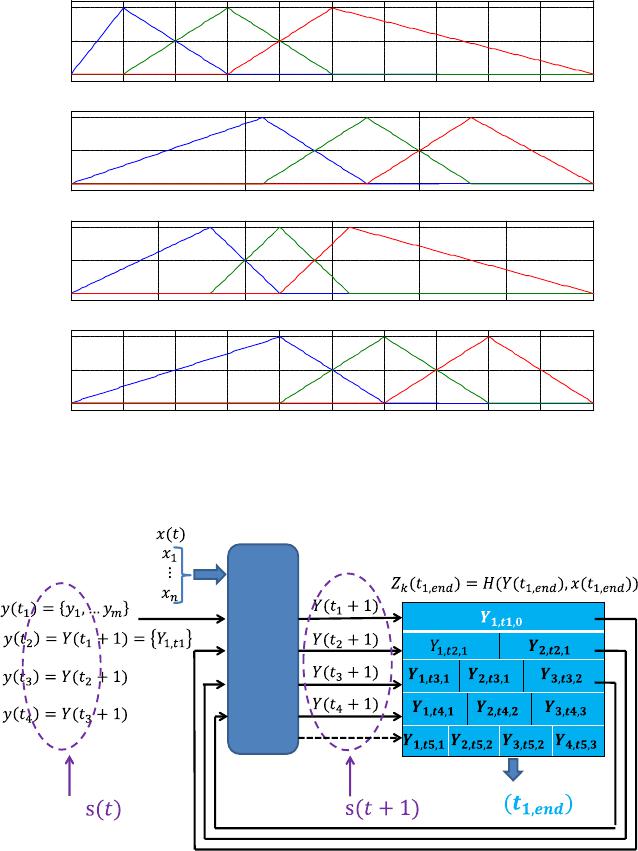 A. ZEGHB IB ET AL. Copyright © 2013 SciRes. ENG 586 The outputs are the new clinical concepts formulated also via fuzzy linguistic terms based on the previous two vector inputs x(t) and y(t). Hence, the output vector will be as fo l lows: ( )( ) ( ) ( 1), k kk YtFxtyt+= . (3) Thus the input matrix ( )( ) ,xt yt ′′ generates a new output vector as follows: ( ) { } { } ,1 , , 1,,1, 1, ; ,. kkk Mj kjMjkk m YtY Y Y yy = += = (4) The dimension, Mj, of the victor ( ) 1 k Yt+ depends on the state i ndex, k. T he stat e transition predictor (STP) represents our data-base of expert knowledge. 2.2. Patient Path Network (PPN) This module has the specific task of memorising all the predicted states from the initial recorded state until the final predicted stable state and builds the network of all the generated states. Furthermore, the simulation run of this module is completed to extract all possible outcome paths that the patient clinical state may follow, “Figure 2”. The nodes of each path indicate the physiological pa- rameter values in fuzzy linguistic terms and the drugs that should be administrated in order to reach the next transition state. Here we consider the recording of only four physiological parameters; (in an intensive care en- vironment of a patient with cardio-respiratory system failure): Cardiac Output (CO) is low (L), Mean Arterial Pressure (MAP) is low (L), mean airway pressure (PaO2) Figure 1 . Fuzzy linguistic ter ms ; Low, Me diu m, a n d Hi g h; of t he four phy s iolog ic al par a me te r s ( cl ini c al c o nce pt s) C O, M A P, PaO2, and CVP. The x-axis represents real values of these parameters. Figure 2 . Phys iological patient map (PPM). T he re are two module s. 02468 10 12 14 16 1820 0 0. 5 1 Low Medium High CO(L/min) CO 050100 150 0 0. 5 1 Low Medium High MAP(mmHg) MAP 051015 20 25 30 0 0. 5 1 Low MediumHigh PaO2(mm Hg) PaO 2 0 1 2 3 45 678910 0 0. 5 1 Low Medium High CVP ( mmHg) CVP State State 𝑌(𝑡+1)=𝐹(𝑥(𝑡),𝑦(𝑡)) Paths 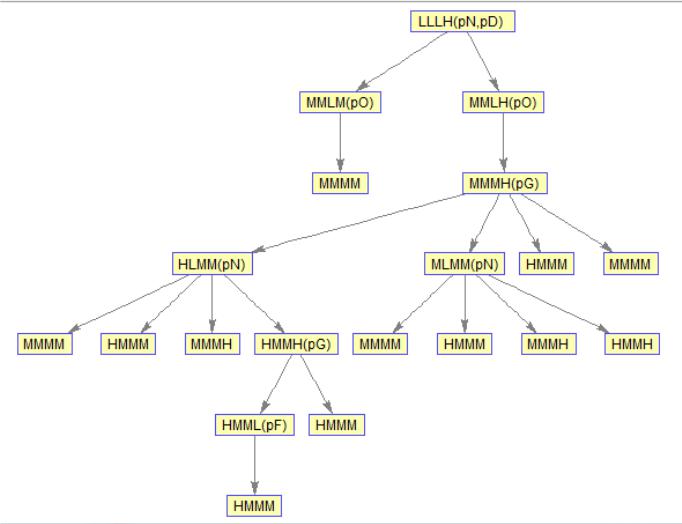 A. ZEGHB IB ET AL. Copyright © 2013 SciRes. ENG 587 is low (L), and Central Venous Pressure (CVP) is high (H). Thus the recorded patient initial state was indicated in the model (see “Figure 3”) as [LLLH]. The physio- logical patient map model in this case will generate the successive possible states of this patient in the form of paths network. The procedure is only stopped under two conditions: the first is when all the newly created states (nodes) reach the stable state [MMMM] or [HMMM], the second condition relates to when the newly state (node) has already been created, similarly to the case illustrated by “Figure 3”, i.e. the state [MMMH]. Patient paths (trajectories) network nodes indicate the physiological parameter values in fuzzy linguistic terms and the drug input that should be administrated to reach the next transition state. There are five types of drugs used by the model to generate this paths-based network; N: noradrenaline, D: dobutamine, G: GTN, F: fluid, O: oxygen, and F: Fluid. These drugs are described also via two fuzzy linguistic terms: “p: positive” to increase the drug, and “l: less” to decr ease the drug dosage. Fr om t he top-node of the initial recorded patient state, the model progresses recursively creating successor nodes and paths until reaching the equilibrium state of each patient path. In the particular (realistic) example of “Figure 3”, the patient map includes 12 possible physiological patient paths generated with this model. Section 3 will expand on the physiological parameters evolution within a spe- cific path, in order to explain the successive nodes created from the model and their convergence to the sta- ble state (eq uilib rium). 3. Physiological Parameters Evolution in Cognitive Map The cause-effect relationship within the patient physio- logical parameters is represented as a fuzzy cognitive map [10]. We argue that this graphical representation may be the ideal tool for reasoning with uncertainty. The path nodes include “9” co ncepts; fo ur “4” of which are causal concepts representing the patient physiological parameters. These concepts are, as is the case of in any dynamic system, in permanent interactions within cause - effect relationships. The valuations of these cause-effect relationships; from the experts; are carried-out indirectly through the drug concept values. The five “5” other con- cepts are drugs; their edges are directed only in one di- rection onto the physiological parameters, as illustrated in “Figure 4”. These are the main considered variables for building the physiological patient map. The predicted evolution of physiological parameters infers different possible patient trajectories in a clear physiological map. T he illustra tion of one tra je ctory from the trajectories map of “Figure 4” can help to get to grips with the mechanism used by predicted clinical concepts interactions to build the successive future patient out- comes, as shown in “Figure 5”. The model operates ite- ratively, because at each time interval the new concept node values are predicted using the previous node con- cept values. Figure 3 . Network of physiological parameters an d diff erent possi bl e patient paths prediction. 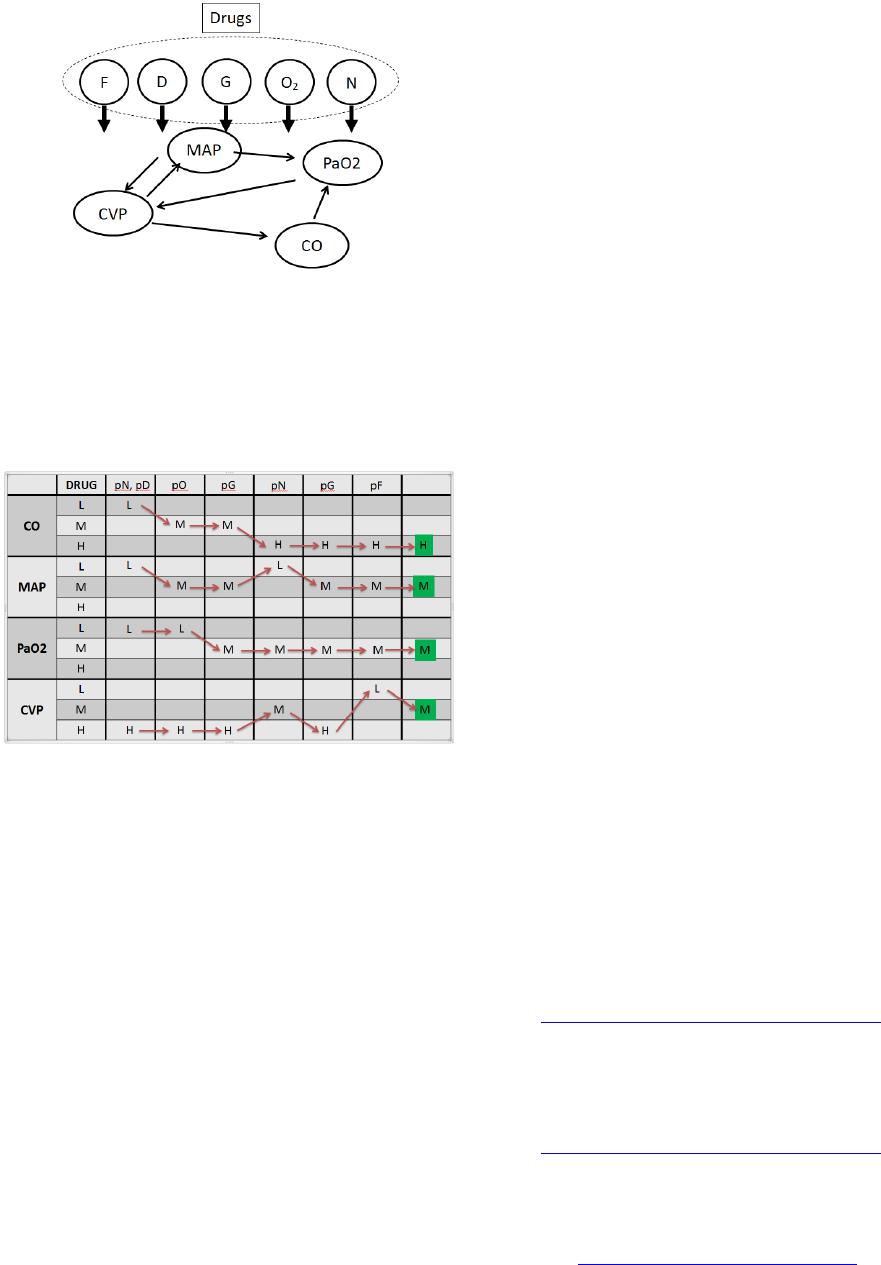 A. ZEGHB IB ET AL. Copyright © 2013 SciRes. ENG 588 Figure 4. Fuzzy cognitive map, within each node of the pa- tient pat h, for the ca use-effect relationship of patient physi- ological parameters and drugs. The drugs have unideric- tional effects. Drug types used in this study are; N: nora- drenaline, D: dobutamine, G: GTN, F: fluid, O2: oxygen, and F: Fl ui d. T he map he re uses no de s ha pes r el at i ng to t he concept type. Drug concepts are circles, physiological pa- rameters are el ipses. Figure 5 . Pat ient pat h evol ut ion f ro m the phy sio logi cal map . This path has seven “7” physiological states (nodes). The initial state is [LLLH] and the outcome state is [HMMM], which is the final patient stable state. We observe the con- tinous physiological parameters evolution in the same time, parallel way, until the system reaches its equilibrium state. The path chosen from the map of “Fig ur e 3” includes seven “7” physiological states (nodes), the initial state being [LLLH] and the outcome state [HMMM] being the final predicted patient stable state. In this path all physi- ological variables change continuously until the system reaches its equilibrium state. The convergence of a phy- siological dynamic system towards a stable state is only possible because of the available expert knowledge re- lating to the biolo gical s ystem b ehaviour. H o wever, these paths can also diverge and it may be possible that they will never reach the “equilibr ium” state. 4. Conclusion The proposed physiological patient map model as de- tailed in this study has ma ny advantages for the clinicians to deal with patients in intensive care unit. Usually, clin- ical decisions are based on clinical assessment and sub- jective judgment of clinicians. The clinicians’ judgments are only reactive actions because the usual existent sys- tems of assessment cannot provide the possible outcome set o f the future scenarios of ph ysiological patie nt states. This model provides the clinicians transparent map, based on their expert-knowledge, of future patient paths that will be conveyed back to the current planning context in order to support proactive clinical actions rather than just reactive actions. This map allows, in terms of profes- sional accountability, a real choice of the best decision and also ensures that decisions are based on available evidence. However as this model is based on the fuzzy sets of clinical concepts, the increase of recorded physi- ological parameters and drugs will make the physiologi- cal patient map more complex and also raises the patient paths number but it is believed that as long as the map itself is systematically built, accuracy and most impor- tantly transparency will still be conserved. Immediate future plans will include validation of this map concept on a simulated patient platform, but our “not so imme- diate” research plan will include two vectors: the first one is to introduce variations of the physiological para- meters to test the generalization properties of the overall framework as to its quality of control and to path con- vergence; the second will provide this model with new tools using probability and possibility theories both for control and path selection. Both data and knowledge fu- sion, especially in the case of information conflicts, will also be a pertinent issue to resolve. 5. Ackno wledgements The authors wish to acknowledge financial support for this work fro m the UK-EPSRC under Grant EP/FO2889X/l. REFERENCES [1] J. J. Ro ss, M. A. Denai and M. Mahfouf, “A Hybrid Hie- rarchical Decision Support System for Cardiac Surgical Intensive Care Patients, Part II—Clinical Implementation and Evaluation,” Artificial Intelligence in Medicine, Vol. 45, No. 1, 2009, pp. 53-62. http://dx.doi.org/10.1016/j.artmed.2008.11.010 [2] M. A. Denai, M. Mahfouf and J. J. Ross, “A Hybrid Hie- rarchical Decision Support System for Cardiac Surgical Intensive Care Patients, Part I—Physiological Modelling and Decision Support Design,” Artificial Intelligence in Medicin e, Vol. 45, No. 1, 2009, pp. 35-52. http://dx.doi.org/10.1016/j.artmed.2008.11.009 [3] T. Winkler and A. Krause, “Simulation of Mechanical Respiration Using a Multi-Compartment Model for Ven- tilation Mechanics and Gas Exchange,” Journal of Clini- cal Monitoring and Computing, Vol. 12, 1995, pp. 231- 239. http://dx.doi.org/10.1007/BF01207204 [4] A. Ben -Tal, “Simplified Models for Gas Exchange in the  A. ZEGHB IB ET AL. Copyright © 2013 SciRes. ENG 589 Human Lungs,” International Journal of Evolutionary Biology, Vol. 238, 2006, pp. 474-495. http://dx.doi.org/10.1016/j.jtbi.2005.06.005 [5] C. J. Hinds, M. J. Roberts, D. Ingram and C. J. Di ckinson, “Computer Simulation to Predict Patient Responses to Alterations in the Ventilation Regime,” Intensive Care Medicine, Vol. 22, 1984, pp. 13-22. [6] J. G. Hardman, N. M. Bedforth, A. B. Ahmed, R. P. Ma- hajan and A. R. Aitkenhead, “A Physiology Simulator: Validation of Its Respiratory Components and Its Ability to Predict the Patient’s Response to Changes in Mechan- ical Ventilation,” British Journal of Anaesthesia, Vol. 81, No. 3, 1998, pp. 327-332. http://dx.doi.org/10.1093/bja/81.3.327 [7] A. Wang, M. Mahfouf, G. H. Mills, G. Panoutsos, D. A. Linkens, K. Goode, H.-F. Kwok and M. Denaï, “Intelli- gent Model-Based Advisory System for the Management of Ventilated Intensive Care Patients—Part I: Hybrid Blood Gas Patient Model,” Computer Methods and Pro- grams in Biomedicine, Vol. 99, No. 2, 2010, pp. 195-207. http://dx.doi.org/10.1016/j.cmpb.2009.09.011 [8] A. Wang, M. Mahfouf, G. H. Mills, G. Panoutsos, D. A. Linkens, K. Goode, H.-F. Kwok and M. Denaï, “Intelli- gent Model-Based Advisory System for the Management of Ventilated Intensive Care Patients—Part II: Decision Support,” Computer Methods and Programs in Biomedi- cine, Vol. 99, No. 2, 2010, pp. 208-217. http://dx.doi.org/10.1016/j.cmpb.2010.03.009 [9] M. A. Denai, M. Mahfouf, S. Mohamed Samuri, G. Pa- noutsos, B. H. Brown and G. H. Mills, “Absolute Elec- trical Impedance Tomography (aEIT) Guided Ventilation Therapy in Critical Care Patients: Simulations and Future Trends,” IEEE Transactions on Information Technology in Biomedicine, Vol. 14, No. 3, Special Issue “New and Emerging Technologies in Bioinformatics and Bioengi- neering”, 201 0. [10] B. Kosko, “Fuzzy Cognitive Maps,” International Jour- nal of Man-Machine Studies, Vol. 24, 1986, pp. 65-75. http://dx.doi.org/10.1016/S0020-7373(86)80040-2 |