

Paper Menu >>
Journal Menu >>
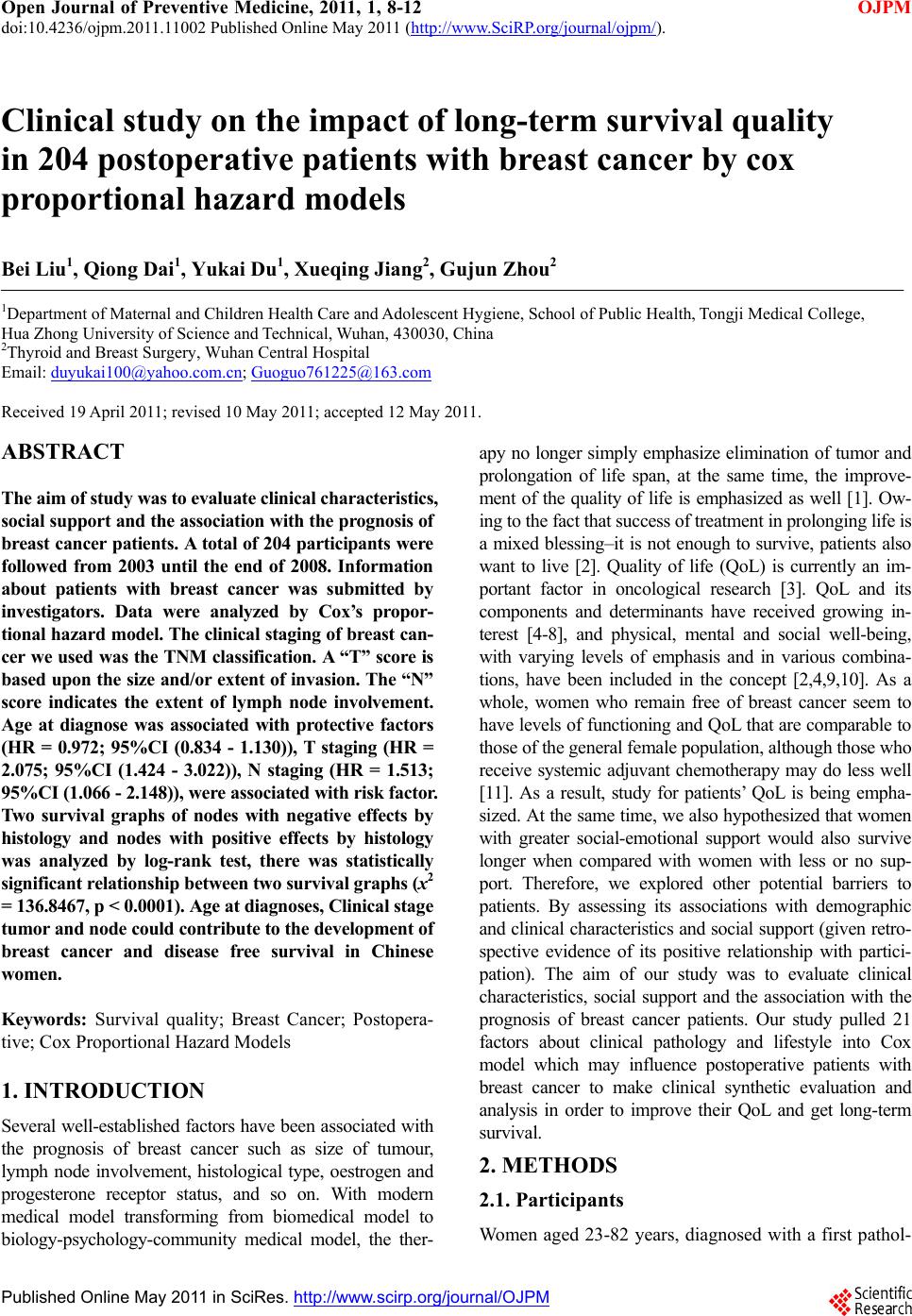 Open Journal of Preventive Medicine, 2011, 1, 8-12 doi:10.4236/ojpm.2011.11002 Published Online May 2011 (http://www.SciRP.org/journal/ojpm/ OJPM ). Published Online May 2011 in SciRes. http://www.scirp.org/journal/OJPM Clinical study on the impact of long-term survival quality in 204 postoperative patients with breast cancer by cox proportional hazard models Bei Liu1, Qiong Dai1, Yukai Du1, Xueqing Jiang2, Gujun Zhou2 1Department of Maternal and Children Health Care and Adolescent Hygiene, School of Public Health, Tongji Medical College, Hua Zhong University of Science and Technical, Wuhan, 430030, China 2Thyroid and Breast Surgery, Wuhan Central Hospital Email: [email protected]; [email protected] Received 19 April 2011; revised 10 May 2011; accepted 12 May 2011. ABSTRACT The aim of study was to evaluate clinical characteristics, social support and the association with the prognosis of breast cancer patients. A total of 204 participants were followed from 2003 until the end of 2008. Information about patients with breast cancer was submitted by investigators. Data were analyzed by Cox’s propor- tional hazard model. The clinical staging of breast can- cer we used was the TNM cl assification. A “T” score is based upon the size and/or extent of invasion. The “N” score indicates the extent of lymph node involvement. Age at diagnose was associated with protective factors (HR = 0.972; 95%CI (0.834 - 1.130)), T staging (HR = 2.075; 95%CI (1.424 - 3.022)), N staging (HR = 1.513; 95%CI (1.066 - 2.148)), were associated with risk factor. Two survival graphs of nodes with negative effects by histology and nodes with positive effects by histology was analyzed by log-rank test, there was statistically significant relationship between two survival graphs (x2 = 136.8467, p < 0.0001). Age at diagnoses, Clinical stage tumor and node could contribute to the development of breast cancer and disease free survival in Chinese women. Keywords: Survival quality; Breast Cancer; Postopera- tive; Cox Proportional Hazard Models 1. INTRODUCTION Several well-established factors have been associated with the prognosis of breast cancer such as size of tumour, lymph node involvement, histological type, oestrogen and progesterone receptor status, and so on. With modern medical model transforming from biomedical model to biology-psychology-community medical model, the ther- apy no longer simply emphasize elimination of tumor and prolongation of life span, at the same time, the improve- ment of the quality of life is emphasized as well [1]. Ow- ing to the fact that success of treatment in prolonging life is a mixed blessing–it is not enough to survive, patients also want to live [2]. Quality of life (QoL) is currently an im- portant factor in oncological research [3]. QoL and its components and determinants have received growing in- terest [4-8], and physical, mental and social well-being, with varying levels of emphasis and in various combina- tions, have been included in the concept [2,4,9,10]. As a whole, women who remain free of breast cancer seem to have levels of functioning and QoL that are comparable to those of the general female population, although those who receive systemic adjuvant chemotherapy may do less well [11]. As a result, study for patients’ QoL is being empha- sized. At the same time, we also hypothesized that women with greater social-emotional support would also survive longer when compared with women with less or no sup- port. Therefore, we explored other potential barriers to patients. By assessing its associations with demographic and clinical characteristics and social support (given retro- spective evidence of its positive relationship with partici- pation). The aim of our study was to evaluate clinical characteristics, social support and the association with the prognosis of breast cancer patients. Our study pulled 21 factors about clinical pathology and lifestyle into Cox model which may influence postoperative patients with breast cancer to make clinical synthetic evaluation and analysis in order to improve their QoL and get long-term survival. 2. METHODS 2.1. Participants Women aged 23-82 years, diagnosed with a first pathol-  B. Liu et al. / Open Journal of Preventive Medicine 1 (2011) 8-12 ogically confirmed breast cancer between January 2000 and February 2001, were identified through three hospi- tals, including Tongji Hospital, Xiehe Hospital and Wu- han Central Hospital in Wuhan city of China. These hospitals were requested to provide complete informa- tion for all known cases of female breast cancer. All pa- tients who entered the study in May 2003 have been received follow-up visit till June, 2008. All of documents included 163 completed data cases and 41 censored cases, which had 25 visit loss cases, 1 death of other diseases case and 15 survival cases. 2.2. Data Collection On the basis of all sources of information, we recon- structed a detailed medical history for each patient. In compiling all sources of information, we also ascertained breast cancer stage, histology, estrogen receptor (ER) status, methods of treatment, age at diagnosis, gestagenic history, and married status [12] through their abstraction of pathology reports and medical records relating to breast cancer diagnosis. For women who had two or more primary cancers diagnosed within the follow-up time, we took the earliest diagnosis, or if both tumors were diagnosed on the same date, the tumor characteris- tics are those associated with the larger tumor. Although we were able to confirm most exposure his- tories of patients through interview of medical records, we were unable to confirm other information. Thus, the exposure information, such as educational level, occupa- tion, emotional function, social function and economical status correlated with health, were obtained by trained interviewers that asked patients, their husband or first- degree relatives. All data were collected with a stan- dardized questionnaire using a telephone interview. Variables included demographics, emotional function, social function and economical status. If patients die, interviewers must obtain their age at death. Due to the nature of the data collected (medical records and tele- phone interview), complete information was impossible for some of the variable assessed. In some instances (e.g. the history of other chronic disease, emotional function, social function and economical status) over 35% of the data were missing, therefore these variables were ex- cluded from the analysis. In the end, complete informa- tion was available for 204 cases from the initial study population of 300 cases. 2.3. Statistical Methods Twenty-one features of patients, clinical pathologic fac- tors and lifestyle have been selected as the indexes of analysis and been quantified, which came from clinical records and may influence prognosis of patients with breast cancer. Patients’ live time were calculated by month, which means the time span from the operation day to death or termination of follow-up visit, and we put corresponding data of every patient into computer on the basis of clinical records and results of follow-up visit, and data was dealt by SAS9.0 for WINDOWS software and the survival rate was calculated by life table method. All indexes of survival rate difference were analyzed by multiple factor Cox proportional hazard model (using gradually backward progressive method, two-tailed α = 0.05). 3. RESULTS The 17 categorical variables were summarized in Table 1. For the model selection there were records with miss- ing variables. Previous analysis on these datasets sug- gested that missing variables might be informative. Therefore, any missing values in the 17 categories were coded as a separate attribute. The distributions of various demographic, reproduc- tive and medical characteristics of the cohort were pro- vided in Table 2. Among the 204 women included in this analysis, 48.04% had at least a college degree, 13.24% had a first-degree family history of breast cancer and 83.33% had biopsy for benign breast cancer. The major- ity was later-stage cancers, and 190 (93.14%) had infil- trating type. Multivariate Cox proportional hazard model analysis was showed in Table 3. On the level of α = 0. 05, it was indicated by analytic results that outstanding factors in- cluding age at diagnosis, T staging, N staging, emotional function, the level of the hospital, may influence survival time statistically. Age at diagnosis was protective factors (coefficient of regression was negative), the rest were all risk factor (coefficient of regression was upright). Survival analysis of clinical stage nodes was showed in Figure 1. Two survival graphs of nodes found nega- tive by histology and nodes found positive by histology were analyzed by log-rank test, there was statistically significant relationship between two survival graphs (x2 = 136.8467, p < 0.0001). 4. DISCUSSION Age at diagnosis is one of the most definitive risk factors on breast cancer. Sixty-five percent of all breast cancers occur in women aged 55 and older. Our study found that age at diagnosis was one of prognostic factors. The younger patients at diagnosis showed lower death hazard (Hazard Ratio: 0.972). But none of the prior studies showed that age was one of the prognostic factors, and it is difficult to hypothesize why age at diagnoses would be more closely related to survival time. We presume that the younger patients at diagnose may have fewer hance of developing other chronic diseases and be more c C opyright © 2011 SciRes. OJPM 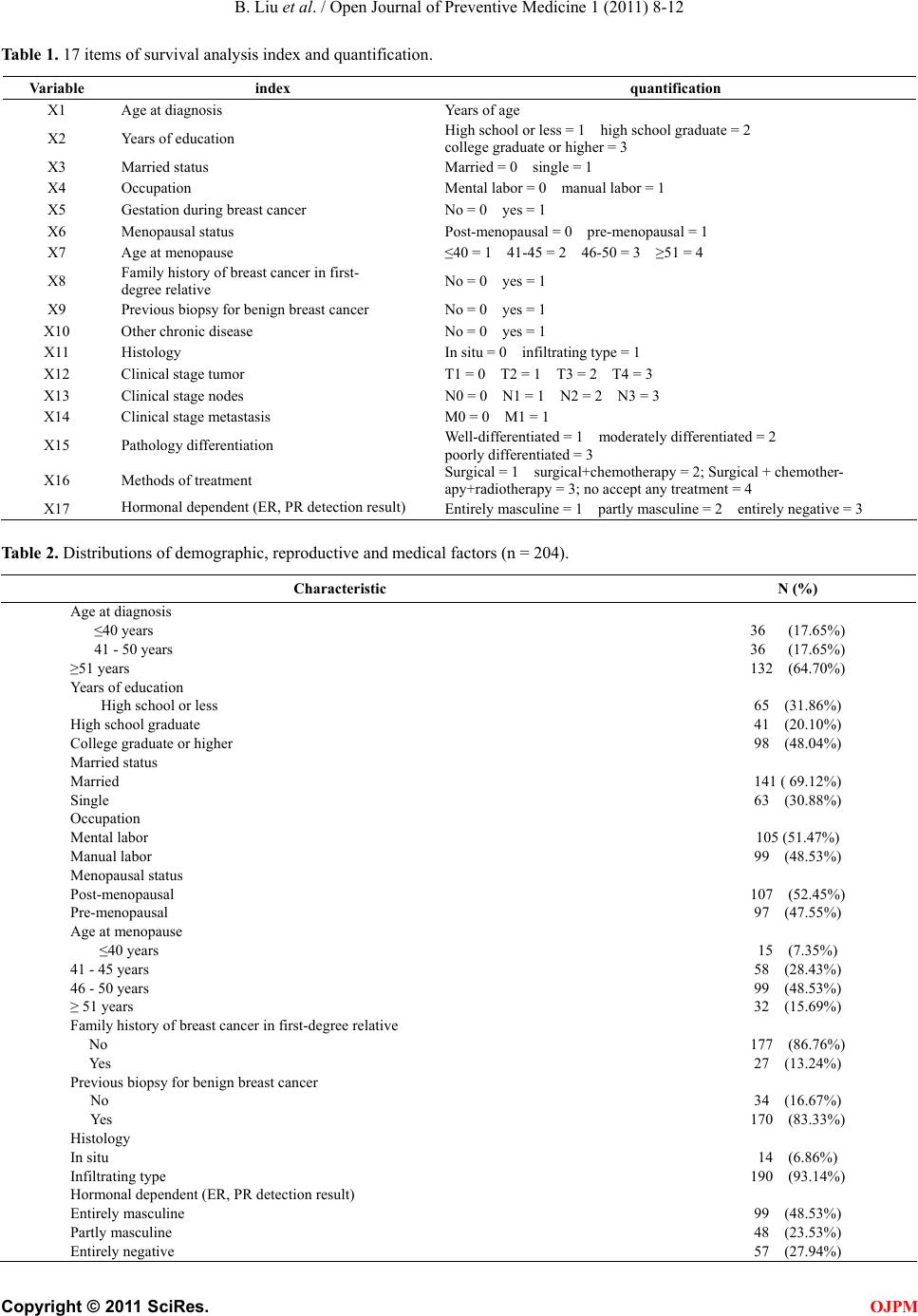 B. Liu et al. / Open Journal of Preventive Medicine 1 (2011) 8-12 Copyright © 2011 SciRes. OJPM Table 1. 17 items of survival analysis index and quantification. Variable index quantification X1 Age at diagnosis Years of age X2 Years of education High school or less = 1 high school graduate = 2 college graduate or higher = 3 X3 Married status Married = 0 single = 1 X4 Occupation Mental labor = 0 manual labor = 1 X5 Gestation during breast cancer No = 0 yes = 1 X6 Menopausal status Post-menopausal = 0 pre-menopausal = 1 X7 Age at menopause ≤40 = 1 41-45 = 2 46-50 = 3 ≥51 = 4 X8 Family history of breast cancer in first- degree relative No = 0 yes = 1 X9 Previous biopsy for benign breast cancer No = 0 yes = 1 X10 Other chronic disease No = 0 yes = 1 X11 Histology In situ = 0 infiltrating type = 1 X12 Clinical stage tumor T1 = 0 T2 = 1 T3 = 2 T4 = 3 X13 Clinical stage nodes N0 = 0 N1 = 1 N2 = 2 N3 = 3 X14 Clinical stage metastasis M0 = 0 M1 = 1 X15 Pathology differentiation Well-differentiated = 1 moderately differentiated = 2 poorly differentiated = 3 X16 Methods of treatment Surgical = 1 surgical+chemotherapy = 2; Surgical + chemother- apy+radiotherapy = 3; no accept any treatment = 4 X17 Hormonal dependent (ER, PR detection result) Entirely masculine = 1 partly masculine = 2 entirely negative = 3 Table 2. Distributions of demographic, reproductive and medical factors (n = 204). Characteristic N (%) Age at diagnosis ≤40 years 36 (17.65%) 41 - 50 years 36 (17.65%) ≥51 years 132 (64.70%) Years of education High school or less 65 (31.86%) High school graduate 41 (20.10%) College graduate or higher 98 (48.04%) Married status Married 141 ( 69.12%) Single 63 (30.88%) Occupation Mental labor 105 (51.47%) Manual labor 99 (48.53%) Menopausal status Post-menopausal 107 (52.45%) Pre-menopausal 97 (47.55%) Age at menopause ≤40 years 15 (7.35%) 41 - 45 years 58 (28.43%) 46 - 50 years 99 (48.53%) ≥ 51 years 32 (15.69%) Family history of breast cancer in first-degree relative No 177 (86.76%) Yes 27 (13.24%) Previous biopsy for benign breast cancer No 34 (16.67%) Yes 170 (83.33%) Histology In situ 14 (6.86%) Infiltrating type 190 (93.14%) Hormonal dependent (ER, PR detection result) Entirely masculine 99 (48.53%) Partly masculine 48 (23.53%) Entirely negative 57 (27.94%) 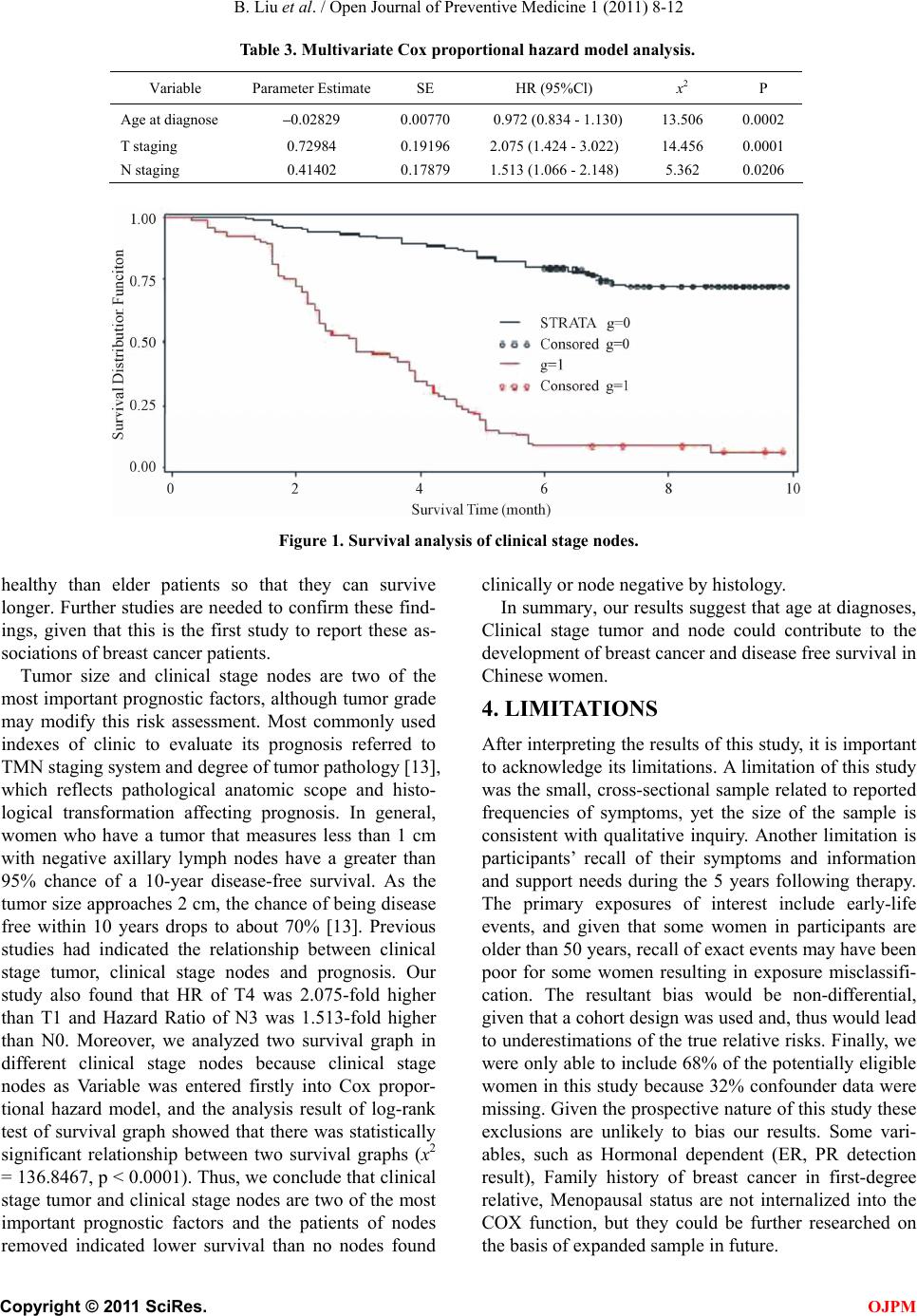 B. Liu et al. / Open Journal of Preventive Medicine 1 (2011) 8-12 Table 3. Multivariate Cox proportional hazard model analysis. Variable Parameter EstimateSE HR (95%Cl) x2 P Age at diagnose –0.02829 0.00770 0.972 (0.834 - 1.130) 13.506 0.0002 T staging 0.72984 0.19196 2.075 (1.424 - 3.022) 14.456 0.0001 N staging 0.41402 0.17879 1.513 (1.066 - 2.148) 5.362 0.0206 Figure 1. Survival analysis of clinical stage nodes. healthy than elder patients so that they can survive longer. Further studies are needed to confirm these find- ings, given that this is the first study to report these as- sociations of breast cancer patients. Tumor size and clinical stage nodes are two of the most important prognostic factors, although tumor grade may modify this risk assessment. Most commonly used indexes of clinic to evaluate its prognosis referred to TMN staging system and degree of tumor pathology [13], which reflects pathological anatomic scope and histo- logical transformation affecting prognosis. In general, women who have a tumor that measures less than 1 cm with negative axillary lymph nodes have a greater than 95% chance of a 10-year disease-free survival. As the tumor size approaches 2 cm, the chance of being disease free within 10 years drops to about 70% [13]. Previous studies had indicated the relationship between clinical stage tumor, clinical stage nodes and prognosis. Our study also found that HR of T4 was 2.075-fold higher than T1 and Hazard Ratio of N3 was 1.513-fold higher than N0. Moreover, we analyzed two survival graph in different clinical stage nodes because clinical stage nodes as Variable was entered firstly into Cox propor- tional hazard model, and the analysis result of log-rank test of survival graph showed that there was statistically significant relationship between two survival graphs (x2 = 136.8467, p < 0.0001). Thus, we conclude that clinical stage tumor and clinical stage nodes are two of the most important prognostic factors and the patients of nodes removed indicated lower survival than no nodes found clinically or node negative by histology. In summary, our results suggest that age at diagnoses, Clinical stage tumor and node could contribute to the development of breast cancer and disease free survival in Chinese women. 4. LIMITATIONS After interpreting the results of this study, it is important to acknowledge its limitations. A limitation of this study was the small, cross-sectional sample related to reported frequencies of symptoms, yet the size of the sample is consistent with qualitative inquiry. Another limitation is participants’ recall of their symptoms and information and support needs during the 5 years following therapy. The primary exposures of interest include early-life events, and given that some women in participants are older than 50 years, recall of exact events may have been poor for some women resulting in exposure misclassifi- cation. The resultant bias would be non-differential, given that a cohort design was used and, thus would lead to underestimations of the true relative risks. Finally, we were only able to include 68% of the potentially eligible women in this study because 32% confounder data were missing. Given the prospective nature of this study these exclusions are unlikely to bias our results. Some vari- ables, such as Hormonal dependent (ER, PR detection result), Family history of breast cancer in first-degree relative, Menopausal status are not internalized into the COX function, but they could be further researched on the basis of expanded sample in future. C opyright © 2011 SciRes. OJPM  B. Liu et al. / Open Journal of Preventive Medicine 1 (2011) 8-12 5. ACKNOWLEDGMENTS This work was supported by grants from Tongji Hospital, Xiehe Hos- pital and the Wuhan Central Hospital. We thanks the help of Professor Ping Yin in data analysis and Assistant Professor Ping Wang in recti- fying the manuscript. REFERENCES [1] Gai, X., Fan, Z. and Bresson, J..(1995) Comparison of survival among patientswith breast cancer treated at first teaching hospital, Changchun, China, and Saint-Sacre- ment Hospital, Quebec, Canada. Chinese Journal Cancer Research, 7(3), 197-205. doi:10.1007/BF03023474 [2] McDowell, I. and Newell, C.. (1996) Measuring Health. A Guide to Rating Scales and Questionnaires, 2nd edi- tion. New York: Oxford University Press, 354-355. [3] Lehto, U.S., Ojanen, M., and Kellokumpu-Lehtinen, P.. (2005) Predictors of quality of life in newly diagnosed mela- noma and breast cancer patients. Ann Oncol, 16(5), 805-816. doi:10.1093/annonc/mdi146 [4] Batel-Copel, L.M., Kornblith, A.B., Batel, P.C. and Hol- land, J.C.. (1997) Do oncologists have an increasing in- terest in the quality of life of their patients? A literature review of the last 15 years. European Journal of Cancer, 33(1), 29-32. doi:10.1016/S0959-8049(96)00414-5 [5] Velikova, G., Stark, D. and Selby, P.. (1999) Quality of life instruments in oncology. European Journal of Cancer, 35(11), 1571-1580. doi:10.1016/S0959-8049(99)00193-8 [6] Osoba, D.. (1999) What has been learned from measur- ing health-related quality of life in clinical oncology. European Journal of Cancer, 35(11), 1565-1570. doi:10.1016/S0959-8049(99)00192-6 [7] Curt, G.A.. (2001) Fatigue in cancer. BMJ, 322(7302), 1560. doi:10.1136/bmj.322.7302.1560 [8] Trask, P.C., Paterson, A.G., Hayasaka, S., Dunn, R.L., Riba, M., and Johnson, T.. (2001) Psychosocial charac- teristics of individuals with non-stage IV melanoma. Journal Clinical Oncology, 19(11), 2844-2850. [9] Moinpour, C.M., Feigl, P., Metch, B., Hayden, K.A., Meyskens, F.L.Jr. and Crowley, J.. (1989) Quality of life end points in cancer clinical trials: Review and recom- mendations. Journal National Cancer Institute, 81(7), 485-495. doi:10.1093/jnci/81.7.485 [10] Osoba, D.. (1994) Lessons learned from measuring health- related quality of life in oncology. Journal Clinical On- cology, 12(3), 608-616. [11] Caroline, B., Victoria, C., Sharon, L., Jill, G., Michael, R. and Amanda R.. (2005) Depression and anxiety in women with early breast cancer: five year observational cohort study. BMJ, 330(7943), 698-702. [12] Furberg, H., Millikan, R., Dressler, L., Newman, B. and Geradts, J.. (2001) Tumor characteristics in African Ameri- can and white women.. Breast Cancer Res Treat, 68(1), 33-43. doi:10.1023/A:1017994726207 [13] Kwan, W., Jackson, J., Weir, L.M., Dingee, C., McGregor, G. and Olivotto, I.A.. (2002) Chronic arm morbidity after curative breast cancer treatment: prevalence and impact on quality of life. Journal Clinical Oncology, 20 (20), 4242-4248. doi:10.1200/JCO.2002.09.018 C opyright © 2011 SciRes. OJPM |