

Paper Menu >>
Journal Menu >>
 Natural Science, 2009, 1, 37-40 NS http://dx.doi.org/10.4236/ns.2009.11007 Copyright © 2009 SciRes. OPEN ACCESS Discussion on low-carbon economy and low-carbon building technology Xiao-Gen Shuai1,2, Hui-Qiang Li2 1CNNC Hunan Taohuajiang Nuclear Power CO., LTD, Yiyan 413000, P. R. China; 2School of Civil Engineering and Mechanics, HUST, Wuhan 430074, P. R. China. Email: [email protected] Received 11 May 2009; revised 20 May 2009; accepted 26 May 2009. ABSTRACT The paper introduced low-carbon economy and low-carbon technology, and proposed the de- tailed technical measures of low-carbon build- ing technology. Moreover, it has quantitatively calculated the “implicit” CO2 emission of C40 and C50 concrete columns, aluminium curtain wall, wall paintings and common floor decora- tion materials. The calculation results show that it is preferable to use high strength concrete, reduce the usage of aluminium materials and use wooden floor according to location. The paper can be a reference for quantitative meas- urement to the low-carbon technology and en- ergy efficiency. Keywords: Low-Carbon Economy; Low-Carbon Technology; Building Technology; Quantitative Cal- culation 1. INTRODUCTION The British energy white paper “Our Energy Future- Creating a Low Carbon Economy” firstly introduced the concept of “Low-carbon Economy” [1]. This concept means that the developed industrial country should use the production technology that reduces the emission of CO2, so as to protecting the environment while main- taining the economic growth. The CO2 and ozone etc. in the aerosphere can absorb the radiant heat from sun and preventing its escape from the earth, therefore empow- ering the aerosphere of the natural greenhouse effect. When the density of greenhouse gases such as CO2 raises, the absorbed radiant heat will increase and the heat given out by the earth will be reduced, thus result- ing in global warming. Global warming will melt the glacier, raise the sea level, reduce the continental area, silt up harbors and destroy the marsh land and river plain, as a result bringing great negative effects to the eco- nomic of coastland area. Moreover, global warming will shift the climate zone to high latitude, change the eco- system in certain area and increase infectious diseases and the consumption of ozonosphere [2]. White paper: China's policies and actions on climate change [3] issued by the Chinese government has indi- cated that, the average temperature of the earth surface in China has increased by 1.1 during the last 100 years. ℃ For the last 30 years, the sea level has increased by 90mm on average. For example, the 《Assessment Re- port on Climate Change of Guangdong》 [4] issued by the weather bureau of Guangdong Province in 2007 forecast that, in the background of global warming, the emission of greenhouse gases such as CO2 will be dou- bled in Guangdong Province, and the sea level will in- crease by 30cm (compared with the highest level in re- cord), which is quite serious. China is one of the first signing countries of 《Kyoto Protocol》, but it has not assumed its responsibility in reducing the emission of gas since it is still a developing country. However, China has a growing power in the economic world, and as a responsible major country China has to face the question of reducing the emission of greenhouse gases and develop a low-carbon economy during its economic growth. The low-carbon technology has relationships with electricity sector, transportation sector, construction sector, chemistry industry and many other new tech- nologies. Price L. et al [5] and Kim Y [6] have studied the energy demand and CO2 emission of Chinese steel industry; and Yang J X [7] have conducted bill analysis over the life cycle of steel industry. Low-carbon building technology is a multi-disciplined subject. Based on the building design and selection of building materials, the paper adopts the life cycle assessment to quantitatively analyze the emission of CO2 and studies the low-carbon building technology, in expecting to provide a brand-new angle for energy saving and green building. 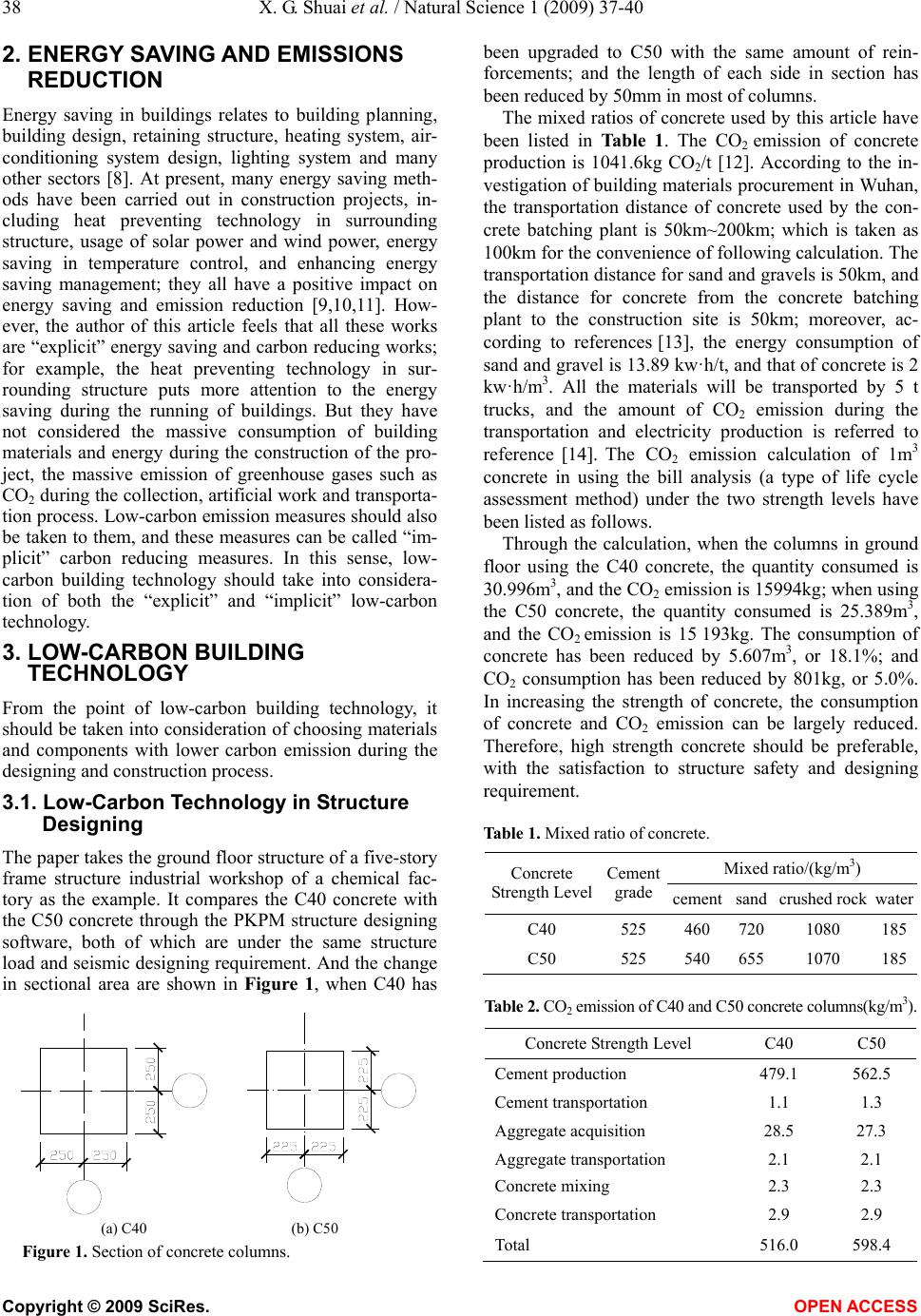 38 X. G. Shuai et al. / Natural Science 1 (2009) 37-40 Copyright © 2009 SciRes. OPEN ACCESS 2. ENERGY SAVING AND EMISSIONS REDUCTION Energy saving in buildings relates to building planning, building design, retaining structure, heating system, air- conditioning system design, lighting system and many other sectors [8]. At present, many energy saving meth- ods have been carried out in construction projects, in- cluding heat preventing technology in surrounding structure, usage of solar power and wind power, energy saving in temperature control, and enhancing energy saving management; they all have a positive impact on energy saving and emission reduction [9,10,11]. How- ever, the author of this article feels that all these works are “explicit” energy saving and carbon reducing works; for example, the heat preventing technology in sur- rounding structure puts more attention to the energy saving during the running of buildings. But they have not considered the massive consumption of building materials and energy during the construction of the pro- ject, the massive emission of greenhouse gases such as CO2 during the collection, artificial work and transporta- tion process. Low-carbon emission measures should also be taken to them, and these measures can be called “im- plicit” carbon reducing measures. In this sense, low- carbon building technology should take into considera- tion of both the “explicit” and “implicit” low-carbon technology. 3. LOW-CARBON BUILDING TECHNOLOGY From the point of low-carbon building technology, it should be taken into consideration of choosing materials and components with lower carbon emission during the designing and construction process. 3.1. Low-Carbon Technology in Structure Designing The paper takes the ground floor structure of a five-story frame structure industrial workshop of a chemical fac- tory as the example. It compares the C40 concrete with the C50 concrete through the PKPM structure designing software, both of which are under the same structure load and seismic designing requirement. And the change in sectional area are shown in Figure 1, when C40 has (a) C40 (b) C50 Figure 1. Section of concrete columns. been upgraded to C50 with the same amount of rein- forcements; and the length of each side in section has been reduced by 50mm in most of columns. The mixed ratios of concrete used by this article have been listed in Table 1. The CO2 emission of concrete production is 1041.6kg CO2/t [12]. According to the in- vestigation of building materials procurement in Wuhan, the transportation distance of concrete used by the con- crete batching plant is 50km~200km; which is taken as 100km for the convenience of following calculation. The transportation distance for sand and gravels is 50km, and the distance for concrete from the concrete batching plant to the construction site is 50km; moreover, ac- cording to references [13], the energy consumption of sand and gravel is 13.89 kw·h/t, and that of concrete is 2 kw·h/m3. All the materials will be transported by 5 t trucks, and the amount of CO2 emission during the transportation and electricity production is referred to reference [14]. The CO2 emission calculation of 1m3 concrete in using the bill analysis (a type of life cycle assessment method) under the two strength levels have been listed as follows. Through the calculation, when the columns in ground floor using the C40 concrete, the quantity consumed is 30.996m3, and the CO2 emission is 15994kg; when using the C50 concrete, the quantity consumed is 25.389m3, and the CO2 emission is 15 193kg. The consumption of concrete has been reduced by 5.607m3, or 18.1%; and CO2 consumption has been reduced by 801kg, or 5.0%. In increasing the strength of concrete, the consumption of concrete and CO2 emission can be largely reduced. Therefore, high strength concrete should be preferable, with the satisfaction to structure safety and designing requirement. Table 1. Mixed ratio of concrete. Mixed ratio/(kg/m3) Concrete Strength Level Cement grade cement sand crushed rockwater C40 525 460 720 1080 185 C50 525 540 655 1070 185 Table 2. CO2 emission of C40 and C50 concrete columns(kg/m3). Concrete Strength Level C40 C50 Cement production 479.1 562.5 Cement transportation 1.1 1.3 Aggregate acquisition 28.5 27.3 Aggregate transportation 2.1 2.1 Concrete mixing 2.3 2.3 Concrete transportation 2.9 2.9 Total 516.0 598.4 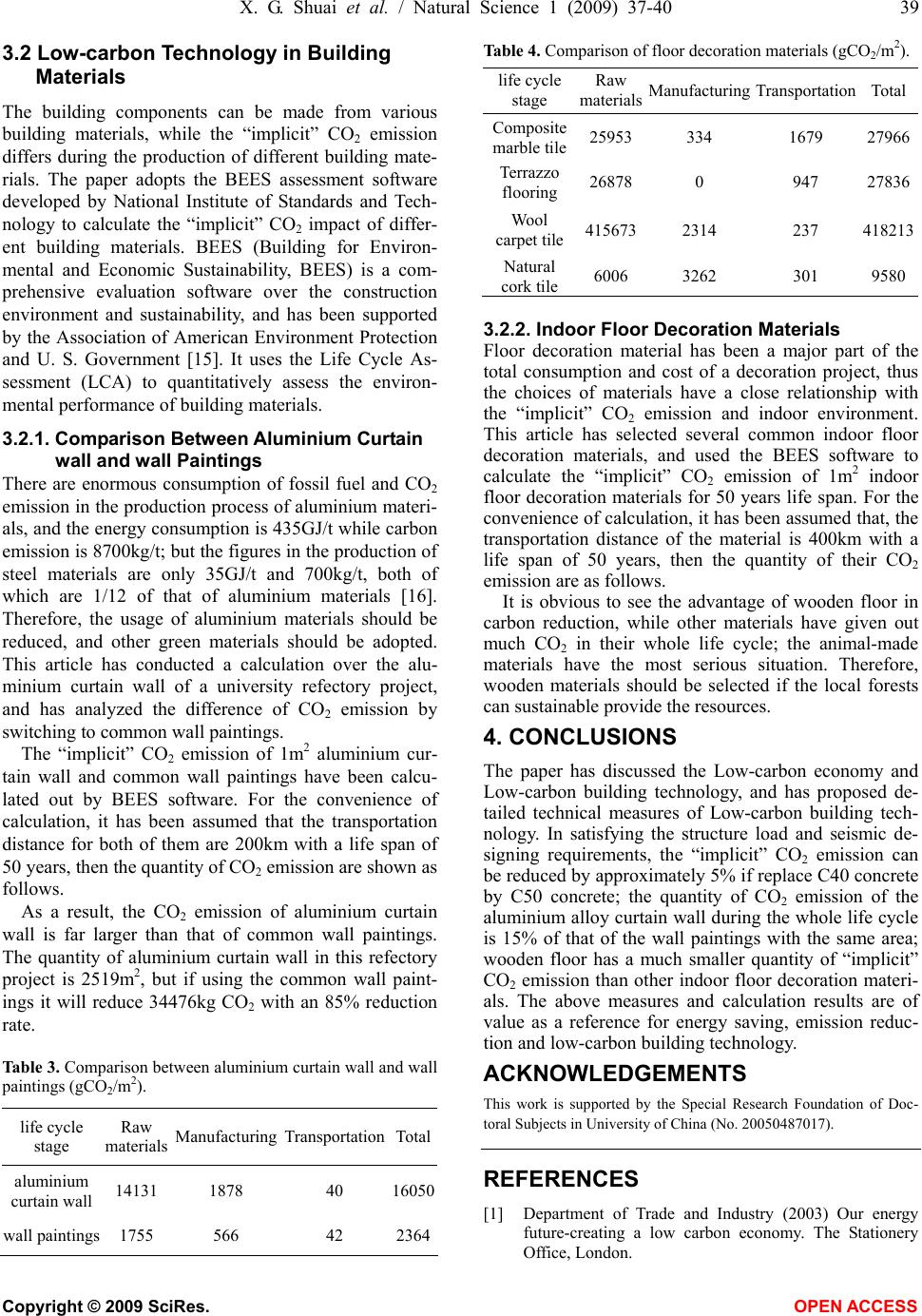 X. G. Shuai et al. / Natural Science 1 (2009) 37-40 39 Copyright © 2009 SciRes. OPEN ACCESS 3.2 Low-carbon Technology in Building Materials The building components can be made from various building materials, while the “implicit” CO2 emission differs during the production of different building mate- rials. The paper adopts the BEES assessment software developed by National Institute of Standards and Tech- nology to calculate the “implicit” CO2 impact of differ- ent building materials. BEES (Building for Environ- mental and Economic Sustainability, BEES) is a com- prehensive evaluation software over the construction environment and sustainability, and has been supported by the Association of American Environment Protection and U. S. Government [15]. It uses the Life Cycle As- sessment (LCA) to quantitatively assess the environ- mental performance of building materials. 3.2.1. Comparison Between Aluminium Curtain wall and wall Paintings There are enormous consumption of fossil fuel and CO2 emission in the production process of aluminium materi- als, and the energy consumption is 435GJ/t while carbon emission is 8700kg/t; but the figures in the production of steel materials are only 35GJ/t and 700kg/t, both of which are 1/12 of that of aluminium materials [16]. Therefore, the usage of aluminium materials should be reduced, and other green materials should be adopted. This article has conducted a calculation over the alu- minium curtain wall of a university refectory project, and has analyzed the difference of CO2 emission by switching to common wall paintings. The “implicit” CO2 emission of 1m2 aluminium cur- tain wall and common wall paintings have been calcu- lated out by BEES software. For the convenience of calculation, it has been assumed that the transportation distance for both of them are 200km with a life span of 50 years, then the quantity of CO2 emission are shown as follows. As a result, the CO2 emission of aluminium curtain wall is far larger than that of common wall paintings. The quantity of aluminium curtain wall in this refectory project is 2519m2, but if using the common wall paint- ings it will reduce 34476kg CO2 with an 85% reduction rate. Table 3. Comparison between aluminium curtain wall and wall paintings (gCO2/m2). life cycle stage Raw materials Manufacturing TransportationTotal aluminium curtain wall 14131 1878 40 16050 wall paintings 1755 566 42 2364 Table 4. Comparison of floor decoration materials (gCO2/m2). life cycle stage Raw materials Manufacturing TransportationTotal Composite marble tile25953 334 1679 27966 Terrazzo flooring 26878 0 947 27836 Wool carpet tile415673 2314 237 418213 Natural cork tile 6006 3262 301 9580 3.2.2. Indoor Floor Decoration Materials Floor decoration material has been a major part of the total consumption and cost of a decoration project, thus the choices of materials have a close relationship with the “implicit” CO2 emission and indoor environment. This article has selected several common indoor floor decoration materials, and used the BEES software to calculate the “implicit” CO2 emission of 1m2 indoor floor decoration materials for 50 years life span. For the convenience of calculation, it has been assumed that, the transportation distance of the material is 400km with a life span of 50 years, then the quantity of their CO2 emission are as follows. It is obvious to see the advantage of wooden floor in carbon reduction, while other materials have given out much CO2 in their whole life cycle; the animal-made materials have the most serious situation. Therefore, wooden materials should be selected if the local forests can sustainable provide the resources. 4. CONCLUSIONS The paper has discussed the Low-carbon economy and Low-carbon building technology, and has proposed de- tailed technical measures of Low-carbon building tech- nology. In satisfying the structure load and seismic de- signing requirements, the “implicit” CO2 emission can be reduced by approximately 5% if replace C40 concrete by C50 concrete; the quantity of CO2 emission of the aluminium alloy curtain wall during the whole life cycle is 15% of that of the wall paintings with the same area; wooden floor has a much smaller quantity of “implicit” CO2 emission than other indoor floor decoration materi- als. The above measures and calculation results are of value as a reference for energy saving, emission reduc- tion and low-carbon building technology. ACKNOWLEDGEMENTS This work is supported by the Special Research Foundation of Doc- toral Subjects in University of China (No. 20050487017). REFERENCES [1] Department of Trade and Industry (2003) Our energy future-creating a low carbon economy. The Stationery Office, London.  40 X. G. Shuai et al. / Natural Science 1 (2009) 37-40 Copyright © 2009 SciRes. OPEN ACCESS [2] Chris, H. (2002) Priorities for a low-carbon economy. New Economy, 9(1), 11-15. [3] State council information office of the People’s Republic of China (2008) White paper: China’s policies and ac- tions on climate change. http://www.chinanews.com.cn/ gn/news/2008/10-29/1429538.shtml. [4] Composing team for Assessment Report on Climate Change of Guangdong (2007) Assessment report on cli- mate change of Guangdong (Selection). Guangdong Me- teorology (in Chinese), 29(3), 1-7. [5] Price, L., Sinton, J., Worrell, E., et al. (2002) Energy use and carbon dioxide emissions from steel production in China. Energy, 27, 429-446. [6] Kim, Y. and Worrell, E. (2002) International comparison of CO2 emission trends in the iron and steel industry. Energy Policy, 30, 827-838. [7] Yang, J. X. and Liu, B. J. (2002) Life cycle inventory of steel products in China. Acta Scientiae Circumstantiae (in Chinese), 22(4), 519-522. [8] Long, W. D., Bai, W. and Fan, R. (2008) Low-carbon economy and the development of building energy-saving. Construction Science and Technology (in Chinese), 24, 15-20. [9] Sunikka, M. (2006) Energy efficiency and low-carbon technologies in urban renewal. Building Research & In- formation, 34(6), 521-533. [10] Arena, A. P. and Rosa, C. D. (2003) Life cycle assess- ment of energy and environmental implications of the implementation of conservation technologies in school building in Mendoza-Argentina. Building and Environ- mental, 38, 359-368. [11] Chris, S., Gregory, A. K. and Peter, R. (2003) Life cycle energy and environmental performance of a new univer- sity building: Modeling challenges and design implica- tions. Energy and Buildings, 35, 1049-1064. [12] Gong, Z. Q. and Zhang, Z. H. (2004) A study on embod- ied environmental profile during the life cycle of cement. China Civil Engineering Journal (in Chinese), 37(5), 86-91. [13] Li, S. T. (2007) Study on appraisal model of reducing construction of construction project (in Chinese). Ph. D. thesis, Huazhong University of science and technology, Wuhan, ON, China. [14] Yang, J. X., Xu, C. and Wang, R. S. (2002) Methodology and application of life cycle assessment (in Chinese). China Meteorological Press, Beijing. [15] Lippiatt, B. C. (2007) Building for environmental and economic sustainability technical manual and user guide. http://www.bfrl.nist.gov/oae/software/bees/bees.html. [16] China Building Materials Academy (2003) Green build- ing materials and making building materials green (in Chinese). Chemical Industry Press, Beijing. |