

Paper Menu >>
Journal Menu >>
 Vol.2, No.2, 78-85 (2011) doi:10.4236/as.2011.2 2012 Copyright © 2011 SciRes. Openly accessible at http://www.scirp.org/journal/AS/ Agricultural Sciences A dual role of selenium in the growth control of seedlings of Stylosanthes humilis Dimas Mendes Ribeiro, Ana Maria Mapeli, Werner Camargos Antunes, Raimundo Santos Barros* Depto de Biologia Vegetal, Universidade Federal de Viçosa, Viçosa, Brazil; *Corresponding Author: [email protected] Received 22 December 2010; revised 12 January 2011; accepted 22 February 2011. ABSTRACT The growth of seedlings of Townsville sytlo (Stylosanthes humilis H.B.K.) is inhibited by aluminium (Al) ions, their elongation being re- covered with sodium selenate at 1.0 µM. Methyl viologen and hydrogen peroxide, reactive oxygen species (ROS)-generating compounds, also inhibited seedling elongation and again growth was relieved by selenate. Selenate, thus, seemed to be operating as a ROS quencher, since N-acetylcysteine (NAC), an antioxidant compound, also stimulated largely the growth of Al-inhibited seedlings. At a higher concentra- tion (0.1 mM), how ever, selenate inhibited seed- ling growth and elongation was recovered by NAC. Ethylene production by selenate plus NAC-treated seedlings was very higher and thus the gaseous hormone was not responsible for the seedling growth inhibition caused by sele- nate. Hence, it seems that at high levels sele- nate operates as a ROS-generating compound whose effects were counteracted by NAC. It can be deduced that, at low concentration, selenate behaves as a ROS quencher an d at high level as a ROS-promoting species. Keyw ords: Aluminium; Ethylene; Growth Inhibition; Reactive Oxygen Species; Selenate; Townsville Stylo 1. INTRODUCTION Plant growth is greatly affected by several environ- mental stresses such as drought, extreme temperatures and heavy metals. On acidic soils Al toxicity has been recognized as a major limiting factor of plant productiv- ity [1]. Plants can respond and adapt to Al stress by al- tering their cellular metabolism and invoking various defense mechanisms [2]. Usually Al toxicity induces accumulation of reactive oxygen species (ROS), that have been established as key signalling molecules con- trolling a diverse range of physiological functions [3,4]. However, at high concentrations and in certain situations, ROS may be toxic [5]. Since the effects of reactive oxygen molecules at cel- lular level is mediated by their production and removal via antioxidant activity [6], the use of free radical quenchers may help to identify the role of ROS in plant systems. Selenium (Se) is interesting in this matter be- cause in response to oxidative stresses, Se compounds at low concentrations, perform a protective function by scavenging free radicals [7,8]. On the other hand, excess Se can cause damage to plants, likely by triggering ROS generation [9,10]. This antagonistic property makes Se unique in studies dealing with systems requiring ROS to elicit a physiological response. Toxicity caused by Se compounds is an ill-understood phenomenon [11]. There are indications that at high lev- els Se can indiscriminately replace S in certain amino- acids that are incorporated into proteins [11,12]. The formation of Se-aminoacids, in turn, is supposed to en- hance ethylene production [13], which can cause dam- ages to plant growth. Some biochemical and physiologi- cal studies were conducted with Se-compounds in plant systems [8,14,15], but no physiological co-action be- tween Se and Al has been stablished. In this work the effects of Se at low concentration added to the growth medium as a protector against Al toxicity were investi- gated. Furthermore, the mode of action of Se, at high concentration, on seedling growth of Townsville stylo was also examined. The experiments were performed with seedlings of Townsville stylo, an annual forage legume cultivated in tropical pastures [16]. The species has been considered as a potential contributor for pasture improvement in tropical zones due to its high-quality forage for livestock, high seed production and wide adaptability to low fertility soils [17].  D. M. Ribeiro et al. / Agricultural Sciences 2 (2011) 78-85 Copyright © 2011 SciRes. Openly accessible at http://www.scirp. org/journal/AS/ 79 2. MATERIALS AND METHODS 2.1. Plant Material and General Conditions Seeds of Townsville stylo (Stylosanthes humilis H.B.K.) were obtained from plants cultivated in 3.5 L plastic pots in a greenhouse in Viçosa (20o45’ S, 42o15’ W), Minas Gerais, Brazil and kept in the laboratory under dry con- ditions. Non-dormant seeds were freed from their husks, scarified with fine sandpaper (no 150), sterilized with 0.5 % NaOCl for 10 min, and thoroughly washed with dis- tilled water. Seeds were taken to 15 cm diameter Petri dishes with two layers of Whatman nº 1 filter paper and 16 ml of distilled water (pH 7.0). This assembly was placed in the dark in a day/night growth chamber (Forma Scientific Inc, Ohio, USA), at 30oC, for 18 h. Afterwards, germinated seeds with a protruded radicle about 3 mm long were transferred to 9 cm diameter Petri dishes with two layers of filter paper, and incubated with 10 ml test solutions. Solutions were prepared by dissolving chemi- cals in 0.5 mM CaCl2 solution, pH 4.0, a condition that prevents proton toxicity and leads to separation of the effects of proton toxicity from the effects of Al toxicity [18]. After 24 h exposure period, root and hypocotyl lengths of the seedlings were determined. 2.2. Se Effects on Growth Sodium selenate (Na2SeO4) was chosen as to repre- sent the several soluble Se compounds whose effects on dormancy breakage of Townsville stylo seeds are all identical [14]. The effects of Na2SeO4, at low concentra- tion (1 µM), on Al-treated seedling were examined by providing the compound to seedlings in the solutions of AlCl3 (1.0, 1.5 and 2 mM). In order to assess for a causal association between Al-induced ROS production and growth inhibition, seedlings were also exposed to com- bined solutions of AlCl3 plus N-acetylcysteine (NAC, 1 mM), a free-radical quenching compound. Seedlings were also exposed to solution of methyl viologen (MV, 10–7 - 10–4 M) and H2O2 (10–7 - 10–4 M), ROS-inducing sub- stances, alone or to each one combined with Na2SeO4. To investigate the effects of the exposure order seeds were treated witch a combined solution of AlCl3 plus Na2SeO4, AlCl3 or Na2SeO4 for the first 6 h. AlCl3 solu- tions was then replaced by Na2SeO4 and AlCl3; Na2SeO4 solutions by AlCl3; seeds were kept in the new media for 18 h. In order to search for the effects of Na2SeO4 at high concentration (0.1 mM) on seedling growth and ethylene production, Se-treated seedlings were also provided with 2-aminoethoxyvinylglycine (AVG, 10 µM) solution, an inhibitor of ethylene biosynthesis. A putative relation- ship between high Na2SeO4 concentration-induced ROS generation and inhibition of seedling growth was also searched for with the employment of NAC (1 mM). 2.3. Root Cell Viability Cell viability was assessed by staining root tip frag- ments with fluorescein diacetate (FDA, 10 μM) and propidium iodide (PI, 2.0 μM), according to [19]. After treatment with test solutions, seedlings were washed with distilled water (pH 7.0) and roots tips were stained for 5 min at room temperature with FDA and PI. The viability of cells was observed under a fluorescent mi- croscope (BH2, Olympus, Japan). 2.4. Ethylene Measurement For ethylene quantification Erlenmeyer flasks (50 ml) containing 10 seedlings imbibed in 3 ml test-solutions were stoppered with rubber serum caps and kept in the growth chamber, under the conditions previously des- cribed. Air samples (1 ml) were taken from the flask headspace and injected in a gas chromatograph (Hewlett Packard 5890, Series II), equipped with a stainless-steel column (1.0 m × 6.0 mm) packed with Porapak-N 80- 100 mesh. Ethylene quantitation was conducted under the following conditions: nitrogen carrier gas and hydr- ogen fluxes were 30 ml·min–1; air flux was 320 ml·min–1. Column, injector and detector temperatures were 60, 110 and 150˚C, respectively. Ethylene peaks were registered by a peak simple software (Peak Simple, Version 3.92) coupled to the chromatograph, and quantified by com- parison with authentic ethylene standards. 2.5. Statistical Analysis The experiments followed a completely randomized design, with 10 replications per treatment. Experimental units consisted of a Petri dish or an Erlenmeyer flask with 10 seedlings. The Tukey test at 5% was applied to detect differences amongst means. 3. RESULTS Aluminium inhibited root and hypocotyl growth of Townsville stylo seedlings in a dose-dependent manner (Figure 1). Inhibition of growth of Al-treated seedling was alleviated by Na2SeO4, at the low concentration em- ployed. Growth recovery by was about 95%, 81% and 66% in roots inhibited with 1.0, 1.5 and 2.0 mM Al respectively. On the other hand, completely counteracted the growth inhibition of hypocotyl caused by Al. Selenate seemed to be operating through the quenching of ROS since NAC, an antioxidant compound, similarly recovered partially (roots) or completely (hy- pocotyls) the growth of Al-inhibited seedlings (Figure 1). Whether or not Al and were supplied to- 2 4 SeO 2 4 O 2 4 SeO Se  D. M. Ribeiro et al. / Agricultural Sciences 2 (2011) 78-85 Copyright © 2011 SciRes. http://www.scirp.org/journal/AS/ 80 Root length (cm) Al Al+Se Al+NAC 0 1.0 1.5 2.0 2.5 3.0 3.5 4.0 AlCl3 (mM) Hypocotyl length (cm) 00.5 1.0 1.5 2.0 0 1.6 1.8 2.0 2.2 2.4 2.6 2.8 (d) (c) (b) (a) Figure 1. Se at low concentration alleviates AlCl3-in- duced inhibition of seedling growth. AlCl3 was provided to uniform seedlings in 0.5 mM CaCl2 soluton pH 4,0 or combined with sodium selenate (1 µM) and N-acetyl cisteine (NAC 1 mM). Means of 100 seedlings ± stan- dard errors. Figure 2. Protective effect of Se against Al-induced damages in root tips of Townsville stylo seedlings. (a) Control; (b) 2 mM AlCl3; (c) 1 µM sodium selenate; and (d) AlCl3 plus so- dium selenate. Healthy cells exhibit green fluorescence due to fluorescein diacetate. Propidium iodide produces a red fluo- rescence of nuclei in damaged cells. Photos are representative of 5 replicates per treatment. gether or separately, one of them anteceding or follow- ing the supply of the other, their effects on seedling growth were very similar (Table 1). Vital staining also revealed differences in the response of seedlings treated with Al plus 4 at low concentration (Figure 2). Aluminium caused considerable damage to root cells of Townsville stylo seedling. Selenate, on the other hand, caused substantial reduction in the Al damages to roots. 2 SeO res 1 and 3). The above results were completely different when 4 2 SeO was used in a high concentration (0.1 mM), two orders of magnitude larger than the one employed to counteract the Al effects. At 0.1 mM, 4 2 SeO inhibited root and hypocotyl elongation by 48 and 21%, respec- tively (Figure 4). As occurred with aluminium roots were shown to be much more sensitive to high Se level than hypocotyls. Selenate caused an increase in ethylene emanation by seedlings by about 89% (as compared to the control). The inhibitor of ethylene biosynthesis AVG substantially decreased ethylene production by seedlings treated with 2 SeO That 4 seemed to be acting as an antioxidant leading to growth alleviation or restoration of seedling inhibited by Al was further demonstrated by treating seedling with 4 and methyl viologen (MV) or H2O2. Similarly to the Al effects, MV and H2O2 inhibited root and hypocotyl elongation in a dose-dependent man- ner (Figure 3). Furthermore, 4 restores (H2O2) or alleviates (MV) the growth of inhibited roots; in hypo- cotyls 4 completely overcame the inhibitory ef- fects of both compounds. It is also observed that roots were much more sensitive to Al than hypocotyls (Figu- 2 SeO 2 SeO 2 SeO 2 SeO , but without any effect on seedling 4 growth (as compared to Se-treated seedlings alone). Openly accessible at  D. M. Ribeiro et al. / Agricultural Sciences 2 (2011) 78-85 Copyright © 2011 SciRes. Openly accessible at http://www.scirp.org/journal/AS/ 81 Root length (cm) - Se + Se 0 1.5 2.0 2.5 3.0 3.5 4.0 4.5 MV (M) Hypocotyl length (cm) 010 -7 10 -6 10 -5 10 -4 0 1.6 1.8 2.0 2.2 2.4 2.6 2.8 H 2 O 2 (M) 010 -7 10 -6 10 -5 10 -4 Figure 3. Effects of sodium selenate supplied with methyl viologen (MV, left) or H2O2 (right) solutions pH 4.0 on seedling growth. Means of 100 seedlings ± standard errors. Hence ethylene seemed not to be required for growth inhibition of the -treated seedlings (Figure 4). Selenate-induced inhibition of seedling growth was com- pletely restored by NAC, but ethylene production by -treated seedling was not decreased by the anti- oxidant compound, which actually showed to be very high (treatment plus NAC, Figure 4). 2 4 SeO 2 4 SeO 2 4 SeO 4. DISCUSSION Growth inhibition is a well-known response of plants to toxic concentrations of Al ions [20]. The data de- scribed herein demonstrate that , at low concen- tration (1.0 µM), can alleviate partial or completely the Al-induced inhibition of root and hypocotyl elongation, respectively (Figure 1). Moreover, NAC, an antioxidant compound [21], was also capable of overcoming the inhibited state caused by Al. These results suggest that the , at low concentration, may act as an antioxi- dant (possibly as a ROS quencher) to counteract inhibit- 2 4 SeO 2 4 SeO tion of root and hypocotyl elongation of Townsville stylo seedlings. In fact, Se can overcome oxidative damages displaying a protective effect against stressing conditions [8, 9]. Selenate addition restored hypocotyl growth to the level of the control under any concentration of Al used. However, root growth inhibition by Al (at 1.5 and 2.0 mM) was not recovered to the control level, indicating that roots were more sensitive to a toxic Al exposure than hypocotyls (see also Figure 3). In order to get further insights into the relationships between Al and 2 4 SeO effects on the control of seedling growth, seedlings were treated with Al or Al plus 2 4 SeO (dissolved in 0.5 mM CaCl2, pH 4.0) for 24 h and after- wards transferred to the medium without Al. Seedling survival 10 days after transference was about 94%, 90%, 30%, and 80% if they were previously exposed to con- trol (0.5 mM CaCl2, pH 4.0), 1 µM , 2 mM AlCl3 and AlCl3 plus 2 4 Se 2 4 SeO O , respectively (not shown). In keeping with those responses, Al toxicity effect was – Se 0 10 – 7 10 – 6 10 – 5 10 – 4 0 10 – 7 10 – 6 10 – 5 10 – 4 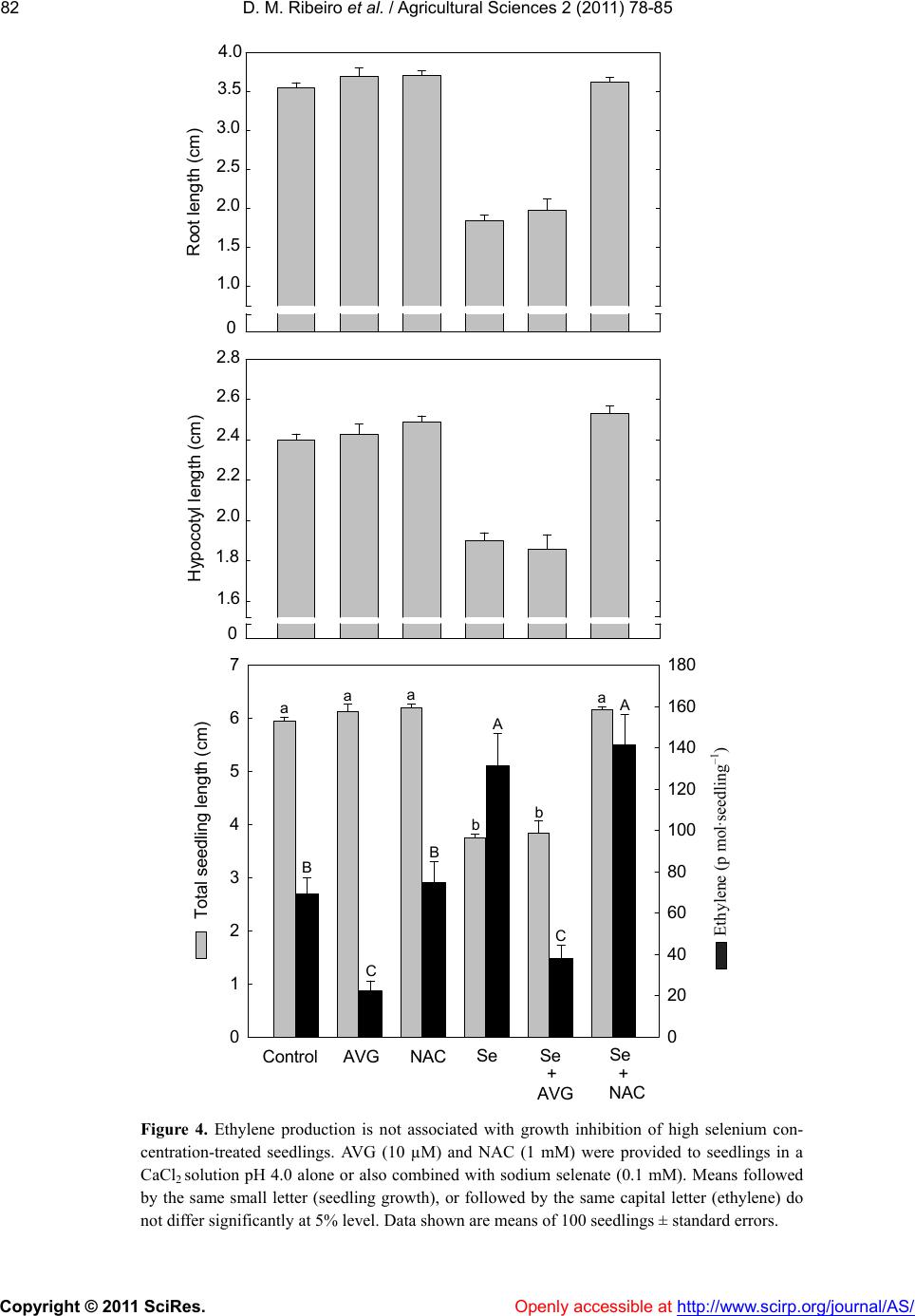 D. M. Ribeiro et al. / Agricultural Sciences 2 (2011) 78-85 Copyright © 2011 SciRes. Openly accessible at http://www.scirp.org/journal/AS/ 82 Root length (cm) 0 1.0 1.5 2.0 2.5 3.0 3.5 4.0 Hypocotyl length (c m) 0 1.6 1.8 2.0 2.2 2.4 2.6 2.8 Total seedling length (cm) 0 1 2 3 4 5 6 7 Ethylene (pmol seedling -1 ) 0 20 40 60 80 100 120 140 160 180 Control AVG NAC Se Se + AVG Se + NAC aaa bb a B C B A C A Figure 4. Ethylene production is not associated with growth inhibition of high selenium con- centration-treated seedlings. AVG (10 µM) and NAC (1 mM) were provided to seedlings in a CaCl2 solution pH 4.0 alone or also combined with sodium selenate (0.1 mM). Means followed by the same small letter (seedling growth), or followed by the same capital letter (ethylene) do not differ significantly at 5% level. Data shown are means of 100 seedlings ± standard errors. Ethylene (p mol·seedling–1) 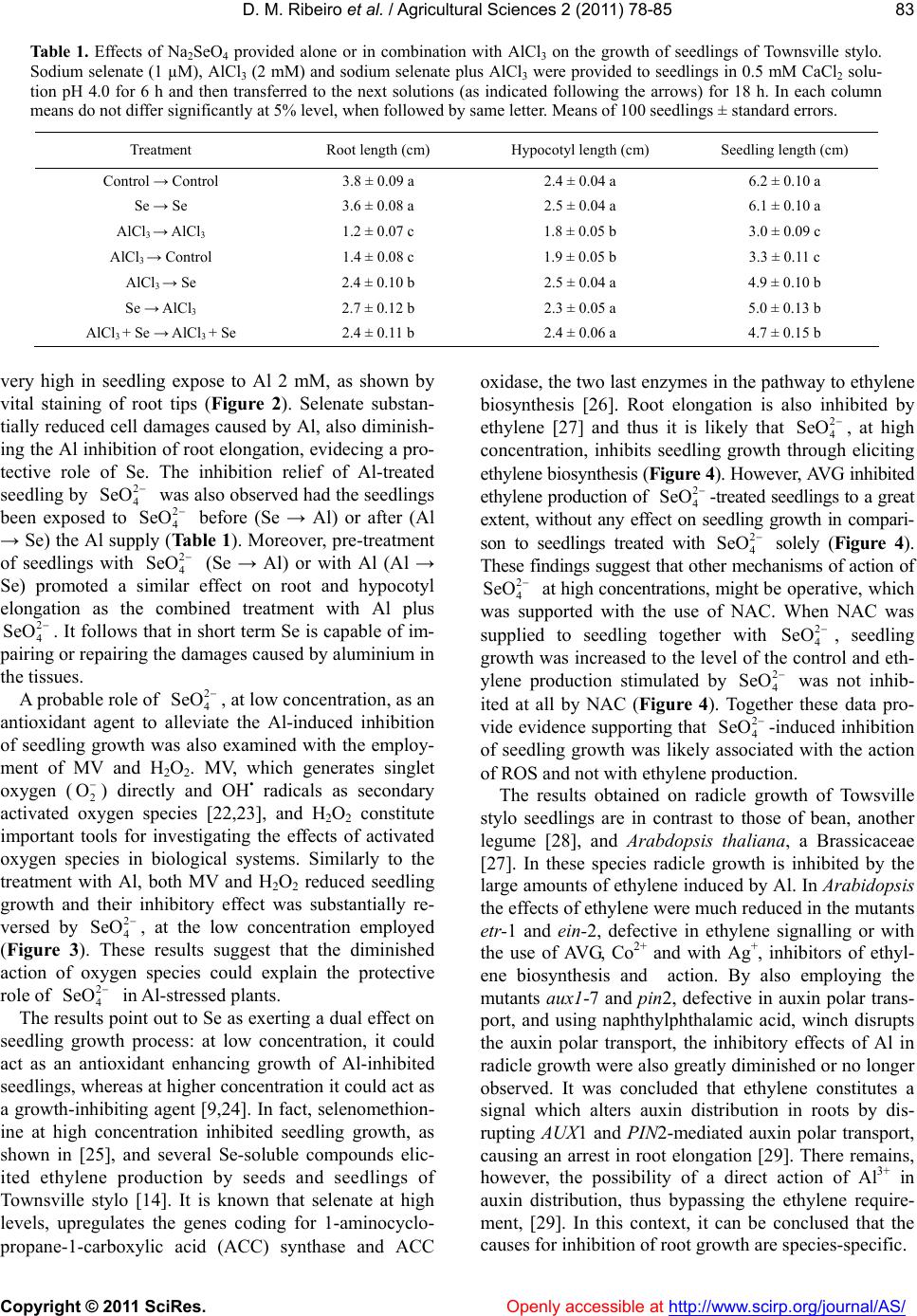 D. M. Ribeiro et al. / Agricultural Sciences 2 (2011) 78-85 Copyright © 2011 SciRes. http://www.scirp. org/journal/AS/ 83 Ta bl e 1 . Effects of Na2SeO4 provided alone or in combination with AlCl3 on the growth of seedlings of Townsville stylo. Sodium selenate (1 µM), AlCl3 (2 mM) and sodium selenate plus AlCl3 were provided to seedlings in 0.5 mM CaCl2 solu- tion pH 4.0 for 6 h and then transferred to the next solutions (as indicated following the arrows) for 18 h. In each column means do not differ significantly at 5% level, when followed by same letter. Means of 100 seedlings ± standard errors. Treatment Root length (cm) Hypocotyl length (cm) Seedling length (cm) Control → Control 3.8 ± 0.09 a 2.4 ± 0.04 a 6.2 ± 0.10 a Se → Se 3.6 ± 0.08 a 2.5 ± 0.04 a 6.1 ± 0.10 a AlCl3 → AlCl3 1.2 ± 0.07 c 1.8 ± 0.05 b 3.0 ± 0.09 c AlCl3 → Control 1.4 ± 0.08 c 1.9 ± 0.05 b 3.3 ± 0.11 c AlCl3 → Se 2.4 ± 0.10 b 2.5 ± 0.04 a 4.9 ± 0.10 b Se → AlCl3 2.7 ± 0.12 b 2.3 ± 0.05 a 5.0 ± 0.13 b AlCl3 + Se → AlCl3 + Se 2.4 ± 0.11 b 2.4 ± 0.06 a 4.7 ± 0.15 b very high in seedling expose to Al 2 mM, as shown by vital staining of root tips (Figure 2). Selenate substan- tially reduced cell damages caused by Al, also diminish- ing the Al inhibition of root elongation, evidecing a pro- tective role of Se. The inhibition relief of Al-treated seedling by was also observed had the seedlings been exposed to before (Se → Al) or after (Al → Se) the Al supply (Table 1). Moreover, pre-treatment of seedlings with (Se → Al) or with Al (Al → Se) promoted a similar effect on root and hypocotyl elongation as the combined treatment with Al plus . It follows that in short term Se is capable of im- pairing or repairing the damages caused by aluminium in the tissues. 2 4 SeO Se 2 4 O 2 4 SeO 2 4 SeO A probable role of , at low concentration, as an antioxidant agent to alleviate the Al-induced inhibition of seedling growth was also examined with the employ- ment of MV and H2O2. MV, which generates singlet oxygen (2) directly and OH• radicals as secondary activated oxygen species [22,23], and H2O2 constitute important tools for investigating the effects of activated oxygen species in biological systems. Similarly to the treatment with Al, both MV and H2O2 reduced seedling growth and their inhibitory effect was substantially re- versed by , at the low concentration employed (Figure 3). These results suggest that the diminished action of oxygen species could explain the protective role of in Al-stressed plants. 2 4 SeO O Se 2 4 SeO 2 4 O Openly accessible at The results point out to Se as exerting a dual effect on seedling growth process: at low concentration, it could act as an antioxidant enhancing growth of Al-inhibited seedlings, whereas at higher concentration it could act as a growth-inhibiting agent [9,24]. In fact, selenomethion- ine at high concentration inhibited seedling growth, as shown in [25], and several Se-soluble compounds elic- ited ethylene production by seeds and seedlings of Townsville stylo [14]. It is known that selenate at high levels, upregulates the genes coding for 1-aminocyclo- propane-1-carboxylic acid (ACC) synthase and ACC oxidase, the two last enzymes in the pathway to ethylene biosynthesis [26]. Root elongation is also inhibited by ethylene [27] and thus it is likely that 2 4 SeO , at high concentration, inhibits seedling growth through eliciting ethylene biosynthesis (Figure 4). However, AVG inhibited ethylene production of -treated seedlings to a great extent, without any effect on seedling growth in compari- son to seedlings treated with solely (Figure 4). These findings suggest that other mechanisms of action of 2 4 SeO 2 4 SeO 2 4 SeO at high concentrations, might be operative, which was supported with the use of NAC. When NAC was supplied to seedling together with , seedling growth was increased to the level of the control and eth- ylene production stimulated by was not inhib- ited at all by NAC (Figure 4). Together these data pro- vide evidence supporting that -induced inhibition of seedling growth was likely associated with the action of ROS and not with ethylene production. 2 4 SeO 2 4 SeO 2 4 SeO The results obtained on radicle growth of Towsville stylo seedlings are in contrast to those of bean, another legume [28], and Arabdopsis thaliana, a Brassicaceae [27]. In these species radicle growth is inhibited by the large amounts of ethylene induced by Al. In Arabidopsis the effects of ethylene were much reduced in the mutants etr-1 and ein-2, defective in ethylene signalling or with the use of AVG, Co2+ and with Ag+, inhibitors of ethyl- ene biosynthesis and action. By also employing the mutants aux1-7 and pin2, defective in auxin polar trans- port, and using naphthylphthalamic acid, winch disrupts the auxin polar transport, the inhibitory effects of Al in radicle growth were also greatly diminished or no longer observed. It was concluded that ethylene constitutes a signal which alters auxin distribution in roots by dis- rupting AU X1 and PI N 2-mediated auxin polar transport, causing an arrest in root elongation [29]. There remains, however, the possibility of a direct action of Al3+ in auxin distribution, thus bypassing the ethylene require- ment, [29]. In this context, it can be conclused that the causes for inhibition of root growth are species-specific. 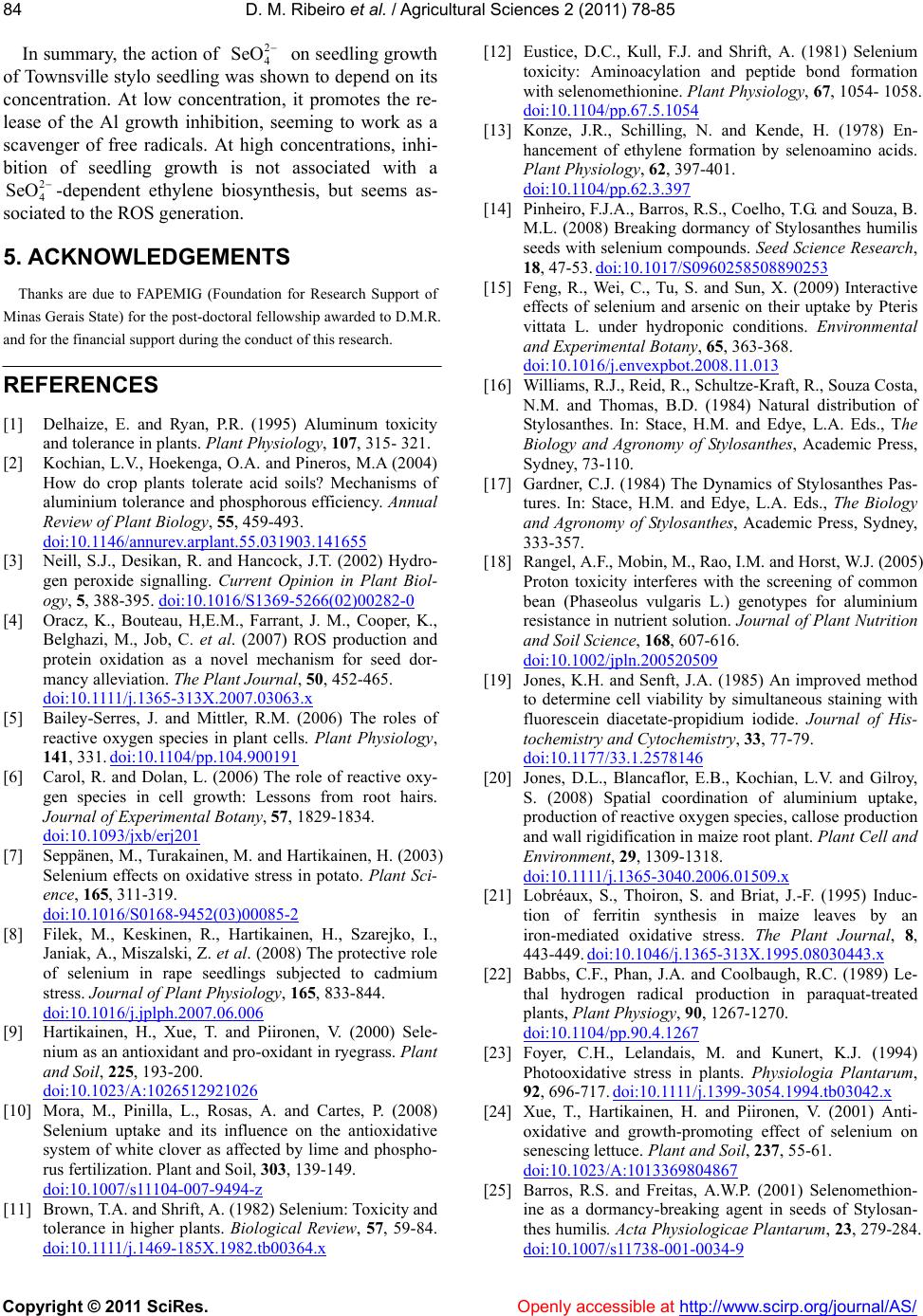 D. M. Ribeiro et al. / Agricultural Sciences 2 (2011) 78-85 Copyright © 2011 SciRes. Openly accessible at http://www.scirp.org/journal/AS/ 84 In summary, the action of on seedling growth of Townsville stylo seedling was shown to depend on its concentration. At low concentration, it promotes the re- lease of the Al growth inhibition, seeming to work as a scavenger of free radicals. At high concentrations, inhi- bition of seedling growth is not associated with a -dependent ethylene biosynthesis, but seems as- sociated to the ROS generation. 2 4 SeO 2 4 SeO 5. ACKNOWLEDGEMENTS Thanks are due to FAPEMIG (Foundation for Research Support of Minas Gerais State) for the post-doctoral fellowship awarded to D.M.R. and for the financial support during the conduct of this research. REFERENCES [1] Delhaize, E. and Ryan, P.R. (1995) Aluminum toxicity and tolerance in plants. Plant Ph ys iol ogy, 107, 315- 321. [2] Kochian, L.V., Hoekenga, O.A. and Pineros, M.A (2004) How do crop plants tolerate acid soils? Mechanisms of aluminium tolerance and phosphorous efficiency. Annual Review of Plant Biol og y, 55, 459-493. doi:10.1146/annurev.arplant.55.031903.141655 [3] Neill, S.J., Desikan, R. and Hancock, J.T. (2002) Hydro- gen peroxide signalling. Current Opinion in Plant Biol- ogy, 5, 388-395. doi:10.1016/S1369-5266(02)00282-0 [4] Oracz, K., Bouteau, H,E.M., Farrant, J. M., Cooper, K., Belghazi, M., Job, C. et al. (2007) ROS production and protein oxidation as a novel mechanism for seed dor- mancy alleviation. The Plant Journal, 50, 452-465. d oi :1 0.1111 /j .13 65-313X.2007.03063.x [5] Bailey-Serres, J. and Mittler, R.M. (2006) The roles of reactive oxygen species in plant cells. Plant Physiology, 141, 331. doi:10.1104/pp.104.900191 [6] Carol, R. and Dolan, L. (2006) The role of reactive oxy- gen species in cell growth: Lessons from root hairs. Journal of Experimental Botany, 57, 1829-1834. doi:10.1093/jxb/erj201 [7] Seppänen, M., Turakainen, M. and Hartikainen, H. (2003) Selenium effects on oxidative stress in potato. Plant Sci- ence, 165, 311-319. doi:10.1016/S0168-9452(03)00085-2 [8] Filek, M., Keskinen, R., Hartikainen, H., Szarejko, I., Janiak, A., Miszalski, Z. et al. (2008) The protective role of selenium in rape seedlings subjected to cadmium stress. Journal of Plant Physiology, 165, 833-844. doi:10.1016/j.jplph.2007.06.006 [9] Hartikainen, H., Xue, T. and Piironen, V. (2000) Sele- nium as an antioxidant and pro-oxidant in ryegrass. Plant and Soil, 225, 193-200. doi:10.1023/A:1026512921026 [10] Mora, M., Pinilla, L., Rosas, A. and Cartes, P. (2008) Selenium uptake and its influence on the antioxidative system of white clover as affected by lime and phospho- rus fertilization. Plant and Soil, 303, 139-149. doi:10.1007/s11104-007-9494-z [11] Brown, T.A. and Shrift, A. (1982) Selenium: Toxicity and tolerance in higher plants. Biological Review, 57, 59-84. d oi :1 0.1111 /j .14 69-185X.1982.tb00364.x [12] Eustice, D.C., Kull, F.J. and Shrift, A. (1981) Selenium toxicity: Aminoacylation and peptide bond formation with selenomethionine. Plant Physiology, 67, 1054- 1058. doi:10.1104/pp.67.5.1054 [13] Konze, J.R., Schilling, N. and Kende, H. (1978) En- hancement of ethylene formation by selenoamino acids. Plant Physiology, 62, 397-401. doi:10.1104/pp.62.3.397 [14] Pinheiro, F.J.A., Barros, R.S., Coelho, T.G. and Souza, B. M.L. (2008) Breaking dormancy of Stylosanthes humilis seeds with selenium compounds. Seed Science Research, 18, 47-53. doi:10.1017/S0960258508890253 [15] Feng, R., Wei, C., Tu, S. and Sun, X. (2009) Interactive effects of selenium and arsenic on their uptake by Pteris vittata L. under hydroponic conditions. Environmental and Experimental Botany, 65, 363-368. doi:10.1016/j.envexpbot.2008.11.013 [16] Williams, R.J., Reid, R., Schultze-Kraft, R., Souza Costa, N.M. and Thomas, B.D. (1984) Natural distribution of Stylosanthes. In: Stace, H.M. and Edye, L.A. Eds., The Biology and Agronomy of Stylosanthes, Academic Press, Sydney, 73-110. [17] Gardner, C.J. (1984) The Dynamics of Stylosanthes Pas- tures. In: Stace, H.M. and Edye, L.A. Eds., The Biology and Agronomy of Stylosanthes, Academic Press, Sydney, 333-357. [18] Rangel, A.F., Mobin, M., Rao, I.M. and Horst, W.J. (2005) Proton toxicity interferes with the screening of common bean (Phaseolus vulgaris L.) genotypes for aluminium resistance in nutrient solution. Journal of Plant Nutrition and Soil Science, 168, 607-616. doi:10.1002/jpln.200520509 [19] Jones, K.H. and Senft, J.A. (1985) An improved method to determine cell viability by simultaneous staining with fluorescein diacetate-propidium iodide. Journal of His- tochemistry and Cytochemistry, 33, 77-79. doi:10.1177/33.1.2578146 [20] Jones, D.L., Blancaflor, E.B., Kochian, L.V. and Gilroy, S. (2008) Spatial coordination of aluminium uptake, production of reactive oxygen species, callose production and wall rigidification in maize root plant. Plant Cell and Environment, 29, 1309-1318. d oi :1 0.1111 /j .13 65-3040.2006.01509.x [21] Lobréaux, S., Thoiron, S. and Briat, J.-F. (1995) Induc- tion of ferritin synthesis in maize leaves by an iron-mediated oxidative stress. The Plant Journal, 8, 443-449. doi:10.1046/j.1365-313X.1995.08030443.x [22] Babbs, C.F., Phan, J.A. and Coolbaugh, R.C. (1989) Le- thal hydrogen radical production in paraquat-treated plants, Plant Physiogy, 90, 1267-1270. doi:10.1104/pp.90.4.1267 [23] Foyer, C.H., Lelandais, M. and Kunert, K.J. (1994) Photooxidative stress in plants. Physiologia Plantarum, 92, 696-717. doi: 10.1111 /j .1399-3054.1994.tb03042.x [24] Xue, T., Hartikainen, H. and Piironen, V. (2001) Anti- oxidative and growth-promoting effect of selenium on senescing lettuce. Plant and Soil, 237, 55-61. doi:10.1023/A:1013369804867 [25] Barros, R.S. and Freitas, A.W.P. (2001) Selenomethion- ine as a dormancy-breaking agent in seeds of Stylosan- thes humilis. Acta Physiologicae Plantarum, 23, 279-284. doi:10.1007/s11738-001-0034-9  D. M. Ribeiro et al. / Agricultural Sciences 2 (2011) 78-85 Copyright © 2011 SciRes. http://www.scirp. org/journal/AS/Openly accessible at 85 [26] Hoewyk, D.V., Takahashi, H., Inoue, E., Hess, A., Tam- aski, M. and Pilon-Smits, E.A.H. (2008) Transcriptome analyses give insights into selenium-stress responses and selenium tolerance mechanisms in Arabidopsis. Physi- ologia Plantaru m, 132, 236-256. doi:10.1093/pcp/pcm077 [27] Sun, P., Tian, Q.-Y., Zhao, M.G., Dai, X.Y., Huang, J.H., Li, L.H. et al., (2007) Aluminum-induced ethylene pro- duction is associated with inhibition of root elongation in lotus japonicus L. Plant and Cell Physiology, 48, 1229-1235. [28] Massot, N., Nicander, B., Barcelo, J., Poschenrieder, C.H. and Tillberg, E. (2002) A rapid increase in cytokinin lev- els of root growth in bean seedlings (Phaseolus vulgaris L). Plant Growth Regulation, 37, 105-112. doi:10.1023/A:1020511007138 [29] Sun, P., Tian, Q.-Y., Chan, J. and Zhang, W.-H. (2010) Aluminium-induced inhibition of root elongation in Arabidopsis is mediated by ethylene and auxin. Journal of Experimental Botany, 61, 347-356. |