

Paper Menu >>
Journal Menu >>
 Vol.2, No.2, 49-55 (2011) Agricultural Sciences doi:10.4236/as.2011.22008 Copyright © 2011 SciRes. Openly accessible at http: //www.scirp.org/journal/AS/ Nematode infestation and N-effect of legumes on soil and crop yields in legume-sorghum rotations Vincent Bado1*, Abdoulsalam Sawadogo2, Bouma Thio2, André B ationo3, Karim Traoré2, Michel Cescas4 1Africa Rice Center (AfricaRice), Sahel Regional Station , Saint Louis , Senegal; *Corre sponding Author: [email protected] 2Institut de l'Environnement et de Recherches Agricoles, Bobo-Dioulasso, Burkina Faso; 3The Tropical Soil Biology and Fertility Institute of International Center for T ropical Agriculture, Nairobi, Kenya; 4Département des Sols et Génie Agroalimentaire (FSSA), Université Laval Ste Foy Québec, Qué bec, Canada. Received 28 June 2010; revised 24 March 2011; accepted 31 March 2011. ABSTRACT The effects of cowpea (Vignaunguiculata) and groundnut (Arachis hypogea) on succeeding sorghum yields, soil mineral N and nematode in- festation were studied during five cropping sea- sons (2000 to 2004) in a weakly acid Ultisol of the agronomy research station of Farakô-Balo- cated in the Guinean zone of Burkina Faso, West Africa. A factorial 5 × 5 design of five crop rota- tions with five fertilizer treatments in a split-plot arrangement with four replications was used. Sorghum yields were affected by the two factors (rotation with legumes a nd fe rti l izer a ppl ications) during the four years. But interactions were not observed between the two factors. Monocrop- ping of sorghum produced the lowest yields and legume-sorghum rotations increased sorghum yie l d s by 50% to 300%. Groundnut-sorghum and cowpea-sorghum rotations increased soil mi- neral N by 36% and 52%, respectively. Crop ro- tation influenced nematode infestation but the effects on soil and sorghum root infestation dif- fered according to the rotation. The cowpeasor- ghum rotation increased soil and sorghum root infestationby nematodes while groundnut-sor- ghum decreesed the nematode population. The soil of the cowpea-sorghum rotation contained 1.5 to 2 times more nematodes than the soil of the monocropping of sorghum. In contrast, the soil of the groundnut-sorghum rotation con- t ai ned from 17 to 19 tim es fewer nematodes than that of themonocropping of sorghum. However, nematode infestation did not affect any of the succeeding sorghum yields. It was concluded that the parasitic effect of nematodes was lim- ited by the predominance of positive N-effects on the development of succeeding sorghum. Keywords: Legume; Nematode; Nitrogen; Crop Rotation; Sorghum 1. INTRODUCTION In sub-Saharan Africa, crop yields are limited by many factors such as nutrient deficiencies. Soils have inherently low levels of nutrients because of low soil organic matter levels and limited use of nutrient inputs by farmers. Nitrogen (N) and phosphorous (P) deficien- cies are the main soil fertility constraints in most of the soils of West Africa [1]. Chemical fertilizers are im- ported from developed countries and remain expensive for poor small holders who therefore never use them or only occasionally apply small quantities. While 73 kg·ha-1 of chemical fertilizers are used by farmers in Asia, only 8 kg·ha-1 are used in Africa [2]. N2-fixing legume crops can help improving soil fertility as sources of nitrogen. Some legume crops such as groundnut (Arachis hypogea L.) and cowpe a (Vignaunguiculata (L.) Walp) are traditionally cultivated by farmers in rotation or intercropping with cereals. Legume crops can supply N for non-fixing cereals via biological nitrogen fixation. In cropping syste ms, N2-fixing legumes can supply N to the subsequent crops through fallen senescent leaves and below ground parts, leading to an increase in succeeding crop yield [3-5]. However, the improvement of soil N content by legumes also creates favourable conditions for the development of soil fauna such as parasitic ne- matodes that could affect the succeeding crop. Some legumes such as groundnut can reduce the population of nematodes, while other legumes can increase nematode infections [3]. In legume-cereal rotations, we can hypo- thesize that a high population of parasitic nematodes induced by a previous legume could probably reduce the  V. Bado et al. / A gricultural Sciences 2 (2011) 49-55 Copyright © 2011 SciRes. Openly accessible at http: //www.scirp.org/journal/AS/ 50 development, N absorption (or N-effect) and the yields of the succeeding crop. Conversely, legumes that can reduce nematode infestation such as groundnut should probably have a better N-effect on the succeeding crop. Little research has been oriented on the interaction of N-effect and nematode induced by legumes on soil and succeeding crop. This research aimed to study the com- bined effect of the two factors (N and nematode infesta- tion) on soil and succeeding crop. 2. MATERIALS AND METHODS The study was undertaken through field experiments carried out over five year s (2000-2004) at the agrono mic research station of Farakô-Ba (4°20'West, 11°6'North and 405 m altitude), located in the Guinean savannah zone of Burkina Faso. This agro ecological zone has one rainy season per year, starting in May-June and ending in October. During the five cropping seasons of the ex- periment, annual rainfall during the cropping seasons varied from 1058 mm in year 2000 to 639 mm in year 2002 (Table 1). In general, planting dates occurred in June and harvesting was carried out in October. The ex- periment was laid down on a six -year-old fallow area on an Ultisol, a weakly acid (pH/KCl: 5.6) sandy soil (74%) with low clay (7%) and organic carbon (0.6%) contents. Available P (P-Bray I: 5.6 mg·kg–1), Ca, Mg and ex- changeable K and exchange capacity (ECEC: 1.8 coml. + kg–1 soil) were very low. Two legume crops: groundnut (Arachis hypogea L.) and cowpea (Vignaunguiculata (L) Walp) were used. Improved varieties of groundnut (RMP-12) and cowpea (KVX-61-1) recommended by the national agronomic research institute (INERA) for the Guinean savannah zone were sown with, respectively, planting densities of 62,500 and 125,000 plants per hectare. An improved variety of sorghum (Sariaso) with a planting density of 62,500 plants per hectare was used. A factorial 5 × 5 experiment in a split-plot experi- mental design with randomised block arrangement and four replications was used. The five crop rotations (Ta- ble 2) were used as first factor in the main plots. Each main plot was split intofive sub plots for different fer- tilization treatments (PK, NPK, NPK + Dolomite, NPK + Manure and Control) employed as second factor. Chemical fertilizers were applied at rates of 14 kg N ha–1, 10 kg P ha–1 and 11 kg K ha–1 to the two legumes using complex NPK fertilizer, triple super phosphate and po- tassium chloride. For the manure-containing treatments, three tonnes per hectare of air-dried cattle manure were applied. Cattle manure contained 1.8%, 18.40%, 0.31% and 0.16%, respectively, of N, C, P and K. In the dolo- mite-containing treatments, one tonne ha–1 of dolomite (249 kg ha–1 of Ca and 114 kg ha–1 of Mg) were used. Except for urea, all fertilizer s were applied at sowing. Nitrogen fertilizers were split on sorghum plots: 14 kg N–1 with NPK fertiliser at sowing and 23 kg N ha–1 40 days after sowing (DAS). Legumes were not inoculated. As regards farmer ’s traditional practices, the residues of Table 1. Monthly and annual rainfall at Farakô-Ba during the five years of the ex- periment. Years Months Total May June July August September October 2000 60 172 236 309 241 41 1059 2001 66 80 154 229 153 33 715 2002 58 65 184 175 125 32 639 2003 98 11 3 98 244 243 43 839 2004 152 161 178 344 268 98 1201 Mean 87 11 8 170 260 206 49 Table 2. Rotation of the three crops of the six treatments during the five years (2000-2004) of ex- perimentation. Years Crop rotations 2000 2001 2002 2003 2004 Cowpea-sorghum Cowpea Sorghum Cowpea Sorghum Cowpea Sorghum-cowpea Sorghum Cowpea Sorghum Cowpea Sorghum Groundnut-sorghum Groundnut Sorghum Groundnut Sorghum Groundnut Sorghum-groundnut Sorghum Groundnut Sorghum Groundnut Sorghum Sorghum-sorghum Sorghum Sorghum Sorghum Sorghum Sorghum  V. Bado et al. / Agricultural Sciences 2 (2011) 49-55 51 Copyright © 2011 SciRes. Openly accessible at http: //www.scirp.org/journal/AS/ sorghum and legumes are exported at the end of each season. Only the senescent leaves and residues of roots of the below ground parts remain as a source of organic residues recycled in the soil. The N-effects of legumes were evaluated by soil N mineralization ( 4 NH+ + 3 NO − ) during the first two months of the second cropping season (2001) after one season of rotation. Soil samples were taken in the first 20 cm layer at sowing, 9, 20, 30, 40 and 53 days after sowing. All sub-plots of the five fertilizer treatments were sampled. Soil samples were taken in sorghum plots of three rotations (sorghum-sorghum, cowpea- sorghum and groundnut-sorghum). Mineral N was ex- tracted with 1M KCl solution and measured by the col- orimetric method [6]. Nematode populations were assessed dur ing the crop- ping season of 2001. All sub-plots of the five fertilizer treatments were sampled. Soil samples were taken in sorghum plots of the three rotations (sorghum-sorghum, cowpea-sorghum and groundnut-sorghum). Soil and root samples of sorghum were removed at 30 and 90 days after sowing, and nematodes were extracted and meas- ured using the methodology described by Seinhorst [7]. Many zero values and high coefficient of variation were observed, particularly on sorghum root infestation by nematodes. Thus, logarithmic function Eq.1 was used for data transformation before statistic analysis [8]. y = log x + 1 (1) x was the number of nematodes and y the transformed value. Agronomic data of sorghum yields were first analyzed per year using the Fisher test for comparison of treat- ment effects [8]. Then, the global effects of the four years were analyzed using the year as a factor. The rota- tions and fertilizers were used as first and second factors, respectively. 3. RESULTS AND DISCUSSIO NS 3.1. Nematode Infestation The effects of crop rotations on soil and sorghum roots infestation by nematodes are presented on (Table 3). Fourgroups of nematodes (Pratylenchus, Scutel- lonema, Helycotylenchus and Trychodorus) were identi- fied in the soil. The two most important groups identi- fied in the soil were Helicotylenchus (55%) and Scute- lonema (34%). But only two groups (Pratylenchus and Scutelloma) were identified on sorghum roots. However, sorghum roots were mainly infested by Pratylenchus (80%) and Scutelonema (20%) at 30 days after sowing and by Pratylenchusonly at 90 days after sowing. But soil and roots infestation by nematodes was not affected by fertilizer application (data not shown). Only crop rotation affected soil and roots infestation (p < 0.01) by nematodes and interactions were not observed between these two factors. Otherwise, variation in the populations of nema t ode s wa s due to crop r ot a tions. Groundnu t and cowpea had opposite effects in the soil and on the succeeding sorghum root infestation by nematodes. Compared to the groundnut-sorghum rotation, a cowpea-sorghum rotationincreased soil (p < 0.01) and sorghum roots (p < 0.01) infestationby the three groups of nematodes (Pratylenchus, Scutellonema, Helycotylen- chus). The soil of the cowpea-sorghum rotation contained 1.5 to 2 times more nematodes than the soil used for- mono cropping of sorghum. As for cowpea-sorghum ro- tation, the monocropping of sorghum also increased the population of Pratylenchus and Scutellonemain the soil and differences were not observed between the two rota- tions. On the other hand, groundnut decreased the inci- dence of the four nematodes in the soil. In ground- nut-sorghum rotations, the soil contained from 17 to 19 times fewer nematodes than cowpea-sorghum and Môn croppedsorghum. 3.2. Soil Mineral Nitrogen For all rotation treatments, soil mineral N decreased rapidly during the season (Fi g u re 1 ). The first rains of the season induced a resurgence of microbial activity leading to a “mineralization flush” of soil organic nitrogen and increases in mineral N. The mineral N decline can be ex- plained by the decrease of the mineralization of soil or- ganic residues, by N uptake by plants, N leaching and other losses of N. The mineralization of soil organic resi- dues started with the first rains of the season and de- creased over time, as indicated by mineral N decreases. Throughout the season, fertilizer applications did not affect soil mineral N. However, soil mineral N was af- fected (p < 0.05) by crop rotation at the start of season (1 - 20 days after sowing) and no interaction was observed between fert il ize r a nd rotation. During thi s fi rst pe riod ( 1 - 20 days after sowing), the presence of legumes in the cropping systems increased soil mineral N (p < 0.05) and differences were not observed between the two legumes (Fig ure 1). At sowing, soil mineral N varied from 4 2 k g N ha–1 in monocropping of sorghum to 55 and 62 kg N ha–1 when sorghum was rotated with groundnut and cowpea, respectively. Otherwise, groundnut-sorghum and cow- pea-sorghum rotations increased soil mineral N from 36% and 52%, respe cti vely. 3.3. Sorghum Yields During the first season (absence of rotation effect), only the effects of fertilizers were measured. The effects 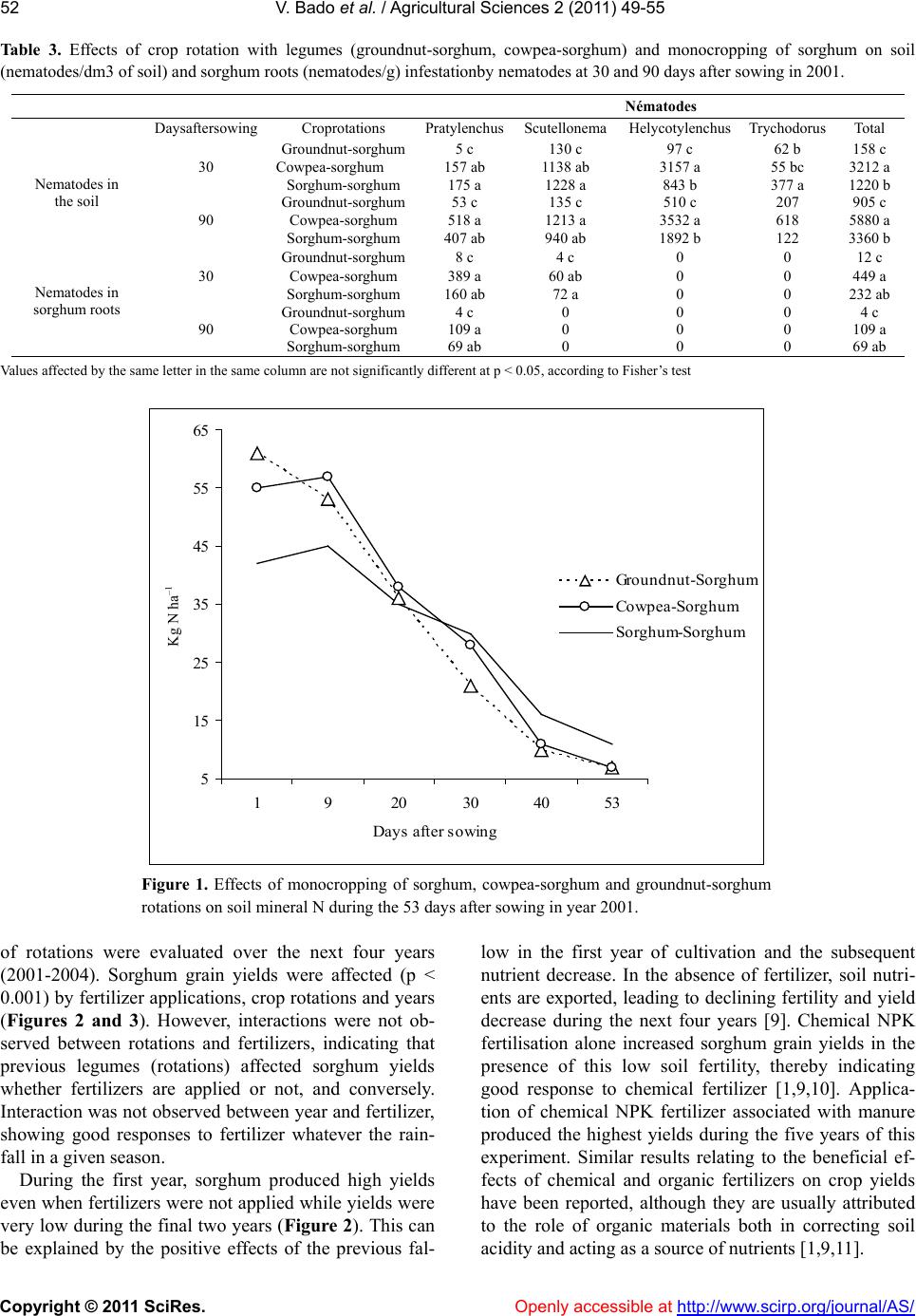 52 V. Bado et al. / Agricultural Sciences 2 (2011) 49-55 Copyright © 2011 SciRes. Openly accessible at http: //www.scirp.org/journal/AS/ Table 3. Effects of crop rotation with legumes (groundnut-sorghum, cowpea-sorghum) and monocropping of sorghum on soil (nematodes/dm3 of soil) and sorghum roots (nematodes/g) infestationby nematodes at 30 and 90 days after sowing in 2001. Nématodes Daysaftersowing Croprotations Pratylenchus Scutellonema Helycotylenchus Trychodorus Total Nematodes in the soil Groundnut-sorghum 5 c 130 c 97 c 62 b 158 c 30 Cowpea-sorghum 157 ab 1138 ab 3157 a 55 bc 3212 a Sorghum-sorghum 175 a 1228 a 843 b 377 a 1220 b Groundnut-sorghum 53 c 135 c 510 c 207 905 c 90 Cowpea-sorghum 518 a 1213 a 3532 a 618 5880 a Sorghum-sorghum 407 ab 940 ab 1892 b 122 3360 b Nematodes in sorghum roots Groundnut-sorghum 8 c 4 c 0 0 12 c 30 Cowpea-sorghum 389 a 60 ab 0 0 449 a Sorghum-sorghum 160 ab 72 a 0 0 232 ab Groundnut-sorghum 4 c 0 0 0 4 c 90 Cowpea-sorghum 109 a 0 0 0 109 a Sorghum-sorghum 69 ab 0 0 0 69 ab Values affected by the same letter in the same column are not significantly different at p < 0.05, according to Fisher’s test 5 15 25 35 45 55 65 19 2030 40 53 D a ys after sowing Kg N ha-1 Groundnut-Sorghum Cowpea-Sorghum Sorghum-Sorghum Figure 1. Effects of monocropping of sorghum, cowpea-sorghum and groundnut-sorghum rotations on soil mineral N during the 53 days after sowing in year 2001. of rotations were evaluated over the next four years (2001-2004). Sorghum grain yields were affected (p < 0.001) by fertilizer applications, crop rotations and years (Fi g u re s 2 and 3). However, interactions were not ob- served between rotations and fertilizers, indicating that previous legumes (rotations) affected sorghum yields whether fertilizers are applied or not, and conversely. Interaction was not observed between year and fertilizer, showing good responses to fertilizer whatever the rain- fall in a given seaso n. During the first year, sorghum produced high yields even when fertilizers were not applied wh ile yields were very low during the final two years (Fi gu re 2). This can be explained by the positive effects of the previous fal- low in the first year of cultivation and the subsequent nutrient decrease. In the absence of fertilizer, soil nutri- ents are exported, leading to declining fertility and yield decrease during the next four years [9]. Chemical NPK fertilisation alone increased sorghum grain yields in the presence of this low soil fertility, thereby indicating good response to chemical fertilizer [1,9,10]. Applica- tion of chemical NPK fertilizer associated with manure produced the highest yields during the five years of this experiment. Similar results relating to the beneficial ef- fects of chemical and organic fertilizers on crop yields have been reported, although they are usually attributed to the role of organic materials both in correcting soil acidity and acting as a source of nutrients [1,9,11]. Kg N ha –1 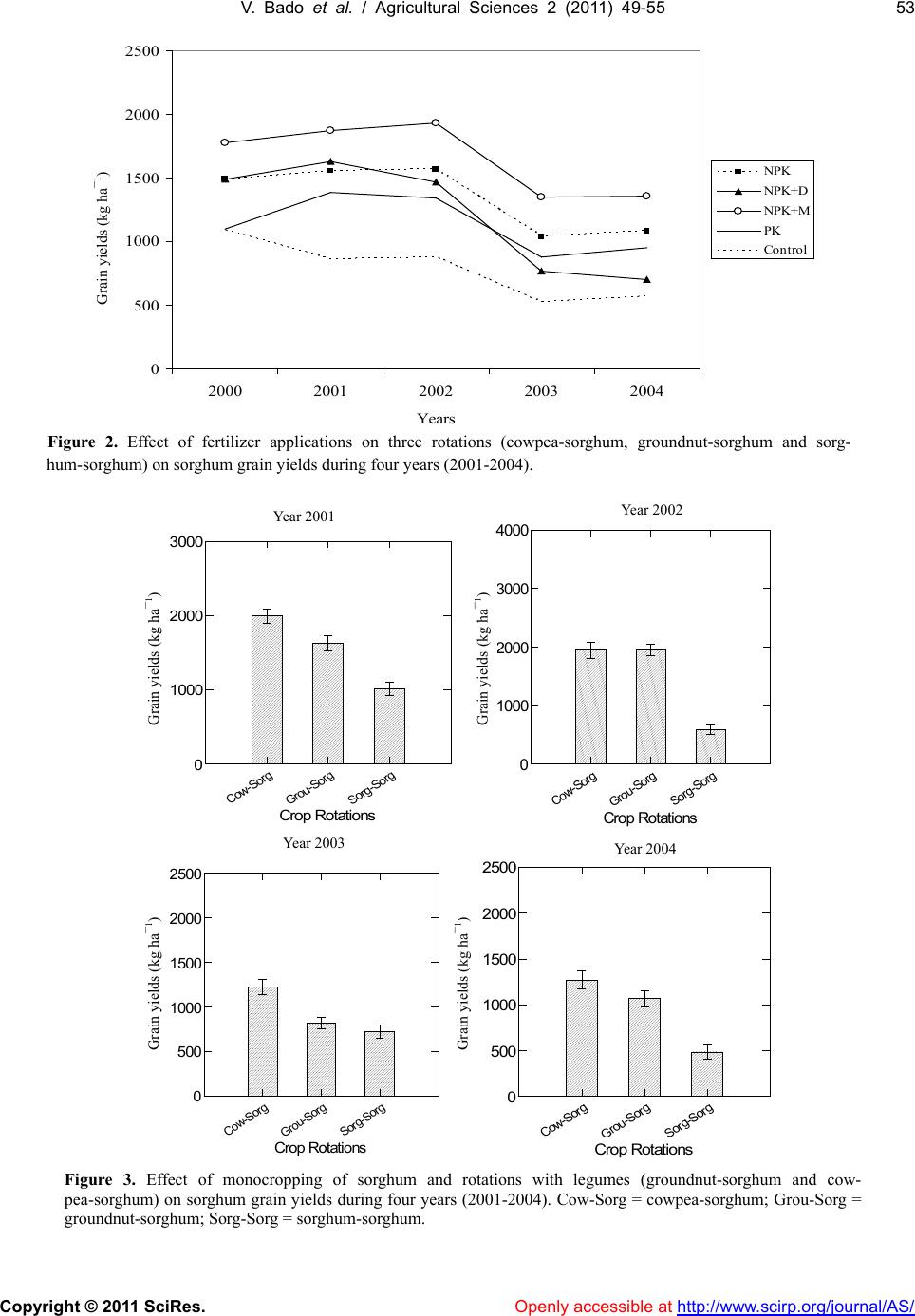 V. Bado et al. / Agricultural Sciences 2 (2011) 49-55 53 Copyright © 2011 SciRes. Openly accessible at http: //www.scirp.org/journal/AS/ 0 500 1000 1500 2000 2500 2000 2001 2002 2003 2004 Years Grain yields (kg ha-1) NPK NPK+D NPK+M PK Control Figure 2. Effect of fertilizer applications on three rotations (cowpea-sorghum, groundnut-sorghum and sorg- hum-sorghum) on sorghum grain yields during four years (2001-2004). Cow- So r g Grou-Sorg Sorg-Sorg Cr op Rota tion s 0 1000 2000 3000 Grain Yields (kg ha-1) Cow- So r g Grou-Sorg Sorg-Sorg Cr op Rota tion s 0 1000 2000 3000 4000 Grain Yields (kg ha-1) Cow-Sorg Grou-Sorg Sorg-Sorg Cr op Rota tion s 0 500 1000 1500 2000 2500 Grain Yields (kg ha-1) Cow- So r g Grou-Sorg Sorg-Sorg Cr op Rota tion s 0 500 1000 1500 2000 2500 Grain Yields (kg ha-1) Figure 3. Effect of monocropping of sorghum and rotations with legumes (groundnut-sorghum and cow- pea-sorghum) on sorghum grain yields during four years (2001-2004). Cow-Sorg = cowpea-sorghum; Grou-Sorg = groundnut-sorghum; Sorg -Sorg = sorghum-sorghum. Ye ar 2001 Year 2002 Ye ar 2003 Ye ar 2004 Grain yields (kg ha – 1) Grain yields (kg ha – 1) Grain yields (kg ha – 1) Grain yields (kg ha – 1) Grain yields (kg ha – 1) 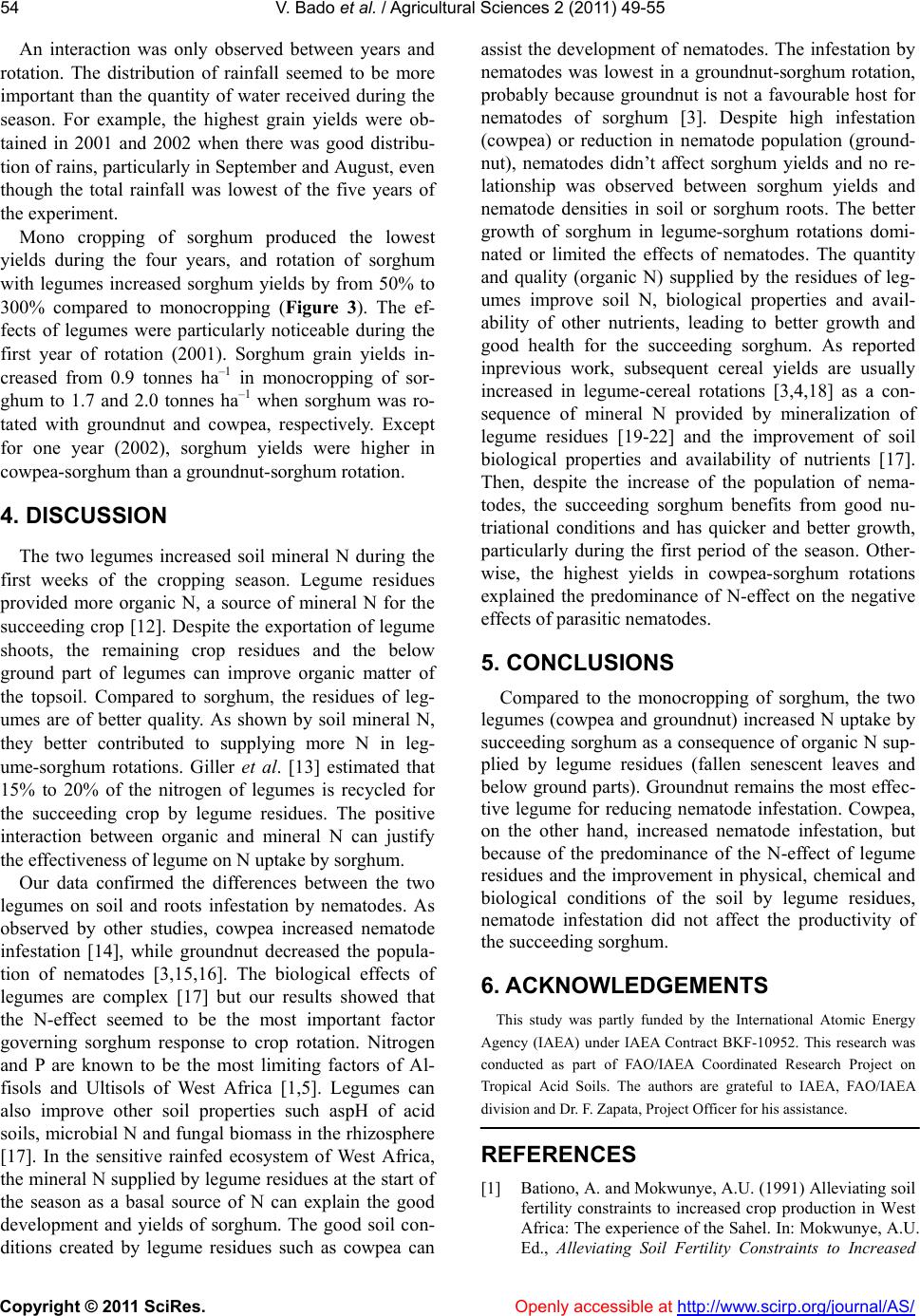 54 V. Bado et al. / Agricultural Sciences 2 (2011) 49-55 Copyright © 2011 SciRes. Openly accessible at http: //www.scirp.org/journal/AS/ An interaction was only observed between years and rotation. The distribution of rainfall seemed to be more important than the quantity of water received during the season. For example, the highest grain yields were ob- tained in 2001 and 2002 when there was good distribu- tion of rains, particularly in September and August, even though the total rainfall was lowest of the five years of the experiment. Mono cropping of sorghum produced the lowest yields during the four years, and rotation of sorghum with legumes increased sorghum yields by from 50% to 300% compared to monocropping (Figure 3). The ef- fects of legumes were particularly noticeable during the first year of rotation (2001). Sorghum grain yields in- creased from 0.9 tonnes ha–1 in monocropping of sor- ghum to 1.7 and 2.0 tonnes ha–1 when sorghum was ro- tated with groundnut and cowpea, respectively. Except for one year (2002), sorghum yields were higher in cowpea-sorghum than a groundnut-sorghum rotation. 4. DISCUSSIO N The two legumes increased soil mineral N during the first weeks of the cropping season. Legume residues provided more organic N, a source of mineral N for the succeeding crop [12]. Despite the exportation of legume shoots, the remaining crop residues and the below ground part of legumes can improve organic matter of the topsoil. Compared to sorghum, the residues of leg- umes are of better quality. As shown by soil mineral N, they better contributed to supplying more N in leg- ume-sorghum rotations. Giller et al. [13] estimated that 15% to 20% of the nitrogen of legumes is recycled for the succeeding crop by legume residues. The positive interaction between organic and mineral N can justify the effecti veness of legume on N upt ake by sorghum. Our data confirmed the differences between the two legumes on soil and roots infestation by nematodes. As observed by other studies, cowpea increased nematode infestation [14], while groundnut decreased the popula- tion of nematodes [3,15,16]. The biological effects of legumes are complex [17] but our results showed that the N-effect seemed to be the most important factor governing sorghum response to crop rotation. Nitrogen and P are known to be the most limiting factors of Al- fisols and Ultisols of West Africa [1,5]. Legumes can also improve other soil properties such aspH of acid soils, microbial N and fungal biomass in the rhizosphere [17]. In the sensitive rainfed ecosystem of West Africa, the mineral N supplied by legume residues at the start of the season as a basal source of N can explain the good development and yields of sorghum. The good soil con- ditions created by legume residues such as cowpea can assist the development of nematodes. The infestation by nematodes was lowest in a groundnut-sorghum rotation, probably because groundnut is not a favourable host for nematodes of sorghum [3]. Despite high infestation (cowpea) or reduction in nematode population (ground- nut), nematodes didn’t affect sorghum yields and no re- lationship was observed between sorghum yields and nematode densities in soil or sorghum roots. The better growth of sorghum in legume-sorghum rotations domi- nated or limited the effects of nematodes. The quantity and quality (organic N) supplied by the residues of leg- umes improve soil N, biological properties and avail- ability of other nutrients, leading to better growth and good health for the succeeding sorghum. As reported inprevious work, subsequent cereal yields are usually increased in legume-cereal rotations [3,4,18] as a con- sequence of mineral N provided by mineralization of legume residues [19-22] and the improvement of soil biological properties and availability of nutrients [17]. Then, despite the increase of the population of nema- todes, the succeeding sorghum benefits from good nu- triational conditions and has quicker and better growth, particularly during the first period of the season. Other- wise, the highest yields in cowpea-sorghum rotations explained the predominance of N-effect on the negative effects of parasitic nematodes. 5. CONCLUSIONS Compared to the monocropping of sorghum, the two legumes (cowpea and groundnut) increased N uptake by succeeding sorghum as a consequence of organic N sup- plied by legume residues (fallen senescent leaves and below ground parts). Groundnut remains the most effec- tive legume for reducing nematode infestation. Cowpea, on the other hand, increased nematode infestation, but because of the predominance of the N-effect of legume residues and the improvement in physical, chemical and biological conditions of the soil by legume residues, nematode infestation did not affect the productivity of the succeeding sorghum. 6. ACKNOWLEDGEMENTS This study was partly funded by the International Atomic Energy Agency (IAEA) under IAEA Contract BKF-10952. This research was conducted as part of FAO/IAEA Coordinated Research Project on Tropical Acid Soils. The authors are grateful to IAEA, FAO/IAEA division and Dr. F. Zapata, Project Officer for his assistance. REFERENCES [1] Bationo, A. and Mokwunye, A.U. (1991) Alleviating soil fertility constraints to increased crop production in West Africa: The experience of the Sahel. In: Mokwunye, A.U. Ed., Alleviating Soil Fertility Constraints to Increased  V. Bado et al. / A gricultural Sciences 2 (2011) 49-55 Copyright © 2011 SciRes. Openl y accessible at ht t p://www.sci rp.org/journal/AS / 55 55 Crop Production in West Africa, Kluwer Academic Pub- lishers, Dordrecht, 195-215. [2] Stoorvogel, J.J. and Smaling, E. (1990) Assessment of soil nutrient depletion in sub-Saharan Africa, 1983-2000. Main Report 28, DLO The Winang Staring Centre for Integrated Land, Soil and Water Research (SC-DLO), Wageningen, 1, 137. [3] Bagayoko, M., Buerkert, A., Lung, G., Bationo, A. and Römheld, V. (2000) Cereal/legume rotation effects on cereal growth in Sudano-Sahelian West Africa: Soil mineral nitrogen, mycorrhizae and nematodes. Plant Soil, 218, 103-116. doi:10.1023/A:1014957605852 [4] Bationo, A. and Ntare , B. R . (2000) Rotation and nitroge n fertilizer effects on pearl millet, cowpea and groundnut yield and soil chemical properties in a sandy soil in the semi-arid tropics, West Africa. Journal of Agricultural Science, 134, pp. 277-284. doi:10.1017/S0021859699007650 [5] Bado, B.V., Bationo, A. and Cescas, M.P. (2006) As- sessment of cowpea and groundnut contributions to soil fertility and succeeding sorghum yields in the Guinean savannah zone of Burkina Faso (West Africa). Biology and Fertility Soils, 43, 171-176. doi:10.1007/s00374-006-0076-7 [6] Keeney, D.R. (1982) Nitrogen availability indices. In: Page, A.L., Millet, R.H. and Keeney, D.R., Eds., Methods of Soil Analysis. Part II, 2nd Edition, Agronomy Mono- graph. Madison, American Society of Agronomy, 9, 711-730. [7] Seinhorst, J.W. (1962) Modifications of the elutriation method for extracting nematodes from soils. Nema- tologica, 8, 117-128. [8] Steel, R.D.G. and Torrie, J.H. (1980) Principles and pro- cedures of statistics: A biometrical approach. The McGraw-Hill Companies, New York. [9] Bado, B.V., Sedogo, M.P., Cescas, M.P. and Lompo, F. (1997) Effet à long terme des fumures sur le sol et les rendements du mais au Burkina Faso. Cahiers Agricul- tures, 6, 571-575. [10] Berger, M., Belem, P.C., Dakouo, D. and Hien, V. (1987) Le maintien de la fertilité des sols dans l’Ouest du Burkina Faso et la nécessité de l'association agriculture-élévage. Coton et Fibres Tropicales, XLIIFasc 3, 10-14. [11] Pichot, J., Sédogo, M.P. and Poulain, J.F. (1981) Évolu- tion de la fertilité d’un sol ferrugineux tropical sous l’influence des fumures minérales et organiques. Agrono- mie Tropicale, 36, 122-133. [12] Varvel, G.E. and Peterson, T.A. (1990) Nitrogen fertiliz- er recovery by corn in monoculture and rotation systems. Agronomy Journal, 82, 935-938. doi:10.2134/agronj1990.00021962008200050019x [13] Giller, K.E., Mcdonagh, J.F., Toomsan, B., Limp i-nuntana, H.F, Coo k, H.C. and Lee, H. (1995) Legumes in the crop- ping systems of North-East Thailand. Proceedings of the 3rd International Conference on Sustainable Agriculture, University of London, Wye College Press, Ashford. [14] Riekert, H.F. and Henshaw, G.E. (1998) Effect of soy- bean, cowpea and groundnut rotations on root-knot nematode build-up and infestation of dry-land maize. African Crop Science Journal, 6, 377-383. [15] Diop, M.T., Ndiaye, S., Mounpotr, S. and Mateille, D.T. (2000) Développement des populations de Meloidogy- nejavanica et de Scutellonemacavenessis dans les sys- tèmes de cultures maraîchères au Sénégal. Nematology, 5, 535-540. [16] Alvey, S., Bagayoko, M., Neuman, G. and Buerkert, A. (2001) Cereal/legume rotations affect chemical proper- ties and biological activities in two West African soils. Plant Soil, 231, 45-54. doi:10.1023/A:1010386800937 [17] Marschner, P., Joergensen, R.G., Piepho, H.P. and Buerkert, A. (2004) Legume rotation effects on early growth and rhizosphere microbiology of sorghum in West African soils. Plant and Soil, 264, 1-2. doi:10.1023/B:PLSO.0000047767.62179.25 [18] Peoples, M.B. and Crasswell, E.T. (1992) Biological nitrogen fixation: Investment, expectation and actual contribution to agriculture. Plant Soil, 141, 13-39. doi:10.1007/BF00011308 [19] Shumba, E.M. (1990) Response of maize in rotation with cowpea to NPK fertilizer in a low rainfall area. Zim- babwe Journal of Agricultural Research, 28, 39-45. [20] Wani, S.P., Rupela, O.P. and Lee, K.K. (1995) Sustaina- ble agriculture in the semi-arid tropics through biological nitrogen fixation in grain legumes. Plant Soil, 174, 29-49. doi:10.1007/BF00032240 [21] Chalk, P.M. (1998) Dynamics of biologically fixed N in legume-cereal rotations: A review. Australian Journal of Agricultural Research, 49, 303-316. doi:10.1071/A97013 [22] Franzluebbers-Kathrin, K.Z., Juo-Anthony, S.R. and Hossner-Lloy d, R. (2000) Tillage, crop residue, legume rotation and green manure effects on sorghum and millet yields in the semiarid tropics of Mali. Plant Soil, 225, 141-151. doi:10.1023/A:1026589528352 |