Paper Menu >>
Journal Menu >>
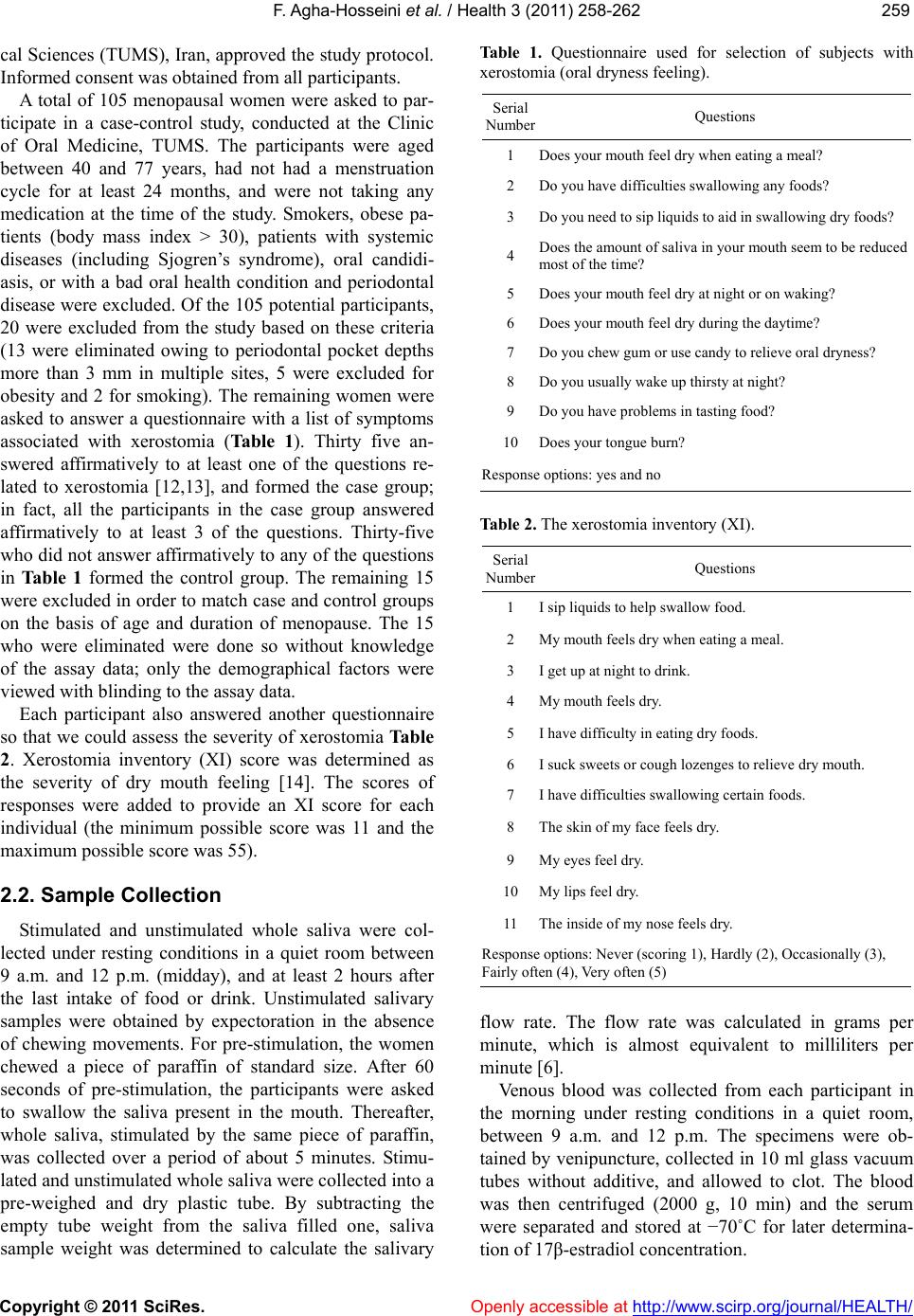
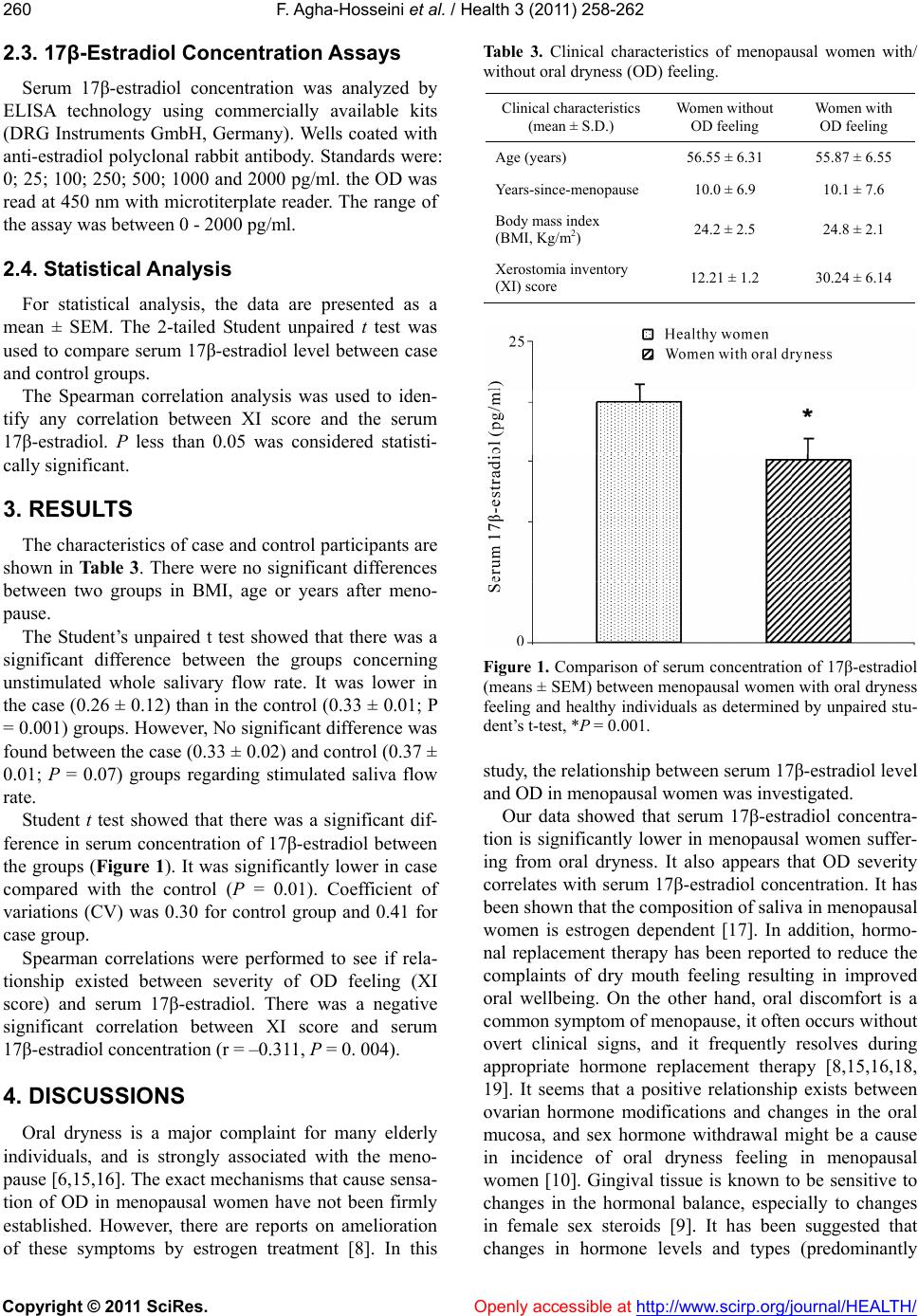
![]() Vol.3, No.5, 258-262 (2011) doi:10.4236/health.2011.35046 C opyright © 2011 SciRes. Openly accessible at http://www.scirp.org/journal/HEALTH/ Health Serum 17β-estradiol and oral dryness feeling in menopause Farzaneh Agha-Hosseini1*, Iraj Mirzaii-Dizgah2 1Department of Oral Medicine/Dental Research Center, Dentistry School, Tehran University of Medical Sciences, Tehran, Iran; *Corresponding Author: [email protected] 2Department of Physiology, School of Medicine, AJA University of Medical Sciences, Tehran, Iran; [email protected] Received 21 January 2011; revised 18 February 2011; accepted 27 February 2011. ABSTRACT The aim of this study was to compare serum 17β-estradiol of menopausal women with/without Oral Dryness (OD) feeling, and evaluate the re- lationship between serum 17β-estradiol and severity of OD feeling. A case-control study was carried out on 70 selected menopausal women aged 40 - 77 years with or without OD feeling (35 as case, 35 as control) conducted at the Clinic of Oral Medicine, Tehran University of Medical Sciences. Xerostomia inventory (XI) score was used as an index of OD feeling severity. The serum 17β-estradiol concentration was meas- ured by an enzyme immunoassay kit (ELISA). Statistical analysis of Student’s t-test and Spearman correlation coefficient was used. The mean serum concentration of 17β-estradiol was significantly lower in case than control. There was a significant negative correlation between XI score and concentration of 17β-estradiol in menopausal women (r = –0.311, P = 0.004). It seems that there is a negatively slight correla- tion between OD feeling severity and serum 17β-estradiol in menopausal women. Keywords: Menopause; Oral Dryness Feeling; 17β-Estradiol; Serum 1. INTRODUCTION Life expectancy for women has increased significantly during the last decade, and most women spend one third of their lives after the menopause. Menopause is a nor- mal developmental stage in a woman’s life, marking the permanent cessation of menstruation [1]. It is the result of irreversible changes in the hormonal and reproductive functions of the ovaries [2]. It is a retrospective diagno- sis usually made after 12 months of amenorrhea. Meno- pause is accompanied by a number of characteristic physi- cal changes; some of which occur in the oral cavity [3]. Oral dryness feeling or xerostomia is a subjective sensation. It is associated with an unpleasant feeling in the mouth and throat [4]. This complaint is more preva- lent in menopausal women on medication, and is quite common also in those without disease or drug usage, unrelated to lowered salivary flow rates [5-8]. It has been suggested that changes in estrogen and progesterone play a major role in the development of some forms of gingival disease [9]. It seems that oral soft tissues are sensitive to changes in female sex steroid blood levels. The decrease in estrogen levels during menopause is thought to affect the oral epithelial matu- ration process, leading to thin and atrophic epithelium [10]. It has been shown that hormone replacement ther- apy can relieve oral discomfort in menopausal women, further suggesting a role for female sex hormones in the maintenance of oral tissues [11]. Our previous study has also shown that the level of stimulated salivary 17β- estradiol concentration is lower in menopausal women with OD feeling, and there is a negative correlation be- tween OD feeling severity and stimulated whole saliva 17β-estradiol [5]. After complain of caries and periodontal problems, the most complain of people who referred to oral medi- cine department of Tehran University of Medical Sci- ences is dry mouth feeling. To relive their problem, con- secutively studies have been designed. The purpose of this study was to evaluate whether the serum 17β-estra- diol level correlates with severity of OD feeling, and to compare serum 17β-estradiol of menopausal women with/without OD feeling. 2. METHODS AND MATERIALS 2.1. Subjects The Ethics Committee of Tehran University of Medi- ![]() F. Agha-Hosseini et al. / Health 3 (2011) 258-262 Copyright © 2011 SciRes. Openly accessible at http://www.scirp.org/journal/HEALTH/ 259259 cal Sciences (TUMS), Iran, approved the study protocol. Informed consent was obtained from all participants. A total of 105 menopausal women were asked to par- ticipate in a case-control study, conducted at the Clinic of Oral Medicine, TUMS. The participants were aged between 40 and 77 years, had not had a menstruation cycle for at least 24 months, and were not taking any medication at the time of the study. Smokers, obese pa- tients (body mass index > 30), patients with systemic diseases (including Sjogren’s syndrome), oral candidi- asis, or with a bad oral health condition and periodontal disease were excluded. Of the 105 potential participants, 20 were excluded from the study based on these criteria (13 were eliminated owing to periodontal pocket depths more than 3 mm in multiple sites, 5 were excluded for obesity and 2 for smoking). The remaining women were asked to answer a questionnaire with a list of symptoms associated with xerostomia (Table 1). Thirty five an- swered affirmatively to at least one of the questions re- lated to xerostomia [12,13], and formed the case group; in fact, all the participants in the case group answered affirmatively to at least 3 of the questions. Thirty-five who did not answer affirmatively to any of the questions in Ta b l e 1 formed the control group. The remaining 15 were excluded in order to match case and control groups on the basis of age and duration of menopause. The 15 who were eliminated were done so without knowledge of the assay data; only the demographical factors were viewed with blinding to the assay data. Each participant also answered another questionnaire so that we could assess the severity of xerostomia Table 2. Xerostomia inventory (XI) score was determined as the severity of dry mouth feeling [14]. The scores of responses were added to provide an XI score for each individual (the minimum possible score was 11 and the maximum possible score was 55). 2.2. Sample Collection Stimulated and unstimulated whole saliva were col- lected under resting conditions in a quiet room between 9 a.m. and 12 p.m. (midday), and at least 2 hours after the last intake of food or drink. Unstimulated salivary samples were obtained by expectoration in the absence of chewing movements. For pre-stimulation, the women chewed a piece of paraffin of standard size. After 60 seconds of pre-stimulation, the participants were asked to swallow the saliva present in the mouth. Thereafter, whole saliva, stimulated by the same piece of paraffin, was collected over a period of about 5 minutes. Stimu- lated and unstimulated whole saliva were collected into a pre-weighed and dry plastic tube. By subtracting the empty tube weight from the saliva filled one, saliva sample weight was determined to calculate the salivary Table 1. Questionnaire used for selection of subjects with xerostomia (oral dryness feeling). Serial Number Questions 1 Does your mouth feel dry when eating a meal? 2 Do you have difficulties swallowing any foods? 3 Do you need to sip liquids to aid in swallowing dry foods? 4 Does the amount of saliva in your mouth seem to be reduced most of the time? 5 Does your mouth feel dry at night or on waking? 6 Does your mouth feel dry during the daytime? 7 Do you chew gum or use candy to relieve oral dryness? 8 Do you usually wake up thirsty at night? 9 Do you have problems in tasting food? 10 Does your tongue burn? Response options: yes and no Table 2. The xerostomia inventory (XI). Serial Number Questions 1 I sip liquids to help swallow food. 2 My mouth feels dry when eating a meal. 3 I get up at night to drink. 4 My mouth feels dry. 5 I have difficulty in eating dry foods. 6 I suck sweets or cough lozenges to relieve dry mouth. 7 I have difficulties swallowing certain foods. 8 The skin of my face feels dry. 9 My eyes feel dry. 10 My lips feel dry. 11 The inside of my nose feels dry. Response options: Never (scoring 1), Hardly (2), Occasionally (3), Fairly often (4), Very often (5) flow rate. The flow rate was calculated in grams per minute, which is almost equivalent to milliliters per minute [6]. Venous blood was collected from each participant in the morning under resting conditions in a quiet room, between 9 a.m. and 12 p.m. The specimens were ob- tained by venipuncture, collected in 10 ml glass vacuum tubes without additive, and allowed to clot. The blood was then centrifuged (2000 g, 10 min) and the serum were separated and stored at −70˚C for later determina- tion of 17β-estradiol concentration. ![]() F. Agha-Hosseini et al. / Health 3 (2011) 258-262 Copyright © 2011 SciRes. Openly accessible at http://www.scirp.org/journal/HEALTH/ 260 2.3. 17β-Estradiol Concentration Assays Serum 17β-estradiol concentration was analyzed by ELISA technology using commercially available kits (DRG Instruments GmbH, Germany). Wells coated with anti-estradiol polyclonal rabbit antibody. Standards were: 0; 25; 100; 250; 500; 1000 and 2000 pg/ml. the OD was read at 450 nm with microtiterplate reader. The range of the assay was between 0 - 2000 pg/ml. 2.4. Statistical Analysis For statistical analysis, the data are presented as a mean ± SEM. The 2-tailed Student unpaired t test was used to compare serum 17β-estradiol level between case and control groups. The Spearman correlation analysis was used to iden- tify any correlation between XI score and the serum 17β-estradiol. P less than 0.05 was considered statisti- cally significant. 3. RESULTS The characteristics of case and control participants are shown in Ta ble 3. There were no significant differences between two groups in BMI, age or years after meno- pause. The Student’s unpaired t test showed that there was a significant difference between the groups concerning unstimulated whole salivary flow rate. It was lower in the case (0.26 ± 0.12) than in the control (0.33 ± 0.01; P = 0.001) groups. However, No significant difference was found between the case (0.33 ± 0.02) and control (0.37 ± 0.01; P = 0.07) groups regarding stimulated saliva flow rate. Student t test showed that there was a significant dif- ference in serum concentration of 17β-estradiol between the groups (Figure 1). It was significantly lower in case compared with the control (P = 0.01). Coefficient of variations (CV) was 0.30 for control group and 0.41 for case group. Spearman correlations were performed to see if rela- tionship existed between severity of OD feeling (XI score) and serum 17β-estradiol. There was a negative significant correlation between XI score and serum 17β-estradiol concentration (r = –0.311, P = 0. 004). 4. DISCUSSIONS Oral dryness is a major complaint for many elderly individuals, and is strongly associated with the meno- pause [6,15,16]. The exact mechanisms that cause sensa- tion of OD in menopausal women have not been firmly established. However, there are reports on amelioration of these symptoms by estrogen treatment [8]. In this Table 3. Clinical characteristics of menopausal women with/ without oral dryness (OD) feeling. Clinical characteristics (mean ± S.D.) Women without OD feeling Women with OD feeling Age (years) 56.55 ± 6.31 55.87 ± 6.55 Years-since-menopause 10.0 ± 6.9 10.1 ± 7.6 Body mass index (BMI, Kg/m2) 24.2 ± 2.5 24.8 ± 2.1 Xerostomia inventory (XI) score 12.21 ± 1.2 30.24 ± 6.14 Figure 1. Comparison of serum concentration of 17β-estradiol (means ± SEM) between menopausal women with oral dryness feeling and healthy individuals as determined by unpaired stu- dent’s t-test, *P = 0.001. study, the relationship between serum 17β-estradiol level and OD in menopausal women was investigated. Our data showed that serum 17β-estradiol concentra- tion is significantly lower in menopausal women suffer- ing from oral dryness. It also appears that OD severity correlates with serum 17β-estradiol concentration. It has been shown that the composition of saliva in menopausal women is estrogen dependent [17]. In addition, hormo- nal replacement therapy has been reported to reduce the complaints of dry mouth feeling resulting in improved oral wellbeing. On the other hand, oral discomfort is a common symptom of menopause, it often occurs without overt clinical signs, and it frequently resolves during appropriate hormone replacement therapy [8,15,16,18, 19]. It seems that a positive relationship exists between ovarian hormone modifications and changes in the oral mucosa, and sex hormone withdrawal might be a cause in incidence of oral dryness feeling in menopausal women [10]. Gingival tissue is known to be sensitive to changes in the hormonal balance, especially to changes in female sex steroids [9]. It has been suggested that changes in hormone levels and types (predominantly ![]() F. Agha-Hosseini et al. / Health 3 (2011) 258-262 Copyright © 2011 SciRes. Openly accessible at http://www.scirp.org/journal/HEALTH/ 261261 estrogen and progesterone) play a great role in the de- velopment of some forms of gingival or periodontal dis- ease [20]. Clinical reports of gingival enlargement con- current with the onset of puberty and during pregnancy, or gingival atrophy and surface desquamation during menopause, have led some investigators to regard the gingival as a secondary target organ for the direct action of female sex hormones [9]. Also, human gingiva has been showed to metabolize estrogens [21]. Consistent with our previous studies on stimulated whole salivary 17β-estradiol [5], and serum and saliva progesterone [22] the results showed that subjects with OD had significantly lower serum 17β-estradiol concen- tration in menopausal women with OD feeling compared with the control group. In addition, a negative correla- tion between serum 17β-estradiol level and severity of OD in menopausal women was also observed. Therefore, it is possible that there is a relationship between serum 17β-estradiol level and OD feeling in menopausal women. We also found that unstimulated, but not stimulated whole saliva flow rate, was significantly lower in meno- pausal women with OD feeling, in comparison with women without OD feeling, which was consistent with our previous studies [5,6,22,23]. It can be concluded that menopausal women with OD feeling suffer from re- duced salivary flow rate in unstimulated conditions. However, it may alleviate in a stimulated state. Our research had not planned for day-to-day collec- tion of serum sample, because we anticipated and ex- perienced resistance from the study participants espe- cially in the control group, so we took only one sample. There were other limitations to this study, e.g., this was a cross-sectional study and longitudinal studies may find similar or different results. 5. CONCLUSIONS It seems that there is a slight negative correlation be- tween OD feeling severity and serum 17β-estradiol in menopausal women. 6. ACKNOWLEDGEMENTS Research conducted with Grant from Tehran University of Medical Sciences, Tehran, Iran. The authors declare that there is no conflict of interests. REFERENCES [1] Frutos, R., Rodríguez, S.S., Miralles-Jorda, L. and Ma- chuca, G. (2002) Oral manifestations and dental treat- ment in menopause. Oral Medicine, 7, 31-35. [2] Bruce, D. and Rymer, J. (2009) Symptoms of the meno- pause. Best Practice & Research Clinical Obstetrics & Gynaecology, 23, 25-32. doi:10.1016/j.bpobgyn.2008.10.002 [3] Zachariasen, R.D. (1993) Oral manifestations of meno- pause. Compendium, 14, 1586-1591. [4] Nederfors, T. (2000). Xerostomia and hyposalivation. Advances in Dental Research, 14, 48-56. doi:10.1177/08959374000140010701 [5] Agha-Hosseini, F., Mirzaii-Dizgah, I., Mansourian, A. and Khayamzadeh, M. (2009) Relationship of stimulated saliva 17beta-estradiol and oral dryness feeling in meno- pause. Maturitas, 62, 197-199. doi:10.1016/j.maturitas.2008.10.016 [6] Agha-Hosseini, F., Mirzaii-Dizgah, I., Mansourian, A. and Zabihi-Akhtechi, G. (2009) Serum and stimulated whole saliva parathyroid hormone in menopausal women with oral dry feeling. Oral Surgery, Oral Medicine, Oral Pathology, Oral Radiology & Endodontics, 107, 806-810. doi:10.1016/j.tripleo.2009.01.024 [7] Narhi, T.O. (1994) Prevalence of subjective feelings of dry mouth in the elderly. Journal of Dental Research, 73, 20-25. doi:10.1177/00220345940730010301 [8] Ben, A.H., Gottlieb, I., Ish-Shalom S., David, A., Szargel, H. and Laufer, D. (1996) Oral complaints related to menopause. Maturitas, 24,185-189. [9] Agha-Hosseini, F., Tirgari, F. and Shaigan, S. (2006) Immunohistochemical analysis of estrogen and proges- terone receptor expression in gingival lesions. Iranian Journal of Public Health, 35, 38-41. [10] Forabosco, A., Criscuolo, M., Coukos, G., et al., (1992) Efficacy of hormone replacement therapy in postmeno- pausal women with oral discomfort. Oral Surgery, Oral Medicine, Oral Pathology, Oral Radiology & Endodon- tics, 73, 570-574. [11] Eliasson, L., Carlén, A., Lainec, M. and Birkhe, D. (2003) Minor gland and whole saliva in menopausal women us- ing a low potency oestrogen (oestriol). Archives of Oral Biology, 48, 511-517. doi:10.1016/S0003-9969(03)00094-3 [12] Agha-Hosseini, F., Mirzaii-Dizgah, I., Moghaddam, P.P. and Akrad, Z.T. (2007) Stimulated whole salivary flow rate and composition in menopausal women with oral dryness feeling. Oral Diseases, 13, 320-323. doi:10.1111/j.1601-0825.2006.01288.x [13] Thomson, W.M. and Williams, S.M. (2000) Further test- ing of the xerostomia inventory. Oral Surgery, Oral Medicine, Oral Pathology, Oral Radiology & Endodon- tic, 89, 46-50. doi:10.1016/S1079-2104(00)80013-X [14] Torres, S.R., Peixoto, C.B., Caldas, D.M., et al. (2000) Relationship between salivary flow rates and Candida counts in subjects with xerostomia. Oral Surgery, Oral Medicine, Oral Pathology, Oral Radiology & Endodon- tic, 93,149-154. doi:10.1067/moe.2002.119738 [15] Ship, J.A., Pillemer, S.R. and Baum, B.J. (2002) Xerostomia and the geriatric patient. Journal of the American Geriatrics Society, 50, 535-543. doi:10.1046/j.1532-5415.2002.50123.x [16] Asplund, R. and Aberg, H.E. (2005) Oral dryness, noc- turia and the menopause. Maturitas, 50, 86-90. doi:10.1016/j.maturitas.2004.04.009 [17] Leimola-Virtanen, R., Helenius, H. and Laine, M. (1997) Hormone replacement therapy and some salivary antim- icrobial factors in post- and perimenopausal women. ![]() F. Agha-Hosseini et al. / Health 3 (2011) 258-262 Copyright © 2011 SciRes. http://www.scirp.org/journal/HEALTH/Openly accessible at 262 Maturitas, 27, 145-151. doi:10.1016/S0378-5122(97)00024-8 [18] Wardrop, R.W., Hailes, J., Burger, H. and Reade, P.C. (1989) Oral discomfort at menopause. Oral Surgery, Oral Medicine, Oral Pathology, Oral Radiology & En- dodontic, 67, 535-540. [19] Yalcin, F., Gurgan, S. and Gurgan, T. (2005) The effect of menopause, hormone replacement therapy (HRT), alen- dronate (ALN), and calcium supplements on saliva. Journal of Contemporary Dental Practice, 6, 10-17. [20] Whitaker, S.B., Bouquot, J.E., Alimari, A.E. and Whitaker, T.J.Jr. (1994) Identification and semiquantifi- cation of estrogen and progesterone receptors in pyo- genic granulomas of pregnancy. Oral Surgery, Oral Medicine, Oral Pathology, Oral Radiology & Endodon- tic, 78, 755-760. [21] Yih, W.Y., Richardson, L., Kratochvil, F.J., Avera, S.P. and Zieper, M.B. (2000) Expression of estrogen receptors in desquamative gingivitis. Journal of Periodontology, 71, 482-487. doi:10.1902/jop.2000.71.3.482 [22] Agha-Hosseini, F., Mirzaii-Dizgah, I. and Mirjalili, N. (2010) Relationship of stimulated whole saliva cortisol level with the severity of a feeling of dry mouth in menopausal women. Gerodontology, in press. doi:10.1111/j.1741-2358.2010.00403.x [23] Mirzaii-Dizgah, I. and Agha-Hosseini, F. (2010) Stimu- lated and unstimulated saliva progesterone in meno- pausal women with oral dryness feeling. Clinical Oral Investigations, in press. doi:10.1007/s00784-010-0449-z |