

Paper Menu >>
Journal Menu >>
 World Journal of Engineering and Technology, 2014, 2, 7-13 Published Online September 2014 in SciRes. http://www.scirp.org/journal/wjet http://dx.doi.org/10.4236/wjet.2014.23B002 How to cite this paper: Chua, S.J.L., Ali, A.S. and Alias, A. (2014) Procurement Method Selection for Building Maintenance Projects: The Case of Malaysian Public Universities. World Journal of Engineering and Technology, 2, 7-13. http://dx.doi.org/10.4236/wjet.2014.23B002 Procurement Method Selection for Building Maintenance Projects: The Case of Malaysian Public Universities Shirley Jin Lin Chua, Azlan Shah Ali, Anuar Alias Faculty of Built Environment, University of Malaya, Kuala Lumpur, Malaysia Email: [email protected], asafab@um. edu .my, [email protected] Received May 2014 Abstract The purpose of this paper is to implement and validate a decision making framework for building maintenance projects. The growing importance of maintenance sector not only in Malaysia but al- so increasingly globalized, the difficulty in selecting an appropriate procurement method and lack of research in this area provide an impetus for this research. There were 19 procurem ent selec- tion criteria identified. In addition, there were 4 types of procurements methods which include outsourcing by specialist term contract, outsourcing by tendered schedule term contract, out- sourcing by repair and maintenance contract and outsourcing by measured term contract identi- fied to be the most popular procurement methods adapted by public universities currently and at the same time were considered most important. The decision making framework was developed based on AHP technique and principles. Expert Choice Software was employed as development tool where the criteria and alternatives were integrated into the framework. Finally, structured interview was conducted to validate the framework developed. The validation process was carried out through structured interview with selected public university. Keywords Analytic Hierarchy Process, Expert Choice Software, Procurement Method, Building Maintenance Manag em en t, Public Universities 1. Introduction Procurement system of a project is a key factor which contributes to the overall client satisfaction and project success. Ng et al. [1] agreed that project success is depends on the selection and use of a suitable procurement strategy. This is supported by Hui and Tsang [2] which claimed that the two main success factors in building maintenance management are selecting the most appropriate procurement strategy and implement it in a proper way. Improving the universities’ building maintenance management systems by selecting the most appropriate procurement method is si gnificant if universities wish to provide conducive learning envi ronment a nd research centre for university organization, students, faculty members, parents and other users. Hashim et al. [3] claimed  S. J. L. Chua et al. 8 that it is a co mplex and i ntimid ate task for the c lient and t he client ’s advisers to select the most appro priate p ro- curement method due to the amplification of demand on quality services for building or space, changes in busi- ness environment and the ever evolving market trend resulting in emergence of various procurement strategy. Thus, the tasks of decision makers to select the most appropriate procurement method becoming more challeng- ing. Alhazmi and McCaffer [4] mentio ned t hat the nat ure in selecting procurement method requires a suitable de- cision-making technique to evaluate the procurement methods against certain criteria systematically. This paper pre sents a stud y of the selecti on of pr ocure ment metho d for build ing maint enance manag ement through the use of Multiple criteria decision making (MCDM) particularly Analytic Hierarchy Process (AHP). The finding of this study will act as a to ol to guide the decision maker to select the most suitable a nd appr opriate procurement method that will i mp r ove the maintenance management in Malaysia. 2. Building Maintenance Procurement Strategy Masterman [5] explained that project procurement act as the organizational structure where a group of people are brought together and organized systematically in term of their responsibilities, duties, roles and interrela- tionship between them. Ibbs and Chih [6] mentioned that the use of a suitable procurement method can affect project efficiency and success. T his statement is true for local, regional or global project in scope. Different procurement method will have different effect on the time, quality and cost of the project therefore it is very cr ucial to co nsider al l factors in the selectio n of the most app ropria te procure ment strategy. This is be- cause each type of procurement system has its own feature and peculiarity that will have effect on the quality, cost and time of the project which is more likely to be known as project performance. Thus, selecting an appro- priate procurement method is very essential to obtain optimum project performance. There were 4 types of procurement methods identified to be the most popular procurement methods adapted by public universi tie s curr ently which include : 1) Outsourcing by Measured T er m Contract (MTC); 2) Outsourcing by Spe c ia list Term Contract (STC); 3) Outsourcing by Tendered Schedule Term contract; 4) Outsourcing by Repair and Maintenance Contract (RMC). 2.1. Possible Assessment Procurement Selection Criteria Love et al. (1998) highlighted that owners that ha ve similar nature do not certainly ha ve similar needs. In fact, the needs rely on many factors and are usually specific to t he particular p roject. It is esse ntial to e stablish a li st of procurement selection criteria before various procurement methods were evaluated. The procurement selec- tion criteria should reflect the requirements and characteristics of the client, project and external environment (Luu et al., 2003a; Kumaraswamy and Dissanayak, 2001 and Ambrose and Tucker, 1999). A list of criteria for procurement methods selection in building maintenance project was established. There were 19 criteria which wer e categorized in three main categories that were clients’ requirement, project characteristic and external en- vironment or factor shown in Table 1. 2.2. Decision Making Framework Ratnasabapathy and Rameezdeen [7] highlighted that it is strategically essential to make sure the selection of procurement method is done systematically and in a closely controlled manner. Masterman [8] claimed that the practice of procurement selection available is rather unstructured and unplanned. Many clients select procure- ment methods in a cursory way simply based upon biased conservative decisions and past experience. In fact, some clients even employ certain procurement method by default without making a deliberated choice. Thus, Cheung et al. [9] suggested that the use of the AHP technique in decision making process enables the decision maker to structure a complex problem in the form of a simple hierarchy and to evaluate a large number of qua- litative and quantitative factors in a systematic manner under multiple criteria. It is a logical way for people to make decisions. Multiple Criteria Decision Making (MCDM) particularly the Analytic Hierarchy Process (AHP) was em- ployed in this study. Decision is made based on multiple criteria that enables the decision maker to derive his  S. J. L. Chua et al. 9 Table 1. List of final procurement selection criteria. Abbrevia tio n used Criteria C1 Clients’ Requirements C1.1 Experience contractor availability C1.2 Q ualit y level C1.3 Knowledge of the strateg y C1.4 D eg ree o f responsibility C1.5 C li en t ’s f in ancial capability C1.6 Price competition C1.7 Time Certainty C1.8 S p eed C1.9 P ublic acc oun tability C1.10 Clarit y of sc ope C1.11 Involvement of owner in the project C1.12 Working relation s hip C1.13 Intuition and pas s experience C1.14 Client in house technical c apab ilit y C1.15 Price or cost certainty C2 Project Characteristic C2.1 Existing building condition C2.2 Project size C3 External Environment/Factor C3.1 Objective or policy of organi zation C3.2 Gover nm e n t po licy own set of importance weightings for the selection criteria according to the building or project characteristics. The application of AHP and Expert choice which able to calculate the judgment consistency assure that the de- cision maker judgments are consistent and the final decision is made well. The decision makers are able to re- examine and revise the judgments for all level of the hierarchy and it shows where the inconsistency exists and how to minimize it in orde r to improve the decision. 3. Research Design The implementation and validation process was carried out through structured interview with a selected public university. Structure interview is chosen so that the researcher can explain the framework in detail to the res- pondents, clarify any doubts arises by the interviewees and at the same time the researcher able to examine the level of understanding of the respondents towards the topic and the framework. The two main purposes of this structured interview are:- 1) The interviewees are requested to do a pair-wise comparison with the assessment criteria and procurement option which has been developed in the Expert Choice software 2) The interviewees also requested to evaluate the proposed decision making framework in term of its capa- bility, applic a bility and validity. During the interview, the framework was demonstrated to the interviewee. Then, the interviewees were asked to run the framework and were asked to evaluate the framework in term of capability, applicability and validity. 4. Results and Discussion The validation process was carried out through structured interviews with the maintenance personnel that in- volve in the decision making process in selecting procurement method for building maintenance work. The in-  S. J. L. Chua et al. 10 terviewee is selected from the maintenance and facilities’ maintenance management department of one of the public univers ity in Malaysia. The building maintenance department in the university named as Department of Development and Mainten- ance. The university was established on 18th of May 1970. The structured interview was conducted on 25th of April 2013 with an assistant head of quantity surveying department. Quantity surveying department deals mat- ters relating to contracts, thus the interviewee who had 17 years of experience were appropriate to be inter- viewed because she involved in the decision making process in selecting the most appropriate procurement strategy. The interview session was held in a meeting room and the all the pairwise comparison judgments was done and evaluation pro cess was made after discussion. All the pairwise comparison judgments made in Expert Choice software were synthesis to obtain vector of priorities. All the vector of priority for main criteria, sub criteria and alternatives were tabulated in Table 2. Based on the result obtained, the interviewee priority main factor in selecting the most approp riate procurement metho d for mainte nanc e of a ir-conditioning services are proj ect characteristics (0.540), external environment or factors (0.297) and clients’ requirements (0.163). The abb reviation used for sub criteria can be referred to Table 3 . All main criteria judgments consistency ratio (CR) were 0.01 that were less than 0.10 (<0.10) which represent good consistency. The result of priority obtained for pairwise comparison among sub criteria under clients’ requirements in se- lecting the most appropriate procurement method for maintenance of air-conditio ning ser vices and ra nking can be referred to Table 3. The consistency ratio value is 0.09 which was lesser than 0.10 (<0.10), therefore the judgments consistency is acceptable. The two sub criteria under project characteristics (C2) which were existing building condition (C2.1) and project size (C2.2) obtained equally 0.500 priority vector. This result revealed that existing building condition and project size were equally important when selecting the most appropriate pro- curement method for maintenance of air-conditioning services. While for objective or policy of organization (C3.1) and government policy (C3.2) which is under external e nvironment or factors ( C3), the interviewees feel that policy of organization government policy (0.750) are more important compared to objective or policy of organization (0.250). Both judgments for sub criteria under C2 and C3 obtained 0.00 (<0.10) consistency ratio, thus the consistency ratio was accepted. From Table 2, the r e sult indicated that for sub criteria u nd e r client s’ requirements (C1) that were C1.6, C1.13, C1.14 and C1.15 has more strength when performing outsourcing by repair and maintenance contract. Sub crite- ria C1.4, C1.5, C1.7, C1.8, C1.9, C1.10, C1.11, C1.12 and C1.14 perform better under outsourcing by specialist term contract while none perform better under outsourcing by tendered schedule term contract. There are 3 sub criteria have more strength under outsourcing by measured term contract which were C1.1, C1.2 and C1.3. While for sub criteria under project characteristic (C2) and external environment or factor (C3), C2.1, C2.2, C3.1 and C3.2 perform better under outsourcing by specialist term contract although C3.1 and 3.2 has equally performance for outsourcing by specialist term contract and outsourcing by repair and maintenance Contract. All the judgments made obtained value of CR less that 0.10 (<0.10) that was acceptable. Table 4 revealed vectors of priorities for the alternatives with respect to the main factor and alternatives’ vector of overall priorities. The results indicated that outsourcing by specialist term contract (0.402) was more preferable among t he four a lterna tives fo r clien ts’ req uireme nts. As t he val ue of co nsistenc y is 0.0 9 < 0.10, the consistency judgment was acceptable. While for project characteristics (C2), outsourcing by specialist term con- tract (0.487) was also more preferable. On the other hand, external environment or facto rs (C3) obtained 0.368 priority vector for both outsourcing by specialist term contract and outsourcing by repair and maintenance con- tract. The consistency ratio for both project characteristics (C2) and external environment or factors (C3) ob- tained 0.06 (<0.10) consistency ratio that was acceptable. The vector of overall priorities for the four alternatives as shown in Table 4 indicated that outsourcing by specialist term contract (0.432) which obtained the highe st of vector of o verall prio rities is the be st procure ment method maintenance for air-conditioning services in that particular university. This is followed by outsourcing by repair and maintenance contract (0.300), outsourcing by Measured Term Contract (0.160) and outsourcing by tendered schedule term contract (0.1 08). 5. Conclusion The proposed framework was well received by the interviewee and the interviewee admitted that the selection of the procurement process proposed was decided on a judgmental basis which was not simply based upon pre- 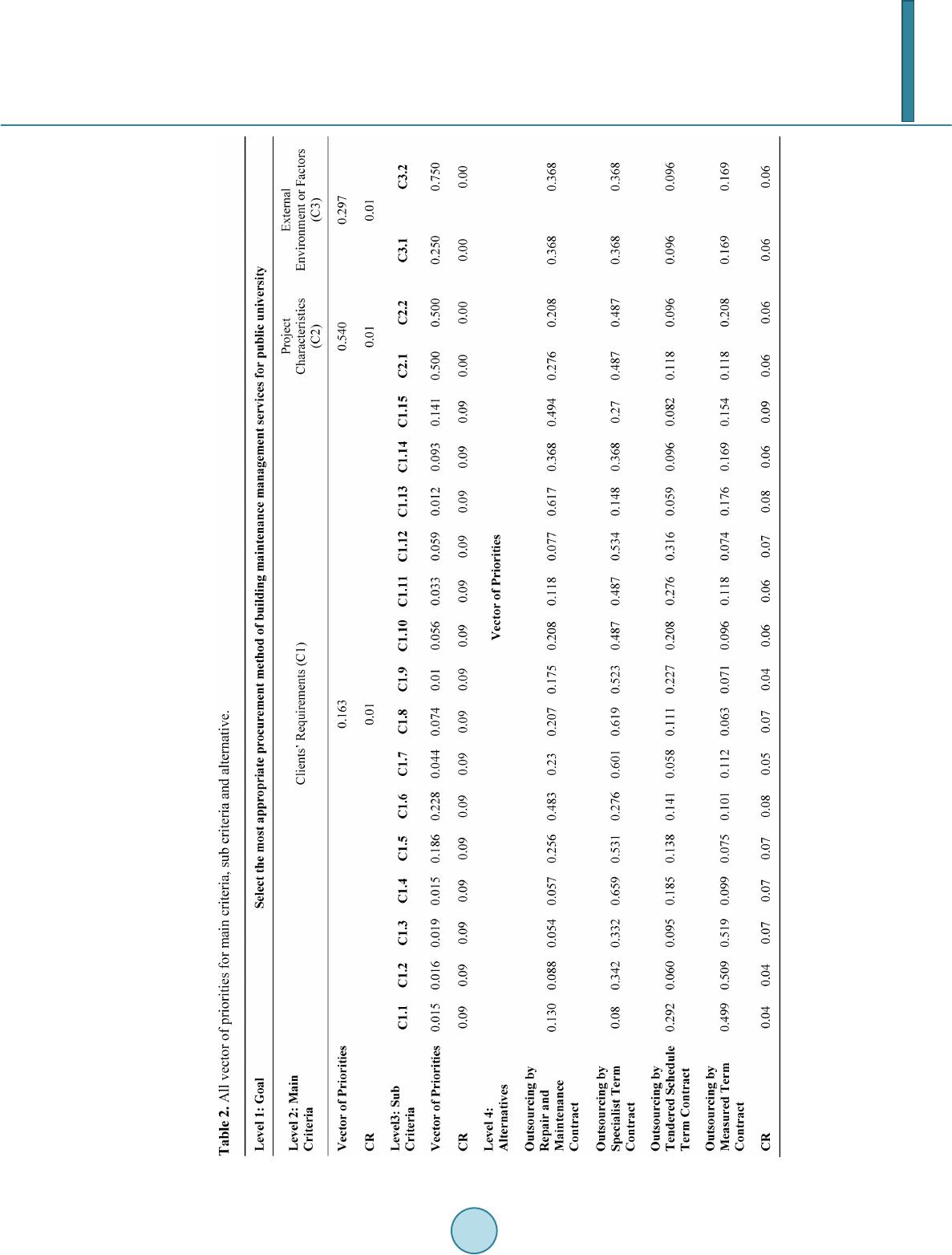 S. J. L. Chua et al. 11  S. J. L. Chua et al. 12 Table 3. All vector of priorities for main criteria, sub criteria and alternative. Abbreviation Used Description V ect o r of Prio rities Ra nking C1.1 Experience d contractor av ail a bil i ty 0.015 12 C1.2 Q ualit y level 0.016 11 C1.3 Knowledge of the strateg y 0.019 10 C1.4 D eg ree o f responsibility 0.015 12 C1.5 Client's financial capability 0.186 2 C1.6 Price competition 0.228 1 C1.7 Time Certainty 0.044 8 C1.8 S p eed 0.074 5 C1.9 P ublic acc oun tability 0.01 14 C1.10 Clarit y of sc ope 0.056 7 C1.11 Involvement of owner in the project 0.033 9 C1.12 Working relation s hip 0.059 6 C1.13 Intuition and pass experience 0.012 13 C1.14 Client in house technical capability 0.093 4 C1.15 Price or cost certainty 0.141 3 Table 4. Vector of overall priorities with respect to main criteria. Main Criteria Clients’ Requirements (C1) Project Characteristics (C2) External Environment/Factors (C3) Vector of Overall Priorities Vector of Prio rities 0.163 0.540 0.297 CR 0.01 0.01 0.01 Alternatives Vecto r of Prio rities Outsourcing by Repai r a nd Maintenance Co ntra ct 0.328 0.242 0.368 0.300 Outsourcing by Specialist Term Contract 0.402 0.487 0.368 0.432 Outsourcing by Tendered Schedule Term Contract 0.14 0.107 0.096 0.108 Outsourcing by Measured Term Contract 0.13 0.163 0.169 0.160 CR 0.09 0.06 0.06 0.05 *CR = Consistency Ratio vious experience and perception. The evaluations done by interviewee regarding the proposed decision making framework revealed the Decision Making Framework for Procurement Method Selection of Building Mainten- ance Management for Public Universities developed was good in terms of capability, applicability and validity in assisting the decision-makers to select the most appropriate procurement method in building maintenance work. Thus, t he pro posed d ecisio n making fr ame work wil l be ca pabl e to assist the decisi on-makers to select the most appropriate procurement method. Acknowledgements The autho rs gra te full y ack no wled ge the fi nanc ial s upport of the University of Malaya Research Grant (UMRG), grant no RG183/12SUS established at the University of Mala ya, Sustainability Science Research Cluster. References [1] Ng, S . T., Luu, D.T. and Chen, S.E. (2002) Decision Criteria and Their Subjectivity in Construction Procurement Se- lection. The Australian Journal of Construction Economics and Building, 2, 70-80. [2] Hui , E.Y.Y. and Tsan g, A.H.C. (2004) Sourcing Strategies of Facilities Management. Journal of Quality in Mainten-  S. J. L. Chua et al. 13 ance Engineeri ng, 10, 85-92. http:/ /dx.doi.org/10.1108/13552510410539169 [3] Hashim, M . , Li , M.C.Y., Yi n, N.C., et al. (2006) Factors Influencing the Selection of Pro cu rement Syst e ms by Clients. International Conference on Construction Industry, 2006, Padang, 1-10. [4] Alh azmi , T. and McCaffer, R. (2000) Project Procurement System Selection Model. Journal of Construction Engi- neer ing and Manage m e nt, 126, 17 6-184. http://dx.doi.org/10.1061/(ASCE)0733-9364(2000)126:3(176) [5] Masterman, J.W.E. (1996) Building Procurement Systems: An Introduction. Spo n Pres s , London. [6] Ibbs, W. and Chi h , Y.-Y. (2011) Alternative Methods for Choosing an Appropriate Project Delivery System (PDS). Facilities, 29, 527-541. http://dx.doi.org/10.1108/02632771111178418 [7] Ratnasabapathy, S. and Rameezdeen, R. (2007) A Decision Support System for the Selection of Best Procurement System in Construction. Built-En v ir onm e nt Sr i Lanka, 7, 53-43. [8] Masterman, J.W.E. (1992) An Introduction to Building Procurement Systems. Spon P ress, London. [9] Cheung, S . O., Lam, T.I., Leung, M.Y., et al. (2001) An Analytical Hierarchy Process Based Procurement Selection Method. Construction Management and Economics, 19, 427 -437. http://dx.doi.org/10.1080/014461901300132401 |