

Paper Menu >>
Journal Menu >>
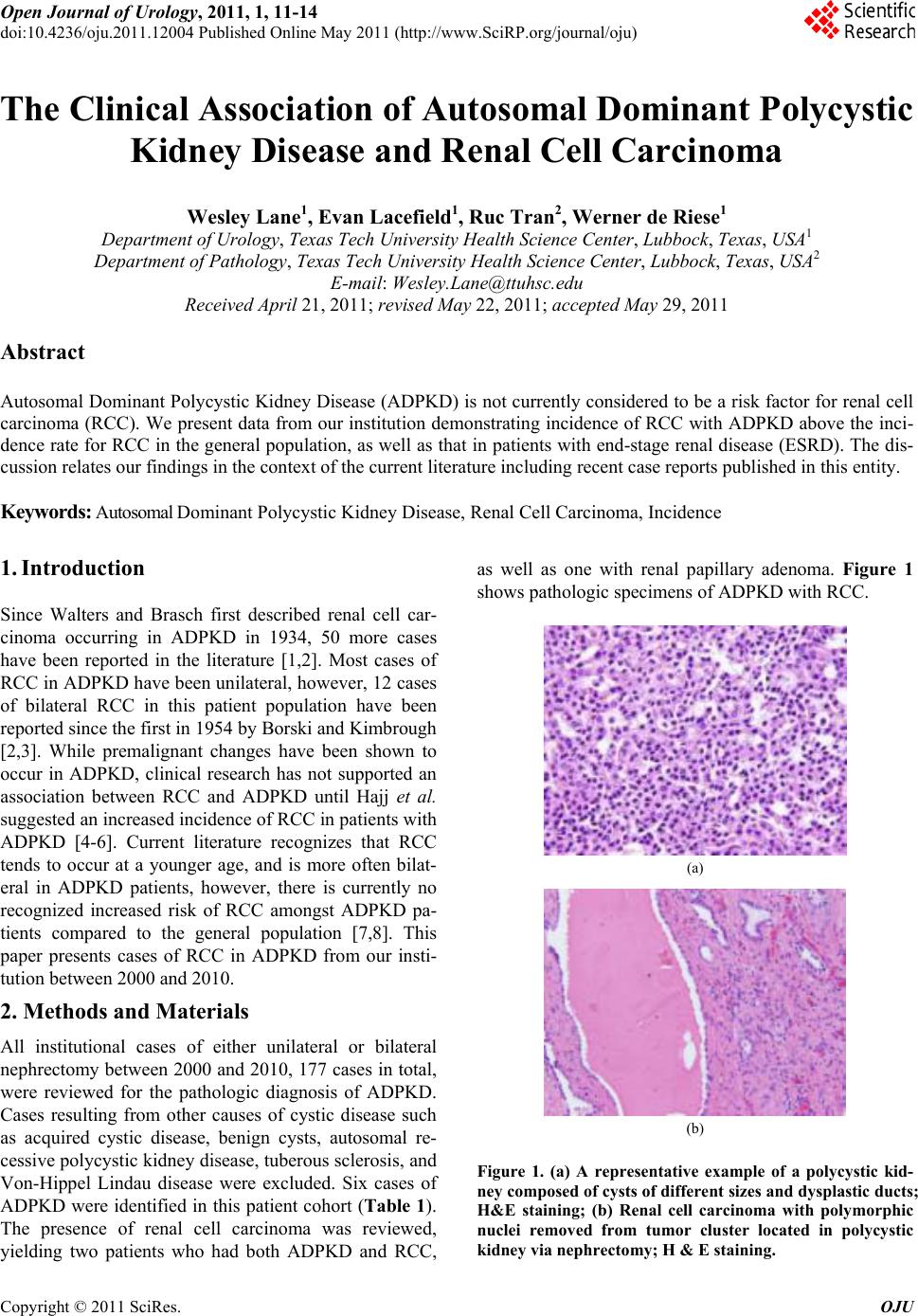 Open Journal of Urology, 2011, 1, 11-14 doi:10.4236/oju.2011.12004 Published Online May 2011 (http://www.SciRP.org/journal/oju) Copyright © 2011 SciRes. OJU The Clinical Association of Autosomal Dominant Polycystic Kidney Disease and Renal Cell Carcinoma Wesley Lane1, Evan Lacefield1, Ruc Tran2, Werner de Riese1 Department of Urology, Texas Tech University Health Science Center, Lubbock, Texas, USA1 Department of Pathology, Texas Tech University Health Science Center, Lubbock, Texas, USA2 E-mail: [email protected] Received April 21, 2011; revised May 22, 2011; accepted May 29, 2011 Abstract Autosomal Dominant Polycystic Kidney Disease (ADPKD) is not currently considered to be a risk factor for renal cell carcinoma (RCC). We present data from our institution demonstrating incidence of RCC with ADPKD above the inci- dence rate for RCC in the general population, as well as that in patients with end-stage renal disease (ESRD). The dis- cussion relates our findings in the context of the current literature including recent case reports published in this entity. Keywords: Autosomal Dominant Polycystic Kidney Disease, Renal Cell Carcinoma, Incidence 1. Introduction Since Walters and Brasch first described renal cell car- cinoma occurring in ADPKD in 1934, 50 more cases have been reported in the literature [1,2]. Most cases of RCC in ADPKD have been unilateral, however, 12 cases of bilateral RCC in this patient population have been reported since the first in 1954 by Borski and Kimbrough [2,3]. While premalignant changes have been shown to occur in ADPKD, clinical research has not supported an association between RCC and ADPKD until Hajj et al. suggested an increased incidence of RCC in patients with ADPKD [4-6]. Current literature recognizes that RCC tends to occur at a younger age, and is more often bilat- eral in ADPKD patients, however, there is currently no recognized increased risk of RCC amongst ADPKD pa- tients compared to the general population [7,8]. This paper presents cases of RCC in ADPKD from our insti- tution between 2000 and 2010. 2. Methods and Materials All institutional cases of either unilateral or bilateral nephrectomy between 2000 and 2010, 177 cases in total, were reviewed for the pathologic diagnosis of ADPKD. Cases resulting from other causes of cystic disease such as acquired cystic disease, benign cysts, autosomal re- cessive polycystic kidney disease, tuberous sclerosis, and Von-Hippel Lindau disease were excluded. Six cases of ADPKD were identified in this patient cohort (Table 1). The presence of renal cell carcinoma was reviewed, yielding two patients who had both ADPKD and RCC, as well as one with renal papillary adenoma. Figure 1 shows pathologic specimens of ADPKD with RCC. (a) (b) Figure 1. (a) A representative example of a polycystic kid- ney composed of cysts of different sizes and dy splastic ducts; H&E staining; (b) Renal cell carcinoma with polymorphic nuclei removed from tumor cluster located in polycystic idney via nephrectomy; H & E staining. k 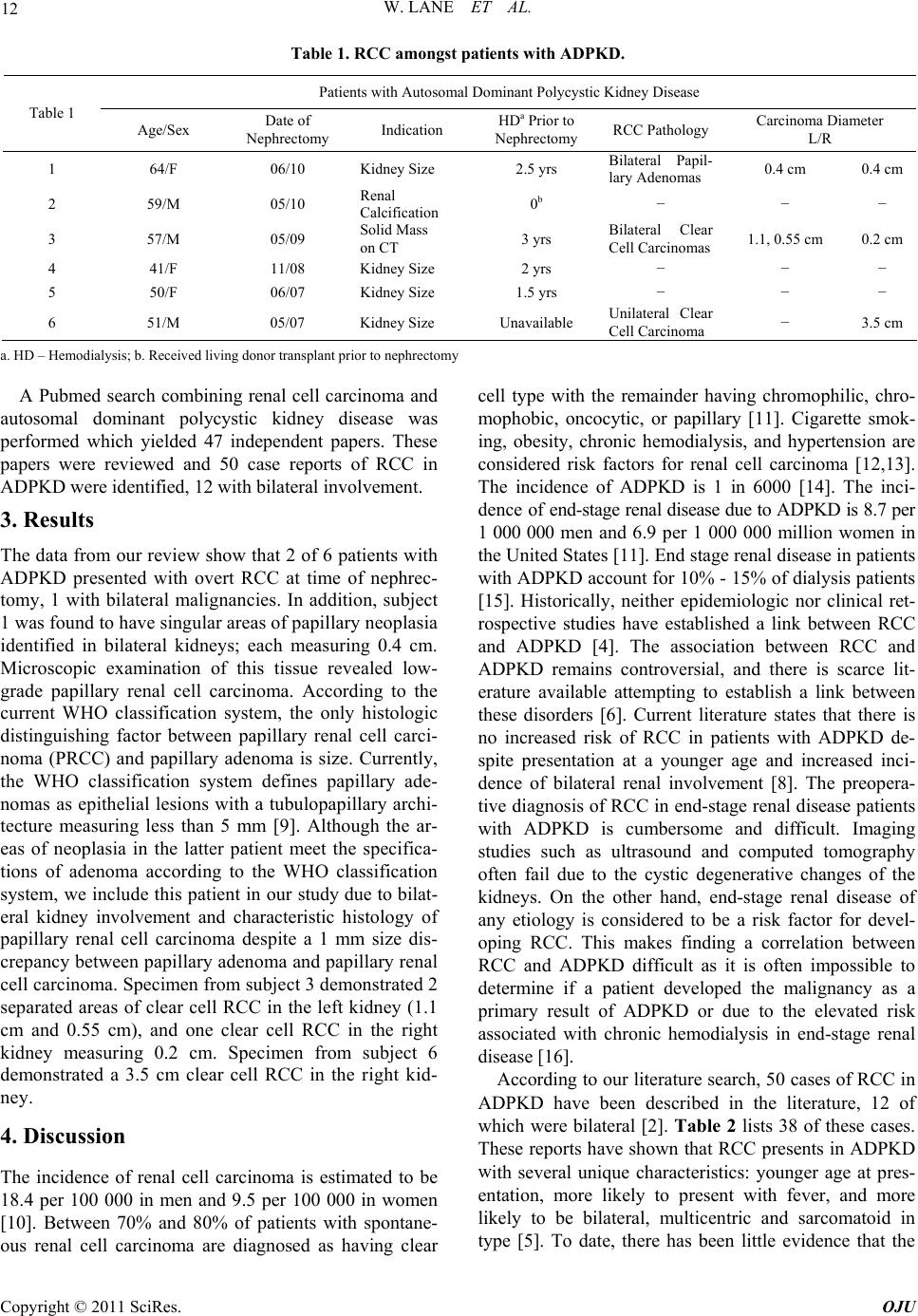 W. LANE ET AL. 12 Table 1. RCC amongst patients with ADPKD. ey Disease Patients with Autosomal Dominant Polycystic Kidn Table 1 Age/Sex Date of Nephrectom HDa Prior to Carcinoma Diameter L/R y Indication Nephrectomy RCC Pathology 1 64/F 06/10 KiBilateral Papilmdney Size 2.5 yrs - lary Adenomas 0.4 cm 0.4 c 2 59/M 05/10 Renal ass 3r Cell Carcinomas 1.1, cm 0. Unle Unilateral Clear Cell Carcinoma 3. Calcification 0b − Bilateral Clea − − 3 57/M 05/09 Solid M on CT yrs 0.552 cm 4 5 41/F 50/F 11/08 06/07 Kidney Size 2 yrs 1.5 yrs − − − − − − Kidney Size 6 51/M 05/07 Kidney Size availab− 5 cm a. HD –modialysis; b.ed living donlant priy utosomal dominant polycystic kidney disease was pe our review show that 2 of 6 patients with ented with overt RCC at time of nephrec- al cell carcinoma is estimated to be 18.4 per 100 000 in men and 9.5 per 100 000 in women cell type with the remainder having chromophilic, chro- mophobic, oncocytic, or papillary [11]. Cigarette smok- have shown that RCC presents in ADPKD w He Receivor transpor to nephrectom A Pubmed search combining renal cell carcinoma and a rformed which yielded 47 independent papers. These papers were reviewed and 50 case reports of RCC in ADPKD were identified, 12 with bilateral involvement. 3. Results The data from ADPKD pres tomy, 1 with bilateral malignancies. In addition, subject 1 was found to have singular areas of papillary neoplasia identified in bilateral kidneys; each measuring 0.4 cm. Microscopic examination of this tissue revealed low- grade papillary renal cell carcinoma. According to the current WHO classification system, the only histologic distinguishing factor between papillary renal cell carci- noma (PRCC) and papillary adenoma is size. Currently, the WHO classification system defines papillary ade- nomas as epithelial lesions with a tubulopapillary archi- tecture measuring less than 5 mm [9]. Although the ar- eas of neoplasia in the latter patient meet the specifica- tions of adenoma according to the WHO classification system, we include this patient in our study due to bilat- eral kidney involvement and characteristic histology of papillary renal cell carcinoma despite a 1 mm size dis- crepancy between papillary adenoma and papillary renal cell carcinoma. Specimen from subject 3 demonstrated 2 separated areas of clear cell RCC in the left kidney (1.1 cm and 0.55 cm), and one clear cell RCC in the right kidney measuring 0.2 cm. Specimen from subject 6 demonstrated a 3.5 cm clear cell RCC in the right kid- ney. 4. Discussion The incidence of ren [10]. Between 70% and 80% of patients with spontane- ous renal cell carcinoma are diagnosed as having clear ing, obesity, chronic hemodialysis, and hypertension are considered risk factors for renal cell carcinoma [12,13]. The incidence of ADPKD is 1 in 6000 [14]. The inci- dence of end-stage renal disease due to ADPKD is 8.7 per 1 000 000 men and 6.9 per 1 000 000 million women in the United States [11]. End stage renal disease in patients with ADPKD account for 10% - 15% of dialysis patients [15]. Historically, neither epidemiologic nor clinical ret- rospective studies have established a link between RCC and ADPKD [4]. The association between RCC and ADPKD remains controversial, and there is scarce lit- erature available attempting to establish a link between these disorders [6]. Current literature states that there is no increased risk of RCC in patients with ADPKD de- spite presentation at a younger age and increased inci- dence of bilateral renal involvement [8]. The preopera- tive diagnosis of RCC in end-stage renal disease patients with ADPKD is cumbersome and difficult. Imaging studies such as ultrasound and computed tomography often fail due to the cystic degenerative changes of the kidneys. On the other hand, end-stage renal disease of any etiology is considered to be a risk factor for devel- oping RCC. This makes finding a correlation between RCC and ADPKD difficult as it is often impossible to determine if a patient developed the malignancy as a primary result of ADPKD or due to the elevated risk associated with chronic hemodialysis in end-stage renal disease [16]. According to our literature search, 50 cases of RCC in ADPKD have been described in the literature, 12 of which were bilateral [2]. Table 2 lists 38 of these cases. These reports ith several unique characteristics: younger age at pres- entation, more likely to present with fever, and more likely to be bilateral, multicentric and sarcomatoid in type [5]. To date, there has been little evidence that the Copyright © 2011 SciRes. OJU 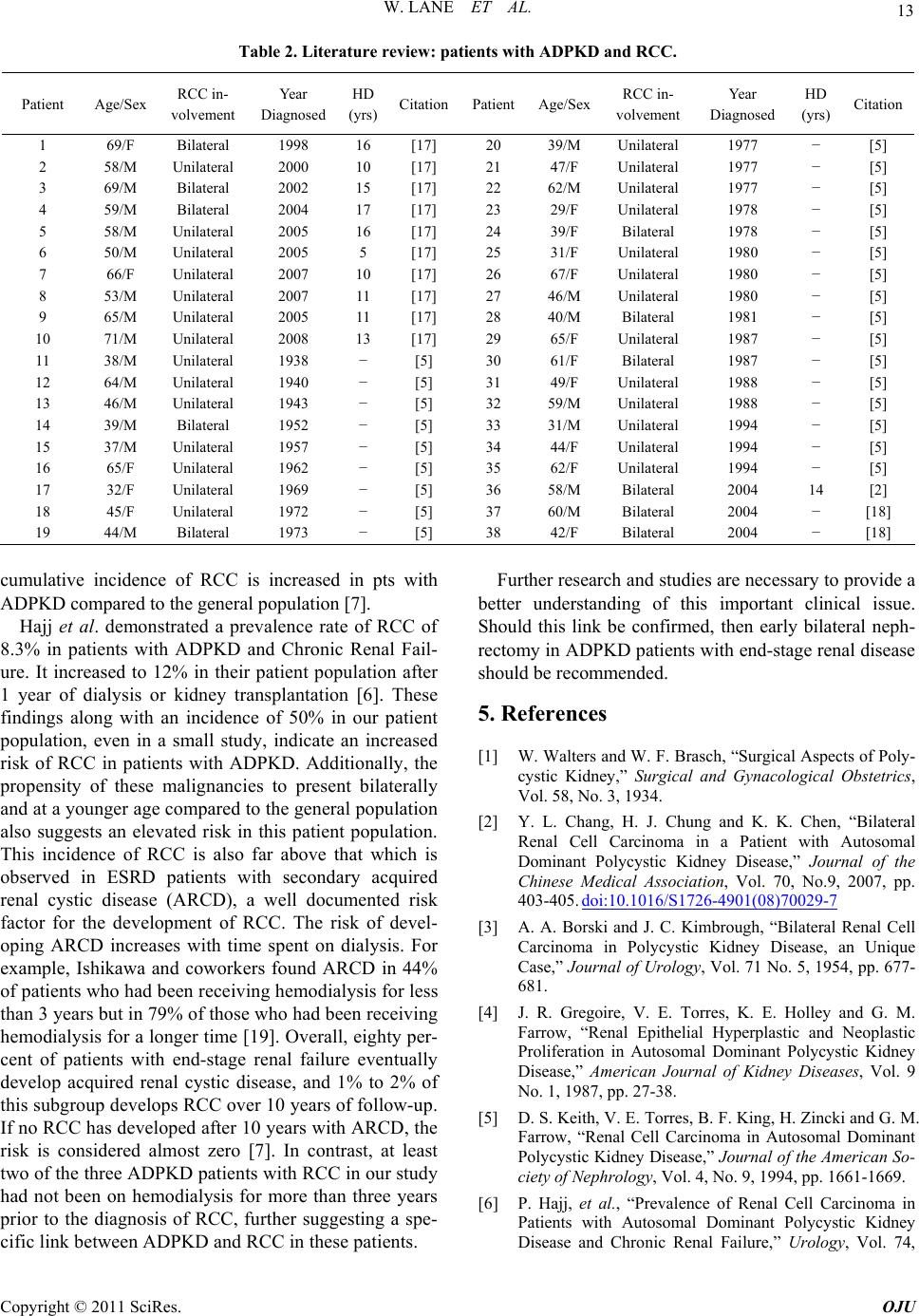 W. LANE ET AL. 13 atie Patient Age/Sex RCC in- volvement Year Diagnosed HD (yrs) Citation Table 2. Literature review: pnts with ADPKD and RCC. Year Diagnosed HD (yrs) Citation Patient Age/SexRCC in- volvement 1 69/F [17] 20 39/M [5] Bilateral 1998 16 Unilateral 1977 − 2 58/M Unilateral 2000 10 [17] 21 47/F Unilateral 1977 − [5] 3 4 69/M 59/M Bilateral 2002 Bilateral 15 17 [17] [17] 22 23 62/M 29/F Unilateral 1977 Unilateral − [5] − [5] 2004 1978 5 58/M Unilateral 2005 16 [17] 24 39/F Bilateral 1978 − [5] 6 50/M Unilateral 2005 5 [17] 25 31/F Unilateral 1980 − [5] 7 66/F Unilateral 2007 10 [17] 26 67/F Unilateral 1980 − [5] 8 53/M Unilateral 2007 11 [17] 27 46/M Unilateral 1980 − [5] 9 65/M Unilateral 2005 11 [17] 28 40/M Bilateral 1981 − [5] 10 71/M Unilateral 2008 13 [17] 29 65/F Unilateral 1987 − [5] 11 38/M Unilateral 1938 − [5] 30 61/F Bilateral 1987 − [5] 12 64/M Unilateral 1940 − [5] 31 49/F Unilateral 1988 − [5] 13 46/M Unilateral 1943 − [5] 32 59/M Unilateral 1988 − [5] 14 39/M Bilateral 1952 − [5] 33 31/M Unilateral 1994 − [5] 15 37/M Unilateral 1957 − [5] 34 44/F Unilateral 1994 − [5] 16 65/F Unilateral 1962 − [5] 35 62/F Unilateral 1994 − [5] 17 32/F Unilateral 1969 − [5] 36 58/M Bilateral 2004 14 [2] 18 45/F Unilateral 1972 − [5] 37 60/M Bilateral 2004 − [18] 19 44/M Bilateral 1973 − [5] 38 42/F Bilateral 2004 − [18] cumive ice is ied its with DP com rthearchdies aessary to provide a beter untandihis imant cnical i and K. K. Chen, “Bilateral arcinoma in a Patient with Autosomal Dominant Polycystic Kidney Disease,” Journal of the ulat KD nciden pared to t of RCC he general population [7]. ncreasn p A Hajj et al. demonstrated a prevalence rate of RCC of 8.3% in patients with ADPKD and Chronic Renal Fail- ure. It increased to 12% in their patient population after 1 year of dialysis or kidney transplantation [6]. These findings along with an incidence of 50% in our patient population, even in a small study, indicate an increased risk of RCC in patients with ADPKD. Additionally, the propensity of these malignancies to present bilaterally and at a younger age compared to the general population also suggests an elevated risk in this patient population. This incidence of RCC is also far above that which is observed in ESRD patients with secondary acquired renal cystic disease (ARCD), a well documented risk factor for the development of RCC. The risk of devel- oping ARCD increases with time spent on dialysis. For example, Ishikawa and coworkers found ARCD in 44% of patients who had been receiving hemodialysis for less than 3 years but in 79% of those who had been receiving hemodialysis for a longer time [19]. Overall, eighty per- cent of patients with end-stage renal failure eventually develop acquired renal cystic disease, and 1% to 2% of this subgroup develops RCC over 10 years of follow-up. If no RCC has developed after 10 years with ARCD, the risk is considered almost zero [7]. In contrast, at least two of the three ADPKD patients with RCC in our study had not been on hemodialysis for more than three years prior to the diagnosis of RCC, further suggesting a spe- cific link between ADPKD and RCC in these patients. Should this link be confirmed, then early bilateral neph- rectomy in ADPKD patients with end-stage renal disease should be recommended. Fu t r rese ders and stu ng of t re nec port lissue. 5. References [1] W. Walters and W. F. Brasch, “Surgical Aspects of Poly- cystic Kidney,” Surgical and Gynacological Obstetrics, Vol. 58, No. 3, 1934. [2] Y. L. Chang, H. J. Chung Renal Cell C Chinese Medical Association, Vol. 70, No.9, 2007, pp. 403-405. doi:10.1016/S1726-4901(08)70029-7 [3] A. A. Borski and J. C. Kimbrough, “Bilateral Renal Cell eoplastic V. E. Torres, B. F. King, H. Zincki and G. M. l Dominant Polycystic Kidney Carcinoma in Polycystic Kidney Disease, an Unique Case,” Journal of Urology, Vol. 71 No. 5, 1954, pp. 677- 681. [4] J. R. Gregoire, V. E. Torres, K. E. Holley and G. M. Farrow, “Renal Epithelial Hyperplastic and N Proliferation in Autosomal Dominant Polycystic Kidney Disease,” American Journal of Kidney Diseases, Vol. 9 No. 1, 1987, pp. 27-38. [5] D. S. Keith, Farrow, “Renal Cell Carcinoma in Autosomal Dominant Polycystic Kidney Disease,” Journal of the American So- ciety of Nephrology, Vol. 4, No. 9, 1994, pp. 1661-1669. [6] P. Hajj, et al., “Prevalence of Renal Cell Carcinoma in Patients with Autosoma Disease and Chronic Renal Failure,” Urology, Vol. 74, Copyright © 2011 SciRes. OJU  14 W. LANE ET AL. No. 3, 2009, pp. 631-634. doi:10.1016/j.urology.2009.02.078 [7] A. J. Wein, et al., “Campbell-Walsh Urology,” 9th Edi- tion, Elsevier Inc., Philidelphia, Vol. 2, pp. 1583-1588 and Vol.4, 2007, pp. 3323. [8] L. Gomella, “The 5-Minute Urology Consult,” Lippincott Williams and Wilkins, Philidelphia, PA, 2009. .07.016 [9] K. L. Wang, et al., “Renal Papillary Adenoma-A Putative Precursor of Papillary Renal Cell Carcinoma,” Human Pathology, Vol. 38, No. 2, 2007, pp. 239-246. doi:10.1016/j.humpath.2006 ancer in [10] D. K. Espey, et al., “Annual Report to the Nation on the Status of Cancer, 1975-2004, Featuring C American Indians and Alaskan Natives,” Cancer, Vol. 110, No. 10, 2007, pp. 2119-2152. doi:10.1002/cncr.23044 [11] B. I. Rini, S. C. Campbell and B. Escudier “Renal Cell Carcinoma,” Lancet, Vol. 28, No. 373, 2009, pp. 1119-1132. doi:10.1016/S0140-6736(09)60229-4 [12] R. P. Theis, S. M. Dolwick Grieb, D. Blurr, T. Siddiqui and N. R. Asal “Smoking, Env Smoke, and Risk of R ironmental Tobacco enal Cell Cancer: A Popula- d L. J. tion-Based Case-Control Study,” BMC Cancer, Vol. 8, No. 387, 2008, pp. 1-11. [13] Y. Wang, X. Chen, Y. Song, B. Caballero an Cheskin, “Association between Obesity and Kidney Dis- ease: A Systematic Review and Meta-Analysis,” Kidney International, Vol. 73, No. 1, 2008, pp. 19-33. doi:10.1038/sj.ki.5002586 [14] P. A. Gabow, “Autosomal Dominant Polycystic Kidney Disease.” New England Journal of Medicine, No. 5, 1993, pp. 332-342. Vol. 329, doi:10.1056/NEJM199307293290508 [15] K. Badani, A. K. Hemal and M. Menon, “Autosomal Dominant Polycystic Kidney Disease view of the Disease from Aetiology, Evaluation, Past and Pain - A Re- s: A Single Center Experience,” International Surgical Treatment Options to Current Practice,” Journal of Postgraduate medicine, Vol. 50, No. 3, 2004, pp. 222-226. [16] Y. Kojima, S. Takahara, O. Miyake, N. Nonomura, A. Morimoto and H. Mori, “Renal Cell Carcinoma in Dialy- sis Patient Journal of Urology, Vol. 13 No. 8, 2006, pp. 1045-1048. doi:10.1111/j.1442-2042.2006.01498.x [17] H. Nishimura, “Renal Cell Carcinoma in Autosomal Dominant Polycystic Kidney Disease,” American Journal of Kidney Disease, Vol. 54, No. 1, 2009, pp . 165-168. doi:10.1053/j.ajkd.2009.01.270 [18] A. Kapoor, et al., “Renal Cell Carcinoma in Autosomal Dominant Polycystic Kidney Disease,” European Jour of Radiology Extra, Vol. 51, No. nal 2, 2004, pp. 87-89. doi:10.1016/j.ejrex.2004.05.003 [19] I. Ishikawa, et al., “Development of Acquired Cystic Disease and Adenocarcinoma of the Kidney in Glom lonephrotic Chronic Hemodialysis Pati eru- ents,” Clinical Nephrolgy, Vol. 14, No. 1, 1980, pp. 1-6. Copyright © 2011 SciRes. OJU |