

Paper Menu >>
Journal Menu >>
 Journal of Modern Physics, 2011, 2, 374-378 doi:10.4236/jmp.2011.25046 Published Online May 2011 (http://www.SciRP.org/journal/jmp) Copyright © 2011 SciRes. JMP Critical Behavior of a Supersymmetric Extension of the Ginzburg-Landau Model Grigoris Panotopoulos Departament de Fisica Teorica , Universitat de Valencia, Burjassot, Spain; Instituto de Fisica Corpuscular (IFIC), Institutos de Paterna, Universitat de Va lencia-CSIC, Valencia, Spain E-mail: [email protected] Received January 31, 2011; revised February 26, 2011; accepted March 18, 2011 Abstract We make a connection between quantum phase transitions in condensed matter systems, and supersymmetric gauge theories that are of interest in the particle physics literature. In particular, we point out interesting effects of the supersymmetric quantum electrodynamics upon the critical behavior of the Ginzburg-Landau model. It is shown that supersymmetry fixes the critical exponents, as well as the Landau-Ginzburg para- meter, and that the model resides in the type II regime of superconductivity. Keywords: Superconductivity, Critical Exponents, Supersymmetry 1. Introduction A very well studied model in the condensed matter literature is the Ginzburg-Landau (GL) model [1], des- cribed by the lagrangian of an Abelian Higgs model 224 22 1 =4 Dm F (1) where is a complex scalar field charged under the abelian gauge field A , with the gauge covariant deri- vative and field strength =DieA (2) = F AA (3) When 2>0m, the gauge symmetry is exact, and the model describes a massive complex scalar particle that interacts with a massless photon. The electric potential between these scalars has the usual Coulomb form, and therefore this is referred to as the Coulomb phase. On the other hand, when 2<0m the gauge symmetry is spon- taneously broken, and in this Higgs phase the model describes a massive gauge boson and a massive real sca- lar field. The nature of the transition between the Higgs and Coulomb phase has been of great interest to the con- densed matter community. The critical fluctuations in the Ginzburg-Landau model of superconductors were studied in [2], while the fixed point structure for the GL model was presented in [3]. Furthermore, in previous works the authors have inves- tigated models in which massless Dirac fermions are coupled to the Ginzburg-Landau model [4]. The presence of the Dirac fermions is justified by the fact that effective microscopic models of strongly correlated electrons usualy contain them [5]. The critical exponents can be computed as a function of the number F N of the fer- mions, and for increasing F N the models is driven into the type II regime of superconductivity. In particular, for the minimum allowed value of the fermion number, =4 F N, both values of the parameter, correspond- ing to the ‘T’ fixed point and the ‘SC’ fixed point, are found to be above the mean-field GL value 12, in contrast to the theoretical [6] and the Monte Carlo num- bers [7] in the GL model. In this article we point out that the generalization of the Ginzburg-Landau model to a supersymmetric one necessarily introduces fermions both in the matter and gauge supermultiplets, and that the restrictions imposed by the symmetries of the model unambigiously determine the critical exponents and the Landau-Ginzburg parameter, which is found to be in the type II regime of superconductivity. Finally, we remind the reader that a) all exactly sol- vable models show that not all of the critical exponents are independent. In fact they satisfy certain scaling laws, supported by all the experimental and numerical results, and it can be shown that there are only two independent critical exponents. If we take them to be and , the rest of the critical exponents are given by [8,9]:  G. PANOTOPOULOS Copyright © 2011 SciRes. JMP 375 =2 D (4) =2 2D (5) =2 (6) 2 =2 D D (7) where D is the dimension of the system, and b) in the Landau-Ginzburg theory there are two fundamental length scales, namely the penetration length and the cohe- rence length 0 . The Landau-Ginzburg parameter is defined as follows 0 (8) and it can be shown that <1 2 corresponds to type I superconductors, while 12 corresponds to type II superconductors. 2. The Supersymmetric Model and Critical Exponents Supersymmetric Quantum Electrodynamics (SQED) is an abelian gauge theory with the following field content [10]: 1) One vector multiplet ,,A consisting of the photon and the photino (in the so-called Wess-Zumino gauge), described by a vector and a Majorana spinor field. 2) Two chiral multiplets , L L and , R R with charges =1 L Q, =1 R Q, each consisting of one Weyl spinor and one scalar field, consti- tuting the left- and right-handed electron and se- lectron, the matter fields. The electron Dirac spinor and the photino Majorana spinor are given by =, = . L R i i (9) The SQED Lagrangian contains kinetic, minimal cou- pling and mass terms and in addition, due to the super- symmetry, coupling terms to the photino and quartic terms in the selectron fields: S 2 2† †† 2 22 22 2 11 =42 2 1 2 QED LR LRLLRLL RR LLRRL R LFFi DD iD eQ PPPP eQeQm m (10) with the gauge covariant derivative and field strength =,DieQA (11) =. F AA (12) It must be noted that the model with just one chiral su- permultiplet is anomalous, while the inclusion of a second chiral supermultiplet with opposite electric charge renders the model anomaly-free, since in this case =0TrQ . The two Weyl spinors combine to form the Dirac spinor of the usual spinor electrodynamics in the standard four- component formalism. The model contains both bosons and fermions, with equal masses and degrees of freedom within each multi- plet. The form of the interactions, as well as the values of the couplings, are completely determined by the symme- tries. It is interesting that there is just one coupling con- stant, namely the electric charge e. We have the usual types of interaction that one encounters in the usual field theory, namely quartic interaction for the scalars, Yukawa coupling, and the gauge (electromagnetic) interaction. We thus know that the theory is renormalizable. In fact, here we have just a wave function renormalization both for the vector and the chiral multiplets due to supersym- metry [11], and furthermore the beta function for the elec- tric charge is determined by the photon self-energy and wave-function renormalization due to gauge invariance [12]. The investigation regarding the critical behavior is ac- cording to the following program: a) Perform a one-loop analysis to compute the relevant counterterms that elimi- nate the unwanted divergencies, b) determine the beta- function for the electric charge e , as well as the anomalous dimensions for the scalars , m , c) find the fixed points from the condition *=0e , and finally d) compute the critical exponents , using the well- known formulas [4,13] * =2 (13) * 1 =21 m (14) where the anomalous dimensions, as well as the beta function are given by [14] = (15) ln 1 =2 Z (16) = mm m (17) with the renormalization mass scale, and 2 =4πe the fine-structure constant. Note that our definitions for the anomalous dimensions are slightly different than [4,13]. 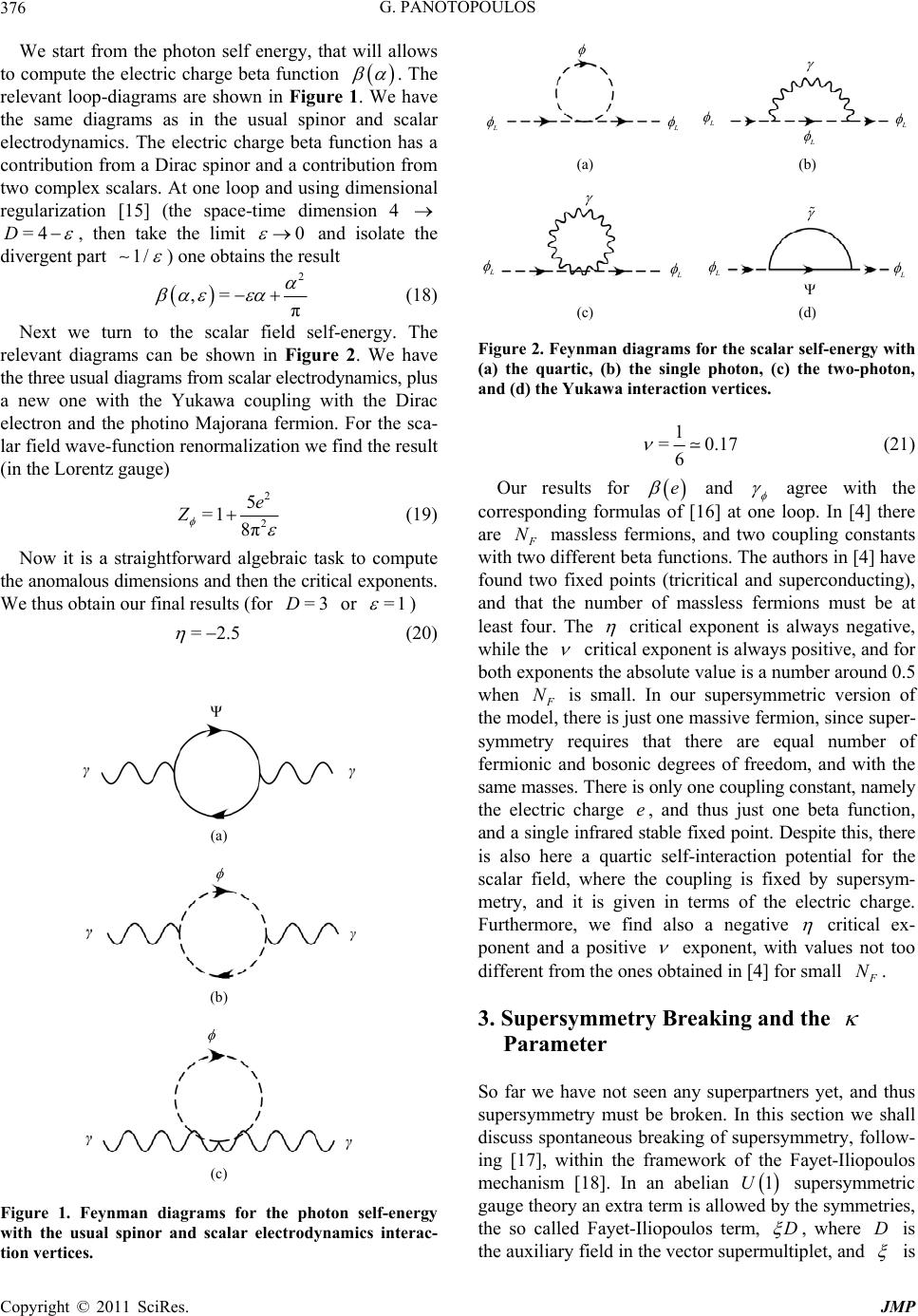 G. PANOTOPOULOS Copyright © 2011 SciRes. JMP 376 We start from the photon self energy, that will allows to compute the electric charge beta function . The relevant loop-diagrams are shown in Figure 1. We have the same diagrams as in the usual spinor and scalar electrodynamics. The electric charge beta function has a contribution from a Dirac spinor and a contribution from two complex scalars. At one loop and using dimensional regularization [15] (the space-time dimension 4 =4D , then take the limit 0 and isolate the divergent part 1/ ) one obtains the result 2 ,= π (18) Next we turn to the scalar field self-energy. The relevant diagrams can be shown in Figure 2. We have the three usual diagrams from scalar electrodynamics, plus a new one with the Yukawa coupling with the Dirac electron and the photino Majorana fermion. For the sca- lar field wave-function renormalization we find the result (in the Lorentz gauge) 2 2 5 =1 8π e Z (19) Now it is a straightforward algebraic task to compute the anomalous dimensions and then the critical exponents. We thus obtain our final results (for =3D or =1 ) =2.5 (20) (a) (b) (c) Figure 1. Feynman diagrams for the photon self-energy with the usual spinor and scalar electrodynamics interac- tion vertices. L L L L L (a) (b) L L L L (c) (d) Figure 2. Feynman diagrams for the scalar self-energy with (a) the quartic, (b) the single photon, (c) the two-photon, and (d) the Yukawa interaction vertices. 1 =0.17 6 (21) Our results for e and agree with the corresponding formulas of [16] at one loop. In [4] there are F N massless fermions, and two coupling constants with two different beta functions. The authors in [4] have found two fixed points (tricritical and superconducting), and that the number of massless fermions must be at least four. The critical exponent is always negative, while the critical exponent is always positive, and for both exponents the absolute value is a number around 0.5 when F N is small. In our supersymmetric version of the model, there is just one massive fermion, since super- symmetry requires that there are equal number of fermionic and bosonic degrees of freedom, and with the same masses. There is only one coupling constant, namely the electric charge e, and thus just one beta function, and a single infrared stable fixed point. Despite this, there is also here a quartic self-interaction potential for the scalar field, where the coupling is fixed by supersym- metry, and it is given in terms of the electric charge. Furthermore, we find also a negative critical ex- ponent and a positive exponent, with values not too different from the ones obtained in [4] for small F N. 3. Supersymmetry Breaking and the Parameter So far we have not seen any superpartners yet, and thus supersymmetry must be broken. In this section we shall discuss spontaneous breaking of supersymmetry, follow- ing [17], within the framework of the Fayet-Iliopoulos mechanism [18]. In an abelian 1U supersymmetric gauge theory an extra term is allowed by the symmetries, the so called Fayet-Iliopoulos term, D , where D is the auxiliary field in the vector supermultiplet, and is 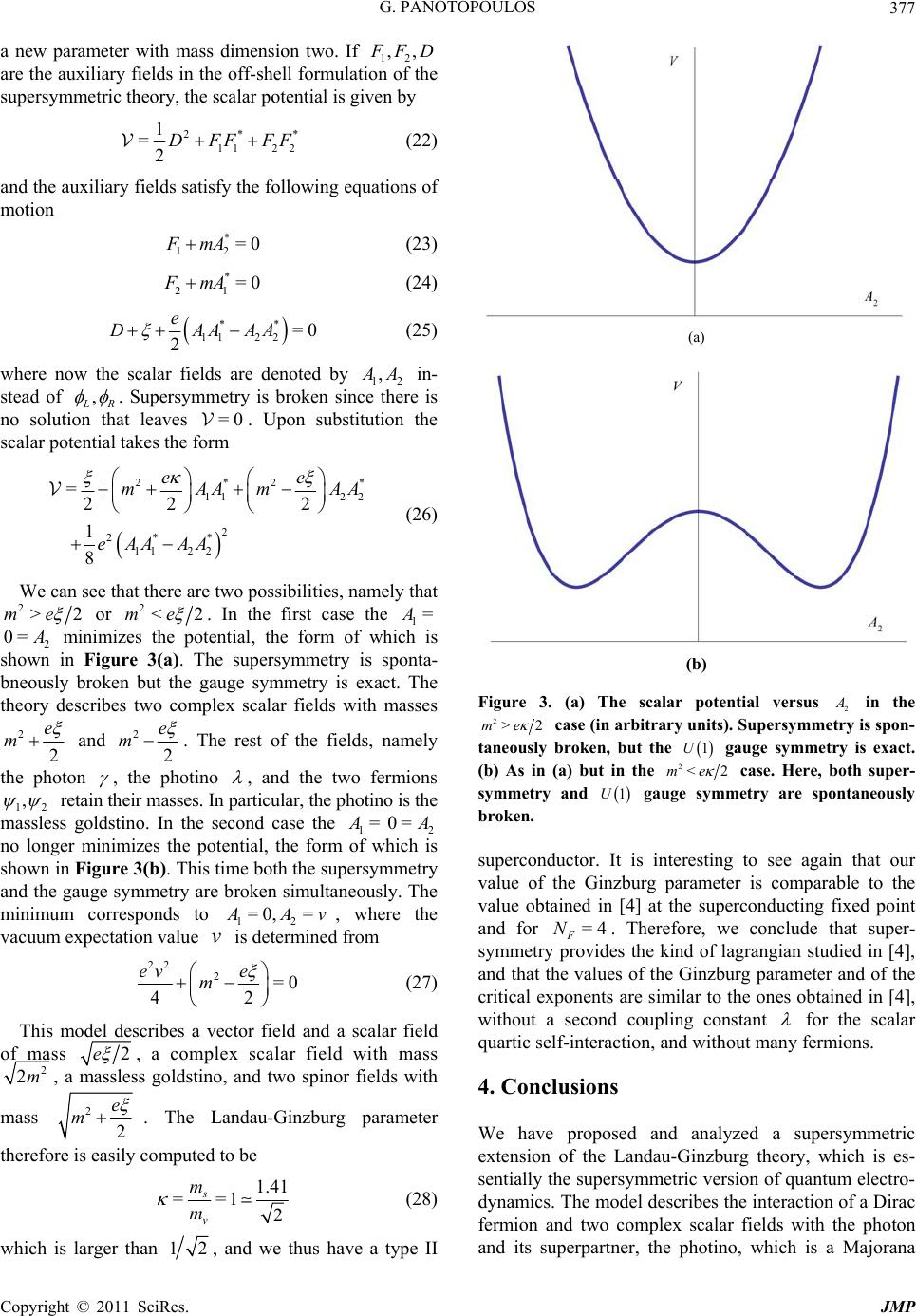 G. PANOTOPOULOS Copyright © 2011 SciRes. JMP 377 a new parameter with mass dimension two. If 12 ,, F FD are the auxiliary fields in the off-shell formulation of the supersymmetric theory, the scalar potential is given by 2* * 112 2 1 =2DFFFF (22) and the auxiliary fields satisfy the following equations of motion * 12 =0FmA (23) * 21 =0FmA (24) ** 1122=0 2 e DAAAA (25) where now the scalar fields are denoted by 12 , A A in- stead of , L R . Supersymmetry is broken since there is no solution that leaves =0. Upon substitution the scalar potential takes the form 2*2* 112 2 2 2* * 1122 =22 2 1 8 ee mAAmAA eAA AA (26) We can see that there are two possibilities, namely that 2>2me or 2<2me . In the first case the 1= A 2 0= A minimizes the potential, the form of which is shown in Figure 3(a). The supersymmetry is sponta- bneously broken but the gauge symmetry is exact. The theory describes two complex scalar fields with masses 2 2 e m and 2 2 e m . The rest of the fields, namely the photon , the photino , and the two fermions 12 , retain their masses. In particular, the photino is the massless goldstino. In the second case the 1= A 2 0= A no longer minimizes the potential, the form of which is shown in Figure 3(b). This time both the supersymmetry and the gauge symmetry are broken simultaneously. The minimum corresponds to 12 =0, = A Av, where the vacuum expectation value v is determined from 22 2=0 42 ev e m (27) This model describes a vector field and a scalar field of mass 2e , a complex scalar field with mass 2 2m, a massless goldstino, and two spinor fields with mass 2 2 e m . The Landau-Ginzburg parameter therefore is easily computed to be 1.41 ==1 2 s v m m (28) which is larger than 12, and we thus have a type II (a) (b) Figure 3. (a) The scalar potential versus 2 A in the 2>2me case (in arbitrary units). Supersymme try is spon- taneously broken, but the 1U gauge symmetry is exact. (b) As in (a) but in the 2<2me case. Here, both super- symmetry and 1U gauge symmetry are spontaneously broken. superconductor. It is interesting to see again that our value of the Ginzburg parameter is comparable to the value obtained in [4] at the superconducting fixed point and for =4 F N. Therefore, we conclude that super- symmetry provides the kind of lagrangian studied in [4], and that the values of the Ginzburg parameter and of the critical exponents are similar to the ones obtained in [4], without a second coupling constant for the scalar quartic self-interaction, and without many fermions. 4. Conclusions We have proposed and analyzed a supersymmetric extension of the Landau-Ginzburg theory, which is es- sentially the supersymmetric version of quantum electro- dynamics. The model describes the interaction of a Dirac fermion and two complex scalar fields with the photon and its superpartner, the photino, which is a Majorana 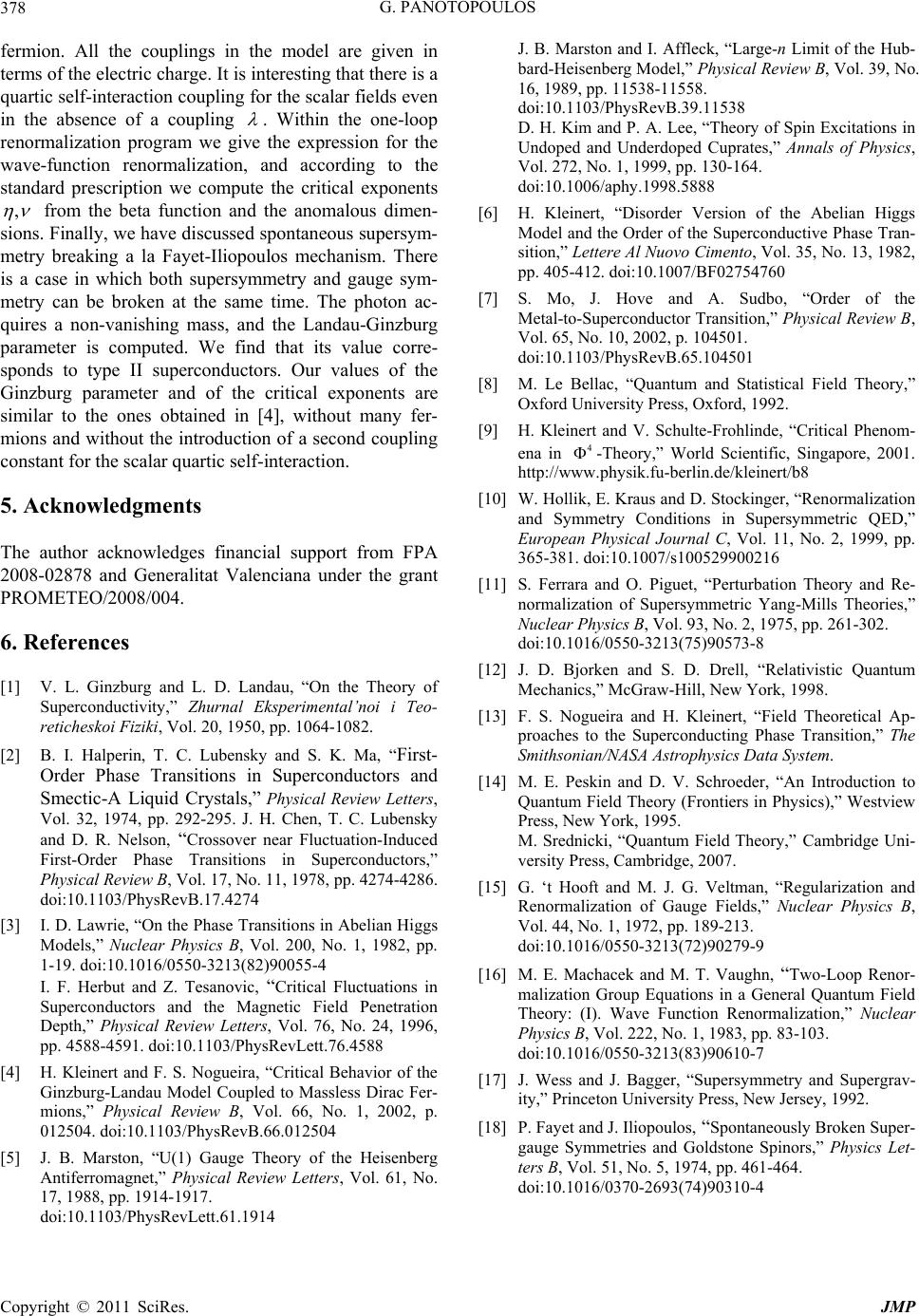 G. PANOTOPOULOS Copyright © 2011 SciRes. JMP 378 fermion. All the couplings in the model are given in terms of the electric charge. It is interesting that there is a quartic self-interaction coupling for the scalar fields even in the absence of a coupling . Within the one-loop renormalization program we give the expression for the wave-function renormalization, and according to the standard prescription we compute the critical exponents , from the beta function and the anomalous dimen- sions. Finally, we have discussed spontaneous supersym- metry breaking a la Fayet-Iliopoulos mechanism. There is a case in which both supersymmetry and gauge sym- metry can be broken at the same time. The photon ac- quires a non-vanishing mass, and the Landau-Ginzburg parameter is computed. We find that its value corre- sponds to type II superconductors. Our values of the Ginzburg parameter and of the critical exponents are similar to the ones obtained in [4], without many fer- mions and without the introduction of a second coupling constant for the scalar quartic self-interaction. 5. Acknowledgments The author acknowledges financial support from FPA 2008-02878 and Generalitat Valenciana under the grant PROMETEO/2008/004. 6. References [1] V. L. Ginzburg and L. D. Landau, “On the Theory of Superconductivity,” Zhurnal Eksperimental’noi i Teo- reticheskoi Fiziki, Vol. 20, 1950, pp. 1064-1082. [2] B. I. Halperin, T. C. Lubensky and S. K. Ma, “First- Order Phase Transitions in Superconductors and Smectic-A Liquid Crystals,” Physical Review Letters, Vol. 32, 1974, pp. 292-295. J. H. Chen, T. C. Lubensky and D. R. Nelson, “Crossover near Fluctuation-Induced First-Order Phase Transitions in Superconductors,” Physical Review B, Vol. 17, No. 11, 1978, pp. 4274-4286. doi:10.1103/PhysRevB.17.4274 [3] I. D. Lawrie, “On the Phase Transitions in Abelian Higgs Models,” Nuclear Physics B, Vol. 200, No. 1, 1982, pp. 1-19. doi:10.1016/0550-3213(82)90055-4 I. F. Herbut and Z. Tesanovic, “Critical Fluctuations in Superconductors and the Magnetic Field Penetration Depth,” Physical Review Letters, Vol. 76, No. 24, 1996, pp. 4588-4591. doi:10.1103/PhysRevLett.76.4588 [4] H. Kleinert and F. S. Nogueira, “Critical Behavior of the Ginzburg-Landau Model Coupled to Massless Dirac Fer- mions,” Physical Review B, Vol. 66, No. 1, 2002, p. 012504. doi:10.1103/PhysRevB.66.012504 [5] J. B. Marston, “U(1) Gauge Theory of the Heisenberg Antiferromagnet,” Physical Review Letters, Vol. 61, No. 17, 1988, pp. 1914-1917. doi:10.1103/PhysRevLett.61.1914 J. B. Marston and I. Affleck, “Large-n Limit of the Hub- bard-Heisenberg Model,” Physical Review B, Vol. 39, No. 16, 1989, pp. 11538-11558. doi:10.1103/PhysRevB.39.11538 D. H. Kim and P. A. Lee, “Theory of Spin Excitations in Undoped and Underdoped Cuprates,” Annals of Physics, Vol. 272, No. 1, 1999, pp. 130-164. doi:10.1006/aphy.1998.5888 [6] H. Kleinert, “Disorder Version of the Abelian Higgs Model and the Order of the Superconductive Phase Tran- sition,” Lette re Al Nuov o Ciment o, Vol. 35, No. 13, 1982, pp. 405-412. doi:10.1007/BF02754760 [7] S. Mo, J. Hove and A. Sudbo, “Order of the Metal-to-Superconductor Transition,” Physical Review B, Vol. 65, No. 10, 2002, p. 104501. doi:10.1103/PhysRevB.65.104501 [8] M. Le Bellac, “Quantum and Statistical Field Theory,” Oxford University Press, Oxford, 1992. [9] H. Kleinert and V. Schulte-Frohlinde, “Critical Phenom- ena in 4 -Theory,” World Scientific, Singapore, 2001. http://www.physik.fu-berlin.de/kleinert/b8 [10] W. Hollik, E. Kraus and D. Stockinger, “Renormalization and Symmetry Conditions in Supersymmetric QED,” European Physical Journal C, Vol. 11, No. 2, 1999, pp. 365-381. doi:10.1007/s100529900216 [11] S. Ferrara and O. Piguet, “Perturbation Theory and Re- normalization of Supersymmetric Yang-Mills Theories,” Nuclear Physics B, Vol. 93, No. 2, 1975, pp. 261-302. doi:10.1016/0550-3213(75)90573-8 [12] J. D. Bjorken and S. D. Drell, “Relativistic Quantum Mechanics,” McGraw-Hill, New York, 1998. [13] F. S. Nogueira and H. Kleinert, “Field Theoretical Ap- proaches to the Superconducting Phase Transition,” The Smithsonian/NASA Astrophysics D ata System. [14] M. E. Peskin and D. V. Schroeder, “An Introduction to Quantum Field Theory (Frontiers in Physics),” Westview Press, New York, 1995. M. Srednicki, “Quantum Field Theory,” Cambridge Uni- versity Press, Cambridge, 2007. [15] G. ‘t Hooft and M. J. G. Veltman, “Regularization and Renormalization of Gauge Fields,” Nuclear Physics B, Vol. 44, No. 1, 1972, pp. 189-213. doi:10.1016/0550-3213(72)90279-9 [16] M. E. Machacek and M. T. Vaughn, “Two-Loop Renor- malization Group Equations in a General Quantum Field Theory: (I). Wave Function Renormalization,” Nuclear Physics B, Vol. 222, No. 1, 1983, pp. 83-103. doi:10.1016/0550-3213(83)90610-7 [17] J. Wess and J. Bagger, “Supersymmetry and Supergrav- ity,” Princeton University Press, New Jersey, 1992. [18] P. Fayet and J. Iliopoulos, “Spontaneously Broken Super- gauge Symmetries and Goldstone Spinors,” Physics Let- ters B, Vol. 51, No. 5, 1974, pp. 461-464. doi:10.1016/0370-2693(74)90310-4 |