

Paper Menu >>
Journal Menu >>
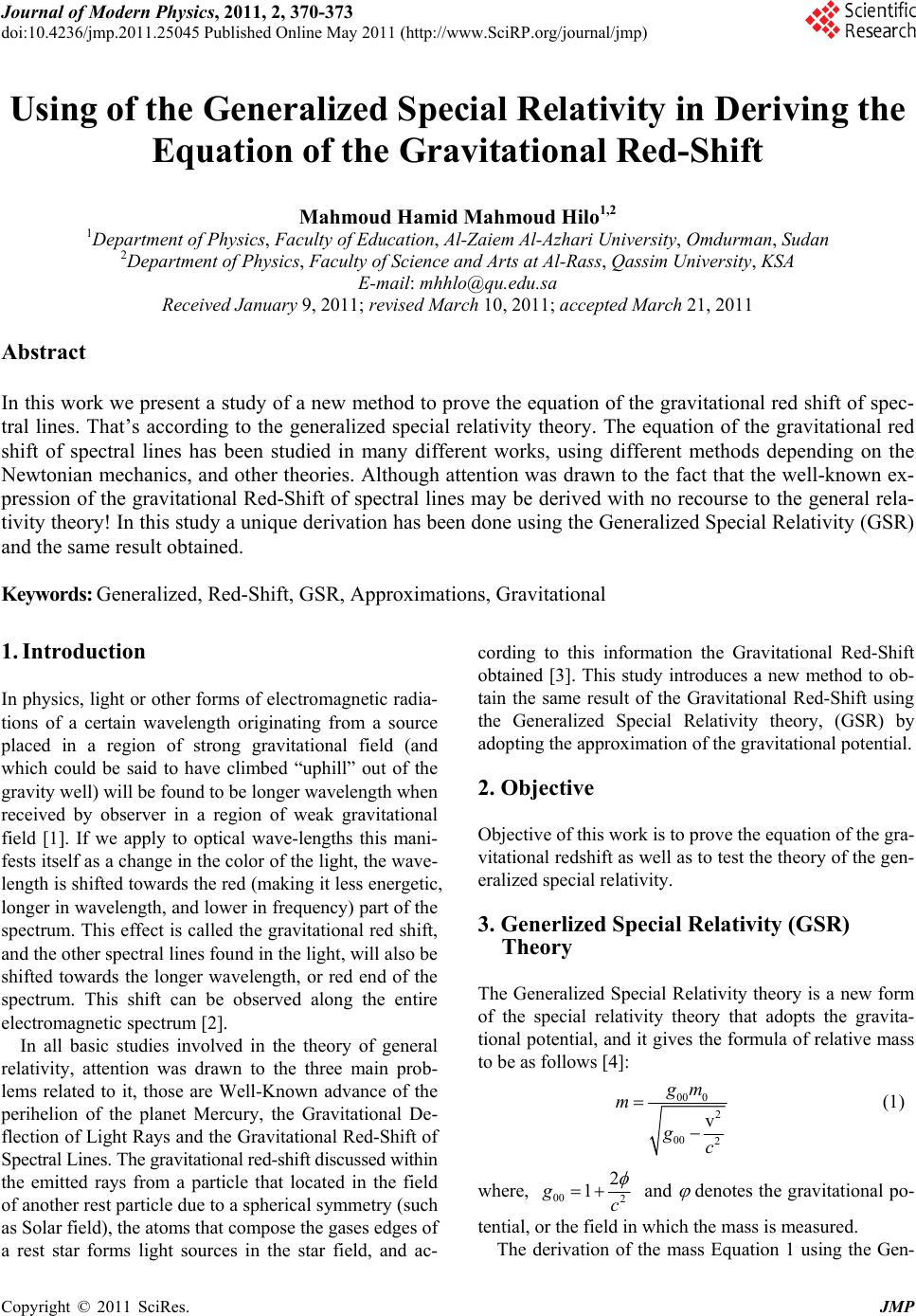 Journal of Modern Physics, 2011, 2, 370-373 doi:10.4236/jmp.2011.25045 Published Online May 2011 (http://www.SciRP.org/journal/jmp) Copyright © 2011 SciRes. JMP Using of the Generalized Special Relativity in Deriving the Equation of the Gravitational Red-Shift Mahmoud Hamid Mahmoud Hilo1,2 1Department of Physics, Faculty of Education, Al-Zaiem Al-Azhari University, Omdurman, Sudan 2Department of Physics, Faculty of Science and Arts at Al-Rass, Qassim University, KSA E-mail: [email protected] Received January 9, 2011; revised March 10, 2011; accepted March 21, 2011 Abstract In this work we present a study of a new method to prove the equation of the gravitational red shift of spec- tral lines. That’s according to the generalized special relativity theory. The equation of the gravitational red shift of spectral lines has been studied in many different works, using different methods depending on the Newtonian mechanics, and other theories. Although attention was drawn to the fact that the well-known ex- pression of the gravitational Red-Shift of spectral lines may be derived with no recourse to the general rela- tivity theory! In this study a unique derivation has been done using the Generalized Special Relativity (GSR) and the same result obtained. Keywords: Generalized, Red-Shift, GSR, Approximations, Gravitational 1. Introduction In physics, light or other forms of electromagnetic radia- tions of a certain wavelength originating from a source placed in a region of strong gravitational field (and which could be said to have climbed “uphill” out of the gravity well) will be found to be longer wavelength when received by observer in a region of weak gravitational field [1]. If we apply to optical wave-lengths this mani- fests itself as a change in the color of the light, the wave- length is shifted towards the red (making it less energetic, longer in wavelength, and lower in frequency) part of the spectrum. This effect is called the gravitational red shift, and the other spectral lines found in the light, will also be shifted towards the longer wavelength, or red end of the spectrum. This shift can be observed along the entire electromagnetic spectrum [2]. In all basic studies involved in the theory of general relativity, attention was drawn to the three main prob- lems related to it, those are Well-Known advance of the perihelion of the planet Mercury, the Gravitational De- flection of Light Rays and the Gravitational Red-Shift of Spectral Lines. The gravitational red-shift discussed within the emitted rays from a particle that located in the field of another rest particle due to a spherical symmetry (such as Solar field), the atoms that compose the gases edges of a rest star forms light sources in the star field, and ac- cording to this information the Gravitational Red-Shift obtained [3]. This study introduces a new method to ob- tain the same result of the Gravitational Red-Shift using the Generalized Special Relativity theory, (GSR) by adopting the approximation of the gravitational potential. 2. Objective Objective of this work is to prove the equation of the gra- vitational redshift as well as to test the theory of the gen- eralized special relativity. 3. Generlized Special Relativity (GSR) Theory The Generalized Special Relativity theory is a new form of the special relativity theory that adopts the gravita- tional potential, and it gives the formula of relative mass to be as follows [4]: 00 0 2 00 2 v g m m gc (1) where, 00 2 2 1gc and denotes the gravitational po- tential, or the field in which the mass is measured. The derivation of the mass Equation 1 using the Gen- 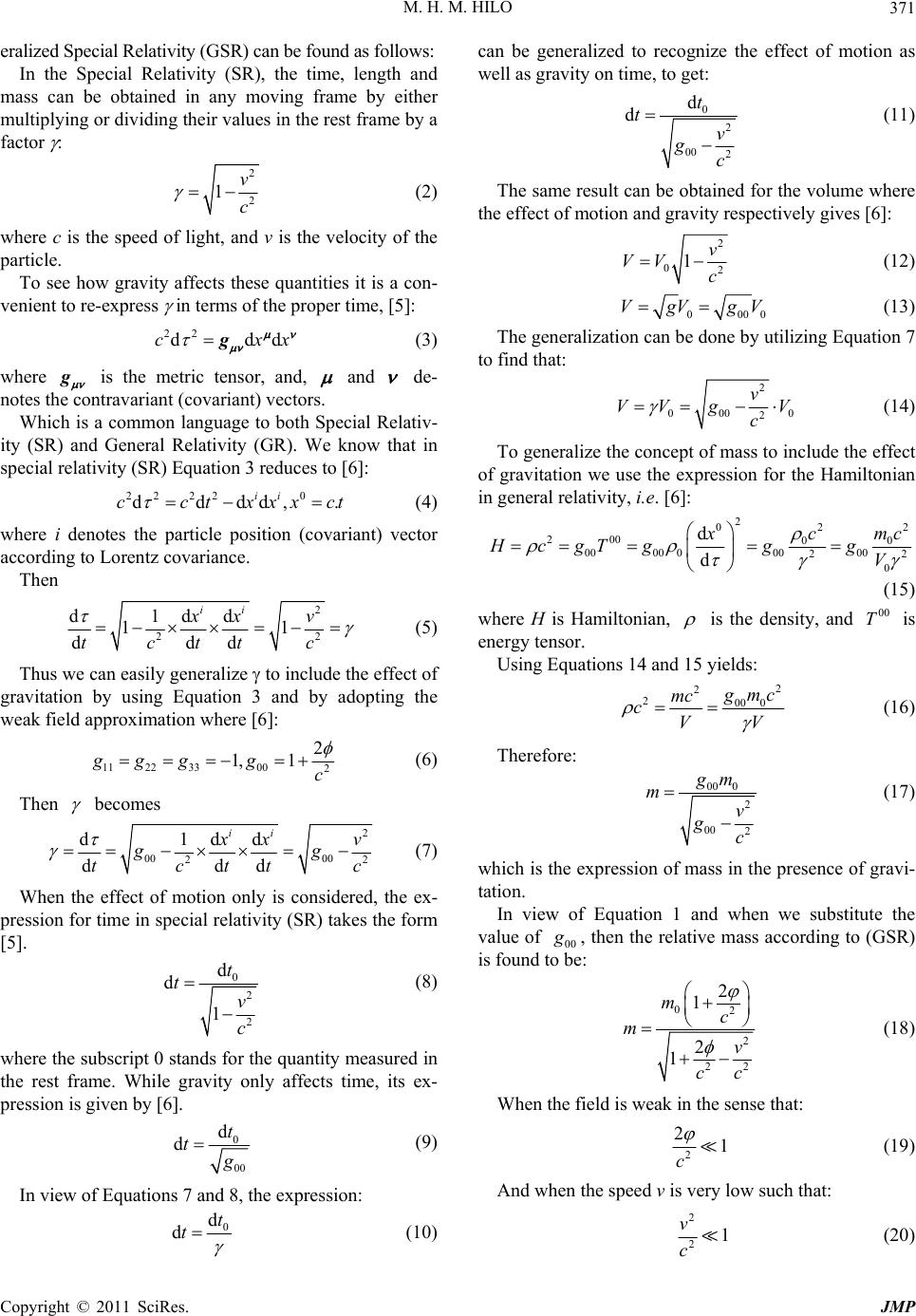 M. H. M. HILO371 eralized Special Relativity (GSR) can be found as follows: In the Special Relativity (SR), the time, length and mass can be obtained in any moving frame by either multiplying or dividing their values in the rest frame by a factor : 2 2 1v c (2) where c is the speed of light, and v is the velocity of the particle. To see how gravity affects these quantities it is a con- venient to re-express in terms of the proper time, [5]: 22 ddcx gdx (3) where g is the metric tensor, and, and de- notes the contravariant (covariant) vectors. Which is a common language to both Special Relativ- ity (SR) and General Relativity (GR). We know that in special relativity (SR) Equation 3 reduces to [6]: 22 220 dddd, ii cctxxx .ct (4) where i denotes the particle position (covariant) vector according to Lorentz covariance. Then 2 22 d1dd 11 ddd ii xx v ttt cc (5) Thus we can easily generalize to include the effect of gravitation by using Equation 3 and by adopting the weak field approximation where [6]: 11 22 33002 2 1, 1gg ggc (6) Then becomes 2 00 00 2 d1dd ddd ii 2 x x gg ttt c v c (7) When the effect of motion only is considered, the ex- pression for time in special relativity (SR) takes the form [5]. 0 2 2 d d 1 t t v c (8) where the subscript 0 stands for the quantity measured in the rest frame. While gravity only affects time, its ex- pression is given by [6]. 0 00 d dt t g (9) In view of Equations 7 and 8, the expression: 0 d dt t (10) can be generalized to recognize the effect of motion as well as gravity on time, to get: 0 2 00 2 d dt t v gc (11) The same result can be obtained for the volume where the effect of motion and gravity respectively gives [6]: 2 02 1v VV c (12) 000 VgVgV0 (13) The generalization can be done by utilizing Equation 7 to find that: 2 000 2 v VV gV c 0 (14) To generalize the concept of mass to include the effect of gravitation we use the expression for the Hamiltonian in general relativity, i.e. [6]: 222 0 200 00 0000 00000 22 0 d d cm x HcgT ggg V c (15) where H is Hamiltonian, is the density, and is energy tensor. 00 T Using Equations 14 and 15 yields: 2 2 200 0 g mc mc cVV (16) Therefore: 00 0 2 00 2 g m m v gc (17) which is the expression of mass in the presence of gravi- tation. In view of Equation 1 and when we substitute the value of 00 g , then the relative mass according to (GSR) is found to be: 02 2 22 2 1 2 1 mc m v cc (18) When the field is weak in the sense that: 2 21 c (19) And when the speed v is very low such that: 2 21 v c (20) Copyright © 2011 SciRes. JMP 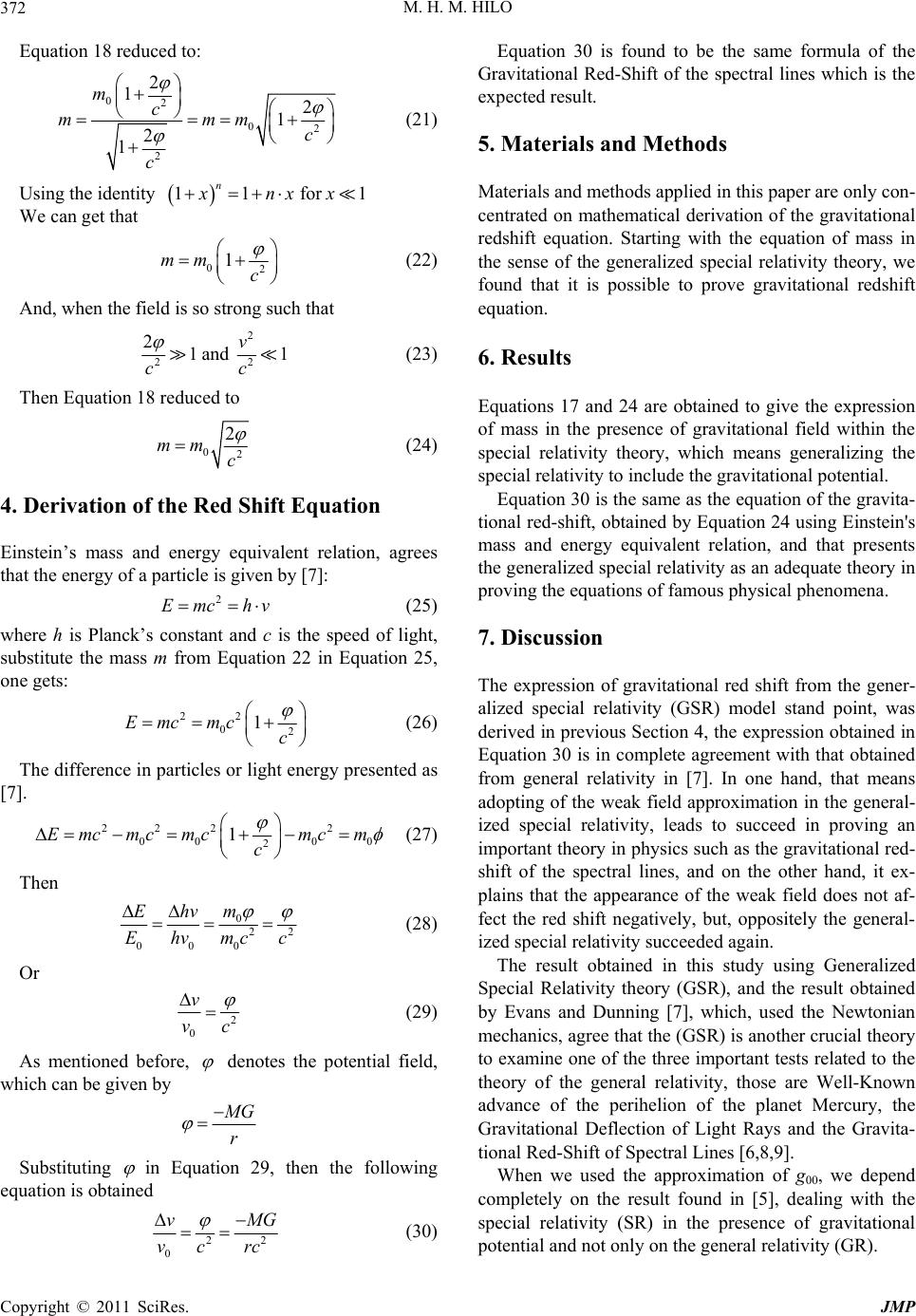 M. H. M. HILO 372 Equation 18 reduced to: 02 02 2 2 12 1 2 1 mc mmm c c 1 (21) Using the identity 11 for n xnxx We can get that 02 1mm c (22) And, when the field is so strong such that 2 22 21 and 1 v cc (23) Then Equation 18 reduced to 02 2 mm c (24) 4. Derivation of the Red Shift Equation Einstein’s mass and energy equivalent relation, agrees that the energy of a particle is given by [7]: 2 Emc hv (25) where h is Planck’s constant and c is the speed of light, substitute the mass m from Equation 22 in Equation 25, one gets: 22 02 1Emcmcc (26) The difference in particles or light energy presented as [7]. 22 22 00 0 2 1Emcmcmc mcm c0 (27) Then 0 2 000 m Ehv Ehv mc c 2 (28) Or 2 0 v vc (29) As mentioned before, denotes the potential field, which can be given by M G r Substituting in Equation 29, then the following equation is obtained 22 0 vM vc rc G (30) Equation 30 is found to be the Gravitational Red-Shift of the spect expecte his paper are only con- ion of the gravitational d 24 are obtained to give the expression e presence of gravitational field within the gravitational red shift from the gener- ativity (GSR) model stand point, was po same formula of the ral lines which is the d result. 5. Materials and Methods Materials and methods applied in t centrated on mathematical derivat redshift equation. Starting with the equation of mass in the sense of the generalized special relativity theory, we found that it is possible to prove gravitational redshift equation. 6. Results Equations 17 an of mass in th special relativity theory, which means generalizing the special relativity to include the gravitational potential. Equation 30 is the same as the equation of the gravita- tional red-shift, obtained by Equation 24 using Einstein's mass and energy equivalent relation, and that presents the generalized special relativity as an adequate theory in proving the equations of famous physical phenomena. 7. Discussion The expression of alized special rel derived in previous Section 4, the expression obtained in Equation 30 is in complete agreement with that obtained from general relativity in [7]. In one hand, that means adopting of the weak field approximation in the general- ized special relativity, leads to succeed in proving an important theory in physics such as the gravitational red- shift of the spectral lines, and on the other hand, it ex- plains that the appearance of the weak field does not af- fect the red shift negatively, but, oppositely the general- ized special relativity succeeded again. The result obtained in this study using Generalized Special Relativity theory (GSR), and the result obtained by Evans and Dunning [7], which, used the Newtonian mechanics, agree that the (GSR) is another crucial theory to examine one of the three important tests related to the theory of the general relativity, those are Well-Known advance of the perihelion of the planet Mercury, the Gravitational Deflection of Light Rays and the Gravita- tional Red-Shift of Spectral Lines [6,8,9]. When we used the approximation of g00, we depend completely on the result found in [5], dealing with the special relativity (SR) in the presence of gravitational tential and not only on the general relativity (GR). Copyright © 2011 SciRes. JMP 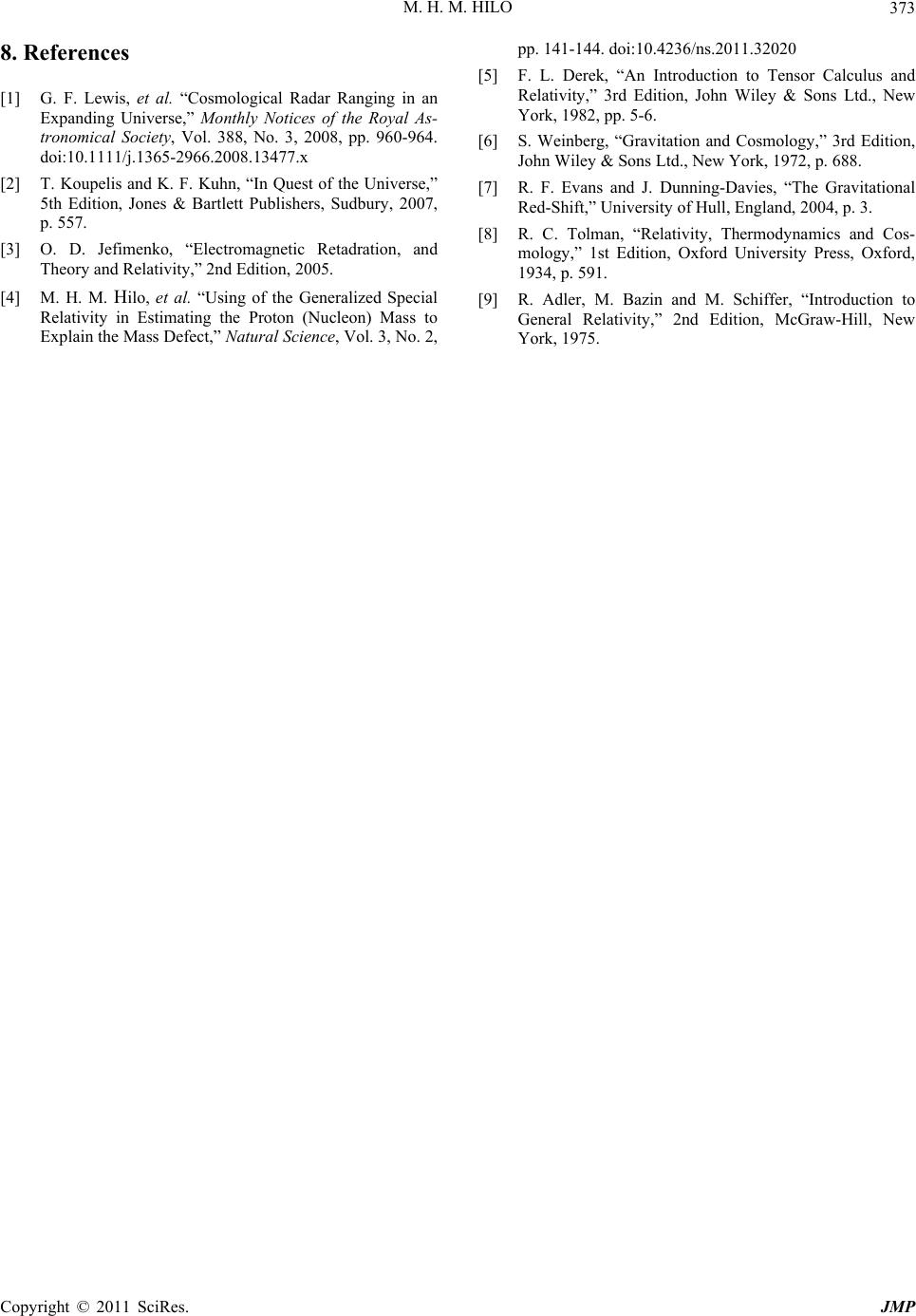 M. H. M. HILO Copyright © 2011 SciRes. JMP 373 Expanding Universe,” Monthly Notices of the Royal As- ciety, Vol. 388, No. 3, 2008, pp. 960-964. 365-2966.2008.13477.x Retadration, ty in Estimating the Proton (Nucleon) Mass to r Calculus and ation and Cosmology,” 3rd Edition, ational Cos- Bazin and M. Schiffer, “Introduction to 8. References [1] G. F. Lewis, et al. “Cosmological Radar Ranging in an R tronomical So doi:10.1111/j.1 [2] T. Koupelis and K. F. Kuhn, “In Quest of the Universe,” 5th Edition, Jones & Bartlett Publishers, Sudbury, 2007, p. 557. [3] O. D. Jefimenko, “Electromagnetic and mology,” 1st Edition, Oxford University Press, Oxford, 1934, p. 591. [9] R. Adler, M. Theory and Relativity,” 2nd Edition, 2005. [4] M. H. M. Hilo, et al. “Using of the Generalized Special Relativi Explain the Mass Defect,” Natural Science, Vol. 3, No. 2, pp. 141-144. doi:10.4236/ns.2011.32020 [5] F. L. Derek, “An Introduction to Tenso elativity,” 3rd Edition, John Wiley & Sons Ltd., New York, 1982, pp. 5-6. [6] S. Weinberg, “Gravit John Wiley & Sons Ltd., New York, 1972, p. 688. [7] R. F. Evans and J. Dunning-Davies, “The Gravit Red-Shift,” University of Hull, England, 2004, p. 3. [8] R. C. Tolman, “Relativity, Thermodynamics and General Relativity,” 2nd Edition, McGraw-Hill, New York, 1975. |