

Paper Menu >>
Journal Menu >>
 Vol.3, No.5, 408-413 (2011) Natural Science http://dx.doi.org/10.4236/ns.2011.35055 Copyright © 2011 SciRes. OPEN ACCESS Nuclear fragmentation at 4.5 A GeV/c in 28Si with emulsion interactions A. Abd El-Daiem1*, A. Abdel-Hafiez2, M. A. Khalifa3 1Physics Department, Faculty of Science, Sohag University, Sohag, Egypt; *Corresponding Author: [email protected] 2Experimental Nuclear Physics Department, Nuclear Research Center, Cairo, Egypt 3Mathematical Deparment, Faculty of Science, Tanta University, Tanta, Egypt Received 11 February 2011; revised 13 March 2011; accepted 27 March 2011. ABSTRACT The experimental results of complete charge distribution of projectile fragments (PFS) and the total charge of the projectile fragments (PFS ) are presented. Also the multiplicity distributions of (PFS) and the rapidity distribution of shower tracks produced from events with nh = 0 from 28Si with emulsion at 4.5 A GeV/c are obtained. Keywords: Multiplicity Distribution; Total Chare and Rapidity Distribution 1. INTRODUCTION Nuclear fragmentation and its possible connection with a critical phenomenon of a phase transition has been the subject intensive theoretical and experimental investigation in the interaction of relativistic heavy nu- clei nucleus collision [1,2] the overlapping region of nuclear volumes is called the participant region, where multiple productions of new particles occurs and the matter breaks up into nucleons. An estimate the degree of centrality of a collision of the nuclei can be made if we determine the total charge Q of the non interacting nucleons or fragments of the projectile nucleus, to which we assign the relativistic particles emitted at an angel θ < 3˚ [3,4]. Then the number of interacting nucleons of the projectile nucleus is on the average nint =28 − 2Q [5]. In the collision of two nuclei, the elementary interaction is more amplified than in the case of hadrons-nucleus in- teraction. At such high energy (4.5 A GeV/c) the rapidity gap between the projectile target fragmentation regions is quite wide, which provides us with a good possibility for testing the limiting fragmentation hypothesis [6,7] in playing that no correlations exist between the projectile and target fragments. These results were obtained from the study of single partied inclusive experiments where the degree of target fragmentation can take any value. It is interesting to compare these results with those of projectile fragments angular distribution from the special class of events nh = 0, where there is no target fragmentation but only a pro- jectile fragmentation. 2. EXPERIMENTS In our experiments, the layers of photo emulsions NIKFI-BR2, with dimensions of 20 cm × 10 cm × 600 µm were irradiated by the 28Si beam from the syncho- phastron in the high energy laboratory of JINR, at Dubna with an average beam momentum of 4.5 A GeV/c. Along the track double scanning was carried out, fast in the forward direction and slow in the backward direction. The scanned beam tracks were further examined by measuring the delta electron density on each of them to exclude the tracks having the secondary particles is clas- sified as follows: 1) Black particle tracks (nb) having a range L < 3 mm in emulsion which corresponds to a proton kinetic en- ergy of 26 MeV. 2) Grey particle tracks (ng) relative ionization I* (= I/I0) < 1.4 and L > 3 mm which correspond to a proton kinetic energy of 26 - 400 MeV, where I is the particle track ionization and I0 is the ionization of a shower track in the narrow forward cone of an opening angel of θ < 3˚ (the b and g particle tracks are called heavy ionization particle tracks (nh)). 3) Shower particle (ns) having I* < 1.4 (tracks of such type with an emission angel of θ < 3 were further sub- jected to rigorous multiple scattering measurement for moment determination and consequently, for separating the produced pions and singly charged projectile frag- ments (protons, deuterons, tritons). A total of 1000 interactions of 28Si with the nuclei of the emulsion were observed by following a primary track length of 78.12 meters, which led to a mean free path of λ = 8.71 ± 0.30 cm. In each event, the charge Z ≥  A. A. El-Daiem et al. / Natural Science 3 (2011) 408-413 Copyright © 2011 SciRes. OPEN ACCESS 409 2 of individual projectile fragments were determined by the combination of several methods, which include grain and delta ray densities. More details on the charge de- terminations of projectile fragments are given in Refer- ence [8]. Projectile fragments essentially travel with the same speed as that if the parent beam nucleus, so the energy of the produced projectile fragments as high enough to distinguish them easily from the target frag- ments. 3. THE TOTAL CHARGE OF THE PROJECTILE FRAGMENTS (PFS) In the Table 1 we have given the data obtained on the average multiplicities of h and s particles as functions of nint. It can be seen that the number of thin prongs in a disintegration increases linearly with increase of nint, and within experimental error this occurs in a completely identical way for the light and heavy emulsion compo- nents. This dependence of < ns > on Q is consistent with the model of independent interactions and indicates a decisive roll of the first interaction. In collisions of light nuclei the values of < nh > do not depend on nint, while for heavy nuclei they rise almost linearly. In Figures 1(a) and (b) we have shown the distribution in Q for events in standard emulsion, and also the distribu- tions obtained by the different methods for three differ- ent groups of nuclei, normalized to the corresponding probability of inelastic interaction. It is evident that the distributions in Q depend substantially on the type of target nucleus. The average total charge for disintegra- tion of an incident 28Si nucleus in hydrogen, light and heavy emulsion nuclei were respectively 11.71 to 0.17, 9.62 ± 0.11 and 4.68 ± 0.16. Note that in Figures 1(a) and (b) in the light emulsion nuclei (H,C,O) there are practi- cally no central interactions (Q = 0), collisions with the heavy component are characterized by a wide set of A values. Study of the dependence of the total charge of the spectator fragments on the impact parameter for events produced in heavy emulsion nuclei. Figures 1(a) and (b) show that for large impact parameters (nh 7) this distribution is practically the same as the distribution in Q for hydrogen of the emulsion and for 8 nh 15 it is close the distribution for events in nuclei (C,N,O). For large nh a dominance of central interactions is observed. In order to see the dependence of the number of inter- acting nucleons on the collision geometry, we have shown in Figure 2 nint as a function of nh. This figure indicate that even in collisions where no, or very little Table 1. Experimental dependence of average multiplicities <nh> and <ns> on the number of interacting nucleon and the pa- rameter Q. target nucleus AgBr CNO <ns> <nh> <ns> <nh> nint Q 1.0 ± 0.0 6.2 ± 0.6 1.0 ± 1.4 1.3 ± 1.9 0 14 3.0 ± 0.8 8.3 ± 0.5 2.5 ± 1.8 2.3 ± 2.2 2 13 5.8 ± 3.0 12.3 ± 3.9 3.4 ± 2.4 3.1 ± 2.4 4 12 5.6 ± 2.1 14.1 ± 4.7 4.1 ± 3.0 2.9 ± 2.4 6 11 6.4 ± 2.6 14.4 ± 4.8 5.9 ± 3.2 3.5 ± 2.4 8 10 8.8 ± 4.0 16.5 ± 6.7 6.4 ± 3.0 3.3 ± 2.3 10 9 10.4 ± 4.1 16.2 ± 6.7 8.2 ± 2.6 3.8 ± 2.2 12 8 13.3 ± 4.7 16.6 ± 7.4 10.0 ± 2.8 4.6 ± 1.9 14 7 13.8 ± 5.1 16.5 ± 7.4 12.3 ± 4.7 4.5 ± 1.8 16 6 16.5 ± 5.2 22.7 ± 8.8 12.6 ± 4.5 4.1 ± 2.1 18 5 19.7 ± 6.8 25.3 ± 9.2 11.4 ± 5.2 4.4 ± 1.5 20 4 22.0 ± 6.8 24.5 ± 9.4 17.7 ± 2.1 5.3 ± 1.3 22 3 22.7 ± 7.2 26.3 ± 9.7 17.6 ± 1.6 5.6 ± 1.0 24 2 26.6 ± 6.5 31.0 ± 6.9 26 1 32.2 ± 6.8 33.4 ± 7.6 28 0 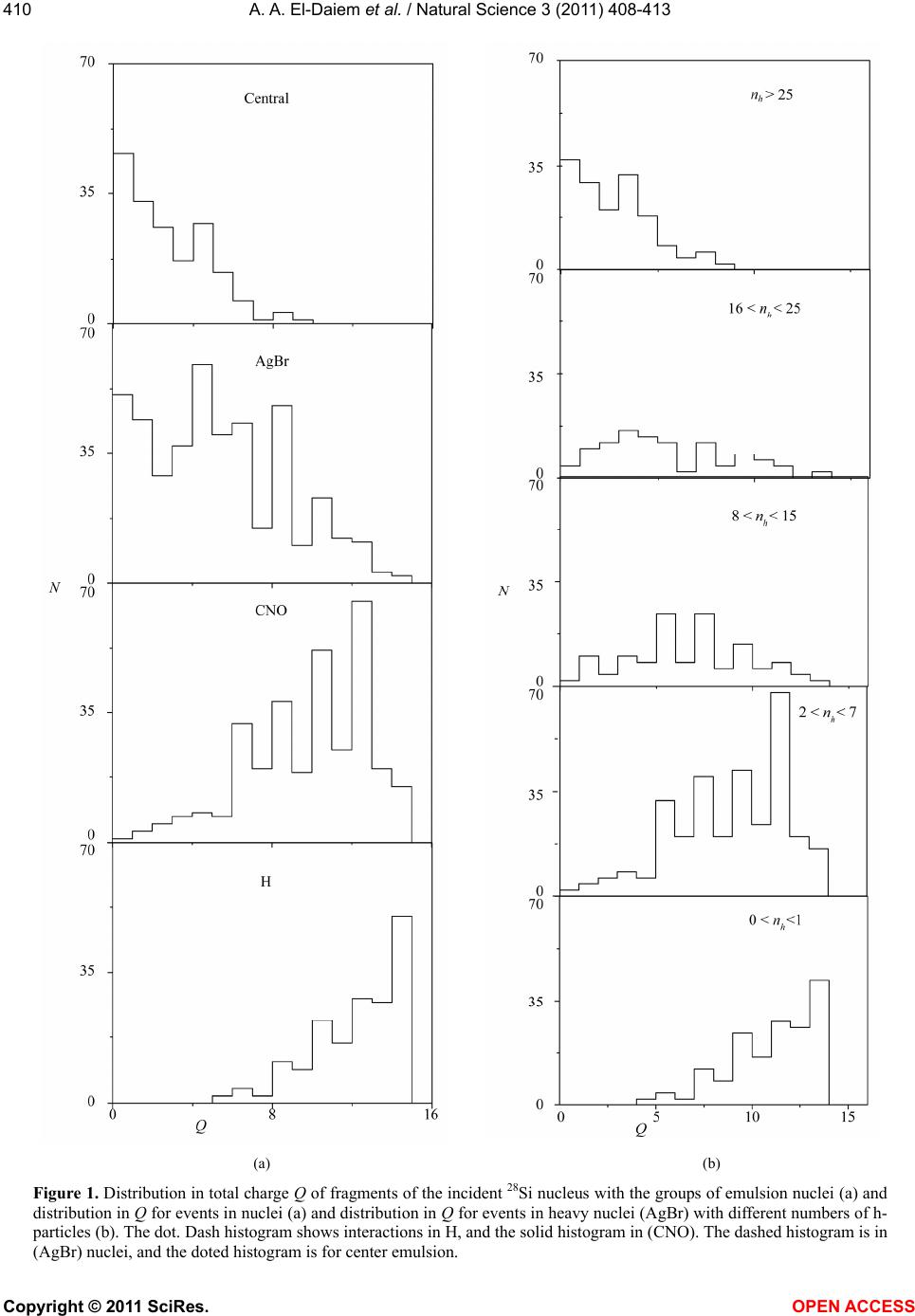 A. A. El-Daiem et al. / Natural Science 3 (2011) 408-413 Copyright © 2011 SciRes. OPEN ACCESS 410 (a) (b) Figure 1. Distribution in total charge Q of fragments of the incident 28Si nucleus with the groups of emulsion nuclei (a) and distribution in Q for events in nuclei (a) and distribution in Q for events in heavy nuclei (AgBr) with different numbers of h- particles (b). The dot. Dash histogram shows interactions in H, and the solid histogram in (CNO). The dashed histogram is in (AgBr) nuclei, and the doted histogram is for center emulsion. 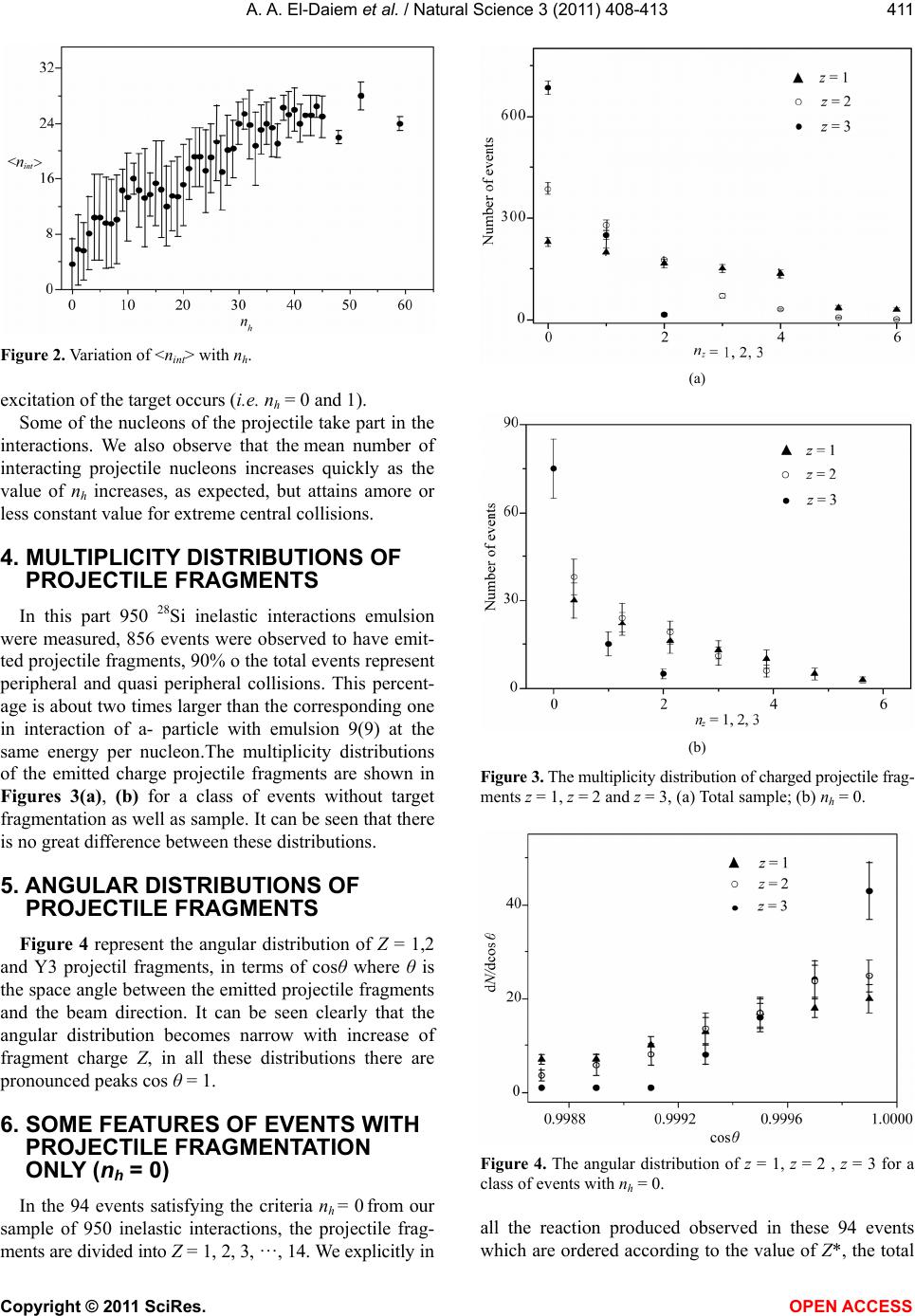 A. A. El-Daiem et al. / Natural Science 3 (2011) 408-413 Copyright © 2011 SciRes. OPEN ACCESS 411 Figure 2. Variation of <nint> with nh. excitation of the target occurs (i.e. nh = 0 and 1). Some of the nucleons of the projectile take part in the interactions. We also observe that the mean number of interacting projectile nucleons increases quickly as the value of nh increases, as expected, but attains amore or less constant value for extreme central collisions. 4. MULTIPLICITY DISTRIBUTIONS OF PROJECTILE FRAGMENTS In this part 950 28Si inelastic interactions emulsion were measured, 856 events were observed to have emit- ted projectile fragments, 90% o the total events represent peripheral and quasi peripheral collisions. This percent- age is about two times larger than the corresponding one in interaction of a- particle with emulsion 9(9) at the same energy per nucleon.The multiplicity distributions of the emitted charge projectile fragments are shown in Figures 3(a), (b) for a class of events without target fragmentation as well as sample. It can be seen that there is no great difference between these distributions. 5. ANGULAR DISTRIBUTIONS OF PROJECTILE FRAGMENTS Figure 4 represent the angular distribution of Z = 1,2 and Y3 projectil fragments, in terms of cosθ where θ is the space angle between the emitted projectile fragments and the beam direction. It can be seen clearly that the angular distribution becomes narrow with increase of fragment charge Z, in all these distributions there are pronounced peaks cos θ = 1. 6. SOME FEATURES OF EVENTS WITH PROJECTILE FRAGMENTATION ONLY (nh = 0) In the 94 events satisfying the criteria nh = 0 from our sample of 950 inelastic interactions, the projectile frag- ments are divided into Z = 1, 2, 3, ···, 14. We explicitly in (a) (b) Figure 3. The multiplicity distribution of charged projectile frag- ments z = 1, z = 2 and z = 3, (a) Total sample; (b) nh = 0. Figure 4. The angular distribution of z = 1, z = 2 , z = 3 for a class of events with nh = 0. all the reaction produced observed in these 94 events which are ordered according to the value of Z*, the total 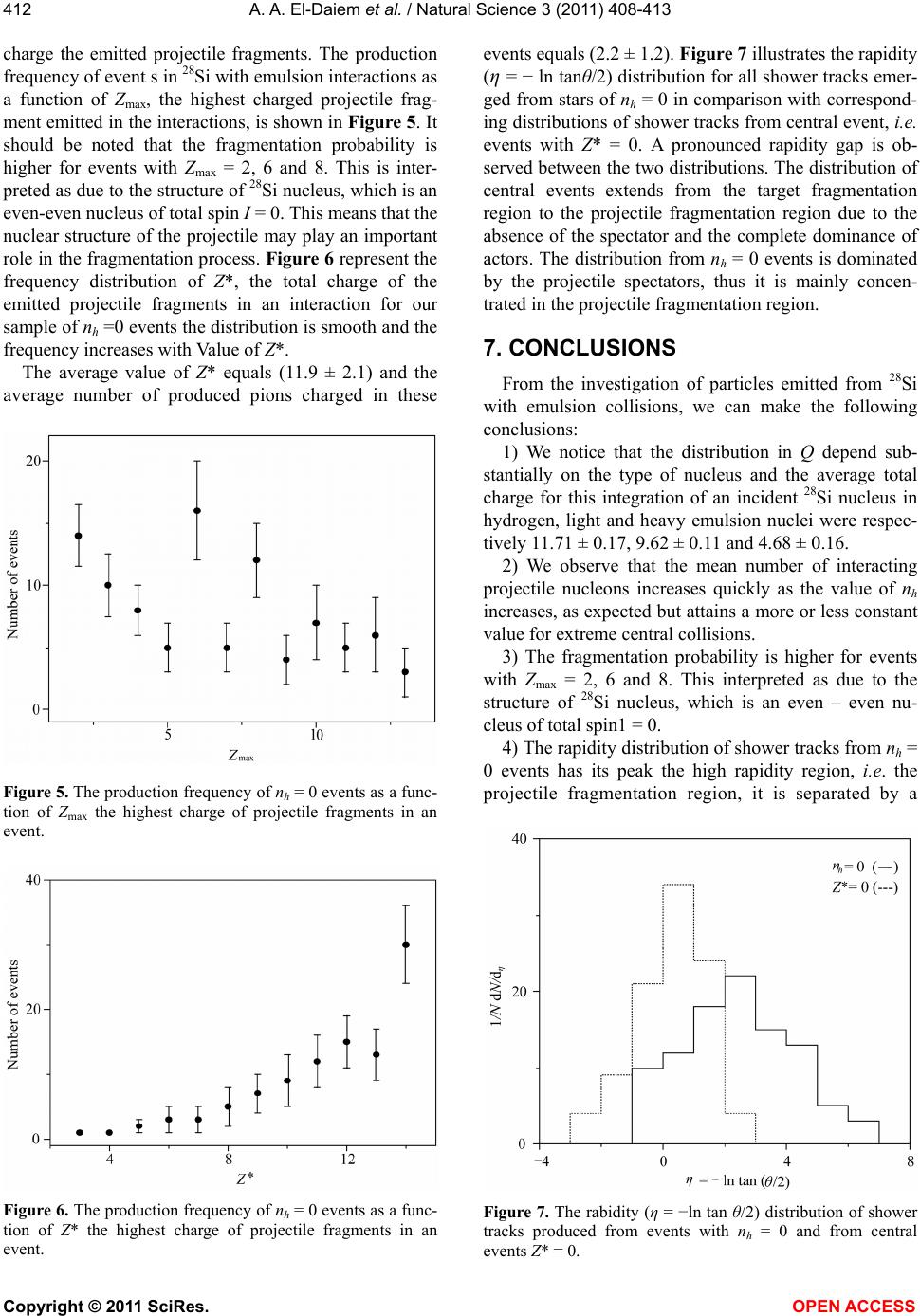 A. A. El-Daiem et al. / Natural Science 3 (2011) 408-413 Copyright © 2011 SciRes. OPEN ACCESS 412 charge the emitted projectile fragments. The production frequency of event s in 28Si with emulsion interactions as a function of Zmax, the highest charged projectile frag- ment emitted in the interactions, is shown in Figure 5. It should be noted that the fragmentation probability is higher for events with Zmax = 2, 6 and 8. This is inter- preted as due to the structure of 28Si nucleus, which is an even-even nucleus of total spin I = 0. This means that the nuclear structure of the projectile may play an important role in the fragmentation process. Figure 6 represent the frequency distribution of Z*, the total charge of the emitted projectile fragments in an interaction for our sample of nh =0 events the distribution is smooth and the frequency increases with Value of Z*. The average value of Z* equals (11.9 ± 2.1) and the average number of produced pions charged in these Figure 5. The production frequency of nh = 0 events as a func- tion of Zmax the highest charge of projectile fragments in an event. Figure 6. The production frequency of nh = 0 events as a func- tion of Z* the highest charge of projectile fragments in an event. events equals (2.2 ± 1.2). Figure 7 illustrates the rapidity (η = − ln tanθ/2) distribution for all shower tracks emer- ged from stars of nh = 0 in comparison with correspond- ing distributions of shower tracks from central event, i.e. events with Z* = 0. A pronounced rapidity gap is ob- served between the two distributions. The distribution of central events extends from the target fragmentation region to the projectile fragmentation region due to the absence of the spectator and the complete dominance of actors. The distribution from nh = 0 events is dominated by the projectile spectators, thus it is mainly concen- trated in the projectile fragmentation region. 7. CONCLUSIONS From the investigation of particles emitted from 28Si with emulsion collisions, we can make the following conclusions: 1) We notice that the distribution in Q depend sub- stantially on the type of nucleus and the average total charge for this integration of an incident 28Si nucleus in hydrogen, light and heavy emulsion nuclei were respec- tively 11.71 ± 0.17, 9.62 ± 0.11 and 4.68 ± 0.16. 2) We observe that the mean number of interacting projectile nucleons increases quickly as the value of nh increases, as expected but attains a more or less constant value for extreme central collisions. 3) The fragmentation probability is higher for events with Zmax = 2, 6 and 8. This interpreted as due to the structure of 28Si nucleus, which is an even – even nu- cleus of total spin1 = 0. 4) The rapidity distribution of shower tracks from nh = 0 events has its peak the high rapidity region, i.e. the projectile fragmentation region, it is separated by a Figure 7. The rabidity (η = −ln tan θ/2) distribution of shower tracks produced from events with nh = 0 and from central events Z* = 0. 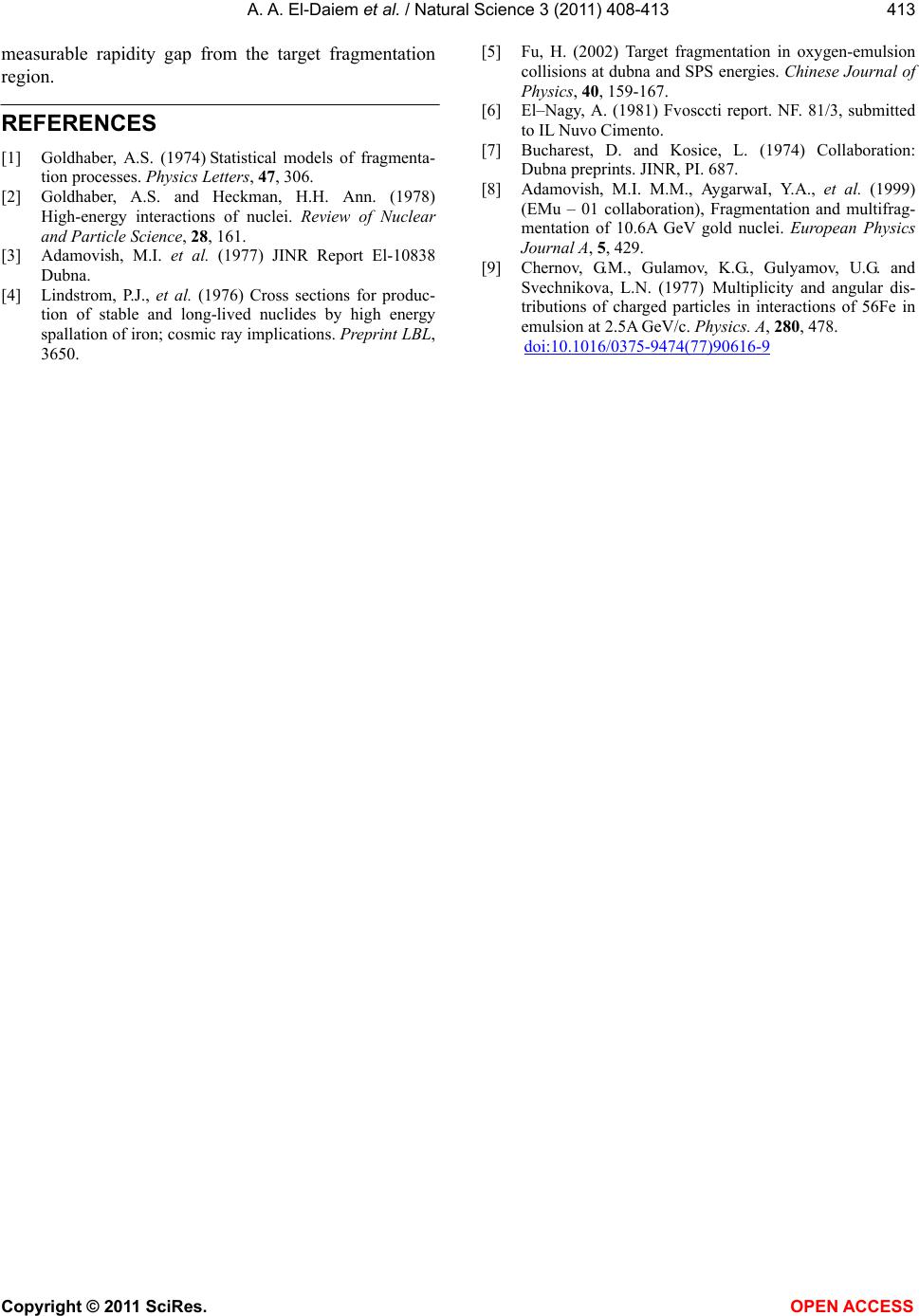 A. A. El-Daiem et al. / Natural Science 3 (2011) 408-413 Copyright © 2011 SciRes. OPEN ACCESS 413 measurable rapidity gap from the target fragmentation region. REFERENCES [1] Goldhaber, A.S. (1974) Statistical models of fragmenta- tion processes. Physics Letters, 47, 306. [2] Goldhaber, A.S. and Heckman, H.H. Ann. (1978) High-energy interactions of nuclei. Review of Nuclear and Particle Science, 28, 161. [3] Adamovish, M.I. et al. (1977) JINR Report El-10838 Dubna. [4] Lindstrom, P.J., et al. (1976) Cross sections for produc- tion of stable and long-lived nuclides by high energy spallation of iron; cosmic ray implications. Preprint LBL, 3650. [5] Fu, H. (2002) Target fragmentation in oxygen-emulsion collisions at dubna and SPS energies. Chinese Journal of Physics, 40, 159-167. [6] El–Nagy, A. (1981) Fvosccti report. NF. 81/3, submitted to IL Nuvo Cimento. [7] Bucharest, D. and Kosice, L. (1974) Collaboration: Dubna preprints. JINR, PI. 687. [8] Adamovish, M.I. M.M., AygarwaI, Y.A., et al. (1999) (EMu – 01 collaboration), Fragmentation and multifrag- mentation of 10.6A GeV gold nuclei. European Physics Journal A, 5, 429. [9] Chernov, G.M., Gulamov, K.G., Gulyamov, U.G. and Svechnikova, L.N. (1977) Multiplicity and angular dis- tributions of charged particles in interactions of 56Fe in emulsion at 2.5A GeV/c. Physics. A, 280, 478. doi:10.1016/0375-9474(77)90616-9 |