

Paper Menu >>
Journal Menu >>
 World Journal of Condensed Matter Physics, 2011, 1, 33-36 doi:10.4236/wjcmp.2011.12006 Published Online May 2011 (http://www.SciRP.org/journal/wjcmp) Copyright © 2011 SciRes. WJCMP 33 New Trends in Corrosion Analysis of Al-Sn Alloy Duplex System Chinedu Ekuma, Eziaku Osarolube, Ephraim O. Chukwuocha, Michael C. Onyeaju Department of Physics, University of Port Harcourt, Port Harcourt, Nigeria. Email: [email protected] Received February 15th, 2011; revised March 18th, 2011; accepted March 20th, 2011. ABSTRACT The corrosion characterization of binary Al-Sn alloy systems has been statistically analyzed in the light of developed model equations. It was observed that the modeled corrosion penetration rate values generated using the developed model equations are in tandem with the experimental values. Keywords: Al-Sn, Statistical Analysis, Corrosion, Model Equations, Correlation 1. Introduction It has since been a worldwide problem for man to combat the menace of material degradation. Many structural failures and general loss of valuable engineering mate- rials have been traced to be caused basically by analysis and not synthesis [1] as over 313 failure cases studied [2] have shown that well over 56.90% are due to corrosion. The causes of materials degradation with the associated environmental variables have been well explained in many literatures [3-14]. A critical look at all forms of co rrosion show that th ey are merely a statistical phenomenon hence, the yardstick behind the adoption of statistics techniques in this present study. However, even with the somewhat semi-empirical nature of corrosion (as it show the rela- tions between available data and measurements that do not necessarily reveal any relation between cause and effect), statistical models attempt to determine the fun- damental relationship between sets of input data (predic- tors) and targets (predictands) [15,16]. The adoption of statistical analysis in corrosion analy- sis in metals has been predicted for years but, its usage has been hampered primarily by the specialty skill needed in applying this principle which, its impediment lies basically on the lack of reference frame for its appli- cation [16] . In this present study, we will apply the non-linear re- gression analysis technique to obtain model equations that will be used to determine the corrosion parameter of in- terest and other statistical parameters adequate for dis- cussing and understanding the phenomenon of corrosion (in this case, Al-Sn alloys of compositions 2.5% and 4.5% by weight respectively of Sn) in selected media environ- ments: HCl and NaCl of concentrations 0.5 M and 1.0 M respectively, using the statistical software SPSS™. The data of Idenyi et al. [17] has been used for this analysis. 2. Results The results of the corrosion penetration rate values for the experimental and modeled values are as shown in Tables 1 to 8, while Table 9 is the model equation of the corrosion parameters of the various Al-Sn alloy systems in the various concentrations of hydrochloric acid and brine environments. 3. Discussion of Results A cursory look at Tables 1-8 clearly reveals that the modeled corrosion penetration values of the various bi- nary alloy samples subjected to the varying concentra- tions (0.5 M and 1.0 M) of hydrochloric acid and brine environments respectively, are in tandem with the ob- served experimental values. This is further confirmed by the nearly perfect coefficient of correlations of all the composites which is in the range 0.94 1.00R≤≤ (see Table 9). The implication of this high positive coeffi- cient of correlation is that the modeled values are in good agreement with the experimental data. Thus, our model can be of good usage in studying effect of the studied environments on Al-Sn binary alloy system on expanded time scale. In order to further confirm the dependence of the corrosion penetration rate mainly on the exposure 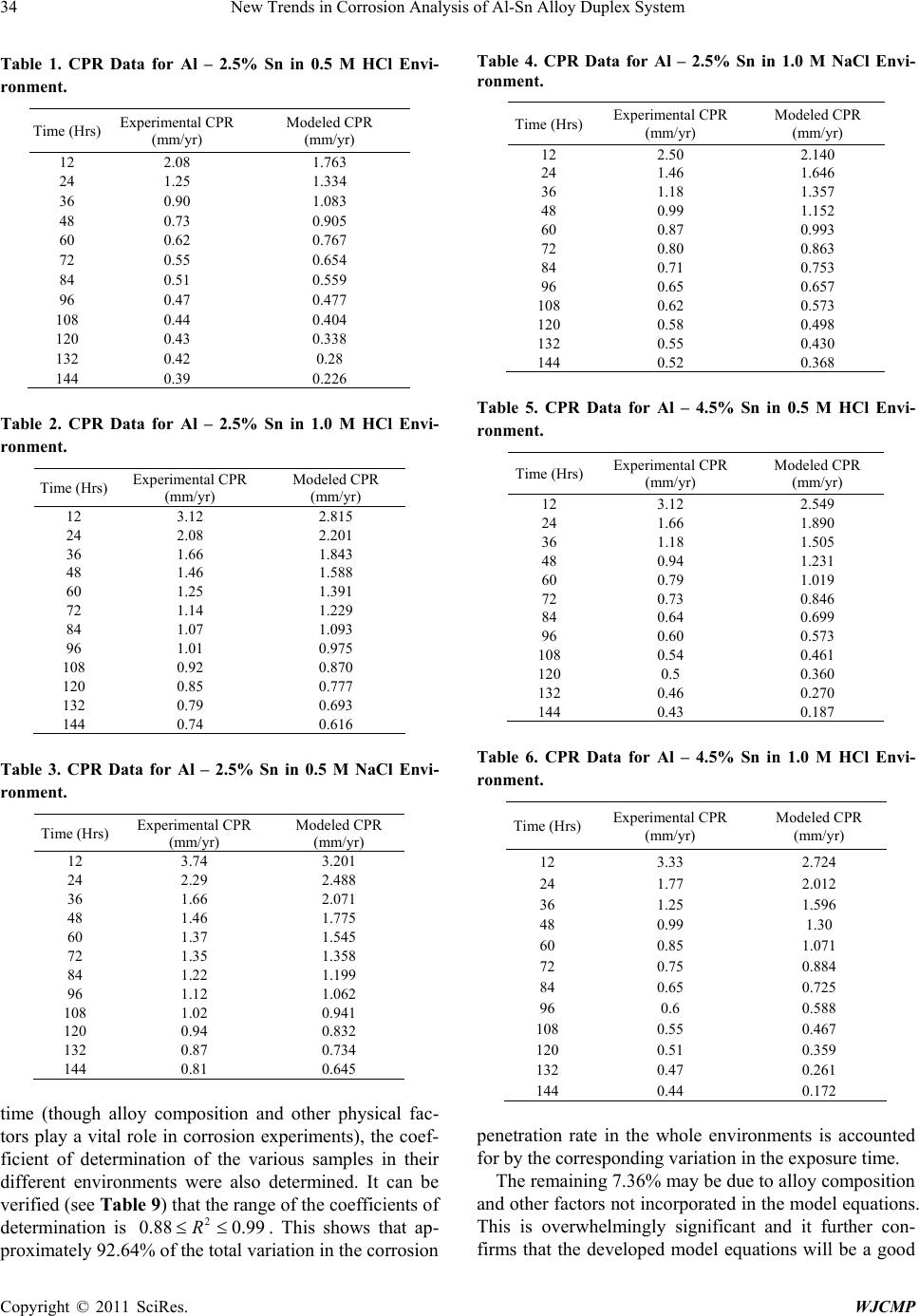 New Trends in Corrosion Analysis of Al-Sn Alloy Duplex System Copyright © 2011 SciRes. WJCMP 34 Table 1. CPR Data for Al – 2.5% Sn in 0.5 M HCl Envi- ronment. Time (Hrs) Experimental CPR (mm/yr) Modeled CPR (mm/yr) 12 2.08 1.763 24 1.25 1.334 36 0.90 1.083 48 0.73 0.905 60 0.62 0.767 72 0.55 0.654 84 0.51 0.559 96 0.47 0.477 108 0.44 0.404 120 0.43 0.338 132 0.42 0.28 144 0.39 0.226 Table 2. CPR Data for Al – 2.5% Sn in 1.0 M HCl Envi- ronment. Time (Hrs) Experimental CPR (mm/yr) Modeled CPR (mm/yr) 12 3.12 2.815 24 2.08 2.201 36 1.66 1.843 48 1.46 1.588 60 1.25 1.391 72 1.14 1.229 84 1.07 1.093 96 1.01 0.975 108 0.92 0.870 120 0.85 0.777 132 0.79 0.693 144 0.74 0.616 Table 3. CPR Data for Al – 2.5% Sn in 0.5 M NaCl Envi- ronment. Time (Hrs) Experimental CPR (mm/yr) Modeled CPR (mm/yr) 12 3.74 3.201 24 2.29 2.488 36 1.66 2.071 48 1.46 1.775 60 1.37 1.545 72 1.35 1.358 84 1.22 1.199 96 1.12 1.062 108 1.02 0.941 120 0.94 0.832 132 0.87 0.734 144 0.81 0.645 time (though alloy composition and other physical fac- tors play a vital role in corrosion experiments), the coef- ficient of determination of the various samples in their different environments were also determined. It can be verified (see Tabl e 9 ) that the range of the coefficients of determination is 2 0.88 0.99R≤≤ . This shows that ap- proximately 92.64% of the total variation in the corr osion Table 4. CPR Data for Al – 2.5% Sn in 1.0 M NaCl Envi- ronment. Time (Hrs) Experimental CPR (mm/yr) Modeled CPR (mm/yr) 12 2.50 2.140 24 1.46 1.646 36 1.18 1.357 48 0.99 1.152 60 0.87 0.993 72 0.80 0.863 84 0.71 0.753 96 0.65 0.657 108 0.62 0.573 120 0.58 0.498 132 0.55 0.430 144 0.52 0.368 Table 5. CPR Data for Al – 4.5% Sn in 0.5 M HCl Envi- ronment. Time (Hrs) Experimental CPR (mm/yr) Modeled CPR (mm/yr) 12 3.12 2.549 24 1.66 1.890 36 1.18 1.505 48 0.94 1.231 60 0.79 1.019 72 0.73 0.846 84 0.64 0.699 96 0.60 0.573 108 0.54 0.461 120 0.5 0.360 132 0.46 0.270 144 0.43 0.187 Table 6. CPR Data for Al – 4.5% Sn in 1.0 M HCl Envi- ronment. Time (Hrs) Experimental CPR (mm/yr) Modeled CPR (mm/yr) 12 3.33 2.724 24 1.77 2.012 36 1.25 1.596 48 0.99 1.30 60 0.85 1.071 72 0.75 0.884 84 0.65 0.725 96 0.6 0.588 108 0.55 0.467 120 0.51 0.359 132 0.47 0.261 144 0.44 0.172 penetration rate in the whole environments is accounted for by the corresponding variation in the exposure time. The remaining 7.36% may be due to alloy composition and other factors not incorporated in the model equations. This is overwhelmingly significant and it further con- firms that the developed model equations will be a good 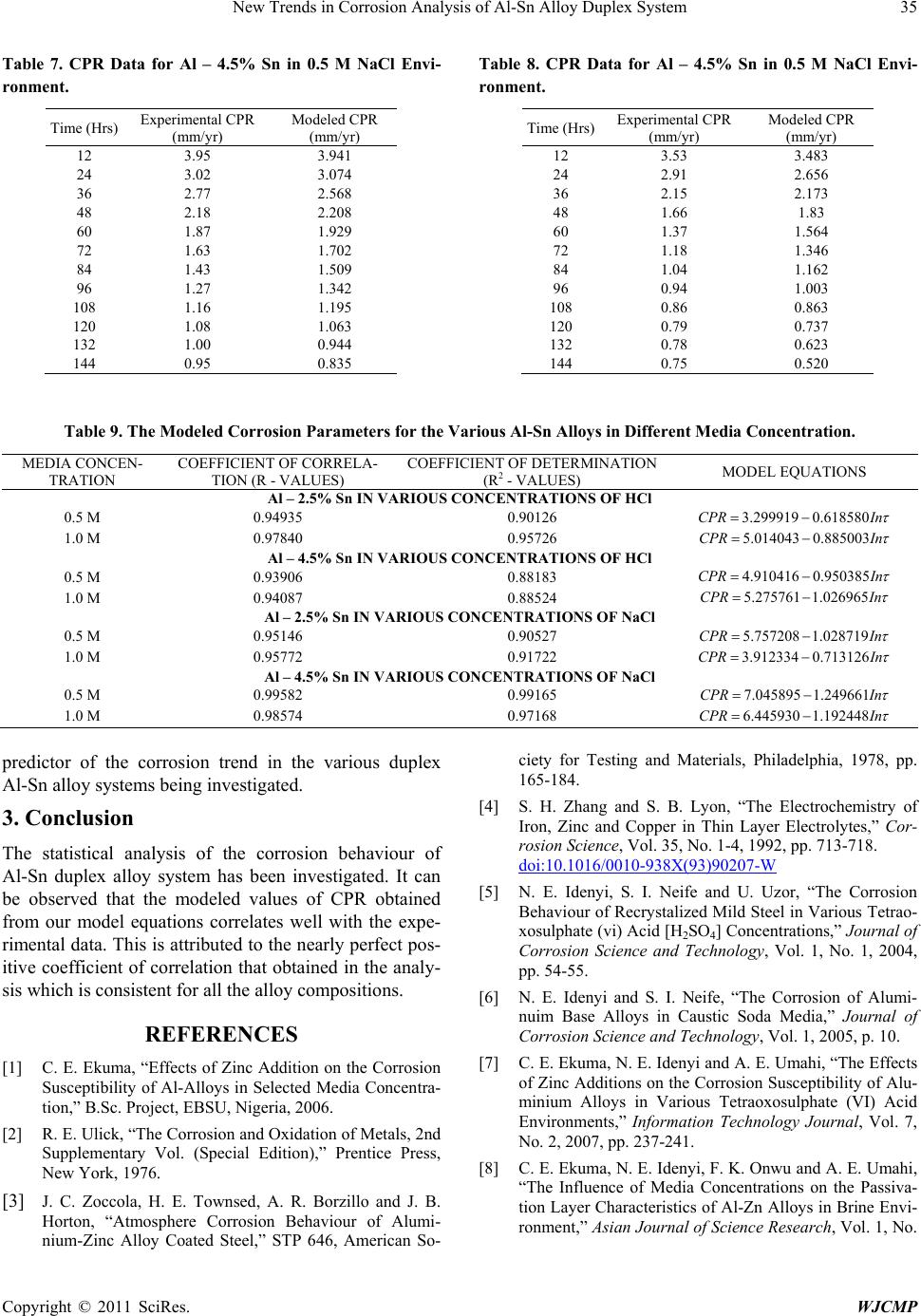 New Trends in Corrosion Analysis of Al-Sn Alloy Duplex System Copyright © 2011 SciRes. WJCMP 35 Table 7. CPR Data for Al – 4.5% Sn in 0.5 M NaCl Envi- ronment. Time (Hrs) Experimental CPR (mm/yr) Modeled CPR (mm/yr) 12 3.95 3.941 24 3.02 3.074 36 2.77 2.568 48 2.18 2.208 60 1.87 1.929 72 1.63 1.702 84 1.43 1.509 96 1.27 1.342 108 1.16 1.195 120 1.08 1.063 132 1.00 0.944 144 0.95 0.835 Table 8. CPR Data for Al – 4.5% Sn in 0.5 M NaCl Envi- ronment. Time (Hrs) Experimental CPR (mm/yr) Modeled CPR (mm/yr) 12 3.53 3.483 24 2.91 2.656 36 2.15 2.173 48 1.66 1.83 60 1.37 1.564 72 1.18 1.346 84 1.04 1.162 96 0.94 1.003 108 0.86 0.863 120 0.79 0.737 132 0.78 0.623 144 0.75 0.520 Table 9. The Modeled Corrosion Parameters for the Various Al-Sn Alloys in Different Media Concentration. MEDIA CONCEN- TRATION COEFFICIENT OF CORRELA- TION (R - VALUES) COEFFICIENT OF DETERMINATION (R 2 - VALUES) MODEL EQUATIO NS Al – 2.5% Sn IN VARIOUS CONCE NTRATIONS OF HCl 0.5 M 0.94935 0.90126 3.299919 0.618580CPR In τ = − 1.0 M 0.97840 0.95726 5.014043 0.885003CPR In τ = − Al – 4.5% Sn IN VARIOUS CONCE NTRATIONS OF HCl 0.5 M 0.93906 0.88183 4.910416 0.950385CPR In τ = − 1.0 M 0.94087 0.88524 5.275761 1.026965CPR In τ = − Al – 2.5% Sn IN VARIOUS CONCENTRATIONS OF NaCl 0.5 M 0.95146 0.90527 5.757208 1.028719CPR In τ = − 1.0 M 0.95772 0.91722 3.912334 0.713126CPR In τ = − Al – 4.5% Sn IN VARIOUS CONCE NTRATIONS OF NaCl 0.5 M 0.99582 0.99165 7.045895 1.249661CPR In τ = − 1.0 M 0.98574 0.97168 6.445930 1.192448CPR In τ = − predictor of the corrosion trend in the various duplex Al-Sn alloy systems being investigated. 3. Conclusion The statistical analysis of the corrosion behaviour of Al-Sn duplex alloy system has been investigated. It can be observed that the modeled values of CPR obtained from our model equations correlates well with the expe- rimental data. This is attributed to the nearly p erfect pos- itive coefficient of correlation that obtained in the analy- sis which is consistent for all the alloy compositions. REFERENCES [1] C. E. Ekuma, “Effects of Zinc Addition on the Corrosion Susceptibility of Al-Alloys in Selected Media Concentra- tion,” B.Sc. Project, EBSU, Nigeria, 2006. [2] R. E. Ul ick, “The Corrosion and Oxidation of Metals, 2nd Supplementary Vol. (Special Edition),” Prentice Press, New York, 1976. [3] J. C. Zoccola, H. E. Townsed, A. R. Borzillo and J. B. Horton, “Atmosphere Corrosion Behaviour of Alumi- nium-Zinc Alloy Coated Steel,” STP 646, American So- ciety for Testing and Materials, Philadelphia, 1978, pp. 165-184. [4] S. H. Zhang and S. B. Lyon, “The Electrochemistry of Iron, Zinc and Copper in Thin Layer Electrolytes,” Cor- rosion Science, Vol. 35, No. 1-4, 1992, pp. 713-718. doi:10.1016/0010-938X(93)90207-W [5] N. E. Idenyi, S. I. Neif e and U. Uzor, “The Corrosion Behaviour of Recrystalized Mild Steel in Various Tetrao- xosulphate (vi) Acid [H2SO4] Concentrations,” Journal of Corrosion Science and Technology, Vol. 1, No. 1, 2004, pp. 54-55. [6] N. E. Idenyi and S. I. Neife, “The Corrosion of Alumi- nuim Base Alloys in Caustic Soda Media,” Journal of Corrosion Science and Technology, Vol. 1, 2005, p. 10. [7] C. E. Ekuma, N. E. Idenyi and A. E. Umahi, “The Effects of Zinc Additions on the Corrosion Susceptibility of Alu- minium Alloys in Various Tetraoxosulphate (VI) Acid Environments,” Information Technology Journal, Vol. 7, No. 2, 2007, pp. 237-241. [8] C. E. Ekuma, N. E. Idenyi, F. K. Onwu and A. E. Umahi, “The Influence of Media Concentrations on the Passiva- tion Layer Characteristics of Al-Zn Alloys in Brine Envi- ronment,” A sian Journal of Scienc e Research, Vol. 1, No. 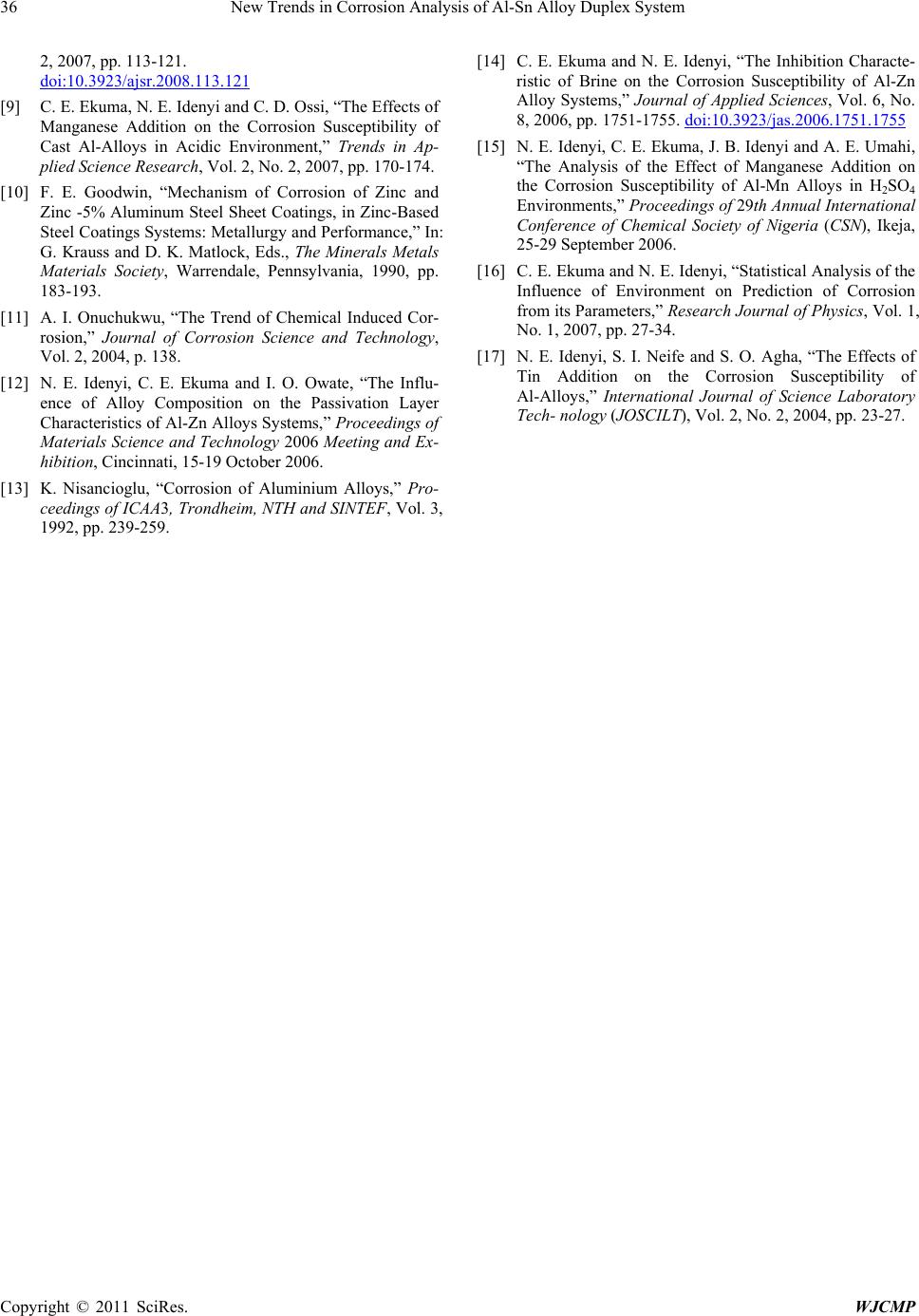 New Trends in Corrosion Analysis of Al-Sn Alloy Duplex System Copyright © 2011 SciRes. WJCMP 36 2, 2007, pp. 113-121. doi:10.3923/ajsr.2008.113.121 [9] C. E. Ekuma, N. E. Idenyi and C. D. Ossi, “The Effects of Manganese Addition on the Corrosion Susceptibility of Cast Al-Alloys in Acidic Environment,” Trends in Ap- plied Science Research, Vol. 2, No. 2, 2007, pp. 170-174. [10] F. E. Goodwin, “Mechanism of Corrosion of Zinc and Zinc -5% Aluminum Steel Sheet Coatings, in Zinc-Based Steel Coatings Systems: Metallurgy and Performance,” In: G. Krauss and D. K. Matlock, Eds., The Minerals Metals Materials Society, Warrendale, Pennsylvania, 1990, pp. 183-193. [11] A. I. Onuchukwu, “The Trend of Chemical Induced Cor- rosion,” Journal of Corrosion Science and Technology, Vol. 2, 2004, p. 138. [12] N. E. Idenyi, C. E. Ekuma and I. O. Owate, “The Influ- ence of Alloy Composition on the Passivation Layer Characteristics of Al-Zn Alloys Syst ems,” Proceedings of Materials Science and Technology 2006 Meeting and Ex- hibition, Cincinnati, 15-19 October 2006. [13] K. Nisancioglu, “Corrosion of Aluminium Alloys,” Pro- ceedings of ICAA3, Trondheim, NTH and SINTEF, Vol. 3, 1992, pp. 239-259. [14] C. E. Ekuma and N. E. Idenyi, “The Inhibition Characte- ristic of Brine on the Corrosion Susceptibility of Al-Zn Alloy Systems,” Journal of Applied Sciences, Vol. 6, No. 8, 2006, pp. 1751-1755. doi:10.3923/jas.2006.1751.1755 [15] N. E. Idenyi, C. E. Ekuma, J. B. Idenyi and A. E. Umahi, “The Analysis of the Effect of Manganese Addition on the Corrosion Susceptibility of Al-Mn Alloys in H2SO4 Environments,” Proceedings of 29th Annual International Conference of Chemical Society of Nigeria (CSN), Ikeja, 25-29 September 2006. [16] C. E. Ekuma and N. E. Idenyi, “Statistical Analysis of the Influence of Environment on Prediction of Corrosion from its Parameters,” Research Journal of Physics, Vol. 1, No. 1, 2007, pp. 27-34. [17] N. E. Idenyi, S. I. Neife and S. O. Agha, “The Effects of Tin Addition on the Corrosion Susceptibility of Al-Alloys,” International Journal of Science Laboratory Tech- nology (JOSCILT), Vol. 2, No. 2, 2004, pp. 23-27. |