

Paper Menu >>
Journal Menu >>
 Journal of Environmental Protection, 2011, 2, 213-220 doi:10.4236/jep.2011.23025 Published Online May 2011 (http://www.scirp.org/journal/jep) Copyright © 2011 SciRes. JEP 213 Impact of Iron Ore Tailing on Foraminifera of the Uppateru River Estuary, East Coast of India Nadimikeri Jayaraju1, Balam Chinnapolla Sundara Raja Reddy2, Kambham Reddeppa Reddy2, Addula Nallapa Reddy3 1Department of Geoinformatics, Yogi Vemana University, Andhra Pradesh, India; 2Department of Geology, Sri Venkateswara University, Andhra Pradesh, India; 3ONGC Regional Labs, Rajahmundry, India. Email: [email protected] Received June 8th, 2010; revised February 1st, 2011; accepted March 2nd, 2011. ABSTRACT Benthic foraminiferal assemblages have been used to determine the effects of Iran ore tailing pollution on the marine environment. The presen t paper attempts to unveil pollution impact as responded b y foraminiferal species of Uppateru estuary. The faunal data thus generated is compared with earlier data sets for possible adverse effects. There has been substantial reduction in total foraminiferal number (TFN), from 574 in 2006 to 213 in 2008 species (St.No.3) per10 gram sediment. Even the total species number (TSN) decreased from 27 in (St.No.8) 2006 to 8 (St.No.1) in 2008. Am- monia accounted for its share (68%), followed by Elphidium (7.4%) and Quinqueloculina (6.5%). These genera are considered to be robu st and o ppo rtunistic typ e in the study a rea. Th is fauna l variation in terms o f density (TFN) may be owing to the pollution caused by iron ore tailing. This study also supports the view that benthic foraminiferal biota can be used as a tool to monitor marine pollution in general and estuarine environment in specific. Keywords: Iron Ore Tailing, Foraminifera, Pollution, Mining, Uppateru, East Coast of I ndia 1. Introduction 1.1. General Perspective on Pollution Anthropogenic pollution has adversely affected almost every habitat on the planet. The badly damaged and de- terred are marine marginal bodies like, estuaries, creeks, lakes etc. The world wide explosion human population has resulted in dramatic changes in the quality and quan- tity of estuarine environment. This has produced sub- stantial changes to the biota of many of the more shel- tered coastal marine and brackish environment. Pollut- ants derived from mine tailings have been shown to ac- cumulate in estuarine sediments, reaching concentrations potentially capable of causing biological effects, how- ever, is difficult due to strong natural environmental gra- dients and the effects of past or present point-sources of contamination [1-3]. The character of foraminifera to document pollution signatures and preserve them was proposed to be poten- tial tool for temporal pollution monitoring studies [4]. Nevertheless, one of the short comings of this work that hampered the effective application of foraminifers for pollution monitoring was the lack of availability of stu- dies documenting presence of specific pollutants and also the pressure of similar foraminiferal characteristics from few naturally stressed areas [5]. The application of fo- raminifera for pollution studies was key because of their high sensitivity to minute variations in density (abun- dance) and diversity. Because of this sensitivity fora- minifera is considered to be one of the most useful pro- xies for the ecotoxicological studies in marine environ- ment in general and the marginal near shore environment in specific [4]. Thus pollution affects all aspects of life on earth and the incorporation of these effects of pollu- tants by some of the life forms like foraminifera make them effective indicator for pollution. Foraminifers are extremely sensitive to the slightest change in the environmental conditions. They have good preservation and fossilization potential and thus have been used extensively in pollution studies across the world [4,6-12]. The application of foraminifera for pol- lution monitoring is based on the variation in population or density (Total Foraminiferal Number, TFN), species diversity (Total Species Number, TSN) and abnormali- ties documented by the test morphology [13,14]. The present paper attempts to investigate the impact of iron ore dust on the foraminiferal density (TFN; abundance) and diversity (TSN) of Uppateru river estuary, which  Impact of Iron Ore Tailing on Foraminifera of the Uppateru River Estuary, East Coast of India 214 hither to remain unstudied. This study is considered to be first of its kind carried out from study area with respect to iron ore tailings. 1.2. Study Area India’s 6300 km long coast line like any other coast line in the world is a store house of various resources. On its east coast, having a length of 2300 km, Nellore coast (60 km) is famous for iron ore export. The export activity results in huge quantities of mining rejects that make their way to estuary during the monsoons and finally into the Bay of Bengal. Nevertheless, it is understood that the ability of any system to withstand and absorb pollutants is limited and therefore, these mining activities take their toll on marine biota. Uppateru estuarine complex (Krishnapatnam Port) has a great significance because it is not only a godown/ storehouse of iron ore (International supplier of iron ore) but also one of the key harbors along the east coast of India. The estuary is being used for export traffic. Therefore, the estuary is considered for the present study to monitor the effect of iron ore tailing on foraminiferal assemblages. Topography: Uppateru has an area of approximately 100 km2. It is located between 14˚07' and 14˚10' N and 80˚03' and 80˚06' E (Figure 1). The water depth during fauna is around 1m to 4 m. The fresh water it receives is from the tributary Uppateru of the river Penna. The estu- ary opens in to Bay of Bengal at its mouth and in this channel area the tidal effect is always manifested. Hydrography: Shallow water bodies wherein average depth is less than 3 m are more abundant than the deep bodies and are refereed to as wetlands. The present study area comes under wetland category. The riverlets that open into it bring approximately 100,000 lakh ton of silt. In the estuary, the sediments are mostly muddy in nature with an admixture of mud and fine sand. The sediments of the estuary become coarser with distance towards the mouth and there is a Bay-ward decrease in mud. Geography: The present study area is slightly mode- rate and laterally compressed by sand along east coast of India. Development of sandbars and crenulated appear- ance of mouths may be due to constant working of the water currents on the coastal front. The region around this estuary is represented more or less level land com- posed of recent deposits such as marine deposits, depo- sits, and sand dunes. The marine deposits formed mainly as a result of regression of the sea and modified by in part by fluvitale process. The alluvium of these rivers is essentially composed of sand, silt and clay in varying proportions and is restricted to very narrow strips in the banks of the river and tributaries. They are usually pale gray and occasionally dark brown. This was result of admixture with laterities, which derived from laterite desposits cropping out in a large area around the estuary. The estuary is rather narrow probably because of the moister northeast trade winds not being the powerful enough to carry the sand for inland, while the drier southeast trade winds carry much of its back again to the bay. Geology: Geologically, the Nellore district forms part of the Cudddapah supergroup and is covered mostly with green-schist facies of metamorphic rocks of Precambrian age. Iron ore mined from near by area is being trans- ported by trucks and lorries to the Krishnapatam Port (Uppateru estuary) for an international export. A daily shipping of 50,000 - 60,000 tones of iron ore is being transported by about 1200 - 1500 trucks to the Krishna- patnam Port (Uppateru River estuary). Two millions tones of iron ore are stacked in large dumps along the shores of Uppateru estuary for shipment. Wind and rain erode these dumps (mainly during the monsoons) trans- porting material in water bodies. Thus, the estuarine wa- ter contains a high concentration of Total Suspended Matter (TSM) that comprises of iron ore. Uppateru estu- ary being easily accessible and navigable forms to be the cost-effective means of transporting mined ore. The Krishnapatnam port, one of the emerging key harbors along the east coast of India, handles an export load of iron ore over 0.4 million tones per month. The study area enjoys a warm tropical climate with an average rainfall of 150 - 200 cm and an average temperature of 22˚C all through the year, except December to February when it is cool and pleasant [15]. 2. Material and Methods Using the Peterson grab, 14 bottom sediment samples from different sites in the Uppateru estuary were col- lected (Figure 1, Table 1). The location of each sample site was determined by two permanent land marks. The upper 2 cm of sediment collected was sampled and stored in polyethylene bottles to avoid contamination. From the study area, certain Physico-chemical parame- ters like salinity, pH, Temp, Ec, Do, TSMetc., were measured using Elico water analysis kit [16]. Foraminiferal Analysis: For carrying out foramina- feral investigations, approximately 10 g of sediment sample were first kept in the oven for drying over night at 60˚C temperature. The dried samples were then soaked in the water for a tray. To disperse, the lumps of clay in the samples, sodium hexa-meta-phosphate was added and kept for a day. Then hydrogen peroxide was added and kept overnight to disintegrate organic matter. Finally, the samples were washed through a 63 µ sieve a slow shower with a low water pressure to prevent the fo- raminiferal test breakage. The sand fraction thus ob- Copyright © 2011 SciRes. JEP 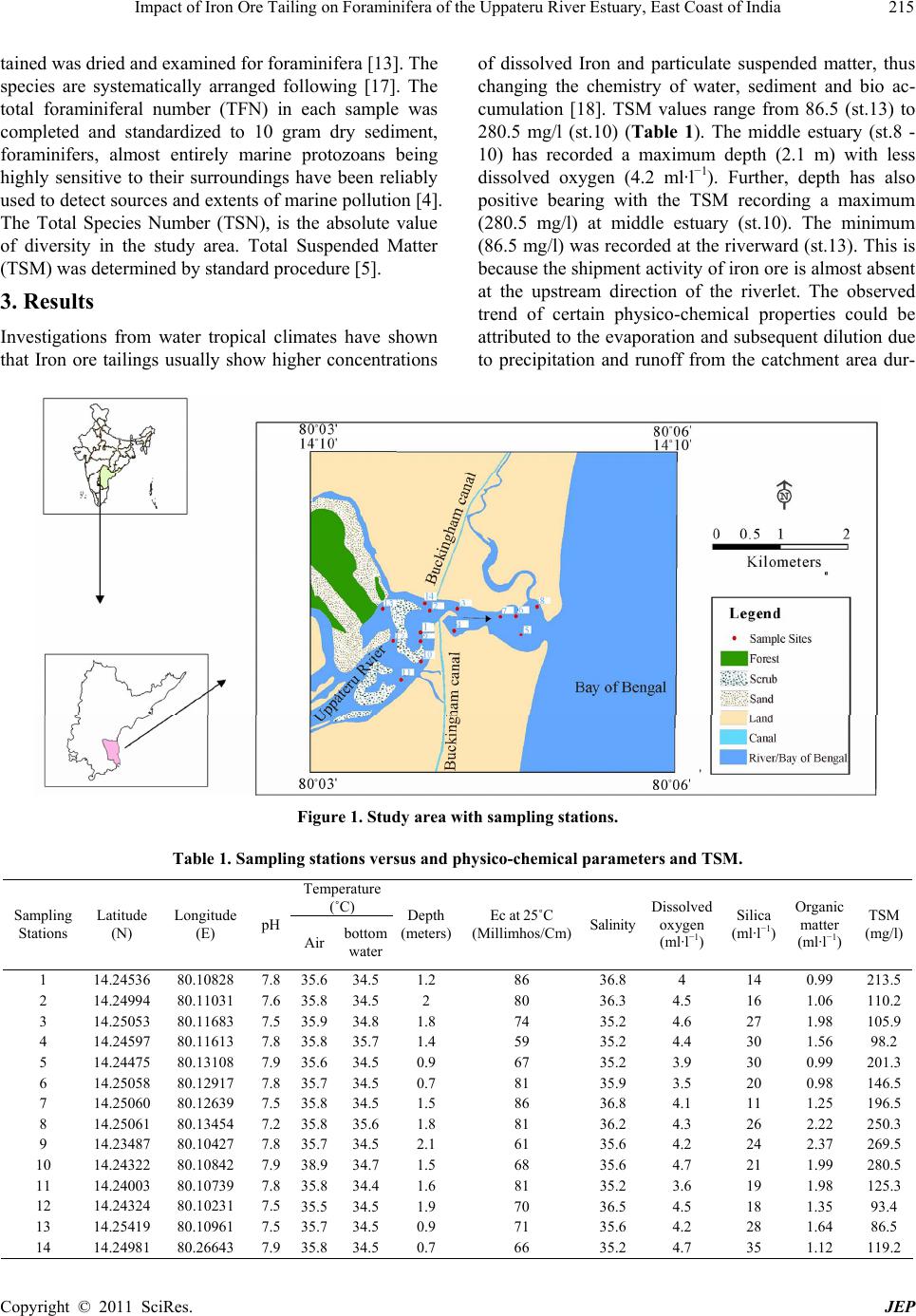 Impact of Iron Ore Tailing on Foraminifera of the Uppateru River Estuary, East Coast of India Copyright © 2011 SciRes. JEP 215 tained was dried and examined for foraminifera [13]. The species are systematically arranged following [17]. The total foraminiferal number (TFN) in each sample was completed and standardized to 10 gram dry sediment, foraminifers, almost entirely marine protozoans being highly sensitive to their surroundings have been reliably used to detect sources and extents of marine pollution [4]. The Total Species Number (TSN), is the absolute value of diversity in the study area. Total Suspended Matter (TSM) was determined by standard procedure [5]. 3. Results Investigations from water tropical climates have shown that Iron ore tailings usually show higher concentrations of dissolved Iron and particulate suspended matter, thus changing the chemistry of water, sediment and bio ac- cumulation [18]. TSM values range from 86.5 (st.13) to 280.5 mg/l (st.10) (Table 1). The middle estuary (st.8 - 10) has recorded a maximum depth (2.1 m) with less dissolved oxygen (4.2 ml·l−1). Further, depth has also positive bearing with the TSM recording a maximum (280.5 mg/l) at middle estuary (st.10). The minimum (86.5 mg/l) was recorded at the riverward (st.13). This is because the shipment activity of iron ore is almost absent at the upstream direction of the riverlet. The observed trend of certain physico-chemical properties could be attributed to the evaporation and subsequent dilution due to precipitation and runoff from the catchment area dur- Figure 1. Study are a with sampling stations. Table 1. Sampling stations versus and physico-c he mic al parameters and TSM. Temperature (˚C) Sampling Stations Latitude (N) Longitude (E) pH Air bottom water Depth (meters) Ec at 25˚C (Millimhos/Cm) Salinity Dissolved oxygen (ml·l−1) Silica (ml·l−1) Organic matter (ml·l−1) TSM (mg/l) 1 14.24536 80.10828 7.8 35.6 34.51.2 86 36.84 14 0.99 213.5 2 14.24994 80.11031 7.6 35.8 34.52 80 36.34.5 16 1.06 110.2 3 14.25053 80.11683 7.5 35.9 34.81.8 74 35.24.6 27 1.98 105.9 4 14.24597 80.11613 7.8 35.8 35.71.4 59 35.24.4 30 1.56 98.2 5 14.24475 80.13108 7.9 35.6 34.50.9 67 35.23.9 30 0.99 201.3 6 14.25058 80.12917 7.8 35.7 34.50.7 81 35.93.5 20 0.98 146.5 7 14.25060 80.12639 7.5 35.8 34.51.5 86 36.84.1 11 1.25 196.5 8 14.25061 80.13454 7.2 35.8 35.61.8 81 36.24.3 26 2.22 250.3 9 14.23487 80.10427 7.8 35.7 34.52.1 61 35.64.2 24 2.37 269.5 10 14.24322 80.10842 7.9 38.9 34.71.5 68 35.64.7 21 1.99 280.5 11 14.24003 80.10739 7.8 35.8 34.41.6 81 35.23.6 19 1.98 125.3 12 14.24324 80.10231 7.5 35.5 34.51.9 70 36.54.5 18 1.35 93.4 13 14.25419 80.10961 7.5 35.7 34.50.9 71 35.64.2 28 1.64 86.5 14 14.24981 80.26643 7.9 35.8 34.50.7 66 35.24.7 35 1.12 119.2 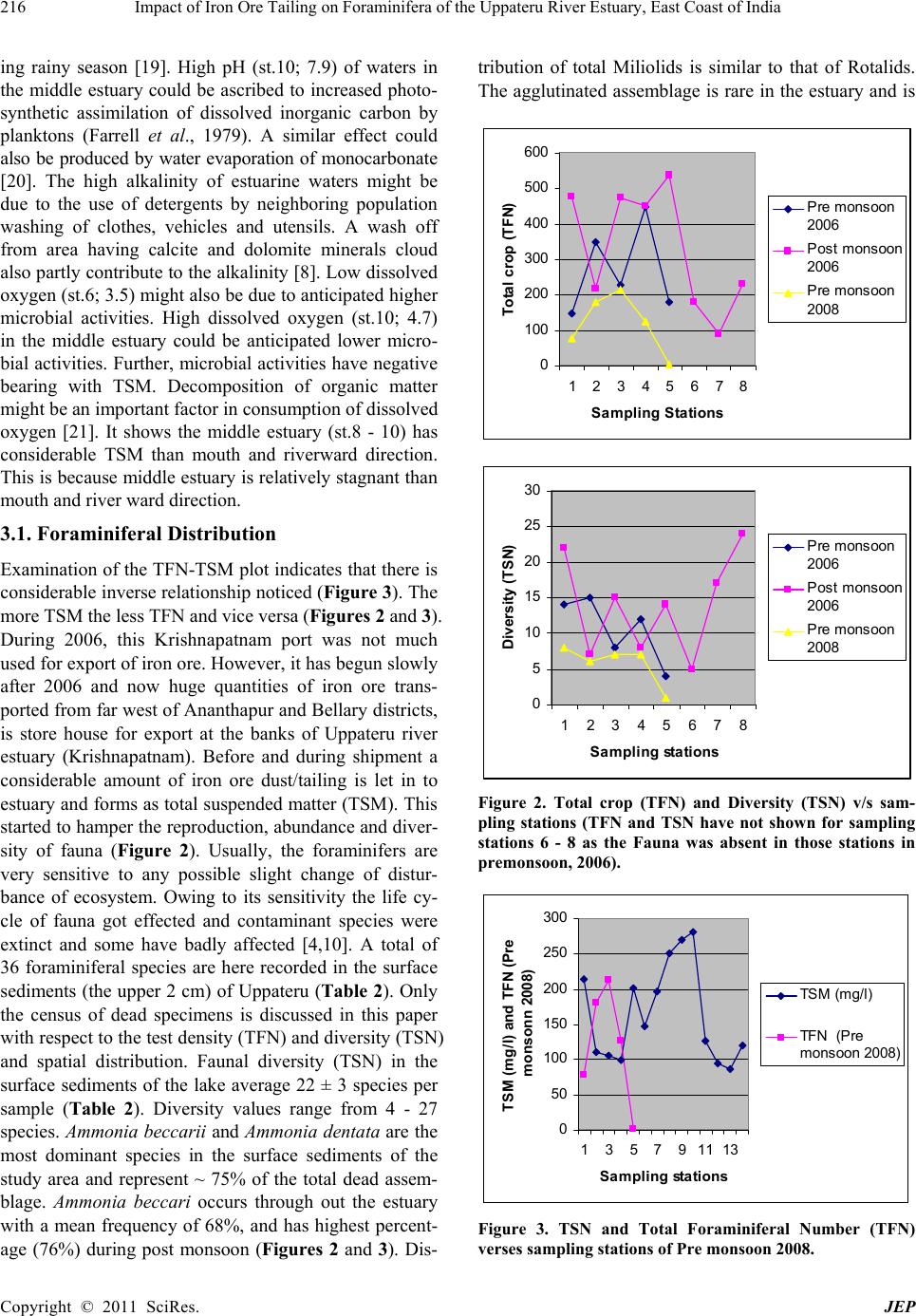 Impact of Iron Ore Tailing on Foraminifera of the Uppateru River Estuary, East Coast of India 216 ing rainy season [19]. High pH (st.10; 7.9) of waters in the middle estuary could be ascribed to increased photo- synthetic assimilation of dissolved inorganic carbon by planktons (Farrell et al., 1979). A similar effect could also be produced by water evaporation of monocarbonate [20]. The high alkalinity of estuarine waters might be due to the use of detergents by neighboring population washing of clothes, vehicles and utensils. A wash off from area having calcite and dolomite minerals cloud also partly contribute to the alkalinity [8]. Low dissolved oxygen (st.6; 3.5) might also be due to anticipated higher microbial activities. High dissolved oxygen (st.10; 4.7) in the middle estuary could be anticipated lower micro- bial activities. Further, microbial activities have negative bearing with TSM. Decomposition of organic matter might be an important factor in consumption of dissolved oxygen [21]. It shows the middle estuary (st.8 - 10) has considerable TSM than mouth and riverward direction. This is because middle estuary is relatively stagnant than mouth and river ward direction. 3.1. Foraminiferal Distribution Examination of the TFN-TSM plot indicates that there is considerable inverse relationship noticed (Figure 3). The more TSM the less TFN and vice versa (Figures 2 and 3). During 2006, this Krishnapatnam port was not much used for export of iron ore. However, it has begun slowly after 2006 and now huge quantities of iron ore trans- ported from far west of Ananthapur and Bellary districts, is store house for export at the banks of Uppateru river estuary (Krishnapatnam). Before and during shipment a considerable amount of iron ore dust/tailing is let in to estuary and forms as total suspended matter (TSM). This started to hamper the reproduction, abundance and diver- sity of fauna (Figure 2). Usually, the foraminifers are very sensitive to any possible slight change of distur- bance of ecosystem. Owing to its sensitivity the life cy- cle of fauna got effected and contaminant species were extinct and some have badly affected [4,10]. A total of 36 foraminiferal species are here recorded in the surface sediments (the upper 2 cm) of Uppateru (Table 2). Only the census of dead specimens is discussed in this paper with respect to the test density (TFN) and diversity (TSN) and spatial distribution. Faunal diversity (TSN) in the surface sediments of the lake average 22 ± 3 species per sample (Table 2). Diversity values range from 4 - 27 species. Ammonia beccarii and Ammonia dentata are the most dominant species in the surface sediments of the study area and represent ~ 75% of the total dead assem- blage. Ammonia beccari occurs through out the estuary with a mean frequency of 68%, and has highest percent- age (76%) during post monsoon (Figures 2 and 3). Dis- tribution of total Miliolids is similar to that of Rotalids. The agglutinated assemblage is rare in the estuary and is 0 100 200 300 400 500 600 12345678 Sampling Stations Total crop (TFN) P re m onsoon 2006 P ost mons oon 2006 P re m onsoon 2008 0 5 10 15 20 25 30 12345678 Sampling sta tions Di versity (TSN) P re m onsoon 2006 P ost mons oon 2006 P re m onsoon 2008 Figure 2. Total crop (TFN) and Diversity (TSN) v/s sam- pling stations (TFN and TSN have not shown for sampling stations 6 - 8 as the Fauna was absent in those stations in premonsoon, 2006). 0 50 100 150 200 250 300 135791113 Sampli ng stations T S M (mg/l ) an d T F N (P r e monsonn 2008) TSM ( mg /l) TFN (Pre m onsoo n 2008) Figure 3. TSN and Total Foraminiferal Number (TFN) erses sampling stations of Pre monsoon 2008. v Copyright © 2011 SciRes. JEP 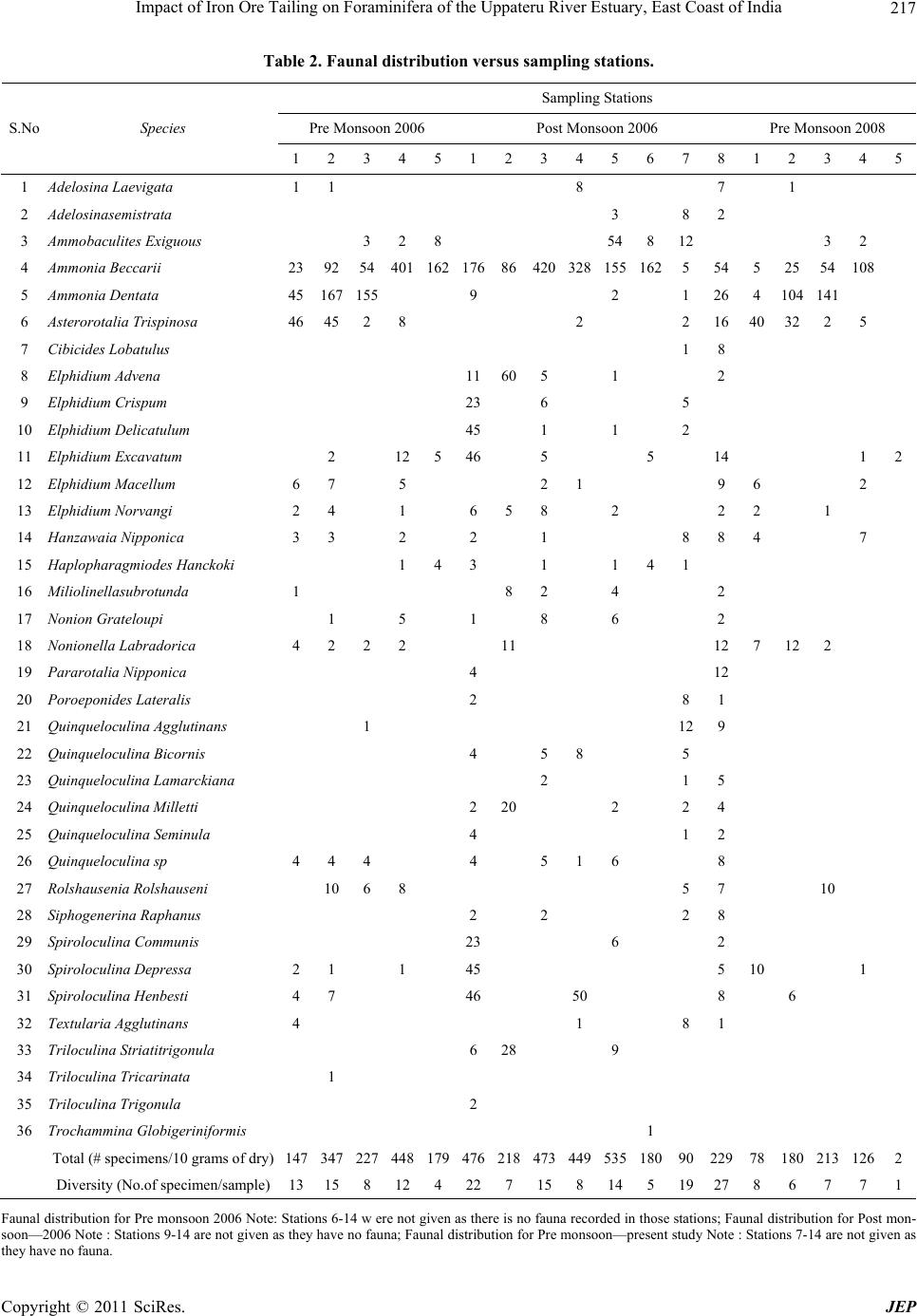 Impact of Iron Ore Tailing on Foraminifera of the Uppateru River Estuary, East Coast of India 217 Table 2. Faunal distribution versus sampling stations. Sampling Stations Pre Monsoon 2006 Post Monsoon 2006 Pre Monsoon 2008 S.No Species 1 2 34512345678 1 2 345 1 Adelosina Laevigata 1 1 8 7 1 2 Adelosinasemistrata 3 82 3 Ammobaculites Exiguous 328 54812 32 4 Ammonia Beccarii 23 92 5440116217686420328155162 554 5 25 54108 5 Ammonia Dentata 45 167 155 9 2 126 4 104 141 6 Aste r orotalia Trispinosa 46 45 28 2 216 40 32 25 7 Cibi c i d es L o b a t u l us 18 8 E lphidium Advena 11605 1 2 9 Elphidium Crispum 23 6 5 10 Elphidium Delicatulum 45 1 1 2 11 Elphidium Excavatum 2 12546 5 5 14 12 12 Elphidium Macellum 6 7 5 21 9 6 2 13 Elphidium Norvangi 2 4 1 658 2 2 2 1 14 Hanzawaia Nipponica 3 3 2 2 1 88 4 7 15 Haplopharagm iodes Hanckoki 143 1 141 16 Miliolinellasubrotunda 1 82 4 2 17 Nonion Grateloupi 1 5 1 8 6 2 18 Nonionella Labradorica 4 2 2 2 11 12 7 12 2 19 Pararotalia Nipponica 4 12 20 Poroeponides Lat eralis 2 81 21 Quinqueloculi n a Agglutinans 1 12 9 22 Quinqueloculina Bicornis 4 58 5 23 Quinqueloculina Lamarckiana 2 15 24 Quinqueloculina Milletti 220 2 24 25 Quinqueloculi n a Seminula 4 12 26 Quinqueloculi n a sp 4 4 4 4 516 8 27 Rolshausenia Rolshauseni 10 68 57 10 28 Siphogene r i na Raphanus 2 2 28 29 Spiroloculina Communis 23 6 2 30 Spiroloculina Depressa 2 1 1 45 5 10 1 31 Spiroloculina Henbesti 4 7 46 50 8 6 32 Textularia Agglutinans 4 1 81 33 Triloculina Striatitrigonula 628 9 34 Triloculina Tricarinata 1 35 Triloculina Trigonula 2 36 Trochammina G lobigeriniformis 1 Total (# specimens/10 grams of dry) 147 347 22744817947621847344953518090 229 78 180 2131262 Diversity (No.of specimen/sample) 13 15 812422715814519 27 8 6 771 Faunal distribution for Pre monsoon 2006 Note: Stations 6-14 w ere not given as there is no fauna recorded in those stations; Faunal distribution for Post mon- soon—2006 Note : Stations 9-14 are not given as they have no fauna; Faunal distribution for Pre monsoon—present study Note : Stations 7-14 are not given as ey have no fauna. th Copyright © 2011 SciRes. JEP 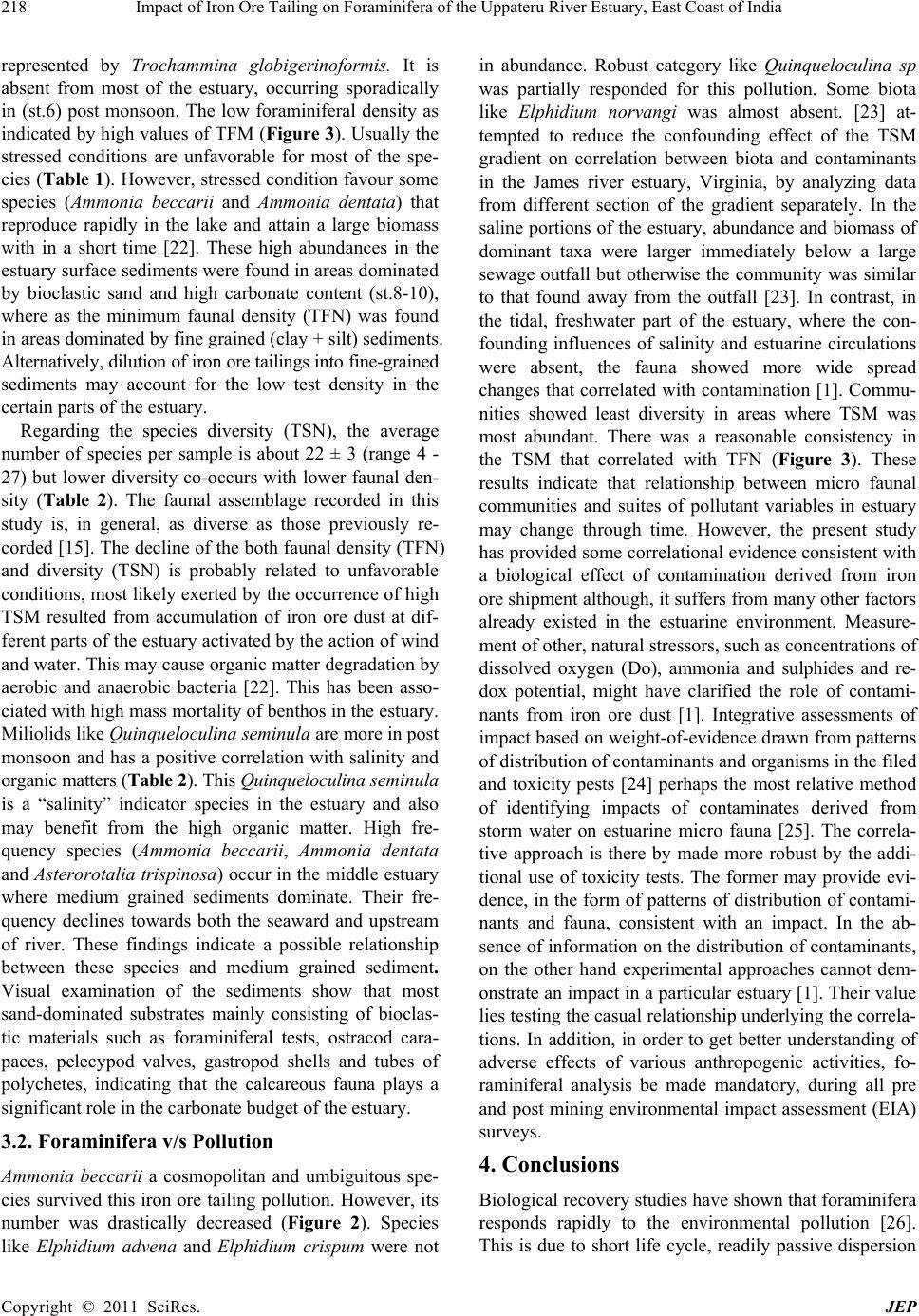 Impact of Iron Ore Tailing on Foraminifera of the Uppateru River Estuary, East Coast of India Copyright © 2011 SciRes. JEP 218 represented by Trochammina globigerinoformis. It is absent from most of the estuary, occurring sporadically in (st.6) post monsoon. The low foraminiferal density as indicated by high values of TFM (Figure 3). Usually the stressed conditions are unfavorable for most of the spe- cies (Table 1). However, stressed condition favour some species (Ammonia beccarii and Ammonia dentata) that reproduce rapidly in the lake and attain a large biomass with in a short time [22]. These high abundances in the estuary surface sediments were found in areas dominated by bioclastic sand and high carbonate content (st.8-10), where as the minimum faunal density (TFN) was found in areas dominated by fine grained (clay + silt) sediments. Alternatively, dilution of iron ore tailings into fine-grained sediments may account for the low test density in the certain parts of the estuary. Regarding the species diversity (TSN), the average number of species per sample is about 22 ± 3 (range 4 - 27) but lower diversity co-occurs with lower faunal den- sity (Table 2). The faunal assemblage recorded in this study is, in general, as diverse as those previously re- corded [15]. The decline of the both faunal density (TFN) and diversity (TSN) is probably related to unfavorable conditions, most likely exerted by the occurrence of high TSM resulted from accumulation of iron ore dust at dif- ferent parts of the estuary activated by the action of wind and water. This may cause organic matter degradation by aerobic and anaerobic bacteria [22]. This has been asso- ciated with high mass mortality of benthos in the estuary. Miliolids like Quinquelo culina seminu la are more in post monsoon and has a positive correlation with salinity and organic matters (Table 2). This Quinqueloculina sem i nula is a “salinity” indicator species in the estuary and also may benefit from the high organic matter. High fre- quency species (Ammonia beccarii, Ammonia dentata and Asteroro talia trispinosa) occur in the middle estuary where medium grained sediments dominate. Their fre- quency declines towards both the seaward and upstream of river. These findings indicate a possible relationship between these species and medium grained sediment. Visual examination of the sediments show that most sand-dominated substrates mainly consisting of bioclas- tic materials such as foraminiferal tests, ostracod cara- paces, pelecypod valves, gastropod shells and tubes of polychetes, indicating that the calcareous fauna plays a significant role in the carbonate budget of the estuary. 3.2. Foraminifera v/s Pollution Ammonia beccarii a cosmopolitan and umbiguitous spe- cies survived this iron ore tailing pollution. However, its number was drastically decreased (Figure 2). Species like Elphidium advena and Elphidium crispum were not in abundance. Robust category like Quinqueloculina sp was partially responded for this pollution. Some biota like Elphidium norvangi was almost absent. [23] at- tempted to reduce the confounding effect of the TSM gradient on correlation between biota and contaminants in the James river estuary, Virginia, by analyzing data from different section of the gradient separately. In the saline portions of the estuary, abundance and biomass of dominant taxa were larger immediately below a large sewage outfall but otherwise the community was similar to that found away from the outfall [23]. In contrast, in the tidal, freshwater part of the estuary, where the con- founding influences of salinity and estuarine circulations were absent, the fauna showed more wide spread changes that correlated with contamination [1]. Commu- nities showed least diversity in areas where TSM was most abundant. There was a reasonable consistency in the TSM that correlated with TFN (Figure 3). These results indicate that relationship between micro faunal communities and suites of pollutant variables in estuary may change through time. However, the present study has provided some correlational evidence consistent with a biological effect of contamination derived from iron ore shipment although, it suffers from many other factors already existed in the estuarine environment. Measure- ment of other, natural stressors, such as concentrations of dissolved oxygen (Do), ammonia and sulphides and re- dox potential, might have clarified the role of contami- nants from iron ore dust [1]. Integrative assessments of impact based on weight-of-evidence drawn from patterns of distribution of contaminants and organisms in the filed and toxicity pests [24] perhaps the most relative method of identifying impacts of contaminates derived from storm water on estuarine micro fauna [25]. The correla- tive approach is there by made more robust by the addi- tional use of toxicity tests. The former may provide evi- dence, in the form of patterns of distribution of contami- nants and fauna, consistent with an impact. In the ab- sence of information on the distribution of contaminants, on the other hand experimental approaches cannot dem- onstrate an impact in a particular estuary [1]. Their value lies testing the casual relationship underlying the correla- tions. In addition, in order to get better understanding of adverse effects of various anthropogenic activities, fo- raminiferal analysis be made mandatory, during all pre and post mining environmental impact assessment (EIA) surveys. 4. Conclusions Biological recovery studies have shown that foraminifera responds rapidly to the environmental pollution [26]. This is due to short life cycle, readily passive dispersion  Impact of Iron Ore Tailing on Foraminifera of the Uppateru River Estuary, East Coast of India 219 and faster colonization [27]. This is in accor dance with our observation of a fair correlation between total pol- lutant contents and total morphological abnormality cou- pled with spatial fluctuations. Conclusions of study are derived as here under. 1) Density (abundance—TFN)) and diversity of fo- raminiferal crop (TSN) has showed a wider fluctuation in the study area. This may have resulted owing to iron ore dust factor suspended in the water as Total Suspended Matter (TSM). 2) The foraminiferal fauna is almost disappeared near the disposable area of iron ore. However, recolonization started immediately after the termination of disposal at selected stations, but the species composition is still very different from original one. 3) Low density (TFN—abundance of species) and di- versity (TSN) occurred in almost all areas (sts1-14) of the Krishnapatnam port activity site. 4) Although it is not a straight forward procedure to distinguish between natural and anthropogenic effects/ stress an foraminifera, the mining related environmental impact is so high compared to natural background impact that we conclude that fluctuation in diversity and density represent a useful biomarker for Iron ore tailing con- tamination near Uppateru and that repeated sampling and measurements in the future will improve the understand- ing of long term biotic impacts [27]. 5) Decrease in the TFN and increase in TSM values in the year (2008) seem to indicate a possible increase in the iron ore dump in the Uppateru area. This suggests the determinations of estuarine health warrants further study. 6) In this study the diversity and density reduction of foraminifera are used as retrogressive bioindicator of iron ore tailing pollution. 5. Acknowledgements NJR thanks Prof. A. R. Reddy, Vice-chancellor, Yogi Vemana University, Kadapa. We thank Dr. Raymond L. Kepner, Jr., USA, for improving the quality of English language of the paper. REFERENCES [1] D. J. Morrisey , S. J. Turner, G. N. Mills, R. B. William- son and B. E. Wsie, “Factors Affecting the Distribution of Benthic Macrofauna in Estuaries Contaminated by Urban Runoff,” Marine Environmental Research, Vol. 55, No. 2, 2003, pp. 113-136. doi:10.1016/S0141-1136(02)00211-8 [2] L. Rosales-Hez, E. Carranza and O. Celis-Hernandez, “Environmental Implications of Heavy Metals in Surface Sediments near Isla de Sacrificios, Mexico,” Bulletin Environmental Contamination Toxicolgy, Vol. 78, No. 5, 2007, pp. 353-357. doi:10.1007/s00128-007-9125-7 [3] M. N. Vazquez, M. A. Gil, E. J. L. Esteves and E. M. A. Narvarte, “Monitoring Heavy Metal Pollution in San An- tonio Bay, Rio Negro, Argentina,” Bulletin Env ironm ental Contamination Toxicolgy, Vol. 79, No. 2, 2007, pp. 121-125.doi:10.1007/s00128-007-9084-z [4] E. Alve, “Benthic Foraminiferal Response to Estuarine Pollution: A Review,” Journal of Foraminiferal Research, Vol. 25, No. 3, 1995, pp. 190-203. doi:10.2113/gsjfr.25.3.190 [5] R. Nigam, R. Saraswat and R. Panchang, “Application of Foraminifera Ecotoxicology: Retrospect, Perspect and Prospect,” Environmental International, Vol. 32, No. 2, 2006, pp. 273-283. doi:10.1016/j.envint.2005.08.024 [6] N. Jayaraju and K. R. Reddi, “Impact of Pollution on Coastal Zone Monitoring with Benthic Foraminifera of Tuticorin, South East Coast of India,” Indian Journal of Marine Sciences, Vol. 25, 1996, pp. 376-378. [7] N. Jayaraju, B. C. Sundara Raja Reddy and K. R. Reddy “The Response Ofbenthic Foraminifera to Various Pollu- tion Sources: A Study from Nellore coast, East Coast of India,” Environmental Monitoring and Assessment, Vol. 142, No. 1-3, 2008, pp. 319-323. doi:10.1007/s10661-007-9931-8 [8] K. K. Rao, “Foraminiferal Fauna from the Cochin Back Waters: Biological Indicators of Man-Made Changes in the Environment,” Journal of Aquatic Biology, Vol. 11, 1996, pp. 9-16. [9] V. Yanko, M. Ahmad and M. Kaminiski, “Morphological Deformities of Benthic Foraminiferal Tests in Response to Pollution by Heavy Metals: Implications for Pollution Monitoring,” Journal of Foraminiferal Research, Vol. 28, No. 3, 1998, pp. 177-200. [10] G. N. Nayak, “Impact of Mining on Environment in Goa,” International Publications, New Delhi, 2002. [11] R. Nigam, G. N. Nayak and S. Naik, “Does Mining Pol- lution Effect the Foraminiferal Distribution in Mandovi Estuary, Goa, India?” Revve de Paleobiologie, Vol. 21, No. 2, 2002, pp. 673-677. [12] R. Nigam, R. Panchang and P. Banerjee, “Foraminifera in Surface Sediments of Mandovi River Estuary: Indicators for Mining Pollution and High Sea Stand in Goa, India,” Journal of Coastal Research, Vol. 21, No. 4, 2005, pp. 853-859. doi:10.2112/03-0061.1 [13] A. Pascual, J. Rodriguez-Lazaro, O. Weber and J. M. Jouanneau, “Late Holocene Pollution in the Gernika Es- tuary (Southern Bay of Biscay) Evidenced by the Study of Foraminifera and Ostracoda,” Hydrobiologia, Vol. 475/476, No. 1, 2002, pp. 477-491. doi:10.1023/A:1020316231441 [14] R. Panchang, R. Nigam , N. Baig and G. N. Nayak, “A Foraminiferal Testimony for the Reduced Adverse Ef- fects of Mining in Zuari Estuary, Goa,” International Journal of Environmental Studies, Vol. 62, No. 5, 2005, pp. 579-591. doi:10.1080/00207230500241801 [15] B. C. S. R. Reddy, “Estuarine Pollution Signatures on the Benthic Foraminifera: A Study from Nellore Coast,” Unpublished Ph. D Thesis, Submitted S. V. University, Copyright © 2011 SciRes. JEP  Impact of Iron Ore Tailing on Foraminifera of the Uppateru River Estuary, East Coast of India Copyright © 2011 SciRes. JEP 220 Tiurpati, 2007. [16] N. Jayaraju, I. Suryakumar and K. R. Reddi, “Foraminif- eral Species Densities and Environmental Variables of Pulicat Lake, Southeast Coast of India,” Journal Geo- logical Society of India, Vol. 70, No. 5, 2007, pp. 829- 836. [17] A. R. Loeblich and H. Tappan, “Foraminiferal Genera and Their Classification,” Van Nostrand Reinhold, New York, 1987. [18] I. J. Holopainen, A. L. Holopainen, H. Hamalainen, M. Rahkola-Sorsa, V. Tkatcheva and M. Viljanen, “Effects of Mining Industry Waste Waters on a Shallow Lake Ecosystem in Karelia, North-West Russia,” Hydrobiologia, Vol. 506, No. 1-3, 2003, pp. 111-119. doi:10.1023/B:HYDR.0000008554.28228.14 [19] M. A. G. Khan and S. H. Chowdhary, “Physical and Chemical Limnology of Lake Kaptai. Bangladesh,” Tropical Ecology, Vol. 35, No. 11, 1994, pp. 35-51. [20] L. R. Bhatt, P. Lacoul, H. D. Lekhak and P. K. Jha, “Phys- icochemical Characteristics and Phytoplanktons of Tan- daha Lake, Katmandu,” Pollution Research, Vol. 18, 1999, pp. 353-358. [21] P. A. Singh, S. Prakash and P. Srivastava, “Relationships of Heavy Metals in Natural Lake Waters with Physico- chemical Characteristics of Waters and Different Chemi- cal Feractions of Metals in Sediments,” Water Air Soil Pollution, Vol. 188, 2008, pp. 181-193. doi:10.1007/s11270-007-9534-6 [22] H. R. Abu-Zied, W. K. Keatings and J. R. Flower, “En- vironmental Controls on Foraminifera in Lake Qurun Egypt,” Journal of Foraminiferal Research, Vol. 37, No. 2, 2007, pp. 136-149. doi:10.2113/gsjfr.37.2.136 [23] R. J. Diaz, “Pollution and Tidal Benthic Communities of the James River Estuary, Virginia,” Hydrobiologia, Vol. 180, No. 1, 1989, pp. 195-211. doi:10.1007/BF00027553 [24] P. M. Chapman , E. A. Power and G. A. Burton Jr., “In- tegrative Assessments in Aquatic Ecosystems,” In: G. A. Burton, Ed., Sediment Toxicity Assessment, Lewis Pub- lishers, Boca Raton, 1992. [25] M. C. Watzin, A. W. McIntosh, E. A. Brown, R. Lacey, D. C. Lester, K. L. Newbrough and A. R. Williams, “As- sessing Sediment Quality in Highly Heterogeneous En- vironments: A Case Study of a Small Urban Harbor in Lake Champlain,” Environmental Toxicology and Chem- istry, Vol. 16, 1997, pp. 2125-2135. [26] E. Alve, “Colonization of New Habitats by Benthic Fo- raminifera: A Review,” Earth-Science Reviews, Vol. 46, No. 1-4, 1999, pp. 167-185. doi:10.1016/S0012-8252(99)00016-1 [27] B. Elberling, K. L. Knudsen, P. H. Kristensen and A. Gert, “Applying Foraminiferal Stratigraphy as a Bio- marker for Heavy Metal Contamination and Mining Im- pact in Fjord in West Greenland,” Marine Environmental Research, Vol. 55, No. 3, 2003, pp. 235-256. doi:10.1016/S0141-1136(02)00219-2 |