

Paper Menu >>
Journal Menu >>
 International Journal of Organic Chemistry, 2011, 1, 20-25 doi:10.4236/ijoc.2011.12004 Published Online June 2011 (http://www.SciRP.org/journal/ijoc) Copyright © 2011 SciRes. IJOC Rapid Biodiesel Fuel Production Using Novel Fibrous Catalyst Synthesized by Radiation-Induced Graft Polymerization Yuji Ueki1*, Nor Hasimah Mohamed2,3, Noriaki Seko1, Masao Tamada1,3 1Environment and Ind ustri al Materials Research Division, Quantum Beam Science Directorate, Japan Atomic Energy Agency, Takasaki, Japan 2Radiation Processing Technology Division, Malaysian Nuclear Agency, Selangor, Malaysia 3Department of Chemistry and Chemical Biology, Graduate School of Engineering, Gunma University, Kiryu, Japan E-mail: [email protected] Received March 30, 2011; revised April 25, 2011: accepted May 16, 2011 Abstract An efficient fibrous catalyst for the biodiesel fuel production has been synthesized by radiation-induced graft polymerization of 4-chloromethylstyrene onto a nonwoven polyethylene (NWPE) fabric followed by amina- tion with trimethylamine (TMA) and further treatment with NaOH. The degree of grafting of NWPE fabric and TMA group density of fibrous catalyst could easily and reproducibly be controlled within a range of up to 340% and 3.6 mmol-TMA/g-catalyst, respectively. In the transesterification of triglycerides and ethanol using the synthesized fibrous catalyst, the conversion ratio of triglycerides reached 95% after 4 h reaction at 50˚C. Keywords: Biomass, Biodiesel Fuel, Triglycerides, Heterogeneous Catalysis, Radiation-Induced Graft Polymerization, Renewable Resources In order to deal with the future exhaustion of fossil fuels and growing international energy demand, numerous attempts to study and develop alternative fuels with re- newability are underway in various parts of the world. Among others, biodiesel fuel (BDF), which is defined as the monoalkyl esters of fatty acids derived from triglyc- erides (TGs) by transesterification with alcohols, has been regarded as a promising alternative fuel over petro- leum because of its qualities such as renewable resources (plant and animal), lower kinetic viscosity, and decrease in petrochemical dependence, green house effect and air pollution. The BDF production be classified into several methods according to the type of catalyst; acid- [1-3], alkali- [1,4-6], lipase- [7,8], and metal oxide-catalyzed method [9,10] and non-catalytic supercritical methanol method [11-13]. Some methods of industrial production of BDF from oil/fat have already been developed; and at present, an alkali catalyst method of using a homogene- ous catalyst such as NaOH or KOH is in the mainstream due to faster reaction rates [1,4-6]. However, occurrence of undesired saponification and difficulty on the separa- tion of homogenized catalyst from the reaction mixture are its weak points. Recently, use of porous anion exchange resins was proposed by N. Shibasaki-Kitakawa et al., as a modifica- tion technique over the traditional alkali catalyst method [14,15]. According to the method of using such a porous anion exchange resin, the catalyst does not dissolve in the reaction system, and therefore a step of separating the catalyst is omitted. However, sample diffusion into the pores of the catalyst is rate-limiting since the catalyst has a reaction site inside the pores. Accordingly, the reaction speed is slow; thus limiting its use in the mass-scale in- dustrial production of BDF. Meanwhile, our team has developed a grafted polymer as an ion exchanger that secures high reaction speed and enables high-speed processing [16-18]. The grafted polymer was synthesized by a radiation-induced graft polymerization that combined the surface of the polymer substance (trunk polymer) with another polymer chain (graft chain). Especially, our team has been intensively studying about the grafted polymers with a substrate of a fibrous polymer having a large specific surface area and having a high-level contact efficiency, and it has found 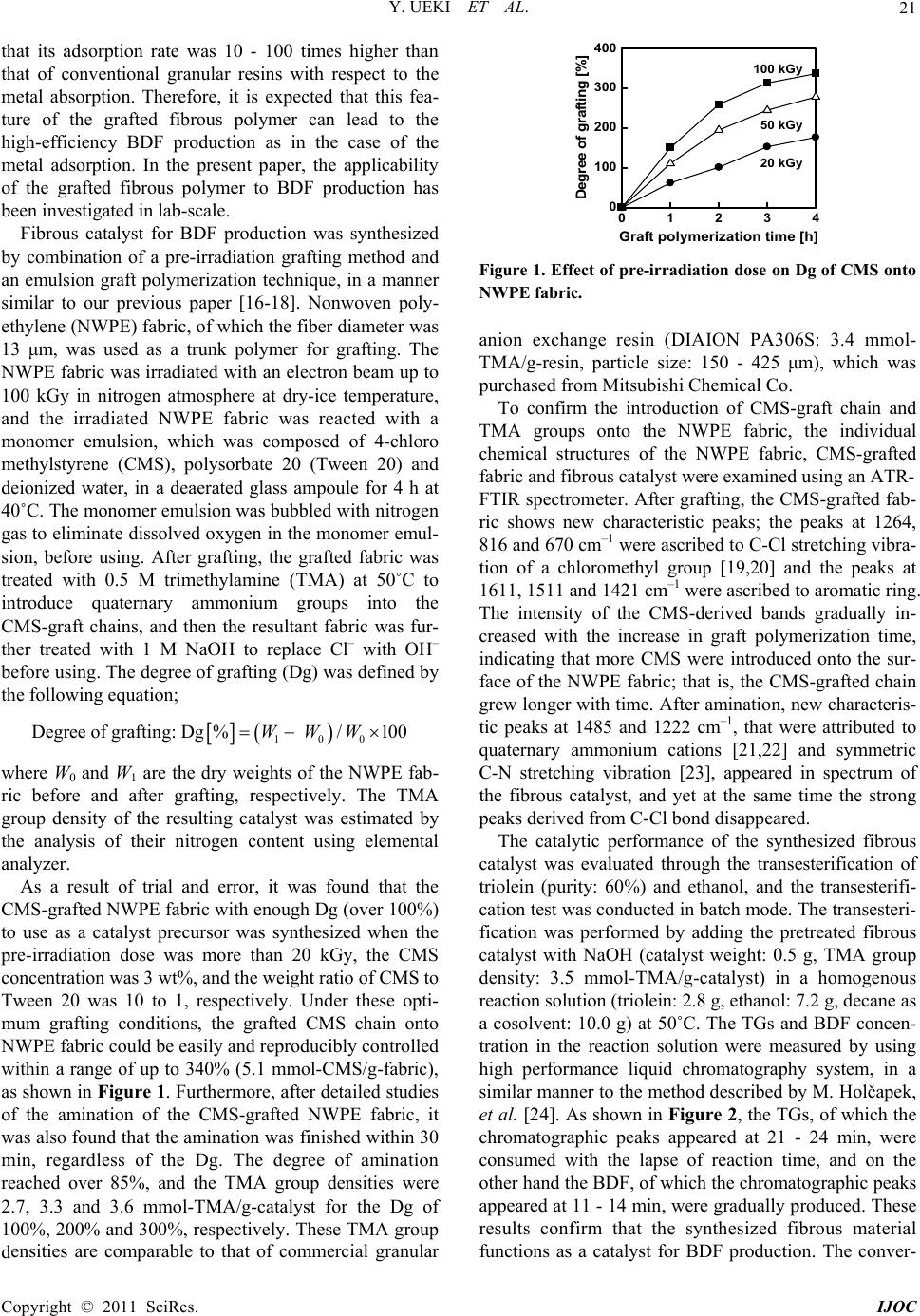 Y. UEKI ET AL.21 that its adsorption rate was 10 - 100 times higher than that of conventional granular resins with respect to the metal absorption. Therefore, it is expected that this fea- ture of the grafted fibrous polymer can lead to the high-efficiency BDF production as in the case of the metal adsorption. In the present paper, the applicability of the grafted fibrous polymer to BDF production has been investigated in lab-scale. Fibrous catalyst for BDF production was synthesized by combination of a pre-irradiation grafting method and an emulsion graft polymerization technique, in a manner similar to our previous paper [16-18]. Nonwoven poly- ethylene (NWPE) fabric, of which the fiber diameter was 13 μm, was used as a trunk polymer for grafting. The NWPE fabric was irradiated with an electron beam up to 100 kGy in nitrogen atmosphere at dry-ice temperature, and the irradiated NWPE fabric was reacted with a monomer emulsion, which was composed of 4-chloro methylstyrene (CMS), polysorbate 20 (Tween 20) and deionized water, in a deaerated glass ampoule for 4 h at 40˚C. The monomer emulsion was bubbled with nitrogen gas to eliminate dissolved oxygen in the monomer emul- sion, before using. After grafting, the grafted fabric was treated with 0.5 M trimethylamine (TMA) at 50˚C to introduce quaternary ammonium groups into the CMS-graft chains, and then the resultant fabric was fur- ther treated with 1 M NaOH to replace Cl– with OH– before using. The degree of grafting (Dg) was defined by the following equation; 100 Degree of grafting: Dg% /100WWW where W0 and W1 are the dry weights of the NWPE fab- ric before and after grafting, respectively. The TMA group density of the resulting catalyst was estimated by the analysis of their nitrogen content using elemental analyzer. As a result of trial and error, it was found that the CMS-grafted NWPE fabric with enough Dg (over 100%) to use as a catalyst precursor was synthesized when the pre-irradiation dose was more than 20 kGy, the CMS concentration was 3 wt%, and the weight ratio of CMS to Tween 20 was 10 to 1, respectively. Under these opti- mum grafting conditions, the grafted CMS chain onto NWPE fabric could be easily and reproducibly controlled within a range of up to 340% (5.1 mmol-CMS/g-fabric), as shown in Figure 1. Furthermore, after detailed studies of the amination of the CMS-grafted NWPE fabric, it was also found that the amination was finished within 30 min, regardless of the Dg. The degree of amination reached over 85%, and the TMA group densities were 2.7, 3.3 and 3.6 mmol-TMA/g-catalyst for the Dg of 100%, 200% and 300%, respectively. These TMA group 01234 0 100 200 300 400 Graft polymerization time [h] Degree of grafting [ 20 kGy 50 kGy 100 kGy Figure 1. Effect of pre-irradiation dose on Dg onto nion exchange resin (DIAION PA306S: 3.4 mmol- aft chain and TM zed fibrous ca %] of CMS NWPE fabric. a TMA/g-resin, particle size: 150 - 425 μm), which was purchased from Mitsubishi Chemical Co. To confirm the introduction of CMS-gr A groups onto the NWPE fabric, the individual chemical structures of the NWPE fabric, CMS-grafted fabric and fibrous catalyst were examined using an ATR- FTIR spectrometer. After grafting, the CMS-grafted fab- ric shows new characteristic peaks; the peaks at 1264, 816 and 670 cm–1 were ascribed to C-Cl stretching vibra- tion of a chloromethyl group [19,20] and the peaks at 1611, 1511 and 1421 cm–1 were ascribed to aromatic ring. The intensity of the CMS-derived bands gradually in- creased with the increase in graft polymerization time, indicating that more CMS were introduced onto the sur- face of the NWPE fabric; that is, the CMS-grafted chain grew longer with time. After amination, new characteris- tic peaks at 1485 and 1222 cm–1, that were attributed to quaternary ammonium cations [21,22] and symmetric C-N stretching vibration [23], appeared in spectrum of the fibrous catalyst, and yet at the same time the strong peaks derived from C-Cl bond disappeared. The catalytic performance of the synthesi talyst was evaluated through the transesterification of triolein (purity: 60%) and ethanol, and the transesterifi- cation test was conducted in batch mode. The transesteri- fication was performed by adding the pretreated fibrous catalyst with NaOH (catalyst weight: 0.5 g, TMA group density: 3.5 mmol-TMA/g-catalyst) in a homogenous reaction solution (triolein: 2.8 g, ethanol: 7.2 g, decane as a cosolvent: 10.0 g) at 50˚C. The TGs and BDF concen- tration in the reaction solution were measured by using high performance liquid chromatography system, in a similar manner to the method described by M. Holčapek, et al. [24]. As shown in Figure 2, the TGs, of which the chromatographic peaks appeared at 21 - 24 min, were consumed with the lapse of reaction time, and on the other hand the BDF, of which the chromatographic peaks appeared at 11 - 14 min, were gradually produced. These results confirm that the synthesized fibrous material functions as a catalyst for BDF production. The conver- densities are comparable to that of commercial granular Copyright © 2011 SciRes. IJOC 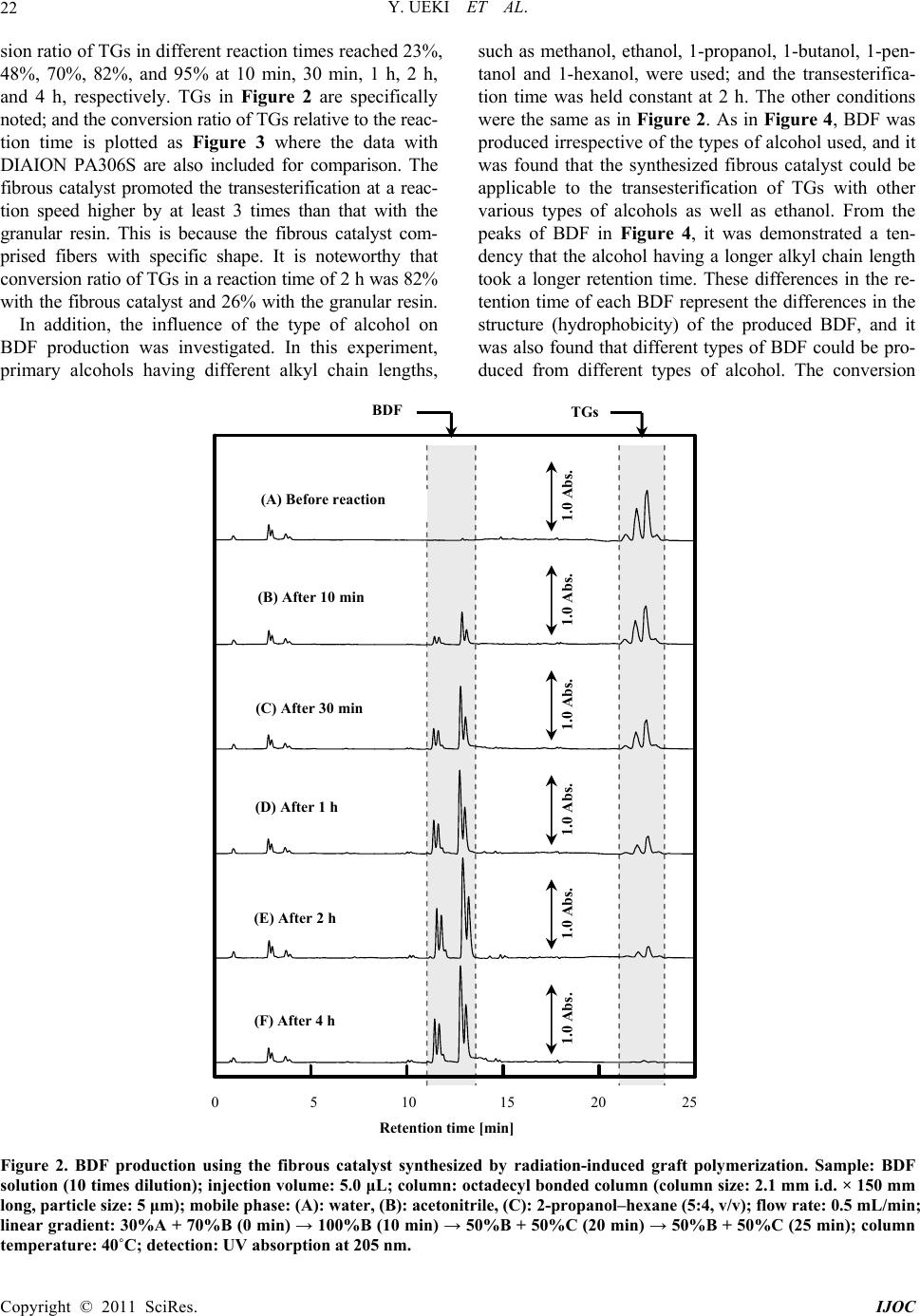 Y. UEKI ET AL. Copyright © 2011 SciRes. IJOC 22 B igure 2. BDF production using the fibrous catalyadiation-induced graft polymerization. Sample: BDF sion ratio of TGs in different reaction times reached 23%, 48%, 70%, 82%, and 95% at 10 min, 30 min, 1 h, 2 h, and 4 h, respectively. TGs in Figure 2 are specifically noted; and the conversion ratio of TGs relative to the reac- tion time is plotted as Figure 3 where the data with DIAION PA306S are also included for comparison. The fibrous catalyst promoted the transesterification at a reac- tion speed higher by at least 3 times than that with the granular resin. This is because the fibrous catalyst com- prised fibers with specific shape. It is noteworthy that conversion ratio of TGs in a reaction time of 2 h was 82% with the fibrous catalyst and 26% with the granular resin. In addition, the influence of the type of alcohol on DF production was investigated. In this experiment, primary alcohols having different alkyl chain lengths, such as methanol, ethanol, 1-propanol, 1-butanol, 1-pen- tanol and 1-hexanol, were used; and the transesterifica- tion time was held constant at 2 h. The other conditions were the same as in Figure 2. As in Figure 4, BDF was produced irrespective of the types of alcohol used, and it was found that the synthesized fibrous catalyst could be applicable to the transesterification of TGs with other various types of alcohols as well as ethanol. From the peaks of BDF in Figure 4, it was demonstrated a ten- dency that the alcohol having a longer alkyl chain length took a longer retention time. These differences in the re- tention time of each BDF represent the differences in the structure (hydrophobicity) of the produced BDF, and it was also found that different types of BDF could be pro- duced from different types of alcohol. The conversion (B) After 10 min (C) After 30 min (D) After 1 h (E) After 2 h (F) After 4 h TGs BDF 1.0 Abs. (A) Before reaction 1.0 Abs. 1.0 Abs. 1.0 Abs. 1.0 Abs. 1.0 Abs. 0 5 10 15 20 25 Retention time [min] Fst synthesized by r solution (10 times dilution); injection volume: 5.0 μL; column: octadecyl bonded column (column size: 2.1 mm i.d. × 150 mm long, particle size: 5 μm); mobile phase: (A): water, (B): acetonitrile, (C): 2-propanol–hexane (5:4, v/v); flow rate: 0.5 mL/min; linear gradient: 30%A + 70%B (0 min) → 100%B (10 min) → 50%B + 50%C (20 min) → 50%B + 50%C (25 min); column temperature: 40˚C; detection: UV absorption at 205 nm. 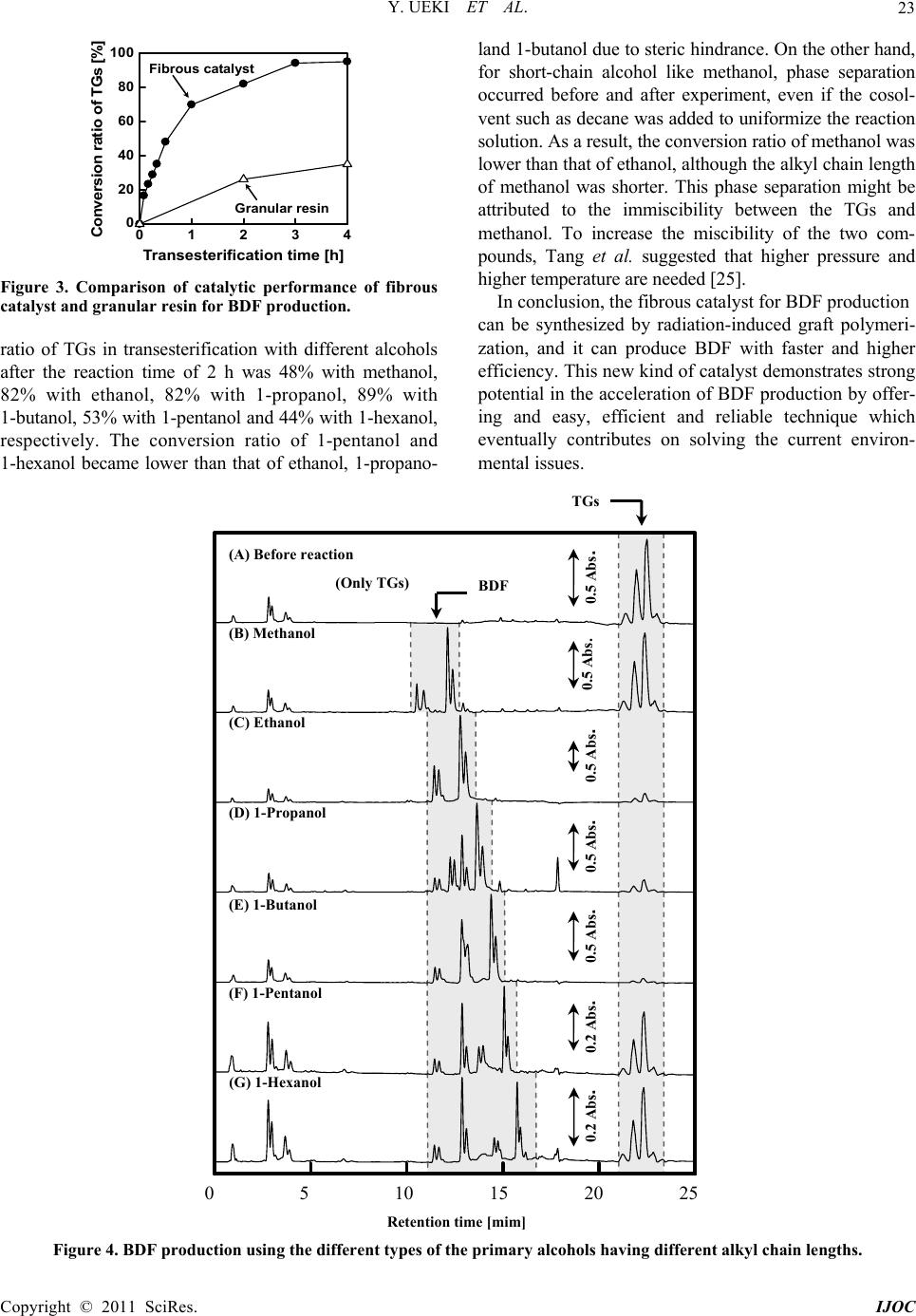 Y. UEKI ET AL.23 01234 0 20 40 60 80 100 %] Transesterification time [h] Conversion ratio of TGs [ Granular resin Fibrous catalyst Figure 3. Comparison of catalytic performance of fibrous tio of TGs in transesterification with different alcohols land 1-butanol due to steric hindrance. On the other hand, for BDF production ca Figure 4. BDF l chain lengths. catalyst and granular resin for BDF production. ra after the reaction time of 2 h was 48% with methanol, 82% with ethanol, 82% with 1-propanol, 89% with 1-butanol, 53% with 1-pentanol and 44% with 1-hexanol, respectively. The conversion ratio of 1-pentanol and 1-hexanol became lower than that of ethanol, 1-propano- for short-chain alcohol like methanol, phase separation occurred before and after experiment, even if the cosol- vent such as decane was added to uniformize the reaction solution. As a result, the conversion ratio of methanol was lower than that of ethanol, although the alkyl chain length of methanol was shorter. This phase separation might be attributed to the immiscibility between the TGs and methanol. To increase the miscibility of the two com- pounds, Tang et al. suggested that higher pressure and higher temperature are needed [25]. In conclusion, the fibrous catalyst n be synthesized by radiation-induced graft polymeri- zation, and it can produce BDF with faster and higher efficiency. This new kind of catalyst demonstrates strong potential in the acceleration of BDF production by offer- ing and easy, efficient and reliable technique which eventually contributes on solving the current environ- mental issues. TGs (A) Before reaction y TGs) BDF (B) Methanol (C) Ethanol (D) 1-Propanol (E) 1-Butanol (F) 1-Pentanol (G) 1-Hexanol production using the different alcohols having different alky Retention time [mim] types of the primary (Onl 0.5 Abs. . . . . . . 0.5 Abs0.5 Abs0.5 Abs0.5 Abs0.2 Abs0.2 Abs 05 10 15 20 25 0 5 10 15 20 25 Copyright © 2011 SciRes. IJOC  Y. UEKI ET AL. 24 Refer ] B. Freedman, E. H. Pryde and T. L. Mounts, “Variab rota, M. ences [1 les Affecting the Yields of Fatty Esters from Transesterified Vegetable Oils,” Journal of American Oil Chemists’ So- ciety, Vol. 61, No. 10, 1984, pp. 1638-1643. [2] M. D. Serio, R. Tesser, M. Dimiccoli, F. Camma Nastasi and E. Santacesaria, “Synthesis of Biodiesel via Homogeneous Lewis Acid Catalyst,” Journal of Molecu- lar Catalysis A: Chemistry, Vol. 239, No. 1-2, 2005, pp. 111-115. doi:10.1016/j.molcata.2005.05.041 [3] G. Guan, K. Kusakabe, N. Sakurai and K. Moriyama, “Transesterification of Vegetable Oil to Biodiesel Fuel Using Acid Catalysts in the Presence of Dimethyl Ether,” Fuel, Vol. 88, No. 1, 2009, pp. 81-86. doi:10.1016/j.fuel.2008.07.021 [4] F. R. Ma and M. A. Hanna, “Biodiesel Production: A Review,” Bioresource Technology, Vol. 70, No. 1, 1999, pp. 1-15. doi:10.1016/S0960-8524(99)00025-5 [5] D. E. López, J. G. Goodwin Jr., D. A. Bruce and E. z and M. F. Almeida, Lotero, “Transesterification of Triacetin with Methanol on Solid Acid and Base Catalysts,” Applied Catalysis A, Vol. 295, No. 2, 2005, pp. 97-105. [6] J. M. Dias, M. C. M. Alvim-Ferra “Comparison of the Performance of Different Homoge- neous Alkali Catalysts during Transesterification of Waste and Virgin Oils and Evaluation of Biodiesel Qual- ity,” Fuel, Vol. 87, No. 17-18, 2008, pp. 3572-3578. doi:10.1016/j.fuel.2008.06.014 [7] M. Mittelbach, “Lipase Catalyzed Alcoholysis of Sun- . Mehrotra, “Biodiesel flower Oil,” Journal of American Oil Chemists’ Society, Vol. 67, No. 3, 1990, pp. 168-170. [8] A. Bajaj, P. Lohan, P. N. Jha and R Production through Lipase Catalyzed Transesterification: An Overview,” Journal of Molecular Catalysis B: Enzy- matic, Vol. 62, No. 1, 2010, pp. 9-14. doi:10.1016/j.molcatb.2009.09.018 [9] O. S. Stamenković, V. B. Veljković, Z. B. Todorović, M. L. Lazić, I. B. Banković-Ilić and D. U. Skala, “Modeling the Kinetics of Calcium Hydroxide Catalyzed Metha- nolysis of Sunflower Oil,” Bioresource Technology, Vol. 101, No. 12, 2010, pp. 4423-4430. doi:10.1016/j.biortech.2010.01.109 [10] Z. Wen, X. Yu, S.-T. Tu, J. Yan and E. Dahlquist, “Syn- thesis of Biodiesel from Vegetable Oil with Methanol Catalyzed by Li-Doped Magnesium Oxide Catalysts,” Applied Energy, Vol. 87, No. 3, 2010, pp. 743-748. doi:10.1016/j.apenergy.2009.09.013 [11] S. Saka and D. Kusdiana, “Biodiesel Fuel from Rapeseed Oil as Prepared in Supercritical Methanol,” Fuel, Vol. 80, No. 2, 2001, pp. 225-231. doi:10.1016/S0016-2361(00)00083-1 [12] D. Kusdiana and S. Saka, “Two-Step Preparation for Catalyst-Free Biodiesel Fuel Production. Hydrolysis and Methyl Esterification,” Applied Biochemistry and Bio- technology, Vol. 115, No. 1-3, 2004, pp. 781-791. doi:10.1385/ABAB:115:1-3:0781 ess for Catalyst-Free Biodiesel P [13] S. Saka, Y. Isayama, Z. Ilham and X. Jiayu, “New roduction Using Sub- Proc- critical Acetic Acid and Supercritical Methanol,” Fuel, Vol. 89, No. 7, 2010, pp. 1442-1446. doi:10.1016/j.fuel.2009.10.018 [14] T. Yonemoto, N. Kitakawa and T. Toda, “Method for Producing Fatty Acid Ester,” Japan Kokai Tokkyo Koho, 2006, Article ID: 2006-104316, pp. 1-14. [15] N. Shibasaki-Kitakawa, H. Honda, H. Kuribayashi, T. Toda, T. Fukumura and T. Yonemoto, “Biodiesel Pro- duction Using Anionic Ion-Exchange Resin as Heteroge- neous Catalyst,” Bioresource Technology, Vol. 98, No. 2, 2007, pp. 416-421. doi:10.1016/j.biortech.2005.12.010 [16] A. Sekine, N. Seko, M. Tamada and Y. Suzuki, “Biode- gradable Metal Adsorbent Synthesized by Graft Polym- erization onto Nonwoven Cotton Fabric,” Radiation Physics and Chemistry, Vol. 79, No. 1, 2010, pp. 16-21. doi:10.1016/j.radphyschem.2009.08.007 [17] T. Takeda, M. Tamada, N. Seko and Y. Ueki, “Ion Ex- change Fabric Synthesized by Graft Polymerization and Its Application to Ultra-Pure Water Production,” Radia- tion Physics and Chemistry, Vol. 79, No. 3, 2010, pp. 223-226. doi:10.1016/j.radphyschem.2009.08.042 [18] L. D. C. Nayanajith, Y. Ueki, N. Seko, H. Hoshina and M. Tamada, “Aminated Adsorbent Synthesized by Radia- tion-Induced Graft Polymerization of 4-Chloromethyl- styrene onto Nonwoven Polylactic Acid Fabric and Its Adsorption Capacity for Metal Ions,” Journal of Ion Ex- change, Vol. 21, No. 3, 2010, pp. 123-126. B.-B. Jang, K.-P. Lee, D.-H. Min and J. Suh, “Immobile Artificial Metalloproteinase Containing Both Catalytic [19] and Binding Groups,” Journal of American Oil Chemists’ Society, Vol. 120, No. 46, 1998, pp. 12008-12016. [20] D. W. Jenkins and S. M. Hudson, “Heterogeneous Graft Copolymerization of Chitosan Powder with Methyl Acrylate Using Trichloroacetyl—Manganese Carbonyl Co-Initiation,” Macromolecules, Vol. 35, No. 9, 2002, pp. 3413-3419. doi:10.1021/ma011336b [21] D. Portehault, C. Giordano, C. Sanchez and M. Antonietti, “Nonaqueous Route toward a Nanostructured Hybrid Ti- tanate,” Chemistry of Materials, Vol. 22, No. 6, 2010, pp. 2125-2131. doi:10.1021/cm903709m [22] K. W. Hipps and U. Mazur, “Vibrational and Low-Lying Electronic Transitions in Tetraalkylammonium Salts of 2 4 CoBr ,4 CoCl 2 , and 4 Co CNS as observed by Ra- man, Infrared, and Tunneling Spectroscopies,” The Journal of Physical Chemistry, Vol. 91, No. 20, 1987, pp. 5218-5224. 2 doi:10.1021/j100304a017 [23] M.-I. Boyer, S. Quillard, E. Rebourt, G. Louarn, J. P. Buisson, A. Monkman and S. Lefrant, “Vibrational Analysis of Polyaniline: A Model Compound Approach,” The Journal of Physical Chemistry B, Vol. 102, No. 38, 1998, pp. 7382-7392. doi:10.1021/jp972652o [24] M. Holčapek, P. Jandera, J. Fischer and B. Prokeš, “Ana- lytical Monitoring of the Production of Biodiesel by High-Performance Liquid Chromatography with Various Detection Methods,” Journal of Chromatography A, Vol. 858, No. 1, 1999, pp. 13-31. Copyright © 2011 SciRes. IJOC  Y. UEKI ET AL. Copyright © 2011 SciRes. IJOC 25 doi:10.1016/S0021-9673(99)00790-6 [25] Z. Tang, Z. Du, E. Min, L. Gao, T. Jiang and B. Han, “Phase Equilibria of Methanol-Triolein System at Ele- vated Temperature and Pressure,” Fluid Phase Equilibria, Vol. 239, No. 1, 2006, pp. 8-11. doi:10.1016/j.fluid.2005.10.010 |