

Paper Menu >>
Journal Menu >>
 International Journal of Organic Chemistry, 2011, 1, 41-46 doi:10.4236/ijoc.2011.12008 Published Online June 2011 (http://www.SciRP.org/journal/ijoc) Copyright © 2011 SciRes. IJOC La2O3 Catalyzed Oxidation of Alcohols Ravikumar R. Gowda, Debashis Chakraborty* Department of Chemistry, Indian Institute of Technology Madras, Chennai, India E-mail: [email protected] Received April 8, 2011; revised April 28, 2011; accepted May 12, 2011 Abstract A variety of aromatic, aliphatic and conjugated alcohols were transformed to the corresponding carboxylic acids and ketones with a quantitative conversion in high yields with 70% t-BuOOH solution is water in the presence of catalytic amounts of La2O3. This method possesses a wide range of capabilities since it can be used with other functional groups which may not tolerate oxidative conditions, involves fairly simple method for work-up, exhibits chemoselectivity and proceeds under ambient conditions. The resulting products are obtained in good yields within reasonable time. Keywords: Oxidation, Alcohol, Carboxylic Acid, La2O3, t-BuOOH 1. Introduction The oxidation of alcohols has been of contemporary in- terest due to diversified potentials in organic chemistry and industrial manufacturing, and is recognized a fun- damental reaction [1-5]. The oxidation of primary alco- hols yields aldehydes which may be further oxidized to give carboxylic acids. The most popular and widely used reagent for oxidation is Jones reagent [6-11]. However, the reaction is stoichiometric and is performed under highly acidic conditions. Substrates having acid sensitive functionalities may not tolerate such acidity. In addition, the generation of Cr-based side products may be viewed as a potential environmental hazard [12]. Other reagents that have been used successfully include Oxone [13], calcium hypochlorite [14] and 2-hydroperoxyhexafluoro- 2-propanol [15]. Excellent catalytic methods using met- als have been developed using oxidation reactions. In- teresting methodologies for metal mediated transforma- tion of aldehydes to carboxylic acids have been reported recently [16-27]. The catalytic oxidation of alcohols em- ploying transition metals such as Ru, Co, Mo, Pd, V and W have been reported [28-39]. In addition, 2,2,6,6- tetramethylpiperidinyl-1-oxyl often referred to as TEMPO along with NaClO has been an efficient combination for such oxidations [40-46]. The above reagents and meth- ods have one or more limitations which include the use of superstoichiometric amounts of expensive reagents and use of highly basic or acidic reaction conditions. The search for catalytic processes that use environmentally benign reagents is always an attractive avenue. Our re- cent results highlight the oxidation of aldehydes to car- boxylic acid using 30% H2O2 as the oxidant in the pres- ence of catalytic amounts of AgNO3 [47]. However, we were unable to convert alcohols to ketones and carbox- ylic acids under similar conditions. We were inspired to venture into the area of La(III) catalyzed oxidation and explore the possibility of using such compounds as cata- lysts for oxidation reaction. 2. Results and Discussion We decided to explore the possibility of converting pri- mary alcohols to carboxylic acids and secondary alcohols to ketones with the various La(III) salts. The optimiza- tion of reaction conditions for the oxidation of primary alcohols to the corresponding carboxylic acids was per- formed with (4-nitrophenyl)methanol as a suitable sub- strate in the presence of different solvents, oxidants and 5 mol% of La(III) salts (Table 1). The oxidation of (4-nitrophenyl)methanol to 4-nitro- benzoic acid takes place rapidly in the presence of 5 mol% La2O3 and 5 equiv. 70% t-BuOOH (water) using MeCN as a suitable solvent (Table 1, Entry 1). In the presence of 2 equiv. 70% t-BuOOH (water), only 30% product could be isolated. With 5 equiv. 5M t-BuOOH (decane), the reaction was found complete in 26 h with 90% isolated yield. Various trials were done in the pres- ence of different solvents (Table 1, Entries 1-9) and dif- ferent La(III) salts (Table 1, Entries 10 and 11). Best results were obtained with 70% t-BuOOH (water) as the oxidant and 5 mol% of La2O3 as the catalyst in MeCN. 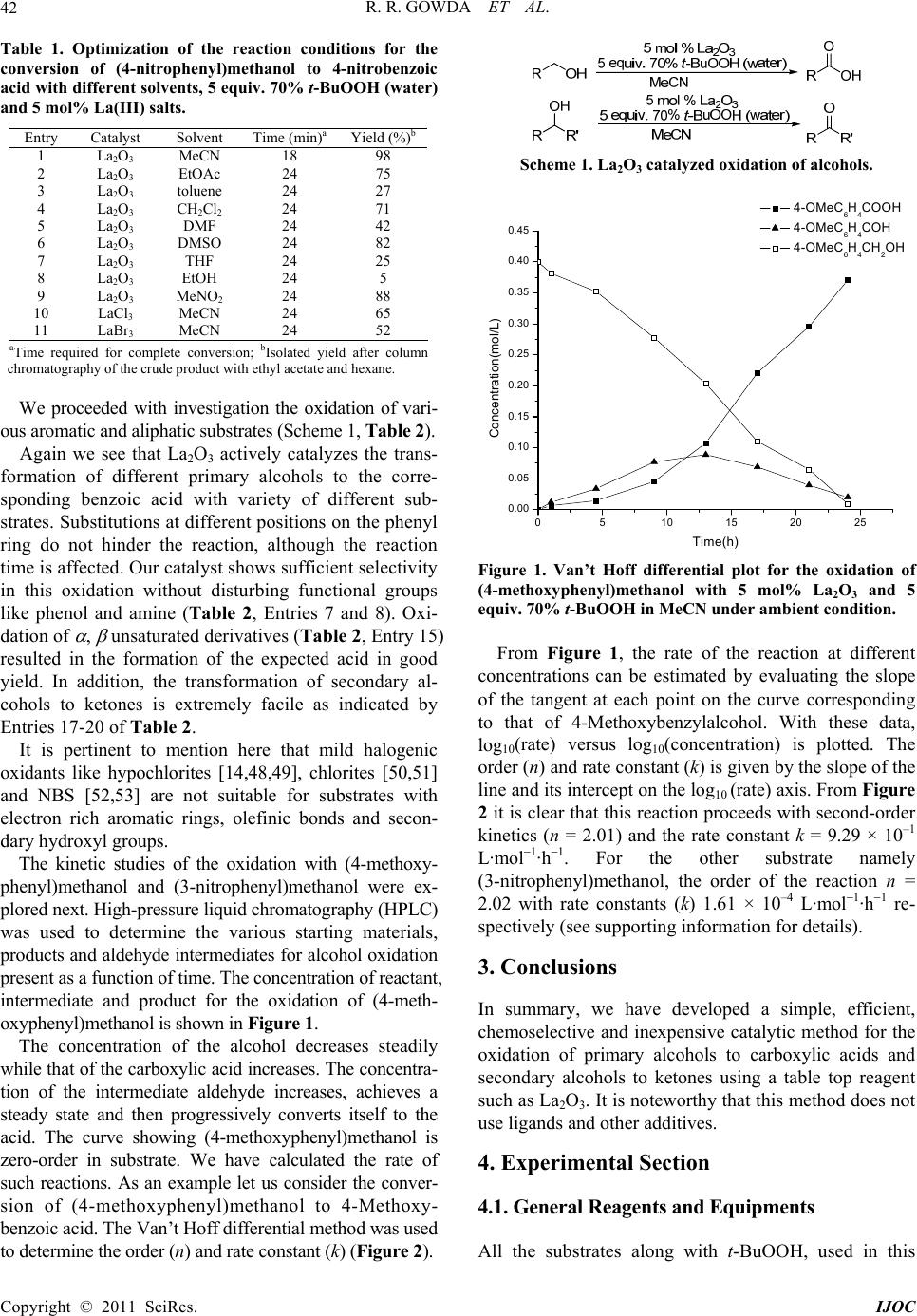 R. R. GOWDA ET AL. 42 Table 1. Optimization of the reaction conditions for the conversion of (4-nitrophenyl)methanol to 4-nitrobenzoic acid with different solvents, 5 equiv. 70% t-BuOOH (water) and 5 mol% La(III) salts. Entry Catalyst Solvent Time (min)a Yield (%)b 1 La2O3 MeCN 18 98 2 La2O3 EtOAc 24 75 3 La2O3 toluene 24 27 4 La2O3 CH2Cl2 24 71 5 La2O3 DMF 24 42 6 La2O3 DMSO 24 82 7 La2O3 THF 24 25 8 La2O3 EtOH 24 5 9 La2O3 MeNO2 24 88 10 LaCl3 MeCN 24 65 11 LaBr3 MeCN 24 52 aTime required for complete conversion; bIsolated yield after column chromatography of the crude product with ethyl acetate and hexane. We proceeded with investigation the oxidation of vari- ous aromatic and aliphatic substrates (Scheme 1, Table 2). Again we see that La2O3 actively catalyzes the trans- formation of different primary alcohols to the corre- sponding benzoic acid with variety of different sub- strates. Substitutions at different positions on the phenyl ring do not hinder the reaction, although the reaction time is affected. Our catalyst shows sufficient selectivity in this oxidation without disturbing functional groups like phenol and amine (Table 2, Entries 7 and 8). Oxi- dation of , unsaturated derivatives (Table 2, Entry 15) resulted in the formation of the expected acid in good yield. In addition, the transformation of secondary al- cohols to ketones is extremely facile as indicated by Entries 17-20 of Table 2. It is pertinent to mention here that mild halogenic oxidants like hypochlorites [14,48,49], chlorites [50,51] and NBS [52,53] are not suitable for substrates with electron rich aromatic rings, olefinic bonds and secon- dary hydroxyl groups. The kinetic studies of the oxidation with (4-methoxy- phenyl)methanol and (3-nitrophenyl)methanol were ex- plored next. High-pressure liquid chromatography (HPLC) was used to determine the various starting materials, products and aldehyde intermediates for alcohol oxidation present as a function of time. The concentration of reactant, intermediate and product for the oxidation of (4-meth- oxyphenyl)methanol is shown in Figure 1. The concentration of the alcohol decreases steadily while that of the carboxylic acid increases. The concentra- tion of the intermediate aldehyde increases, achieves a steady state and then progressively converts itself to the acid. The curve showing (4-methoxyphenyl)methanol is zero-order in substrate. We have calculated the rate of such reactions. As an example let us consider the conver- sion of (4-methoxyphenyl)methanol to 4-Methoxy- benzoic acid. The Van’t Hoff differential method was used to determine the order (n) and rate constant (k) (Figure 2). Scheme 1. La2O3 catalyzed oxidation of alcohols. 0510 15 20 25 0.00 0.05 0.10 0.15 0.20 0.25 0.30 0.35 0.40 0.45 Concentration(mol/L) T 4-OMeC ime(h) 6H4COOH 4-OMeC6H4COH 4-OMeC6H4CH2OH r details). Figure 1. Van’t Hoff differential plot for the oxidation of (4-methoxyphenyl)methanol with 5 mol% La2O3 and 5 equiv. 70% t-BuOOH in MeCN under ambient condition. From Figure 1, the rate of the reaction at different concentrations can be estimated by evaluating the slope of the tangent at each point on the curve corresponding to that of 4-Methoxybenzylalcohol. With these data, log10(rate) versus log10(concentration) is plotted. The order (n) and rate constant (k) is given by the slope of the line and its intercept on the log10 (rate) axis. From Figure 2 it is clear that this reaction proceeds with second-order kinetics (n = 2.01) and the rate constant k = 9.29 × 10⁻¹ L·mol1·h1. For the other substrate namely (3-nitrophenyl)methanol, the order of the reaction n = 2.02 with rate constants (k) 1.61 × 10⁻⁴ L·mol1·h1 re- spectively (see supporting information fo 3. Conclusions In summary, we have developed a simple, efficient, chemoselective and inexpensive catalytic method for the oxidation of primary alcohols to carboxylic acids and secondary alcohols to ketones using a table top reagent such as La2O3. It is noteworthy that this method does not use ligands and other additives. 4. Experimental Section 4.1. General Reagents and Equipments All the substrates along with t-BuOOH, used in this Copyright © 2011 SciRes. IJOC 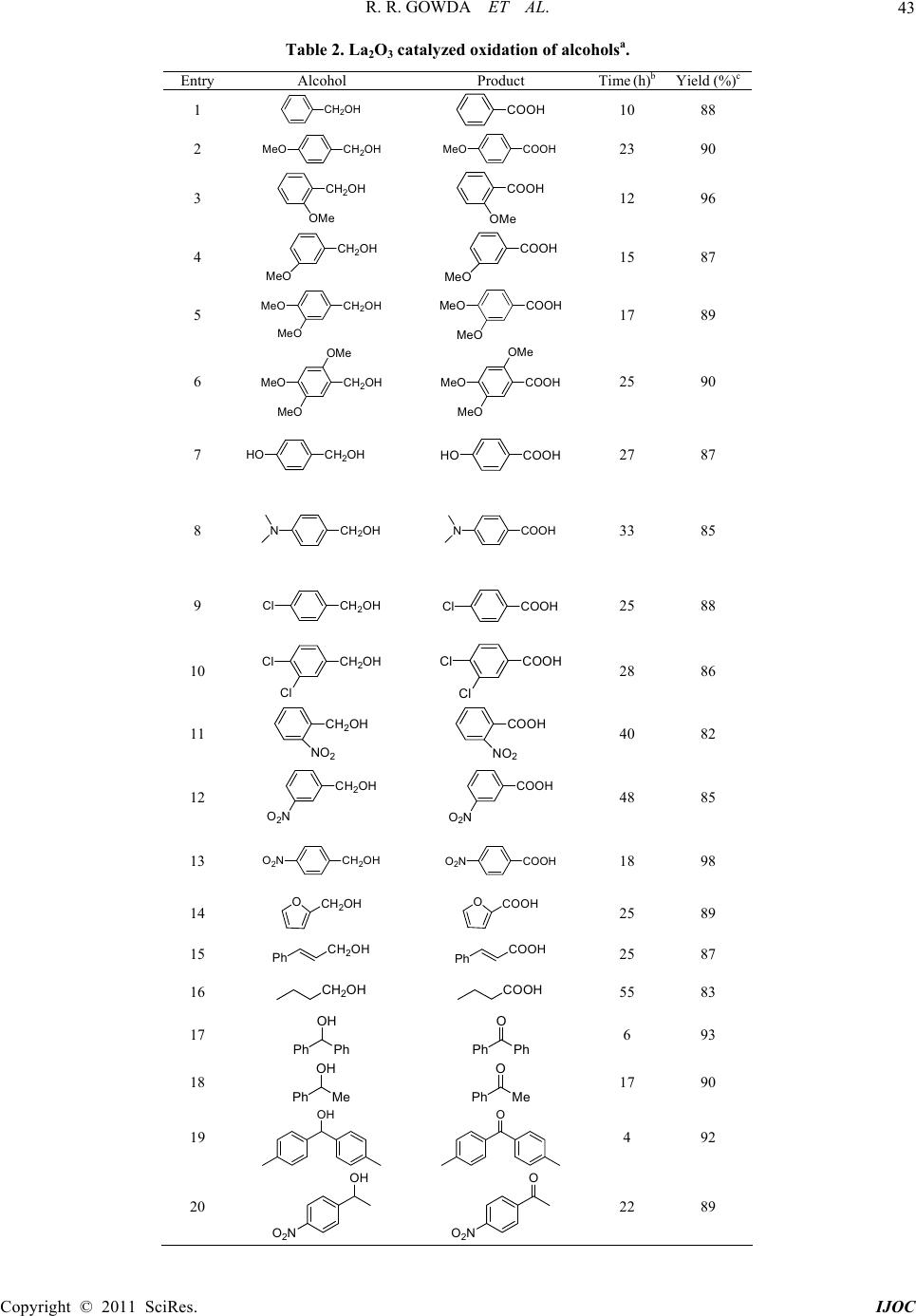 R. R. GOWDA ET AL.43 Table 2. La2O3 catalyzed oxidation of alcoholsa. Entry Alcohol Product Time (h)bYield (%)c 1 CH 2 OH COOH 10 88 2 CH2OHMeO COOHMeO 23 90 3 CH 2 OH OMe COOH OMe 12 96 4 CH 2 OH MeO COOH MeO 15 87 5 CH 2 OHMeO MeO COOHMeO MeO 17 89 6 CH 2 OHMeO OMe MeO COOHMeO OMe MeO 25 90 7 CH 2 OHHO COOHHO 27 87 8 CH 2 OHN COOHN 33 85 9 CH 2 OHCl COOHCl 25 88 10 CH 2 OHCl Cl COOHCl Cl 28 86 11 CH 2 OH NO 2 COOH NO 2 40 82 12 CH 2 OH O 2 N COOH O 2 N 48 85 13 CH 2 OHO 2 N COOHO 2 N 18 98 14 OCH 2 OH OCOOH 25 89 15 Ph CH 2 OH Ph COOH 25 87 16 CH 2 OH COOH 55 83 17 Ph Ph OH Ph Ph O 6 93 18 Ph Me OH Ph Me O 17 90 19 OH O 4 92 20 OH O 2 N O O 2 N 22 89 Copyright © 2011 SciRes. IJOC 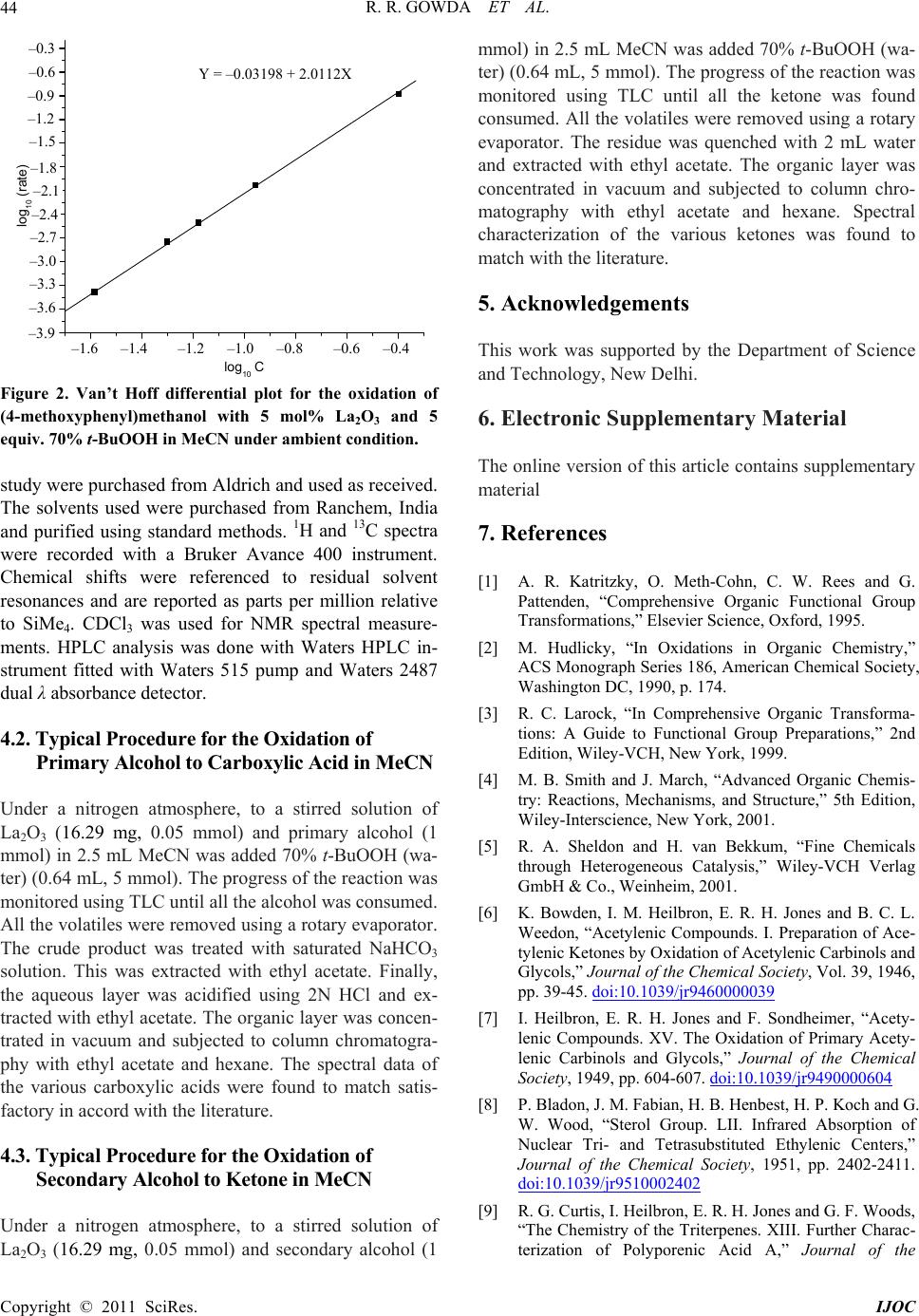 R. R. GOWDA ET AL. 44 --1 -1-1 -0 -01.6 .4.2 .0.8.6-0.4 -3.9 -3.6 -3.3 .0 .7 .4 .1 .8 .5 .2 .9 .6 .3-0 -3 -2 -2 -2 -1 -1 -1 -0 -0 Y = -0.03198 + 2.0112 X log10 (rate) log10 C Figure 2. Van’t Hoff differential plot for the oxidation of (4-methoxyphenyl)methanol with 5 mol% La2O3 and 5 equiv. 70% t-BuOOH in MeCN under ambient condition. study were purchased from Aldrich and used as received. The solvents used were purchased from Ranchem, India and purified using standard methods. 1H and 13C spectra were recorded with a Bruker Avance 400 instrument. Chemical shifts were referenced to residual solvent resonances and are reported as parts per million relative to SiMe4. CDCl3 was used for NMR spectral measure- ments. HPLC analysis was done with Waters HPLC in- strument fitted with Waters 515 pump and Waters 2487 dual λ absorbance detector. 4.2. Typical Procedure for the Oxidation of Primary Alcohol to Carboxylic Acid in MeCN Under a nitrogen atmosphere, to a stirred solution of La2O3 (16.29 mg, 0.05 mmol) and primary alcohol (1 mmol) in 2.5 mL MeCN was added 70% t-BuOOH (wa- ter) (0.64 mL, 5 mmol). The progress of the reaction was monitored using TLC until all the alcohol was consumed. All the volatiles were removed using a rotary evaporator. The crude product was treated with saturated NaHCO3 solution. This was extracted with ethyl acetate. Finally, the aqueous layer was acidified using 2N HCl and ex- tracted with ethyl acetate. The organic layer was concen- trated in vacuum and subjected to column chromatogra- phy with ethyl acetate and hexane. The spectral data of the various carboxylic acids were found to match satis- factory in accord with the literature. 4.3. Typical Procedure for the Oxidation of Secondary Alcohol to Ketone in MeCN Under a nitrogen atmosphere, to a stirred solution of La2O3 (16.29 mg, 0.05 mmol) and secondary alcohol (1 mmol) in 2.5 mL MeCN was added 70% t-BuOOH (wa- ter) (0.64 mL, 5 mmol). The progress of the reaction was monitored using TLC until all the ketone was found consumed. All the volatiles were removed using a rotary evaporator. The residue was quenched with 2 mL water and extracted with ethyl acetate. The organic layer was concentrated in vacuum and subjected to column chro- matography with ethyl acetate and hexane. Spectral characterization of the various ketones was found to match with the literature. – 0.3 – 0.6 Y = –0.03198 + 2.0112X – 0.9 – 1.2 – 1.5 – 1.8 – 2.1 – 2.4 – 2.7 – 3.0 – 3.3 5. Acknowledgements – 3.6 – 3.9 This work was supported by the Department of Science and Technology, New Delhi. – 1.6 –1.4 –1.2 –1.0 –0.8 –0.6 –0.4 6. Electronic Supplementary Material The online version of this article contains supplementary material 7. References [1] A. R. Katritzky, O. Meth-Cohn, C. W. Rees and G. Pattenden, “Comprehensive Organic Functional Group Transformations,” Elsevier Science, Oxford, 1995. [2] M. Hudlicky, “In Oxidations in Organic Chemistry,” ACS Monograph Series 186, American Chemical Society, Washington DC, 1990, p. 174. [3] R. C. Larock, “In Comprehensive Organic Transforma- tions: A Guide to Functional Group Preparations,” 2nd Edition, Wiley-VCH, New York, 1999. [4] M. B. Smith and J. March, “Advanced Organic Chemis- try: Reactions, Mechanisms, and Structure,” 5th Edition, Wiley-Interscience, New York, 2001. [5] R. A. Sheldon and H. van Bekkum, “Fine Chemicals through Heterogeneous Catalysis,” Wiley-VCH Verlag GmbH & Co., Weinheim, 2001. [6] K. Bowden, I. M. Heilbron, E. R. H. Jones and B. C. L. Weedon, “Acetylenic Compounds. I. Preparation of Ace- tylenic Ketones by Oxidation of Acetylenic Carbinols and Glycols,” Journal of the Chemical Society, Vol. 39, 1946, pp. 39-45. doi:10.1039/jr9460000039 [7] I. Heilbron, E. R. H. Jones and F. Sondheimer, “Acety- lenic Compounds. XV. The Oxidation of Primary Acety- lenic Carbinols and Glycols,” Journal of the Chemical Society, 1949, pp. 604-607. doi:10.1039/jr9490000604 [8] P. Bladon, J. M. Fabian, H. B. Henbest, H. P. Koch and G. W. Wood, “Sterol Group. LII. Infrared Absorption of Nuclear Tri- and Tetrasubstituted Ethylenic Centers,” Journal of the Chemical Society, 1951, pp. 2402-2411. doi:10.1039/jr9510002402 [9] R. G. Curtis, I. Heilbron, E. R. H. Jones and G. F. Woods, “The Chemistry of the Triterpenes. XIII. Further Charac- terization of Polyporenic Acid A,” Journal of the Copyright © 2011 SciRes. IJOC  R. R. GOWDA ET AL.45 Chemical Society, 1953, pp. 457-464. doi:10.1039/jr9530000457 [10] A. Bowers, T. G. Halsall, E. R. H. Jones and A. J. Lemin, “Chemistry of the Triterpenes and Related Compounds. XVIII. Elucidation of the Structure of Polyporenic Acid C,” Journal of the Chemical Society, 1953, pp. 2548-2560. doi:10.1039/jr9530002548 [11] C. Djerassi, R. R. Engle and A. Bowers, “Direct Conver- sion of Steroidal Δ5-3β-Alcohols to Δ5- and Δ4-3-Ketones,” The Journal of Organic Chemistry, Vol. 21, No. 12, 1956, pp. 1547-1549. doi:10.1021/jo01118a627 [12] G. Cainelli and G. Cardillo, “Chromium Oxidations in Organic Chemistry,” Springer, Berlin, 1984. [13] R. T. Benjamin, M. Sivakumar, G. O. Hollist and B. Borhan, “Facile Oxidation of Aldehydes to Acids and Esters with Oxone,” Organic Letters, Vol. 5, No. 7, 2003, pp. 1031-1034. doi:10.1021/ol0340078 [14] S. O. Nwaukwa and P. M. Keehn, “The Oxidation of Aldehydes to Acids with Calcium Hypochlorite [Ca(OCl)2],” Tetrahedron Letters, Vol. 23, No. 31, 1982, pp. 3131-3134. doi:10.1016/S0040-4039(00)88577-9 [15] B. Ganem, R. P. Heggs, A. J. Biloski and D. R. Schwartz, “A New Oxidation of Aldehydes to Carboxylic Acids,” Tetrahedron Letters, Vol. 21, No. 8, 1980, pp. 685-688. doi:10.1016/S0040-4039(00)71445-6 [16] T. Yamada, O. Rhode, T. Takai and T. Mukaiyama, “Oxidation of Aldehydes into Carboxylic Acids with Molecular Oxygen Using Nickel(II) Complex Catalyst,” Chemical Letters, Vol. 20, No. 1, 1991, pp. 5-8. doi:10.1246/cl.1991.5 [17] B. Bhatia, T. Punniyamurthy and J. Iqbal, “Cobalt(II)- Catalyzed Reaction of Aldehydes with Acetic Anhydride under an Oxygen Atmosphere: Scope and Mechanism,” The Journal of Organic Chemistry, Vol. 58, No. 20, 1993, pp. 5518-5523. doi:10.1021/jo00072a041 [18] H. Heaney, “Novel Organic Peroxygen Reagents for Use in Organic Synthesis,” Topics in Current Chemistry, Vol. 164, 1993, pp. 1-19. doi:10.1007/3-540-56252-4_22 [19] A. N. Kharata, P. Pendleton, A. Badalyan, M. Abedini and M. M. Amini, “Oxidation of Aldehydes Using Sil- ica-Supported Co(II)-Substituted Heteropoly Acid,” Journal of Molecular Catalysis A: Chemical, Vol. 175, No. 1-2, 2001, pp. 277-283. doi:10.1016/S1381-1169(01)00234-5 [20] S. Biella, L. Prati and M. Rossi, “Gold Catalyzed Oxida- tion of Aldehydes in the Liquid Phase,” Journal of Mo- lecular Catalysis A: Chemical, Vol. 197, No. 1-2, 2003, pp. 207-212. doi:10.1016/S1381-1169(02)00618-0 [21] J. M. Grill, J. W. Ogle and S. A. Miller, “An Efficient and Practical System for the Catalytic Oxidation of Al- cohols, Aldehydes, and α,β-Unsaturated Carboxylic Ac- ids,” The Journal of Organic Chemistry, Vol. 71, No. 25, 2006, pp. 9291-9296. doi:10.1021/jo0612574 [22] J. K. Joseph, S. L. Jain and J. B. Sain, “Novel Transition Metal Free Oxidation of Aromatic Aldehydes to Carbox- ylic Acids Using N-Methylpyrrolidin-2-one Hydrotribro- mide (MPHT) as Catalyst and Hydrogen Peroxide as Oxi- dant,” Catalysis Communications, Vol. 8, No. 1, 2007, pp. 83-87. doi:10.1016/j.catcom.2006.05.035 [23] M. Lim, C. M. Yoon, G. An and H. Rhee, “Environmen- tally Benign Oxidation Reaction of Aldehydes to Their Corresponding Carboxylic Acids Using Pd/C with NaBH4 and KOH,” Tetrahedron Letters, Vol. 48, No. 22, 2007, pp. 3835-3839. doi:10.1016/j.tetlet.2007.03.151 [24] X. T. Zhou, H. B. Ji, Q. L. Yuan, J. C. Xu, L. X. Pei and L. F. Wang, “Aerobic Oxidation of Benzylic Aldehydes to Acids Catalyzed by Iron (III) Meso-Tetraphenylpor- phyrin Chloride under Ambient Conditions,” Chinese Chemical Letters, Vol. 18, No. 8, 2007, pp. 926-928. doi:10.1016/j.cclet.2007.05.031 [25] D. Sloboda-Rozner, K. Neimann and R. Neumann, “Aero- bic Oxidation of Aldehydes Catalyzed by ε-Keggin Type Polyoxometalates [Mo12 VO39(μ2-OH)10H2{XII(H2O)3}4] (X = Ni, Co, Mn and Cu) as Heterogeneous Catalysts,” Journal of Molecular Catalysis A: Chemical, Vol. 262, No. 1-2, 2007, pp. 109-113. doi:10.1016/j.molcata.2006.08.046 [26] C. Mukhopadhyay and A. Datta, “Bismuth(III) Nitrate Pentahydrate: A Stoichiometric Reagent for Microwave Induced Mild and Highly Efficient Aerial Oxidation of Aromatic Aldehydes under Solvent-Free Conditions,” Catalysis Communications, Vol. 9, No. 15, 2008, pp. 2588-2592. doi:10.1016/j.catcom.2008.07.019 [27] M. Uyanik and K. Ishihara, “Hypervalent Iodine-Medi- ated Oxidation of Alcohols,” Chemical Communications, No. 16, 2009, pp. 2086-2099. doi:10.1039/b823399c [28] N. A. Noureldin and D. G. Lee, “Heterogeneous Per- manganate Oxidations. 2. Oxidation of Alcohols Using Solid Hydrated Copper Permanganate,” The Journal of Organic Chemistry, Vol. 47, No. 14, 1982, pp. 2790-2792. doi:10.1021/jo00135a024 [29] S. I. Murahashi, T. Naota and N. Hirai, “Aerobic Oxida- tion of Alcohols with Ruthenium-Cobalt Bimetallic Catalyst in the Presence of Aldehydes,” The Journal of Organic Chemistry, Vol. 58, No. 26, 1993, pp. 7318-7319. doi:10.1021/jo00078a002 [30] K. Sato, M. Aoki, J. Takagi and R. Noyori, “Organic Solvent- and Halide-Free Oxidation of Alcohols with Aqueous Hydrogen Peroxide,” Journal of the American Chemical Society, Vol. 119, No. 50, 1997, pp. 12386-12387. doi:10.1021/ja973412p [31] K. Sato, J. Takagi, M. Aoki and R. Noyori, “Hydrogen Peroxide Oxidation of Benzylic Alcohols to Benzalde- hydes and Benzoic Acids under Halide-Free Conditions,” Tetrahedron Letters, Vol. 39, No. 41, 1998, pp. 7549-7552. doi:10.1016/S0040-4039(98)01642-6 [32] B. Betzemeier, M. Cavazzini, S. Quici and P. Knochel, “Copper-Catalyzed Aerobic Oxidation of Alcohols under Fluorous Biphasic Conditions,” Tetrahedron Letters, Vol. 41, No. 22, 2000, pp. 4343-4346. doi:10.1016/S0040-4039(00)00620-1 [33] H. Ji, T. Mizugaki, K. Ebitani and K. Kaneda, “Highly Efficient Oxidation of Alcohols to Carbonyl Compounds in the Presence of Molecular Oxygen Using a Novel Het- erogeneous Ruthenium Catalyst,” Tetrahedron Letters, Copyright © 2011 SciRes. IJOC  R. R. GOWDA ET AL. Copyright © 2011 SciRes. IJOC 46 Vol. 43, No. 40, 2002, pp. 7179-7183. doi:10.1016/S0040-4039(02)01678-7 [34] B. A. Steinhoff and S. S. Stahl, “Ligand-Modulated Pal- ladium Oxidation Catalysis: Mechanistic Insights into Aerobic Alcohol Oxidation with the Pd(OAc)2/Pyridine Catalyst System,” Organic Letters, Vol. 4, No. 23, 2002, pp. 4179-4181. doi:10.1021/ol026988e [35] G. J. ten Brink, I. W. C. E. Arends and R. A. Sheldon, “Catalytic Conversions in Water. Part 21: Mechanistic Investigations on the Palladium-Catalysed Aerobic Oxi- dation of Alcohols in Water,” Advanced Synthesis & Ca- talysis, Vol. 344, No. 3-4, 2002, pp. 355-369. doi:10.1002/1615-4169(200206)344:3/4<355::AID-ADS C355>3.0.CO;2-S [36] Y. Maeda, N. Kakiuchi, S. Matsumura, T. Nishimura, T. Kawamura and S. Uemura, “Oxovanadium Com- plex-Catalyzed Aerobic Oxidation of Propargylic Alco- hols,” The Journal of Organic Chemistry, Vol. 67, No. 19, 2002, pp. 6718-6724. doi:10.1021/jo025918i [37] K. Yamaguchi and N. Mizuno, “Scope, Kinetics, and Mechanistic Aspects of Aerobic Oxidations Catalyzed by Ruthenium Supported on Alumina,” Chemistry — A European Journal, Vol. 9, No. 18, 2003, pp. 4353-4361. doi:10.1002/chem.200304916 [38] V. B. Sharma, S. L. Jain and B. Sain, “Cobalt Phthalo- cyanine Catalyzed Aerobic Oxidation of Secondary Al- cohols: An Efficient and Simple Synthesis of Ketones,” Tetrahedron Letters, Vol. 44, No. 2, 2003, pp. 383-386. doi:10.1016/S0040-4039(02)02453-X [39] K. Jeyakumar and D. K. Chand, “Aerobic Oxidation of Benzyl Alcohols by MoVI Compounds,” Applied Or- ganometallic Chemistry, Vol. 20, No. 12, 2006, pp. 840-844. doi:10.1002/aoc.1141 [40] T. Miyazawa, T. Endo, S. Shiihashi and M. Okawara, “Selective Oxidation of Alcohols by Oxoaminium Salts (R2N=O+X),” The Journal of Organic Chemistry, Vol. 50, No. 8, 1985, pp. 1332-1334. doi:10.1021/jo00208a047 [41] P. L. Anelli, C. Biffi, F. Montanari and S. Quici, “Fast and Selective Oxidation of Primary Alcohols to Alde- hydes or to Carboxylic Acids and of Secondary Alcohols to Ketones Mediated by Oxoammonium Salts under Two-Phase Conditions,” The Journal of Organic Chem- istry, Vol. 52, No. 12, 1987, pp. 2559-2562. doi:10.1021/jo00388a038 [42] A. E. J. De Nooy, A. C. Besemer and H. van Bekkum, “On the Use of Stable Organic Nitroxyl Radicals for the Oxidation of Primary and Secondary Alcohols,” Synthesis, Vol. 10, 1996, pp. 1153-1176. doi:10.1055/s-1996-4369 [43] S. D. Rychnovsky and R. Vaidyanathan, “TEMPO- Catalyzed Oxidations of Alcohols Using m-CPBA: The Role of Halide Ions,” The Journal of Organic Chemistry, Vol. 64, No. 1, 1999, pp. 310-312. doi:10.1021/jo9819032 [44] M. Zhao, J. Li, E. Mano, Z. Song, D. M. Tschaen, E. J. J. Grabowski and P. J. Reider, “Oxidation of Primary Al- cohols to Carboxylic Acids with Sodium Chlorite Cata- lyzed by TEMPO and Bleach,” The Journal of Organic Chemistry, Vol. 64, No. 7, 1999, pp. 2564-2566. doi:10.1021/jo982143y [45] Y. Tashino and H. Togo, “TEMPO-Mediated Environ- mentally Benign Oxidation of Primary Alcohols to Car- boxylic Acids with Poly[4-(diacetoxyiodo)styrene],” Or- ganic Chemistry, Vol. 36, No. 5, 2005. [46] M. Zhao, J. Li, E. Mano, Z. J. Song and D. M. Tschaen, “Oxidation of Primary Alcohols to Carboxylic Acids with Sodium Chlorite Catalyzed by TEMPO and Bleach: 4-Methoxyphenylacetic Acid,” Organic Syntheses, Vol. 81, 2005, pp. 195-203. [47] D. Chakraborty, R. R. Gowda and P. Malik, “Silver Ni- trate-Catalyzed Oxidation of Aldehydes to Carboxylic Acids by H2O2,” Tetrahedron Letters, Vol. 50, No. 47, 2009, pp. 6553-6556. doi:10.1016/j.tetlet.2009.09.044 [48] R. V. Stevens, K. T. Chapman, C. A. Stubbs, W. W. Tam and K. F. Albizati, “Further Studies on the Utility of So- dium Hypochlorite in Organic Synthesis. Selective Oxi- dation of Diols and Direct Conversion of Aldehydes to Esters,” Tetrahedron Letters, Vol. 23, No. 45, 1982, pp. 4647-4650. doi:10.1016/S0040-4039(00)85677-4 [49] S. R. Wilson, S. Tofigh and R. N. Misra, “A Novel, Nonoxidative Method for the Conversion of Aldehydes to Esters,” The Journal of Organic Chemistry, Vol. 47, No. 7, 1982, pp. 1360-1361. doi:10.1021/jo00346a044 [50] B. S. Bal, W. E. Childers Jr. and H. W. Pinnick, “Oxida- tion of ,β-Unsaturated Aldehydes,” Tetrahedron, Vol. 37, No. 11, 1981, pp. 2091-2096. doi:10.1016/S0040-4020(01)97963-3 [51] E. Dalcanale and F. Montanari, “Selective Oxidation of Aldehydes to Carboxylic Acids with Sodium Chlo- rite-Hydrogen Peroxide,” The Journal of Organic Chem- istry, Vol. 51, No. 4, 1986, pp. 567-569. doi:10.1021/jo00354a037 [52] T. Ogawa and M. Matsui, “A Novel Oxidative Transfor- mation: Oxidative Esterification,” Journal of the Ameri- can Chemical Society, Vol. 98, No. 6, 1976, pp. 1629-1630. doi:10.1021/ja00422a083 [53] Y.-F. Cheung, “N-Bromosuccinimide: Direct Oxidation of Aldehydes to Acid Bromides,” Tetrahedron Letters, Vol. 20, No. 40, 1979, pp. 3809-3810. doi:10.1016/S0040-4039(01)95530-3 |