

Paper Menu >>
Journal Menu >>
 Green and Sustainable Chemistry, 2011, 1, 36-40 doi:10.4236/gsc.2011.12007 Published Online May 2011 (http://www.SciRP.org/journal/gsc) Copyright © 2011 SciRes. GSC An Efficient and Rapid Synthesis of 2-Amino-4-Arylthiazoles Employing Microwave Irradiation in Water Kishor S. Jain,* Jitender B. Bariwal, Muthu K. Kathiravan, Vikas K. Raskar, Gajanan S. Wankhede, Nitin A. Londhe, Satish N. Dighe P. G. Research Centre, Department of Pharmaceutical Chemistry, Sinhgad College of Pharmacy, Pune, India E-mail: [email protected] Received March 26, 2011; revised April 26, 2011; accepted May 18, 2011 Abstract A facile, high yielding green chemical synthetic protocol adaptable to the parallel synthesis of a library of potentially bioactive 2-amino-4-arylthiazoles is reported herein. The methodology involves the condensation of various aracyl bromides with N-arylthioureas under MWI using water as solvent, to yield pure products (81% - 97%) in very short reaction times (1-20 min). Keywords: Green Chemical Synthesis, MWI, Water, 2-Amino-4-arylthiazoles 1. Introduction Molecules containing a thiazole amine-moiety exhibit interesting biological activities depending on the substi- tution pattern at the thiazole ring [1]. 2-Aminothiazole nucleus is a potential pharmacophore for a broad spec- trum of activities, comprising of antibacterial [2], anti- fungal [3], antitubercular [4], anti-HIV [5], pesticidal [6], anti-inflammatory [7], antiprotozoal [8] etc. Several me- thods reported for the synthesis of 2-aminothiazoles de- rivatives include Hantzsch reaction [9], solid supported [10] and solution phase [11] syntheses to generate librar- ies of these derivatives, as well as, those employing cat- alysts such as ammonium-molybdophosphate (AMP) [12], β-cyclodextrin [13], iodine [14], siliyl chloride [15], in organic as well as inorganic solvents at elevated tem- peratures [16,17]. However, these methods suffer from drawbacks like strong reaction conditions, low yields, cumbersome product isolation procedures as well as the use of expensive catalysts etc. The development of effi- cient and eco-friendly chemical processes for the prepa- ration these thiazole derivatives is still a major need. In recent times, water has shown great promise as an attractive alternative to conventional solvents (e.g., VOC’s) [18]. It possesses the unique advantage of being costless and environmental friendly. Water not only acts as reac- tion media but also promotes the rate of reaction due to its ability to form hydrogen bonding as well as solvation effect. Microwave Assisted Organic Synthesis (MAOS) has shown high impact in enhancing the rates of reaction and to speed up library syntheses for NDDR [19]. In recent years, synthesis of bioactive heterocycles using micro- wave irradiation has evolved as an important technique of green chemistry [20]. Water with the additive effect of microwave has been recognized as a green chemical com- ponent in the MAOS. In continuation to our research work devoted to the development of green chemical techniques, we herein report an efficient method for the synthesis of 2-amino- 4-arylthiazoles employing water as a solvent under MW irradiation. This novel process allows access to a library of 2-amino-4-arylthiazoles in very short reaction time without affecting the yield and purity of the target com- pounds. 2. Experimental All reagents and chemicals used were of LR grade and purchased from standard vendors and used as received. Microwave synthesizer; (Questron Technologies Corpo- ration, Canada; model-ProM) having monomode open- vessel was used for the synthesis. The 1H NMR spectra were recorded in CDCl3 using NMR Varian Mercury YH-300 MHz spectrometer and chemical shifts are given in units as per million, downfield from TMS (tetrame- 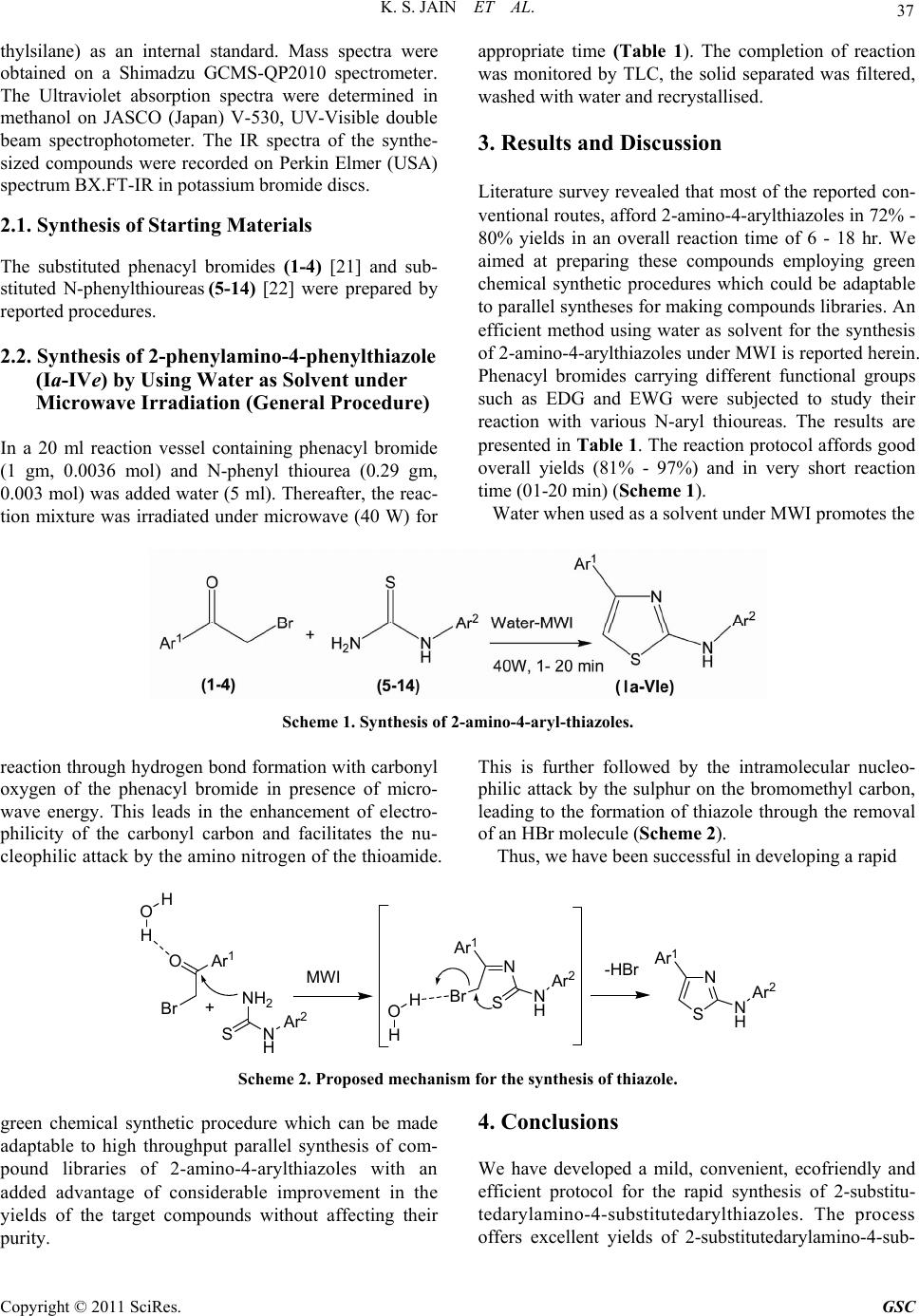 K. S. JAIN ET AL. 37 thylsilane) as an internal standard. Mass spectra were obtained on a Shimadzu GCMS-QP2010 spectrometer. The Ultraviolet absorption spectra were determined in methanol on JASCO (Japan) V-530, UV-Visible double beam spectrophotometer. The IR spectra of the synthe- sized compounds were recorded on Perkin Elmer (USA) spectrum BX.FT-IR in potassium bromide discs. 2.1. Synthesis of Starting Materials The substituted phenacyl bromides (1-4) [21] and sub- stituted N-phenylthioureas (5-14) [22] were prepared by reported procedures. 2.2. Synthesis of 2-phenylamino-4-phenylthiazole (Ia-IVe) by Using Water as Solvent under Microwave Irradiation (General Procedure) In a 20 ml reaction vessel containing phenacyl bromide (1 gm, 0.0036 mol) and N-phenyl thiourea (0.29 gm, 0.003 mol) was added water (5 ml). Thereafter, the reac- tion mixture was irradiated under microwave (40 W) for appropriate time (Table 1). The completion of reaction was monitored by TLC, the solid separated was filtered, washed with water and recrystallised. 3. Results and Discussion Literature survey revealed that most of the reported con- ventional routes, afford 2-amino-4-arylthiazoles in 72% - 80% yields in an overall reaction time of 6 - 18 hr. We aimed at preparing these compounds employing green chemical synthetic procedures which could be adaptable to parallel syntheses for making compounds libraries. An efficient method using water as solvent for the synthesis of 2-amino-4-arylthiazoles under MWI is reported herein. Phenacyl bromides carrying different functional groups such as EDG and EWG were subjected to study their reaction with various N-aryl thioureas. The results are presented in Table 1. The reaction protocol affords good overall yields (81% - 97%) and in very short reaction time (01-20 min) (Sc heme 1). Water when used as a solvent under MWI promotes the Scheme 1. Synthesis of 2-amino-4-aryl-thiazoles. reaction through hydrogen bond formation with carbonyl oxygen of the phenacyl bromide in presence of micro- wave energy. This leads in the enhancement of electro- philicity of the carbonyl carbon and facilitates the nu- cleophilic attack by the amino nitrogen of the thioamide. This is further followed by the intramolecular nucleo- philic attack by the sulphur on the bromomethyl carbon, leading to the formation of thiazole through the removal of an HBr molecule (Scheme 2). Thus, we have been successful in developing a rapid Ar1 O Br S NH2 N H Ar2 + MWI OH H N S Ar1 Br N H Ar2 OH H N S Ar1 N H Ar2 -HBr Scheme 2. Proposed mechanism for the synthesis of thiazole. green chemical synthetic procedure which can be made adaptable to high throughput parallel synthesis of com- pound libraries of 2-amino-4-arylthiazoles with an added advantage of considerable improvement in the yields of the target compounds without affecting their purity. 4. Conclusions We have developed a mild, convenient, ecofriendly and efficient protocol for the rapid synthesis of 2-substitu- tedarylamino-4-substitutedarylthiazoles. The process offers excellent yields of 2-substitutedarylamino-4-sub- Copyright © 2011 SciRes. GSC 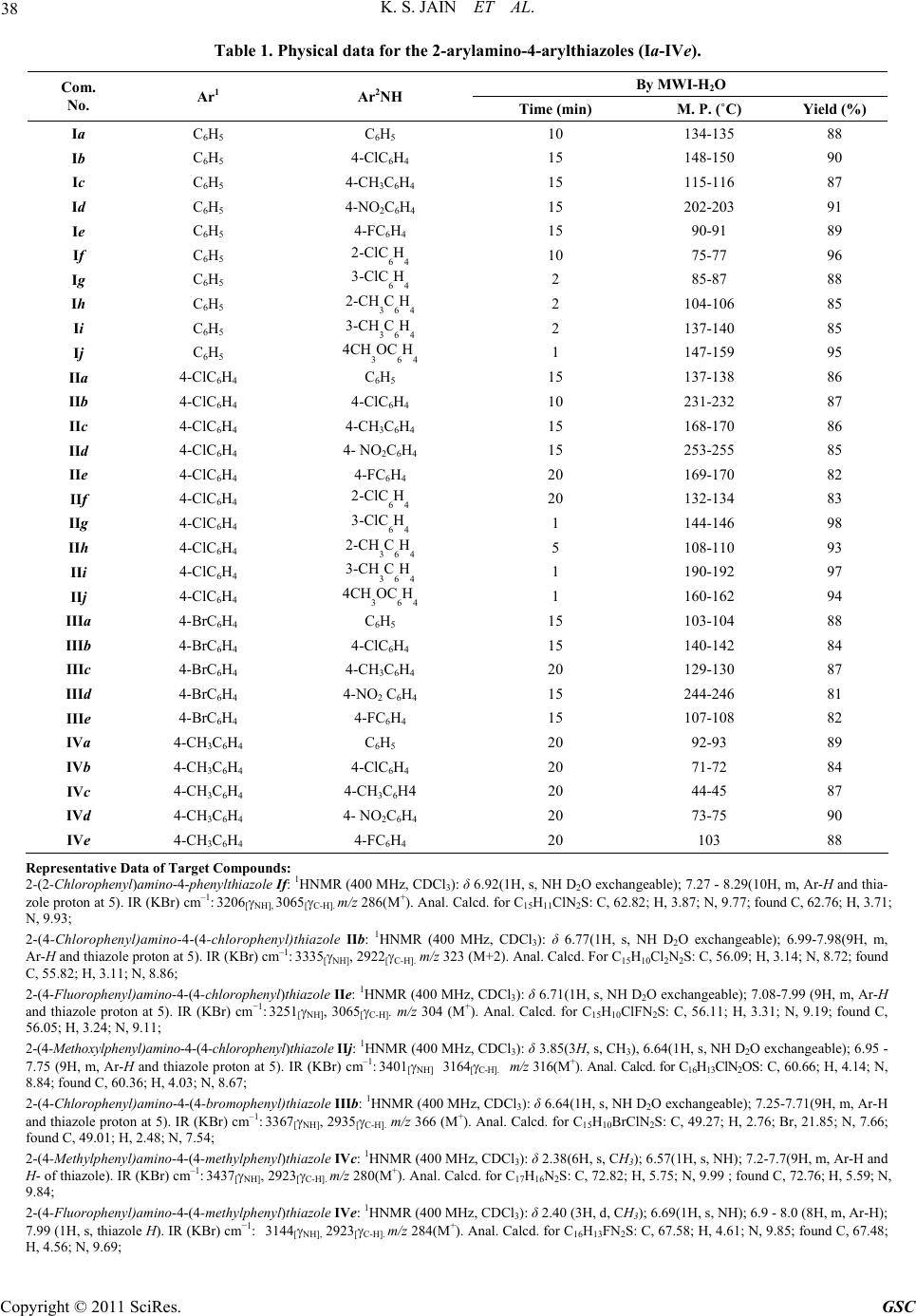 38 K. S. JAIN ET AL. Table 1. Physical data for the 2-arylamino-4-arylthiazoles (Ia-IVe). By MWI-H2O Com. No. Ar1 Ar2NH Time (min) M. P. (˚C) Yield (%) Ia C6H5 C 6H5 10 134-135 88 Ib C6H5 4-ClC6H4 15 148-150 90 Ic C6H5 4-CH3C6H4 15 115-116 87 Id C6H5 4-NO2C6H4 15 202-203 91 Ie C6H5 4-FC6H4 15 90-91 89 If C6H5 2-ClC6H4 10 75-77 96 Ig C6H5 3-ClC6H4 2 85-87 88 Ih C6H5 2-CH3C6H4 2 104-106 85 Ii C6H5 3-CH3C6H4 2 137-140 85 Ij C6H5 4CH3OC6H4 1 147-159 95 IIa 4-ClC6H4 C 6H5 15 137-138 86 IIb 4-ClC6H4 4-ClC6H4 10 231-232 87 IIc 4-ClC6H4 4-CH3C6H4 15 168-170 86 IId 4-ClC6H4 4- NO2C6H4 15 253-255 85 IIe 4-ClC6H4 4-FC6H4 20 169-170 82 IIf 4-ClC6H4 2-ClC6H4 20 132-134 83 IIg 4-ClC6H4 3-ClC6H4 1 144-146 98 IIh 4-ClC6H4 2-CH3C6H4 5 108-110 93 IIi 4-ClC6H4 3-CH3C6H4 1 190-192 97 IIj 4-ClC6H4 4CH3OC6H4 1 160-162 94 IIIa 4-BrC6H4 C 6H5 15 103-104 88 IIIb 4-BrC6H4 4-ClC6H4 15 140-142 84 IIIc 4-BrC6H4 4-CH3C6H4 20 129-130 87 IIId 4-BrC6H4 4-NO2 C6H4 15 244-246 81 IIIe 4-BrC6H4 4-FC6H4 15 107-108 82 IVa 4-CH3C6H4 C 6H5 20 92-93 89 IVb 4-CH3C6H4 4-ClC6H4 20 71-72 84 IVc 4-CH3C6H4 4-CH3C6H4 20 44-45 87 IVd 4-CH3C6H4 4- NO2C6H4 20 73-75 90 IVe 4-CH3C6H4 4-FC6H4 20 103 88 Representative Data of Target Compounds: 2-(2-Chlorophenyl)amino-4-phenylthiazole If: 1HNMR (400 MHz, CDCl3): δ 6.92(1H, s, NH D2O exchangeable); 7.27 - 8.29(10H, m, Ar-H and thia- zole proton at 5). IR (KBr) cm–1: 3206[NH], 3065[C-H]. m/z 286(M+). Anal. Calcd. for C15H11ClN2S: C, 62.82; H, 3.87; N, 9.77; found C, 62.76; H, 3.71; N, 9.93; 2-(4-Chlorophenyl)amino-4-(4-chlorophenyl)thiazole IIb: 1HNMR (400 MHz, CDCl3): δ 6.77(1H, s, NH D2O exchangeable); 6.99-7.98(9H, m, Ar-H and thiazole proton at 5). IR (KBr) cm–1: 3335[NH], 2922[C-H]. m/z 323 (M+2). Anal. Calcd. For C15H10Cl2N2S: C, 56.09; H, 3.14; N, 8.72; found C, 55.82; H, 3.11; N, 8.86; 2-(4-Fluorophenyl)amino-4-(4-chlorophenyl)thiazole IIe: 1HNMR (400 MHz, CDCl3): δ 6.71(1H, s, NH D2O exchangeable); 7.08-7.99 (9H, m, Ar-H and thiazole proton at 5). IR (KBr) cm−1: 3251[NH], 3065[C-H]. m/z 304 (M+). Anal. Calcd. for C15H10ClFN2S: C, 56.11; H, 3.31; N, 9.19; found C, 56.05; H, 3.24; N, 9.11; 2-(4-Methox ylp h en yl )ami no-4-(4-chlorop henyl)thiazole IIj: 1HNMR (400 MHz, CDCl3): δ 3.85(3H, s, CH3), 6.64(1H, s, NH D2O exchangeable); 6.95 - 7.75 (9H, m, Ar-H and thiazole proton at 5). IR (KBr) cm–1: 3401[NH] 3164[C-H]. m/z 316( M+). Anal. Calcd. for C16H13ClN2OS: C, 60.66; H, 4.14; N, 8.84; found C, 60.36; H, 4.03; N, 8.67; 2-(4-Chlorophenyl)a mino-4-(4-bromophenyl)thiazole IIIb: 1HNMR (400 MHz, CDCl3): δ 6.64(1H, s, NH D2O exchangeable); 7.25-7.71(9H, m, Ar-H and thiazole proton at 5). IR (KBr) cm–1: 3367[NH], 2935[C-H]. m/z 366 (M+). Anal. Calcd. for C15H10BrClN2S: C, 49.27; H, 2.76; Br, 21.85; N, 7.66; found C, 49.01; H, 2.48; N, 7.54; 2-(4-Methylphenyl)amino-4-(4-methylphenyl)thiazole IVc: 1HNMR (400 MHz, CDCl3): δ 2.38(6H, s, CH3); 6.57(1H, s, NH); 7.2-7.7(9H, m, Ar-H and H- of thiazole). IR (KBr) cm–1: 3437[NH], 2923[C-H]. m/z 280(M+). Anal. Calcd. for C17H16N2S: C, 72.82; H, 5.75; N, 9.99 ; found C, 72.76; H, 5.59; N, 9.84; 2-(4-Fluorophenyl)amino-4-(4-methylphenyl)thiazole IVe: 1HNMR (400 MHz, CDCl3): δ 2.40 (3H, d, CH3); 6.69(1H, s, NH); 6.9 - 8.0 (8H, m, Ar-H); 7.99 (1H, s, thiazole H). IR (KBr) cm−1: 3144[NH], 2923[C-H]. m/z 284(M+). Anal. Calcd. for C16H13FN2S: C, 67.58; H, 4.61; N, 9.85; found C, 67.48; H, 4.56; N, 9.69; Copyright © 2011 SciRes. GSC  K. S. JAIN ET AL. Copyright © 2011 SciRes. GSC 39 stitutedarylthiazoles under green chemical conditions in very short reaction times. 5. Acknowledgments The authors acknowledge the contributions of Professor M. N. Navale, President, & Dr. (Mrs.) S. M. Navale, Secretary, Sinhgad Technical Education Society, Pune for providing facilities to carry out the synthetic work and basic spectroscopic analysis. The Mass and NMR were done at Department of Chemistry, Saurashtra Uni- versity, Rajkot, India and University of Pune, India, re- spectively. 6. References [1] M. Schnürch, B. Waldner, K. Hilber and M. D. Mi- hovilovic, “Synthesis of 5-Arylated N-Arylthiazole-2- Amines as Potential Skeletal Muscle Cell Differentiation Promoters,” Bioorganic & Medicinal Chemistry Letters, Vol 21, No. 7, 2011, pp. 2149-2154. doi:10.1016/j.bmcl.2011.01.123 [2] N. Vukovic, S. Sukdolak, S. Solujic and T. Milosevic, “Synthesis and Antimicrobial Evaluation of Some Novel 2-Aminothiazole Derivatives of 4-hydroxy-Chromene-2- one,” Arch Pharm (Weinheim), Vol. 341, No. 8, 2008, pp. 491-496. doi:10.1002/ardp.200700215 [3] De Logu A, M. Saddi, M. C. Cardia, R. Borgna, C. Sanna, B. Saddi and E. Maccioni, “In Vitro Activity of 2-Cyclo- Hexylidenhydrazo-4-phenyl-thiazole Compared with those of Amphotericin B and Fluconazole against Clinical Iso- lates of Candida Spp. and Fluconazole-Resistant Candida Albicans,” Journal of Antimicrobial Chemotherapy, Vol. 55, No. 5, 2005, pp. 692-698. doi:10.1093/jac/dki084 [4] Q. Al-Balas, N. G. Anthony, B. Al-Jaidi, A. Alnimr, G. Abbott, A. K. Brown, R. C. Taylor, G. S. Besra, T. D. McHugh, S. H. Gillespie, B. F. Johnston and S. P. Mac- kay, G. D. Coxon, “Identification of 2-ami-no-thia- zole-4-car-boxylate Derivatives Active against Mycobac- terium Tuberculosis H37rv And The Beta-Ketoacyl- Acp Synthase Mtfabh,” PLoS One, Vol. 4, No. 5, 2009, pp. 5617-5621. doi:10.1371/journal.pone.0005617 [5] T. K. Venkatachalam, E. A. Sudbeck, C. Mao and F. M. Uckun, “Anti-HIV Activity of Aromatic and Heterocyclic Thiazolyl Thiourea Compounds,” Bioorganic & Medici- nal Chemistry Letters, Vol. 11, No. 4, 2001, pp 523-528. doi:10.1016/S0960-894X(01)00011-7 [6] M. C. Wilkes, P. B. Lavrik and J. Greenplate, “Synthesis of N-Benzoyl-N-Alkyl-2-aminothiazoles: Heliothis Vi- rescens Proinsecticides” Journal of Agricultural Food Chemistry, Vol. 39, No. 9, 1991, pp. 1652-1657. doi:10.1021/jf00009a023 [7] B. S. Holla, K. V. Malini, B. S. Rao, B. K. Sarojini and N. S. Kumari, “Synthesis of Some New 2,4-disub- Stituted Thiazoles as Possible Antibacterial and Anti-In- Flam- matory Agents,” European Journal of Medicinal Chem- istry, Vol 38, No. 3, 2003, pp. 313-318. doi:10.1016/S0223-5234(02)01447-2 [8] D. C. Warhurst, I. S. Agadu, D. Nolder, and J. F. Ros- signol, “In Vitro Activity of Nitazoxanide and Related Compounds against Isolates of Giardia Intestinalis, En- tamoeba Histolytica and Trichomonas Vaginalis,” Jour- nal of Antimicrobial Chemotherapy, Vol. 49, No. 1, 2002, pp. 103-111. [9] D. V. Jawale, D. L. Lingampalle, U. R. Pratap and R. A. Mane, “One-Pot Synthesis of 2-aminothiazoles in PEG- 400,” Chinese Chemical Letters, Vol 21, No. 4, 2010, pp. 412-416. doi:10.1016/j.cclet.2009.11.035 [10] P. C. Kearney, M. Fernandez, J. A. Flygare, “Solid-Phase Synthesis of 2-Aminothiazoles”, Journal of Organic Chemistry, Vol. 63, No. 1, 1998, pp. 196-200. doi:10.1021/jo971542a [11] N. Bailey, A. W. Dean, D. B. Judd, D. Middlemiss, R. Storer and S. P. Watson, “A Convenient Procedure for the Solution Phase Preparation of 2-Aminothiazole Com- binatorial Libraries,” Bioorganic & Medicinal Chemistry Letters, Vol. 6, No. 12, 1996, pp. 1409-1414. doi:10.1016/0960-894X(96)00241-7 [12] B. Das, V. S. Reddy and R. Ramu, “A Rapid and High-Yielding Synthesis of Thiazoles and Aminothia- zoles Using Ammonium-12-molybdophosphate,” Journal of Molecular Catalysis A: Chemical, Volume 252, No. 1-2, 2006, pp. 235-237. doi:10.1016/j.molcata.2006.02.065 [13] N. M. Reddy, M. Somi, Sridhar, R. Nageswar, Y. V. D. Rao and K. Rama, “Aqueous Phase Synthesis of Thia- zoles and Aminothiazoles in the Presence of b-Cyc- lo-Dextrin,” Tetrahedron Letters, Vol 46, No. 35, 2005, pp. 5953-5961. doi:10.1016/j.tetlet.2005.06.130 [14] M. Kidwai, D. Bhatnagar, P. Mothsra, A. K. Singh, S. Dey, “Molecular Iodine as a Versatile Reagent for Hantzsch Synthesis of 2-Aminothiazole Derivatives,” Journal of Sulfur Chemistry, Vol. 30, No. 1, 2009, pp. 29-36. doi:10.1080/17415990802422365 [15] H. N. Karade, M. Sathe and M. P. Kaushik, “Synthesis of 4-aryl Substituted 3, 4-dihydropyrimidinones Using Sil- ica-chloride Under Solvent Free Conditions,” Molecules 2007, Vol 12, No. 7, pp 1341-1351. doi:10.3390/12071341 [16] I. Yavari, S. Z. Sayyed-Alangi, R. Hajinasiri and H. Saj- jadi-Ghotbabadi, “A One-Pot Synthesis of Functionalized Ethyl 1,3-Thiazole-5-Carboxylates from Thioamides or Thioureas and 2-Chloro-1,3-Dicarbonyl Compounds in an Ionic Liquid,” Monatshefte für Chemie, Vol 140, No. 2, pp. 209-211. doi:10.1007/s00706-008-0065-7 [17] S. I. Zav’yalov, O. V. Dorofeeva, E. E. Rumyantseva, L. B. Kulikova, G. I. Ezhova, N. E. Kravchenko and A. G. Zavozin, “Synthesis of 2-aminothiazole Derivatives,” Phar- maceutical Chemistry Journal, Vol 35, No. 2, pp. 96-98. doi:10.1023/A:1010477022450 [18] C.-J. Li, “Water as Solvent for Organic and Material Synthesis, Green Chemical Syntheses and Processes,” ACS Symposium Series, Chapter 6, Vol. 767, 2000, pp. 62-73.  40 K. S. JAIN ET AL. [19] J. B. Bariwal, J. C. Trivedi and Erik V. Van der Eycken, “Microwave Irradiation and Multi-component Reac- tions,” Topics in Heterocyclic Chemistry, Vol. 25, 2010, pp. 169-230. [20] M. S. Phoujdar, M. K. Kathiravan, J. B. Bariwal, A. K. Shah and K. S. Jain, “Microwave-Based Synthesis of Novel Thienopyrimidine Bioisosteres of Gefitinib,” Tet- rahedron Letters, Vol. 49, No. 7, 2008, pp 1269-1273. doi:10.1016/j.tetlet.2007.11.135 [21] B. S. Furniss, A. J. Hannaford, P. W. G. Smith. and A. R. Tatchell, “Vogel’s Textbook of Practical Organic Chem- istry,” 5th Edition, ELBS Publication, London, 2010, pp. 1050-1051. [22] “Dictionary of Organic Compounds,” Chapman & Hall Electronic Publishing Division, London, Vol. 5, 1996, p. 4823, 5348. Copyright © 2011 SciRes. GSC |