

Paper Menu >>
Journal Menu >>
 Sociology Mind 2011. Vol.1, No.2, 45-54 Copyright © 2011 SciRes. DOI:10.4236/sm.2011.12006 Integration of Highly Qualified Sub-Saharan Immigrants in Prague ——Comparison with the Situation in Paris, London and Liege1 Andrea Gerstnerová Charles University, Prague, Czech Republic. Email: [email protected] Received February 10st, 2011; revised February 18th, 2011; accepted March 2nd, 2011. Successful integration of immigrants into the host society demands a creation of specific conditions that would facilitate immigrants their adaptation to a new sociocultural, economic and political environment. Therefore, the process of integration itself is not only a task for immigrants, but also for a majority. One of the key factors for a creation of truly cohesive society is the support of positive aspects of mutual inter-cultural relations. This could be reinforced by implementation of “adequate” integration programs adapted to the local context as well as sen- sible use of mass media. If the host society does not dispose of effective instruments to integrate its “own citi- zens”, it is generally difficult to create strategies for insertion of immigrants of different cultural backgrounds (such as Sub-Saharan Africans). Basic features of the integration process of Sub-Saharan Africans and political reactions of the major socie ty were identified in Prague, Paris, Lond o n a nd Liege. Keywords: Immigration; Sub-Saharan Africans; Integration Process; Host Society ; Country of Origin; Remittances; Development; Diaspora; Social Cohesion. Introduction “Immigrant is first of all a human being longing for a life in a tolerant and helpful society. Existing barriers among different cultural communities, usually created artificially, are being reinforced by a variety of prejudices that are for each nation and each social group quite specific. The false notions about members of different cultural communities subsequently pre- vent the creation of a socially cohesive society in which each community would have its decent place” (Mabaya, 2007). The aim of the presented research named Integration of Highly Qualified Sub-Saharan Immigrants in Prague; Com- parison with the situation in Paris, London and Liege is to ana- lyse similarities and differences of the socio-economic integra- tion of highly skilled Sub-Saharan immigrants residing on a long term basis in respective host societies. The conducted research evaluated in what areas are usually highly skilled Sub-Saharan immigrants socially marginalized and in what areas are their personal or professional qualities – thanks to the implementation of adequate integration policies – optimally valorised. Nevertheless, the ambition of the research was not to provide an exhaustive analysis of the integration process of all Sub-Saharan communities living in Europe, but rather to give an insight of certain aspects of the integration reality of Sub-Saharan immigrants through examples of 68 respondents residing in selected European cities – i.e. Prague, Paris. London, Liege. In order to execute a comparison of the integration process of Sub-Saharan Africans living in the Czech Republic and selected European countries, it was necessary to choose a comparable sample of respondents. The analyzed sample of altogether 68 Sub-Saharan respondents comprises highly qualified men re- siding on a long-term basis in one of the selected European cities. Variables that could not have been taken into account during the execution of the qualitative research in aforemen- tioned European countries were the reason of emigration and the country of origin. These variables vary from country to country owing to their specific historical circumstances and socioeconomic development. Up until recently the major part of highly skilled Sub-Saha- ran immigrants living in the Czech Republic was constituted by students and interns from formerly “ideologically related Afri- can countries” (i.e. Angola, Ethiopia, and Guinea Conakry). As late as the globalization process was launched, the migration flows to the Czech Republic have been considerably polarized. On the contrary, the motivation of Sub-Saharan immigrants to enter France, Great Britain and Belgium is not that clear as in was the case of the Czech Republic. In the geographical per- spective, a majority of African respondents originally came from the former French, British and Belgian colonies. The most respondents were from the Democratic Republic of Congo, Rwanda, Mali, and Cameroun. Target Group As a primary target group of the realized research was cho- sen Sub-Saharan immigrants (originally from the East, West and the South part of the African continent) that had been re- siding in one of the aforementioned European countries for more than one year on a basis of acquired citizenship, long- term residence permit, short-term residence permit or submitted application for the international protection. The special atten- 1This article has been written in the frame of a postdoctoral project “Socio- economic Integration of Sub-Saharan Immigrants in Europe: Three-Dimen- sional Approach”, funded by the Czech Science Foundation (identification number of the project: P404/11/P289). 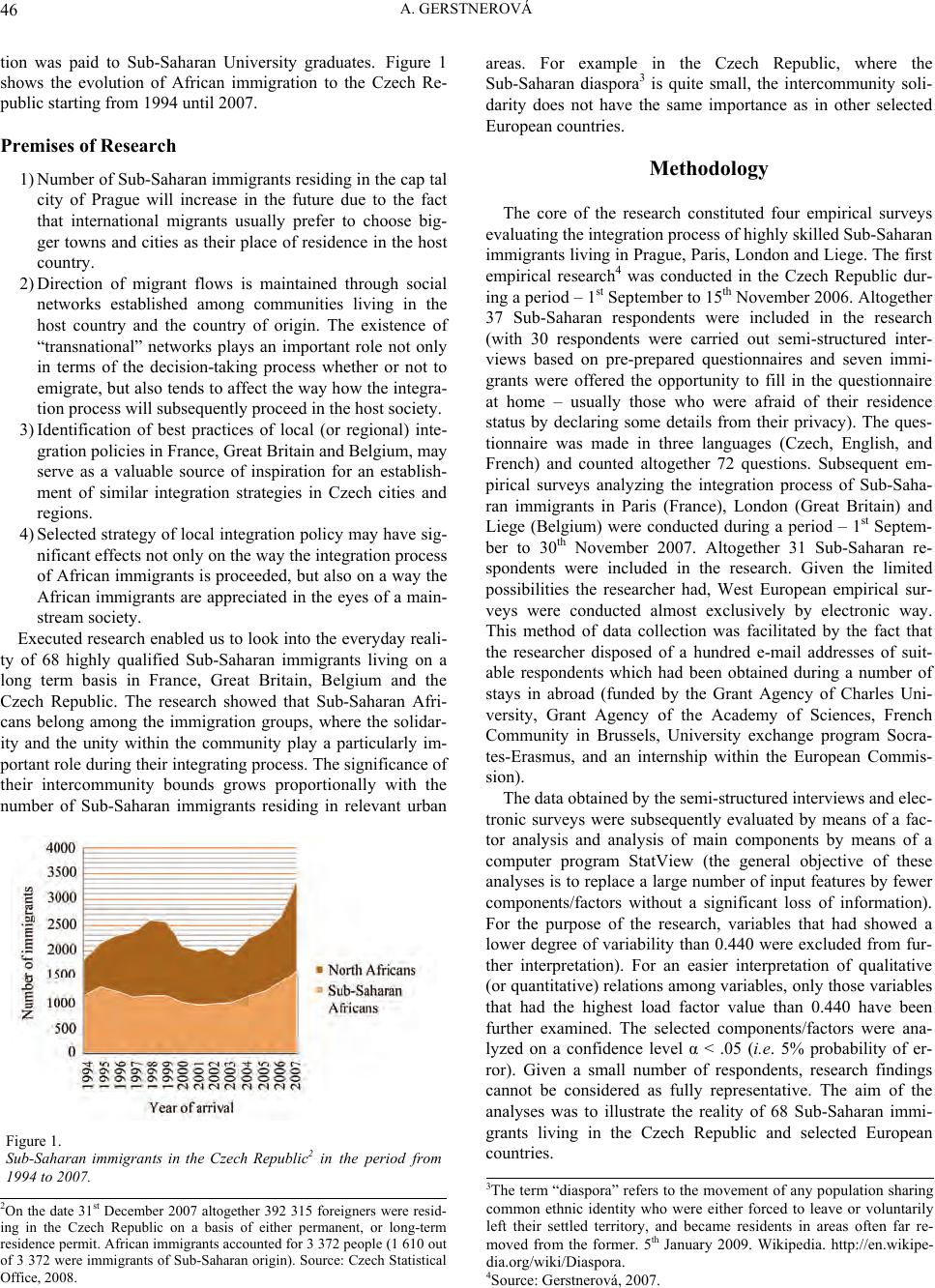 A. GERSTNEROVÁ 46 tion was paid to Sub-Saharan University graduates. Figure 1 shows the evolution of African immigration to the Czech Re- public starting from 1994 until 2007. Premises of Research 1) Number of Sub-Saharan immigrants residi ng in the cap tal city of Prague will increase in the future due to the fact that international migrants usually prefer to choose big- ger towns and cities as their place of residence in the host country. 2) Direction of migrant flows is maintained through social networks established among communities living in the host country and the country of origin. The existence of “transnational” networks plays an important role not only in terms of the decision-taking process whether or not to emigrate, but also tends to affect the way how the integra- tion process will subsequently proceed in the host society. 3) Identification of best practices of local (or regional) inte- gration policies in France, Great Britain and Belgium, may serve as a valuable source of inspiration for an establish- ment of similar integration strategies in Czech cities and regions. 4) Selected strategy of local integration policy may have sig- nificant effects not only on the way the integration process of African immigrants is proceeded, but also on a way the African immigrants are appreciated in the eyes of a main- stream society. Executed research enabled us to look into the everyday reali- ty of 68 highly qualified Sub-Saharan immigrants living on a long term basis in France, Great Britain, Belgium and the Czech Republic. The research showed that Sub-Saharan Afri- cans belong among the immigration groups, where the solidar- ity and the unity within the community play a particularly im- portant role during their integrating process. The significance of their intercommunity bounds grows proportionally with the number of Sub-Saharan immigrants residing in relevant urban Figure 1. Sub-Saharan immigrants in the Czech Republic2 in the period from 1994 to 2007. areas. For example in the Czech Republic, where the Sub-Saharan diaspora3 is quite small, the intercommunity soli- darity does not have the same importance as in other selected European countries. Methodology The core of the research constituted four empirical surveys evaluating the integration process of highly skilled Sub-Saharan immigrants living in Prague, Paris, London and Liege. The first empirical research4 was conducted in the Czech Republic dur- ing a period – 1st September to 15th November 2006. Altogether 37 Sub-Saharan respondents were included in the research (with 30 respondents were carried out semi-structured inter- views based on pre-prepared questionnaires and seven immi- grants were offered the opportunity to fill in the questionnaire at home – usually those who were afraid of their residence status by declaring some details from their privacy). The ques- tionnaire was made in three languages (Czech, English, and French) and counted altogether 72 questions. Subsequent em- pirical surveys analyzing the integration process of Sub-Saha- ran immigrants in Paris (France), London (Great Britain) and Liege (Belgium) were conducted during a period – 1st Septem- ber to 30th November 2007. Altogether 31 Sub-Saharan re- spondents were included in the research. Given the limited possibilities the researcher had, West European empirical sur- veys were conducted almost exclusively by electronic way. This method of data collection was facilitated by the fact that the researcher disposed of a hundred e-mail addresses of suit- able respondents which had been obtained during a number of stays in abroad (funded by the Grant Agency of Charles Uni- versity, Grant Agency of the Academy of Sciences, French Community in Brussels, University exchange program Socra- tes-Erasmus, and an internship within the European Commis- sion). The data obtained by the semi-structured interviews and elec- tronic surveys were subsequently evaluated by means of a fac- tor analysis and analysis of main components by means of a computer program StatView (the general objective of these analyses is to replace a large number of input features by fewer components/factors without a significant loss of information). For the purpose of the research, variables that had showed a lower degree of variability than 0.440 were excluded from fur- ther interpretation). For an easier interpretation of qualitative (or quantitative) relations among variables, only those variables that had the highest load factor value than 0.440 have been further examined. The selected components/factors were ana- lyzed on a confidence level α < .05 (i.e. 5% probability of er- ror). Given a small number of respondents, research findings cannot be considered as fully representative. The aim of the analyses was to illustrate the reality of 68 Sub-Saharan immi- grants living in the Czech Republic and selected European countries. 3The term “diaspora” refers to the movement of any population sharing common ethnic identity who were either forced to leave or voluntarily left their settled territory, and became residents in areas often far re- moved from the former. 5th January 2009. Wikipedia. http://en.wikipe- dia.org/wiki/Diaspora. 4Source: Gerstnerová, 2007. 2On the date 31st December 2007 altogether 392 315 foreigners were resid- ing in the Czech Republic on a basis of either permanent, or long-term residence permit. African immigrants accounted for 3 372 people (1 610 out of 3 372 were immigrants of Sub-Saharan origin). Source: Czech S tatistical Office, 2008.  A. GERSTNEROVÁ 47 Comparison of Results of Factor Analysis Evaluating the Integration Process of Highly Skilled Sub-Saharan Immigrants Settled in the Czech Republic and Selected West European Countries One of the major outcomes of the realised research is that the integration of Sub-Saharan immigrants into a major society in West European countries follows primarily a communitarist model (where the community provides its members with a basic socioeconomic background, necessary for their integration into the respective host society). Nevertheless, the question is, whether this rather communitarist way of integration of Sub- Saharan community is actually the result of their free choice or whether they are directly or indirectly forced to accept this model of integration by the social environment (i.e. by mass media coverage or incorporated prejudices towards different cultural communities within members of a mainstream society). On the contrary, the integration process of Sub-Saharan im- migrants living in the Czech Republic on a long term basis follows more likely an assimilative approach for which the successful integration is based on the suppression of the use of mother tongue and initial cultural identity. One of the fundamental differences between Sub-Saharan respondents residing in the West European countries on the one hand and Sub-Saharan respondents living in the Czech Repub- lic on the other hand, is a lack of community life relied to a specific geographic area within the latter group. While in West- ern European cities, African quarters5 can be found quite easily, Sub-Saharan immigrants settled in the Czech Republic do not usually tent to concentrate in any geographically specified area (with the exception of Prague 6 Suchdol where Czech Agricul- tural University is situated – the University is regularly at- tended by students from developing countries). Traditionally strong social connections and community life of Sub-Saharan diaspora in West European cities usually take on distinctive forms. In other words, the urban environment where the community of Sub-Saharan origin is settled is often easily distinguishable from other immigrant groups (see Figure 2). The difference lies, for instance, in the type of economic ac- tivities, decoration of buildings, selection of religious symbols, etc. The level of development of these culturally conditioned means of socioeconomic and sociocultural integration (some- times in forms of “ethnic institutionalization”)6, determines to a great extent the acceptance of the African community by a ma- jor society. The life within the Sub-Saharan community can be for immigrants in many aspects comfortable. However, a total reliance on services provided by the African diaspora brings in certain difficulties. Living together with other members of the same immigrant community sometimes decreases immigrant’s chances to be well-integrated in a major society. Moreover, geographical segregation of Sub-Saharan immigrants in certain urban districts of West European capitals stimulates to a con- siderable level the development of negative prejudices towards immigrants, which subsequently makes their socioeconomic integration even more difficult. Another important difference between Sub-Saharan respon- dents living in West European countries and in the Czech Re- public, was the fact that long-term immigrants residing in the Czech Republic are in comparison with their European coun- terparts usually less generous as for their families in countries of origin (i.e. the total amount of remittances sent by SubSaha- ran respondents living in the Czech Republic was extraordinary low and random) and they do not visit their relatives very often either. Such a weakness of the social network between immi- grants and their initial families as well as lower level of solidar- ity within the Sub-Saharan diaspora itself can be explained by both – lower percentage of Sub-Saharan community members residing in the Czech Republic in absolute terms, and motives of arrival that drew them into the Czech Republic. Two-thirds of Sub-Saharan respondents living in the Czech Republic used as a gateway study visas, (as declared on the basis of Figure 2. Look at African district with ethnic businesses in Paris. Photo: Andrea Gerstnerová; Note: Photos were taken in the 19th Parisian arron- dissement on 18th September 2008. 5Areas with a higher proportion of African immigrants on a respective area – usually a number of adjacent streets. 6McLOUGHLIN, S. From Diaspora to Multi-Locality: Writing British Asian Cities; University of Leeds: End of Year Report for 2007. http://www. diaspo- ras.ac.uk/assets/McLoughlin%20end%20of%20year%2007.pdf.  A. GERSTNEROVÁ 48 semi-structural interviews conducted in Prague, see Figure 3) while in case of France, Great Britain and Belgium an asylum system. In general, asylum seekers and recognized refugees who are settled in the Czech Republic face the biggest problems during their integration process. By contrast, immigrants who came to the Czech Republic in late 60s and 70s (primarily from Angola and Ethiopia) on a basis of “bilateral agreements on friendship and mutual assistance among socialist countries” describe their integration process in very positive terms. In general, the suc- cessful economic integration of immigrants does not automati- cally lead them to satisfactory position in a mainstream society itself, although it may help them in this respect (Castles, 2008; Niessen, 2007). Their integration process of African immi- grants (arrived during the 2nd half of the 20th century) into the mainstream society has been usually facilitated by their Czech companions. In the case of France, Great Britain and Belgium, the highest socioeconomic status (with respect to the position held in the labour market and the social prestige) were reached by those Sub-Saharan respondents who had been residing in the host society for more than five years on a basis of either permanent residence permit or acquired citizenship. On the contrary, the most disadvantaged groups of Sub-Saharan respondents resid- ing in West European countries (with respect to the position held in the labour market and the social prestige) were those provided with a temporary residence status. Figure 4 shows the most frequently occupie d jobs by Sub-Saharan immigra nts who have been residing in London and Paris no more than 5 years. Owing to the fact that among well-integrated Sub-Saharan im- migrants usually do not belong newcomers under 25 years of age, we can deduce that the successful integration of immi- grants requires a certain amount of time. However, it would be wrong to believe that the situation of Sub-Saharan immigrants in selected West European countries is homogenous (see Table 1). To a large extent the socioeconomic situation of Sub-Saharan immigrants depends on: 1) applied concept of national (vs. local) integration policy (i.e. assimila- tive integration model, multicultural model, etc.); 2) type of approved residence status; 3) degree of openness of the labour market; 4) level of recognition of migrant’s formal qualifica- tion and his or her previous professional experience; 5) stage of economic cycle; 6) and place of residence (larger cities usually offer more possibilities of economic inclusion as well as socio- cultural activities than rural peripheries). As it has been de- clared on the basis of conducted factor analyses. The successful integration of Sub-Saharan immigrants into the major socioeconomic structures depends to a large extent on their ability to assume a dual identity – African and European. “Respecting European values” (i.e. national law, common habits, etc.) helps usually immigrants to better integrate them- selves into the social network of the mainstream society, and Figure 3. Semi-structural interviews with Sub-Saharan immigrants in Prague. Photo: Andrea Gerstnerová; Note: Photos were taken in the office of a civic association Humanists on 2 4th January 2007. Figure 4. Examples of frequently occupied jobs by Sub-Saharan immigrants in London and Paris (workers in cleaning services, shop assistants in su- permarkets, servicemen). Photo: Andrea Gerstnerová; Note: Photos were taken in August 2007 in London’s district Camden and in September 2008 in the 19th Parisian arrondissement. 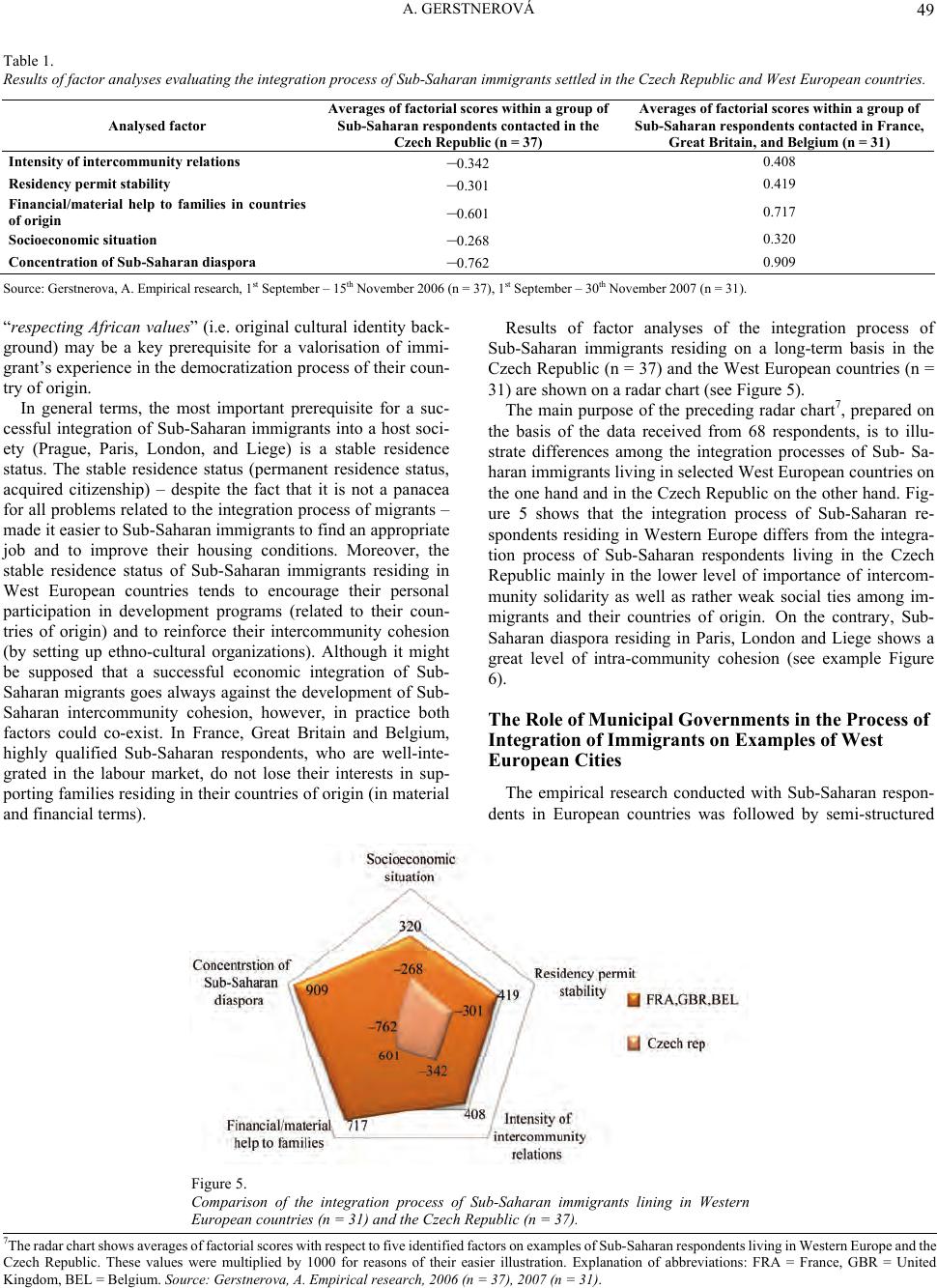 A. GERSTNEROVÁ 49 Table 1. Results of factor analyses ev aluating the integration process of Sub-Saharan immigrants settled in the Czech Republic and West European countries. Analysed factor Averages of f actorial scores within a group of Sub-Saharan responde nts contact ed in the Czech Republic (n = 37) Averages of f actorial scores within a group of Sub-Saharan responde nts contac ted in France, Great Britain, and Bel giu m (n = 31) Intensity of intercommunity relations –0.342 0.408 Residency p ermit stability –0.301 0.419 Financial/material help to families in countries of origin –0.601 0.717 Socioeconomic situation –0.268 0.320 Concentration of Sub- Saharan di aspora –0.762 0.909 Source: Gerstnerova, A. Empirical research, 1st September – 15th Novem ber 2006 (n = 37), 1st Sept e mber – 30th November 2007 (n = 31). “respecting African values” (i.e. original cultural identity back- ground) may be a key prerequisite for a valorisation of immi- grant’s experience in the democratization process of their coun- try of origin. In general terms, the most important prerequisite for a suc- cessful integration of Sub-Saharan immigrants into a host soci- ety (Prague, Paris, London, and Liege) is a stable residence status. The stable residence status (permanent residence status, acquired citizenship) – despite the fact that it is not a panacea for all problems related to the integration process of migrants – made it easier to Sub-Saharan immigrants to find an appropriate job and to improve their housing conditions. Moreover, the stable residence status of Sub-Saharan immigrants residing in West European countries tends to encourage their personal participation in development programs (related to their coun- tries of origin) and to reinforce their intercommunity cohesion (by setting up ethno-cultural organizations). Although it might be supposed that a successful economic integration of Sub- Saharan migrants goes always against the development of Sub- Saharan intercommunity cohesion, however, in practice both factors could co-exist. In France, Great Britain and Belgium, highly qualified Sub-Saharan respondents, who are well-inte- grated in the labour market, do not lose their interests in sup- porting families residing in their countries of origin (in material and financial terms). Results of factor analyses of the integration process of Sub-Saharan immigrants residing on a long-term basis in the Czech Republic (n = 37) and the West European countries (n = 31) are shown on a radar chart (see Figure 5). The main purpose of the preceding radar chart7, prepared on the basis of the data received from 68 respondents, is to illu- strate differences among the integration processes of Sub- Sa- haran immigrants living in selected West European countries on the one hand and in the Czech Republic on the other hand. Fig- ure 5 shows that the integration process of Sub-Saharan re- spondents residing in Western Europe differs from the integra- tion process of Sub-Saharan respondents living in the Czech Republic mainly in the lower level of importance of intercom- munity solidarity as well as rather weak social ties among im- migrants and their countries of origin. On the contrary, Sub- Saharan diaspora residing in Paris, London and Liege shows a great level of intra-community cohesion (see example Figure 6). The Role of Municipal Governments in the Process of Integration of Immigrants on Examples of West European Cities The empirical research conducted with Sub-Saharan respon- dents in European countries was followed by semi-structured Figure 5. Comparison of the integration process of Sub-Saharan immigrants lining in Western European countries (n = 31) and the Czech Re publ ic (n = 37). 7The radar chart shows averages of factorial scores with respect to five identified factors on examples of Sub-Saharan respondents living in Wester n Europe and the Czech Republic. These values were multiplied by 1000 for reasons of their easier illustration. Explanation of abbreviations: FRA = France, GBR = United Kingdom, BEL = Belgium . Source: Gerstnerova, A. Empirical r esearch, 2006 (n = 37), 2007 (n = 31). 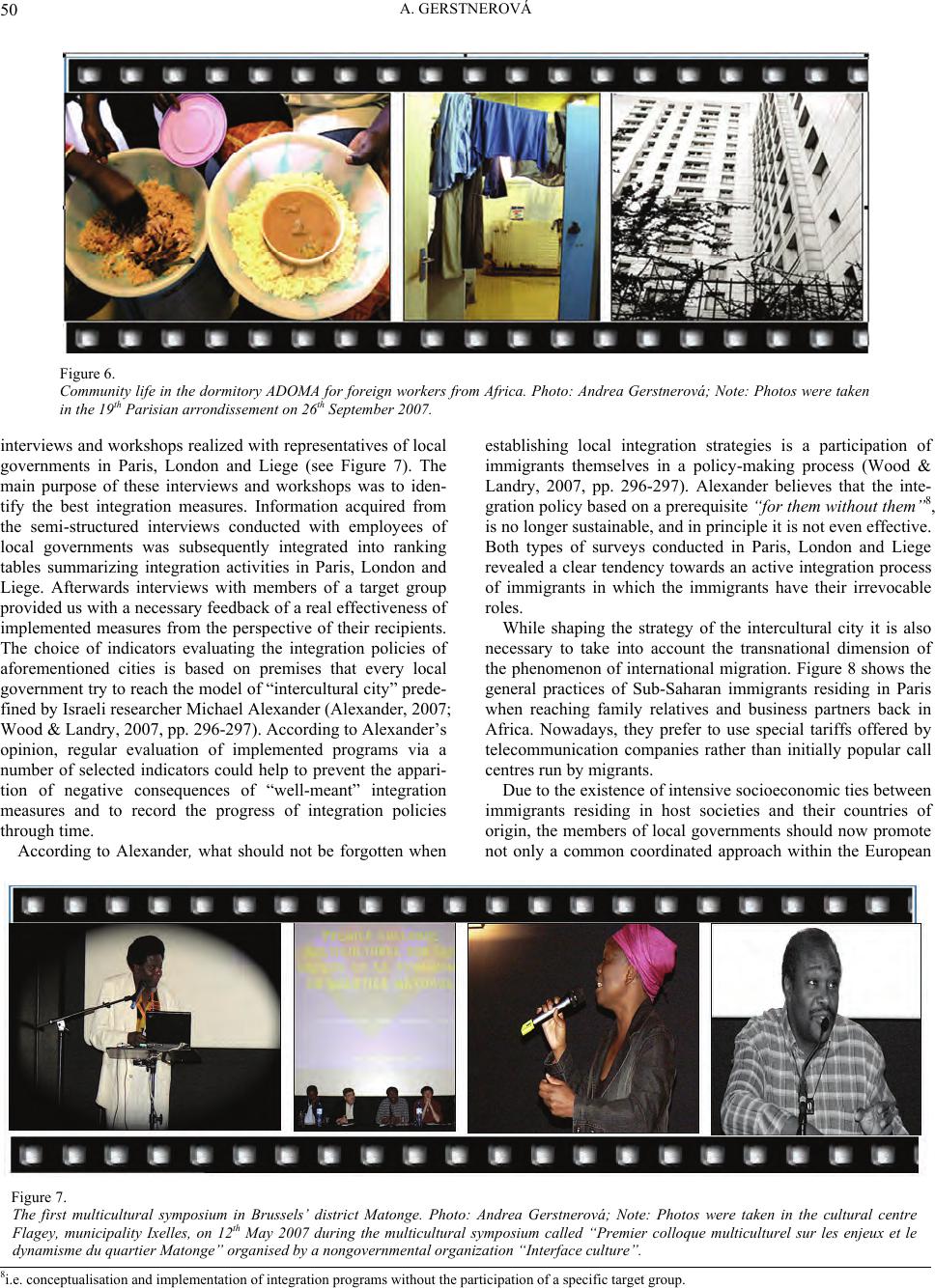 A. GERSTNEROVÁ 50 Figure 6. Community life in the dormitory ADOMA for foreign workers from Africa. Photo: Andrea Gerstnerová; Note: Photos were taken in the 19th Parisian arrondisseme n t on 26th September 2007. interviews and workshops realized with representatives of local governments in Paris, London and Liege (see Figure 7). The main purpose of these interviews and workshops was to iden- tify the best integration measures. Information acquired from the semi-structured interviews conducted with employees of local governments was subsequently integrated into ranking tables summarizing integration activities in Paris, London and Liege. Afterwards interviews with members of a target group provided us with a necessary feedback of a real effectiveness of implemented measures from the perspective of their recipients. The choice of indicators evaluating the integration policies of aforementioned cities is based on premises that every local government try to reach the model of “intercultural city” prede- fined by Israeli researcher Michael Alexander (Alexander, 2007; Wood & Landry, 2007, pp. 296-297). According to Alexander’s opinion, regular evaluation of implemented programs via a number of selected indicators could help to prevent the appari- tion of negative consequences of “well-meant” integration measures and to record the progress of integration policies through time. According to Alexander, what should not be forgotten when establishing local integration strategies is a participation of immigrants themselves in a policy-making process (Wood & Landry, 2007, pp. 296-297). Alexander believes that the inte- gration policy based on a prerequisite “for them without them”8, is no longer sustainable, and in principle it is not even effective. Both types of surveys conducted in Paris, London and Liege revealed a clear tendency towards an active integration process of immigrants in which the immigrants have their irrevocable roles. While shaping the strategy of the intercultural city it is also necessary to take into account the transnational dimension of the phenomenon of international migration. Figure 8 shows the general practices of Sub-Saharan immigrants residing in Paris when reaching family relatives and business partners back in Africa. Nowadays, they prefer to use special tariffs offered by telecommunication companies rather than initially popular call centres run by migrants. Due to the existence of intensive socioeconomic ties between immigrants residing in host societies and their countries of origin, the members of local governments should now promote not only a common coordinated approach within the European Figure 7. The first multicultural symposium in Brussels’ district Matonge. Photo: Andrea Gerstnerová; Note: Photos were taken in the cultural centre Flagey, municipality Ixelles, on 12th May 2007 during the multicultural symposium called “Premier colloque multiculturel sur les enjeux et le dynamisme du quartier Matonge” organised by a nongovernmental or ganization “Interface cul tu re ” . 8i.e. conceptualisation and implementa tion of integration programs without the particip ation of a specific target group. 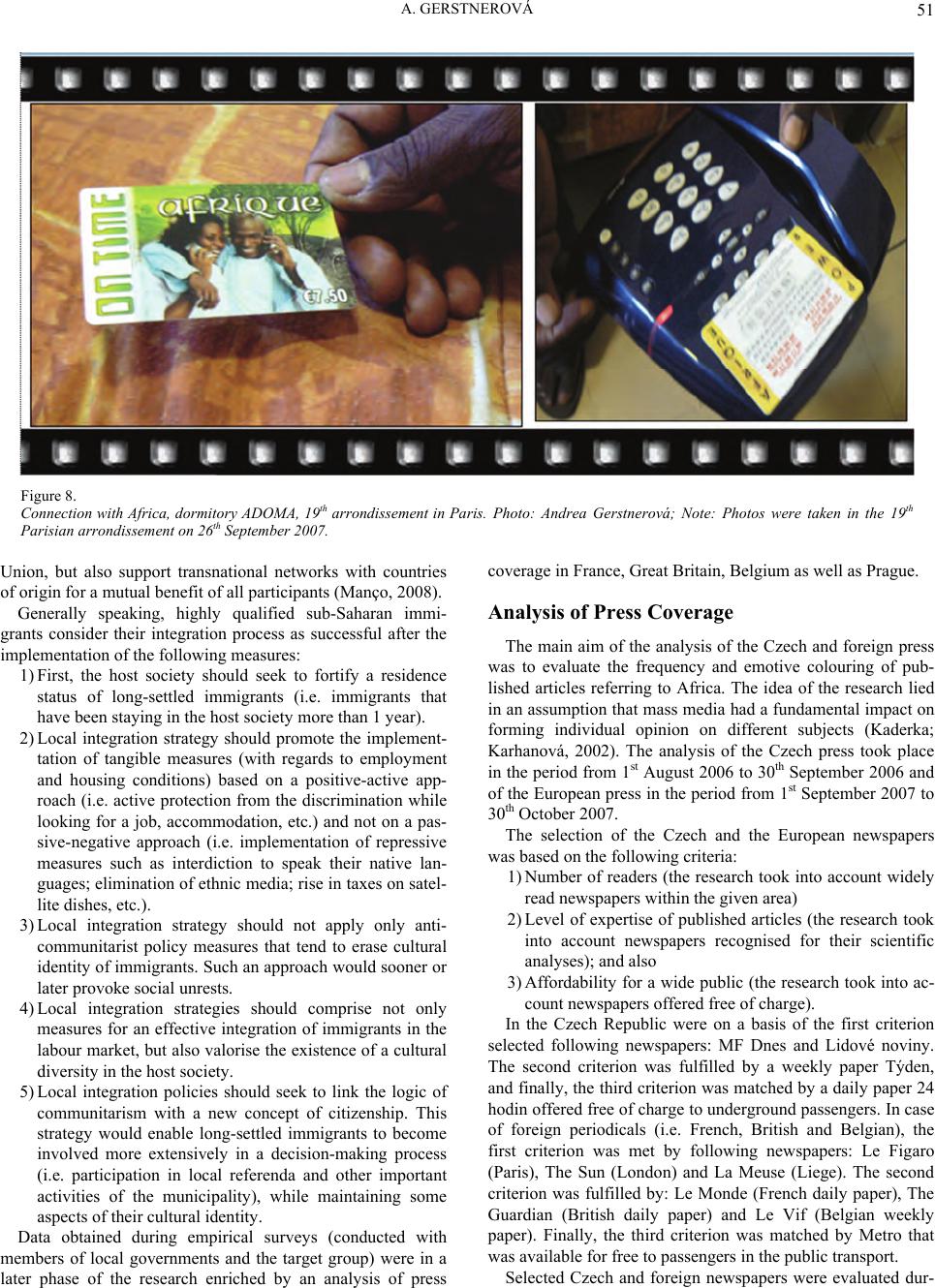 A. GERSTNEROVÁ 51 Figure 8. Connection with Africa, dormitory ADOMA, 19th arrondissement in Paris. Photo: Andrea Gerstnerová; Note: Photos were taken in the 19th Parisian arrondissement on 26th September 2007. Union, but also support transnational networks with countries of origin for a mutual benefit of all participants (Manço, 2008). Generally speaking, highly qualified sub-Saharan immi- grants consider their integration process as successful after the implementatio n of the following measures: 1) First, the host society should seek to fortify a residence status of long-settled immigrants (i.e. immigrants that have been staying in the host society more than 1 year). 2) Local integration strategy should promote the implement- tation of tangible measures (with regards to employment and housing conditions) based on a positive-active app- roach (i.e. active protection from the discrimination while looking for a job, accommodation, etc.) and not on a pas- sive-negative approach (i.e. implementation of repressive measures such as interdiction to speak their native lan- guages; elimination of ethnic media; rise in taxes on satel- lite dishes, etc.). 3) Local integration strategy should not apply only anti- communitarist policy measures that tend to erase cultural identity of immigrants. Such an approach would sooner or later provoke social unrests. 4) Local integration strategies should comprise not only measures for an effective integration of immigrants in the labour market, but also valorise the existence of a cultural diversity in the host socie ty. 5) Local integration policies should seek to link the logic of communitarism with a new concept of citizenship. This strategy would enable long-settled immigrants to become involved more extensively in a decision-making process (i.e. participation in local referenda and other important activities of the municipality), while maintaining some aspects of their cultural identity. Data obtained during empirical surveys (conducted with members of local governments and the target group) were in a later phase of the research enriched by an analysis of press coverage in France, Great Britain, Belgium as well as Prague. Analysis of Press Coverage The main aim of the analysis of the Czech and foreign press was to evaluate the frequency and emotive colouring of pub- lished articles referring to Africa. The idea of the research lied in an assumption that mass media had a fundamental impact on forming individual opinion on different subjects (Kaderka; Karhanová, 2002). The analysis of the Czech press took place in the period from 1st August 2006 to 30th September 2006 and of the European press in the period from 1st September 2007 to 30th October 2007. The selection of the Czech and the European newspapers was based on the following criteria: 1) Number of readers (the research took into account widely read newspapers within the given area) 2) Level of expertise of published articles (the research took into account newspapers recognised for their scientific analyses); and also 3) Affordability for a wide public (the research took into ac- count newspapers offered free of charge). In the Czech Republic were on a basis of the first criterion selected following newspapers: MF Dnes and Lidové noviny. The second criterion was fulfilled by a weekly paper Týden, and finally, the third criterion was matched by a daily paper 24 hodin offered free of charge to underground passengers. In case of foreign periodicals (i.e. French, British and Belgian), the first criterion was met by following newspapers: Le Figaro (Paris), The Sun (London) and La Meuse (Liege). The second criterion was fulfilled by: Le Monde (French daily paper), The Guardian (British daily paper) and Le Vif (Belgian weekly paper). Finally, the third criterion was matched by Metro that was available for free to passengers in the public transport. Selected Czech and foreign newspapers were evaluated dur- 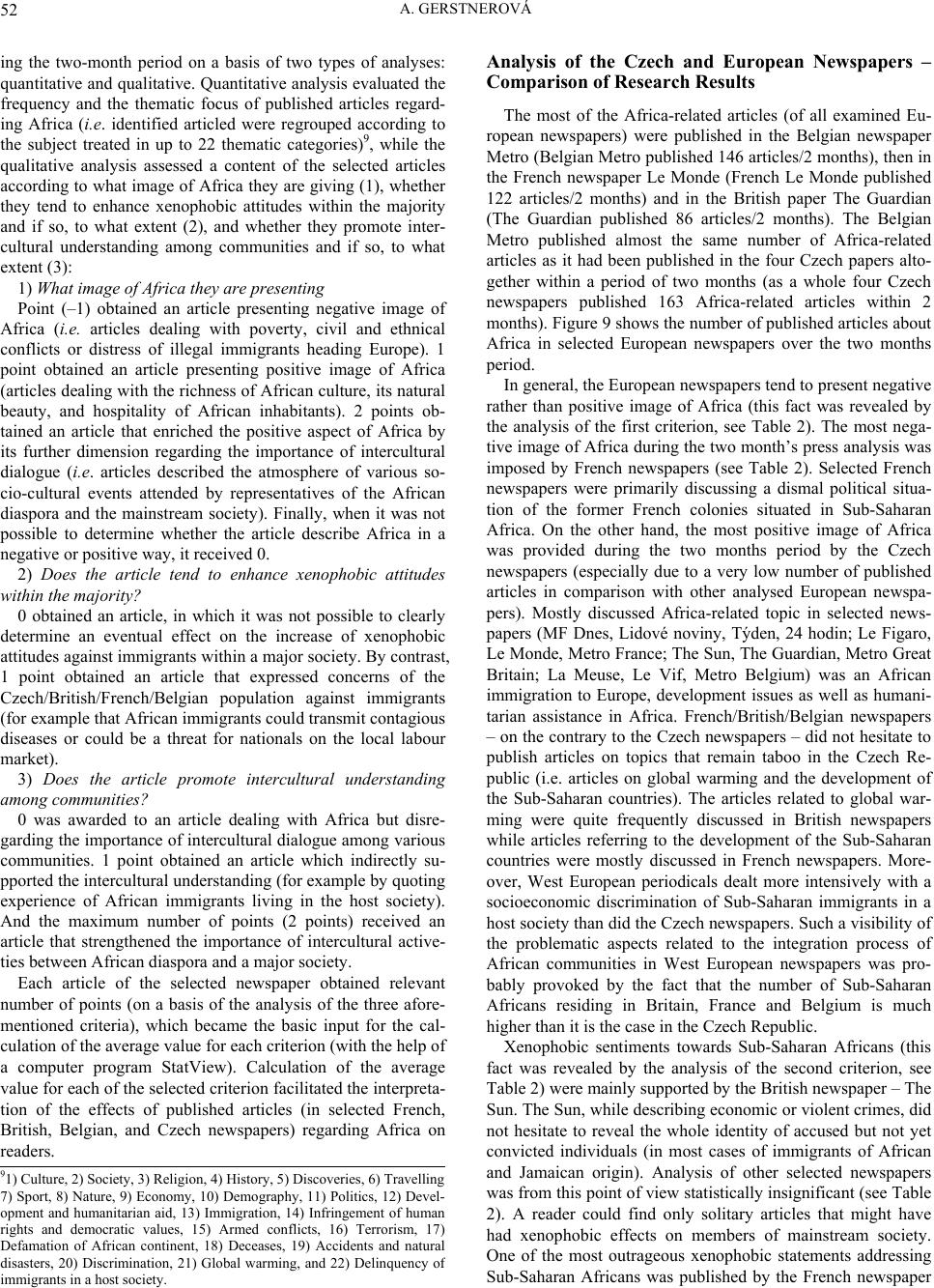 A. GERSTNEROVÁ 52 ing the two-month period on a basis of two types of analyses: quantitative and qualitative. Quantitative analysis evaluated the frequency and the thematic focus of published articles regard- ing Africa (i.e. identified articled were regrouped according to the subject treated in up to 22 thematic categories)9, while the qualitative analysis assessed a content of the selected articles according to what image of Africa they are giving (1), whether they tend to enhance xenophobic attitudes within the majority and if so, to what extent (2), and whether they promote inter- cultural understanding among communities and if so, to what extent (3): 1) What image of Africa they are presenting Point (–1) obtained an article presenting negative image of Africa (i.e. articles dealing with poverty, civil and ethnical conflicts or distress of illegal immigrants heading Europe). 1 point obtained an article presenting positive image of Africa (articles dealing with the richness of African culture, its natural beauty, and hospitality of African inhabitants). 2 points ob- tained an article that enriched the positive aspect of Africa by its further dimension regarding the importance of intercultural dialogue (i.e. articles described the atmosphere of various so- cio-cultural events attended by representatives of the African diaspora and the mainstream society). Finally, when it was not possible to determine whether the article describe Africa in a negative or positive way, it received 0. 2) Does the article tend to enhance xenophobic attitudes within the majority ? 0 obtained an article, in which it was not possible to clearly determine an eventual effect on the increase of xenophobic attitudes against immigrants within a major society. By contrast, 1 point obtained an article that expressed concerns of the Czech/British/French/Belgian population against immigrants (for example that African immigrants could transmit contagious diseases or could be a threat for nationals on the local labour market). 3) Does the article promote intercultural understanding among communities? 0 was awarded to an article dealing with Africa but disre- garding the importance of intercultural dialogue among various communities. 1 point obtained an article which indirectly su- pported the intercultural understanding (for example by quoting experience of African immigrants living in the host society). And the maximum number of points (2 points) received an article that strengthened the importance of intercultural active- ties between African diaspora and a major society. Each article of the selected newspaper obtained relevant number of points (on a basis of the analysis of the three afore- mentioned criteria), which became the basic input for the cal- culation of the average value for each criterion (with the help of a computer program StatView). Calculation of the average value for each of the selected criterion facilitated the interpreta- tion of the effects of published articles (in selected French, British, Belgian, and Czech newspapers) regarding Africa on readers. Analysis of the Czech and European Newspapers – Comparison of Research Results The most of the Africa-related articles (of all examined Eu- ropean newspapers) were published in the Belgian newspaper Metro (Belgian Metro published 146 articles/2 months), then in the French newspaper Le Monde (French Le Monde published 122 articles/2 months) and in the British paper The Guardian (The Guardian published 86 articles/2 months). The Belgian Metro published almost the same number of Africa-related articles as it had been published in the four Czech papers alto- gether within a period of two months (as a whole four Czech newspapers published 163 Africa-related articles within 2 months). Figure 9 shows the number of published articles about Africa in selected European newspapers over the two months period. In general, the European newspapers tend to present negative rather than positive image of Africa (this fact was revealed by the analysis of the first criterion, see Table 2). The most nega- tive image of Africa during the two month’s press analysis was imposed by French newspapers (see Table 2). Selected French newspapers were primarily discussing a dismal political situa- tion of the former French colonies situated in Sub-Saharan Africa. On the other hand, the most positive image of Africa was provided during the two months period by the Czech newspapers (especially due to a very low number of published articles in comparison with other analysed European newspa- pers). Mostly discussed Africa-related topic in selected news- papers (MF Dnes, Lidové noviny, Týden, 24 hodin; Le Figaro, Le Monde, Metro France; The Sun, The Guardian, Metro Great Britain; La Meuse, Le Vif, Metro Belgium) was an African immigration to Europe, development issues as well as humani- tarian assistance in Africa. French/British/Belgian newspapers – on the contrary to the Czech newspapers – did not hesitate to publish articles on topics that remain taboo in the Czech Re- public (i.e. articles on global warming and the development of the Sub-Saharan countries). The articles related to global war- ming were quite frequently discussed in British newspapers while articles referring to the development of the Sub-Saharan countries were mostly discussed in French newspapers. More- over, West European periodicals dealt more intensively with a socioeconomic discrimination of Sub-Saharan immigrants in a host society than did the Czech newspapers. Such a visibility of the problematic aspects related to the integration process of African communities in West European newspapers was pro- bably provoked by the fact that the number of Sub-Saharan Africans residing in Britain, France and Belgium is much higher than it is the case in the Czech Republic. Xenophobic sentiments towards Sub-Saharan Africans (this fact was revealed by the analysis of the second criterion, see Table 2) were mainly supported by the British newspaper – The Sun. The Sun, while describing economic or violent crimes, did not hesitate to reveal the whole identity of accused but not yet convicted individuals (in most cases of immigrants of African and Jamaican origin). Analysis of other selected newspapers was from this point of view statistically insignificant (see Table 2). A reader could find only solitary articles that might have had xenophobic effects on members of mainstream society. One of the most outrageous xenophobic statements addressing Sub-Saharan Africans was published by the French newspaper 91) Culture, 2 ) Society, 3) Religion, 4) History, 5) Discoveries, 6) Travell i ng 7) Sport, 8) Nature, 9) Economy, 10) Demography, 11) Politics, 12) Devel- opment and humanitarian aid, 13) Immigration, 14) Infringement of human rights and democratic values, 15) Armed conflicts, 16) Terrorism, 17) Defamation of African continent, 18) Deceases, 19) Accidents and natural disasters, 20) Discrimination, 21) Global warming, and 22) Delinquency o f immigrants in a host society. 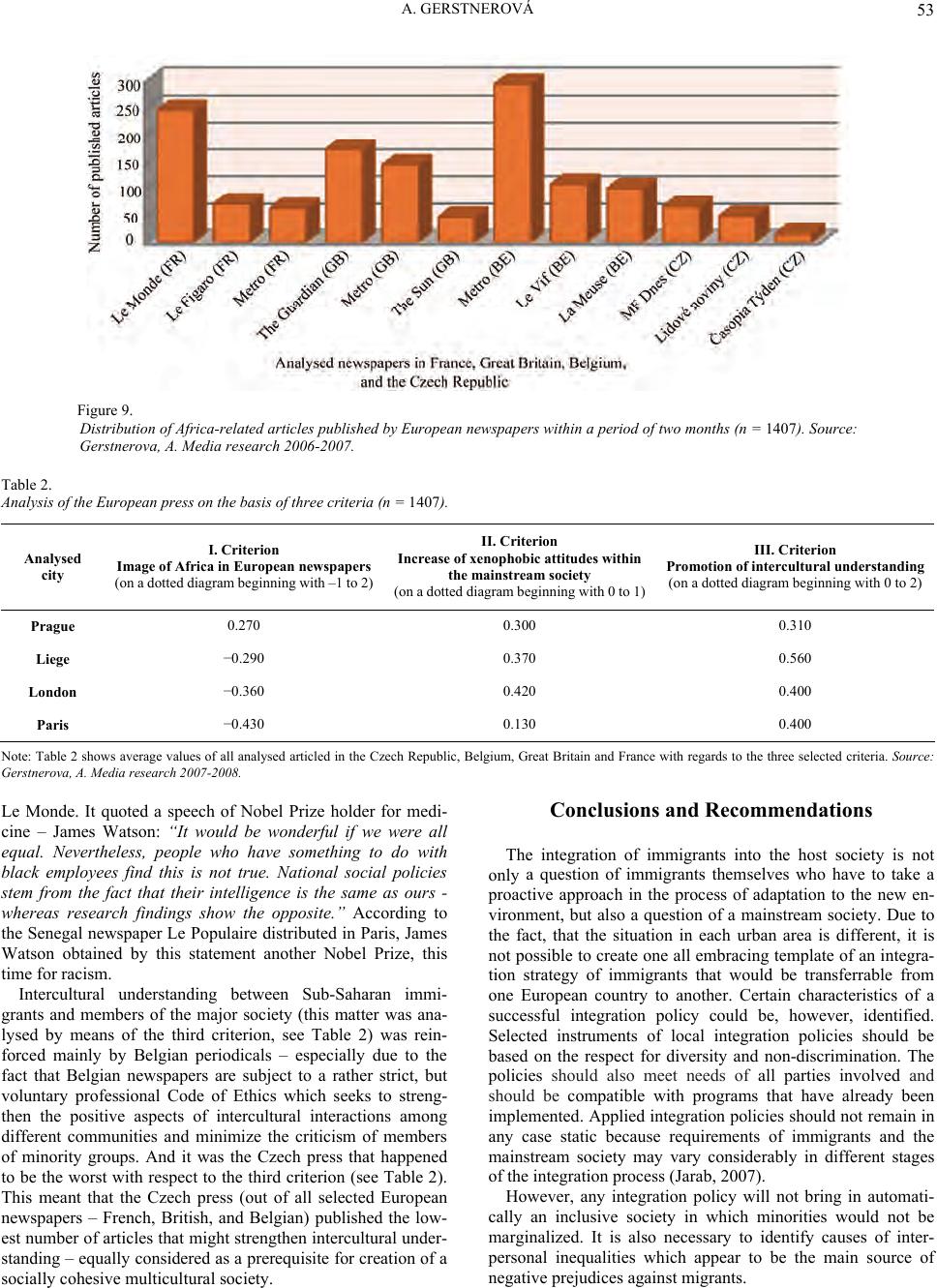 A. GERSTNEROVÁ 53 Figure 9. Distribution of Africa-related articles published by European newspapers within a period of two months (n = 1407). Source: Gerstnerova, A. Media research 2006-2007. Table 2. Analysis of the European pres s on the basis of three criteria (n = 1407). Analysed city I. Criterion Image of Africa in European newspapers (on a dotte d dia gra m be ginnin g wit h – 1 to 2) II. Criteri on Increase of xenophobic attitudes within the mainst ream society (on a dotted dia gra m beginnin g with 0 to 1) III. Criterion Promotion of intercultural understanding (on a dotted diagram beginning with 0 to 2) Prague 0.270 0.300 0.310 Liege −0.290 0.370 0.560 London −0.360 0.420 0.400 Paris −0.430 0.130 0.400 Note: Table 2 shows average values of all analysed articled in the Czech Republic, Belgium, Great Britain and France with regards to the three selected criteria. Source: Gerstnerova, A. M e dia research 2007-2008. Conclusions and Recommendations Le Monde. It quoted a speech of Nobel Prize holder for medi- cine – James Watson: “It would be wonderful if we were all equal. Nevertheless, people who have something to do with black employees find this is not true. National social policies stem from the fact that their intelligence is the same as ours - whereas research findings show the opposite.” According to the Senegal newspaper Le Populaire distributed in Paris, James Watson obtained by this statement another Nobel Prize, this time for racism. The integration of immigrants into the host society is not only a question of immigrants themselves who have to take a proactive approach in the process of adaptation to the new en- vironment, but also a question of a mainstream society. Due to the fact, that the situation in each urban area is different, it is not possible to create one all embracing template of an integra- tion strategy of immigrants that would be transferrable from one European country to another. Certain characteristics of a successful integration policy could be, however, identified. Selected instruments of local integration policies should be based on the respect for diversity and non-discrimination. The policies should also meet needs of all parties involved and should be compatible with programs that have already been implemented. Applied integration policies should not remain in any case static because requirements of immigrants and the mainstream society may vary considerably in different stages of the integration process (Jarab, 2007). Intercultural understanding between Sub-Saharan immi- grants and members of the major society (this matter was ana- lysed by means of the third criterion, see Table 2) was rein- forced mainly by Belgian periodicals – especially due to the fact that Belgian newspapers are subject to a rather strict, but voluntary professional Code of Ethics which seeks to streng- then the positive aspects of intercultural interactions among different communities and minimize the criticism of members of minority groups. And it was the Czech press that happened to be the worst with respect to the third criterion (see Table 2). This meant that the Czech press (out of all selected European newspapers – French, British, and Belgian) published the low- est number of articles that might strengthen intercultural under- standing – equally considered as a prerequisite for creation of a socially cohesive multicultural society. However, any integration policy will not bring in automati- cally an inclusive society in which minorities would not be marginalized. It is also necessary to identify causes of inter- personal inequalities which appear to be the main source of negative prejudices against migrants. 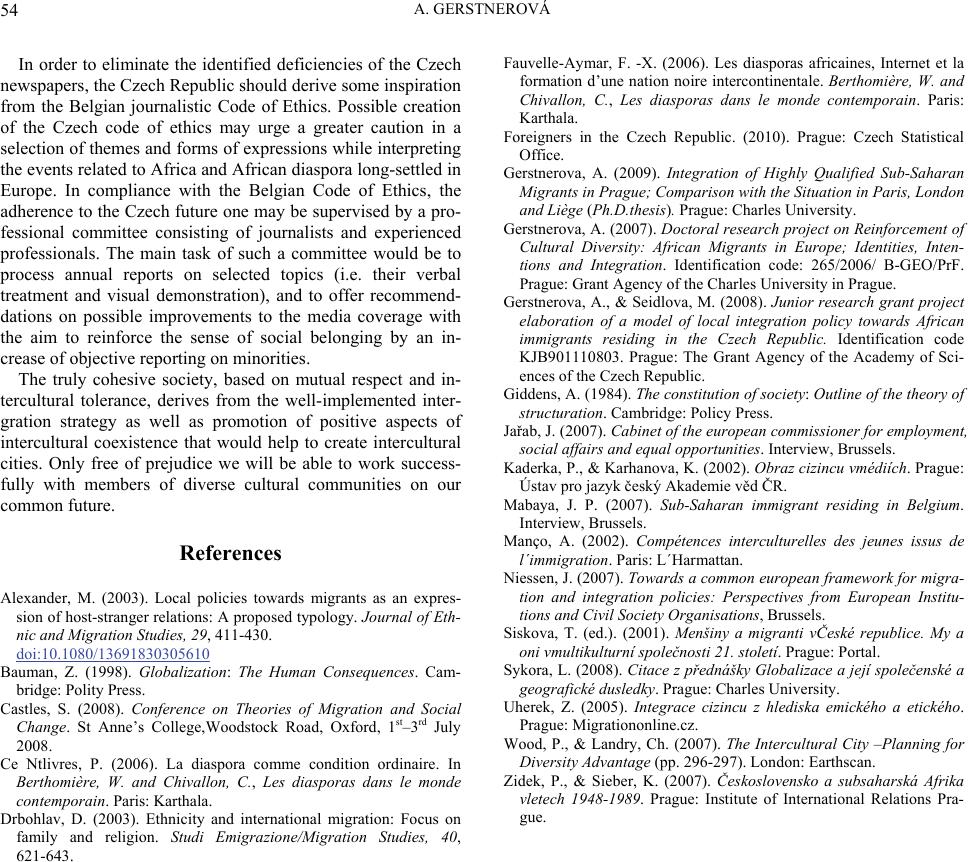 A. GERSTNEROVÁ 54 In order to eliminate the identified deficiencies of the Czech newspapers, the Czech Republic should derive some inspiration from the Belgian journalistic Code of Ethics. Possible creation of the Czech code of ethics may urge a greater caution in a selection of themes and forms of expressions while interpreting the events related to Africa and African diaspora long-settled in Europe. In compliance with the Belgian Code of Ethics, the adherence to the Czech future one may be supervised by a pro- fessional committee consisting of journalists and experienced professionals. The main task of such a committee would be to process annual reports on selected topics (i.e. their verbal treatment and visual demonstration), and to offer recommend- dations on possible improvements to the media coverage with the aim to reinforce the sense of social belonging by an in- crease of objective reporting on minorities. The truly cohesive society, based on mutual respect and in- tercultural tolerance, derives from the well-implemented inter- gration strategy as well as promotion of positive aspects of intercultural coexistence that would help to create intercultural cities. Only free of prejudice we will be able to work success- fully with members of diverse cultural communities on our common future. References Alexander, M. (2003). Local policies towards migrants as an expres- sion of host-stranger relations: A proposed typology. Journal of Eth- nic and Migration Studies, 29, 411-430. doi:10.1080/13691830305610 Bauman, Z. (1998). Globalization: The Human Consequences. Cam- bridge: Polity Press. Castles, S. (2008). Conference on Theories of Migration and Social Change. St Anne’s College,Woodstock Road, Oxford, 1st–3rd July 2008. Ce Ntlivres, P. (2006). La diaspora comme condition ordinaire. In Berthomière, W. and Chivallon, C., Les diasporas dans le monde contemporain. Paris: Karthala. Drbohlav, D. (2003). Ethnicity and international migration: Focus on family and religion. Studi Emigrazione/Migration Studies, 40, 621-643. Fauvelle-Aymar, F. -X. (2006). Les diasporas africaines, Internet et la formation d’une nation noire intercontinentale. Berthomière, W. and Chivallon, C., Les diasporas dans le monde contemporain. Paris: Karthala. Foreigners in the Czech Republic. (2010). Prague: Czech Statistical Office. Gerstnerova, A. (2009). Integration of Highly Qualified Sub-Saharan Migrants in Prague; Comparison with the Situation in Paris, London and Liège (Ph.D.thesis). Prague: Charles University. Gerstnerova, A. (2007). Doctoral research project on Reinforcement of Cultural Diversity: African Migrants in Europe; Identities, Inten- tions and Integration. Identification code: 265/2006/ B-GEO/PrF. Prague: Grant Agency of the Charles University in Prague. Gerstnerova, A., & Seidlova, M. (2008). Junior research grant project elaboration of a model of local integration policy towards African immigrants residing in the Czech Republic. Identification code KJB901110803. Prague: The Grant Agency of the Academy of Sci- ences of the Czech Republic. Giddens, A. (1984). The constitution of society: Outline of the theory of structuration. Cambridge: Policy Press. Jařab, J. (2007). Cabinet of the european commissioner for employment, social affairs and equal opp or tunities. Interview, Brussels. Kaderka, P., & Karhanova, K. (2002). Obraz cizincu vmédiích. Prague: Ústav pro jazyk český A k ademi e věd ČR. Mabaya, J. P. (2007). Sub-Saharan immigrant residing in Belgium. Interview, Brussels. Manço, A. (2002). Compétences interculturelles des jeunes issus de l´immigration. Paris: L´Harmattan. Niessen, J. (2007). Towards a common european framework for migra- tion and integration policies: Perspectives from European Institu- tions and Civil Society Organisations, Brussels. Siskova, T. (ed.). (2001). Menšiny a migranti vČeské republice. My a oni vmultikulturní společnosti 21. století. Prague: Portal. Sykora, L. (2008). Citace z přednášky Globalizace a její společenské a geografické dusledky. Prague: Charles University. Uherek, Z. (2005). Integrace cizincu z hlediska emického a etického. Prague: Migrationonli n e .cz. Wood, P., & Landry, Ch. (2007). The Intercultural City –Planning for Diversity Advantage (pp. 296-297). London: Earthscan. Zidek, P., & Sieber, K. (2007). Československo a subsaharská Afrika vletech 1948-1989. Prague: Institute of International Relations Pra- gue. |