

Paper Menu >>
Journal Menu >>
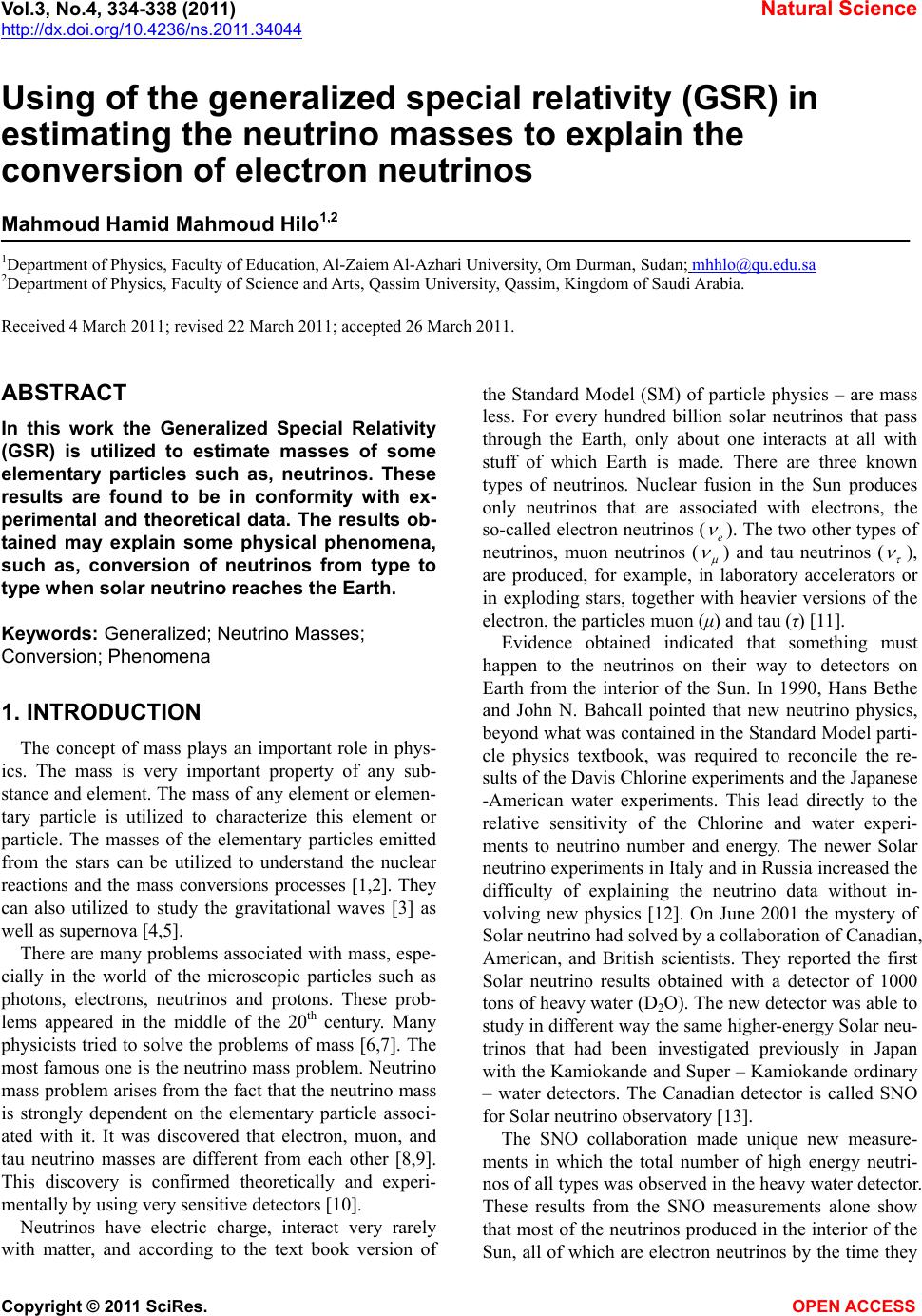 Vol.3, No.4, 334-338 (2011) Natural Science http://dx.doi.org/10.4236/ns.2011.34044 Copyright © 2011 SciRes. OPEN ACCESS Using of the generalized special relativity (GSR) in estimating the neutrino masses to explain the conversion of electron neutrinos Mahmoud Hamid Mahmoud Hilo1,2 1Department of Physics, Faculty of Education, Al-Zaiem Al-Azhari University, Om Durman, Sudan; [email protected] 2Department of Physics, Faculty of Science and Arts, Qassim University, Qassim, Kingdom of Saudi Arabia. Received 4 March 2011; revised 22 March 2011; accepted 26 March 2011. ABSTRACT In this work the Generalized Special Relativity (GSR) is utilized to estimate masses of some elementary particles such as, neutrinos. These results are found to be in conformity with ex- perimental and theoretical data. The results ob- tained may explain some physical phenomena, such as, conversion of neutrinos from type to type when solar neutrino reaches the Earth. Keywords: Generalized; Neutrino Masses; Conversion; Phenomena 1. INTRODUCTION The concept of mass plays an important role in phys- ics. The mass is very important property of any sub- stance and element. The mass of any element or elemen- tary particle is utilized to characterize this element or particle. The masses of the elementary particles emitted from the stars can be utilized to understand the nuclear reactions and the mass conversions processes [1,2]. They can also utilized to study the gravitational waves [3] as well as supernova [4,5]. There are many problems associated with mass, espe- cially in the world of the microscopic particles such as photons, electrons, neutrinos and protons. These prob- lems appeared in the middle of the 20th century. Many physicists tried to solve the problems of mass [6,7]. The most famous one is the neutrino mass problem. Neutrino mass problem arises from the fact that the neutrino mass is strongly dependent on the elementary particle associ- ated with it. It was discovered that electron, muon, and tau neutrino masses are different from each other [8,9]. This discovery is confirmed theoretically and experi- mentally by using very sensitive detectors [10]. Neutrinos have electric charge, interact very rarely with matter, and according to the text book version of the Standard Model (SM) of particle physics – are mass less. For every hundred billion solar neutrinos that pass through the Earth, only about one interacts at all with stuff of which Earth is made. There are three known types of neutrinos. Nuclear fusion in the Sun produces only neutrinos that are associated with electrons, the so-called electron neutrinos (e ). The two other types of neutrinos, muon neutrinos ( ) and tau neutrinos ( ), are produced, for example, in laboratory accelerators or in exploding stars, together with heavier versions of the electron, the particles muon (μ) and tau (τ) [11]. Evidence obtained indicated that something must happen to the neutrinos on their way to detectors on Earth from the interior of the Sun. In 1990, Hans Bethe and John N. Bahcall pointed that new neutrino physics, beyond what was contained in the Standard Model parti- cle physics textbook, was required to reconcile the re- sults of the Davis Chlorine experiments and the Japanese -American water experiments. This lead directly to the relative sensitivity of the Chlorine and water experi- ments to neutrino number and energy. The newer Solar neutrino experiments in Italy and in Russia increased the difficulty of explaining the neutrino data without in- volving new physics [12]. On June 2001 the mystery of Solar neutrino had solved by a collaboration of Canadian, American, and British scientists. They reported the first Solar neutrino results obtained with a detector of 1000 tons of heavy water (D2O). The new detector was able to study in different way the same higher-energy Solar neu- trinos that had been investigated previously in Japan with the Kamiokande and Super – Kamiokande ordinary – water detectors. The Canadian detector is called SNO for Solar neutrino observatory [13]. The SNO collaboration made unique new measure- ments in which the total number of high energy neutri- nos of all types was observed in the heavy water detector. These results from the SNO measurements alone show that most of the neutrinos produced in the interior of the Sun, all of which are electron neutrinos by the time they 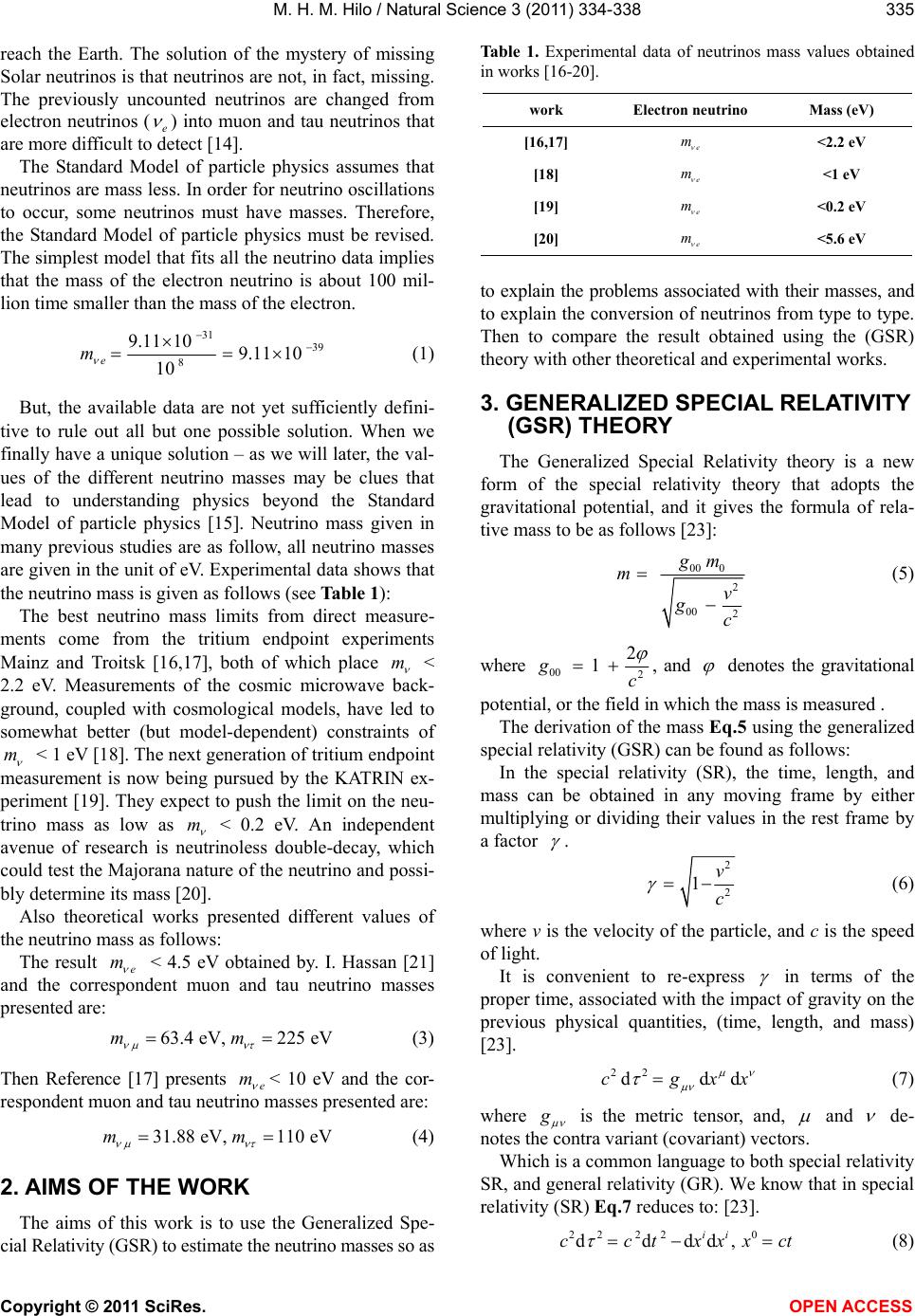 M. H. M. Hilo / Natural Science 3 (2011) 334-338 Copyright © 2011 SciRes. OPEN ACCESS 335 reach the Earth. The solution of the mystery of missing Solar neutrinos is that neutrinos are not, in fact, missing. The previously uncounted neutrinos are changed from electron neutrinos (e ) into muon and tau neutrinos that are more difficult to detect [14]. The Standard Model of particle physics assumes that neutrinos are mass less. In order for neutrino oscillations to occur, some neutrinos must have masses. Therefore, the Standard Model of particle physics must be revised. The simplest model that fits all the neutrino data implies that the mass of the electron neutrino is about 100 mil- lion time smaller than the mass of the electron. 31 39 8 9.11 109.11 10 10 e m (1) But, the available data are not yet sufficiently defini- tive to rule out all but one possible solution. When we finally have a unique solution – as we will later, the val- ues of the different neutrino masses may be clues that lead to understanding physics beyond the Standard Model of particle physics [15]. Neutrino mass given in many previous studies are as follow, all neutrino masses are given in the unit of eV. Experimental data shows that the neutrino mass is given as follows (see Table 1): The best neutrino mass limits from direct measure- ments come from the tritium endpoint experiments Mainz and Troitsk [16,17], both of which place m < 2.2 eV. Measurements of the cosmic microwave back- ground, coupled with cosmological models, have led to somewhat better (but model-dependent) constraints of m < 1 eV [18]. The next generation of tritium endpoint measurement is now being pursued by the KATRIN ex- periment [19]. They expect to push the limit on the neu- trino mass as low as m < 0.2 eV. An independent avenue of research is neutrinoless double-decay, which could test the Majorana nature of the neutrino and possi- bly determine its mass [20]. Also theoretical works presented different values of the neutrino mass as follows: The result e m < 4.5 eV obtained by. I. Hassan [21] and the correspondent muon and tau neutrino masses presented are: 63.4 eV, 225 eVmm (3) Then Reference [17] presents e m < 10 eV and the cor- respondent muon and tau neutrino masses presented are: 31.88 eV, 110 eVmm (4) 2. AIMS OF THE WORK The aims of this work is to use the Generalized Spe- cial Relativity (GSR) to estimate the neutrino masses so as Table 1. Experimental data of neutrinos mass values obtained in works [16-20]. work Electron neutrino Mass (eV) [16,17] e m <2.2 eV [18] e m <1 eV [19] e m <0.2 eV [20] e m <5.6 eV to explain the problems associated with their masses, and to explain the conversion of neutrinos from type to type. Then to compare the result obtained using the (GSR) theory with other theoretical and experimental works. 3. GENERALIZED SPECIAL RELATIVITY (GSR) THEORY The Generalized Special Relativity theory is a new form of the special relativity theory that adopts the gravitational potential, and it gives the formula of rela- tive mass to be as follows [23]: 00 0 2 00 2 gm m v gc (5) where 00 2 2 1gc , and denotes the gravitational potential, or the field in which the mass is measured . The derivation of the mass Eq.5 using the generalized special relativity (GSR) can be found as follows: In the special relativity (SR), the time, length, and mass can be obtained in any moving frame by either multiplying or dividing their values in the rest frame by a factor . 2 2 1v c (6) where v is the velocity of the particle, and c is the speed of light. It is convenient to re-express in terms of the proper time, associated with the impact of gravity on the previous physical quantities, (time, length, and mass) [23]. 22 dddcgxx (7) where g is the metric tensor, and, and de- notes the contra variant (covariant) vectors. Which is a common language to both special relativity SR, and general relativity (GR). We know that in special relativity (SR) Eq.7 reduces to: [23]. 22 220 dddd, ii cctxxxct (8) 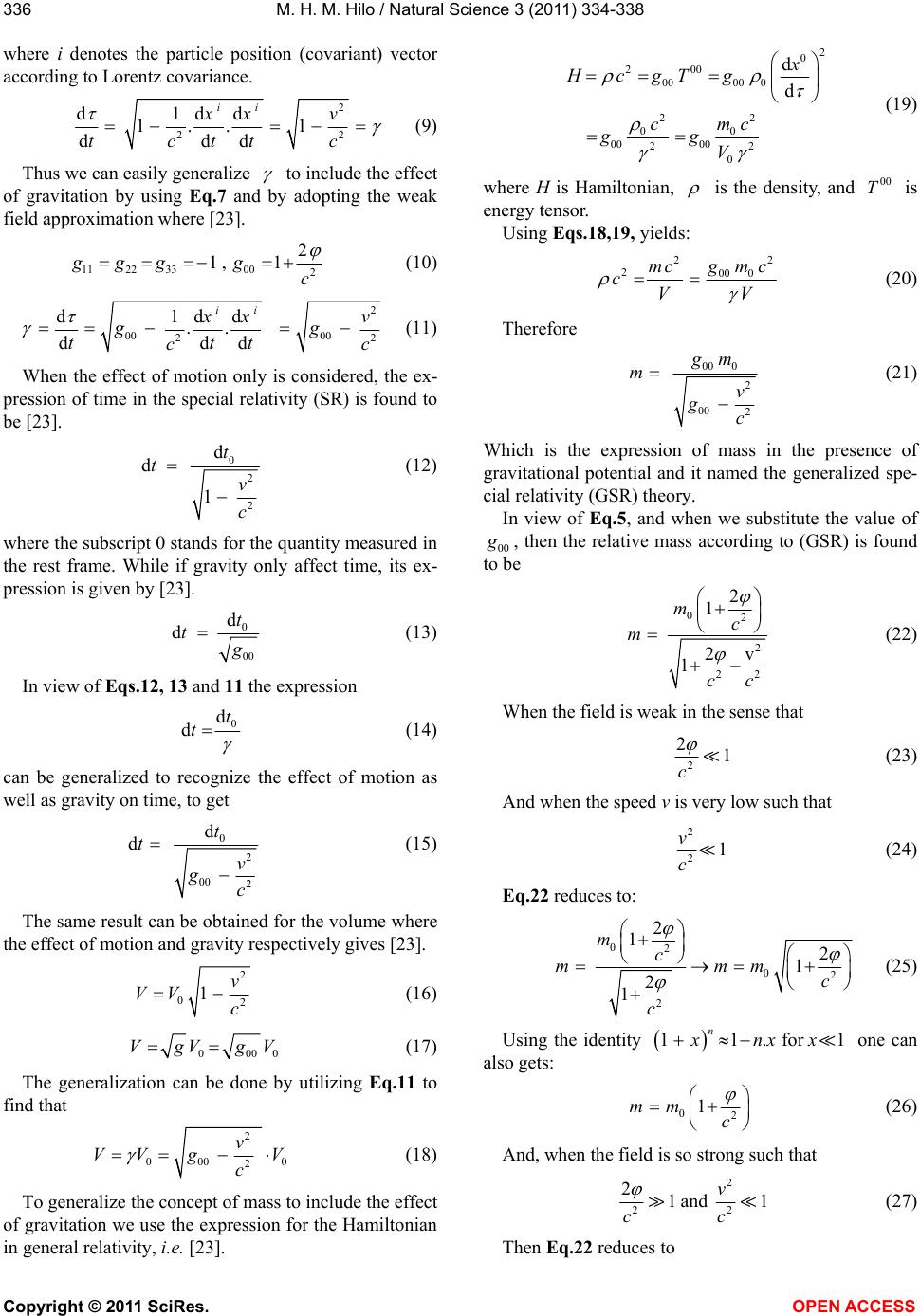 M. H. M. Hilo / Natural Science 3 (2011) 334-338 Copyright © 2011 SciRes. OPEN ACCESS 336 where i denotes the particle position (covariant) vector according to Lorentz covariance. 2 22 d1dd 1.. 1 ddd ii xx v ttt cc (9) Thus we can easily generalize to include the effect of gravitation by using Eq.7 and by adopting the weak field approximation where [23]. 1122 33002 2 1, 1 gggg c (10) 2 00 00 22 d1dd .. ddd ii x xv gg ttt cc (11) When the effect of motion only is considered, the ex- pression of time in the special relativity (SR) is found to be [23]. 0 2 2 d d 1 t t v c (12) where the subscript 0 stands for the quantity measured in the rest frame. While if gravity only affect time, its ex- pression is given by [23]. 0 00 d dt t g (13) In view of Eqs.12, 13 and 11 the expression 0 d dt t (14) can be generalized to recognize the effect of motion as well as gravity on time, to get 0 2 00 2 d dt t v gc (15) The same result can be obtained for the volume where the effect of motion and gravity respectively gives [23]. 2 02 1v VV c (16) 0000 VgV gV (17) The generalization can be done by utilizing Eq.11 to find that 2 000 0 2 v VV gV c (18) To generalize the concept of mass to include the effect of gravitation we use the expression for the Hamiltonian in general relativity, i.e. [23]. 2 0 200 0000 0 22 00 00 00 22 0 d d x HcgTg cmc gg V (19) where H is Hamiltonian, is the density, and 00 T is energy tensor. Using Eqs.18,19, yields: 2 2 200 0 g mc mc cVV (20) Therefore 00 0 2 00 2 gm m v gc (21) Which is the expression of mass in the presence of gravitational potential and it named the generalized spe- cial relativity (GSR) theory. In view of Eq.5, and when we substitute the value of 00 g , then the relative mass according to (GSR) is found to be 02 2 22 2 1 2v 1 mc m cc (22) When the field is weak in the sense that 2 21 c (23) And when the speed v is very low such that 2 21 v c (24) Eq.22 reduces to: 02 02 2 2 12 1 2 1 mc mmm c c (25) Using the identity 11.for 1 n xnxx one can also gets: 02 1mm c (26) And, when the field is so strong such that 2 22 21 and 1 v cc (27) Then Eq.22 reduces to 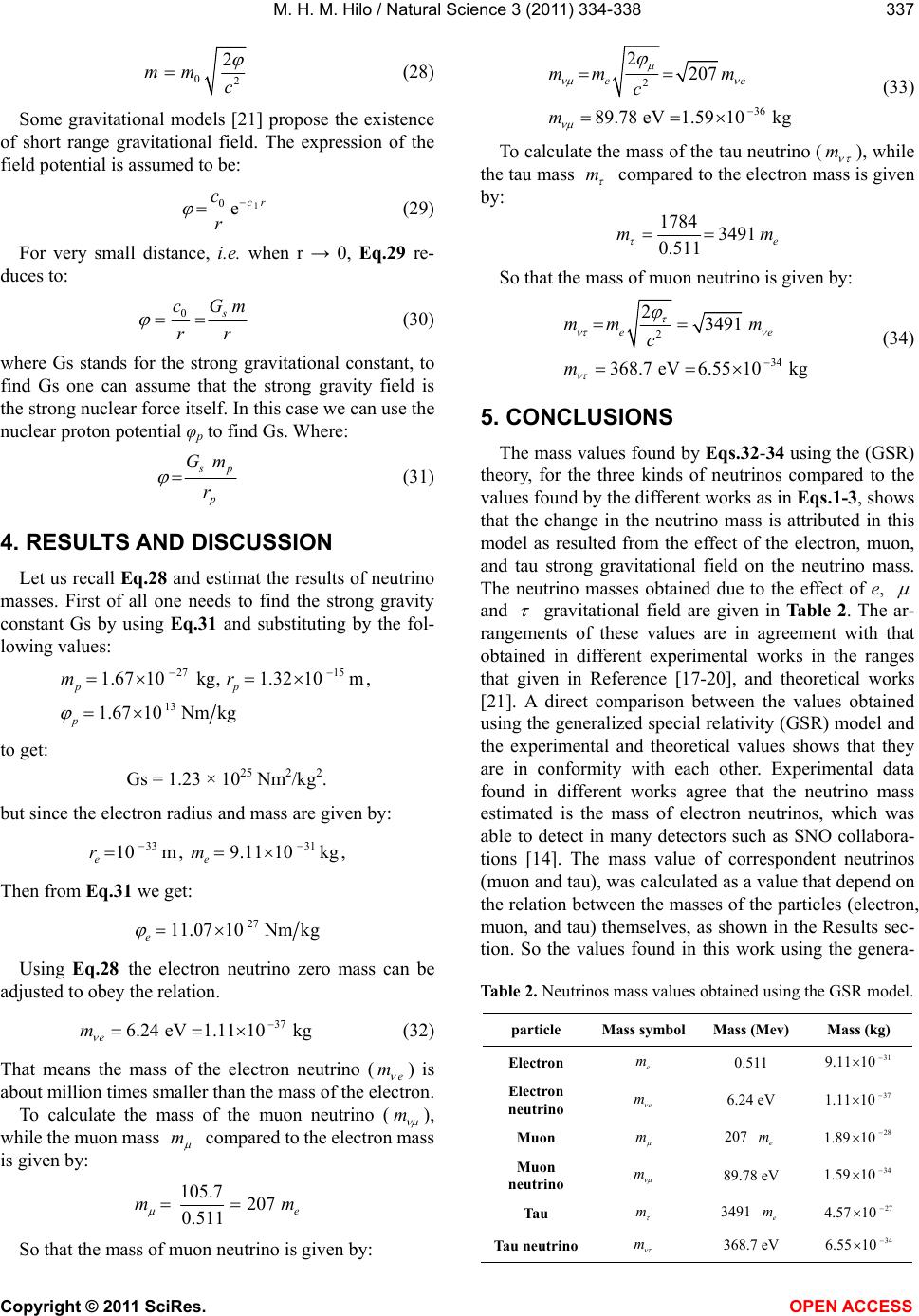 M. H. M. Hilo / Natural Science 3 (2011) 334-338 Copyright © 2011 SciRes. OPEN ACCESS 337 02 2 mm c (28) Some gravitational models [21] propose the existence of short range gravitational field. The expression of the field potential is assumed to be: 1 0ecr c r (29) For very small distance, i.e. when r → 0, Eq.29 re- duces to: 0s cGm rr (30) where Gs stands for the strong gravitational constant, to find Gs one can assume that the strong gravity field is the strong nuclear force itself. In this case we can use the nuclear proton potential φp to find Gs. Where: s p p Gm r (31) 4. RESULTS AND DISCUSSION Let us recall Eq.2 8 and estimat the results of neutrino masses. First of all one needs to find the strong gravity constant Gs by using Eq.31 and substituting by the fol- lowing values: 27 15 13 1.67 10kg,1.32 10m, 1.6710Nm kg pp p mr to get: Gs = 1.23 × 1025 Nm2/kg2. but since the electron radius and mass are given by: 33 31 10m, 9.1110kg, ee rm Then from Eq.31 we get: 27 11.0710Nm kg e Using Eq.28 the electron neutrino zero mass can be adjusted to obey the relation. 37 6.24 eV1.1110kg e m (32) That means the mass of the electron neutrino (e m ) is about million times smaller than the mass of the electron. To calculate the mass of the muon neutrino (m ), while the muon mass m compared to the electron mass is given by: 105.7 207 0.511 e mm So that the mass of muon neutrino is given by: 2 36 2207 89.78 eV1.5910kg ee mm m c m (33) To calculate the mass of the tau neutrino (m ), while the tau mass m compared to the electron mass is given by: 1784 3491 0.511 e mm So that the mass of muon neutrino is given by: 2 34 23491 368.7 eV6.5510kg ee mm m c m (34) 5. CONCLUSIONS The mass values found by Eqs .3 2-34 using the (GSR) theory, for the three kinds of neutrinos compared to the values found by the different works as in Eqs.1-3, shows that the change in the neutrino mass is attributed in this model as resulted from the effect of the electron, muon, and tau strong gravitational field on the neutrino mass. The neutrino masses obtained due to the effect of e, and gravitational field are given in Table 2. The ar- rangements of these values are in agreement with that obtained in different experimental works in the ranges that given in Reference [17-20], and theoretical works [21]. A direct comparison between the values obtained using the generalized special relativity (GSR) model and the experimental and theoretical values shows that they are in conformity with each other. Experimental data found in different works agree that the neutrino mass estimated is the mass of electron neutrinos, which was able to detect in many detectors such as SNO collabora- tions [14]. The mass value of correspondent neutrinos (muon and tau), was calculated as a value that depend on the relation between the masses of the particles (electron, muon, and tau) themselves, as shown in the Results sec- tion. So the values found in this work using the genera- Table 2. Neutrinos mass values obtained using the GSR model. particle Mass symbolMass (Mev) Mass (kg) Electron e m 0.511 31 9.1110 Electron neutrino e m 6.24 eV 37 1.1110 Muon m 207 e m 28 1.8910 Muon neutrino m 89.78 eV 34 1.5910 Tau m 3491 e m 27 4.5710 Tau neutrinom 368.7 eV 34 6.5510  M. H. M. Hilo / Natural Science 3 (2011) 334-338 Copyright © 2011 SciRes. OPEN ACCESS 338 lized special relativity (GSR) model, affirm that the missing neutrinos are not, in fact, missing, but, actually are not able to detect. And that explains the conversion of a part of the electron neutrinos into muon and tau neutrinos, by the time that Solar neutrinos reach the earth, which explain why the number of detected neutri- nos is less than that predicted by theoretical model of the sun and by textbook description of neutrinos. REFERENCES [1] Nadyozhin D.K. (1978) The neutrino radiation for a hot neutron star formation and the envelope outburst problem. Astrophysics and Space Science, 53, 131-153. doi:10.1007/BF00645909 [2] Mikheev S.P. and Smirnov A.Y. (1985) Resonance en- hancement of oscillations in matter and solar neutrino spectroscopy. Soviet Journal Nuclear Physics, 42, 913- 917. [3] Kotake K., Sato K. and Takahashi K. (2006) Explosion mechanism, neutrino burst, and gravitational wave in core collapse supernovae. Reports Progress in Physics, 69, 971-1144. doi:10.1088/0034-4885/69/4/R03 [4] Janka H.T. et al. (2007) Supernova explosions and the birth of neutron stars. McGill University, Montreal. DOI: 10.1063/1.2900257. [5] Colgate S.A. and White R.H. (1966) The hydrodynamic behavior of supernovae explosions, astrophysics. Astro- physical Journal, 143, 626-681. [6] Jegerlehner B., et al. (1996) Neutrino oscillations and the supernova 1987A signal. Physical Review D, 54, 1194- 1203. doi:10.1103/PhysRevD.54.1194 [7] Lunardini C. and Smirnov A.Y (2001) Neutrinos from SN1987A, Earth matter effects and the LMA solution of the solar neutrino problem, Physical Review D, 63, 073009. doi:10.1103/PhysRevD.63.073009 [8] Lunardini C. and Smirnov A.Y. (2004) Neutrinos from SN1987A: Flavor conversion and interpretation of results, Astroparticle Physics, 21, 703-720. doi:10.1016/j.astropartphys.2004.05.005 [9] Aliu E. et al. (2005) Evidence for muon neutrino oscilla- tion in an accelerator-based experiment. Physical Review Letter, 94, 081802. doi:10.1103/PhysRevLett.94.081802 [10] Esteban-Pretel A. et al. (2008) Mu-tau neutrino refraction and collective three-flavor transformations in supernovae. Physical Review D, 77, 065024. doi:10.1103/PhysRevD.77.065024 [11] Abdurashitov J.N. et al. (2002) Measurements of the solar neutrino capture rate by the Russian-American gal- lium solar neutrino experiments during one half of the 22-year cycle of solar activity. Journal of Experimental and Theoretical Physics, 95, 181-193. doi:10.1134/1.1506424 [12] Drell S. (2003) Personal letter to John Bahcall, January 29. Soviet Journal Nuclear Physics, 42, 913-917. [13] Bahcall J.N. et al. (2001) Solar models: Current epoch and time dependences, neutrinos, and helioseismological properties. Astrophysical Journal, 555, 990-1012. doi:10.1086/321493 [14] Eguchi K. et al. (2003) First results from kamland: Evi- dence for reactor antineutrino disappearance. Physical Review Letter, 90, 021802. doi:10.1103/PhysRevLett.90.021802 [15] Bondi, H. (1957) Negative mass in general relativity. Reviews of Modern Physics, 29, 423-428. doi:10.1103/RevModPhys.29.423 [16] Bonn J. et al. (2002) Results from the Mainz neutrino mass experiment. Progress in Particle and Nuclear Phys- ics, 48 , 133-139. doi:10.1016/S0146-6410(02)00119-9 [17] Lobashev V.M. et al. (2002) Study of the tritium beta-spectrum in experiment “Troitsk ν-mass”. Progress in Particle and Nuclear Physics, 48, 133-139. doi:10.1016/S0146-6410(02)00118-7 [18] Komatsu E. et al. (2009) Five-year wilkinson microwave anisotropy probe (WMAP) observations: cosmological interpretation. The Astrophysical Journal Supplement Se- ries, 180, 330-376. [19] Bornschein L. (2003) Collaboration KATRIN-direct me- asureement of neutrino masses in the SUB-EV region. Universität Karlsruhe, Karlsruhe. [20] Elliott S. and Engel J. (2004) Double beta decay. Journal of Physics G: Nuclear and Particle Physics, 30, R183 –R215. doi:10.1088/0954-3899/30/9/R01 [21] Hassan I. (1998). Neutrino masses. M.Sc. thesis, Sudan University of Science and Technology, Khartoum. [22] Braginsky V.L., et al. (1957) Laboratory experiments to test relativistic gravity. Physical Review D, 15, 2047- 2068. S. Chu. doi:10.1103/PhysRevD.15.2047 [23] Hilo M.H.M. et al. (2011) Using of the generalized spe- cial relativity in estimating the proton (nucleon) mass to explain the mass defect. Natural Science, 3, 141-144. doi:10.4236/ns.2011.32020 |