

Paper Menu >>
Journal Menu >>
 Journal of Geoscience and Environment Protection, 2014, 2, 80-85 Published Online June 2014 in SciRes. http://www.scirp.org/journal/gep http://dx.doi.org/10.4236/gep.2014.23011 How to cite this paper: Romanova, A., & Iurchenko, N. (2014). Planktonic Foraminifera Diversity in the Sea of Okhotsk and Correlation to Past Climate Change. Journal of Geoscience and Environment Protection, 2, 80-85. http://dx.doi.org/10.4236/gep.2014.23011 Planktonic Foraminifera Diversity in the Sea of Okhotsk and Correlation to Past Climate Change A. Romanova*, N. Iurchenko Far Eastern Geological Institute, Far Eastern Branch Russian Academy of Science, Vladivostok, Russia Email: *[email protected] Received April 2014 Abstract 80 sediment stations and 4 sediment cores collected in the Sea of Okhotsk were used in this study in order to reveal additional proxy for past climate reconstruction based on planktonic foraminif- era. Variation in diversity indices (Simpson, Shannon and equitability indices) along the sea be- came additional criteria for 5 biogeographical provinces based on planktonic foraminifera. All of them show different structure aspects of the planktonic foraminifera assemblages that is very in- formative in cases of high relative abundance of N. pachyderma sin. and influence of carbonate dissolution factor. During the last 100 ky the diversity indices were changed and we can assume the migration of biogeographical provinces borders: borders of the Northern province were mov- ed to the central part in cold MIS 2, 4, structure of assemblages during MIS 3, 5 was close to the modern Central province but characterized by low total foraminiferal abundance in the sediments. The Simpson and Shannon indices are more sensitive to changes in structure of planktonic fo- raminifera assemblages when equitability index varies lightly during the Late Pleistocene-Holocene. Keywords Planktonic Foraminifera, Diversity Indexes, Late Pleistocene—Holocene, The Sea of Okhotsk 1. Introduction The object of the study is the Sea of Okhotsk, largest Russian Far East Sea. As a source region of North Pacific Intermediate Water, the Sea of Okhotsk plays a significant role in the ventilation of the North Pacific (Tallay, 1991). Analyzing planktonic foraminifera in marine sediments assists us in reconstructing historical patterns of climatic fluctuations. Studying of planktonic foraminifera in Sea of Okhotsk has some challenges: low quantity of species, one taxon domination in some intervals, low percents of another species, influence of dissolution (Romanova, Cherepanova, & Gorbarenko, 2014). These facts don't allow us to use standard approaches for pa- leoclimate reconstructions using planktonic foraminifera. Our aims were to document variations in foraminiferal diversity indices to reveal the special characteristics of this proxy for interpreting the paleodata. * Corresponding author.  A. Romanova, N. Iurchenko 81 2. Materials and Methods 80 sediment stations and 4 sediment cores were used in this study. Surface sediment samples were collected by multicorer (MC 800) and piston corer (upper 0 - 5 cm) during the Academician Lavrentev 55 and 42 cruises (Figure 1). Cores were collected from the central part of the sea by gravity cores during the Academician Nes- meyanov 25 and Academician Lavrentev 42 cruises (Gorbarenko et al., 2004). Cores were sampled at each 5 - 10 cm intervals for foraminiferal analysis. Samples were prepared by standard techniques of foraminiferal analysis (Barash, 1970). Planktonic foraminifera were identified using taxonomical classification of Loeblich and Tappan (1987). The basic chronology for the most studied core 936 is given by different analyses which result published before (Gorbarenko et al., 2004). Core 936 were divided into foraminiferal complexes that correspond to Marine Isotopic Stages (MIS) and correlated with another cores (LV 40 - 06, LV 40 - 18, LV 40 - 20) that don’t have such depth of information (Romanova, 2013). Three diversity indices were calculated by software package PAST usually used for paleontological datasets (Harper, 1999). Simpson index measures concentration of dominance in the community from 0 to 1, taking into account the number of individuals(n) as well as number of taxa (i): с=1 – 2 )( n i n ∑ , If Simpson index gives weight to general species Shannon index gives more weight to scarce species. It varies from 0 for assemblages with only a single taxon to high values for assemblages with many taxa: n i n n i n Hln ∑ −−= , Equitability measures the evenness with which individuals are divided among the taxa present: E= S H log , Diversity indices calculated for surface sediments gives initial model for interpreting data in cores. 3. Results and Discussion 3.1. Foraminifera Diversity and Dominance in Surface Sediments There are seven species and subspecies in the Sea of Okhotsk (Romanova, 2013): Neogloboquadr ina pach y- derma (Ehrenberg, 1861) sinistral and dextral forms, Globigerina bulloides d’Orbigny, 1826, Turborotalia quinqueloba (Natland, 1938), Globigerinita glitinata (Egger, 1863), G. uvula (Ehrenberg, 1861) и Globorotalia scitula (Brady, 1882). Diversity indices calculated for surface sediments showed different patterns (Figure 2). In case with the Sea of Okhotsk index c showed the concentration of dominant species N. pachyderma sin. Maximum values (0.9 - 1) are in coastal, northern and south-eastern parts of the sea. There are also high c values in central part (0.8 - 1) that is conducted with influence of carbonate dissolution in some stations. Minimum c values (0.3 - 0.7) and maximum H values (0.9 - 1) are revealed in the central part close to 54˚ N. 4 - 7 species and subspecies were found here. Minimum H values (0) are also characterized monodominant assemblages of planktonic foraminifera in the coastal area. Low H values are in northern and Kuril regions characterized by presence of more dissolution resistant species in sediments. Maximum values of equitability (0.8 - 1) are repre- sented in monodominant assemblages of northern and south-eastern regions of the sea. Minimum e values (0.2 - 0.3) are marked in assemblages with maximum number of taxa (6 - 7), which are commonly abundant in the central part. A map of species diversity (number of species) shows a good defined region of high diversity in the central part which characterized by slow accumulation processes, low input of terrigenous material from the coastal area and influence of warm currents from Pacific through Kuril inflows. A map of species equitability shows a broad belt of high species dominance (high equitability) beneath the northern part. Area of low domi- nance (low equitability) corresponds to the increased relative abundance of Pacific taxa and increased of G. bul- loides abundance. As a result diversity indices might be additional criteria for distinguishing biogeographical 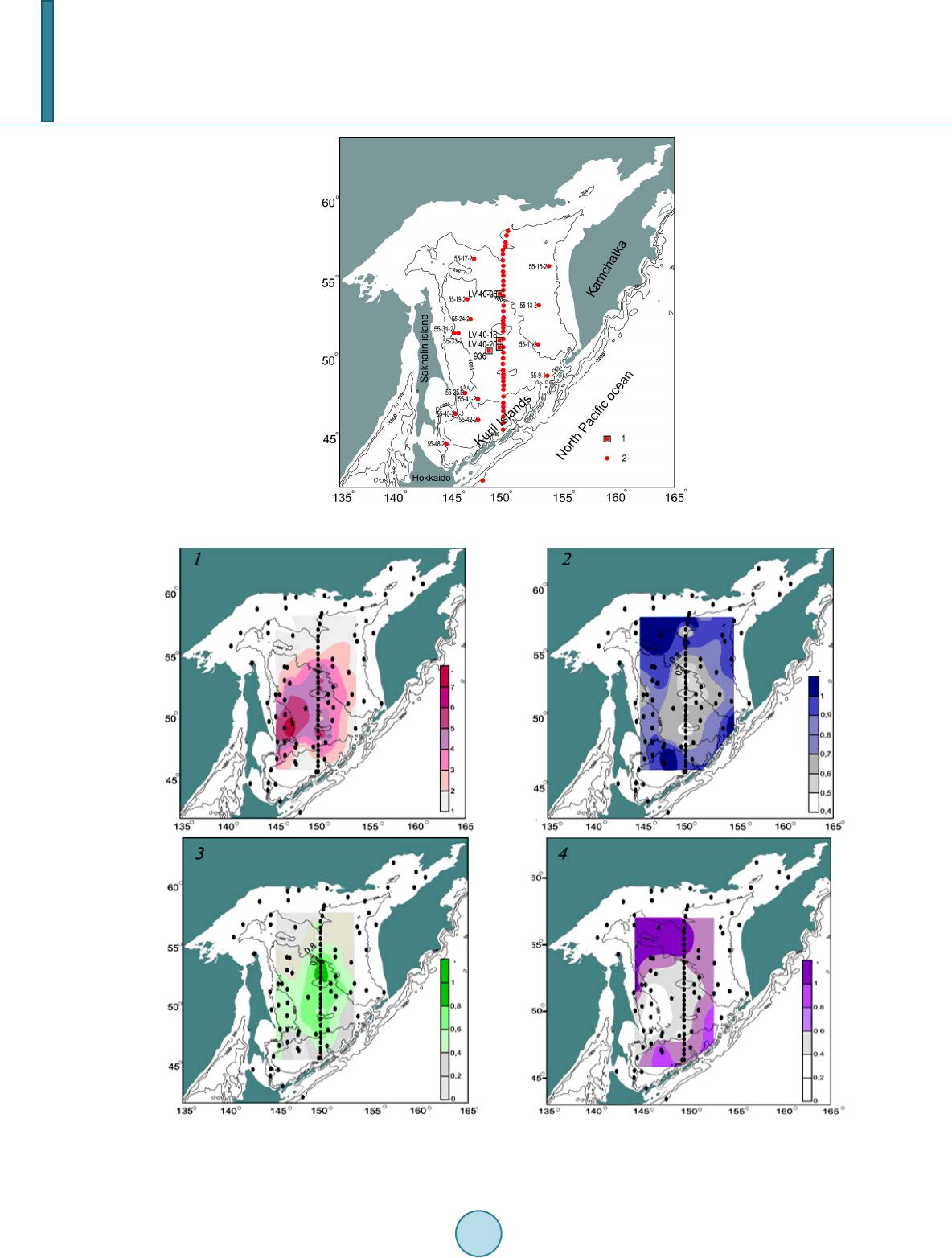 A. Romanova, N. Iurchenko 82 Figure 1. Locations of studied sediment stations (1) and cores (2). Figure 2. Diversity indexes and the number of taxons: 1: number of taxons; 2: Simpson index; 3: Shannon index; 4: equitab ility .  A. Romanova, N. Iurchenko 83 provinces (Table 1) in the Sea of Okhotsk by planktonic foraminifera that haven’t been applied before this study. 3.2. Diversity Indices in the Cores Applying data obtained from sediment stations we can assume border changes of biogeographical provinces during the last 100 ky. Each complex of planktonic foraminifera corresponds to major climate event or MIS 1 - 5 and char- acterized by specific proxies of planktonic foraminifera. Additionally we estimate total and relative abundance of planktonic foraminifera, found traces of dissolution in the cores sediments and compare it with calculated diversity indices. Results presented in Table 2 as averaged dataset for four studied cores. Diversity indices for complex V (MIS 5) have similar values as majority values for assemblages from the central part of the sea. It must be explained by relatively high number of species (4 - 5) at the paleoassemblage. Averaged diversity indices for complex VI are the same that can be explained by presence of scarce species in certain intervals of MIS 4 that might be reflects short period of warming. Generally complex 4 has all character- istics of the northern part of the Central province that also confirmed by another criteria (Table 2). Complex III in spite of relatively small total abundance of foraminifera in the sediments comparing with complex I has all diversity characteristics of the Central province. Shannon index shows high values due to the presence of 6 spe- cies but low relative abundance of scarce species the equitability index is still low. Simpson index becomes lower with decreasing of N. pachyderma sin. in the sediments during MIS 3. Such structure of paleoassemblage might be formed in conditions close to modern one. Presence of N. pachyderma dex. (up to 6%), T. quinqueloba (up to 5%), G. scitula (up to 1%), G. glutinata (up to 1%) indicate the strengthening of Pacific inflow into the Sea of Okhotsk during certain periods of MIS 3. Complex II is characterized as “the coldest” one. Diversity in- dices are close to the values of Northern province. This period is characterized by strong sea-ice conditions that induced to low concentration of foraminifera in the sediments and total domination of N. pachyderma sin. in pa- leoassemblage. N. pachyderma sin. is one of the species that can live in ice where algal biomass in winter is high compared to the water column, perhaps indicating an overwintering strategy (Dieckmann et al., 1991). Complex I is characterized by sharp increasing of total abundance. Diversity indices reflect the structure of paleoassem- blage that mostly depends on decreasing percents of N. pachyderma (60-78%), increasing of G. bulloides abun- dance up to 28 %, T. quinqueloba up to 8 % and presence of N. pachyderma dex., G. scitula, G. glutinata. Table 1. Biogeographical provinces of the Sea of Okhotsk based on planktonic foraminifera. Province Sediments T (˚С), S (‰) Р F Assemblages c H, e Coastal Sand 8 - 10˚С 28 - 30‰ +- 0-0,1 N. pachyderma sin.—100% - Northern Aleurite clays 10 - 11˚С 32.5 - 33‰ + - 12 N. pachyderma sin.—92% G. bulloides—8% 0.87 0.2 0.88 Central Thin aleurite clays 11 - 12˚С 32.4 - 32.5‰ + - 381 N. pachyderma sin.—65% G. bulloides—22% T. quinqueloba—7% N. pachyderma dex.—3% G. glutinata—<1% G. uvula—<1% G. scitula—<1% 0.57 0.64 0.57 Southern Sand, aleurite 13 - 14˚C 33‰ - - Presence of G. ruber G. conglobatus - South Eastern Thin aleurite clays 9 - 10˚C 32.5‰ + 110 N. pachyderma sin.—85% G. bulloides—12% G. quinqueloba—<1% N. pachyderma dex.—2% G. glutinata—<1% G. uvula—<1% 0.79 0.36 0.71 Note: D—traces of dissolution; F—foraminiferal number or total abundance of foraminifera (shells/g of dry sediments); c, H, e—diversity indices.  A. Romanova, N. Iurchenko 84 Table 2. Complexes of planktonic foraminifera in the Sea of Okhotsk in cores 936, LV 40 - 06, LV 40 - 18, LV 40 - 20. Complex max F с, H, e Characteristics of paleoassemblage D Province I 2749 0.4; 0.7-1; 0.4 Relative abundance of N. pachyderma sin down to 54%; G. bulloides up to 40%, presence of N. pachyderma dex., G. glutinata, T. quinqueloba, G. scitula, G. uvula +- Central II 108 0.7; 0.3, 0.7 N. pachyderma sin. up to 100%; G. bulloides down to 5.6%, presence of N. pachyderma dex - Northern III 603 0.4; 0.8; 0.5 N. pachyderma sin 43% - 84% G. bulloides up to 38% N. pachyderma dex. (up to 6%), T. quinqueloba (up to 5%), G. scitula (up to 1%), G. glutinata (up to 1%) +- Central IV 21 0.7; 0.5; 0.6 N. pachyderma sin. up to100%; in some intervals presence of G. scitula, G. quinqueloba; G. bulloides up to 20% - Northern part of the central province V 346 0.7; 0.5; 0.6 N. pachyderma 60% - 78%; G. bulloides up to 28%; T. quinqueloba up to 8%; presence of N. pachyderma dex., G. scitula, G. glutinata +- Central Note: Each complex corresponds to MIS 1-5. D—traces of dissolution; max F—maximum of foraminiferal number or total abundance of foraminifera (shells/g of dry sediments); c, H, e—diversity indices. 4. Conclusion Therefore, we conclude that diversity indices can be additional proxy for paleooceanologial changes that should be used in comprehensive foraminiferal analysis in case with the Okhotsk foraminiferal fauna that has some challenges in studying. Diversity indices show different aspect of changes in structure of foraminiferal assem- blages: dominance of N. pachyderma sin., increasing role of another taxa, evenness with which individuals are divided among the taxa present. A map of species diversity (number of species) shows a good defined region of high diversity in the central part with slow accumulation rates, low terrigenous dilution and influence of warm Pacific waters. Use of the Shannon diversity index enhances and clarifies this region of high diversity. We as- sume that Shannon and Simpson indices are more representative and sensitive to changes in structure of assem- blages that is caused by environmental changes. Equitability index is not so indicative because in case of small number of species (1 - 2) and dominance of one species it repeats the Simpson index. Correlation the data ob- tained from sediment station with cores data showed that borders of the biogeographical provinces were moved from the northern part to the central during cold MIS 2, 4. Structure of assemblages during MIS 3, 5 was close to the modern Central province but characterized by low total foraminiferal abundance in the sediments. Acknowledgements The authors would like to express their sincere appreciation to Dr. M. Cherepanova for fruitful suggestions and comments, and to Dr. S. Gorbarenko, A. Derkachev for provided material. We also appreciate Prof. V. Pushkar, Prof. M. Kuchera and N. Lubke for their help and constructive critics. This research was supported by grant FEB RAS 14-III-В-08-186. References Barash, M. (1970). Planktonic Foraminifera in North Atlantic Sedimen ts . Moscow publ. Dieckmann, G. , Spindler, M. , Lange, M. A. , Ackley, S. F. & Eicken, H. (1991): Antarctic Sea Ice: A Habitat for the Fo- raminifer Neogloboquadrina Pachyd erma. Journal of Foraminiferal Research, 21, 182-189. http://dx.doi.org/10.2113/gsjfr.21.2.182 Gorbarenko, S. A., Southon J. R., Keigwin L. D., Cherepanova M. V., & Gvozdeva I. G. (2004). Late Pleistocene-Holocene Oceanographic Variability in The Okhotsk Sea: Geochemical, Lithological And Paleontological Evidence. Palaeogeo- graphy Palaeoclimatology Palaeoecology, 209, 281-301. http:// dx.doi.org/10.1016/j.palaeo.2004.02.013 Harper, D. A. T. (Ed.) (1999). Numerical Palaeobiology. New York: John Wiley & Sons. Loeblich, A. R., & Tappan, H. (1987). Foraminiferal Genera and Their Classification. New York: Van Nostrand Rienhold  A. Romanova, N. Iurchenko 85 Co. Romanova, A. (2013). Paleogeography of Sedimentation in Sea Of Okhotsk during Late Pleistocene-Holocene (Based on Data from Planktonic Foraminifera Analysis). Reporter KRASSC. Earth Sciences, 21, 183-194. http://repo.kscnet.ru/id/eprint/487 Romanova, A., Cherepanova, M., & Gorbarenko, S. (2014). Planktonic Foraminifera as Paleoenvironmental Proxies of Up- per Quaternary Sedimentation in the Okhotsk Sea. Russian Journal of Pacific Geology, 33, 89-101. Talley, L. D. (1993). Distribution and Formation of North Pacific Intermediate Water. Journal of Physical Oceanography, 23, 517-537. http://dx.doi.org/10.1175/1520-0485(1993)023<0517:DAFONP>2.0.CO;2 |