

Paper Menu >>
Journal Menu >>
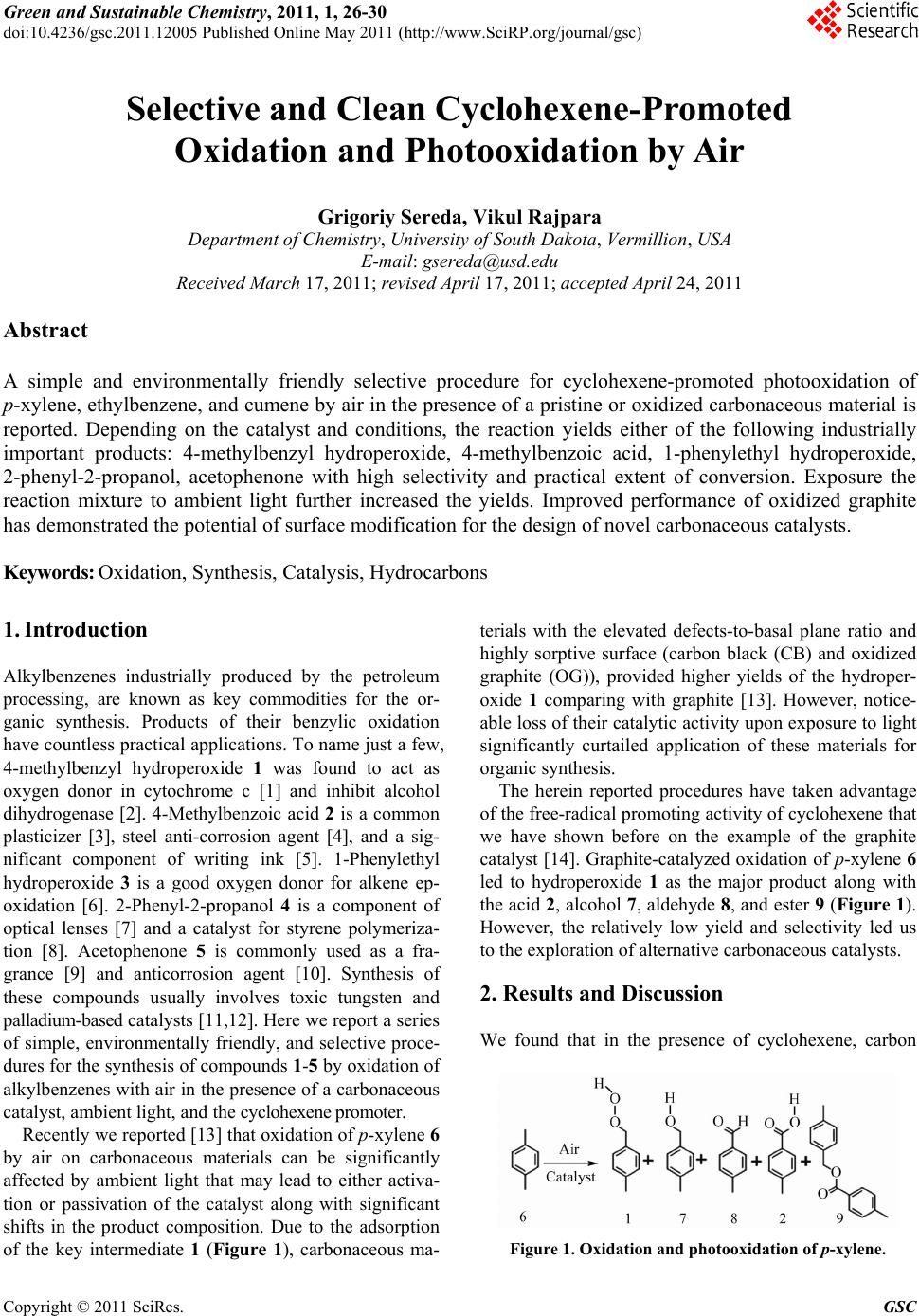 Green and Sustainable Chemistry, 2011, 1, 26-30 doi:10.4236/gsc.2011.12005 Published Online May 2011 (http://www.SciRP.org/journal/gsc) Copyright © 2011 SciRes. GSC Selective and Clean Cyclohexene-Promoted Oxidation and Photooxidation by Air Grigoriy Sereda, Vikul Rajpara Department of C hemi st ry , University of South Dakota, Vermillion, USA E-mail: [email protected] Received March 17, 2011; revised April 17, 2011; accepted April 24, 2011 Abstract A simple and environmentally friendly selective procedure for cyclohexene-promoted photooxidation of p-xylene, ethylbenzene, and cumene by air in the presence of a pristine or oxidized carbonaceous material is reported. Depending on the catalyst and conditions, the reaction yields either of the following industrially important products: 4-methylbenzyl hydroperoxide, 4-methylbenzoic acid, 1-phenylethyl hydroperoxide, 2-phenyl-2-propanol, acetophenone with high selectivity and practical extent of conversion. Exposure the reaction mixture to ambient light further increased the yields. Improved performance of oxidized graphite has demonstrated the potential of surface modification for the design of novel carbonaceous catalysts. Keywords: Oxidation, Synthesis, Catalysis, Hydrocarbons 1. Introduction Alkylbenzenes industrially produced by the petroleum processing, are known as key commodities for the or- ganic synthesis. Products of their benzylic oxidation have countless practical applications. To name just a few, 4-methylbenzyl hydroperoxide 1 was found to act as oxygen donor in cytochrome c [1] and inhibit alcohol dihydrogenase [2]. 4-Methylbenzoic acid 2 is a common plasticizer [3], steel anti-corrosion agent [4], and a sig- nificant component of writing ink [5]. 1-Phenylethyl hydroperoxide 3 is a good oxygen donor for alkene ep- oxidation [6]. 2-Phenyl-2-propanol 4 is a component of optical lenses [7] and a catalyst for styrene polymeriza- tion [8]. Acetophenone 5 is commonly used as a fra- grance [9] and anticorrosion agent [10]. Synthesis of these compounds usually involves toxic tungsten and palladium-based catalysts [11,12]. Here we report a series of simple, environmentally friendly, and selective proce- dures for the synthesis of compounds 1-5 by oxidation of alkylbenzenes with air in the presence of a carbonaceous catalyst, ambient light, and the cyclohexene promoter. Recently we reported [13] that oxidation of p-xylene 6 by air on carbonaceous materials can be significantly affected by ambient light that may lead to either activa- tion or passivation of the catalyst along with significant shifts in the product composition. Due to the adsorption of the key intermediate 1 (Figure 1), carbonaceous ma- terials with the elevated defects-to-basal plane ratio and highly sorptive surface (carbon black (CB) and oxidized graphite (OG)), provided higher yields of the hydroper- oxide 1 comparing with graphite [13]. However, notice- able loss of their catalytic activity upon exposure to light significantly curtailed application of these materials for organic synthesis. The herein reported procedures have taken advantage of the free-radical promoting activity of cyclohexene that we have shown before on the example of the graphite catalyst [14]. Graphite-catalyzed oxidation of p-xylene 6 led to hydroperoxide 1 as the major product along with the acid 2, alcohol 7, aldehyde 8, and ester 9 (Figure 1). However, the relatively low yield and selectivity led us to the exploration of alternative carbonaceous catalysts. 2. Results and Discussion We found that in the presence of cyclohexene, carbon Figure 1. Oxidation and photooxidation of p-xylene. 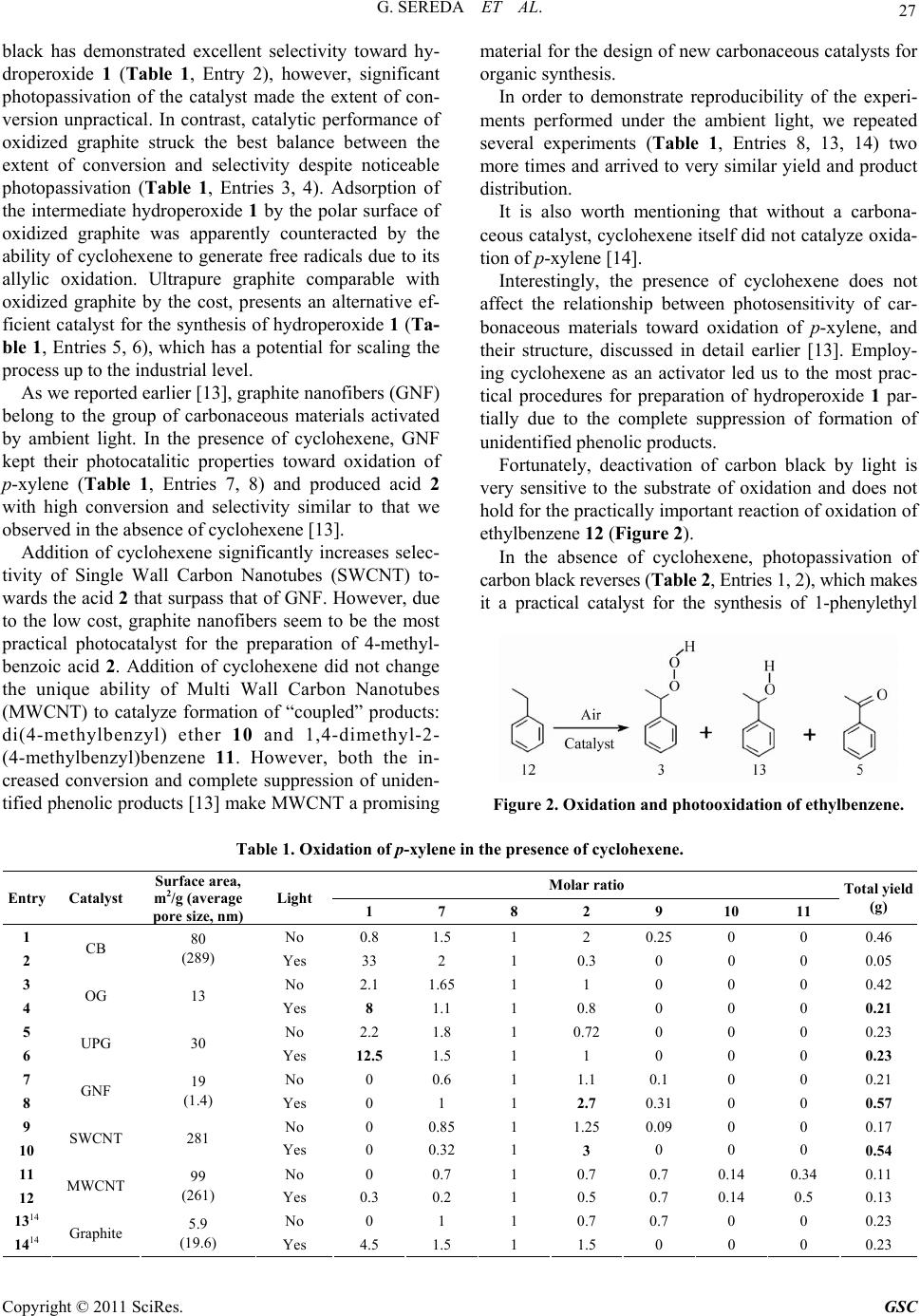 G. SEREDA ET AL. 27 black has demonstrated excellent selectivity toward hy- droperoxide 1 (Table 1, Entry 2), however, significant photopassivation of the catalyst made the extent of con- version unpractical. In contrast, catalytic performance of oxidized graphite struck the best balance between the extent of conversion and selectivity despite noticeable photopassivation (Table 1, Entries 3, 4). Adsorption of the intermediate hydroperoxide 1 by the polar surface of oxidized graphite was apparently counteracted by the ability of cyclohexene to generate free radicals due to its allylic oxidation. Ultrapure graphite comparable with oxidized graphite by the cost, presents an alternative ef- ficient catalyst for the synthesis of hydroperoxide 1 (Ta- ble 1, Entries 5, 6), which has a potential for scaling the process up to the industrial level. As we reported earlier [13], graphite nanofibers (GNF) belong to the group of carbonaceous materials activated by ambient light. In the presence of cyclohexene, GNF kept their photocatalitic properties toward oxidation of p-xylene (Table 1, Entries 7, 8) and produced acid 2 with high conversion and selectivity similar to that we observed in the absence of cyclohexene [13]. Addition of cyclohexene significantly increases selec- tivity of Single Wall Carbon Nanotubes (SWCNT) to- wards the acid 2 that surpass that of GNF. However, due to the low cost, graphite nanofibers seem to be the most practical photocatalyst for the preparation of 4-methyl- benzoic acid 2. Addition of cyclohexene did not change the unique ability of Multi Wall Carbon Nanotubes (MWCNT) to catalyze formation of “coupled” products: di(4-methylbenzyl) ether 10 and 1,4-dimethyl-2- (4-methylbenzyl)benzene 11. However, both the in- creased conversion and complete suppression of uniden- tified phenolic products [13] make MWCNT a promising material for the design of new carbonaceous catalysts for organic synthesis. In order to demonstrate reproducibility of the experi- ments performed under the ambient light, we repeated several experiments (Table 1, Entries 8, 13, 14) two more times and arrived to very similar yield and product distribution. It is also worth mentioning that without a carbona- ceous catalyst, cyclohexene itself did not catalyze oxida- tion of p-xylene [14]. Interestingly, the presence of cyclohexene does not affect the relationship between photosensitivity of car- bonaceous materials toward oxidation of p-xylene, and their structure, discussed in detail earlier [13]. Employ- ing cyclohexene as an activator led us to the most prac- tical procedures for preparation of hydroperoxide 1 par- tially due to the complete suppression of formation of unidentified phenolic products. Fortunately, deactivation of carbon black by light is very sensitive to the substrate of oxidation and does not hold for the practically important reaction of oxidation of ethylbenzene 12 (Figure 2). In the absence of cyclohexene, photopassivation of carbon black reverses (Table 2, Entries 1, 2), which makes it a practical catalyst for the synthesis of 1-phenylethyl Figure 2. Oxidation and photooxidation of ethylbenzene. Table 1. Oxidation of p-xylene in the presence of cyclohexene. Molar ratio Entry Catalyst Surface area, m2/g (average pore size, nm)Light 1 7 8 2 9 10 11 Total yield (g) 1 No 0.8 1.5 1 2 0.25 0 0 0.46 2 CB 80 (289) Yes 33 2 1 0.3 0 0 0 0.05 3 No 2.1 1.65 1 1 0 0 0 0.42 4 OG 13 Yes 8 1.1 1 0.8 0 0 0 0.21 5 No 2.2 1.8 1 0.72 0 0 0 0.23 6 UPG 30 Yes 12.5 1.5 1 1 0 0 0 0.23 7 No 0 0.6 1 1.1 0.1 0 0 0.21 8 GNF 19 (1.4) Yes 0 1 1 2.7 0.31 0 0 0.57 9 No 0 0.85 1 1.25 0.09 0 0 0.17 10 SWCNT 281 Yes 0 0.32 1 3 0 0 0 0.54 11 No 0 0.7 1 0.7 0.7 0.14 0.34 0.11 12 MWCNT 99 (261) Yes 0.3 0.2 1 0.5 0.7 0.14 0.5 0.13 1314 No 0 1 1 0.7 0.7 0 0 0.23 1414 Graphite 5.9 (19.6) Yes 4.5 1.5 1 1.5 0 0 0 0.23 Copyright © 2011 SciRes. GSC 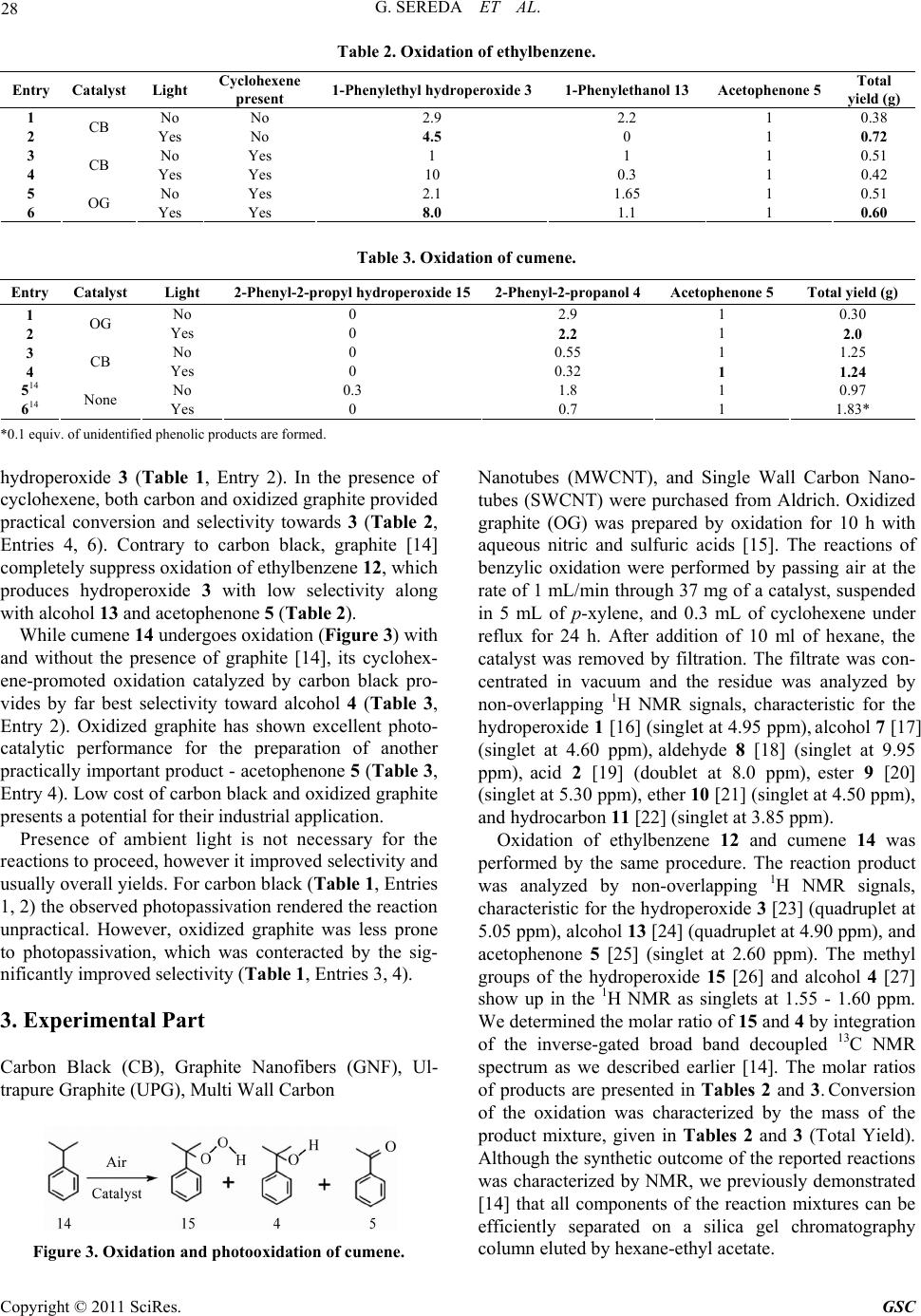 28 G. SEREDA ET AL. Table 2. Oxidation of ethylbenzene. Entry Catalyst Light Cyclohexene present 1-Phenylethyl hydroperoxide 3 1-Phenylethanol 13 Acetophenone 5 Total yield (g) 1 No No 2.9 2.2 1 0.38 2 CB Yes No 4.5 0 1 0.72 3 No Yes 1 1 1 0.51 4 CB Yes Yes 10 0.3 1 0.42 5 No Yes 2.1 1.65 1 0.51 6 OG Yes Yes 8.0 1.1 1 0.60 Table 3. Oxidation of cumene. Entry Catalyst Light 2-Phenyl-2-propyl hydroperoxide 152-Phenyl-2-propanol 4Acetophenone 5 Total yield (g) 1 No 0 2.9 1 0.30 2 OG Yes 0 2.2 1 2.0 3 No 0 0.55 1 1.25 4 CB Yes 0 0.32 1 1.24 514 No 0.3 1.8 1 0.97 614 None Yes 0 0.7 1 1.83* *0.1 equiv. of unidentified phenolic products are formed. hydroperoxide 3 (Table 1, Entry 2). In the presence of cyclohexene, both carbon and oxidized graphite provided practical conversion and selectivity towards 3 (Table 2, Entries 4, 6). Contrary to carbon black, graphite [14] completely suppress oxidation of ethylbenzene 12, which produces hydroperoxide 3 with low selectivity along with alcohol 13 and acetophenone 5 (Table 2). While cumene 14 undergoes oxidation (Figure 3) with and without the presence of graphite [14], its cyclohex- ene-promoted oxidation catalyzed by carbon black pro- vides by far best selectivity toward alcohol 4 (Table 3, Entry 2). Oxidized graphite has shown excellent photo- catalytic performance for the preparation of another practically important product - acetophenone 5 (Table 3, Entry 4). Low cost of carbon black and oxidized graphite presents a potential for their industrial application. Presence of ambient light is not necessary for the reactions to proceed, however it improved selectivity and usually overall yields. For carbon black (Table 1 , Entries 1, 2) the observed photopassivation rendered the reaction unpractical. However, oxidized graphite was less prone to photopassivation, which was conteracted by the sig- nificantly improved selectivity (Table 1, Entries 3, 4). 3. Experimental Part Carbon Black (CB), Graphite Nanofibers (GNF), Ul- trapure Graphite (UPG), Multi Wall Carbon Figure 3. Oxidation and photooxidation of cumene. Nanotubes (MWCNT), and Single Wall Carbon Nano- tubes (SWCNT) were purchased from Aldrich. Oxidized graphite (OG) was prepared by oxidation for 10 h with aqueous nitric and sulfuric acids [15]. The reactions of benzylic oxidation were performed by passing air at the rate of 1 mL/min through 37 mg of a catalyst, suspended in 5 mL of p-xylene, and 0.3 mL of cyclohexene under reflux for 24 h. After addition of 10 ml of hexane, the catalyst was removed by filtration. The filtrate was con- centrated in vacuum and the residue was analyzed by non-overlapping 1H NMR signals, characteristic for the hydroperoxide 1 [16] (singlet at 4.95 ppm), alcohol 7 [17] (singlet at 4.60 ppm), aldehyde 8 [18] (singlet at 9.95 ppm), acid 2 [19] (doublet at 8.0 ppm), ester 9 [20] (singlet at 5.30 ppm), ether 10 [21] (singlet at 4.50 ppm), and hydrocarbon 11 [22] (singlet at 3.85 ppm). Oxidation of ethylbenzene 12 and cumene 14 was performed by the same procedure. The reaction product was analyzed by non-overlapping 1H NMR signals, characteristic for the hydroperoxide 3 [23] (quadruplet at 5.05 ppm), alcohol 13 [24] (quadruplet at 4.90 ppm), and acetophenone 5 [25] (singlet at 2.60 ppm). The methyl groups of the hydroperoxide 15 [26] and alcohol 4 [27] show up in the 1H NMR as singlets at 1.55 - 1.60 ppm. We determined the molar ratio of 15 and 4 by integration of the inverse-gated broad band decoupled 13C NMR spectrum as we described earlier [14]. The molar ratios of products are presented in Tables 2 and 3. Conversion of the oxidation was characterized by the mass of the product mixture, given in Tables 2 and 3 (Total Yield). Although the synthetic outcome of the reported reactions was characterized by NMR, we previously demonstrated [14] that all components of the reaction mixtures can be efficiently separated on a silica gel chromatography column eluted by hexane-ethyl acetate. Copyright © 2011 SciRes. GSC  G. SEREDA ET AL. 29 Surface analysis of the catalysts was performed by the nitrogen adsorption/desorption measurements. The sam- ples were outgassed for 1 h at 100˚C and analyzed at 77 K using a Quantachrome Nova 2200e gas adsorption ana- lyzer. 4. Conclusions In conclusion, we introduced carbon black, ultrapure graphite, and graphite nanofibers as selective, ambient light-activated catalysts for selective oxidation of p-xylene, ethylbenzene, and cumene by air. While the presence of ambient light is not necessary, it significantly improves the practical outcome in terms of selectivity and usually overall yield. Utilization of cyclohexene as a promoter has allowed us to circumvent previously re- ported photopassivation of carbon black and oxidized graphite. Depending on the catalyst and conditions, this environmentally friendly reaction yields either of the following industrially important products: 4-methlbenzyl hydroperoxide 1, 4-methylbenzoic acid 2, 1-phenylethyl hydroperoxide 3, 2-phenyl-2-propanol 4, acetophenone 5 with high selectivity and practical extents of conversion without any use of toxic metal co-catalysts. Improved performance of oxidized graphite has demonstrated the potential of surface modification for the design of novel carbonaceous catalysts. Furthermore, addition of cyclo- hexene significantly improves the unique catalytic per- formance of carbon nanotubes towards oxidation and oxidative coupling that makes them perspective materials for additional research. 5. Acknowledgements This work has been supported by the Director, Office of Science, Office of Biological & Environmental Research, Biological Systems Science Division, of the U.S. De- partment of Energy under Contract No. DE-FG02- 08ER64624, and NSF (EPSCoR Grants No. 0554609, 0903804). We also thank the group of Prof. Ranjit Koodali (USD) for assistance in performing surface analyses. 6. References [1] L. Zidek, M. Machala and L. Skursky, “Interactions of Organic Hydroperoxides with Heme Proteins,” Drug Metabolism and Drug Interactions, Vol. 9, No. 3-4, 1991, pp. 209-224. [2] L. Skursky, A. N. Khan, M. N. Saleem and Y. Y. Al-Tamer, “A New Potent Inhibitor of Horse Liver Al- cohol Dehydrogenase: p-Methylbenzyl Hydroperoxide,” Biochemistry International, Vol. 26, No. 5, 1992, pp. 899-904. [3] C. A. McAdams, International Patent Applications, 2009, No. WO 2009137775 A2 20091112. [4] N. N. Andreev, E. V. Starovoitova and N. A. Lebedeva, “Steel Corrosion Inhibition by Benzoic Acid Salts in Cal- cium Hydroxide Solutions,” Protection of Metals, Vol. 44, No. 7, 2008, pp. 688-691. doi:10.1134/S0033173208070072 [5] T. Nagada and K. Ami, Patent of Japan, 2000, No. JP 2000219836 A 20000808. [6] N. Meki, M. Yoshii, H. Tanaka and M. Ishino, Patent of Japan, 1996, No. JP 08133995 A 19960528. [7] T. Fujita, K. Tanaka and T. Takaoka, International Patent Applications, 2004, No. WO 2004010169 A1 20040129. [8] S. V. Kostjuk, A. Yu. Dubovik, I. V. Vasilenko, A. N. Frolov and F. N. Kaputsky, “Kinetic and Mechanistic Study of the Quasiliving Cationic Polymerization of Sty- rene with the 2-Phenyl-2-Propanol/AlCl3·OBu2 Initiating System,” European Polymer Journal, Vol. 43, No. 3, 2007, pp. 968-979. doi:10.1016/j.eurpolymj.2006.12.011 [9] U. Huchel, A. Bauer and S. Sauf, International Patent Applications, 2010, No. WO 2010142481 A1 20101216. [10] K. Ito, et al., German Patent, 1969, No. DE 1912869 A 19690918. [11] L. Won-Ho, L. Dong-Il, C. Jong-Hyun and Y. Hyun-Kyung, US Patent Application, 2010, No. 20060094909. [12] M. G. White and A. V. Iretski, US Patent, No. 62813822001. [13] G. A. Sereda and V. Rajpara, “Photoactivated and Photopassivated Benzylic Oxidation Catalyzed by Pristine and Oxidized Carbons,” Catalysis Communications, Vol. 12, No. 7, 2011, pp. 669-672. doi:10.1016/j.catcom.2010.12.027 [14] G. A. Sereda and V. Rajpara, “Benzylic Oxidation and Photooxidation by Air in the Presence of Graphite and Cyclohexene,” Tetrahedron Letters, Vol. 48, No. 19, 2007, pp. 3417-3421. doi:10.1016/j.tetlet.2007.03.072 [15] B. W. Ahn, Y. S. Chi and T. J. Kang, “Preparation and Characterization of Multi-walled Carbon Nanotube/poly- (ethylene Terephthalate) Nanoweb,” Journal of Applied Polymer Science, Vol. 110, No. 6, 2008, pp. 4055-4063. doi:10.1002/app.28968 [16] E. J. Lorand and E. I. Edwards, “p-Methylbenzyl Hydroperoxide,” Journal of the American Chemical Society, Vol. 77, No. 15, 1955, pp. 4035-4037. doi:10.1021/ja01620a022 [17] C. J. Pouchert and J. Behnke, “The Aldrich Library of 13C and 1H FTNMR Spectra,” 1st Edition, John Wiley & Sons Ltd., Chichester, 1993. [18] C. J. Pouchert and J. Behnke, “The Aldrich Library of 13C and 1H FTNMR Spectra,” 1st Edition, John Wiley & Sons Ltd., Chichester, 1993. [19] C. J. Pouchert and J. Behnke, “The Aldrich Library of 13C and 1H FTNMR Spectra,” 1st Edition, John Wiley & Copyright © 2011 SciRes. GSC  G. SEREDA ET AL. Copyright © 2011 SciRes. GSC 30 Sons Ltd., Chichester, 1993. [20] M. R. Burgstein, H. Berberich and P. W. Roesky, “Homoleptic Lanthanide Amides as Homogeneous Catalysts for Alkyne Hydroamination and the Tishchenko Reaction,” Chemistry - A European Journal, Vol. 7, No. 14, 2001, pp. 3078-3085. doi:10.1002/1521-3765(20010716)7:14<3078::AID-CHE M3078>3.0.CO;2-E [21] Z. Zhu and J. H. Espenson, “Organic Reactions Catalyzed by Methylrhenium Trioxide: Dehydration, Amination, and Disproportionation of Alcohols,” Journal of Organic Chemistry, Vol. 61, No. 1, 1996, pp. 324-328. doi:10.1021/jo951613a [22] Y. Nishimoto, S. A. Babu, M. Yasuda and A. Baba, “Es- ters as Acylating Reagent in a Friedel-Crafts Reaction: Indium Tribromide Catalyzed Acylation of Arenes Using Dimethylchlorosilane,” Journal of Organic Chemistry, Vol. 73, No. 23, 2008, pp. 9465-9468. doi:10.1021/jo801914x [23] B. G. Dixon and G. B. Schuster, “Chemiluminescence of Secondary Peroxy Esters,” Journal of American Chemical Society, Vol. 103, No. 11, 1981, pp. 3068-3077. doi:10.1021/ja00401a026 [24] R. L. Letsinger and D. F. Pollart, “α- versus β-Elimination in the Cleavage of Ethers by Organoalkali Metal Compounds,” Journal of American Chemical Soci- ety, Vol. 78, No. 23, 1956, pp. 6079-6085. doi:10.1021/ja01604a036 [25] C. J. Pouchert and J. Behnke, “The Aldrich Library of 13C and 1H FTNMR Spectra,” 1st Edition, John Wiley & Sons Ltd., Chichester, 1993. [26] C. J. Pouchert and J. Behnke, “The Aldrich Library of 13C and 1H FTNMR Spectra,” 1st Edition, John Wiley & Sons Ltd., Chichester, 1993. [27] C. J. Pouchert and J. Behnke, “The Aldrich Library of 13C and 1H FTNMR Spectra,” 1st Edition, John Wiley & Sons Ltd., Chichester, 1993. |