

Paper Menu >>
Journal Menu >>
 Vol.3, No.3, 255-258 (2011) Natural Science http://dx.doi.org/10.4236/ns.2011.33032 Copyright © 2011 SciRes. OPEN ACCESS Happiness and heart rate response: a case of fan services at japanese professional baseball games Kohzoh Yoshino*, Sayaka Matsumoto, Eiichi Someya, Muneo Kitajima Center for Service Research, National Institute of Advanced Industrial Science and Technology (AIST), Midorigaoka, Ikeda, Osaka, Japan; *Corresponding Author: [email protected] Received 19 November 2010; revised 22 December 2010; accepted 25 December 2010. ABSTRACT The aim of this study was to develop a method for predicting the psychological states of spec- tators watching professional baseball games at a stadium. This method includes a real time measurement of instantaneous heart rate (i.e., the inverse of the RR interval) without prevent- ing the subject from watching the game and a mathematical procedure used to predict mo- ment by moment psychological states by cor- relating the degree of a psychological state with the strength of heart rate response, defined as the mean deviation of heart rate variability from a linear regression line from 5 sec before to 25 sec after an event during a baseball game. We recorded the instantaneous heart rates of 10 subjects (total of 27 cases) while they watched Japanese professional baseball games at a sta- dium and had them subjectively rate the degree of their psychological states in an after-event interview. We identified three psychological states (happiness, excitement, and vigor) whose strength can be predicted from the strength of heart rate response. Analysis of the measured data clarified that heart rate response had a sig- nificant correlation with the subjective rating of the intensity of happiness (r = 0.56, p < 0.0001), vigor (r = 0.55, p < 0.0001), and excitement (r = 0.49, p < 0.0001). Keywords: Sports Entertainment; Physiological Signal; Heart Rate; Happiness; Excitation 1. INTRODUCTION One of the most important goals of sports entertain- ment services, such as professional baseball game ser- vices, is to enhance the happiness of spectators at the stadium. To this end, it is important to measure how the spectator psychologically responds to each event at the stadium, and to develop a method to use the data to achieve this goal. Human psychological states can be measured in two ways. One is on-site measurement, in which the spectators report their psychological states by filling out questionnaires or by verbally describing them. The other is after-event interviews in which they are asked to remember their psychological state during the event in baseball game [1,2]. Since these methods are easy to carry out, they have been used widely. However, each method has a problem. One is that the on-site measurement is likely to interfere with spectators’ watch- ing of games. The other is that the after-event measure- ment may not be reliable due to interviewees’ failure to remember or to their psychological biases [3,4]. In this paper, the use of an on-site physiological measurement that does not interfere with spectators’ watching of games and a method to relate the physiological data with spectators’ psychological states is proposed. Physiological signals such as heart rate reflect the autonomic nervous system’s activity [5]. The autonomic nervous system is strongly affected by such psychologi- cal states as excitement. Thus, it may be possible to use heart rate (physiological signals) to evaluate psycho- logical states [6-9]. The use of physiological signals has two advantages over the conventional method. The first is a relatively unobtrusive and automatic measurement of psychological states in real time without interfering with the spectators’ watching of games, and the second is a continuous measurement of their variability. To our knowledge, no study thus far has clarified the correlation between the physiological response and the psychological state of a spectator watching a profes- sional game at a stadium. We hypothesize that heart rate increases when a spectator becomes happy and excited by such events as the favored team’s scoring and ap- pealing fan service events while it decreases when a spectator becomes depressed by events such as the op- posing team’s scoring and boring fan service events. For this study, we recorded the instantaneous heart rates of 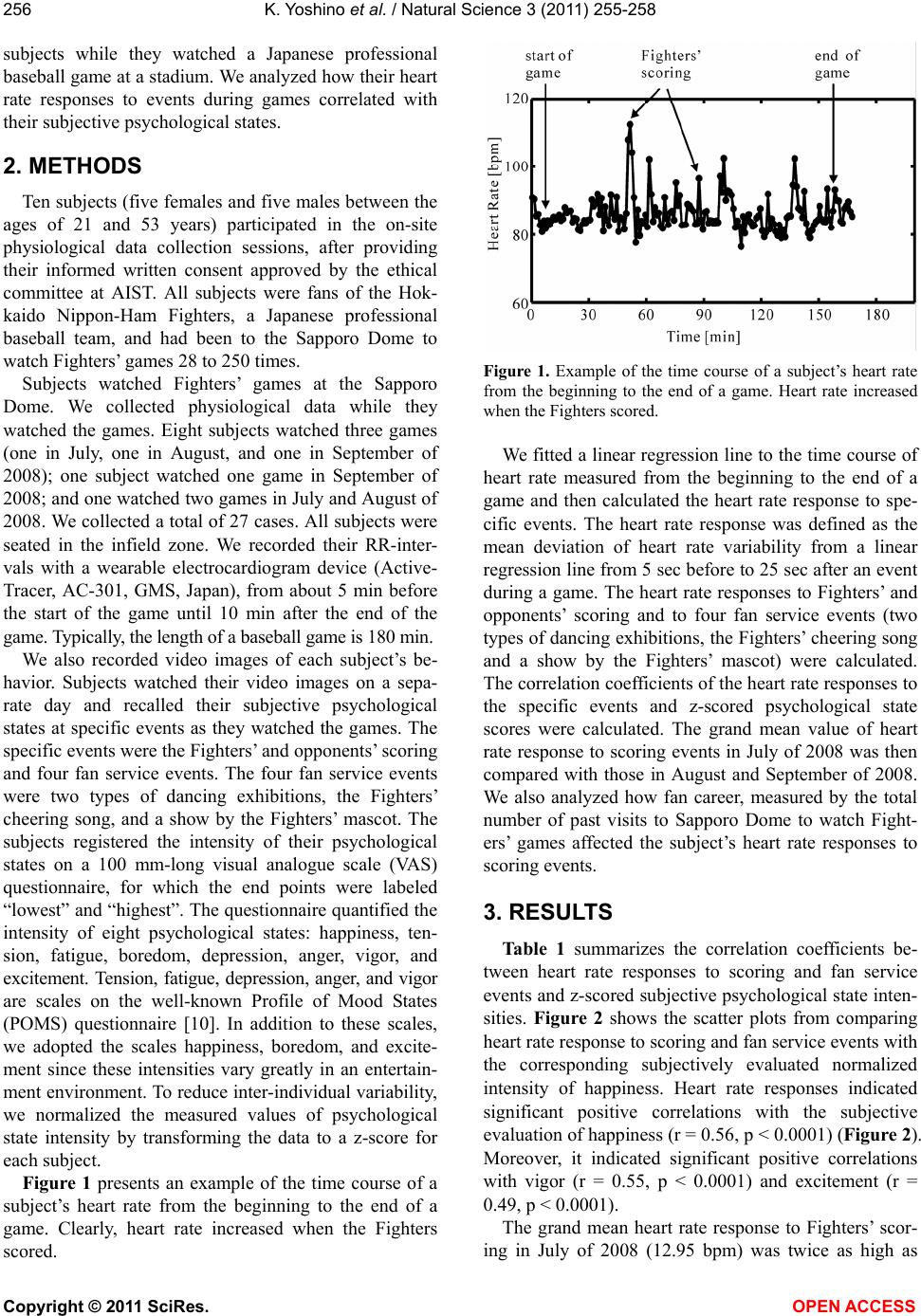 K. Yoshino et al. / Natural Science 3 (2011) 255-258 Copyright © 2011 SciRes. OPEN ACCESS 256 subjects while they watched a Japanese professional baseball game at a stadium. We analyzed how their heart rate responses to events during games correlated with their subjective psychological states. 2. METHODS Ten subjects (five females and five males between the ages of 21 and 53 years) participated in the on-site physiological data collection sessions, after providing their informed written consent approved by the ethical committee at AIST. All subjects were fans of the Hok- kaido Nippon-Ham Fighters, a Japanese professional baseball team, and had been to the Sapporo Dome to watch Fighters’ games 28 to 250 times. Subjects watched Fighters’ games at the Sapporo Dome. We collected physiological data while they watched the games. Eight subjects watched three games (one in July, one in August, and one in September of 2008); one subject watched one game in September of 2008; and one watched two games in July and August of 2008. We collected a total of 27 cases. All subjects were seated in the infield zone. We recorded their RR-inter- vals with a wearable electrocardiogram device (Active- Tracer, AC-301, GMS, Japan), from about 5 min before the start of the game until 10 min after the end of the game. Typically, the length of a baseball game is 180 min. We also recorded video images of each subject’s be- havior. Subjects watched their video images on a sepa- rate day and recalled their subjective psychological states at specific events as they watched the games. The specific events were the Fighters’ and opponents’ scoring and four fan service events. The four fan service events were two types of dancing exhibitions, the Fighters’ cheering song, and a show by the Fighters’ mascot. The subjects registered the intensity of their psychological states on a 100 mm-long visual analogue scale (VAS) questionnaire, for which the end points were labeled “lowest” and “highest”. The questionnaire quantified the intensity of eight psychological states: happiness, ten- sion, fatigue, boredom, depression, anger, vigor, and excitement. Tension, fatigue, depression, anger, and vigor are scales on the well-known Profile of Mood States (POMS) questionnaire [10]. In addition to these scales, we adopted the scales happiness, boredom, and excite- ment since these intensities vary greatly in an entertain- ment environment. To reduce inter-individual variability, we normalized the measured values of psychological state intensity by transforming the data to a z-score for each subject. Figure 1 presents an example of the time course of a subject’s heart rate from the beginning to the end of a game. Clearly, heart rate increased when the Fighters scored. Figure 1. Example of the time course of a subject’s heart rate from the beginning to the end of a game. Heart rate increased when the Fighters scored. We fitted a linear regression line to the time course of heart rate measured from the beginning to the end of a game and then calculated the heart rate response to spe- cific events. The heart rate response was defined as the mean deviation of heart rate variability from a linear regression line from 5 sec before to 25 sec after an event during a game. The heart rate responses to Fighters’ and opponents’ scoring and to four fan service events (two types of dancing exhibitions, the Fighters’ cheering song and a show by the Fighters’ mascot) were calculated. The correlation coefficients of the heart rate responses to the specific events and z-scored psychological state scores were calculated. The grand mean value of heart rate response to scoring events in July of 2008 was then compared with those in August and September of 2008. We also analyzed how fan career, measured by the total number of past visits to Sapporo Dome to watch Fight- ers’ games affected the subject’s heart rate responses to scoring events. 3. RESULTS Table 1 summarizes the correlation coefficients be- tween heart rate responses to scoring and fan service events and z-scored subjective psychological state inten- sities. Figure 2 shows the scatter plots from comparing heart rate response to scoring and fan service events with the corresponding subjectively evaluated normalized intensity of happiness. Heart rate responses indicated significant positive correlations with the subjective evaluation of happiness (r = 0.56, p < 0.0001) (Figure 2). Moreover, it indicated significant positive correlations with vigor (r = 0.55, p < 0.0001) and excitement (r = 0.49, p < 0.0001). The grand mean heart rate response to Fighters’ scor- ing in July of 2008 (12.95 bpm) was twice as high as 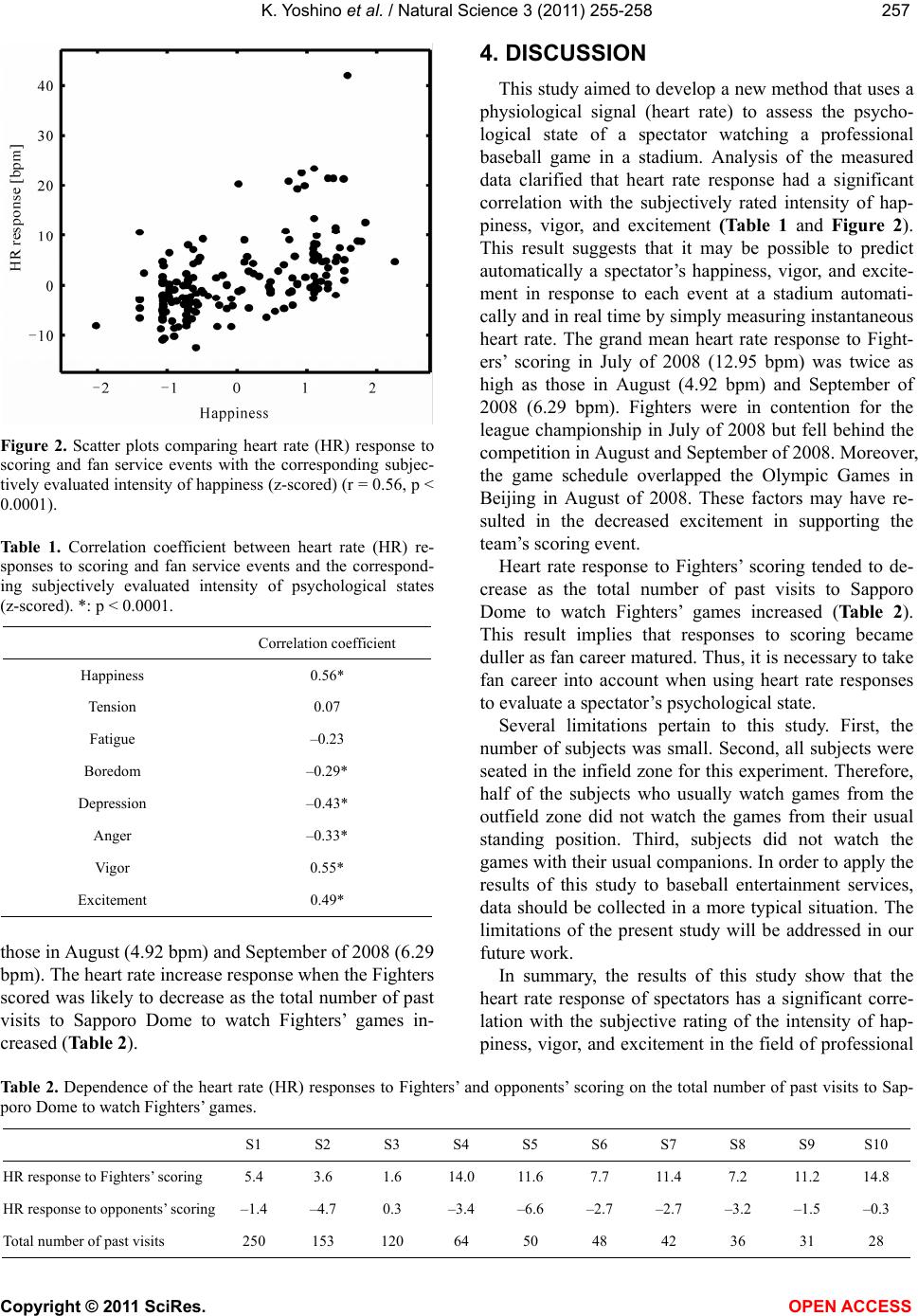 K. Yoshino et al. / Natural Science 3 (2011) 255-258 Copyright © 2011 SciRes. OPEN ACCESS 257257 Figure 2. Scatter plots comparing heart rate (HR) response to scoring and fan service events with the corresponding subjec- tively evaluated intensity of happiness (z-scored) (r = 0.56, p < 0.0001). Table 1. Correlation coefficient between heart rate (HR) re- sponses to scoring and fan service events and the correspond- ing subjectively evaluated intensity of psychological states (z-scored). *: p < 0.0001. Correlation coefficient Happiness 0.56* Tension 0.07 Fatigue –0.23 Boredom –0.29* Depression –0.43* Anger –0.33* Vigor 0.55* Excitement 0.49* those in August (4.92 bpm) and September of 2008 (6.29 bpm). The heart rate increase response when the Fighters scored was likely to decrease as the total number of past visits to Sapporo Dome to watch Fighters’ games in- creased (Table 2). 4. DISCUSSION This study aimed to develop a new method that uses a physiological signal (heart rate) to assess the psycho- logical state of a spectator watching a professional baseball game in a stadium. Analysis of the measured data clarified that heart rate response had a significant correlation with the subjectively rated intensity of hap- piness, vigor, and excitement (Table 1 and Figure 2). This result suggests that it may be possible to predict automatically a spectator’s happiness, vigor, and excite- ment in response to each event at a stadium automati- cally and in real time by simply measuring instantaneous heart rate. The grand mean heart rate response to Fight- ers’ scoring in July of 2008 (12.95 bpm) was twice as high as those in August (4.92 bpm) and September of 2008 (6.29 bpm). Fighters were in contention for the league championship in July of 2008 but fell behind the competition in August and September of 2008. Moreover, the game schedule overlapped the Olympic Games in Beijing in August of 2008. These factors may have re- sulted in the decreased excitement in supporting the team’s scoring event. Heart rate response to Fighters’ scoring tended to de- crease as the total number of past visits to Sapporo Dome to watch Fighters’ games increased (Table 2). This result implies that responses to scoring became duller as fan career matured. Thus, it is necessary to take fan career into account when using heart rate responses to evaluate a spectator’s psychological state. Several limitations pertain to this study. First, the number of subjects was small. Second, all subjects were seated in the infield zone for this experiment. Therefore, half of the subjects who usually watch games from the outfield zone did not watch the games from their usual standing position. Third, subjects did not watch the games with their usual companions. In order to apply the results of this study to baseball entertainment services, data should be collected in a more typical situation. The limitations of the present study will be addressed in our future work. In summary, the results of this study show that the heart rate response of spectators has a significant corre- lation with the subjective rating of the intensity of hap- piness, vigor, and excitement in the field of professional Table 2. Dependence of the heart rate (HR) responses to Fighters’ and opponents’ scoring on the total number of past visits to Sap- poro Dome to watch Fighters’ games. S1 S2 S3 S4 S5 S6 S7 S8 S9 S10 HR response to Fighters’ scoring 5.4 3.6 1.6 14.0 11.6 7.7 11.4 7.2 11.2 14.8 HR response to opponents’ scoring –1.4 –4.7 0.3 –3.4 –6.6 –2.7 –2.7 –3.2 –1.5 –0.3 Total number of past visits 250 153 120 64 50 48 42 36 31 28  K. Yoshino et al. / Natural Science 3 (2011) 255-258 Copyright © 2011 SciRes. OPEN ACCESS 258 baseball entertainment. 5. ACKNOWLEDGEMENTS This research was supported by the Ministry of Economy, Trade and Industry (METI). The authors express their gratitude to collaborating company Hokkaido Nippon-Ham Fighters for their helpful discussions and for providing experimental field space. We also thank Dr. M. Mo- chimaru and Dr. K. Naito of the National Institute of Advanced Indus- trial Science and Technology (AIST) for their helpful discussions. REFERENCES [1] Caro, L.M. and Garcia, J.A.M. (2007) Cognitive-affec- tive model of consumer satisfaction. An exploratory study within the framework of a sporting event. Journal of Business Research, 60, 108-114. doi:10.1016/j.jbusres.2006.10.008 [2] Leeuwen, L.V., Quick, S. and Daniel, K. (2002) The sport spectator satisfaction model: A conceptual framework for understanding the satisfaction of spectators. Sport Man- agement Review, 5, 99-128. doi:10.1016/S1441-3523(02)70063-6 [3] Bower, G. (1981) Mood and memory. American Psy- chologist, 36, 129-148. doi:10.1037/0003-066X.36.2.129 [4] DeVries, M. (1992) The experience of psychopathology. Cambridge University Press, Cambridge. doi:10.1017/CBO9780511663246 [5] Akselrod, S., Gordon, D., Ubel, F.A., Shannon, D.C., Barger, A.C. and Cohen, R.J. (1981) Power spectrum analysis of heart rate fluctuation: A quantitative probe of beat-to-beat cardiovascular control. Science, 213, 220-222. doi:10.1126/science.6166045 [6] Andreassi, J.L. (2006) Psychophysiology. Human be- havior & physiological response. 5th Edtion, Lawrence Erlbaum Associates, New Jersey. [7] Murata, J., Matsukawa, K., Shimizu, J., Matsumoto, M., Wada, T. and Ninomiya, I. (1999) Effects of mental stress on cardiac and motor rhythms. Journal of the Autonomic Nervous System, 75, 32-37. doi:10.1016/S0165-1838(98)00171-4 [8] Ohsuga, M., Shimono, F. and Genno, H. (2001) Assess- ment of phasic work stress using autonomic indices. In- ternational Journal of Psychophysiology, 40, 211-220. doi:10.1016/S0167-8760(00)00189-6 [9] Yoshino, K., Edamatsu, M., Yoshida, M. and Matsuoka, K. (2007) An algorithm for detecting startle state based on physiological signals. Accident Analysis & Prevention, 39, 308-312. doi:10.1016/j.aap.2006.08.003 [10] McNair, D.M., Lorr, M. and Droppleman, L.F. (1992) Profile of mood states. Educational and Industrial Testing Service, San Diego. |