

Paper Menu >>
Journal Menu >>
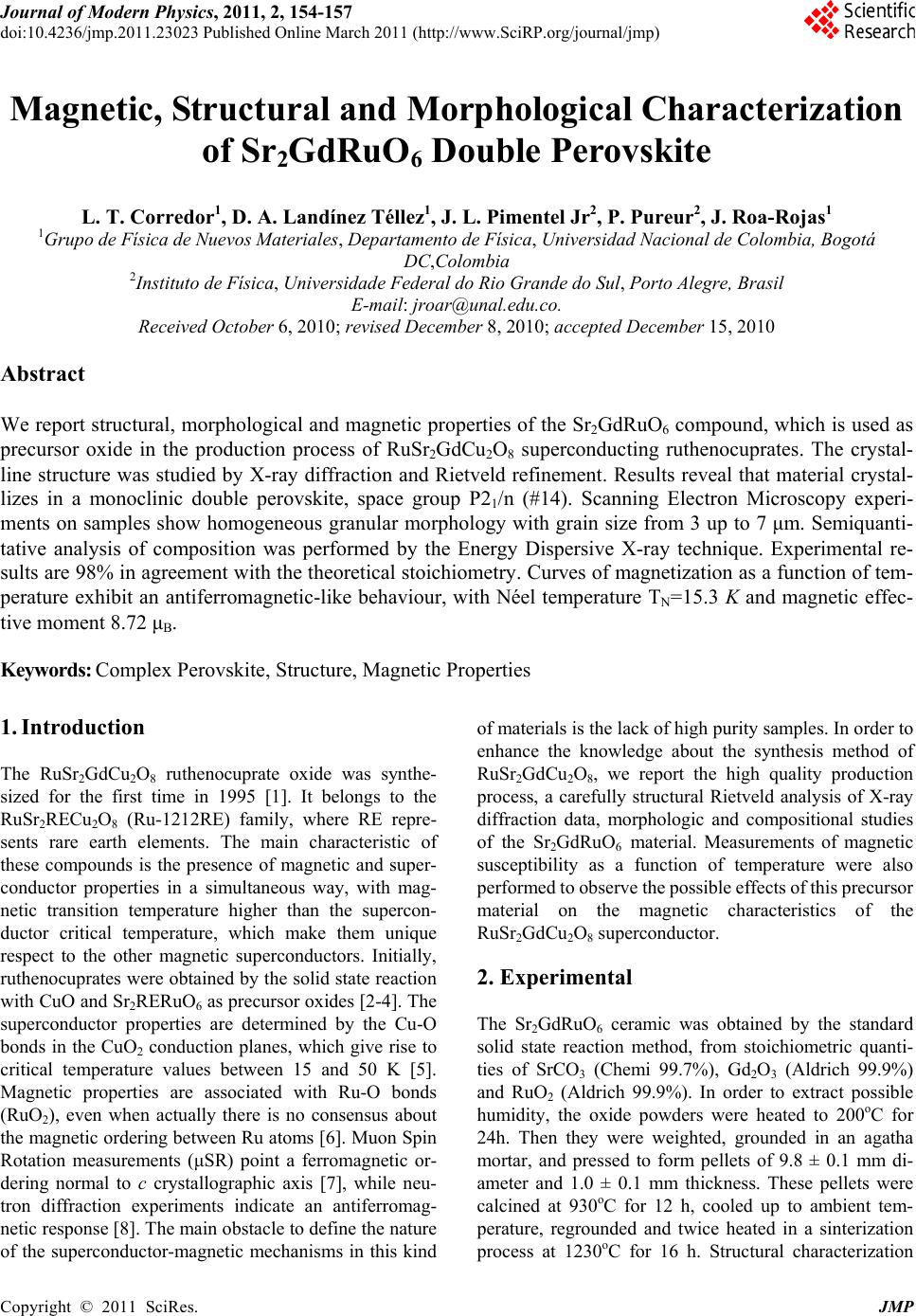 Journal of Modern Physics, 2011, 2, 154-157 doi:10.4236/jmp.2011.23023 Published Online March 2011 (http://www.SciRP.org/journal/jmp) Copyright © 2011 SciRes. JMP Magnetic, Structural and Morphological Characterization of Sr2GdRuO6 Double Perovskite L. T. Corredor1, D. A. Landínez Téllez1, J. L. Pimentel Jr2, P. Pureur2, J. Roa-Rojas1 1Grupo de Física de Nuevos Materiales, Departamento de Física, Universidad Nacional de Colombia, Bogotá DC,Colombia 2Instituto de Física, Universidade Federal do Rio Grande do Sul, Porto Alegre, Brasil E-mail: [email protected]. Received October 6, 2010; revised December 8, 2010; accepted December 15, 2010 Abstract We report structural, morphological and magnetic properties of the Sr2GdRuO6 compound, which is used as precursor oxide in the production process of RuSr2GdCu2O8 superconducting ruthenocuprates. The crystal- line structure was studied by X-ray diffraction and Rietveld refinement. Results reveal that material crystal- lizes in a monoclinic double perovskite, space group P21/n (#14). Scanning Electron Microscopy experi- ments on samples show homogeneous granular morphology with grain size from 3 up to 7 μm. Semiquanti- tative analysis of composition was performed by the Energy Dispersive X-ray technique. Experimental re- sults are 98% in agreement with the theoretical stoichiometry. Curves of magnetization as a function of tem- perature exhibit an antiferromagnetic-like behaviour, with Néel temperature TN=15.3 K and magnetic effec- tive moment 8.72 μB. Keywords: Complex Perovskite, Structure, Magnetic Properties 1. Introduction The RuSr2GdCu2O8 ruthenocuprate oxide was synthe- sized for the first time in 1995 [1]. It belongs to the RuSr2RECu2O8 (Ru-1212RE) family, where RE repre- sents rare earth elements. The main characteristic of these compounds is the presence of magnetic and super- conductor properties in a simultaneous way, with mag- netic transition temperature higher than the supercon- ductor critical temperature, which make them unique respect to the other magnetic superconductors. Initially, ruthenocuprates were obtained by the solid state reaction with CuO and Sr2RERuO6 as precursor oxides [2-4]. The superconductor properties are determined by the Cu-O bonds in the CuO2 conduction planes, which give rise to critical temperature values between 15 and 50 K [5]. Magnetic properties are associated with Ru-O bonds (RuO2), even when actually there is no consensus about the magnetic ordering between Ru atoms [6]. Muon Spin Rotation measurements (μSR) point a ferromagnetic or- dering normal to c crystallographic axis [7], while neu- tron diffraction experiments indicate an antiferromag- netic response [8]. The main obstacle to define the nature of the superconductor-magnetic mechanisms in this kind of materials is the lack of high purity samples. In order to enhance the knowledge about the synthesis method of RuSr2GdCu2O8, we report the high quality production process, a carefully structural Rietveld analysis of X-ray diffraction data, morphologic and compositional studies of the Sr2GdRuO6 material. Measurements of magnetic susceptibility as a function of temperature were also performed to observe the possible effects of this precursor material on the magnetic characteristics of the RuSr2GdCu2O8 superconductor. 2. Experimental The Sr2GdRuO6 ceramic was obtained by the standard solid state reaction method, from stoichiometric quanti- ties of SrCO3 (Chemi 99.7%), Gd2O3 (Aldrich 99.9%) and RuO2 (Aldrich 99.9%). In order to extract possible humidity, the oxide powders were heated to 200oC for 24h. Then they were weighted, grounded in an agatha mortar, and pressed to form pellets of 9.8 ± 0.1 mm di- ameter and 1.0 ± 0.1 mm thickness. These pellets were calcined at 930oC for 12 h, cooled up to ambient tem- perature, regrounded and twice heated in a sinterization process at 1230oC for 16 h. Structural characterization 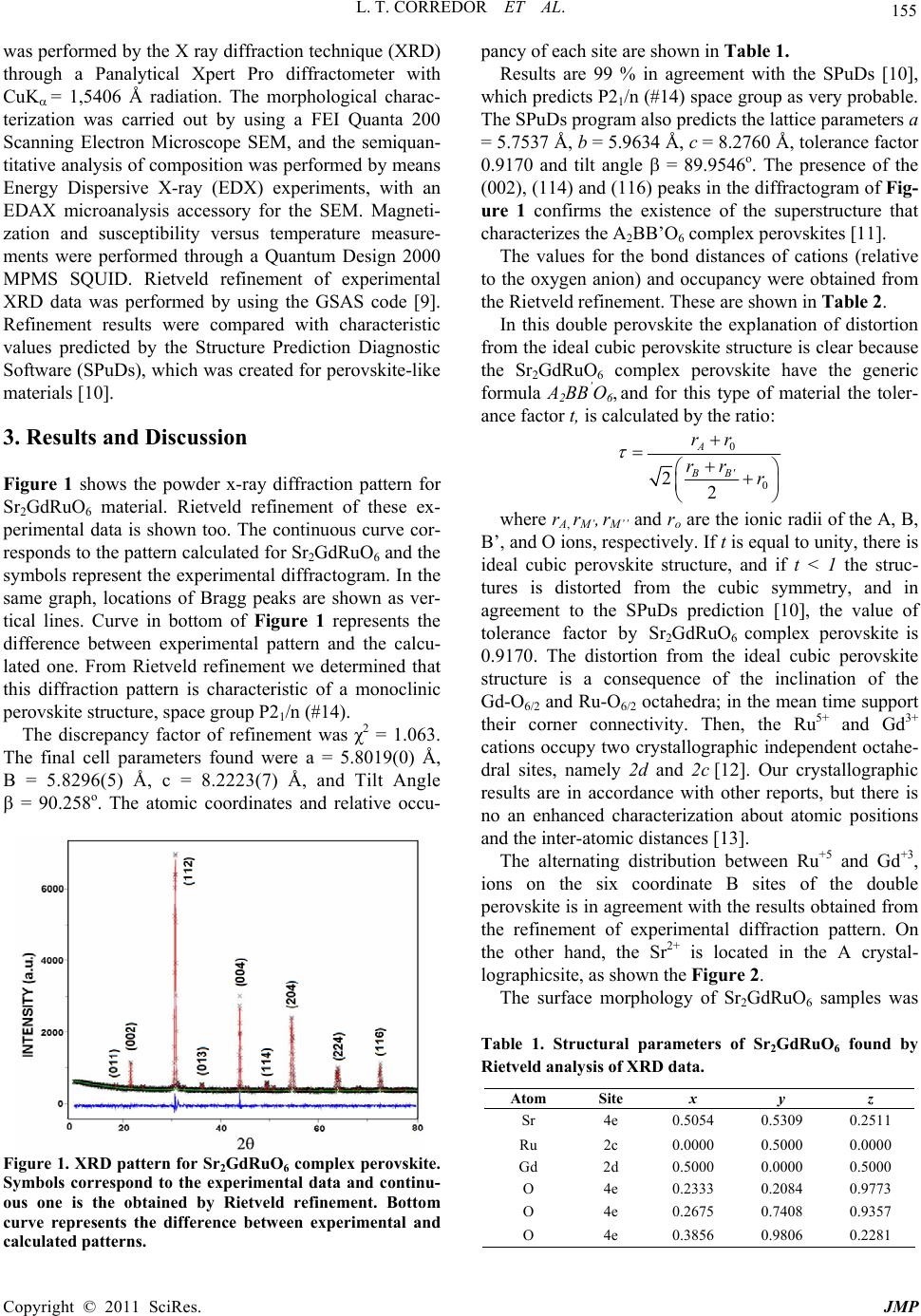 L. T. CORREDOR ET AL. 155 was performed by the X ray diffraction technique (XRD) through a Panalytical Xpert Pro diffractometer with CuK = 1,5406 Å radiation. The morphological charac- terization was carried out by using a FEI Quanta 200 Scanning Electron Microscope SEM, and the semiquan- titative analysis of composition was performed by means Energy Dispersive X-ray (EDX) experiments, with an EDAX microanalysis accessory for the SEM. Magneti- zation and susceptibility versus temperature measure- ments were performed through a Quantum Design 2000 MPMS SQUID. Rietveld refinement of experimental XRD data was performed by using the GSAS code [9]. Refinement results were compared with characteristic values predicted by the Structure Prediction Diagnostic Software (SPuDs), which was created for perovskite-like materials [10]. 3. Results and Discussion Figure 1 shows the powder x-ray diffraction pattern for Sr2GdRuO6 material. Rietveld refinement of these ex- perimental data is shown too. The continuous curve cor- responds to the pattern calculated for Sr2GdRuO6 and the symbols represent the experimental diffractogram. In the same graph, locations of Bragg peaks are shown as ver- tical lines. Curve in bottom of Figure 1 represents the difference between experimental pattern and the calcu- lated one. From Rietveld refinement we determined that this diffraction pattern is characteristic of a monoclinic perovskite structure, space group P21/n (#14). The discrepancy factor of refinement was χ2 = 1.063. The final cell parameters found were a = 5.8019(0) Å, B = 5.8296(5) Å, c = 8.2223(7) Å, and Tilt Angle = 90.258o. The atomic coordinates and relative occu- Figure 1. XRD pattern for Sr2GdRuO6 complex perovskite. Symbols correspond to the experimental data and continu- ous one is the obtained by Rietveld refinement. Bottom curve represents the difference between experimental and calculated patterns. pancy of each site are shown in Table 1. Results are 99 % in agreement with the SPuDs [10], which predicts P21/n (#14) space group as very probable. The SPuDs program also predicts the lattice parameters a = 5.7537 Å, b = 5.9634 Å, c = 8.2760 Å, tolerance factor 0.9170 and tilt angle = 89.9546o. The presence of the (002), (114) and (116) peaks in the diffractogram of Fig- ure 1 confirms the existence of the superstructure that characterizes the A2BB’O6 complex perovskites [11]. The values for the bond distances of cations (relative to the oxygen anion) and occupancy were obtained from the Rietveld refinement. These are shown in Table 2. In this double perovskite the explanation of distortion from the ideal cubic perovskite structure is clear because the Sr2GdRu O 6 complex perovskite have the generic formula A2BB’O6, and for this type of material the toler- ance factor t, is calculated by the ratio: 0 0 22 A BB' rr rr r where rA, rM’, rM’’ and ro are the ionic radii of the A, B, B’, and O ions, respectively. If t is equal to unity, there is ideal cubic perovskite structure, and if t < 1 the struc- tures is distorted from the cubic symmetry, and in agreement to the SPuDs prediction [10], the value of tolerance factor by Sr2GdRuO6 complex perovskite is 0.9170. The distortion from the ideal cubic perovskite structure is a consequence of the inclination of the Gd-O6/2 and Ru-O6/2 octahedra; in the mean time support their corner connectivity. Then, the Ru5+ and Gd3+ cations occupy two crystallographic independent octahe- dral sites, namely 2d and 2c [12]. Our crystallographic results are in accordance with other reports, but there is no an enhanced characterization about atomic positions and the inter-atomic distances [13]. The alternating distribution between Ru+5 and Gd+3, ions on the six coordinate B sites of the double perovskite is in agreement with the results obtained from the refinement of experimental diffraction pattern. On the other hand, the Sr2+ is located in the A crystal- lographicsite, as shown the Figure 2. The surface morphology of Sr2GdRuO6 samples was Table 1. Structural parameters of Sr2GdRuO6 found by Rietveld analysis of XRD data. Atom Site x y z Sr 4e 0.5054 0.5309 0.2511 Ru 2c 0.0000 0.5000 0.0000 Gd 2d 0.5000 0.0000 0.5000 O 4e 0.2333 0.2084 0.9773 O 4e 0.2675 0.7408 0.9357 O 4e 0.3856 0.9806 0.2281 Copyright © 2011 SciRes. JMP 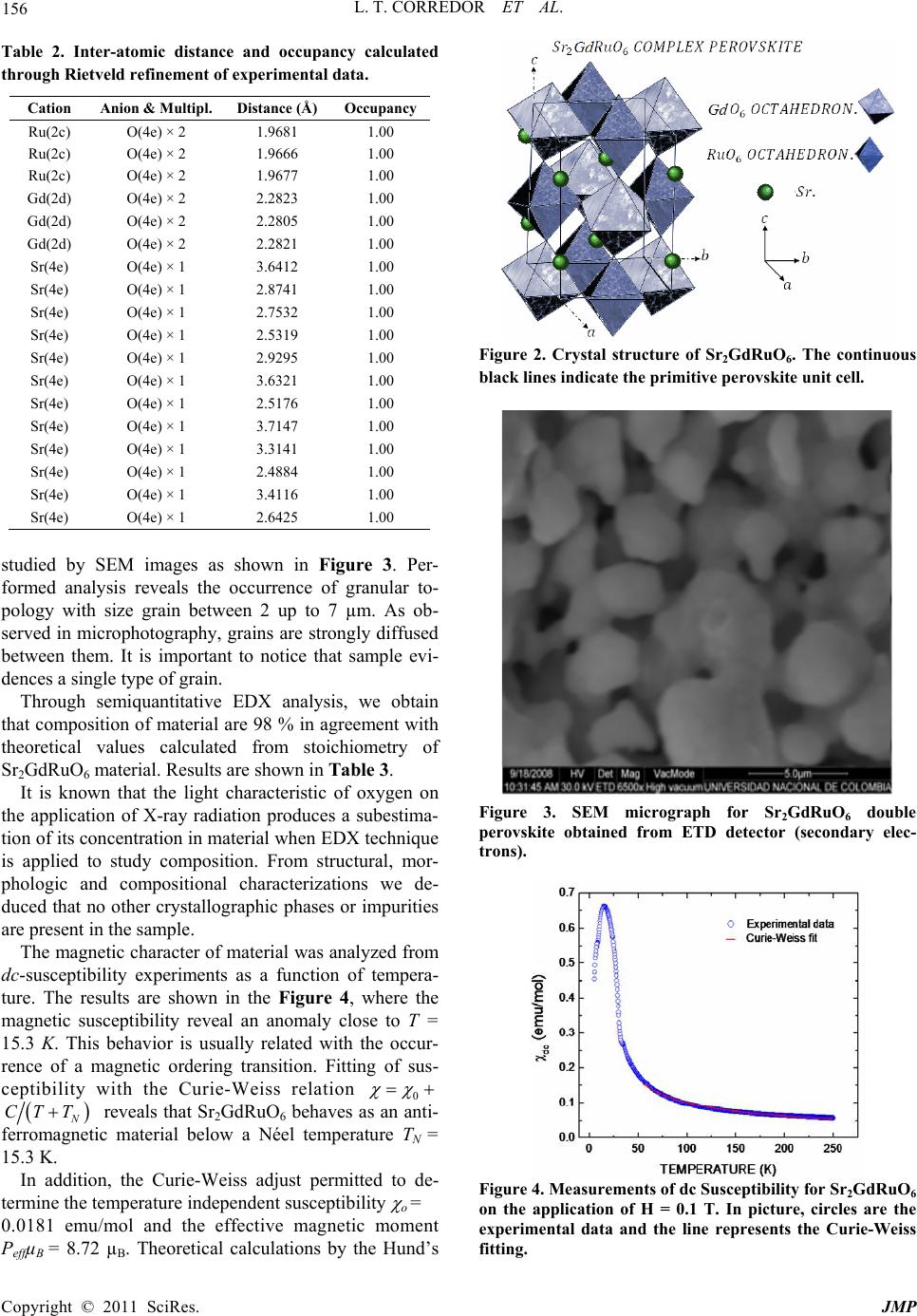 156 L. T. CORREDOR ET AL. Table 2. Inter-atomic distance and occupancy calculated through Rietveld refinement of experimental data. Cation Anion & Multipl. Distance (Å) Occupancy Ru(2c) O(4e) × 2 1.9681 1.00 Ru(2c) O(4e) × 2 1.9666 1.00 Ru(2c) O(4e) × 2 1.9677 1.00 Gd(2d) O(4e) × 2 2.2823 1.00 Gd(2d) O(4e) × 2 2.2805 1.00 Gd(2d) O(4e) × 2 2.2821 1.00 Sr(4e) O(4e) × 1 3.6412 1.00 Sr(4e) O(4e) × 1 2.8741 1.00 Sr(4e) O(4e) × 1 2.7532 1.00 Sr(4e) O(4e) × 1 2.5319 1.00 Sr(4e) O(4e) × 1 2.9295 1.00 Sr(4e) O(4e) × 1 3.6321 1.00 Sr(4e) O(4e) × 1 2.5176 1.00 Sr(4e) O(4e) × 1 3.7147 1.00 Sr(4e) O(4e) × 1 3.3141 1.00 Sr(4e) O(4e) × 1 2.4884 1.00 Sr(4e) O(4e) × 1 3.4116 1.00 Sr(4e) O(4e) × 1 2.6425 1.00 studied by SEM images as shown in Figure 3. Per- formed analysis reveals the occurrence of granular to- pology with size grain between 2 up to 7 µm. As ob- served in microphotography, grains are strongly diffused between them. It is important to notice that sample evi- dences a single type of grain. Through semiquantitative EDX analysis, we obtain that composition of material are 98 % in agreement with theoretical values calculated from stoichiometry of Sr2GdRuO6 material. Results are shown in Table 3. It is known that the light characteristic of oxygen on the application of X-ray radiation produces a subestima- tion of its concentration in material when EDX technique is applied to study composition. From structural, mor- phologic and compositional characterizations we de- duced that no other crystallographic phases or impurities are present in the sample. The magnetic character of material was analyzed from dc-susceptibility experiments as a function of tempera- ture. The results are shown in the Figure 4, where the magnetic susceptibility reveal an anomaly close to T = 15.3 K. This behavior is usually related with the occur- rence of a magnetic ordering transition. Fitting of sus- ceptibility with the Curie-Weiss relation 0 N CTT reveals that Sr2GdRuO6 behaves as an anti- ferromagnetic material below a Néel temperature TN = 15.3 K. In addition, the Curie-Weiss adjust permitted to de- termine the temperature independent susceptibility o = 0.0181 emu/mol and the effective magnetic moment PeffµB = 8.72 µB. Theoretical calculations by the Hund’s Figure 2. Crystal structure of Sr2GdRuO6. The continuous black lines indicate the primitive perovskite unit c ell. Figure 3. SEM micrograph for Sr2GdRuO6 double perovskite obtained from ETD detector (secondary elec- trons). Figure 4. Measurements of dc Susceptibility for Sr2GdRuO6 on the application of H = 0.1 T. In picture, circles are the experimental data and the line represents the Curie-Weiss fitting. Copyright © 2011 SciRes. JMP 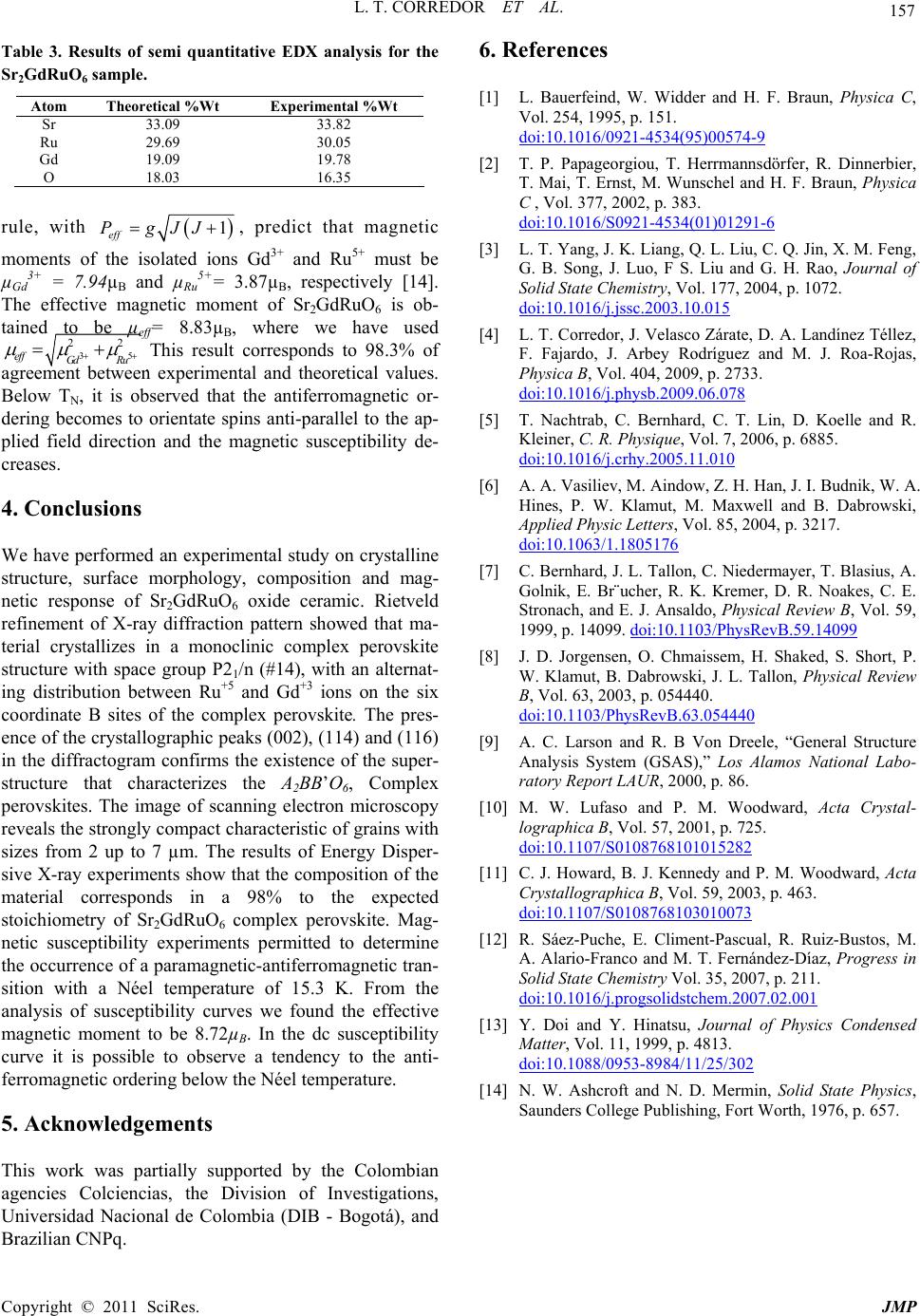 L. T. CORREDOR ET AL. Copyright © 2011 SciRes. JMP 157 6. References Table 3. Results of semi quantitative EDX analysis for the Sr2GdRuO6 sample. [1] L. Bauerfeind, W. Widder and H. F. Braun, Physica C, Vol. 254, 1995, p. 151. doi:10.1016/0921-4534(95)00574-9 Atom Theoretical %Wt Experimental %Wt Sr 33.09 33.82 Ru 29.69 30.05 Gd 19.09 19.78 O 18.03 16.35 [2] T. P. Papageorgiou, T. Herrmannsdörfer, R. Dinnerbier, T. Mai, T. Ernst, M. Wunschel and H. F. Braun, Physica C , Vol. 377, 2002, p. 383. doi:10.1016/S0921-4534(01)01291-6 rule, with 1 eff PgJJ , predict that magnetic [3] L. T. Yang, J. K. Liang, Q. L. Liu, C. Q. Jin, X. M. Feng, G. B. Song, J. Luo, F S. Liu and G. H. Rao, Journal of Solid State Chemistry, Vol. 177, 2004, p. 1072. doi:10.1016/j.jssc.2003.10.015 moments of the isolated ions Gd3+ and Ru5+ must be µGd3+ = 7.94µB and µRu5+= 3.87µB, respectively [14]. The effective magnetic moment of Sr2GdRuO6 is ob- tained to be µeff= 8.83µB, where we have used 35 ef fGd Ru .This result corresponds to 98.3% of agreement between experimental and theoretical values. Below TN, it is observed that the antiferromagnetic or- dering becomes to orientate spins anti-parallel to the ap- plied field direction and the magnetic susceptibility de- creases. [4] L. T. Corredor, J. Velasco Zárate, D. A. Landínez Téllez, F. Fajardo, J. Arbey Rodríguez and M. J. Roa-Rojas, Physica B, Vol. 404, 2009, p. 2733. doi:10.1016/j.physb.2009.06.078 22 [5] T . Nachtrab, C. Bernhard, C. T. Lin, D. Koelle and R. Kleiner, C. R. Physique, Vol. 7, 2006, p. 6885. doi:10.1016/j.crhy.2005.11.010 [6] A. A. Vasiliev, M. Aindow, Z. H. Han, J. I. Budnik, W. A. Hines, P. W. Klamut, M. Maxwell and B. Dabrowski, Applied Physic Letters, Vol. 85, 2004, p. 3217. doi:10.1063/1.1805176 4. Conclusions We have performed an experimental study on crystalline structure, surface morphology, composition and mag- netic response of Sr2GdRuO6 oxide ceramic. Rietveld refinement of X-ray diffraction pattern showed that ma- terial crystallizes in a monoclinic complex perovskite structure with space group P21/n (#14), with an alternat- ing distribution between Ru+5 and Gd+3 ions on the six coordinate B sites of the complex perovskite. The pres- ence of the crystallographic peaks (002), (114) and (116) in the diffractogram confirms the existence of the super- structure that characterizes the A2BB’O6, Complex perovskites. The image of scanning electron microscopy reveals the strongly compact characteristic of grains with sizes from 2 up to 7 µm. The results of Energy Disper- sive X-ray experiments show that the composition of the material corresponds in a 98% to the expected stoichiometry of Sr2GdRuO6 complex perovskite. Mag- netic susceptibility experiments permitted to determine the occurrence of a paramagnetic-antiferromagnetic tran- sition with a Néel temperature of 15.3 K. From the analysis of susceptibility curves we found the effective magnetic moment to be 8.72µB. In the dc susceptibility curve it is possible to observe a tendency to the anti- ferromagnetic ordering below the Néel temperature. [7] C. Bernhard, J. L. Tallon, C. Niedermayer, T. Blasius, A. Golnik, E. Br¨ucher, R. K. Kremer, D. R. Noakes, C. E. Stronach, and E. J. Ansaldo, Physical Revie w B, Vol. 59, 1999, p. 14099. doi:10.1103/PhysRevB.59.14099 [8] J. D. Jorgensen, O. Chmaissem, H. Shaked, S. Short, P. W. Klamut, B. Dabrowski, J. L. Tallon, Physical Review B, Vol. 63, 2003, p. 054440. doi:10.1103/PhysRevB.63.054440 [9] A. C. Larson and R. B Von Dreele, “General Structure Analysis System (GSAS),” Los Alamos National Labo- ratory Report LAUR, 2000, p. 86. [10] M. W. Lufaso and P. M. Woodward, Acta Crystal- lographica B, Vol. 57, 2001, p. 725. doi:10.1107/S0108768101015282 [11] C. J. Howard, B. J. Kennedy and P. M. Woodward, Acta Crystallographica B, Vol. 59, 2003, p. 463. doi:10.1107/S0108768103010073 [12] R. Sáez-Puche, E. Climent-Pascual, R. Ruiz-Bustos, M. A. Alario-Franco and M. T. Fernández-Díaz, Progress in Solid State Chemistry Vol. 35, 2007, p. 211. doi:10.1016/j.progsolidstchem.2007.02.001 [13] Y. Doi and Y. Hinatsu, Journal of Physics Condensed Matter, Vol. 11, 1999, p. 4813. doi:10.1088/0953-8984/11/25/302 [14] N. W. Ashcroft and N. D. Mermin, Solid State Physics, Saunders College Publishing, Fort Worth, 1976, p. 657. 5. Acknowledgements This work was partially supported by the Colombian agencies Colciencias, the Division of Investigations, Universidad Nacional de Colombia (DIB - Bogotá), and Brazilian CNPq. |