

Paper Menu >>
Journal Menu >>
 Chinese Medicine, 2011, 2, 29-31 doi:10.4236/cm.2011.21005 Published Online March 2011 (http://www.SciRP.org/journal/cm) Copyright © 2011 SciRes . CM Polyphenol Content and Antioxidant Effects in Herb Teas Shizuo Toda Department of Health Sciences, Kansai University of Health S c ie nces, Osaka, Japan E-mail: [email protected] Received September 22, 2010; revised November 4, 2010; accepted December 22, 2010 Abstract Herb teas, Arabian jasmine, Balsam pear, Barley grass, Guava, Hardy rubber tree, Japanese persimmon, Jobs tears, Oolong tea, Puerh tea and Wolofberry have been consumed as beverages for health in Asia. Oxidative stress induces various diseases. Some of them, Arabian jasmine, Guava, Hardy rubber tree, Japanese per- simmon, Oolong tea and Puerh tea, have high total polyphenol content and antioxidant activities. Herbs and herbal polyphenols pay in controlling oxidation and prevent the damage by oxidation. These results showed that some of them, Arabian jasmine, Guava, Hardy rubber tree, Japanese persimmon, Oolong tea and Puerh tea, have high total polyphenol content and antioxidant activities. It has been demonstrated that high total polyphenol content in the herb teas provides high antioxidant activities. Keywords: Antioxidant Effect, Herb Tea, Polyphenol 1. Introduction Reactive oxygen species and free radicals induce oxida- tive stress. Oxid ative stress is related to acute lung injury, acute respiratory distress syndrome and hyperoxia, aging, cardiovascular diseases as hypertension and myocardial infarction, cancer, diabetes, eye disease as age-related macular degeneration, immune diseases as inflammation and autoimmune disease, kidney disease, liver disease, neurological diseases as Alzheimer’s disease, Hungting- ton’s disease and Parkinson’s disease, and pancreatitis [1-3]. The antioxidant pays in controlling oxidation and pre- vents the oxidation induced damage. They are, aminoa- cid (N-acetyl cysteine, L-arginine, glutathione, glycine, histi dine, ta urine a nd thiols), enzyme (catalase and supe- roxide dismutase), mineral (copper, iron, selenium, zinc), natural product (allicin, anthocyanin, biochanin A, caro- tenoids, cucumin, ellagic acid, epigallocatechin-3-O- gallate, flavo noid s, gluc osino lates, narin gin, p hyytic acid , polyphenol, querecetin), protein (alubumin, billrubin, ceruloplasmin, glutathione, lactoferrin, thioredoxin and transferrin), vitamine (nicotinamide, retinol, riboflavin, vitamin C, vitamin E), and urate [1-4]. Herbs have been consumed for food and medicinal purposes. They have a wide variety of active phyto- chemicals, including allicin, anthocyanin, biochanin A, carotenoids, coumarins, curcumins, ellagic acid, epigal- locatechin-3-O-gallate, flavonoids, lignans, phthalides, phytic acid, plant sterols, polyphenols, saponins, sulfides and terpenoids. They contain potent antioxidant com- pounds, prevent odidative stress and provide significant protection against chronic diseases [5,6]. Tea is a rich source of polyphenolic flavonoids which exhibits potent antioxidant activity in vitro and in vivo. The polyphenolic flavonoid content of tea depends upon the type and preparation method. Randomized clinical examining the effect of tea on putative intermediary biomarkers suggest a potential health benefit from tea consumption [7]. Herb teas, Arabian jasmine, Balsam pear, Barley grass, Guava, Hardy rubber tree, Japanese persimmon, Jobs tears, Oolong tea, Puerh tea and Wolofberry have been consumed beverages for health in Asia, and especially Japan. This article investigats total polyphenol content and antioxidant activities of these herb teas were investi- gated. 2. Materials and Methods 2.1. Materials The tested herbs, Arabian jasmine, Balsam pear, Barley grass, Chameleon plant, Guava, Hardy rubber tree, Jap- anese persimmon, Jobs tears, Oolong tea, Puerh tea and Wolofberry, were from Yamamoto Kampo Co. (Aichi, Japan). They were of com mercial grade. 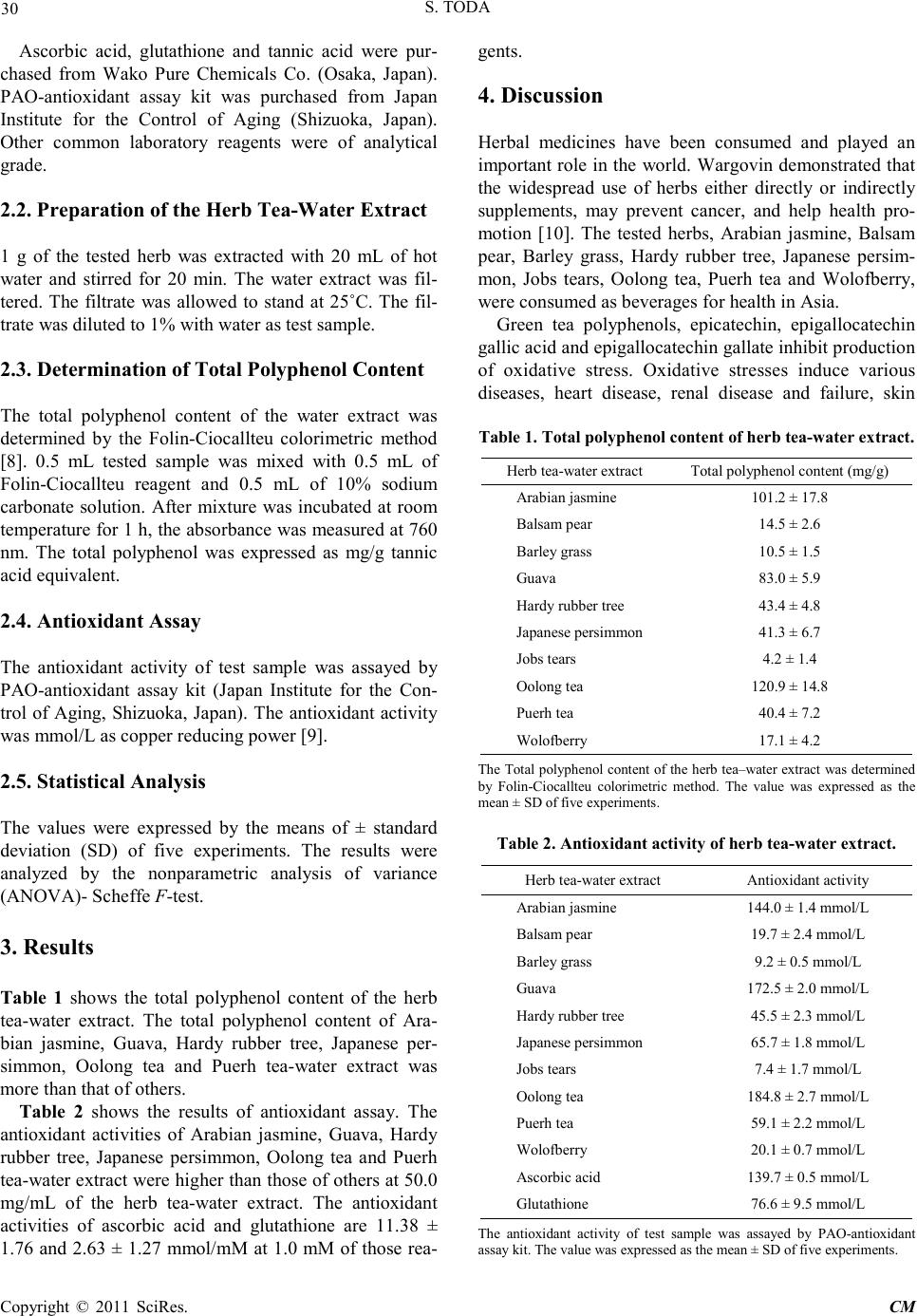 S. TODA Copyright © 2011 SciRes. CM 30 Ascorbic acid, glutathione and tannic acid were pur- chased from Wako Pure Chemicals Co. (Osaka, Japan). PAO-antioxidant assay kit was purchased from Japan Institute for the Control of Aging (Shizuoka, Japan). Other common laboratory reagents were of analytical grade. 2.2. Preparation of the Herb Tea-Water Extract 1 g of the tested herb was extracted with 20 mL of hot water and stirred for 20 min. The water extract was fil- tered. The filtrate was allowed to stand at 25˚C. The fil- trate was diluted to 1 % with water as test sa mple . 2.3. Determination of Total Polyphenol Content The total polyphenol content of the water extract was determined by the Folin-Ciocallteu colorimetric method [8]. 0.5 mL tested sample was mixed with 0.5 mL of Folin-Ciocallteu reagent and 0.5 mL of 10% sodium carbonate solution. After mixture was incubated at room temperature for 1 h, the absorbance was measured at 760 nm. The total polyphenol was expressed as mg/g tannic acid equivalent. 2.4. Antioxidant Assay The antioxidant activit y of test sample was assayed by PAO-antioxidant assay kit (Japan Institute for the Con- trol of Aging, Shizuoka, Japan). The antioxidant activit y was mmol/L as copper reducing power [9]. 2.5. Statistical Analysis The values were expressed by the means of ± standard deviation (SD) of five experiments. The results were analyzed by the nonparametric analysis of variance (ANOVA)- Scheffe F-test. 3. Resul t s Table 1 shows the total polyphenol content of the herb tea-water extract. The total polyphenol content of Ara- bian jasmine, Guava, Hardy rubber tree, Japanese per- simmon, Oolong tea and Puerh tea-water extract was more than that of othe rs. Table 2 shows the results of antioxidant assay. The antioxidant activities of Arabian jasmine, Guava, Hardy rubber tree, Japanese persimmon, Oolong tea and Puerh tea-water extract were higher than those of others at 50.0 mg/mL of the herb tea-water extract. The antioxidant activities of ascorbic acid and glutathione are 11.38 ± 1.76 and 2.63 ± 1.27 mmol/mM at 1.0 mM of those rea- gents. 4. Discussion Herbal medicines have been consumed and played an important role in the world. Wargovin demonstrated that the widespread use of herbs either directly or indirectly supplements, may prevent cancer, and help health pro- motion [10]. The tested herbs, Arabian jasmine, Balsam pear, Barley grass, Hardy rubber tree, Japanese persim- mon, Jobs tears, Oolong tea, Puerh tea and Wolofberry, were consumed as beverages for health in Asia. Green tea polyphenols, epicatechin, epigallocatechin gallic acid and ep igallocate chin gallate in hibit pr od uction of oxidative stress. Oxidative stresses induce various diseases, heart disease, renal disease and failure, skin Table 1. Total polyphenol content of herb te a-water extract. Herb tea-water extract Total polyph enol content (mg/g) Arabian jasmine 101.2 ± 17.8 Balsam pe ar 14.5 ± 2.6 Barley grass 10.5 ± 1.5 Guava 83.0 ± 5.9 Hardy rubber tree 43.4 ± 4.8 Japanes e persimmon 41.3 ± 6.7 Jobs tears 4.2 ± 1.4 Oolong tea 120.9 ± 14.8 Puerh tea 40.4 ± 7.2 Wolofberry 17.1 ± 4.2 The Total polyphe nol content of the h erb t ea–wate r extract was determined by Folin-Ciocallteu colorimetric method. The value was expressed as the mean ± SD of five experiments. Table 2. Antioxidant activity of herb tea-water extract. Herb tea-water extract Antioxidant activity Arabian jasmine 14 4. 0 ± 1.4 mmol / L Balsam pe ar 19.7 ± 2.4 mmol/L Barley grass 9.2 ± 0. 5 m m ol/L Guava 172.5 ± 2.0 mmol/L Hardy rubber tree 45.5 ± 2.3 mmol/L Japanes e persimmon 65.7 ± 1.8 mmol/L Jobs tears 7.4 ± 1.7 mmol/ L Oolong tea 184.8 ± 2. 7 mmo l/L Puerh tea 59.1 ± 2.2 mmol/L Wolofberry 20.1 ± 0.7 mmol/L Ascorbic acid 139. 7 ± 0.5 mmol /L Glutathione 76.6 ± 9.5 mmol/L The antioxidant activity of test sample was assayed by PAO-antioxidant assay kit. The value was expressed as the mean ± SD of five experiments. 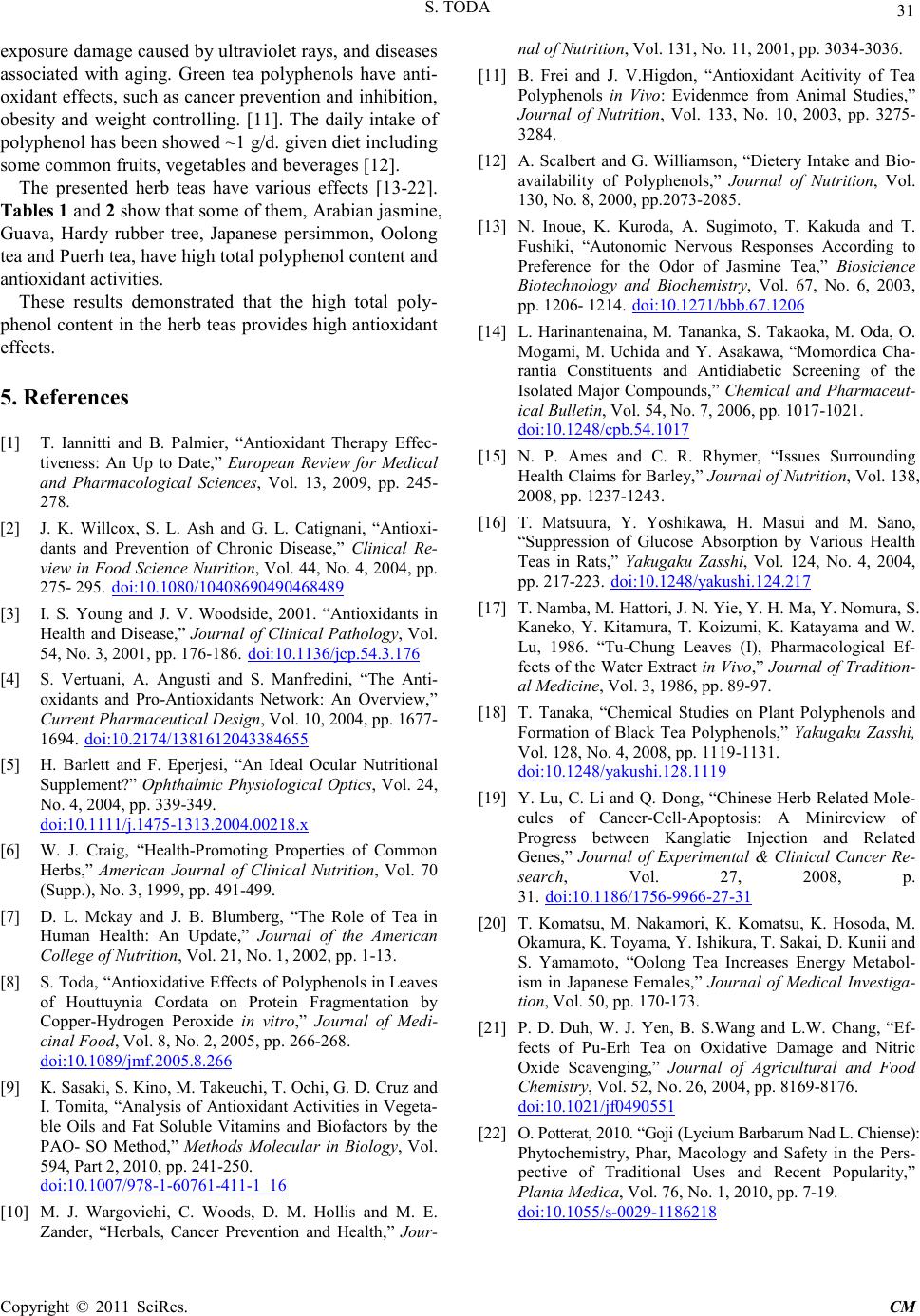 S. TODA Copyright © 2011 SciRes . CM 31 exposure damage caused by ultraviolet rays, and diseases associated with aging. Green tea polyphenols have anti- oxidant effects, suc h as cancer prevention and inhibitio n, obesity and weight controlling. [11]. The daily intake of pol ypheno l ha s be en sho wed ~1 g/d. give n diet including so me co mmon fruit s, vegetabl es and beverages [12]. The presented herb teas have various effects [13-22]. Tables 1 and 2 show that some of them, Arabian jasmine, Guava, Hardy rubber tree, Japanese persimmon, Oolong tea and Puerh tea, have high total polyphenol content and antioxidant activities. These results demonstrated that the high total poly- pheno l conte nt i n the he rb te as pr ovide s high antioxidant effects. 5. Referen ces [1] T. Iannitti and B. Palmier, “Antioxidant Therapy Effec- tiveness: An Up to Date,” Eu ropean Review for Medical and Pharmacological Sciences, Vol. 13, 2009, pp. 245- 278. [2] J. K. Willcox, S. L. Ash and G. L. Catign ani, “Antioxi- dants and Prevention of Chronic Disease,” Clinical Re- view in Foo d Science Nutrition, Vol. 44, No. 4, 2004, pp . 275- 295. doi:10.1080/10408690490468489 [3] I. S. Young and J. V. Woodside, 2001. “Antioxidants in Health and Disease,” Journal of Clinical Pathology, Vol. 54, No. 3, 2001, pp. 176-186. doi:10.1136/jcp.54.3.176 [4] S. Vertuani, A. Angusti and S. Manfredini, “The An ti- oxidants and Pro-Antioxidants Network: An Overview,” Current Pharmaceutical Design, Vol. 10, 2004, pp. 1677- 1694. doi:10.2174/1381612043384655 [5] H. Barlett and F. Eperjesi, “An Ideal Ocular Nutritional Supplement?” Ophthalmic Physiological Optics, Vol. 24, No. 4, 2004, pp. 339-349. doi:10.1111/j.1475-1313.2004.00218.x [6] W. J. Craig, “Healt h-Promoting Properties of Common Herbs,” American Journal of Clini cal Nutrition, Vol. 70 (Supp.), No. 3, 1999, pp. 491-499. [7] D. L. Mckay and J. B. Blumberg, “The Role of Tea in Human Health: An Update,” Journal of the American College of Nut rition, Vol. 21, No. 1, 2002, pp. 1-13. [8] S. Toda, “Antioxidative Effects of Polyphenols in Leaves of Houttuynia Cordata on Protein Fragmentation by Copper-Hydrogen Peroxide in vitro,” Journal of Medi- cinal Food, Vol. 8, No. 2, 2005, pp. 266-268. doi:10.1089/jmf.2005.8.266 [9] K. Sasaki, S. Kino, M. Takeuchi, T. Ochi, G. D. Cruz and I. Tomita, “Analysis of Antioxidant Activities in Vegeta- ble Oils and Fat Soluble Vitamins and Biofactors by the P AO- SO Method,” Methods Molecular in Biology, Vol. 594, Part 2, 2010, pp. 241-250. doi:10.1007/978-1-60761-411-1_16 [10] M. J. Wargovichi, C. Woods, D. M. Hollis and M. E. Zander, “Herbals, Cancer Prevention and Health,” Jour- nal of Nutrition, Vol. 131, No. 11, 2001, pp. 3034-3036. [11] B. Frei and J. V.Higdon, “Antioxidant Acitivity of Tea Polyphenols in Vivo: Evidenmce from Animal Studies,” Journal of Nutrition, Vol. 133, No. 10, 2003, pp. 3275- 3284. [12] A. Scalbert and G. Williamson, “Dietery Intake and Bio- availability of Polyphenols,” Journal of Nutrition, Vol. 130, No. 8, 2000, pp.2073-2085. [13] N. Inoue, K. Kuroda, A. Sugimoto, T. Kakuda and T. Fushiki, “Autonomic Nervous Responses According to Preference for the Odor of Jasmine Tea,” Biosicience Biotechnology and Biochemistry, Vol. 67, No. 6, 2003, pp. 1206- 1214. doi:10.1271/bbb.67.1206 [14] L. Harinantenaina, M. Tananka, S. Takao ka, M. Oda, O. Mog a mi , M. Uchida and Y. Asakawa, “Momordica Cha- rantia Constituents and Antidiabetic Screening of the Isolated Major Compounds,” Chemical and Pharmaceut- ical Bulletin, Vol. 54, No. 7, 200 6, pp. 1017-1021. doi:10.1248/cpb.54.1017 [15] N. P. Ame s and C. R. Rhymer, “Issues Surrounding Health Claims for Barley,” Journal of Nutrition, Vol. 138, 2008, pp . 1237-1243. [16] T. Matsuura, Y. Yoshikawa, H. Masui and M. Sano, “Suppression of Glucose Absorption by Various Health Teas in Rats,” Yakugaku Za sshi, Vol. 124, No. 4, 2004, pp. 217-223. doi:10.1248/yakushi.124.217 [17] T. Namb a , M. Hattori, J. N. Yie, Y. H. Ma, Y. Nomura, S. Kaneko, Y. Kitamura, T. Ko i z u mi , K. Katayama and W. Lu, 1986. “Tu-Chung Leaves (I), Pharmacological Ef- fects of the Water Extract in Vi vo ,” Journal of Tradition- al Medicine, Vol. 3, 198 6, pp. 89-97. [18] T. Tanaka, “Chemical Studies on Plant Polyphenols and Formation of Black Tea Polyphenols,” Yakugaku Zasshi, Vol. 128, No. 4, 2008, pp. 1119-1131. doi:10.1248/yakushi.128.1119 [19] Y. Lu, C. Li and Q. Dong, “Chinese Herb R elated Mole- cules of Cancer-Cell-Apoptosis: A Minireview of Progress between Kanglatie Injection and Related Genes,” Journal of Exp erimental & Clinical Cancer Re- search, Vol. 27, 2008, p. 31. doi:10.1186/1756-9966-27-31 [20] T. Ko ma t s u , M. Na kamo r i , K. Ko mat s u , K. Hosoda, M. Oka mu r a , K. Toy a ma , Y. Ishikura, T. Sakai, D. Kunii and S. Yamamo t o, “Oolong Tea Increases Energy Metabol- ism in Japanese Females,” Journal of Medical Investiga- tion, Vol. 50, pp. 170-173. [21] P. D. Duh, W. J. Yen, B. S.Wang and L.W. Chang, “Ef- fects of Pu-Erh Tea on Oxidative Damage and Nitric Oxide Scavenging,” Journal of Agricultural and Food Chemistry, Vol. 52, No. 26, 2004, pp. 8169-8176. doi:10.1021/jf0490551 [22] O. Potterat, 2010. “Goji (Lycium Barb a ru m Nad L. Chien se) : Phytochemistry, Phar, Macology and Safety in the Pers- pective of Traditional Uses and Recent Popularity,” Planta Medica, Vol. 76, No. 1, 2010, pp . 7-19. doi:10.1055/s-0029-1186218 |