

Paper Menu >>
Journal Menu >>
 Creative Education 2011. Vol. 2, No. 1, 41-46 Copyright © 2011 SciRes. DOI:10.4236/ce.2011.21006 Teachers’ Perceptions about the Use of Play to Facilitate Development and Teach Prosocial Skills Michelle Haney, Victor Bissonnette Berry College, Mount Berry, USA. Email: [email protected] Received January 5th, 2011; revised February 21st, 2011; accepted February 24th, 2011. The purpose of this study was to investigate teachers’ perceptions about the use of play to promote social, emo- tional, and cognitive skills to support planning for a school program aimed at increasing inclusive pl a y for young children. This research was inspired by Vivian Gussin Paley’s book, You Can’t Say You Can’t Play (1992). Par- ticipants included undergraduate students and graduate education students in the Teacher Education Program at a small liberal arts college, as well as practicing elementary school teachers. The results indicated that graduate students and practicing teachers had a more accurate understanding about the developmental benefits of incor- porating play into the classroom and a greater willingness to embrace the “you can’t say you can’t play” rule to promote inclusive play and acceptance. Implications for designing a preventative program for inclusive play in young children are discussed. Keywords: Children, Play, Inclusion Introduction Play is an important experience for children. Young children recognize social play as essential for connecting to their peers. Social play opportunities promote social competence in a vari- ety of ways including strengthening skills such as sharing, per- spective taking, and negotiating. Social play opportunities also enhance conflict resolution skills and enrich self concept (Frost, Wortham, & Reifel, 2001). In addition, emotional development is supported as children develop self-esteem through play by becoming more skilled with regulation of affect and learning to identify emotional states of others (Grolnick & Slowiaczek, 1994; Lindsey & Colwell, 2003; Normandeau & Guay, 1998). Through conflicts and resolutions embedded in social play, children learn to handle internal and external conflicts in an appropriate manner. Furthermore, play has the potential to strengthen empathy and sensitivity towards others through per- spective taking. As children gain experience imagining what others are thinking and feeling, they become more skilled in expressing empathy and compassion towards others (Frost, Wortham, & Reifel, 2001). Developmental theorists Piaget and Vygotsky provide frame- works for considering the cognitive implications of play for development. While Piaget describes play as practice for strengthening of skills and existing schema (i.e., assimilation), Vygotsky ascribes a more central role of play as a mechanism for building cognitive structures, such as symbolic representa- tion. Building upon these theories, there are many ways in which engaging in play facilitates the development of cognitive skills. For instance, through fantasy play children begin using symbols. Symbolic representation is the fundamental cognitive skill underlying literacy, writing, mathematics, and other com- plex skills essential for functioning in modern cultures. Through social play, particularly fantasy play, children develop theory of mind, the understanding that others experience unique thoughts (Astington & Jenkins, 1995; Watson, Linkie-Nixon, Wilson, & Capage, 1999). Contemporary researchers have ex- tended these theoretical considerations to address the role of play in literacy development (Owocki, 1999; Roskos & Neu- man, 1998), attachment to caregivers Kerns & Barth , 1995; Schiffman, 2003), social competence in a variety of settings (Connolly & Doyle, 1984), and assessment of functioning (Casby, 2003). Furthermore, when children demonstrate proso- cial inclusive behaviors, classrooms become environments conducive to overall learning (Wentzel, 1991). Although teachers seem to acknowledge the role of play in developing skills, they seem unsure of how to utilize play in an instructional manner (Saracho & Spodek, 1998). Despite a plethora of research suggesting positive outcomes associated with opportunities to engage in social play and negative out- comes associated with peer rejection, there is often a hands-off policy during recess and free-play time in school. Teachers tend to underestimate the prevalence of bullying and do not appear to recognize their potential role as preventing violence and promoting prosocial skill development (Rodkin & Hodges, 2003). When teachers do attempt to implement strategies sup- porting friendships among children in their classrooms, often indirect strategies such as providing free time for play, allowing children to choose with whom they would like to play, and making informal comment on the play between friends are used (Buysee, Goldman, & Skinner, 2003). Overall, there appears lacking a curriculum or integrated strategy to weave teaching of prosocial interactions into the entire school day. A promising approach to promoting prosocial skill develop- ment involves directly addressing skills promoting mutual ac- ceptance and respect within a natural context. An example of this approach is the “You can’t say you can’t play” rule origi- nated by veteran kindergarten teacher, Vivian Gussin Paley (1992). The “You can’t say you can’t play” strategy embraces a philosophy different from traditional intervention techniques  M. HANEY 42 which are often based on a medical model of fixing the deficit (Zakriski, Jacobs, & Coie, 1997). In the case of a lonely and withdrawn child, a deficit based intervention might identify and remediate difficulties with the child’s social skills. Thus, the responsibility for inclusion and acceptance is put on the re- jected child rather than on the social community in which the child functions. In contrast to the medical model, Paley ’s “You can’t say you can’t play” strategy reframes the problem using a social-ecological approach targeting the entire classroom com- munity. No longer does the problem belong solely to the re- jected child. Instead, the entire classroom, children and teacher, must work together to directly address the complex issues sur- rounding inclusion and tolerance. Bronfenbrenner’s (1979) ecological systems theory captures the central goals of the “You can’t say” strategy. In a review of the literature on bullying and victimization, Espelage and Swearer (2003) advocate for interventions utilizing Brofen- brenner’s theoretical framework in which individual factors are considered within multiple contexts of environmental factors that influence and are influenced by one another. However, there exist few empirically validated studies on class-wide so- cial intervention programs (Brown, Odom, & Conroy, 2001). A handful of studies exist in which Paley’s rule is imple- mented and evaluated. Sapon-Shevin (1998) explored imple- mentation of the “You can’t say you can’t play” rule in four different classrooms, including kindergarten, first, second, and fourth grade classes. Anecdotal teacher reports of the effec- tiveness and ease of implementation in their respective class- rooms were quite positive. Adopting a more quantitative ap- proach, Harrist and Bradley (2003) identified six kindergarten classes to implement the strategy over the course of the year. Pre and posttest data were collected via sociometric interviews, teacher report, and children self-report within six target and four control classrooms representing three different schools. Students in the target classrooms reported enjoying playing with each other significantly more than before the intervention (based on sociometric status), with a moderate effect size. The authors suggested that more time may be needed to implement the rule in order to detect behavioral effects on student interac- tions. Another possible limitation to this study was that the rule was implemented, not by the classroom teacher, but by a research assistant who visited the class on a weekly basis. In fact, Harrist and Bradley (2003) recommended that future re- search assess teacher’s commitment to implementing the rule (treatment fidelity). They noted that only limited anecdotal information was obtained regarding teacher attitude about the rule and their commitment to implementation. Such informa- tion would be useful to teacher training and evaluation of valid outcomes. Although not routinely incorporated into interven- tion programs, failure of teachers to commit to comprehensive implementation of intervention strategies can negatively impact treatment effectiveness (Detrich, 1999; Gable, Henrickson, & Van Acker, 2001). Paley’s (1992) and Sapon-Shevin’s (1998) qualitative find- ings and results of the more quantitative study by Harrist and Bradley (2003) describe positive outcomes associated with implementation of the rule. However, in these cases participat- ing teachers and administrators were selected because of their interest in exploring ways of promoting inclusive play and prosocial behavior in their classrooms. Optimally, implementa- tion of the “You can’t say you can’t play” rule would occur on a school or system-wide basis rather than within a patchwork of classes. There are several noteworthy benefits of a systemic approach to prevention-intervention programs. School-wide implementation of prevention and intervention strategies allow for the creation of caring communities (Battistich, Solomon, Watson, & Schaps, 1997) in which skills can be generalized and supported across settings. Reframing schools as caring communities results in numerous positive outcomes for stu- dents and teachers (Battistich et al., 1997; McNeeley, None- maker, & Blum, 2002). A system or school wide approach to implementing the “You can’t say you can’t play rule” involves recruiting all teachers regardless of their previous beliefs about play, teaching experi- ences, or attitudes about intervening in a dimension of student school experience traditionally considered outside the curricu- lum. In an effort to inform the creation of a comprehension training program that supports treatment fidelity, the current study was designed to investigate questions regarding percep- tions of teachers that may impact their effectiveness in imple- menting the “You can’t say you can’t play” rule. Specifically, the following questions were addressed: 1) To what extent do teachers believe that strategies promot- ing inclusive social play are useful in facilitating social, emo- tional, and cognitive development? 2) Is teaching experience associated with an increased aware- ness of the significance of inclusive social play opportunities in promoting development? 3) Are teachers willi n g t o i mplement the play strategy? 4) What factors are associated with a teachers’ willingness to implement the play strategy? 5) Are there trends in perceptions about play and about im- plementation the play strategy that might be beneficial for fu- ture training purposes? Method Participants One hundred seventeen (87 female and 8 male) participants were recruited from graduate and undergraduate education classes at a private liberal arts college in northwest Georgia. Thirty seven undergraduate participants were either education majors or minors in their sophomore or junior year. Thirty nine graduate students were all enrolled in the graduate education program. In addition, 16 participants were recruited from teaching faculty employed by two separate elementary schools within the same vicinity (one private and one public). Forty of the participants had at least one year of teaching experience, whereas, 55 had no teaching experience. Volunteers were treated in accordance with the “Ethical Principles of Psycholo- gists and Code of Conduct” (American Psychological Associa- tion, 2002). Materials Participants completed questionnaires in typical college classrooms. The first part of this questionnaire asked them for demographic information, including: gender, age, education level, teaching experience, and area of teaching specialization. Next, the questionnaire explained, “Pretend that there is a new 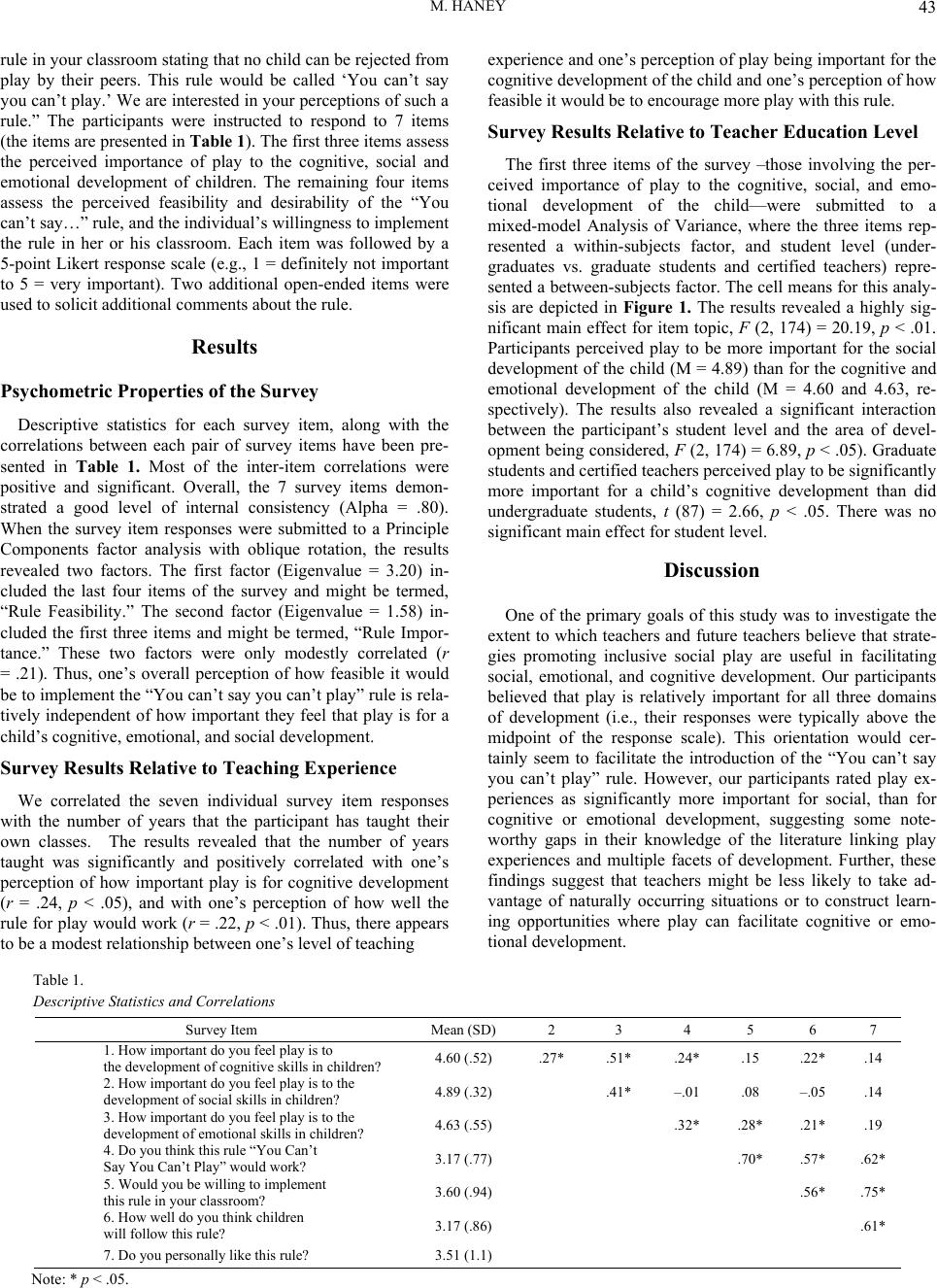 M. HANEY 43 rule in your classroom stating that no child can be rejected from play by their peers. This rule would be called ‘You can’t say you can’t play.’ We are interested in your perceptions of such a rule.” The participants were instructed to respond to 7 items (the items are presented in Table 1). The first three items assess the perceived importance of play to the cognitive, social and emotional development of children. The remaining four items assess the perceived feasibility and desirability of the “You can’t say…” rule, and the individual’s willingness to implement the rule in her or his classroom. Each item was followed by a 5-point Likert response scale (e.g., 1 = definitely not important to 5 = very important). Two additional open-ended items were used to solicit additional comments about the rule. Results Psychomet ric Proper ties of the Survey Descriptive statistics for each survey item, along with the correlations between each pair of survey items have been pre- sented in Table 1. Most of the inter-item correlations were positive and significant. Overall, the 7 survey items demon- strated a good level of internal consistency (Alpha = .80). When the survey item responses were submitted to a Principle Components factor analysis with oblique rotation, the results revealed two factors. The first factor (Eigenvalue = 3.20) in- cluded the last four items of the survey and might be termed, “Rule Feasibility.” The second factor (Eigenvalue = 1.58) in- cluded the first three items and might be termed, “Rule Impor- tance.” These two factors were only modestly correlated (r = .21). Thus, one’s overall perception of how feasible it would be to implement the “You can’t say you can’t play” rule is rela- tively independent of how important they feel that play is for a child’s cognitive, emotional, and social development. Survey Results Relative to Teaching Experience We correlated the seven individual survey item responses with the number of years that the participant has taught their own classes. The results revealed that the number of years taught was significantly and positively correlated with one’s perception of how important play is for cognitive development (r = .24, p < .05), and with one’s perception of how well the rule for play would work (r = .22, p < .01). Thus, there appears to be a modest relationship between one’s level of teaching experience and one’s perception of play being important for the cognitive development of the child and one’s perception of how feasible it would be to encourage more play with this rule. Survey Results Relative to Teacher Education Level The first three items of the survey –those involving the per- ceived importance of play to the cognitive, social, and emo- tional development of the child—were submitted to a mixed-model Analysis of Variance, where the three items rep- resented a within-subjects factor, and student level (under- graduates vs. graduate students and certified teachers) repre- sented a between-subjects factor. The cell means for this analy- sis are depicted in Figure 1. The results revealed a highly sig- nificant main effect for item topic, F (2, 174) = 20.19, p < .01. Participants perceived play to be more important for the social development of the child (M = 4.89) than for the cognitive and emotional development of the child (M = 4.60 and 4.63, re- spectively). The results also revealed a significant interaction between the participant’s student level and the area of devel- opment being considered, F (2, 174) = 6.89, p < .05). Graduate students and certified teachers perceived play to be significantly more important for a child’s cognitive development than did undergraduate students, t (87) = 2.66, p < .05. There was no significant main effect for student level. Discussion One of the primary goals of this study was to investigate the extent to which teachers and future teachers believe that strate- gies promoting inclusive social play are useful in facilitating social, emotional, and cognitive development. Our participants believed that play is relatively important for all three domains of development (i.e., their responses were typically above the midpoint of the response scale). This orientation would cer- tainly seem to facilitate the introduction of the “You can’t say you can’t play” rule. However, our participants rated play ex- periences as significantly more important for social, than for cognitive or emotional development, suggesting some note- worthy gaps in their knowledge of the literature linking play experiences and multiple facets of development. Further, these findings suggest that teachers might be less likely to take ad- vantage of naturally occurring situations or to construct learn- ing opportunities where play can facilitate cognitive or emo- tional development. Table 1. Descriptive Statistics and Correlations Survey Item Mean (SD) 2 3 4 5 6 7 1. How important do you feel play is to the developm ent of cognitive skills in children? 4.60 (.52) .27* .51* .24* .15 .22* .14 2. How important do you feel play is to the development of social skills in children? 4.89 (.32) .41* –.01 .08 –.05 .14 3. How important do you feel play is to the development of emotional skills in children? 4.63 (.55) .32* .28* .21* .19 4. Do you think this rule “You Can’t Say You Can’t Play” would work? 3.17 (.77) .70* .57* .62* 5. Would you be willing to implement this rule in your classroom? 3.60 (.94) .56* .75* 6. How well do you think children will follow th is rule? 3.17 (.86) .61* 7. Do you personally like this rule? 3.51 (1.1) Note: * p < .05. 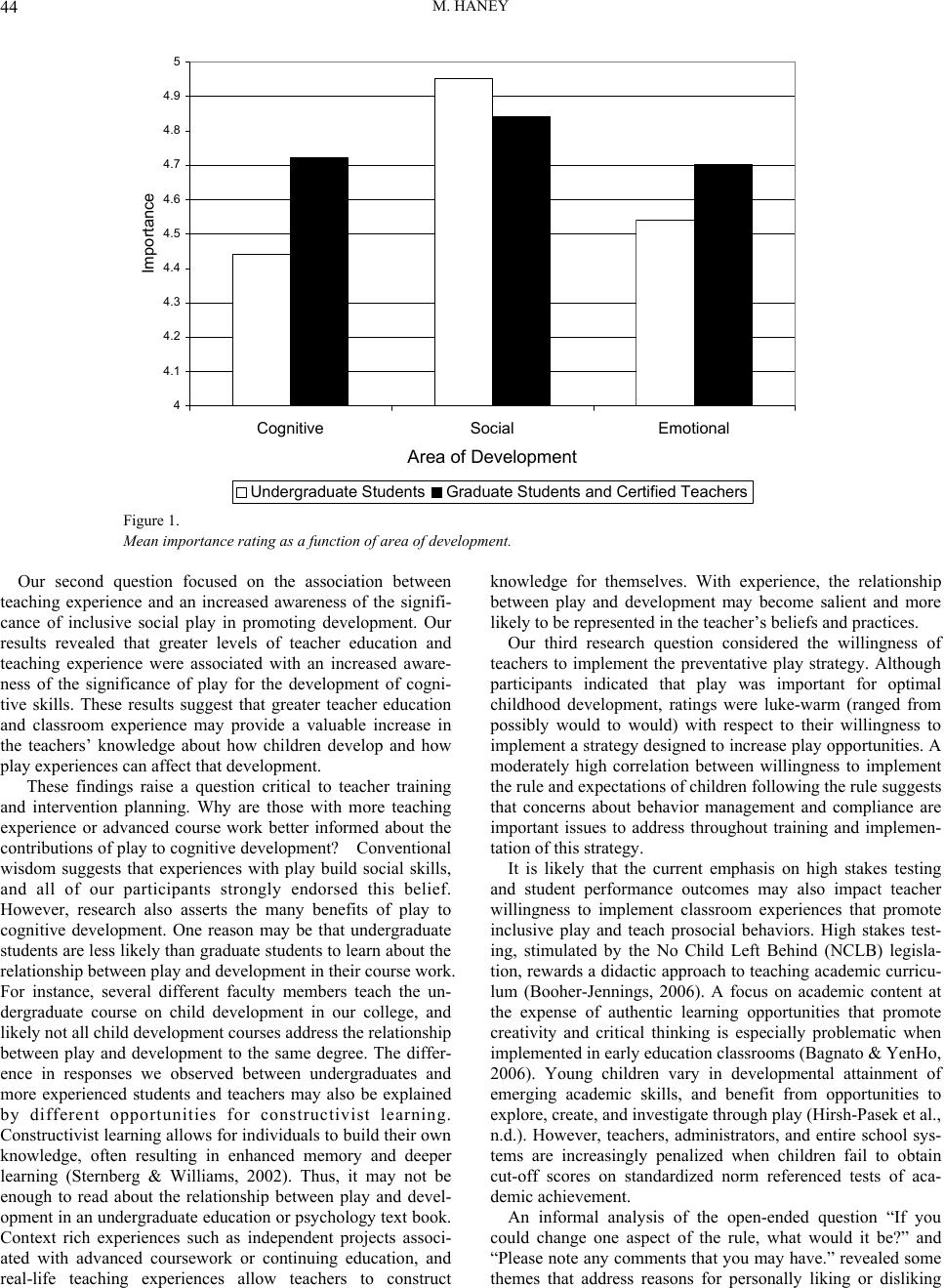 M. HANEY 44 4 4.1 4.2 4.3 4.4 4.5 4.6 4.7 4.8 4.9 5 CognitiveSocial Emotional Area of Development Importance Undergraduate StudentsGraduate Students and Certified Teachers Figure 1. Mean importance ratin g as a function of area of development. Our second question focused on the association between teaching experience and an increased awareness of the signifi- cance of inclusive social play in promoting development. Our results revealed that greater levels of teacher education and teaching experience were associated with an increased aware- ness of the significance of play for the development of cogni- tive skills. These results suggest that greater teacher education and classroom experience may provide a valuable increase in the teachers’ knowledge about how children develop and how play experiences can affect that development. These findings raise a question critical to teacher training and intervention planning. Why are those with more teaching experience or advanced course work better informed about the contributions of play to cognitive development? Conventional wisdom suggests that experiences with play build social skills, and all of our participants strongly endorsed this belief. However, research also asserts the many benefits of play to cognitive development. One reason may be that undergraduate students are less likely than graduate students to learn about the relationship between play and development in their course work. For instance, several different faculty members teach the un- dergraduate course on child development in our college, and likely not all child development courses address the relationship between play and development to the same degree. The differ- ence in responses we observed between undergraduates and more experienced students and teachers may also be explained by different opportunities for constructivist learning. Constructivist learning allows for individuals to build their own knowledge, often resulting in enhanced memory and deeper learning (Sternberg & Williams, 2002). Thus, it may not be enough to read about the relationship between play and devel- opment in an undergraduate education or psychology text book. Context rich experiences such as independent projects associ- ated with advanced coursework or continuing education, and real-life teaching experiences allow teachers to construct knowledge for themselves. With experience, the relationship between play and development may become salient and more likely to be represented in the teacher’s beliefs and practices. Our third research question considered the willingness of teachers to implement the preventative play strategy. Although participants indicated that play was important for optimal childhood development, ratings were luke-warm (ranged from possibly would to would) with respect to their willingness to implement a strategy designed to increase play opportunities. A moderately high correlation between willingness to implement the rule and expectations of children following the rule suggests that concerns about behavior management and compliance are important issues to address throughout training and implemen- tation of this strategy. It is likely that the current emphasis on high stakes testing and student performance outcomes may also impact teacher willingness to implement classroom experiences that promote inclusive play and teach prosocial behaviors. High stakes test- ing, stimulated by the No Child Left Behind (NCLB) legisla- tion, rewards a didactic approach to teaching academic curricu- lum (Booher-Jennings, 2006). A focus on academic content at the expense of authentic learning opportunities that promote creativity and critical thinking is especially problematic when implemented in ea rly education classrooms (Bagnato & YenHo, 2006). Young children vary in developmental attainment of emerging academic skills, and benefit from opportunities to explore, create, and investigate through play (Hirsh-Pasek et al., n.d.). However, teachers, administrators, and entire school sys- tems are increasingly penalized when children fail to obtain cut-off scores on standardized norm referenced tests of aca- demic achievement. An informal analysis of the open-ended question “If you could change one aspect of the rule, what would it be?” and “Please note any comments that you may have.” revealed some themes that address reasons for personally liking or disliking  M. HANEY 45 the rule. Three main themes emerged. Firstly, participants ex- pressed concern that the rule took away a student’s right to chose their own friends. Further, it was sometimes noted that by taking away a fundamental freedom of choice schools would be inadvertently encouraging conformity. Those who expressed this concern did so in a manner suggesting that conformity was an undesirable trait when associated with social functioning. Another common theme involved the normality of rejection throughout the course of one’s life. These participants sug- gested that early school experiences in being rejected from one’s peers somehow sensitized children to the routine experi- ences of rejection they were destined to endure throughout their lives. It is noteworthy that current developmental and social psychological research demonstrates an almost universal ten- dency for social rejection to diminish one’s self-esteem. Con- trasting these societal norms with scientific research results would likely lead to thought provoking and important discus- sion. Thirdly, many participants suggested that as teachers they simply do not have the time or energy to spend teaching chil- dren prosocial skills related to inclusive play. Paley (1992) noted concerns similar to those expressed by our participants in her description of teacher reactions to the rule. Ultimately, the lowest ratings occurred in response to the question “How well do you think children will follow the rule?” Thus, although teachers and those in teacher training programs may feel play is important to development and may even be willing to implement the rule, there are concerns about students complying with the rule. This finding indicates that a significant part of training and program planning must involve ongoing discussions and strategies to address issues related to student compliance. For instance, useful strategies may include journals, role playing, and class meetings infused into class- room activities. The factor analysis revealed that training teachers to imple- ment the “you can’t say you can’t play” rule must address two distinctly different issues. In preparing teachers to implement this program, it is critical that the significant role that inclusive play has in enhancing social, emotional and cognitive devel- opment be clearly communicated (the “Rule Importance” fac- tor). In addition, the program must involve training and on-going support to increase acceptance and perceive feasibility of the “you can’t say you can’t play” rule (the “Rule Feasibil- ity” factor). Specifically, teachers are likely to benefit from training opportunities (e.g. via case studies, video vignettes, modeling, observations) related to introducing the rule to stu- dents, supporting students in understanding and practicing the rule, dealing with problems that emerge as students struggle with inclusive play, and assessing the progress of the program. Overall, it is hoped that this research will stimulate optimism about the effectiveness of strategies that teach prosocial skills and empower teachers to feel competent integrating these skills into the curriculum. A preventative approach that integrates pro-social learning opportunities into daily school experiences affords children the potential to maximize their learning ex- perience at school and generalize these pro-social skills to strengthen their social communities throughout their lives. References American Psychological Association. (2002). Ethical principles of psychologists and code of conduct. American Psychologist, 57, 1060-1073. doi:10.1037/0003-066X.57.12.1060 Astington, J. W., & Jenkins, J. M. (1995). Theory of mind development and social understanding. Emotion, 9, 151-165. doi:10.1080/02699939508409006 Battistich, V., Solomon, D., Watson, M., & Schaps, E. (1997). Caring School Communities. Educational Psychologi st , 32, 137-151. doi:10.1207/s15326985ep3203_1 Bagnato, S. J., & Yeh-Ho, H. ( 2006). High-stakes testing with pre- school children: Violation of professional standards for evidence- based practice in early childhood intervention. KEDI International Journal of Educatio n a l Policy, 3, 2006. Booher-Jennings, J. (2005). Below the bubble: 'Educational triage' and the Texas accountability system. American Educational Re- search Journal, 42, 231-268. doi:10.3102/00028312042002231 Bronfenbrenner, U. (1979). The ecology of human development: Ex- periments by nature and design. Cambridge, MA: Harvard Univer- sity Press. Brown, W. H., Odom, S. L., & Conroy, M. A. (2001). An intervention hierarchy for promoting young children’s peer interactions in natural environments. Topics in Early Childhood Special Education, 21, 162-175. doi:10.1177/027112140102100304 Buysee, V., Goldman, B. D., & Skinner, M. L. (2003). Friendship for- mation in inclusive early childhood classrooms: What is the teacher’s role? Early Childhood Research Quarterly, 18, 485-501. doi:10.1016/j.ecresq.2003.09.007 Casby, M. W. (2003). Developmental assessment of play: A model for early intervention. Communication Disorders Quarterly, 24, 175- 183. doi:10.1177/15257401030240040301 Connolly, J. A., & Doyle, A.-B. (1984). Relation of social fantasy to social competence in preschoolers. Developmental Psychology, 20, 797-806. doi:10.1037/0012-1649.20.5.797 Detrich, R. (1999). Increasing treatment fidelity by matching interven- tions to contextual variables within the educational setting. School Psychology Review, 28 , 608-620. Espelage, D. L. & Swearer, S. M. (2003). Research on school bullying and victimization: What have we learned and where do we need to go? School Psychol o g y Review, 32, 365-383. Frost, J. L., Wortham, S. C., & Reifel, S. (2001). Play and child devel- opment. Upper Saddle River, New Jersey: Merrill Prentice Hall. Harrist, A. W. & Bradley, K. D . (2003). “ You can’t say you can’t play”: Intervening in the process of social exclusion in the kindergarten classroom. Early Childh ood Research Quarte rly, 18, 185-205. doi:10.1016/S0885-2006(03)00024-3 Hirsch-Pasek, K., Go linkoff, R. M., Berk, L. E., & Sin ger, D.G. (n.d.). A manifesto for playful learning in preschool: Presenting the scien- tific evidence. In Open Eye. Retrieved March 9, 2011, from http://openeyecampaign.wordpress.com/research-and-supporting-lite rature/a-manifesto-for-playful-learning-in-preschool-presenting-the- scientific-evidence-by-kathy-hirsh-pasek-et-al-synopsis/. Gable, R. G., Henrickson, J. M., & Van Acker, R. (2001). Maintaining the integrity of FBA-based interventions in the schools. Education and Treatment of Children, 24, 248-260. Grolnick, W. S. & Slowiaczek, M. L. (1994). Parents’ involvement in children’s schooling: A multidimensional conceptualization and mo- tivational model. Child Development, 65, 237-252. doi:10.2307/1131378 Kerns, K. & Barth, J. M. (1995). Attachment and play: Convergence across components of parent-child relationships and their relation- ships to peer competence. Journal of Social & Personal Relation- ships, 12, 243-260. doi:10.1177/0265407595122006 Lindsey, E. W. & Colwell, M. J. (2003). Preschoolers’ emotional competency: Links to pretend and physical play. Child Study Journal, 33, 39-52. McNeeley, C. A., Nonnemaker, J. M., & Blum, R. W. (2002). Promot- ing school connectedness: Evidence from the national longitudinal study of adolescent health. Journal of Schoo l He a lt h, 72, 138-146. doi:10.1111/j.1746-1561.2002.tb06533.x  M. HANEY 46 Normandeau, S. & Guay, F. (1998). Preschool behavior and first-grade school achievement: The mediational role of cognitive self-control. Journal of Educational Psychology, 90, 111-121. doi:10.1037/0022-0663.90.1.111 Owocki, G. (1999). Literacy through play. Portsmouth, NH: Heine- mann. Paley, V. G. (1992). You Can’t Say You Can’t Play. Cambridge, MA: Harvard University Press. Rodkin, P. C., & Hodges, E. V. E. (2003). Bullies and victims in the peer ecology: Four questions for psychologists and school psy- chologists. School Psychology Review, 32 , 384-400. Roskos, K. & Neuman, S. B. (1998). P lay as an opportunity for literacy. In O. N. Saracho and B. Spodek (Eds.). Multiple Perspectives on Play in Early Childhood Education. Albany, NY: Sate University of New York Press. Schiffman, R. F. (2003). Mother-infant interaction in low-income fami- lies. The American Journal of Mat e r nal/Child Nursing, 28, 246-251. Sternberg, R. J., & Williams, W. M. (2002). Educational psychology. Boston, MA: Allyn & Bacon. Watson, A. C., Linkie-Nixon, C., Wilson, A., & Capage, L. (1999). Social interaction skills and theory of mind in young children. De- velopmental Psychology, 35, 386-391. doi:10.1037/0012-1649.35.2.386 Wentzel, K. R. (1991). Social competence at school: Relation between social responsibility and academic achievement. Review of Educa- tional Research, 61, 1-24. Zakriski, A., Jacobs, M., & Coie, J. (1997). Coping with childhood peer rejection. In S. Wolchik & I. N. Sandler (Eds.), Handbook of chil- dren’s coping skills: Linking theory and intervention. New York: Plenum Press. |