

Paper Menu >>
Journal Menu >>
 Creative Education 2011. Vol. 2, No. 1, 10-17 Copyright © 2011 SciRes. DOI:10.4236/ce.2011.21002 A Formative Study of an E-book Instructional Model in Early Literacy Kathleen Roskos, Karen Burstein, Byeong-Keun You, Jeremy Brueck, Carolyn O’Brien 1John Carroll University, Ohio, United States 2Southwest Institute for Families and Children, Scottsdale, United States 3The University of Akron, Akron, United States Email: [email protected] Received August 4th, 2010; revised February 7th, 2011; accepted February 12th, 2011. The electronic book is a rapidly growing alternative to the conventional book even for very young children; however, empirical studies on e-books as curricular tools in early literacy development and instruction are rare. Few instructional designs have been developed and tested. This formative study investigates the potential func- tionality and usability of a prototy pe 4-component e-book instructional model in a small sample of preschool classrooms. Using qualitative analytic strategies, observational data of its components were examined to identify salient indicators and design features, and to assess its feasibility. Results yielded design information on each component: (1) e-book as a quality technology-mediated environment; (2) physical place criteria; (3) engage- ment indicators; and (4) instructional potential. Strengths and weaknesses of the four-component model design were identified for purposes of revision and stabilizing the model for further testing in a larger classroom sam- ple. Keywords: E-books, Preschool, Early Literacy Introduction For nearly everyone, the electronic book is a rapidly growing alternative to the conventional book even for very young chil- dren. Most major publishing houses and many major libraries now offer e-book collections for young children, not to mention the recent ‘apps’ available from iTunes downloadable to iPods, iPads and iPhones. What the shift from page to screen might mean for young literacy learners remains to be seen, although that the e-book has arrived in their world is abundantly clear. Equally uncertain is how the e-book ‘fits’ in the pr eschool classroom as a curricular tool and an instructional resource (Teale, 2010). Here we are adrift even as e-books for children spread ever more widely into everyday life. Research is very needed at this juncture to build an evidence base around e-books for ‘edutainment’ as well as early literacy education and to offer principles and methods for e-book pedagogy in early childhood classrooms. What We Know In general, studies of e-book design show that children’s first e-books are mediocre at best. Examining the technical design of early childhood e-books, (de Jong & Bus, 2003) developed an analytic method that rated digital elements of e-book construc- tion. Coding a corpus of 55 Dutch commercial e-books for features of multimedia, interactivity, print quality and quality of “hotspot” click locations, their analysis revealed generally weak designs in this corpus with many e-books containing low qual- ity multimedia additions, limited child-text interactivity, and hotspots irrelevant to the stor y line. Subsequent studies cor- roborate the lackluster quality of most e-books available for young children across cultures, reflecting what might be termed overall ‘garden variety’ design (Roskos, Brueck, & Widman, 2009; Korat & Shamir, 2004). Still, a growing body of primarily lab-based research points to the potential of well-designed e-books for supporting and influencing young children’s emerging literacy skills. In a se- ries of studies r ooted in Paivio’s dual-coding theory (Pavio, 1986; Verhallen & colleagues, 2006), for example, found that children lagging in language skills benefited from e-books with rich visualizations and sounds and music. Redundancies in these features in the e-book d esign appeared to mobilize chil- dren’s mental energy and to re-invigorate their mental effort, which led to improved story comprehension. Other researchers have obtained similar findings—when e-book design features draw children’s attention to words, they learn words (Segers, 2009). When design emphasizes emergent literacy skills (e.g., phonological awareness), they learn these skills (Shamir & Korat, 2009). E-books, in sum, show promise as instructional tools that may go beyond the power of traditional storybooks. But empirical studies on e-books as curricular resources in early literacy instruction are presently rare. Although some preliminary research shows, for example, that kindergarteners that received mobile device reading interventions profited, de- monstrating gains in their beginning reading skills (Fishburn, 2008). The problems and educational effects of importing e-book technology (touch screen computers, interactive white boards, mobile devices) into the early literacy program in 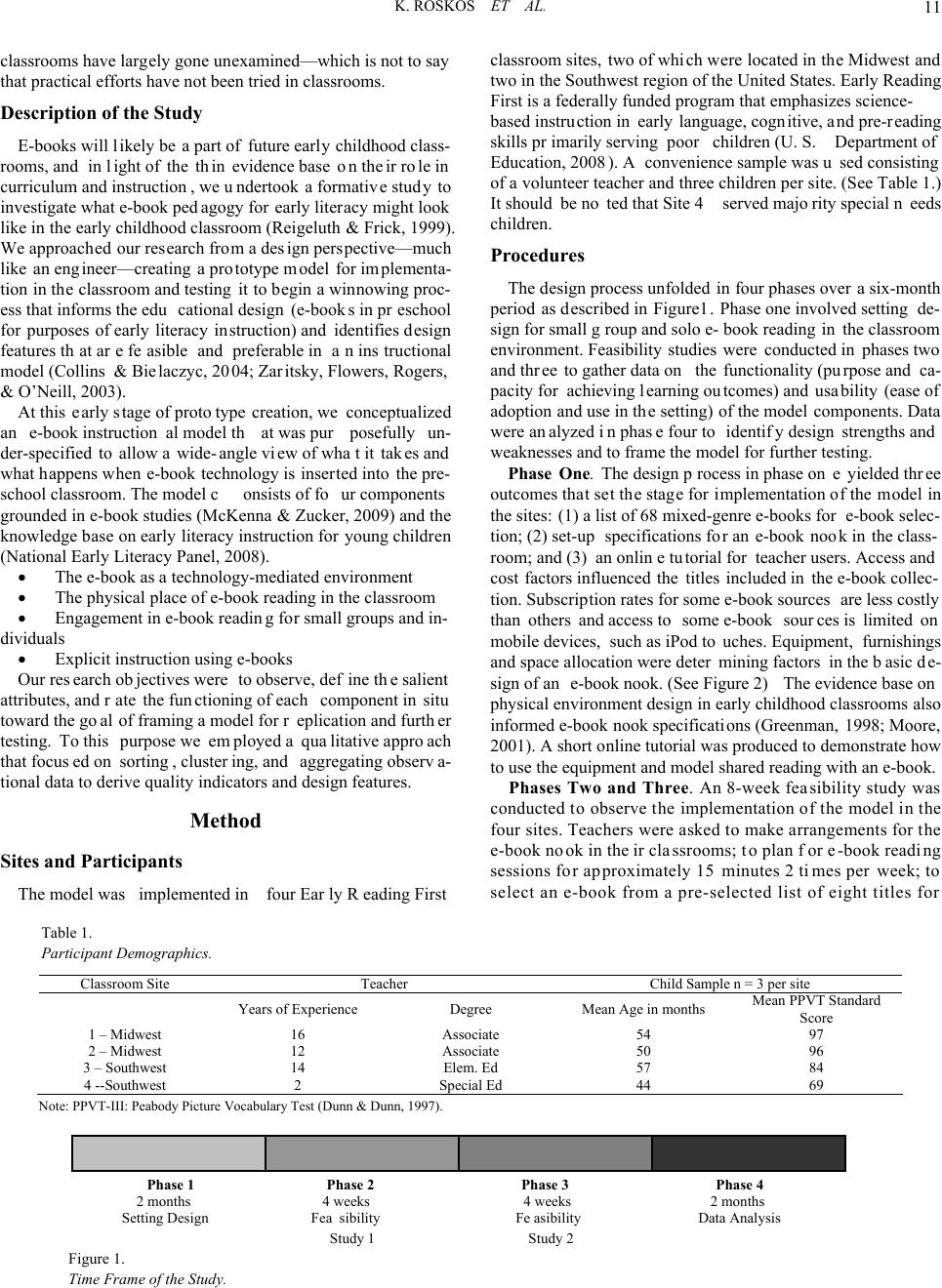 K. ROSKOS ET AL. 11 classrooms have largely gone unexamined—which is not to say that practical efforts have not been tried in classrooms. Description of the Study E-books will likely be a part of future early childhood class- rooms, and in light of the thin evidence base on their role in curriculum and instruction, we undertook a formative study to investigate what e-book pedagogy for early literacy might look like in the early childhood classroom (Reigeluth & Frick, 1999). We approached our research from a design perspective—much like an engineer—creating a prototype model for implementa- tion in the classroom and testing it to begin a winnowing proc- ess that informs the educational design (e-books in preschool for purposes of early literacy instruction) and identifies design features that are feasible and preferable in an instructional model (Collins & Bielaczyc, 2004; Zaritsky, Flowers, Rogers, & O’Neill, 2003). At this early stage of prototype creation, we conceptualized an e-book instructional model that was purposefully un- der-specified to allow a wide-angle view of what it takes and what happens when e-book technology is inserted into the pre- school classroom. The model consists of four components grounded in e-book studies (McKenna & Zucker, 2009) and the knowledge base on early literacy instruction for young children (National Early Literacy Panel, 2008). The e-book as a technology-mediated environment The physical place of e-book reading in the classroom Engagement in e-book reading for small groups and in- dividuals Explicit instruction using e-books Our research objectives were to observe, define the salient attributes, and rate the functioning of each component in situ toward the goal of framing a model for replication and further testing. To this purpose we employed a qualitative approach that focused on sorting, clustering, and aggregating observa- tional data to derive quality indicators and design features. Method Sites and Participants The model was implemented in four Early Reading First classroom sites, two of which were located in the Midwest and two in the Southwest region of the United States. Early Reading First is a federally funded program that emphasizes science- based instruction in early language, cognitive, and pre-reading skills primarily serving poor children (U. S. Department of Education, 2008). A convenience sample was used consisting of a volunteer teacher and three children per site. (See Table 1.) It should be no ted that Site 4 served majority special n eeds children. Procedures The design process unfolded in four phases over a six-month period as described in Figure1. Phase one involved setting de- sign for small group and solo e-book reading in the classroom environment. Feasibility studies were conducted in phases two and three to gather data on the functionality (purpose and ca- pacity for achieving learning outcomes) and usability (ease of adoption and use in the setting) of the model components. Data were analyzed in phase four to identify design strengths and weaknesses and to frame the model for further testing. Phase One. The design process in phase one yielded three outcomes that set the stage for implementation of the model in the sites: (1) a list of 68 mixed-genre e-books for e-book selec- tion; (2) set-up specifications for an e-book nook in the class- room; and (3) an online tutorial for teacher users. Access and cost factors influenced the titles included in the e-book collec- tion. Subscription rates for some e-book sources are less costly than others and access to some e-book sources is limited on mobile devices, such as iPod to uches. Equipment, furnishings and space allocation were determining factors in the basic de- sign of an e-book nook. (See Figure 2) The evidence base on physical environment design in early childhood classrooms also informed e-book nook specifications (Greenman, 1998; Moore, 2001). A short online tutorial was produced to demonstrate how to use the equipment and model shared reading with an e-book. Phases Two and Three. An 8-week feasibility study was conducted to observe the implementation of the model in the four sites. Teachers were asked to make arrangements for the e-book nook in their classrooms; to plan for e-book reading sessions for approximately 15 minutes 2 times per week; to select an e-book from a pre-selected list of eight titles for Table 1. Participant Demographic s. Classroom Site Teacher Child Sample n = 3 per site Years of Experience Degree Mean Age in months Mean PPVT Standard Score 1 – Midwest 16 Associate 54 97 2 – Midwest 12 Associate 50 96 3 – Southwest 14 Elem. Ed 57 84 4 --Southwest 2 Special Ed 44 69 Note: PPVT-III: Peabody Picture Vocabulary Test (Dunn & Dunn, 1997). Phase 1 Phase 2 Phase 3 Phase 4 2 months 4 weeks 4 weeks 2 months Setting Design Fea sibility Feasibility Data Analysis Study 1 Study 2 Figure 1. Time Frame of the Study. 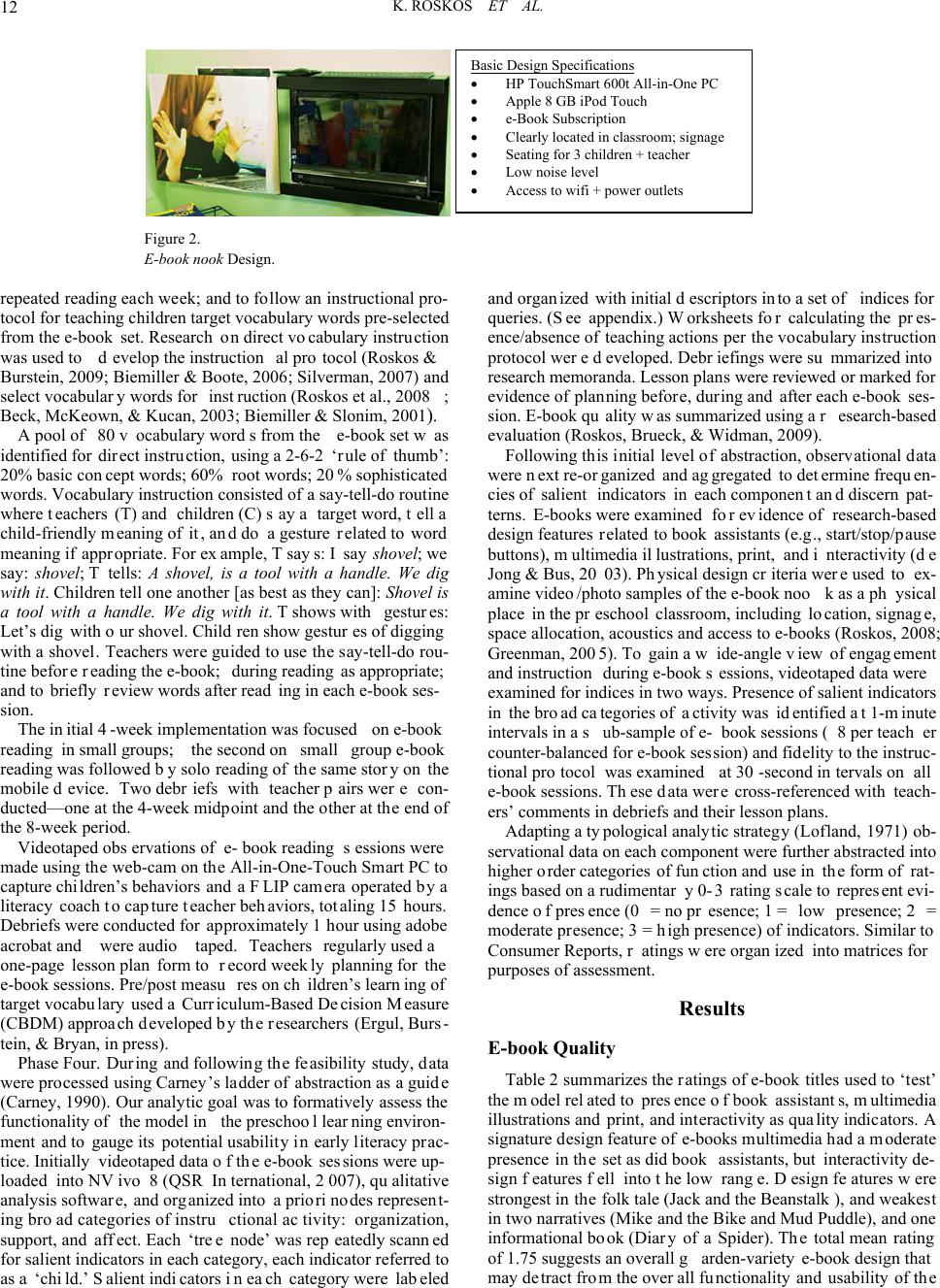 K. ROSKOS ET AL. 12 Basic Design Specifications HP TouchSmart 600t All-in-One PC Apple 8 GB iPod Touch e-Book Subscription Clearly located in classroom; signage Seating for 3 children + teacher Low noise level Access to wifi + power outlets Figure 2. E-book nook Design. repeated reading each week; and to follow an instructional pro- tocol for teaching children target vocabulary words pre-selected from the e-book set. Research on direct vocabulary instruction was used to develop the instructional protocol (Roskos & Burstein, 2009; Biemiller & Boote, 2006; Silverman, 2007) and select vocabulary words for instruction (Roskos et al., 2008; Beck, McKeown, & Kucan, 2003; Biemiller & Slonim, 2001). A pool of 80 v ocabulary words from the e-book set w as identified for direct instruction, using a 2-6-2 ‘rule of thumb’: 20% basic concept words; 60% root words; 20% sophisticated words. Vocabulary instruction consisted of a say-tell-do routine where teachers (T) and children (C) say a target word, tell a child-friendly meaning of it, and do a gesture related to word meaning if appropriate. For example, T says: I say shovel; we say: shovel; T tells: A shovel, is a tool with a handle. We dig with it. Children tell one another [as best as they can]: Shovel is a tool with a handle. We dig with it. T shows with gestures: Let’s dig with our shovel. Children show gestures of digging with a shovel. Teachers were guided to use the say-tell-do rou- tine before reading the e-book; during reading as appropriate; and to briefly review words after read ing in each e-book ses- sion. The initial 4-week implementation was focused on e-book reading in small groups; the second on small group e-book reading was followed by solo reading of the same story on the mobile device. Two debriefs with teacher pairs were con- ducted—one at the 4-week midpoint and the other at the end of the 8-week period. Videotaped observations of e-book reading sessions were made using the web-cam on the All-in-One-Touch Smart PC to capture children’s behaviors and a FLIP camera operated by a literacy coach to capture teacher behaviors, totaling 15 hours. Debriefs were conducted for approximately 1 hour using adobe acrobat and were audio taped. Teachers regularly used a one-page lesson plan form to record weekly planning for the e-book sessions. Pre/post measures on children’s learning of target vocabulary used a Curriculum-Based Decision Measure (CBDM) approach developed by the researchers (Ergul, Burs- tein, & Bryan, in press). Phase Four. During and following the feasibility study, data were processed using Carney’s ladder of abstraction as a guide (Carney, 1990). Our analytic goal was to formatively assess the functionality of the model in the preschool learning environ- ment and to gauge its potential usability in early literacy prac- tice. Initially videotaped data of the e-book sessions were up- loaded into NVivo 8 (QSR International, 2007), qualitative analysis software, and organized into a priori nodes represent- ing broad categories of instructional activity: organization, support, and affect. Each ‘tree node’ was repeatedly scanned for salient indicators in each category, each indicator referred to as a ‘child.’ Salient indicators in each category were labeled and organized with initial descriptors into a set of indices for queries. (See appendix.) Worksheets for calculating the pres- ence/absence of teaching actions per the vocabulary instruction protocol were developed. Debriefings were su mmarized into research memoranda. Lesson plans were reviewed or marked for evidence of planning before, during and after each e-book ses- sion. E-book quality was summarized using a research-based evaluation (Roskos, Brueck, & Widman, 2009). Following this initial level of abstraction, observational data were next re-organized and aggregated to determine frequen- cies of salient indicators in each component and discern pat- terns. E-books were examined for evidence of research-based design features related to book assistants (e.g., start/stop/pause buttons), multimedia illustrations, print, and i nteractivity (de Jong & Bus, 20 03). Physical design criteria were used to ex- amine video/photo samples of the e-book nook as a physical place in the preschool classroom, including location, signage, space allocation, acoustics and access to e-books (Roskos, 2008; Greenman, 2005). To gain a wide-angle view of engagement and instruction during e-book sessions, videotaped data were examined for indices in two ways. Presence of salient indicators in the broad categories of activity was identified at 1-minute intervals in a sub-sample of e- book sessions ( 8 per teach er counter-balanced for e-book session) and fidelity to the instruc- tional protocol was examined at 30-second intervals on all e-book sessions. These data were cross-referenced with teach- ers’ comments in debriefs and their lesson plans. Adapting a typological analytic strategy (Lofland, 1971) ob- servational data on each component were further abstracted into higher order categories of function and use in the form of rat- ings based on a rudimentary 0-3 rating scale to represent evi- dence of presence (0 = no presence; 1 = low presence; 2 = moderate presence; 3 = high presence) of indicators. Similar to Consumer Reports, ratings were organized into matrices for purposes of assessment. Results E-book Quality Table 2 summarizes the ratings of e-book titles used to ‘test’ the model related to presence of book assistants, multimedia illustrations and print, and interactivity as quality indicators. A signature design feature of e-books multimedia had a moderate presence in the set as did book assistants, but interactivity de- sign features fell into the low range. Design features were strongest in the folk tale (Jack and the Beanstalk), and weakest in two narratives (Mike and the Bike and Mud Puddle), and one informational book (Diary of a Spider). The total mean rating of 1.75 suggests an overall garden-variety e-book design that may detract from the overall functionality and usability of the 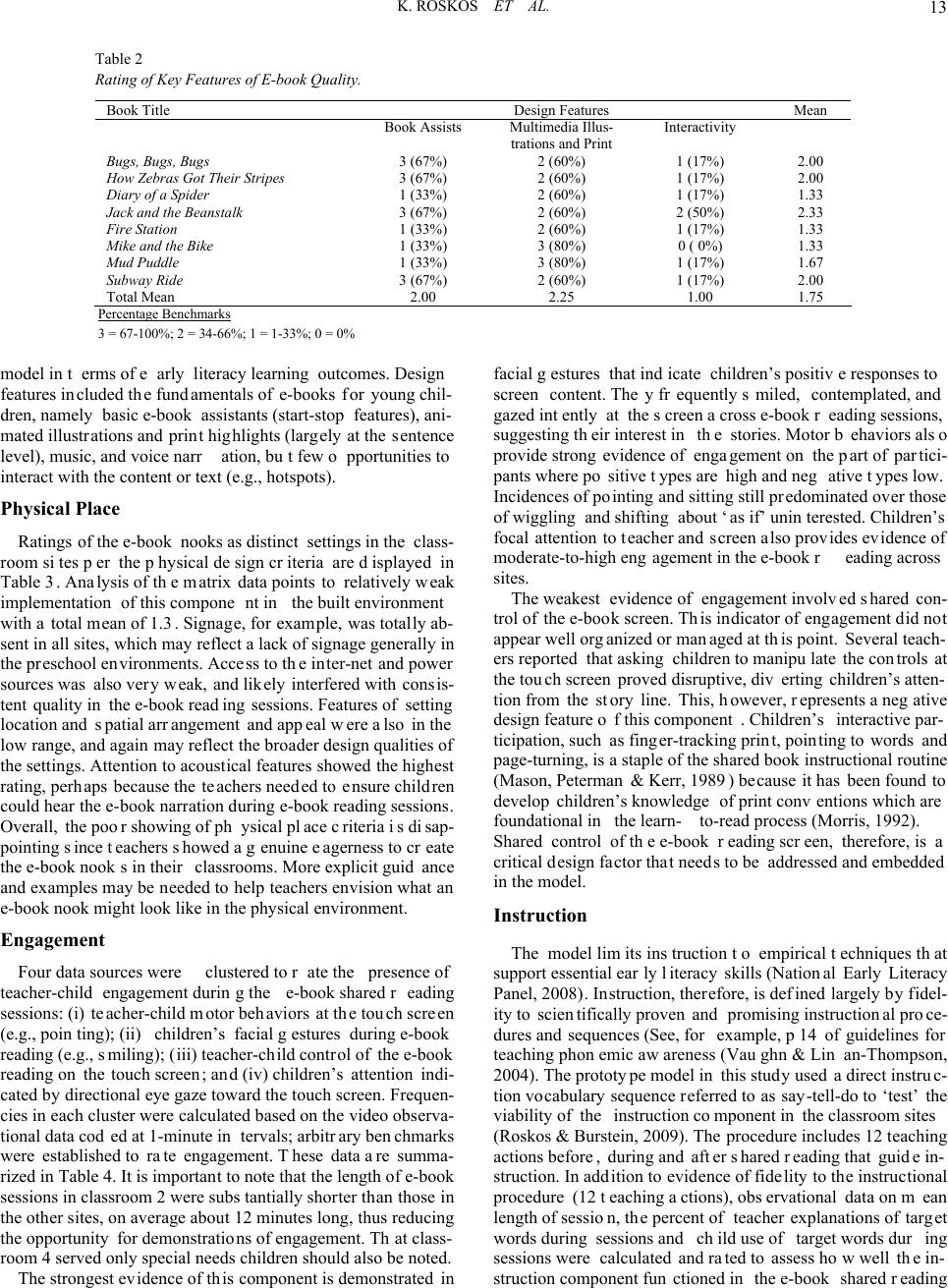 K. ROSKOS ET AL. 13 Table 2 Rating of Key Features of E-book Quality. Book Title Design Features Mean Book Assists Multimedia Illus- trations and Print Interactivity Bugs, Bugs, Bugs 3 (67%) 2 (60%) 1 (17%) 2.00 How Zebras Got Their Stripes 3 (67%) 2 (60%) 1 (17%) 2.00 Diary of a Spider 1 (33%) 2 (60%) 1 (17%) 1.33 Jack and the Beanstalk 3 (67%) 2 (60%) 2 (50%) 2.33 Fire Station 1 (33%) 2 (60%) 1 (17%) 1.33 Mike and the Bike 1 (33%) 3 (80%) 0 ( 0%) 1.33 Mud Puddle 1 (33%) 3 (80%) 1 (17%) 1.67 Subway Ride 3 (67%) 2 (60%) 1 (17%) 2.00 Total Mean 2.00 2.25 1.00 1.75 Percentage Benchmarks 3 = 67-100%; 2 = 34-66%; 1 = 1-33%; 0 = 0% model in t erms of e arly literacy learning outcomes. Design features included the fundamentals of e-books for young chil- dren, namely basic e-book assistants (start-stop features), ani- mated illustrations and print highlights (largely at the sentence level), music, and voice narration, but few opportunities to interact with the content or text (e.g., hotspots). Physical Place Ratings of the e-book nooks as distinct settings in the class- room sites per the physical design criteria are displayed in Table 3. Analysis of the matrix data points to relatively weak implementation of this component in the built environment with a total mean of 1.3. Signage, for example, was totally ab- sent in all sites, which may reflect a lack of signage generally in the preschool environments. Access to the inter-net and power sources was also very weak, and likely interfered with consis- tent quality in the e-book reading sessions. Features of setting location and spatial arrangement and appeal were also in the low range, and again may reflect the broader design qualities of the settings. Attention to acoustical features showed the highest rating, perhaps because the teachers needed to ensure children could hear the e-book narration during e-book reading sessions. Overall, the poor showing of physical place criteria is disap- pointing since teachers showed a genuine eagerness to create the e-book nooks in their classrooms. More explicit guid ance and examples may be needed to help teachers envision what an e-book nook might look like in the physical environment. Engagement Four data sources were clustered to r ate the presence of teacher-child engagement during the e-book shared reading sessions: (i) teacher-child motor behaviors at the touch screen (e.g., pointing); (ii) children’s facial gestures during e-book reading (e.g., smiling); (iii) teacher-child control of the e-book reading on the touch screen; and (iv) children’s attention indi- cated by directional eye gaze toward the touch screen. Frequen- cies in each cluster were calculated based on the video observa- tional data coded at 1-minute intervals; arbitrary benchmarks were established to rate engagement. These data are summa- rized in Table 4. It is important to note that the length of e-book sessions in classroom 2 were substantially shorter than those in the other sites, on average about 12 minutes long, thus reducing the opportunity for demonstrations of engagement. Th at class- room 4 served only special needs children should also be noted. The strongest evidence of this component is demonstrated in facial gestures that indicate children’s positive responses to screen content. They frequently smiled, contemplated, and gazed intently at the screen across e-book r eading sessions, suggesting their interest in the stories. Motor b ehaviors also provide strong evidence of engagement on the part of partici- pants where positive types are high and negative types low. Incidences of pointing and sitting still predominated over those of wiggling and shifting about ‘as if’ uninterested. Children’s focal attention to teacher and screen also provides evidence of moderate-to-high engagement in the e-book reading across sites. The weakest evidence of engagement involved shared con- trol of the e-book screen. This indicator of engagement did not appear well organized or managed at this point. Several teach- ers reported that asking children to manipulate the controls at the touch screen proved disruptive, diverting children’s atten- tion from the story line. This, however, represents a negative design feature o f this component. Children’s interactive par- ticipation, such as finger-tracking print, pointing to words and page-turning, is a staple of the shared book instructional routine (Mason, Peterman & Kerr, 1989) because it has been found to develop children’s knowledge of print conventions which are foundational in the learn-to-read process (Morris, 1992). Shared control of the e-book reading screen, therefore, is a critical design factor that needs to be addressed and embedded in the model. Instruction The model limits instruction to empirical techniques that support essential early literacy skills (National Early Literacy Panel, 2008). Instruction, therefore, is defined largely by fidel- ity to scientifically proven and promising instructional proce- dures and sequences (See, for example, p 14 of guidelines for teaching phonemic awareness (Vaughn & Linan-Thompson, 2004). The prototype model in this study used a direct instruc- tion vocabulary sequence referred to as say-tell-do to ‘test’ the viability of the instruction component in the classroom sites (Roskos & Burstein, 2009). The procedure includes 12 teaching actions before, during and after shared reading that guide in- struction. In addition to evidence of fidelity to the instructional procedure (12 teaching actions), observational data on mean length of session, the percent of teacher explanations of target words during sessions and child use of target words during sessions were calculated and rated to assess how well the in- struction component functioned in the e-book shared reading 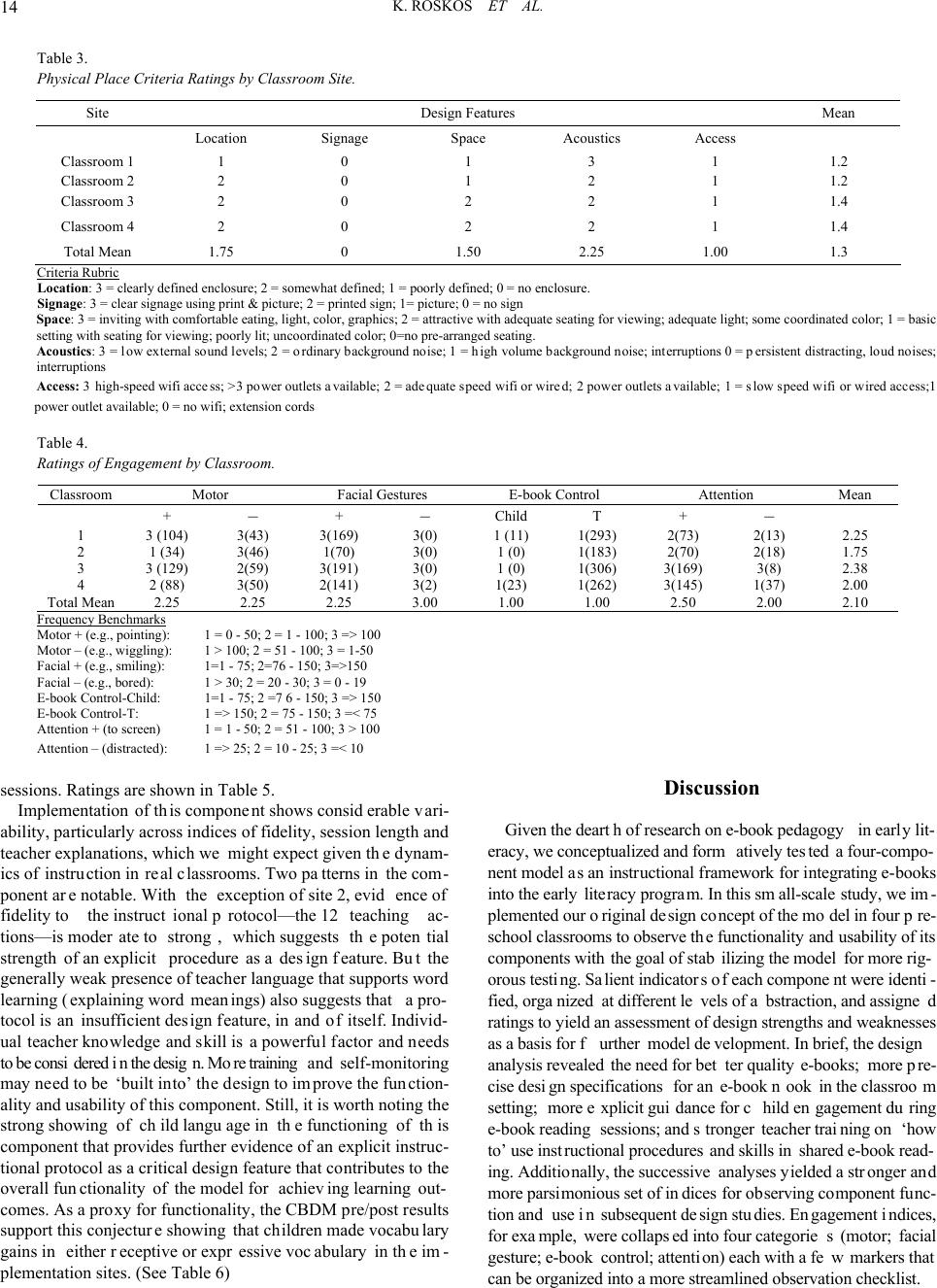 K. ROSKOS ET AL. 14 Table 3. Physical Place Crit eria Ratings by Classroom Site. Site Design Features Mean Location Signage Space Acoustics Access Classroom 1 1 0 1 3 1 1.2 Classroom 2 2 0 1 2 1 1.2 Classroom 3 2 0 2 2 1 1.4 Classroom 4 2 0 2 2 1 1.4 Total Mean 1.75 0 1.50 2.25 1.00 1.3 Criteria Rubric Location: 3 = clearly defined enclosure; 2 = somewhat defined; 1 = poorly defined; 0 = no enclosure. Signage: 3 = clear signage using print & picture; 2 = printed sign; 1= picture; 0 = no sign Space: 3 = inviting with comfortable eating, light, color, graphics; 2 = attractive with adequate seating for viewing; adequate light; some coordinated color; 1 = basic setting with seating for viewing; poorly lit; uncoordinated color; 0=no pre-arranged seating. Acoustics: 3 = low external sound levels; 2 = ordinary background noise; 1 = high volume background noise; interruptions 0 = persistent distracting, loud noises; interruptions Access: 3 high-speed wifi access; >3 power outlets available; 2 = adequate speed wifi or wired; 2 power outlets available; 1 = slow speed wifi or wired access;1 power outlet available; 0 = no wifi; extension cords Table 4. Ratings of Engagement by Classroom. Classroom Motor Facial Gestures E-book Control Attention Mean + – + – Child T + – 1 3 (104) 3(43) 3(169) 3(0) 1 (11) 1(293) 2(73) 2(13) 2.25 2 1 (34) 3(46) 1(70) 3(0) 1 (0) 1(183) 2(70) 2(18) 1.75 3 3 (129) 2(59) 3(191) 3(0) 1 (0) 1(306) 3(169) 3(8) 2.38 4 2 (88) 3(50) 2(141) 3(2) 1(23) 1(262) 3(145) 1(37) 2.00 Total Mean 2.25 2.25 2.25 3.00 1.00 1.00 2.50 2.00 2.10 Frequency Benchmarks Motor + (e.g., pointing): 1 = 0 - 50; 2 = 1 - 100; 3 => 100 Motor – (e.g., wiggling): 1 > 100; 2 = 51 - 100; 3 = 1-50 Facial + (e.g., smiling): 1=1 - 75; 2=76 - 150; 3=>150 Facial – (e.g., bored): 1 > 30; 2 = 20 - 30; 3 = 0 - 19 E-book Control-Child: 1=1 - 75; 2 =7 6 - 150; 3 => 150 E-book Control-T: 1 => 150; 2 = 75 - 150; 3 =< 75 Attention + (to screen) 1 = 1 - 50; 2 = 51 - 100; 3 > 100 Attention – (distracted): 1 => 25; 2 = 10 - 25; 3 =< 10 sessions. Ratings are shown in Table 5. Implementation of this component shows considerable vari- ability, particularly across indices of fidelity, session length and teacher explanations, which we might expect given the dynam- ics of instruction in real classrooms. Two patterns in the com- ponent are notable. With the exception of site 2, evidence of fidelity to the instructional protocol—the 12 teaching ac- tions—is moderate to strong, which suggests the potential strength of an explicit procedure as a design feature. But the generally weak presence of teacher language that supports word learning (explaining word meanings) also suggests that a pro- tocol is an insufficient design feature, in and of itself. Individ- ual teacher knowledge and skill is a powerful factor and needs to be consi dered in the desig n. More training and self-monitoring may need to be ‘built into’ the design to improve the function- ality and usability of this component. Still, it is worth noting the strong showing of child language in the functioning of this component that provides further evidence of an explicit instruc- tional protocol as a critical design feature that contributes to the overall functionality of the model for achieving learning out- comes. As a proxy for functionality, the CBDM pre/post results support this conjecture showing that children made vocabulary gains in either receptive or expressive vocabulary in the im- plementation sites. (See Table 6) Discussion Given the dearth of research on e-book pedagogy in early lit- eracy, we conceptualized and formatively tested a four-compo- nent model as an instructional framework for integrating e-books into the early literacy program. In this small-scale study, we im- plemented our original design concept of the model in four p re- school classrooms to observe the functionality and usability of its components with the goal of stabilizing the model for more rig- orous testing. Salient indicators of each component were identi- fied, organized at different le vels of a bstraction, and assigne d ratings to yield an assessment of design strengths and weaknesses as a basis for further model development. In brief, the design analysis revealed the need for better quality e-books; more pre- cise design specifications for an e-book nook in the classroom setting; more explicit guidance for child engagement during e-book reading sessions; and stronger teacher training on ‘how to’ use instructional procedures and skills in shared e-book read- ing. Additionally, the successive analyses yielded a stronger and more parsimonious set of indices for observing component func- tion and use in subsequent design studies. Engagement indices, for example, were collapsed into four categories (motor; facial gesture; e-book control; attention) each with a few markers that can be organized into a more streamlined observation checklist. 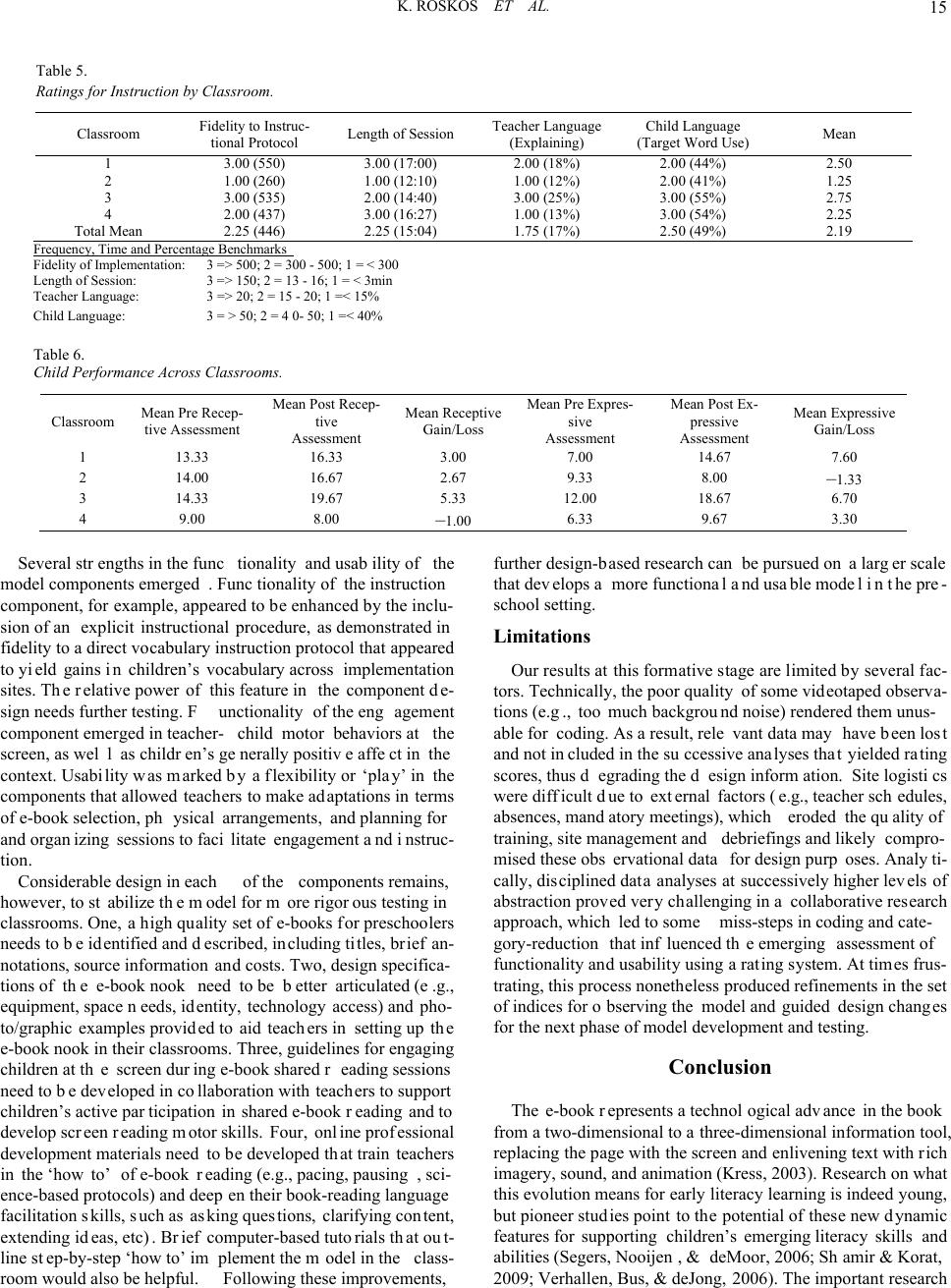 K. ROSKOS ET AL. 15 Table 5. Ratings for Instruct i o n b y C l a s s r o o m . Classroom Fidelity to Instruc- tional Protocol Length of Session Teacher Language (Explaining) Child Language (Target Word Use) Mean 1 3.00 (550) 3.00 (17:00) 2.00 (18%) 2.00 (44%) 2.50 2 1.00 (260) 1.00 (12:10) 1.00 (12%) 2.00 (41%) 1.25 3 3.00 (535) 2.00 (14:40) 3.00 (25%) 3.00 (55%) 2.75 4 2.00 (437) 3.00 (16:27) 1.00 (13%) 3.00 (54%) 2.25 Total Mean 2.25 (446) 2.25 (15:04) 1.75 (17%) 2.50 (49%) 2.19 Frequency, Time and Percentage Benchmarks Fidelity of Implementation: 3 => 500; 2 = 300 - 500; 1 = < 300 Length of Session: 3 => 150; 2 = 13 - 16; 1 = < 3min Teacher Language: 3 => 20; 2 = 15 - 20; 1 =< 15% Child Language: 3 = > 50; 2 = 4 0- 50; 1 =< 40% Table 6. Child Performance Across Classrooms. Classroom Mean Pre Recep- tive Assessment Mean Post Recep- tive Assessment Mean Receptive Gain/Loss Mean Pre Expres- sive Assessment Mean Post Ex- pressive Assessment Mean Expressive Gain/Loss 1 13.33 16.33 3.00 7.00 14.67 7.60 2 14.00 16.67 2.67 9.33 8.00 –1.33 3 14.33 19.67 5.33 12.00 18.67 6.70 4 9.00 8.00 –1.00 6.33 9.67 3.30 Several strengths in the functionality and usability of the model components emerged . Functionality of the instruction component, for example, appeared to be enhanced by the inclu- sion of an explicit instructional procedure, as demonstrated in fidelity to a direct vocabulary instruction protocol that appeared to yield gains in children’s vocabulary across implementation sites. The relative power of this feature in the component de- sign needs further testing. Functionality of the engagement component emerged in teacher-child motor behaviors at the screen, as wel l as children’s generally positive affect in the context. Usability was marked by a flexibility or ‘play’ in the components that allowed teachers to make adaptations in terms of e-book selection, physical arrangements, and planning for and organizing sessions to facilitate engagement and instruc- tion. Considerable design in each of the components remains, however, to stabilize the model for more rigorous testing in classrooms. One, a high quality set of e-books for preschoolers needs to be identified and described, including titles, brief an- notations, source information and costs. Two, design specifica- tions of the e-book nook need to be better articulated (e.g., equipment, space needs, identity, technology access) and pho- to/graphic examples provided to aid teachers in setting up the e-book nook in their classrooms. Three, guidelines for engaging children at the screen during e-book shared reading sessions need to be developed in collaboration with teachers to support children’s active participation in shared e-book reading and to develop screen reading motor skills. Four, online professional development materials need to be developed that train teachers in the ‘how to’ of e-book reading (e.g., pacing, pausing, sci- ence-based protocols) and deepen their book-reading language facilitation skills, such as asking questions, clarifying content, extending ideas, etc). Brief computer-based tutorials that out- line step-by-step ‘how to’ implement the model in the class- room would also be helpful. Following these improvements, further design-based research can be pursued on a larger scale that develops a more functional and usable model in the pre- school setting. Limitations Our results at this formative stage are limited by several fac- tors. Technically, the poor quality of some videotaped observa- tions (e.g., too much background noise) rendered them unus- able for coding. As a result, relevant data may have been lost and not included in the successive analyses that yielded rating scores, thus degrading the d esign information. Site logistics were difficult due to external factors (e.g., teacher schedules, absences, mandatory meetings), which eroded the quality of training, site management and debriefings and likely compro- mised these observational data for design purposes. Analyti- cally, disciplined data analyses at successively higher levels of abstraction proved very challenging in a collaborative research approach, which led to some miss-steps in coding and cate- gory-reduction that influenced the emerging assessment of functionality and usability using a rating system. At times frus- trating, this process nonetheless produced refinements in the set of indices for observing the model and guided design changes for the next phase of model development and testing. Conclusion The e-book represents a technological advance in the book from a two-dimensional to a three-dimensional information tool, replacing the page with the screen and enlivening text with rich imagery, sound, and animation (Kress, 2003). Research on what this evolution means for early literacy learning is indeed young, but pioneer studies point to the potential of these new dynamic features for supporting children’s emerging literacy skills and abilities (Segers, Nooijen, & deMoor, 2006; Shamir & Korat, 2009; Verhallen, Bus, & deJong, 2006). The important research 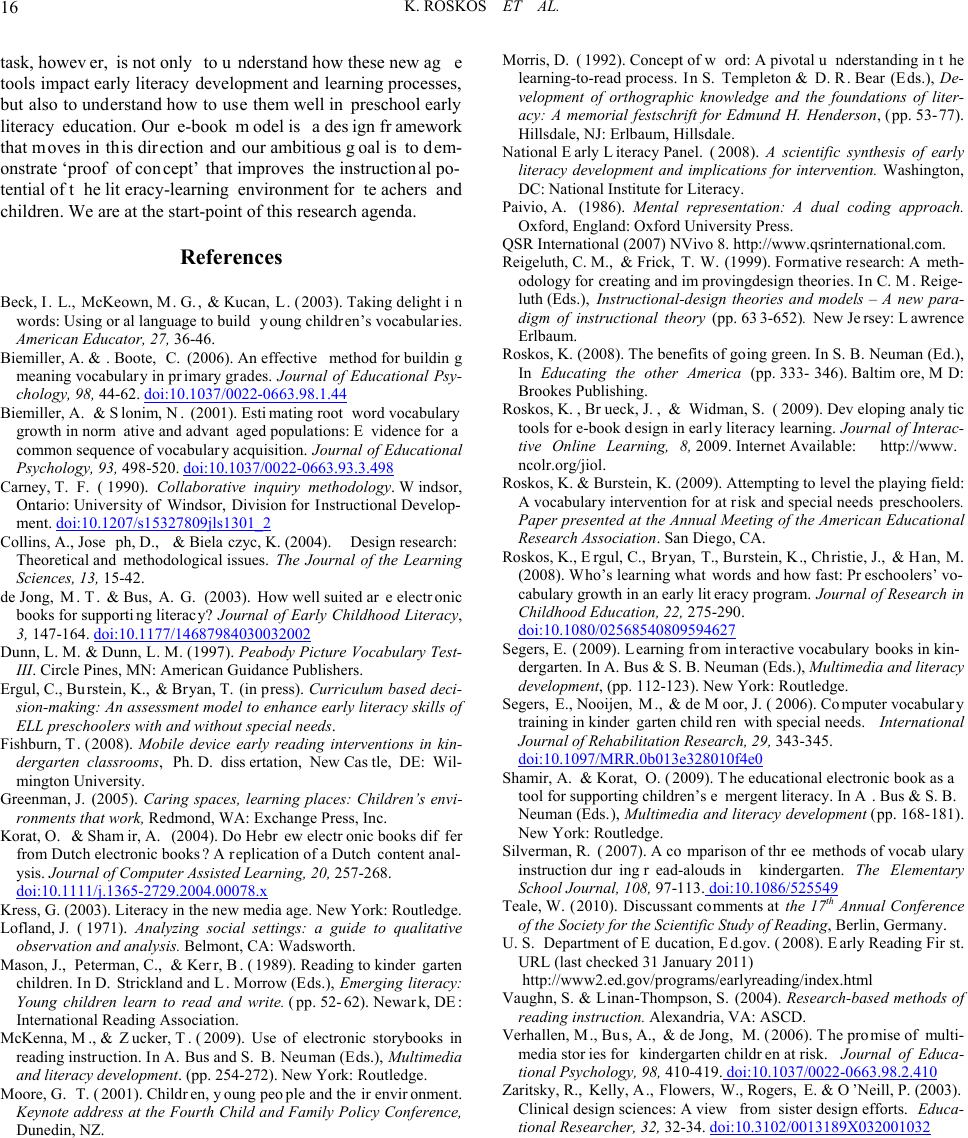 K. ROSKOS ET AL. 16 task, however, is not only to understand how these new age tools impact early literacy development and learning processes, but also to understand how to use them well in preschool early literacy education. Our e-book model is a design framework that moves in this direction and our ambitious goal is to dem- onstrate ‘proof of concept’ that improves the instructional po- tential of t he literacy-learning environment for teachers and children. We are at the start-point of this research agenda. References Beck, I. L., McKeown, M. G., & Kucan, L. (2003). Taking delight in words: Using oral language to build young children’s vocabularies. American Educator, 27, 36-46. Biemiller, A. &. Boote, C. (2006). An effective method for building meaning vocabulary in primary grades. Journal of Educational Psy- chology, 98, 44-62. doi:10.1037/0022-0663.98.1.44 Biemiller, A. & Slonim, N. (2001). Estimating root word vocabulary growth in normative and advant aged populations: E vidence for a common sequence of vocabulary acquisition. Journal of Educational Psychology, 93, 498-520. doi:10.1037/0022-0663.93.3.498 Carney, T. F. (1990). Collaborative inquiry methodology. Windsor, Ontario: University of Windsor, Division for Instructional Develop- ment. doi:10.1207/s15327809jls1301_2 Collins, A., Joseph, D., & Bielaczyc, K. (2004). Design research: Theoretical and methodological issues. The Journal of the Learning Sciences, 13, 15-42. de Jong, M. T. & Bus, A. G. (2003). How well suited ar e electronic books for supporting literacy? Journal of Early Childhood Literacy, 3, 147-164. doi:10.1177/14687984030032002 Dunn, L. M. & Dunn, L. M. (1997). Peabody Picture Vocabulary Test- III. Circle Pines, MN: American Guidance Publishers. Ergul, C., Burstein, K., & Bryan, T. (in press). Curriculum based deci- sion-making: An assessment model to enhance early literacy skills of ELL preschoolers with and without special needs. Fishburn, T. (2008). Mobile device early reading interventions in kin- dergarten classrooms, Ph. D. dissertation, New Castle, DE: Wil- mington University. Greenman, J. (2005). Caring spaces, learning places: Children’s envi- ronments that work, Redmond, WA: Exchange Press, Inc. Korat, O. & Shamir, A. (2004). Do Hebrew electronic books differ from Dutch electronic books? A replication of a Dutch content anal- ysis. Journal of Computer Assisted Learning, 20, 257-268. doi:10.1111/j.1365-2729.2004.00078.x Kress, G. (2003). Literacy in the new media age. New York: Routledge. Lofland, J. (1971). Analyzing social settings: a guide to qualitative observation and analysis. Belmont, CA: Wadsworth. Mason, J., Peterman, C., & Kerr, B. (1989). Reading to kinder garten children. In D. Strickland and L. Morrow (Eds.), Emerging literacy: Young children learn to read and write. (pp. 52-62). Newark, DE: International Reading Association. McKenna, M., & Zucker, T. (2009). Use of electronic storybooks in reading instruction. In A. Bus and S. B. Neuman (Eds.), Multimedia and literacy developm ent. (pp. 254-272). New York: Routledge. Moore, G. T. (2001). Children, young people and their environment. Keynote address at the Fourth Child and Family Policy Conference, Dunedin, NZ. Morris, D. (1992). Concept of word: A pivotal understanding in the learning-to-read process. In S. Templeton & D. R. Bear (Eds.), De- velopment of orthographic knowledge and the foundations of liter- acy: A memorial festschrift for Edmund H. Henderson, (pp. 53-77). Hillsdale, NJ: Erlbaum, Hillsdale. National Early Literacy Panel. (2008). A scientific synthesis of early literacy development and implications for intervention. Washington, DC: National Institute for Literacy. Paivio, A. (1986). Mental representation: A dual coding approach. Oxford, England: Oxford University Press. QSR International (2007) NVivo 8. http://www.qsrinternational.com. Reigeluth, C. M., & Frick, T. W. (1999). Formative research: A meth- odology for creating and improvingdesign theories. In C. M. Reige- luth (Eds.), Instructional-design theories and models – A new para- digm of instructional theory (pp. 633-652). New Jersey: Lawrence Erlbaum. Roskos, K. (2008). The benefits of going green. In S. B. Neuman (Ed.), In Educating the other America (pp. 333-346). Baltimore, MD: Brookes Publishing. Roskos, K., Brueck, J., & Widman, S. (2009). Developing analytic tools for e-book design in early literacy learning. Journal of Interac- tive Online Learning, 8, 2009. Internet Available: http://www. ncolr.org/jiol. Roskos, K. & Burstein, K. (2009). Attempting to level the playing field: A vocabulary intervention for at risk and special needs preschoolers. Paper presented at the Annual Meeting of the American Educational Research Association. San Diego, CA. Roskos, K., Ergul, C., Bryan, T., Burstein, K., Christie, J., & Han, M. (2008). Who’s learning what words and how fast: Preschoolers’ vo- cabulary growth in an early literacy program. Journal of Research in Childhood Education, 22, 275-290. doi:10.1080/02568540809594627 Segers, E. (2009). Learning from interactive vocabulary books in kin- dergarten. In A. Bus & S. B. Neuman (Eds.), Multimedia and literacy development, (pp. 112-123). New York: Routledge. Segers, E., Nooijen, M., & de Moor, J. (2006). Computer vocabulary training in kinder garten children with special needs. International Journal of Rehabilitatio n Research, 29, 343-345. doi:10.1097/MRR.0b013e328010f4e0 Shamir, A. & Korat, O. (2009). The educational electronic book as a tool for supporting children’s emergent literacy. In A . Bus & S. B. Neuman (Eds.), Multimedia and literacy development (pp. 168-181). New York: Routledge. Silverman, R. (2007). A comparison of three methods of vocabulary instruction during read-alouds in kindergarten. The Elementary School Journal, 108, 97-113. doi:10.1086/525549 Teale, W. (2010). Discussant comments at the 17th Annual Conference of the Society for the Scientific Study of Reading, Berlin, Germany. U. S. Department of Education, Ed.gov. (2008). Early Reading First. URL (last checked 31 January 2011) http://www2.ed.gov/programs/earlyreading/index.html Vaughn, S. & Linan-Thompson, S. (2004). Research-based methods of reading instruction. Alexandria, VA: ASCD. Verhallen, M., Bus, A., & de Jong, M. (2006). The promise of multi- media stories for kindergarten children at risk. Journal of Educa- tional Psychology, 98, 410-419. doi:10.1037/0022-0663.98.2.410 Zaritsky, R., Kelly, A., Flowers, W., Rogers, E. & O’Neill, P. (2003). Clinical design sciences: A view from sister design efforts. Educa- tional Researcher, 32, 32-34. doi:10.3102/0013189X032001032 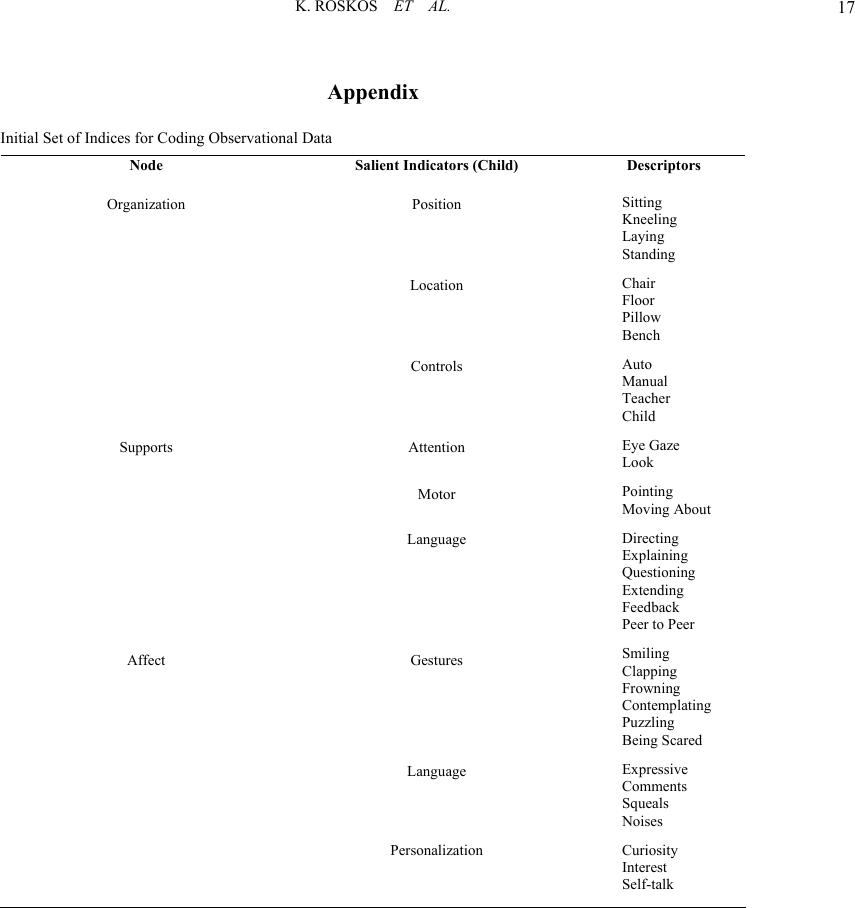 K. ROSKOS ET AL. 17 Appendix Initial Set of Indices for Coding Observational Data Node Salient Indicators (Child) Descriptors Organization Position Sitting Kneeling Laying Standing Location Chair Floor Pillow Bench Controls Auto Manual Teacher Child Supports Attention Eye Gaze Look Motor Pointing Moving About Language Directing Explaining Questioning Extending Feedback Peer to Peer Affect Gestures Smiling Clapping Frowning Contemplating Puzzling Being Scared Language Expressive Comments Squeals Noises Personalization Curiosity Interest Self-talk |