

Paper Menu >>
Journal Menu >>
 Pharmacology & Pharmacy, 2011, 2, 82-87 doi:10.4236/pp.2011.22010 Published Online April 2011 (http://www.SciRP.org/journal/pp) Copyright © 2011 SciRes. PP Symptoms and Their Interpretation in Patients Self-Treating Abdominal Cramping and Pain with a Spasmolytic (Butylscopolamine Bromide) —A Pharmacy-Based Survey Stefan Müller-Lissner1, Eckhard Schäfer2, Anke Kondla2 1Park-Klinik Weissensee, Charité - Universitätsmedizin Berlin, Germany; 2Boehringer Ingelheim, Ingelheim, Germany. Email: [email protected] Received December 13th, 2010; revised February 10th, 2011; accepted March 1st, 2011. ABSTRACT Background: A majority of people suffering from functional abdominal complaints treat themselves with OTC medica- tion. Aim: To gain information on symptoms and their interpretation in patients self-treating abdominal cramping and pain with a spasmolytic (butylscopolamine). Method: 4,680 questionnaires were distributed by 306 pharmacists in Germany to patients suffering from abdominal complaints and buying butylscopolamine. Key findings: Questionnaires from 1,539 respondents were returned, and 1,417 could be evaluated. Abdominal cramping was the major reason for buying butylsco polamine. Only a mino rity of respondents h ad consulted a general practitione r (27.3%) and even less a specialist (12.5%). Only a minority of subjects met expert criteria for irritable bowel syndrome (13%). There was a large overlap between self-reported dysmenorrhoea and bowel symptoms (35%). Conclusions: Real life conditions do not seem to be well covered by expert criteria. Differentiating bo wel origin from uterine origin in pelvic pain syndromes seems especially problematic. This may particularly apply to the OTC market. Keywords: Abdominal Pain, Butylscopolami ne Bromide, Irritable Bowel Syn drome (IBS), Dys men orrhoea 1. Introduction Recent market research has shown that up to 46% of subjects living in the community report abdominal cramp- ing and pain [1]. These are also the most common symp- toms of the irritable bowel syndrome (IBS), but IBS is also associated with changes in bowel habits and disor- dered defecation (diarrhoea/constipation). It has been re- ported that 20-50% of all reports of abdominal cramping and pain can be attribu ted to IBS [2]. This is in line with the prevalence of IBS of 11.5% reported by Hungin and colleagues, based on a community-based survey of over 40,000 subjects living in several European countries [3]. In Germany, the prevalence of IBS is up to 12.5% [4]. The majority of sufferers from abdominal cramping and pain or IBS use self-medication with over-the-counter (OTC) drugs t o relie ve thei r symptoms [4,5]. One of the medications that can be used to treat ab- dominal cramping and pain is butylscopolamine butyl- bromide (from now on abbreviated as butylscopolamine). This is a quaternary ammonium compound which has antispasmodic effects due to an anticholinergic effect on muscarinic receptors on smooth muscle cells in the gas- tro-intestinal tract. Bu tylscopolamine has been registered, in Germany, as a prescription drug for the treatment of IBS symptoms since 1951 and since 2001 also as a non- prescription, or OTC medicine, for the treatment of ab- dominal cramping pain. A recent survey revealed that up to 15% of the German sufferers used butylscopola- mine as their main brand to treat abdominal cramping and pain [5]. The efficacy and safety of butylscopola- mine have been demonstrated in several recently re- viewed pla- cebo-controlled clinical studies [6] but few data is avail- able regarding the use of spasmolytics when obtained OTC. Therefore, the purpose of this pharmacy-based patient survey was to gain information on the use of spasmolytics as a self-medication by patients suffering from abdominal cramping and pain in real-life practice (in this case, those who chose self-treatment with butyl- scopolamine). 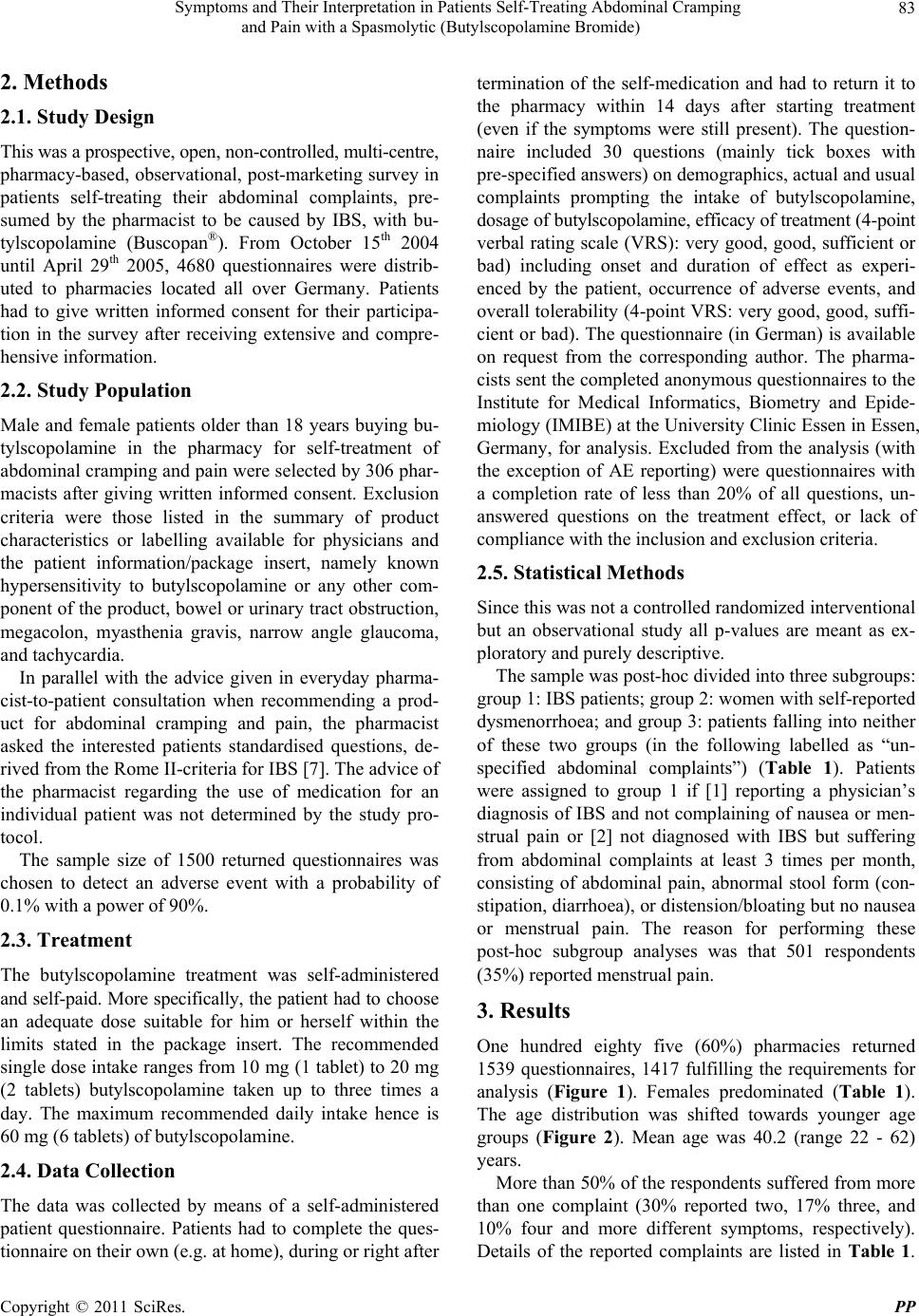 Symptoms and Their Interpretation in Patients Self-Treating Abdominal Cramping 83 and Pain with a Spasmolytic (Butylscopolamine Bromide) 2. Methods 2.1. Study Design This was a prospective, open, non-controlled, multi-centre, pharmacy-based, observational, pos t-marke ting surv ey in patients self-treating their abdominal complaints, pre- sumed by the pharmacist to be caused by IBS, with bu- tylscopolamine (Buscopan®). From October 15th 2004 until April 29th 2005, 4680 questionnaires were distrib- uted to pharmacies located all over Germany. Patients had to give written informed consent for their participa- tion in the survey after receiving extensive and compre- hensive information. 2.2. Study Population Male and female patients older than 18 years buying bu- tylscopolamine in the pharmacy for self-treatment of abdominal cramping and pain were selected by 306 phar- macists after giving written informed consent. Exclusion criteria were those listed in the summary of product characteristics or labelling available for physicians and the patient information/package insert, namely known hypersensitivity to butylscopolamine or any other com- ponent of the product, bowel or urinary tract obstruction, megacolon, myasthenia gravis, narrow angle glaucoma, and tachycardia. In parallel with the advice given in everyday pharma- cist-to-patient consultation when recommending a prod- uct for abdominal cramping and pain, the pharmacist asked the interested patients standardised questions, de- rived from the Rome II-criteria for IBS [7]. The advice of the pharmacist regarding the use of medication for an individual patient was not determined by the study pro- tocol. The sample size of 1500 returned questionnaires was chosen to detect an adverse event with a probability of 0.1% with a power of 90%. 2.3. Treatment The butylscopolamine treatment was self-administered and self-paid. More specifically, the patient had to choo se an adequate dose suitable for him or herself within the limits stated in the package insert. The recommended single dose intake ranges from 10 mg (1 tablet) to 20 mg (2 tablets) butylscopolamine taken up to three times a day. The maximum recommended daily intake hence is 60 mg (6 tablets) of butylscopolamine. 2.4. Data Collection The data was collected by means of a self-administered patient questionnaire. Patients had to complete the ques- tionnaire on their own (e.g. at home), during or right after termination of the self-medication and had to return it to the pharmacy within 14 days after starting treatment (even if the symptoms were still present). The question- naire included 30 questions (mainly tick boxes with pre-specified answers) on demographics, actual and usual complaints prompting the intake of butylscopolamine, dosage of butylscopolamine, efficacy of treatment (4-point verbal rating scale (VRS): very good, good, sufficient or bad) including onset and duration of effect as experi- enced by the patient, occurrence of adverse events, and overall tolerability (4-point VRS: very good , good, suffi- cient or bad). Th e questionnaire (in German) is available on request from the corresponding author. The pharma- cists sent the completed anony mous questionnaires to th e Institute for Medical Informatics, Biometry and Epide- miology (IMIBE) at the University Clinic Essen in Essen, Germany, for analysis. Excluded from the analysis (with the exception of AE reporting) were questionnaires with a completion rate of less than 20% of all questions, un- answered questions on the treatment effect, or lack of compliance with the inclusion and exclusion criteria. 2.5. Statistical Methods Since this was not a controlled randomized interventional but an observational study all p-values are meant as ex- ploratory and p urely descriptive. The sample was post-hoc divided into three subgroups: group 1: IBS patients; group 2: women with self-reported dysmenorrhoea; and group 3: patien ts falling into neither of these two groups (in the following labelled as “un- specified abdominal complaints”) (Table 1). Patients were assigned to group 1 if [1] reporting a physician’s diagnosis of IBS and not complaining of nausea or men- strual pain or [2] not diagnosed with IBS but suffering from abdominal complaints at least 3 times per month, consisting of abdominal pain, abnormal stool form (con- stipation, diarrhoea), or distension/bloating but no nausea or menstrual pain. The reason for performing these post-hoc subgroup analyses was that 501 respondents (35%) reported menstrual pain. 3. Results One hundred eighty five (60%) pharmacies returned 1539 questionnaires, 1417 fulfilling the requirements for analysis (Figure 1). Females predominated (Table 1). The age distribution was shifted towards younger age groups (Figure 2). Mean age was 40.2 (range 22 - 62) years. More than 50% of the respondents suffered from more than one complaint (30% reported two, 17% three, and 10% four and more different symptoms, respectively). Details of the reported complaints are listed in Table 1. Copyright © 2011 SciRes. PP 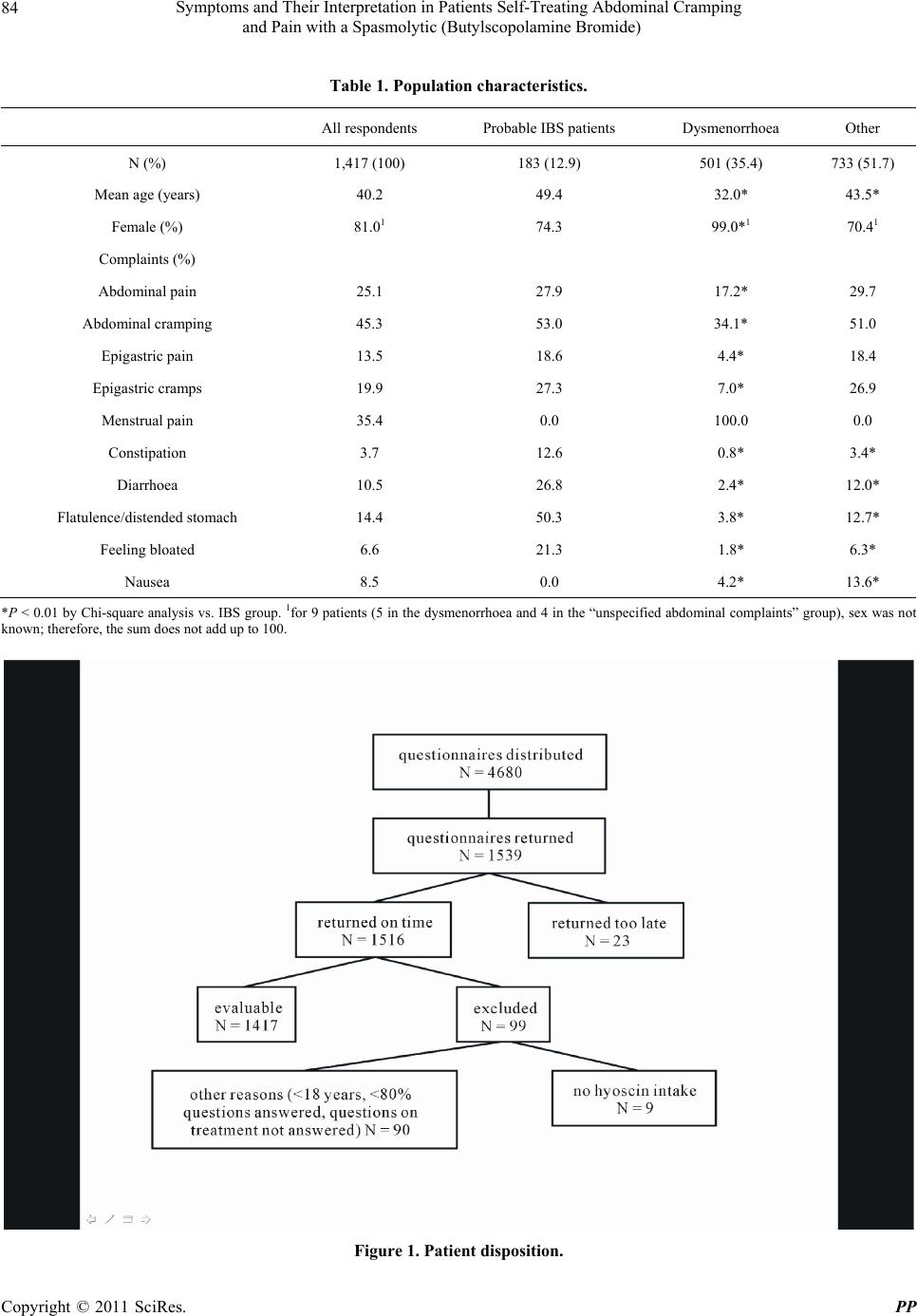 Symptoms and Their Interpretation in Patients Self-Treating Abdominal Cramping and Pain with a Spasmolytic (Butylscopolamine Bromide) Copyright © 2011 SciRes. PP 84 Table 1. Population characteristics. All respondents Probable IBS patients Dysmenorrhoea Other N (%) 1,417 (100) 183 (12.9) 501 (35.4) 733 (51.7) Mean age (years) 40.2 49.4 32.0* 43.5* Female (%) 81.01 74.3 99.0*1 70.41 Complaints (%) Abdominal pain 25.1 27.9 17.2* 29.7 Abdominal cramping 45.3 53.0 34.1* 51.0 Epigastric pain 13.5 18.6 4.4* 18.4 Epigastric cram ps 19.9 27.3 7.0* 26.9 Menstrual pain 35.4 0.0 100.0 0.0 Constipation 3.7 12.6 0.8* 3.4* Diarrhoea 10.5 26.8 2.4* 12.0* Flatulence/distended stomach 14.4 50.3 3.8* 12.7* Feeling bloated 6.6 21.3 1.8* 6.3* Nausea 8.5 0.0 4.2* 13.6* *P < 0.01 by Chi-square analysis vs. IBS group. 1for 9 patients (5 in the dysmenorrhoea and 4 in the “unspecified abdominal complaints” group), sex was not known; the r efore, the sum does not add up to 100. Figure 1. Patient disposition. 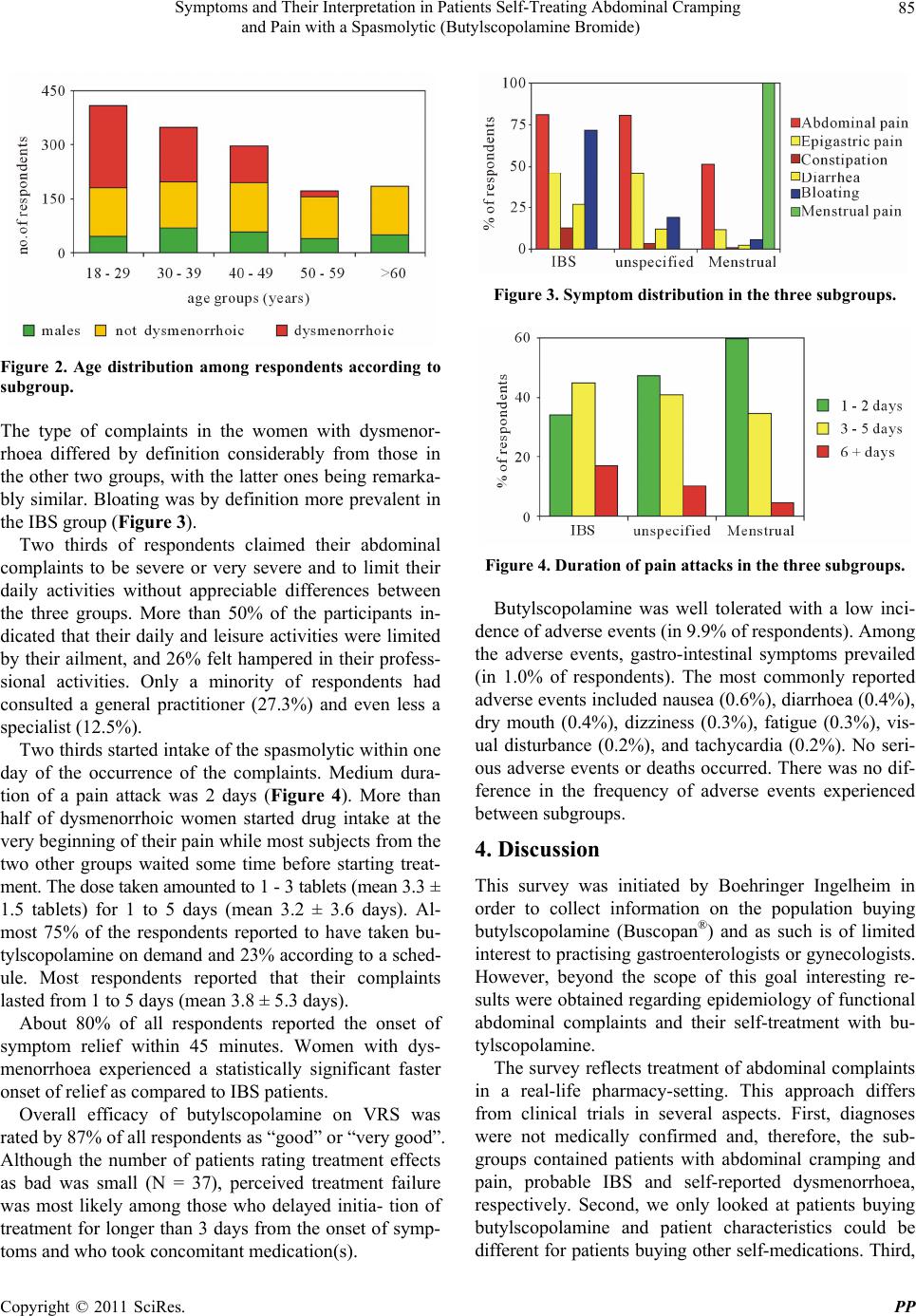 Symptoms and Their Interpretation in Patients Self-Treating Abdominal Cramping 85 and Pain with a Spasmolytic (Butylscopolamine Bromide) Figure 2. Age distribution among respondents according to subgroup. The type of complaints in the women with dysmenor- rhoea differed by definition considerably from those in the other two groups, with the latter ones being remarka- bly similar. Bloating was by definition more prevalent in the IBS group (Figure 3). Two thirds of respondents claimed their abdominal complaints to be severe or very severe and to limit their daily activities without appreciable differences between the three groups. More than 50% of the participants in- dicated that their daily and leisure activities were limited by their ailment, and 26% felt hampered in their profess- sional activities. Only a minority of respondents had consulted a general practitioner (27.3%) and even less a specialist (12.5%). Two thirds started intake of the spasmolytic within one day of the occurrence of the complaints. Medium dura- tion of a pain attack was 2 days (Figure 4). More than half of dysmenorrhoic women started drug intake at the very beginning of their pain while most subjects from the two other groups waited some time before starting treat- ment. The dose taken amounted to 1 - 3 tablets (mean 3.3 ± 1.5 tablets) for 1 to 5 days (mean 3.2 ± 3.6 days). Al- most 75% of the respondents reported to have taken bu- tylscopolamine on demand and 23% according to a sched- ule. Most respondents reported that their complaints lasted from 1 to 5 days (mean 3.8 ± 5.3 days). About 80% of all respondents reported the onset of symptom relief within 45 minutes. Women with dys- menorrhoea experienced a statistically significant faster onset of relief as compared to IBS patients. Overall efficacy of butylscopolamine on VRS was rated by 87% of all respond ents as “good” or “ver y good ”. Although the number of patients rating treatment effects as bad was small (N = 37), perceived treatment failure was most likely among those who delayed initia- tion of treatment for longer than 3 days from the onset of symp- toms and who took concomitant medication(s). Figure 3. Symptom distribution in the three subgroup s. Figure 4. Duration of pain attacks in the three subgroups. Butylscopolamine was well tolerated with a low inci- dence of adverse events (in 9.9% of respondents). Among the adverse events, gastro-intestinal symptoms prevailed (in 1.0% of respondents). The most commonly reported adverse events included nausea (0.6%), diarrhoea (0.4%), dry mouth (0.4%), dizziness (0.3%), fatigue (0.3%), vis- ual disturbance (0.2%), and tachycardia (0.2%). No seri- ous adverse events or deaths occurred. There was no dif- ference in the frequency of adverse events experienced between subgroups. 4. Discussion This survey was initiated by Boehringer Ingelheim in order to collect information on the population buying butylscopolamine (Buscopan®) and as such is of limited interest to practisin g gastroenterolog ists or gynecologists. However, beyond the scope of this goal interesting re- sults were obtained regarding epidemiology of functional abdominal complaints and their self-treatment with bu- tylscopolamine. The survey reflects treatment of abdominal complaints in a real-life pharmacy-setting. This approach differs from clinical trials in several aspects. First, diagnoses were not medically confirmed and, therefore, the sub- groups contained patients with abdominal cramping and pain, probable IBS and self-reported dysmenorrhoea, respectively. Second, we only looked at patients buying butylscopolamine and patient characteristics could be different for patients buying other self-medications. Third, Copyright © 2011 SciRes. PP 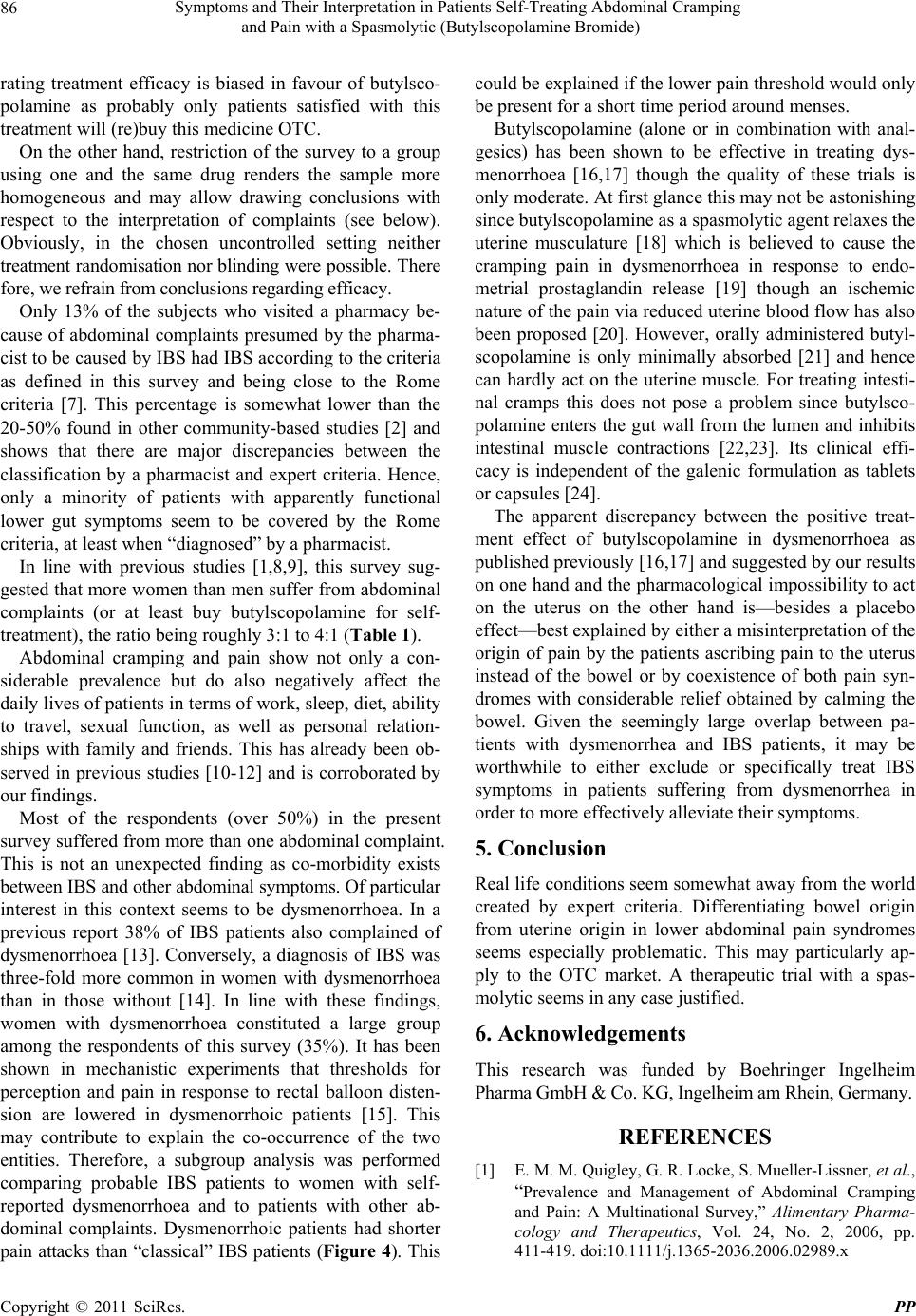 Symptoms and Their Interpretation in Patients Self-Treating Abdominal Cramping 86 and Pain with a Spasmolytic (Butylscopolamine Bromide) rating treatment efficacy is biased in favour of butylsco- polamine as probably only patients satisfied with this treatment will (re)buy this medicine OTC. On the other hand, restriction of the survey to a group using one and the same drug renders the sample more homogeneous and may allow drawing conclusions with respect to the interpretation of complaints (see below). Obviously, in the chosen uncontrolled setting neither treatment randomisation nor blinding were possible. There fore, we refrain from conclusions regarding efficacy. Only 13% of the subjects who visited a pharmacy be- cause of abdominal complaints presu med by the pharma- cist to be caused by IBS had IBS according to the criteria as defined in this survey and being close to the Rome criteria [7]. This percentage is somewhat lower than the 20-50% found in other community-based studies [2] and shows that there are major discrepancies between the classification by a pharmacist and expert criteria. Hence, only a minority of patients with apparently functional lower gut symptoms seem to be covered by the Rome criteria, at least when “diagnosed” by a pharmacist. In line with previous studies [1,8,9], this survey sug- gested that more women than men suffer from abdominal complaints (or at least buy butylscopolamine for self- treatment ), the ratio being rou ghl y 3: 1 t o 4: 1 (Table 1). Abdominal cramping and pain show not only a con- siderable prevalence but do also negatively affect the daily lives of patients in terms of work, sleep, diet, ability to travel, sexual function, as well as personal relation- ships with family and friends. This has already been ob- served in previo us studies [10-12] and is corroborated by our findings. Most of the respondents (over 50%) in the present survey suffered from more than one abdomina l complaint. This is not an unexpected finding as co-morbidity exists between IBS and other abdominal symptoms. Of particular interest in this context seems to be dysmenorrhoea. In a previous report 38% of IBS patients also complained of dysmenorrhoea [13]. Conversely, a diagnosis of IBS was three-fold more common in women with dysmenorrhoea than in those without [14]. In line with these findings, women with dysmenorrhoea constituted a large group among the respondents of this survey (35%). It has been shown in mechanistic experiments that thresholds for perception and pain in response to rectal balloon disten- sion are lowered in dysmenorrhoic patients [15]. This may contribute to explain the co-occurrence of the two entities. Therefore, a subgroup analysis was performed comparing probable IBS patients to women with self- reported dysmenorrhoea and to patients with other ab- dominal complaints. Dysmenorrhoic patients had shorter pain attacks than “classical” IBS patients (Figure 4). This could be explained if the lower pain threshold would only be present for a short time period around menses. Butylscopolamine (alone or in combination with anal- gesics) has been shown to be effective in treating dys- menorrhoea [16,17] though the quality of these trials is only moderate. At first glance this may not be astonishing since butylscopolamine as a spasmolytic agent relaxes the uterine musculature [18] which is believed to cause the cramping pain in dysmenorrhoea in response to endo- metrial prostaglandin release [19] though an ischemic nature of the pain via reduced uterine blood flow has also been proposed [20]. However, orally administered butyl- scopolamine is only minimally absorbed [21] and hence can hardly act on the uterine muscle. For treating intesti- nal cramps this does not pose a problem since butylsco- polamine enters the gut wall from the lumen and inhibits intestinal muscle contractions [22,23]. Its clinical effi- cacy is independent of the galenic formulation as tablets or capsules [24]. The apparent discrepancy between the positive treat- ment effect of butylscopolamine in dysmenorrhoea as published previously [16,17] and suggested by our results on one hand and the pharmacological impossibility to act on the uterus on the other hand is—besides a placebo effect—best explained by either a misinterpretation of the origin of pain by the patients ascribing pain to the uterus instead of the bowel or by coexistence of both pain syn- dromes with considerable relief obtained by calming the bowel. Given the seemingly large overlap between pa- tients with dysmenorrhea and IBS patients, it may be worthwhile to either exclude or specifically treat IBS symptoms in patients suffering from dysmenorrhea in order to more effectively alleviate their symptoms. 5. Conclusion Real life conditions seem somewhat away from the world created by expert criteria. Differentiating bowel origin from uterine origin in lower abdominal pain syndromes seems especially problematic. This may particularly ap- ply to the OTC market. A therapeutic trial with a spas- molytic seems in any case justified. 6. Acknowledgements This research was funded by Boehringer Ingelheim Pharma GmbH & Co. KG, Ingelheim am Rhein, Germ any. REFERENCES [1] E. M. M. Quigley, G. R. Locke, S. Mueller-Lissner, et al., “Prevalence and Management of Abdominal Cramping and Pain: A Multinational Survey,” Alimentary Pharma- cology and Therapeutics, Vol. 24, No. 2, 2006, pp. 411-419. doi:10.1111/j.1365-2036.2006.02989.x Copyright © 2011 SciRes. PP  Symptoms and Their Interpretation in Patients Self-Treating Abdominal Cramping and Pain with a Spasmolytic (Butylscopolamine Bromide) Copyright © 2011 SciRes. PP 87 [2] D. A. Drossman, Z. Li, E. Andruzzi, et al., “U.S. House- holder Survey of Functional Gastrointestinal Disorders,” Prevalence, Sociodemography, and Health Impact, Di- gestive Disease and Sciences, Vol. 38, No. 9, 1993, pp. 1569-1580. [3] A. P. S. Hungin, P. J. Whorwell, J. Tack and F. Mearin, “The Prevalence, Patterns and Impact of Irritable Bowel Syndrome: An International Survey of 40 000 Subjects,” Alimentary Pharmacology and Therapeutics, Vol. 17, 2003, pp. 643-650. doi:10.1046/j.1365-2036.2003.01456.x [4] A. Icks, B. Haastert, P. Enck, W. Rathmann and G. Giani, “Prevalence of Functional Bowel Disorders and Related Health Care Seeking: A Population-Based Study,” Zeitschrift für Gastroenterologie, Vol. 40, No. 3, 2002, pp. 177-183. doi:10.1055/s-2002-22324 [5] S. Mueller-Lissner, E. M. M. Quigley, I. Helfrich and E. Schaefer, “Drug Treatment of Chronic-Intermittent Ab- dominal Cramping and Pain: A Multi-National Survey on Usage and Attitudes,” Alimentary Pharmacology and Therapeutics, Vol. 32, No. 3, 2010, pp. 472-477. doi:10.1111/j.1365-2036.2010.04368.x [6] G. N. Tytgat, “Hyoscine Butylbromide—A Review of Its Use in the Treatment of Abdominal Cramping and Pain,” Drugs, Vol. 67, No. 9, 2008, pp. 1343-1357. [7] W. G. Thompson, G. F. Longstreth, D. A. Drossman, et al., “Functional Bowel Disorders and Functional Abdo- minal Pain,” Gut, Vol. 45, Suppl. 2, 1999, pp. 43-47. doi:10.1136/gut.45.2008.ii43 [8] L. Chang, “Review Article: Epidemiology and Quality of Life in Functional Gastrointestinal Disorders,” Alimen- tary Pharmacology and Therapeutics, Vol. 20, Suppl. 7, 2004, pp. 31-39 [9] F. Mearin, X. Badia, A. Balboa, et al., “Irritable Bowel Syndrome Prevalence Varies Enormously Depending on the Employed Diagnostic Criteria: Comparison of Rome II versus Previous Criteria in a General Population,” Scandinavian Journal of Gastroenterology, Vol. 36, No. 11, 2001, pp. 1155-1161. [10] A. P. S. Hungin, L. Chang, G. R. Locke, E. H. Dennis and V. Barghout, “Irritable Bowel Syndrome in the United States: Prevalence, Symptom Patterns and Impact,” Ali- mentary Pharmacology and Therapeutics, Vol. 21, No. 11, 2005, pp. 1365-1375. doi:10.1111/j.1365-2036.2005.02463.x [11] M. Proctor and C. Farquhar, “Diagnosis and Management of Dysmenorrhoea,” British Medical Journal, Vol. 332, No. 7550, 2006, pp. 1134-1138. doi:10.1136/bmj.332.7550.1134 [12] D. B. Silk, “Impact of Irritable Bowel Syndrome on Personal Relationships and Working Practices,” Euro- pean Journal of Gastroenterology, Vol. 13, No. 11, 2001, pp. 1327-1332. doi:10.1097/00042737-200111000-00011 [13] G. Altman, K. C. Cain, S. Motzer, et al., “Increased Symptoms in Female IBS Patients with Dysmenorrhea and PMS,” Gastroenterology Nursing, Vol. 29, No. 1, 2006, pp. 4-11. doi:10.1097/00001610-200601000-00002 [14] M. D. Crowell, N. H. Dubin, J. C. Robinson, et al., “Functional Bowel Disorders in Women with Dysme- norrhea,” American Journal of Gastroenterology, Vol. 89, No. 11, 1994, pp. 1973-1977. [15] W. Brinkert, G. Dimcevski, L. Arendt-Nielsen, A. M. Drewes and O. H. Wilder-Smith, “Dysmenorrhoea is Associated with Hypersensitivity in the Sigmoid Colon and Rectum,” Pain, Vol. 132, Suppl. 1, 2007, pp. 46-51. doi:10.1016/j.pain.2006.12.011 [16] A. R. de los Santos, R. Zmijanovich, M. S. Perez, M. L. Marti and G. Di Girolamo, “Antispasmodic/Analgesic Associations in Primary Dysmenorrhea Double-Blind Crossover Placebo-Controlled Clinical Trial,” Inter- national Journal of Clinical Pharmacology Research, Vol. 21 No. 1, 2001, pp. 21-29. [17] J. H. Kemp, “Buscopan in Spasmodic Dysmenorrhoea,” Current Medical Research and Opinion, Vol. 1, No. 1, 1972, pp. 19-25. doi:10.1185/03007997209111141 [18] K. Fujimoto, A. Nakai, T. Okada, T. Ikeuchi, N. Satogami, S. Daido, M. Yakami and K. Togashi, “Effect of Hyoscine Butylbromide (HBB) on the Uterine Corpus: Quantitative Assessment with T2-Weighted (T2W) MRI in Healthy Volunteers,” Journal of Magnetic Resonance Imaging, Vol. 32, No. 2, 2010, pp. 441-445. doi:10.1002/jmri.22252 [19] O. Ylikorkala and M. Y. Dawood, “New Concepts in Dysmenorrhea,” American Journal of Obstetrics and Gynecology, Vol. 130, No. 7, 1978, pp. 833-847. [20] S. Altunyurt, M. Gol, S. Altunyurt, O. Sezer and N. Demir, “Primary Dysmenorrhea and Uterine Blood Flow: A Color Doppler Study,” Journal of Reproductive Medicine, Vol. 50, No. 4, 2005, pp. 251-255. [21] K. Hellstrom, A. Rosen and K. Soderlund, “The Gastrointestinal Absorption and the Excretion of H3 Butylscopolamine (Hyoscine Butylbromide) in Man,” Scandinavian Journal of Gastroenterology, Vol. 5, No. 7, 1970, pp. 585-592. [22] A. R. Pomeroy and M. J. Rand, “Anticholinergic Effects and Passage through the Intestinal Wall of N-Buthyl- hyoscine Bromide,” Journal of Pharmacy and Pharma- cology, Vol. 21, No. 3, 1969, pp. 180-187. doi:10.1111/j.2042-7158.1969.tb08224.x [23] A. Sagrada, A. Schiavone, A. Cefala, P. Trespi and A. Giachetti, “N-Butyl Hyoscine Exerts Local Spasmolytic Effect in the Small and Large Bowel of the Conscious Dog,” Archives Internationales de Pharmacodynamie et de Therapie, Vol. 287, No. 2, 1987, pp. 237-247. [24] Z. Ge, Y. Yuan, S. Zhang, X. Hou, J. Wang, J. Cai, R. Shi, Y. Li, B. Wang and F. Ji, E. Richter and E. Schaefer, “Efficacy and Tolerability of Two Oral Hyoscine Butyl- bromide Formulations in Chinese Patients with Recurrent Episodes of Self-Reported Gastric or Intestinal Spasm- Like Pain,” International Journal of Clinical Pharmac- ology and Therapeutic, Vol. 49, No. 3, 2011, pp. 198-205. |