

Paper Menu >>
Journal Menu >>
 Pharmacology & Pharmacy, 2011, 2, 67-72 doi:10.4236/pp.2011.22008 Published Online April 2011 (http://www.SciRP.org/journal/pp) Copyright © 2011 SciRes. PP 67 Studies on the in Vitro Dissolution of Insoluble Volatile Drug from Su-Anxin Nasal Inhalant and Its Correlation on the Nose Steady Self-Controllable Expiration and Inspiration at Night Xiaodong Li 1,2, Guoxiang Xie2, Suyun Li1,3, Chao Hou1,3 1College of Pharmacy, Fujian University of Traditional Chinese Medicine, Fuzhou, China; 2 Department of Nutrition, University of North Carolina at Greensboro, North Carolina Research Campus, Kannapolis, USA; 3Nasal preparation institute of traditional Chi- nese medicine of Fujian province, College of Pharmacy, Fujian University of Traditional Chinese Medicine, Fuzhou, China. Email: [email protected] Received February 1st, 2011; revised March 2nd, 2011; accepted March 12th, 2011. ABSTRACT In the paper, the in vitro dissolution of borneo l in 12 hou rs from 6 batches of optimized inhalant samples were investi- gated. As a new dosage form, the in vitro release apparatus of nasal inhalant was invented and a pushing bump was used accord ing to the simulation of the nose expiration and inspiration. Based on the data of r2 in the profile and simi- lar factor f2 from 6 linear release tendencies, a good controlled release and a zero order tendency were observed. It can be suggested that there is a good correlation between the in vitro controlled release and the nose steady self-controllable expiration and inspira tion, which will contribute to the tren d of insoluble volatile d rug controlled release and the effect of quick absorption in nasal pulmonary delivery to cure severe or acute cardiovascular or lung diseases at patients’ sleeping, such as angina or breathing obstruction. Also, it was concluded that the prescription composed of insoluble volatile drugs can be prepared to be nasal inhalant from which drugs can be absorbed through nose steady self-controllable insp iration to the lung then in to the blood and have a great effectiveness improvement of bioava ilabil- ity at night timing drug delivery system. Keywords: Su-Anxin Nasal Inhalants, Insoluble Vola tile Drugs, Timing Drug Delivery System, In Vitro Dissolution, Controlled Release 1. Introduction Aromatherapy, a practice of therapeutic use of essential plant-based oils or other volatile materials for relieving anxieties and stresses, improving body immunity and curing some uncertain diseases, has played a great role in the care of our health and many products of natural es- sential oil, such as cosmetics, are gaining a pretty good sale every year. In China, the herbs with essential oils have been used as traditional Chinese medicine to cure different kinds of diseases for several thousand years. In recent literatures , quite a lot of researches were reported for aromatherapy to have an good effect on Alzheimer’s disease, anxiety symptoms, stress, supportive care of can- cer patients, hypertension, cognition and mood modula- tion, psychiatric disorders, inhalational anaesthetic agents, cardiovascular disease and so on [1-11]. In this paper a new use mode and dosage form, named Su-anxin nasal inhalant, was mainly introduced to cure cardiovascular or pulmonary disease in patients’ sleeping. As a kind of aromatherapy, this nasal inhalant not only gave the scientific proofs at its device and in vitro release test, but also brought a product for healthcare with good convenience, low cost, steady dose and high bioavail- ability. Su-anxin nasal inhalant was defined as an inhaled preparation which is composed of a kind of equipment with two sides, one stuck to the middle part, called phil- trum, under the nose with the help of some stickers, the 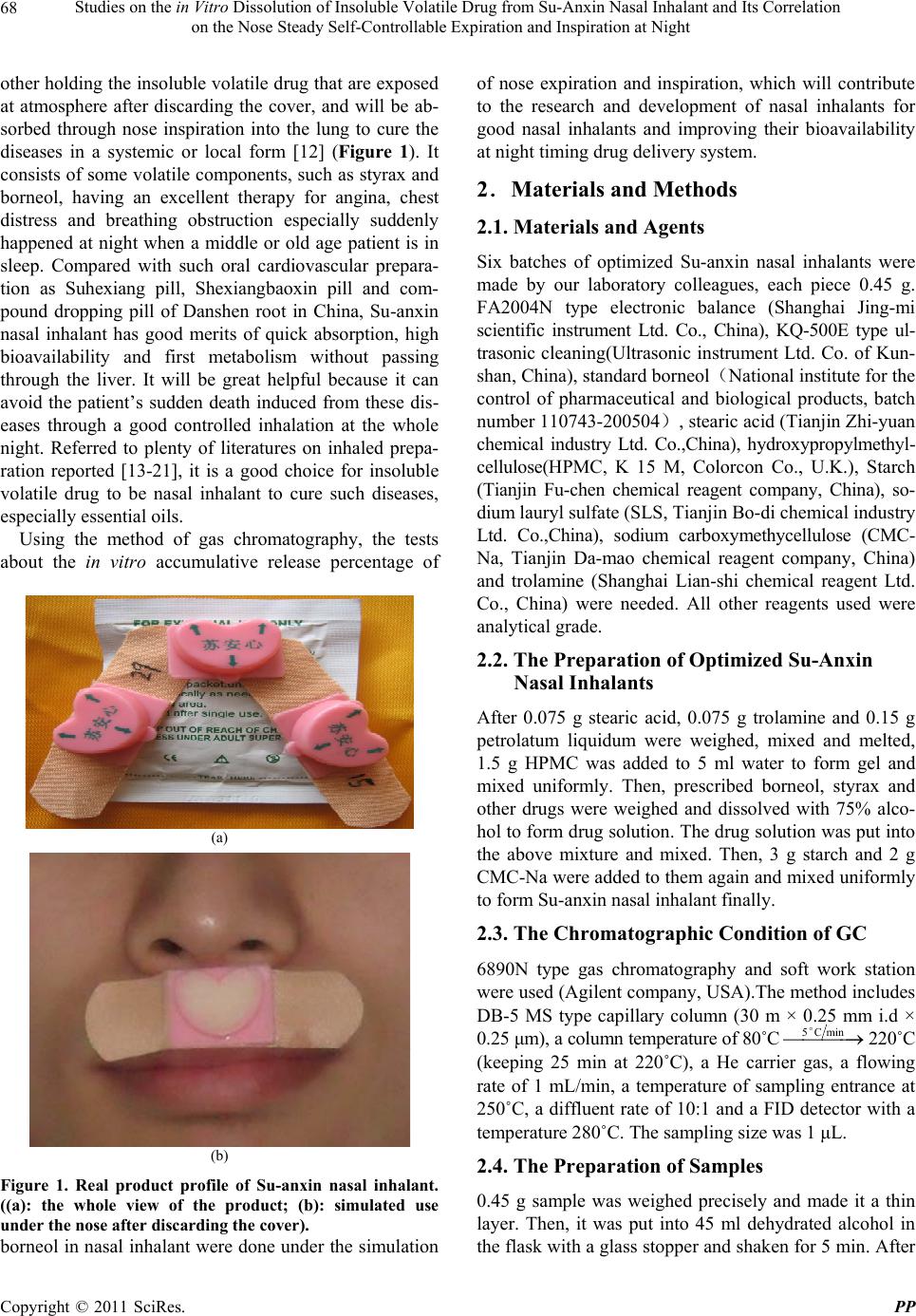 Studies on the in Vitro Dissolution of Insoluble Volatile Drug from Su-Anxin Nasal Inhalant and Its Correlation 68 on the Nose Steady Self-Controllable Expiration and Inspiration at Night other holding the insoluble volatile drug that are exposed at atmosphere after discarding the cover, and will be ab- sorbed through nose inspiration into the lung to cure the diseases in a systemic or local form [12] (Figure 1). It consists of some volatile components, such as styrax and borneol, having an excellent therapy for angina, chest distress and breathing obstruction especially suddenly happened at night when a middle or old age patient is in sleep. Compared with such oral cardiovascular prepara- tion as Suhexiang pill, Shexiangbaoxin pill and com- pound dropping pill of Danshen root in China, Su-anxin nasal inhalant has good merits of quick absorption, high bioavailability and first metabolism without passing through the liver. It will be great helpful because it can avoid the patient’s sudden death induced from these dis- eases through a good controlled inhalation at the whole night. Referred to plenty of literatures on inhaled prepa- ration reported [13-21], it is a good choice for insoluble volatile drug to be nasal inhalant to cure such diseases, especially essential oils. Using the method of gas chromatography, the tests about the in vitro accumulative release percentage of (a) (b) Figure 1. Real product profile of Su-anxin nasal inhalant. ((a): the whole view of the product; (b): simulated use under the nose after discarding the cover). borneol in nasal inhalant were done under the simulation of nose expiration and inspiration, which will contribute to the research and development of nasal inhalants for good nasal inhalants and improving their bioavailability at night timing drug delivery system. 2.Materials and Methods 2.1. Materials and Agents Six batches of optimized Su-anxin nasal inhalants were made by our laboratory colleagues, each piece 0.45 g. FA2004N type electronic balance (Shanghai Jing-mi scientific instrument Ltd. Co., China), KQ-500E type ul- trasonic cleaning(Ultrasonic instrument Ltd. Co. of Kun- shan, China), standard borneol(National institute for the control of pharmaceutical and biological products, batch number 110743-200504), stearic acid (Tianjin Zhi-yuan chemical industry Ltd. Co.,China), hydroxypropylmethyl- cellulose(HPMC, K 15 M, Colorcon Co., U.K.), Starch (Tianjin Fu-chen chemical reagent company, China), so- dium lauryl sulfate (SLS, Tianjin Bo-di chemical industry Ltd. Co.,China), sodium carboxymethycellulose (CMC- Na, Tianjin Da-mao chemical reagent company, China) and trolamine (Shanghai Lian-shi chemical reagent Ltd. Co., China) were needed. All other reagents used were analytical grade. 2.2. The Preparation of Optimized Su-Anxin Nasal Inhalants After 0.075 g stearic acid, 0.075 g trolamine and 0.15 g petrolatum liquidum were weighed, mixed and melted, 1.5 g HPMC was added to 5 ml water to form gel and mixed uniformly. Then, prescribed borneol, styrax and other drugs were weighed and dissolved with 75% alco- hol to form drug solution. The drug solution was put into the above mixture and mixed. Then, 3 g starch and 2 g CMC-Na were added to them again and mixed uniformly to form Su-anxin nasal inhalant finally. 2.3. The Chromatographic Condition of GC 6890N type gas chromatography and soft work station were used (Agilent company, USA).The method includes DB-5 MS type capillary column (30 m × 0.25 mm i.d × 0.25 μm), a column temperature of 80˚C5Cmin 220˚C (keeping 25 min at 220˚C), a He carrier gas, a flowing rate of 1 mL/min, a temperature of sampling entrance at 250˚C, a diffluent rate of 10:1 and a FID detector with a temperature 280˚C. The sampling size was 1 μL. 2.4. The Preparation of Samples 0.45 g sample was weighed precisely and made it a thin layer. Then, it was put into 45 ml dehydrated alcohol in the flask with a glass stopper and shaken for 5 min. After Copyright © 2011 SciRes. PP  Studies on the in Vitro Dissolution of Insoluble Volatile Drug from Su-Anxin Nasal Inhalant and Its Correlation 69 on the Nose Steady Self-Controllable Expiration and Inspiration at Night 24 h in a tight state, the solution was ultrasounded 10 min and filtered into 50 ml measuring flask. Moreover, mod- erate dehydrated alcohol was added to wash the flask with a glass stopper and filtered into measuring flask again. After metered with dehydrated alcohol, the sample solution was prepared. The total six batches were done. 2.5. The Preparation of Standard Solution Standard borneol 25 mg was weighed precisely and put it into 25 mL measuring flask. After dissolved and metered by dehydrated alcohol, the standard solution at real con- centration 1.004 mg/mL was obtained. 2.6. The Preparation of Negative Solution Prescribed styrax and other drugs except borneol were weighed and negative product was prepared on the basis of the item 2.2. Then, according to the item 2.4, the nega- tive solution was obtained. 2.7. Dissolution Studies Borneol releases from the different 6 batches inhalants were determined using self-made dissolution apparatus (Figure 2) designed for simulation of our nose expiration and inspiration with 50 ml of dehydrated alcohol as dis- solution medium. The temperature of the dissolution me- dium was maintained at room temperature. 20 ml dehy- drated alcohol was added into conical flask and the inha- lant sample was put in the intubation tube with the drug surface upwards. One point of intubation tube was set beneath the liquid of dehydrated alcohol in the conical flask and, the other was blocked by a glass stopper. There is an inlet beside the intubation tube near to the stopper, Figure 2. the test apparatus of the in vitro release for in- halants. through which the mild wind was pushed into the tube by a pushing bump and the gas from insoluble volatile drug was taken into the liquid and dissolved in the dehydrated alcohol with the wind while other gases from the atmos- phere were sent out to atmosphere. When the release time came, the push bump was turned off and the conical flask was taken down. Meanwhile, a new conical flask with 20 ml dehydrated alcohol in it was connected to the intubation tube quickly to assure the next continual test. Then, previous about 20 ml dehydrated alcohol was put into measuring flask and metered. Samples of 20 ml were withdrawn at 0.5, 1.0, 2.0, 4.0, 6.0, 8.0 and 12.0 hour and replaced 20.0 ml fresh dissolution media every scheduled time.Analysis of dissolved borneol in the dehydrated alcohol solution was conducted by GC method. All ex- periments were performed in triplicate. 3. Results and Discussion 3.1. The Calibration Curve of Borneol To determine the linearity of the GC detector response, calibration standard solutions of borneol at the concen- tration of 20.08, 40.16, 60.24, 80.32 and 100.4 μg/mL were prepared on the basis of item 2.5. Linear correlation was obtained between peak areas versus concentration of borneol. Each measurement represented the average of three replicates. The regression equation was A = 4.8582C + 14.809 (r = 0.9998), which indicates a good linear rela- tion between peaks and borneol concentration at the range of 20.08 ~ 100.4 μg/ml. Related spectrum can be seen at Figure 3. 3.2. Accuracy, Reproducibility, Repeatability and Recovery Accuracy was performed by running the borneol standard solution of 60.24 μg/ml for 5 continual times under the same conditions. Reproducibility was evaluated by ana- lyzing one sample after diluted 10 times at interval 8 hours. Repeatability was performed by running 5 pieces of samples after diluted 10 times under the same condi- tions. Recoveries varied between 99.0% and 104.4% with RSD 1.96%. The results obtained shows that the method is very accurate and precise, which were pre- sented in Tables 1-4. 3.3. Determination of Borneol in Sample The total 6 batches samples were analyzed by GC method and average determination were 8.26%, 8.96%, 8.21%, 8.37%, 8.50% and 8.32% respectively, which could be used as the total quantity of borneol in the test of the in vitro dissolution. Copyright © 2011 SciRes. PP  Studies on the in Vitro Dissolution of Insoluble Volatile Drug from Su-Anxin Nasal Inhalant and Its Correlation 70 on the Nose Steady Self-Controllable Expiration and Inspiration at Night 3.4. The Release of Borneol from Su-anxin Inhalants In order to express the correlation between the controlled release and the nose expiration and inspiration at night, a series of our previous screenings of prescription on o/w, w/o and other excipients’ choice [22] were cancelled and just the in vitro dissolution release behaviors of borneol from 6 batches optimized Su-anxin inhalants were done. The all accumulative releases of borneol from inhalants were controllable, showing a tendency of zero order re- lease (the lest r2 = 0.9784). Table 5 and Figure 4 illus- trated the data and the profile of the release in 12 hours. However, if the illustration was shown without the point of the time at 0.5 hour, the tendency of zero order release was more obvious than that in 12 hours, which could be seen in Table 6 and Figure 5. From the point at 0.5 hour, the largest release percentage was observed, showing the first large concentration of insoluble volatile drug at the surface of the preparation and a prompt absorption through nasal lung delivery. The phenomenon was interestingly accorded with the previous in vivo test which gave a Cmax of borneol in the blood of rabbits [23]. (a) (b) (c) Figure 3. The GC illustration of borneol in inhalant. ((a) standard solution; (b) sample solution; (c) negative sample solution without borneol). Table 1. The data on the accuracy trial (n = 5). times 1 2 3 4 5 peak area295.4 298.6 292.1 297.2 294.8 RSD% 1.78 Table 2. The data on the reproducibility trial (n = 6). time(h) 0.5 1 2 4 6 8 peak area 422.0410.1402.6 400.0 394.2387.1 RSD% 3.04 Table 3. The data on the repeatability trial (n = 5). times 1 2 3 4 5 peak area 369.1 363.0 359.1 347.8 354.3 RSD% 2.27 Table 4. The data on the recovery trial (n = 6). samples (mg) borneol in samples (mg) added standard (mg) Theoretical borneol (mg) Measured borneol (mg) recovery (%) RSD % 223.719.9 20.1 40.0 39.8 99.0 219.519.6 20.2 39.8 39.9 100.5 222.919.9 20.2 40.1 40.5 102.0 224.220.0 20.3 40.3 40.6 101.5 223.119.9 19.9 39.8 39.7 99.5 218.619.5 20.3 39.8 40.7 104.4 1.96 Table 5. The data of in vitro accumulative release from 6 batches inhalants. time(h) 0.5 1 2 4 6 8 12 batch1(%) 2.383.957.4110.43 14.07 16.89 22.1 batch2(%) 2.363.635.378.89 12.07 14.9219.83 batch3(%) 2.033.365.228.89 12.05 15.0120.04 batch4(%) 2.855.217.1511.25 14.93 18.06 23.18 batch5(%) 2.5 4.186.099.86 12.57 15.9820.91 batch6(%) 2.674.527.1511.14 14.14 17.09 22.65 Figure 4. The dissolution release profile of borneol from inhalants in 12 hours. Copyright © 2011 SciRes. PP 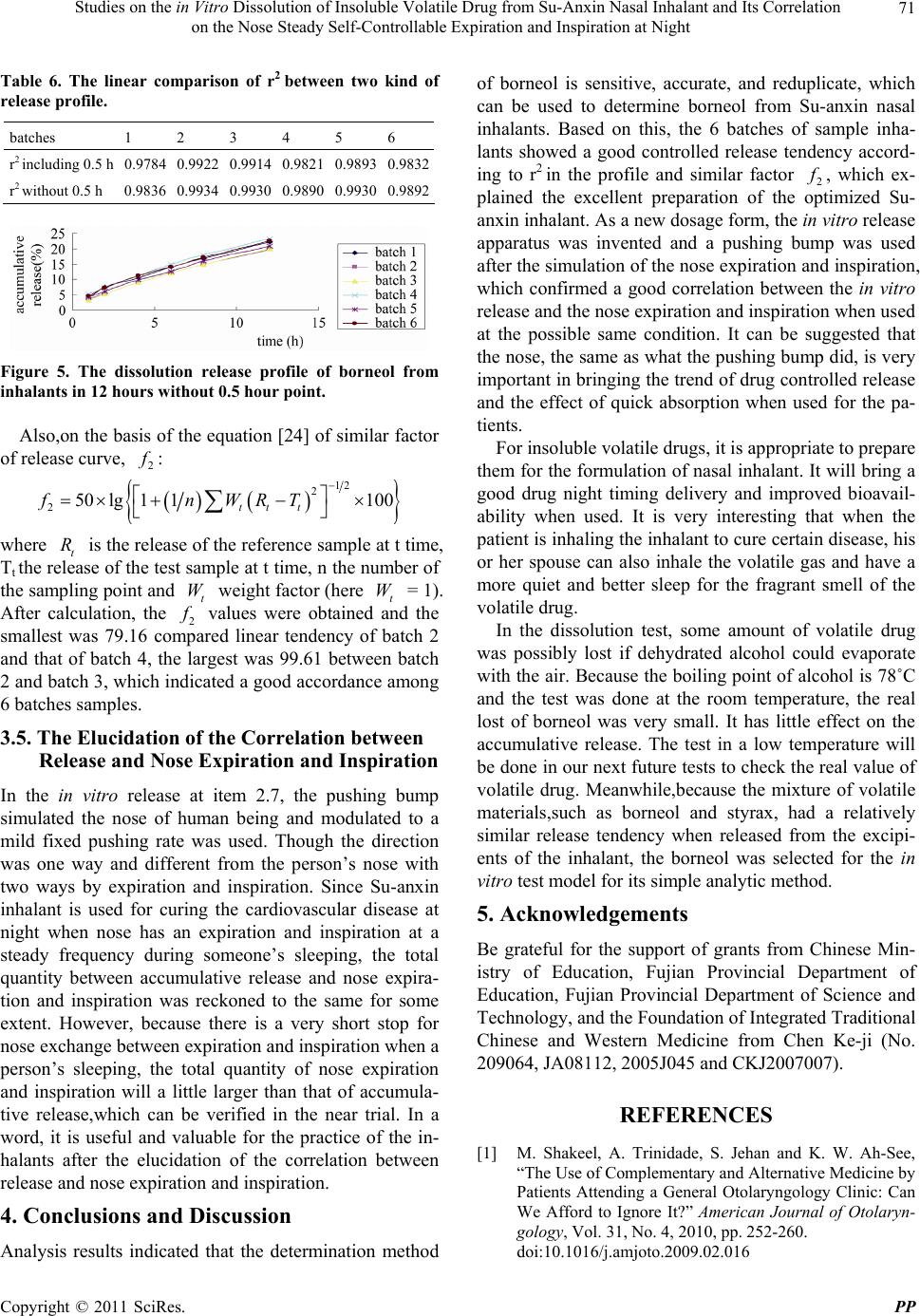 Studies on the in Vitro Dissolution of Insoluble Volatile Drug from Su-Anxin Nasal Inhalant and Its Correlation 71 on the Nose Steady Self-Controllable Expiration and Inspiration at Night Table 6. The linear comparison of r2 between two kind of release profile. batches 1 2 3 4 5 6 r2 including 0.5 h 0.9784 0.9922 0.9914 0.9821 0.9893 0.9832 r2 without 0.5 h 0.9836 0.9934 0.9930 0.9890 0.9930 0.9892 Figure 5. The dissolution release profile of borneol from inhalants in 12 hours without 0.5 hour point. Also,on the basis of the equation [24] of similar factor of release curve, 2 f : 12 2 250 lg11100 tt t fnWRT where t is the release of the reference sample at t time, Tt the release of the test sample at t time, n the number of the sampling point and t weight factor (here t W = 1). After calculation, the 2 R W f values were obtained and the smallest was 79.16 compared linear tendency of batch 2 and that of batch 4, the largest was 99.61 between batch 2 and batch 3, which indicated a good accordance among 6 batches samples. 3.5. The Elucidation of the Correlation between Release and Nose Expiration and Inspiration In the in vitro release at item 2.7, the pushing bump simulated the nose of human being and modulated to a mild fixed pushing rate was used. Though the direction was one way and different from the person’s nose with two ways by expiration and inspiration. Since Su-anxin inhalant is used for curing the cardiovascular disease at night when nose has an expiration and inspiration at a steady frequency during someone’s sleeping, the total quantity between accumulative release and nose expira- tion and inspiration was reckoned to the same for some extent. However, because there is a very short stop for nose exchange between expiration and inspiration when a person’s sleeping, the total quantity of nose expiration and inspiration will a little larger than that of accumula- tive release,which can be verified in the near trial. In a word, it is useful and valuable for the practice of the in- halants after the elucidation of the correlation between release and nose expiration and inspiration. 4. Conclusions and Discussion Analysis results indicated that the determination method of borneol is sensitive, accurate, and reduplicate, which can be used to determine borneol from Su-anxin nasal inhalants. Based on this, the 6 batches of sample inha- lants showed a good controlled release tendency accord- ing to r2 in the profile and similar factor 2 f , which ex- plained the excellent preparation of the optimized Su- anxin inhalant. As a new dosage form, the in vitro release apparatus was invented and a pushing bump was used after the simulation of the nose expiration and inspiration, which confirmed a good correlation between the in vitro release and the nose expiration and inspiration when used at the possible same condition. It can be suggested that the nose, the same as what the pushing bump did, is very important in bringing the trend of drug controlled release and the effect of quick absorption when used for the pa- tients. For insoluble volatile drugs, it is appropriate to prepare them for the formulation of nasal inhalant. It will bring a good drug night timing delivery and improved bioavail- ability when used. It is very interesting that when the patient is inhaling the inhalant to cure certain disease, his or her spouse can also inhale the volatile gas and have a more quiet and better sleep for the fragrant smell of the volatile drug. In the dissolution test, some amount of volatile drug was possibly lost if dehydrated alcohol could evaporate with the air. Because the boiling point of alcohol is 78˚C and the test was done at the room temperature, the real lost of borneol was very small. It has little effect on the accumulative release. The test in a low temperature will be done in our next future tests to check the real value of volatile drug. Meanwhile,because the mixture of volatile materials,such as borneol and styrax, had a relatively similar release tendency when released from the excipi- ents of the inhalant, the borneol was selected for the in vitro test model for its simple analytic method. 5. Acknowledgements Be grateful for the support of grants from Chinese Min- istry of Education, Fujian Provincial Department of Education, Fujian Provincial Department of Science and Technology, and the Foundation of Integrated Traditional Chinese and Western Medicine from Chen Ke-ji (No. 209064, JA08112, 2005J045 and CKJ2007007). REFERENCES [1] M. Shakeel, A. Trinidade, S. Jehan and K. W. Ah-See, “The Use of Complementary and Alternative Medicine by Patients Attending a General Otolaryngology Clinic: Can We Afford to Ignore It?” American Journal of Otolaryn- gology, Vol. 31, No. 4, 2010, pp. 252-260. doi:10.1016/j.amjoto.2009.02.016 Copyright © 2011 SciRes. PP  Studies on the in Vitro Dissolution of Insoluble Volatile Drug from Su-Anxin Nasal Inhalant and Its Correlation on the Nose Steady Self-Controllable Expiration and Inspiration at Night Copyright © 2011 SciRes. PP 72 2. [2] K. J. Hunt, H. F. Coelho, B. Wider, R. Perry, S. K. Hung, R. Terry and E. Ernst, “Complementary and Alternative Medicine Use in England: Results from a National Sur- vey,” International Journal of Clinical Practice, Vol. 64, No. 11, 2010, pp. 1496-1502. doi:10.1111/j.1742-1241.2010.02484.x [3] D. Jimbo, Y. Kimura, M. Taniguchi, M. Inoue and K. Urakami, “Effect of Aromatherapy on Patients with Alz- heimer’s Disease,” Psychogeriatrics, Vol. 9, No. 4, 2009, pp. 173-179. doi:10.1111/j.1479-8301.2009.00299.x [4] L. Weinberg, D. Story, J. Nam and L. Mcnicol, “Phar- macoeconomics of Volatile Inhalational Anaesthetic Agents: An 11-Year Retrospective Analysis,” Anaesthe- sia and intensive care, Vol. 38, No. 5, 2010, pp. 849-854. [5] D. K. Conn and D. P. Seitz, “Advances in the Treatment of Psychiatric Disorders in Long-Term Care Homes,” Current Opinion in Psychiatry, Vol. 23, No. 6, 2010, pp. 516-521. doi:10.1097/YCO.0b013e32833efe56 [6] E. Heuberger and J. Llmberger, “The Influence of Essen- tial Oils on Human Vigilance,” Natural Product Commu- nications, Vol. 5, No. 9, 2010, pp. 1441-1446. [7] L. Moss, M. Rouse, K. A. Wesnes and M. Moss, “Dif- ferential Effects of the Aromas of Salvia Species on Memory and Mood,” Human Psychopharmacology, Vol. 25, No. 5, 2010, pp. 388-396. doi:10.1002/hup.1129 [8] H. W. Tsang and T. Y. Ho, “A Systematic Review on the Anxiolytic Effects of Aromatherapy on Rodents under Experimentally Induced Anxiety Models,” Reviews in the Neurosciences, Vol. 21, No. 2, 2010, pp. 141-152. [9] M. H. Hur, M. S. Lee, C. Kim and E. Ernst, “Aromather- apy for Treatment of Hypertension: A Systematic Re- view,” Journal of Evaluation in Clinical Practice, Vol. 17, No. 2, 2010, pp. 1365-2753. [10] J. Tillett and D. Ames, “The Uses of Aromatherapy in Women’s Health,” Journal of Perinatal & Neonatal Nursing, Vol. 24, No. 3, 2010, pp. 238-245. [11] A. Supoken, T. Chaisrisawatsuk and B. Chumworathayi, “Proportion of Gynecologic Cancer Patients Using Com- plementary and Alternative Medicine,” Asian Pacific Journal of Cancer Prevention, Vol. 10, 2009, pp. 779- 782. [12] X. D. Li and L. P. Zhang, “The Application Prospect of Nasal Inhalant of Traditional Chinese Medicine,” Journal of Fujian College of Traditional Chinese Medicine, Vol. 17, 2007, pp. 56-58. [13] S. T. Charlton, S. S. Davis and L. Illum, “Evaluation of Bioadhesive Polymer as Delivery Systems for Nose to Brain Delivery: In Vitro Characterisation Studies,” Journal of Controlled Release, Vol. 118, No. 2, 2007, pp. 225-234. doi:10.1016/j.jconrel.2006.12.014 [14] R. Siekmeier and G. Scheuch, “Inhaled Insulin—Does It Become Reality?” Journal of Physiology and Pharma- cology, Vol. 59, No. 6, 2008, pp. 81-113. [15] B. Luppi, F. Bigucci, T. Cerchiara and V. Zecchi, “Chitosan-Based Hydrogels for Nasal Drug Delivery: From Inserts to Nanoparticles,” Expert Opinion on Drug Delivery, Vol. 7, No. 7, 2010, pp. 811-828. doi:10.1517/17425247.2010.495981 [16] K. W. Spencer, “Isopropyl Alcohol Inhalation as Treat- ment for Nausea and Vomiting,” Plastic Surgical Nurses, Vol. 24, No. 4, 2004, pp. 149- 154. [17] C. Li, C. S. Gao and X. G. Mei, “The Research Develop- ment of Protain/Polypeptide Drugs in Pulmonary Inhaled Preparation,” Foreign Medical Sciences Section of Phar- macy, Vol. 34, 2007, pp. 56-58. [18] J. P. Zhu and R. S. Zhao, “Inhaled Delivery Drugs and Their Clinical Application and Evaluation,” Clinical Medication Journal, Vol. 6, 2008, pp. 49-5 [19] Y. C. Hong and H. W. Huang, “To Cure Chronic Rhinitis Through a Main Drug Delivery: Chinese Medicine Aerosol,” Journal of Modern Integrated Medicine, Vol. 11, 2002, p. 1097 [20] Q. L. Yang, “The Treatment of Respiratory Diseases: Chinese Medicine Aerosol,” Journal of Liaoning Univer- sity of Traditional Chinese Medicine, Vol. 10, 2008, pp. 103-104. [21] L. Illum, “Nasal Drug Delivery—Possibilities, Problems and Solutions,” Journal of Controlled Release, Vol. 87, No. 1-3, 2003, pp. 187-198. doi:10.1016/S0168-3659(02)00363-2 [22] X. D. Li and S. Y. Li, “Studies on Improving Absorption of Insoluble Volatile Drugs from Su-Anxin Nasal Inhalant,” The Proceedings of 2010 Second Asia Arden Pharmaceu- Tical Technology Forum, 279. [23] X. D. Li, Y. Chen and F. H. Wu, “Analysis of in Vitro And in Vivo Drug Components in Rabbits from Su- Anxin Nasal Inhalant,” Journal of Chengdu Medical Col- lege, Vol. 5, No. 2, 2010, pp. 119-121. [24] P. Costa, “An Alternative Method to the Evaluation of Similarity Factor in Dissolution Testing,” International Journal of Pharmaceutics, Vol. 220, No. 2, 2001, pp. 77-83. doi:10.1016/S0378-5173(01)00651-2 |