

Paper Menu >>
Journal Menu >>
 Open Journal of Obstetrics and Gynecology, 2011, 1, 1-5 doi:10.4236/ojog.2011.11001 Published Online March 2011 (http://www.SciRP.org/journal/ojog/ OJOG ). Published Online March 2011 in SciRes. http://www.scirp.org/journal/OJOG Early discharge after major gynaecological surgery: advantages of fast track surgery Jonathan Carter1,2, Shannon Philp1,2, Vive k Ar or a1 1Sydney Gynaecological Oncology Group, Sydney Cancer Centre, Royal Prince Alfred Hospital, Sydney, Australia 2The University of Sydney, Sydney, Australia Email: [email protected] Received 20 February 2011; revised 21 March 2011; accepted 28 March 2011. ABSTRACT Introduction: Fast Track Surgery (FTS) programs have been adopted by many specialties with docu- mented improved patient outcomes and reduced length of stay (LOS). Methods: We initiated a FTS program in January 2008 and present our experience up to and including November 2010 on patients whose LOS was 2 days. Results: During the study period 242 patients had a laparotomy performed. Overall 54 (22.3%) patients were discharged on day 2. In the first year of initiating our FTS program 10% were discharged on day 2, 25% in year 2 and 31% in year 3. Twenty-two patients (41%) had malignant pathol- ogy and of these, 16 (73%) had local or regional spread and 6 (27%) had distant spread. Forty pa- tients (74%) had vertical midline incisions (VMI) performed. Surgery was classified as complex in 40 cases (74%) and 6 (11%) patients underwent staging lymph node dissection. Av erage patient BMI was 26.1 with 44% of patients considered overweight or obese. There were no intraoperative complications recorded. When compared to 188 patients whose LOS was greater than 2 days, the early discharge cohort were more likely to have benign pathology, more likely to be younger, to have a transverse incision, to have re- ceived COX II inhibitors, to have a lower net haemo- globin (Hb) change and to tolerate early oral feeding. Conclusions: Increased clinical experience with FTS enables over 31% patients undergoing laparotomy to be safely discharged on day 2 without an increase in the readmission rate or morbidity. Keywords: Fast Track Surgery; Gynaecology; Oncology 1. INTRODUCTION In contemporary surgical care patients would often be admitted to hospital the day prior to planned surgery, undergo preoperative mechanical and antibiotic bowel preparation and have IV fluids running to keep them in fluid balance, prior to any surgical or anaesthetic insult. Intraoperatively patients were often volume loaded to maintain a filling pressure, had nasogastric tubes in- serted, as well as pelvic drains to prevent development of collections, then spent 2 - 3 days nil by mouth (NBM) until bowel sounds were heard before b eing commenced on a graduated diet of clear liquids, free fluids, light diet and finally commenced on a regular diet 5 - 7 days post surgery. Patients were then discharged, on average 5 - 7 days post surgery [1] . Fast Track Surgery (FTS) or Enhanced Surgical Re- covery (ESR) programs have been developed and re- fined in many specialties with documented improved patient outcomes and as a consequence earlier discharge form hospital and reduced length of stay (LOS) [1-5]. The aim of this study is to identify patients following a FTS program [6] who have been discharged earlier than anticipated, being day 2 post op after major gynae- cological/gynaecological oncologic surgery and analyse elements that may have aided in their early discharge. 2. METHODS After Ethics approval was granted the FTS Database was searched to identify patients operated upon by laparo- tomy between January 2008 and November 2010 and whose LOS was 2 days. Data was collected in a real time fashion and analysis undertaken in a retrospective fash- ion. Our FTS protocol commences with preoperative pa- tient counseling regarding the program. Patients are made aware that their anticipated LOS is 3 days, that narcotic analg esia will be limited and adequ ate analgesia provided by a combination of intraoperative paracoxib +/- transverse abdominis plane (TAP) block [7]. Post- operatively meloxicam is prescribed for 3 days with regular paracetamol. Early oral feeding by way of oral liquids are allowed on the night of surgery and patients are commenced on a light diet on post op day 1 with rapid progression thereafter. If significant abdominal 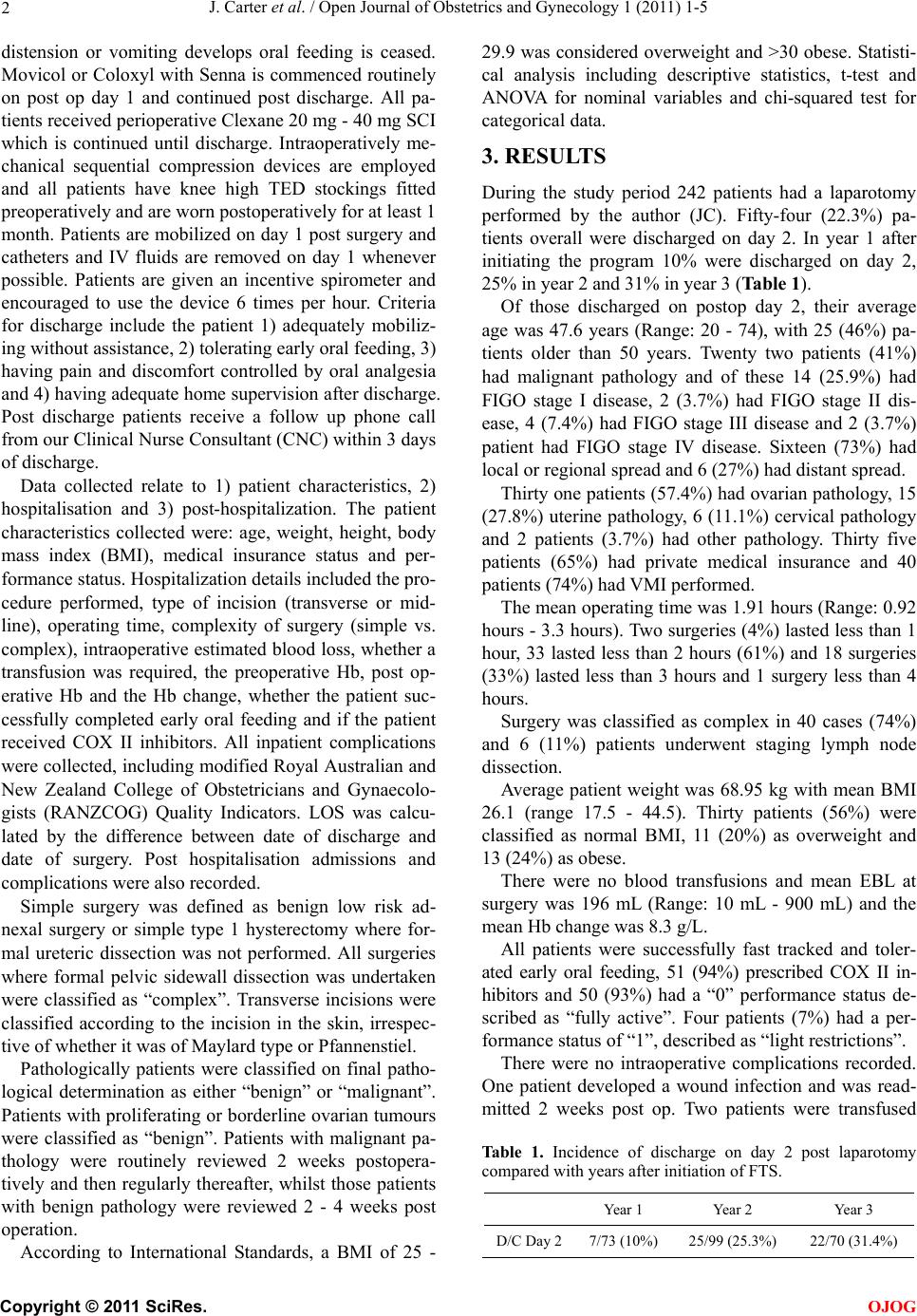 J. Carter et al. / Open Journal of Obstetrics and Gynecology 1 (2011) 1-5 2 distension or vomiting develops oral feeding is ceased. Movicol or Colo xyl with Senna is commenced routinely on post op day 1 and continued post discharge. All pa- tients received perioperative Clexane 20 mg - 40 mg SCI which is continued until discharge. Intraoperatively me- chanical sequential compression devices are employed and all patients have knee high TED stockings fitted preoperati vel y and are worn postoperatively for at least 1 month. Patients are mobilized on day 1 post surgery and catheters and IV fluids are removed on day 1 whenever possible. Patients are given an incentive spirometer and encouraged to use the device 6 times per hour. Criteria for discharge include the patient 1) adequately mobiliz- ing without assistance, 2) tolerating ear ly oral feeding, 3) having pain and discomfort controlled by oral analgesia and 4) having adequate home supervision after discharge. Post discharge patients receive a follow up phone call from our Clinical Nurse Consultant (CNC) within 3 days of discharge. Data collected relate to 1) patient characteristics, 2) hospitalisation and 3) post-hospitalization. The patient characteristics collected were: age, weight, height, body mass index (BMI), medical insurance status and per- formance status. Hospitalization details included the pro- cedure performed, type of incision (transverse or mid- line), operating time, complexity of surgery (simple vs. complex), intraoperative estimated blood loss, wh ether a transfusion was required, the preoperative Hb, post op- erative Hb and the Hb change, whether the patient suc- cessfully completed early oral feeding and if the patient received COX II inhibitors. All inpatient complications were collected, including modified Royal Australian and New Zealand College of Obstetricians and Gynaecolo- gists (RANZCOG) Quality Indicators. LOS was calcu- lated by the difference between date of discharge and date of surgery. Post hospitalisation admissions and complications were also recorded. Simple surgery was defined as benign low risk ad- nexal surgery or simple type 1 hysterectomy where for- mal ureteric dissection was not performed. All surgeries where formal pelvic sidewall dissection was undertaken were classified as “complex”. Transverse incisions were classified according to the incision in the skin, irrespec- tive of whether it was of Maylard type or Pfannenstiel. Pathologically patients were classified on final patho- logical determination as either “benign” or “malignant”. Patients with proliferating or borderline ovarian tumours were classified as “benign”. Patients with malignant pa- thology were routinely reviewed 2 weeks postopera- tively and then regularly thereafter, whilst those patients with benign pathology were reviewed 2 - 4 weeks post operation. According to International Standards, a BMI of 25 - 29.9 was considered overweight and >30 obese. Statisti- cal analysis including descriptive statistics, t-test and ANOVA for nominal variables and chi-squared test for categorical data. 3. RESULTS During the study period 242 patients had a laparotomy performed by the author (JC). Fifty-four (22.3%) pa- tients overall were discharged on day 2. In year 1 after initiating the program 10% were discharged on day 2, 25% in year 2 and 31% in year 3 (Table 1). Of those discharged on postop day 2, their average age was 47.6 years (Range: 20 - 74), with 25 (46%) pa- tients older than 50 years. Twenty two patients (41%) had malignant pathology and of these 14 (25.9%) had FIGO stage I disease, 2 (3.7%) had FIGO stage II dis- ease, 4 (7.4%) had FIGO stage III disease and 2 (3.7%) patient had FIGO stage IV disease. Sixteen (73%) had local or regional spread and 6 (27%) had distant spread. Thirty one patients (57.4%) had ovarian pathology, 15 (27.8%) uterine pathology, 6 (11.1%) cervical pathology and 2 patients (3.7%) had other pathology. Thirty five patients (65%) had private medical insurance and 40 patients (74%) had VMI perfo rmed. The mean operating time was 1.91 hours (Range : 0.92 hours - 3.3 hours). Two surgeries (4%) lasted less than 1 hour, 33 lasted less than 2 hours (61%) and 18 surgeries (33%) lasted less than 3 hours and 1 surgery less than 4 hours. Surgery was classified as complex in 40 cases (74%) and 6 (11%) patients underwent staging lymph node dissection. Average patient weight was 68.95 kg with mean BMI 26.1 (range 17.5 - 44.5). Thirty patients (56%) were classified as normal BMI, 11 (20%) as overweight and 13 (24%) as obese. There were no blood transfusions and mean EBL at surgery was 196 mL (Range: 10 mL - 900 mL) and the mean Hb change was 8. 3 g/L. All patients were successfully fast tracked and toler- ated early oral feeding, 51 (94%) prescribed COX II in- hibitors and 50 (93%) had a “0” performance status de- scribed as “fully active”. Four patients (7%) had a per- formance status of “1”, described as “light restrictions”. There were no intraoperative complications recorded. One patient developed a wound infection and was read- mitted 2 weeks post op. Two patients were transfused Table 1. Incidence of discharge on day 2 post laparotomy compared with years after initiation of FTS. Year 1 Year 2 Year 3 D/C Day 27/73 (10%)25/99 (25.3%) 22/70 (31.4%) C opyright © 2011 SciRes. OJOG 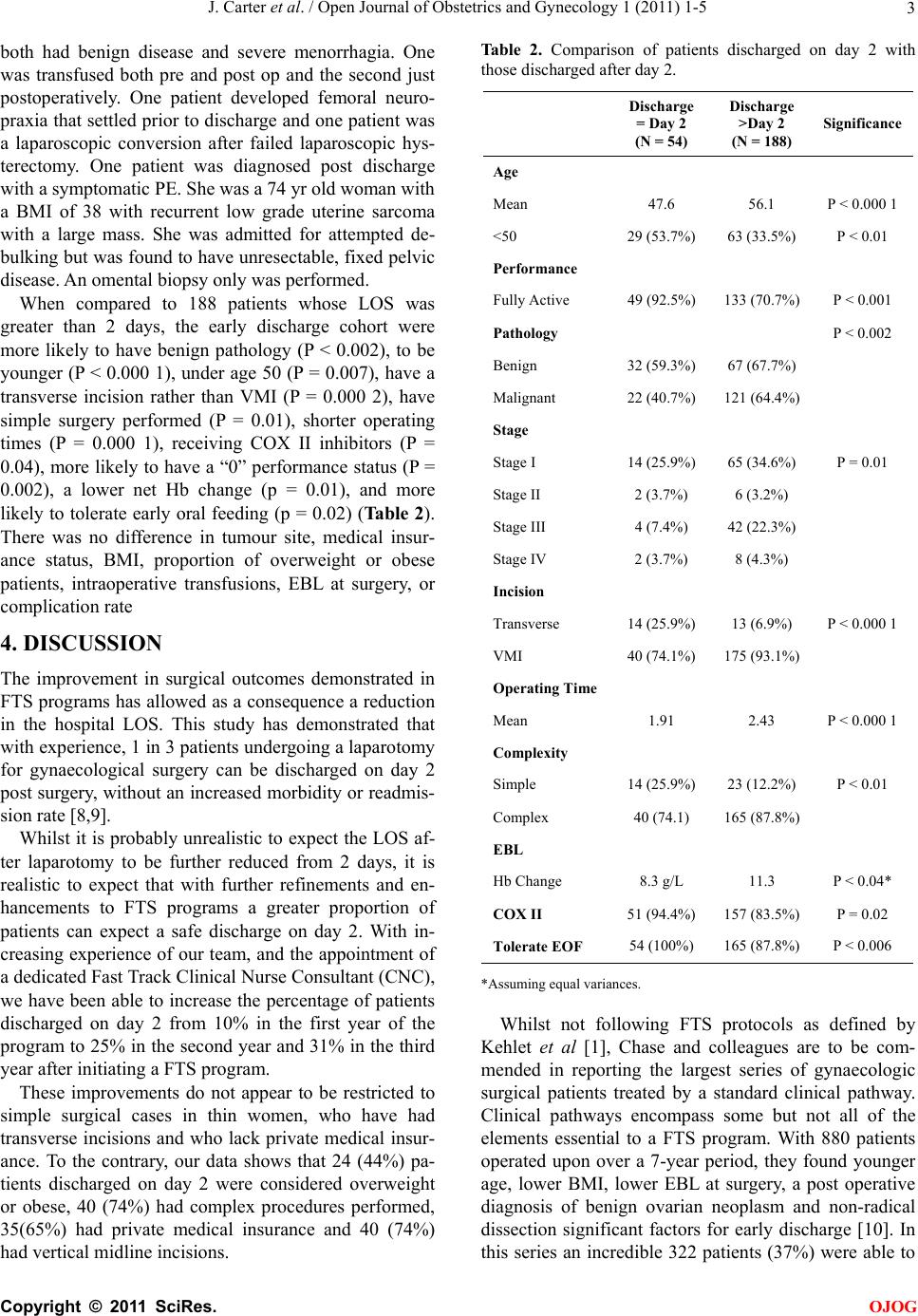 J. Carter et al. / Open Journal of Obstetrics and Gynecology 1 (2011) 1-5 3 both had benign disease and severe menorrhagia. One was transfused both pre and post op and the second just postoperatively. One patient developed femoral neuro- praxia that settled prior to disch arge and one patien t was a laparoscopic conversion after failed laparoscopic hys- terectomy. One patient was diagnosed post discharge with a symptomatic PE. She was a 74 yr old woman with a BMI of 38 with recurrent low grade uterine sarcoma with a large mass. She was admitted for attempted de- bulking but was found to have unresectable, fixed pelvic disease. An omental biopsy o n l y was performed. When compared to 188 patients whose LOS was greater than 2 days, the early discharge cohort were more likely to have benign pathology (P < 0.002), to be younger (P < 0.000 1), under age 50 (P = 0.007), have a transverse incision rather than VMI (P = 0.000 2), have simple surgery performed (P = 0.01), shorter operating times (P = 0.000 1), receiving COX II inhibitors (P = 0.04), more likely to have a “0” performance status (P = 0.002), a lower net Hb change (p = 0.01), and more likely to tolerate early oral feeding (p = 0.02) (Table 2). There was no difference in tumour site, medical insur- ance status, BMI, proportion of overweight or obese patients, intraoperative transfusions, EBL at surgery, or complication rate 4. DISCUSSION The improvement in surgical outcomes demonstrated in FTS programs has allowed as a consequence a reduction in the hospital LOS. This study has demonstrated that with experience, 1 in 3 patients undergoing a laparotomy for gynaecological surgery can be discharged on day 2 post surgery, without an increased morbidity or readmis- sion rate [8,9]. Whilst it is probably unrealistic to exp ect the LOS af- ter laparotomy to be further reduced from 2 days, it is realistic to expect that with further refinements and en- hancements to FTS programs a greater proportion of patients can expect a safe discharge on day 2. With in- creasing experience of our team, and the appointment of a dedicated Fast Track Clinical Nurse Consultant (CNC), we have been able to increase the percentage of patients discharged on day 2 from 10% in the first year of the program to 25% in the second year an d 31% in the third year after initiating a FTS program. These improvements do not appear to be restricted to simple surgical cases in thin women, who have had transverse incisions and who lack private medical insur- ance. To the contrary, our data shows that 24 (44%) pa- tients discharged on day 2 were considered overweight or obese, 40 (74%) had complex procedures performed, 35(65%) had private medical insurance and 40 (74%) had vertical midline in cisions. Table 2. Comparison of patients discharged on day 2 with those discharged after day 2. Discharge = Day 2 (N = 54) Discharge >Day 2 (N = 188) Significance Age Mean 47.6 56.1 P < 0.000 1 <50 29 (53.7%) 63 (33.5%) P < 0.01 Performance Fully Active 49 (92.5%) 133 (70.7%) P < 0.001 Pathology P < 0.002 Benign 32 (59.3%) 67 (67.7%) Malignant 22 (40.7%) 121 (64.4%) Stage Stage I 14 (25.9%) 65 (34.6%) P = 0.01 Stage II 2 (3.7%) 6 (3.2%) Stage III 4 (7.4%) 42 (22.3%) Stage IV 2 (3.7%) 8 (4.3%) Incision Transverse 14 (25.9%) 13 (6.9%) P < 0.000 1 VMI 40 (74.1%) 175 (93.1%) Operating Time Mean 1.91 2.43 P < 0.000 1 Complexity Simple 14 (25.9%) 23 (12.2%) P < 0.01 Complex 40 (74.1) 165 (87.8%) EBL Hb Change 8.3 g/L 11.3 P < 0.04* COX II 51 (94.4%) 157 (83.5%) P = 0.02 Tolerate EOF 54 (100%) 165 (87.8%) P < 0.006 *Assuming equal variances. Whilst not following FTS protocols as defined by Kehlet et al [1], Chase and colleagues are to be com- mended in reporting the largest series of gynaecologic surgical patients treated by a standard clinical pathway. Clinical pathways encompass some but not all of the elements essential to a FTS program. With 880 patients operated upon over a 7-year period, they found younger age, lower BMI, lower EBL at surgery, a post operative diagnosis of benign ovarian neoplasm and non-radical dissection significant factors for early discharge [10]. In this series an incredible 322 patients (37%) were able to C opyright © 2011 SciRes. OJOG  J. Carter et al. / Open Journal of Obstetrics and Gynecology 1 (2011) 1-5 4 be discharged on day 2, setting the benchmark for all others following the principals of FTS to aspire to. Our findings are similar to Chase et al, in that younger age, ovarian tumours, benign pathology, transverse skin inci- sions, decreased operating time, early oral feeding, use of COX II inhibitors and net haemoglobin change were all significantly different in the early discharge group when compared to the group of patients discharged after day 2. In addition, with our greater experience, we have found in our third year after adopting FTS principles, 31.4% of our patients can now be discharged on day 2. We did not find insurance status, weight, BMI or esti- mated blood loss to be significantly different between the groups. Both Chase et al and our own group have questioned the reported perceived benefits of laparoscopic surgery in light of results achieved with FTS laparotomy [6,10]. Recent evidence from the GOG LAP2 study support our position. This is the largest prospective randomized study in the world comparing laparoscopic surgery for endometrial cancer to non-fast tracked laparotomy pa- tients. In summary there were similar rates of in- tra-operative complications, with a significant number of patients converted to laparotomy due to poor visibility, metastatic cancer or bleeding. Median LOS of non-fast tracked laparotomy patients was 4 days and 3 days for laparoscopy patients [11]. Furthermore, whilst quality of life (QOL) was enhanced across many parameters in the laparoscopy group at 6 weeks, these differences were not significant by 6 months. Whilst cross trial comparisons are statistically invalid, one can only speculate whether the 1 day difference in LOS would be negated if the laparotomy patients in this study were fast tracked [12]. Similar results have also b een publish ed by Mouritis and colleagues [13] who have reported a median LOS of 5 days for their non-fast tracked hysterectomy patients compared to 2 days for laparoscopic hysterectomy pa- tients and no difference in major complication rate. Further enhancements to our FTS program which will allow a greater proportion of patients to be safely dis- charged on day 2 include enhancing preoperative con- sultations to further emphasise the rationale of FTS and encouraging patients to contribute by agreeing to dis- charge when medically appropriate. A number of our patients discharged on day 3 could have been discharged on day 2 had there been appropriate supervision at home on discharge. Improving GI function is also an area we have identified as worthy of further study. Simple tech- niques such as initiating a regular chewing gum regimen after surgery to stimulate bowel function has been sh own to be effective and would add little financial impost and minimal risk of increased morbidity [14-19]. Health care organisations and Hospital Administrators also derive significant financial benefit from a FTS program and should provide funding for the initiation and mainte- nance of such programs. This study has shown that with experience over 30% patients undergoing laparotomy on a FTS program, can be safely discharged on day 2 without an increase in the readmission rate or morbidity. REFERENCES [1] Kehlet, H. and Wilmore, D.W. (2002) Multimodal strate- gies to improve surgical outcome. American Journal of Surgery, 183, 630-641. doi:10.1016/S0002-9610(02)00866-8 [2] Australian Safety and Efficacy Register of New Interventional Procedures-Surgical (ASERNIPS), The Royal Australasian College of Surgeons (2009) Brief review: Fast-track surgery and enhanced recovery after surgery (ERAS) programs. [3] Fearon, K., Ljungqvist, O., Von Meyenfeldt, M., Revh- aug, A., Dejong, C., Lassen, K., et al. (2005) Enhanced recovery after surgery: A consensus review of clinical care of patients undergoing colonic resection. Clinical Nutrition, 24, 466-477. doi:10.1016/j.clnu.2005.02.002 [4] Kehlet, H. and Wilmore, D.W. (2008) Evidence-based surgical care and the evolution of fast-track surgery. Annals of Surgery, 248, 189-198. doi:10.1097/SLA.0b013e31817f2c1a [5] Pruthi, R., Niesen, M., Smith, A., Nix, J., Schultz, H. and Wallen, E. (2010) Fast track program in patients under- going radical cystectomy: Results in 362 consecutive patients. Journal of the American College of Surgeons, 210, 93-99. doi:10.1016/j.jamcollsurg.2009.09.026 [6] Carter, J., Szabo, R., Sim, W., Pather, S., Philp, S., Nattr- ess, K., et al. (2010) Fast track surgery in gynaecological oncology. A clinical audit. Australian and New Zealand Journal of Obstetrics and Gynaecology, 50, 159-163. doi:10.1111/j.1479-828X.2009.01134.x [7] McDonnell, J.G., O'Donnell, B., Curley, G., Heffernan, A., Power, C. and Laffey, J.G. (2007) The analgesic efficacy of transversus abdominis plane block after abdominal sur- gery: A prospective randomized controlled trial. Anes- thesia & Analgesia, 104, 193-197. [8] Marx, C., Rasmussen, T., Jakobsen, D.H., Ottosen, C., Lundvall, L., Ottesen, B., et al. (2006) The effect of accelerated rehabilitation on recovery after surgery for ovarian malignancy. Acta Obstetricia et Gynecologica Scandinavica, 85, 488-492. doi:10.1080/00016340500408325 [9] Massad, L., Vogler, G., Herzog, T. and Mutch, D. (1993) Correlates of length of stay in gynecologic oncology patients undergoing inpatient surgery. Gynecologic Onc- ology, 51, 214-218. doi:10.1006/gyno.1993.1275 [10] Chase, D.M., Lopez, S., Nguyen, C., Pugmire, G.A. and Monk, B.J. (2008) A clinical pathway for postoperative management and early patient discharge: Does it work in gynecologic oncology? American Journal of Obstetrics and Gynecology, 199, e1-e7. [11] Walker, J.L., Piedmonte, M.R., Spirtos, N.M., Eisenkop, S.M., Schlaerth, J.B., Mannel, R.S., et al. (2009) Lapar- C opyright © 2011 SciRes. OJOG  J. Carter et al. / Open Journal of Obstetrics and Gynecology 1 (2011) 1-5 Copyright © 2011 SciRes. 5 OJOG oscopy compared with laparotomy for comprehensive surgical staging of uterine cancer: Gynecologic oncology group study LAP2. Journal of Clinical Oncology, 27, 5331-5336. [12] Kornblith, A.B., Huang, H.Q., Walker, J.L., Spirtos, N.M., Rotmensch, J. and Cella, D. (2009) Quality of life of patients with endometrial cancer undergoing laparo- scopic international federation of gynecology and obste- trics staging compared with laparotomy: A gynecologic oncology group study. Journal of Clinical Oncology, 27, 5337-5342. [13] Mourits, M,, Bijen, C., Art, H., ter Brugge, H., van der Sijde, R., Paulsen, et al. (2010) Safety of laparoscopy versus laparotomy in early-stage endometrial cancer: A randomised trial. Lancet Oncology, 16, 1-9. [14] de Castro, S., van den Esschert, J., van Heek, N., Dalhuisen, S., Koelemay, M., Busch, O., et al. (2008) A systemic review of the efficacy of gum chewing for the amelioration of postoperative ileus. Digestive Surgery, 25, 39-45. doi:10.1159/000117822 [15] Edward, J., Fitzgerald, F. and Irfan, A. (2009) Systematic Review and Meta-Analysis of Chewing-Gum Therapy in the Reduction of Postoperative Paralytic Ileus Following Gastrointestinal Surgery. World Journal of Surgery, 33, 2557-2566. [16] Hansen, C., Sorensen, M., Moller, C., Ottesen, B. and Kehlet, H. (2007) Effect of laxatives on gastrointestinal functional recovery in fast-track hysterectomy: A double- blind, placebo-controlled randomized study. American Journal of Obstetrics and Gynecology, 196, 311e1- 311e7. [17] Ljungqvist, O. and Soreide, E. (2003) Preoperative fasting. British Journal of Surgery, 90, 400-406. doi:10.1002/bjs.4066 [18] Macmillan, S., Kammerer-Doak, D., Rogers, R. and Parker, K. (2000) Early feeding and the incidence of gas- trointestinal symptoms after major gynecologic surgery. Obstetrics & Gynecology, 96, 604-608. doi:10.1016/S0029-7844(00)00957-1 [19] Schilder, J., Hurteau, J., Look, K., Moore, D., Raff, G., Stehma n, F., et al. (1997) A prospective controlled trial of early postoperative oral intake following major abdo- minal gynecologic surgery. Gynecologic Oncology, 67, 235-240. doi:10.1006/gyno.1997.4860 |