

Paper Menu >>
Journal Menu >>
 Materials Sciences and Applicatio ns, 2011, 2, 270-275 doi:10.4236/msa.2011.24035 Published Online April 2011 (http://www.scirp.org/journal/msa) Copyright © 2011 SciRes. MSA Development of Hydrogel Polyelectrolyte Membranes with Fixed Sulpho-Groups via Radical Copolymerization of Acrylic Monomers Ivan A. Stadniy1, Viktoriia V. Konovalova1*, Yuriy M. Samchenko2, Ganna A. Pobigay1, Anatoliy F. Burban1, Zoya R. Ulberg2 1Department of Chemistry, National University of Kiev-Mohyla Academy, Kiev, Ukraine; 2Institute of Biocolloidal Chemistry NAS of Ukraine, Kiev, Ukraine E-mail: [email protected] Receives September 24th, 2010; revised December 7th, 2010; accepted February 14th, 2011. ABSTRACT Electrolyte hydrogels are perspective materials for applications in electrochemical devices, which work at ambient temperatures. In this work, hydrogel sulpho-modified membranes were formed by radical co-polymerization of sodium styrensulphonate and potassium sulphopropyl acrylate with acrylamide and acrylonitrile. The hydrogel membranes were obtained in the form of thin films. Properties of the membranes were studied by thermogravimetry, mass-spectro- metry and IR-spectrometry. The prepared membranes were thermally stable up to 70˚C - 90˚C, and showed ion ex- change capacity and swelling coefficients sufficient for use as ion-exchange or proton-conducting membranes. Keywords: Copolymer Hydrogels, Polyelectrolyte Membranes, Acrylamide, Swelling, Ion Exchange Capacity, Thermogravimetry 1. Introduction Synthetic polymeric membranes continue to be the object of intensive researches because of their important role in separation science and technology [1,2]. Fast growing application of membrane processes in various industrial sectors demands development of synthetic membranes with diversified properties and performance characteris- tics. Membrane separation properties are governed by methods of membranes preparation and chemicophysical nature of the membrane materials. Hydrogel membranes have attracted vast attention be- cause of their novel properties and high potential for ap- plications in industry [3], in particular, as electrolyte membranes [4-6]. One of the advantages of hydrogels is that they can be easily transformed into thin films. Sev- eral different polymerization techniques have been de- veloped for this purpose. Moreover, such techniques al- low introduction of interacting species with active func- tional groups into a polymeric network. These advan- tages, alongside with gels good ionic conductivity and ionic exchange property [7,8], have led to their interest- ing applications in many electrochemical solid state ionic devices, such as high-energy density batteries, fuel cells, sensors and electrochemical display devices [9,10]. Hydrogels have 3D networks, which contain hydro- philic functional groups. They are insoluble in water but rather swell more than 95% after absorbing water. Hy- drogel membranes can essentially be thought of as sub- stances which contain solid skeleton and are composed of polymers or long chain molecules cross-linked to cre- ate a tangled network, enclosing a continuous liquid phase. The properties of such gels depend strongly on the interaction of the skeleton and the liquid phase. The liq- uid phase prevents polymer network from collapsing into compact mass while the skeleton prevents liquid from escaping the network. Macroscopically most gel materi- als are solid, but exhibit liquid-like characteristics mi- croscopically due to the presence of a large number of liquid-filled micro- and nanopores. Such ultraporous structure of gels provides channels for directed ion mi- gration [11] and allows to synthesize ion conducting ma- terials and membranes. One of the methods for producing polymeric electro- lyte membranes is entrapping of an aqueous solution of strong acid with a polymeric matrix [12,13]. It has been  Development of Hydrogel Polyelectrolyte Membranes with Fixed Sulpho-Groups via Radical 271 Copolymerization of Acrylic Monomers determined, in particular, that polyacrylamide-based hy- drogels after doping with H3PO4 exhibit ionic conductivi- ties in the range of 10–3 - 10–2 S·cm–1 at room temperature. The observed ionic conductivity increases with the in- crease in water content up to about 30 mass% - 35 mass%, remaining almost constant for higher water concentra- tions reaching a conductivity plateau. At this conductiv- ity plateau, ionic conductivity increases with the increase of phosphoric acid/acrylamide molar ratio to a maximum at 1.8 - 2.0 mol of H3PO4 to 1 mol of acrylamide [13]. All characteristics of an electrolyte directly depend upon the structure and morphology of the host matrixes of the prepared hydrogels. The electrical conductivity change is most likely related to changes in local viscosity due to H3PO4 interactions both with the solvent and the polymer matrix which stiffens the hydrogel [14]. Polar organic or inorganic fillers and additives are known to lower the host polymer’s crystallinity and flexibility [15]. For example, addition of alkali salts to a phosphoric acid-polyacrylamide proton conducting hydrogel influ- ences the hydrogel structure and morphology [16]. This effect was examined by measuring changes polyacryla- mide chain vibrations, in phosphate group and in intersti- tial water molecules as a function of concentration and cationic nature of the additive. After addition of H3PO4 to the polyacrylamide hydrogel matrix, amide groups be- come more accessible and the polyacrylamide-phosphor- ric acid network behaves like structure-maker promoting larger association with the ‘bulk’ liquid water molecules. Another way of producing polymeric hydrogel elec- trolyte membranes is introduction of copolymers based on highly conducting monomers [17]. In the present study we have prepared hydrogel electrolyte membranes containing highly conducting sulpho-group by radical copolymerization of sodium styrensulphonate or potas- sium sulphopropyl acrylate with acrylamide and acry- lonitrile. The most important parameters for the prepared polyelectrolyte hydrogels (e.g. thermostability, ion ex- change capacity and swelling) were also studied. 2. Experimental Hydrogels with potassium sulphopropyl acrylate (SpA) and sodium styrene sulphonate (SS) were prepared by radical copolymerization with acrylamide (AA) and acrylnitrile (AN) in aqueous media at room temperature. Cross-linking was accomplished by N,N′-methylenebisa- crylamide (BIS). The process of gel formation was in- duced using potassium persulfate-sodium metabisulphite oxidation-reduction system. Scheme of polymerization is presented on Figure 1. Potassium sulphopropylacrylate concentration varied from 0 to 25 wt% of the total co-monomers content, sty- rene sulphonate concentration-from 0 to 14 wt%, limited by the solubility of the respective monomers. Total con- tent of monomers was 50 wt% of polymerization mixture. Concentation of BIS was equal to 0.4 wt%. The ratio of AA to AN was 1:1 (wt). All chemicals were purchased from Sigma-Aldrich and used as received except AN, which was washed from the polymerization inhibitor and then distilled. Hydrogel membranes were obtained in the form of films (plates) with thickness of about 500 µm. In order to separate non-reacted monomers and initiators after the synthesis, hydrogel samples were washed with signifi- cant amount of distilled water at 45˚C. Water was changed once per day, and the ratio between mass of gel and mass of water was always 1:4 [18]. FT-IR spectra of the synthesized hydrogel films were obtained using a FT-IR spectrometer TENSOR 37 BRUKER to a depth of about 2 - 3 µm into the sample. The dynamic weight loss tests were conducted on thermogravimetric analyzer (TGA) Derivatograph Q- 1500D for 50 mg samples with heating rate 10 ˚C/min in the 20˚C - 900˚C temperature range. Measurements were performed under nitrogen atmosphere. This analysis produced differential curves of mass loss, allowing for evaluation of thermal degradation. Hydrogel mass-spectrometry was carried out at 30 to 800˚C and for molecular weights ranging from 10 to 200 Daltones. Hydrogel samples were placed in a quarts- molibdenum cell and evacuated at 5 × 10⁻¹ Pa, then sys- tem was connected to the admission system of MI-1201 mass-spectrometer (Ukraine). Rate of samples heating was 10˚C per minute. Water uptake (WU) of the membranes was evaluated from the mass change of membrane before and after drying. The dry membrane swelled in de-ionized water for a day, then the surface water was wiped carefully with a filter paper, and it was immediately weighed. Af- ter drying the sample overnight in a vacuum oven at 60˚C, the water uptake (WU), was calculated using the formula: WU =100 wet dry dry mm т where mwet and mdry are mass of fully hydrated membrane, and that of the dry membrane, respectively. The ion exchange capacity (IEC, mequiv/g) of the membranes was found titrimetrically. To determine the membranes’ IEC, the membranes were placed in 0.1M hydrochloric acid solution, washed with distilled water and immersed in 10 ml of 2 M NaCl solution for 1 day to C opyright © 2011 SciRes. MSA 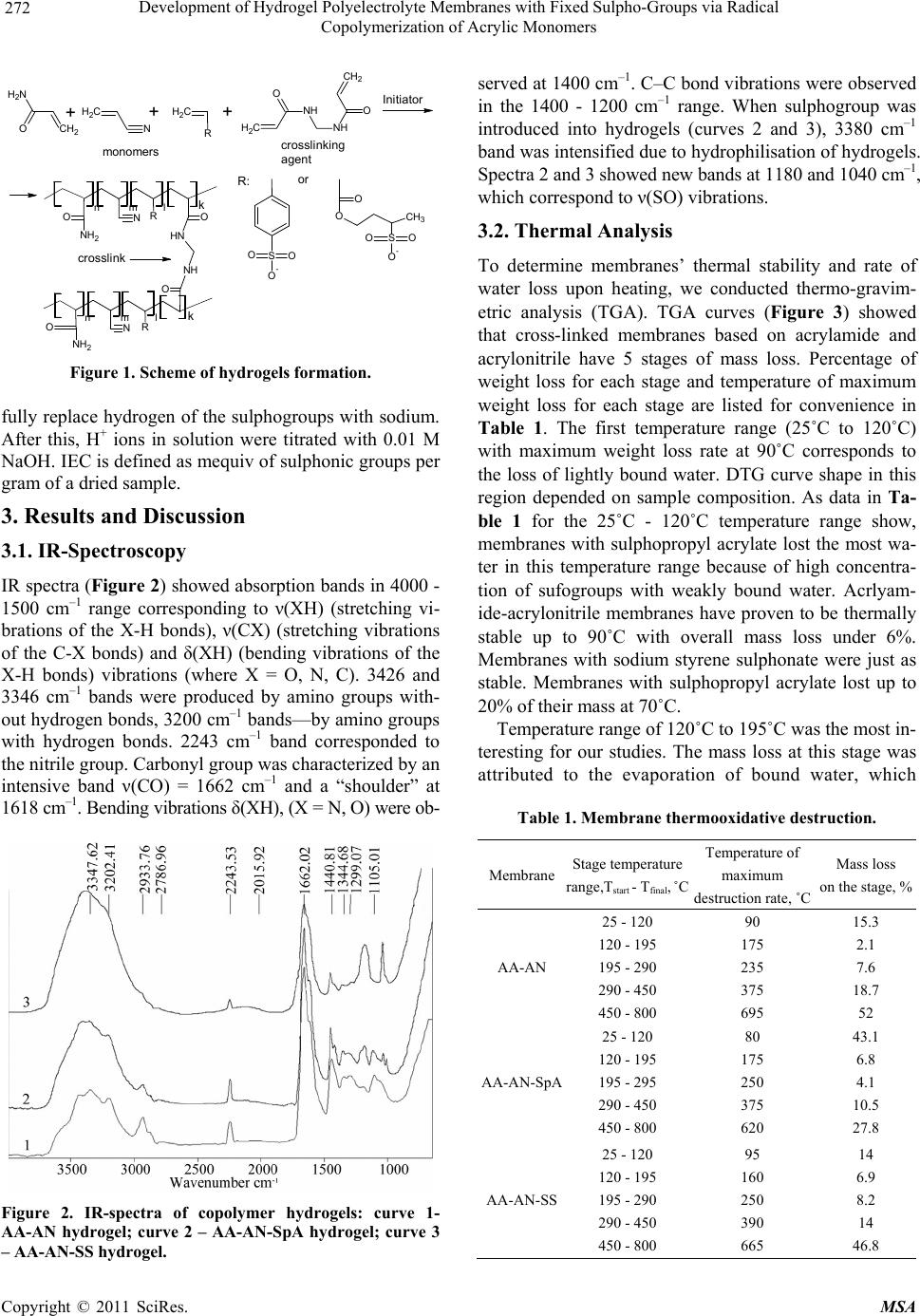 Development of Hydrogel Polyelectrolyte Membranes with Fixed Sulpho-Groups via Radical 272 Copolymerization of Acrylic Monomers CH2 NH2 O CH2 N NH NH O CH2 O CH2 +++ crosslinking agent monomers Initiator NH2 NR NH NH R N O NH2 O OO nm lk nmlk CH2 R crosslink R: SO O O- O OCH3 SOO O- or Figure 1. Scheme of hydrogels formation. fully replace hydrogen of the sulphogroups with sodium. After this, Н+ ions in solution were titrated with 0.01 M NaOH. IEC is defined as mequiv of sulphonic groups per gram of a dried sample. 3. Results and Discussion 3.1. IR-Spectroscopy IR spectra (Figure 2) showed absorption bands in 4000 - 1500 cm–1 range corresponding to ν(ХН) (stretching vi- brations of the X-H bonds), ν(СХ) (stretching vibrations of the C-X bonds) and δ(ХН) (bending vibrations of the X-H bonds) vibrations (where Х = О, N, C). 3426 and 3346 cm–1 bands were produced by amino groups with- out hydrogen bonds, 3200 cm–1 bands—by amino groups with hydrogen bonds. 2243 cm–1 band corresponded to the nitrile group. Carbonyl group was characterized by an intensive band ν(СО) = 1662 cm–1 and a “shoulder” at 1618 cm–1. Bending vibrations δ(ХН), (Х = N, O) were ob- Figure 2. IR-spectra of copolymer hydrogels: curve 1- AA-AN hydrogel; curve 2 – AA-AN-SpA hydrogel; curve 3 – AA-AN-SS hydrogel. served at 1400 cm–1. С–С bond vibrations were observed in the 1400 - 1200 cm–1 range. When sulphogroup was introduced into hydrogels (curves 2 and 3), 3380 cm–1 band was intensified due to hydrophilisation of hydrogels. Spectra 2 and 3 showed new bands at 1180 and 1040 cm–1, which correspond to ν(SO) vibrations. 3.2. Thermal Analysis To determine membranes’ thermal stability and rate of water loss upon heating, we conducted thermo-gravim- etric analysis (TGA). TGA curves (Figure 3) showed that cross-linked membranes based on acrylamide and acrylonitrile have 5 stages of mass loss. Percentage of weight loss for each stage and temperature of maximum weight loss for each stage are listed for convenience in Table 1. The first temperature range (25˚C to 120˚C) with maximum weight loss rate at 90˚C corresponds to the loss of lightly bound water. DTG curve shape in this region depended on sample composition. As data in Ta- ble 1 for the 25˚C - 120˚C temperature range show, membranes with sulphopropyl acrylate lost the most wa- ter in this temperature range because of high concentra- tion of sufogroups with weakly bound water. Acrlyam- ide-acrylonitrile membranes have proven to be thermally stable up to 90˚C with overall mass loss under 6%. Membranes with sodium styrene sulphonate were just as stable. Membranes with sulphopropyl acrylate lost up to 20% of their mass at 70˚C. Temperature range of 120˚C to 195˚C was the most in- teresting for our studies. The mass loss at this stage was attributed to the evaporation of bound water, which Table 1. Membrane thermooxidative destruction. Membrane Stage temperature range,Тstart - Тfinal, ˚C Temperature of maximum destruction rate, ˚C Mass loss on the stage, % AA-AN 25 - 120 120 - 195 195 - 290 290 - 450 450 - 800 90 175 235 375 695 15.3 2.1 7.6 18.7 52 AA-AN-SpA 25 - 120 120 - 195 195 - 295 290 - 450 450 - 800 80 175 250 375 620 43.1 6.8 4.1 10.5 27.8 AA-AN-SS 25 - 120 120 - 195 195 - 290 290 - 450 450 - 800 95 160 250 390 665 14 6.9 8.2 14 46.8 C opyright © 2011 SciRes. MSA 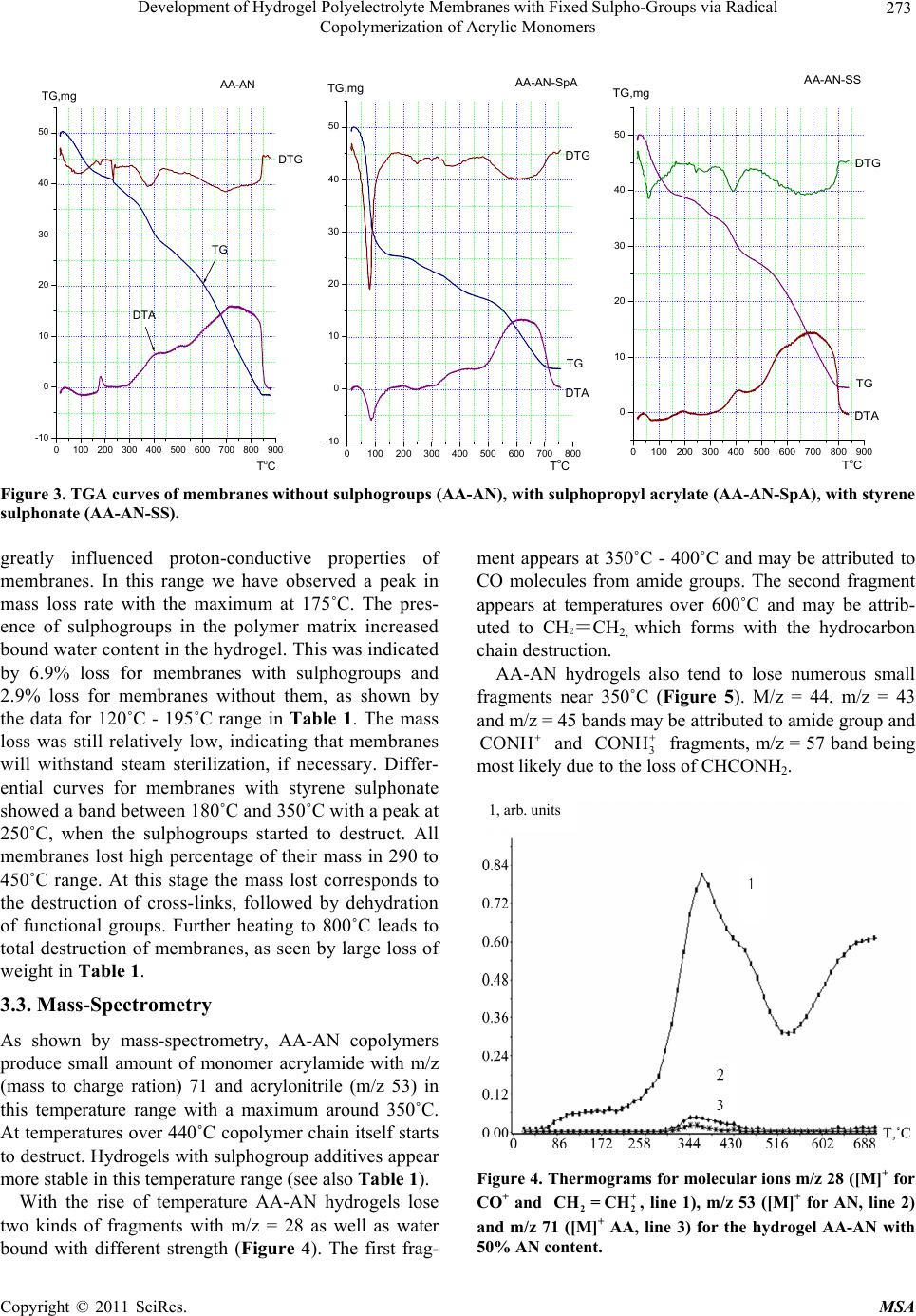 Development of Hydrogel Polyelectrolyte Membranes with Fixed Sulpho-Groups via Radical Copolymerization of Acrylic Monomers Copyright © 2011 SciRes. MSA 273 0100 200 300 400 500 600 700 800 900 -10 0 10 20 30 40 50 DTA TG DTG T o C TG,mg AA-AN 0100 200 300 400 500 600 700 800 -10 0 10 20 30 40 50 T o C TG,mg DTA TG DTG AA-AN-SpA 0100 200 300 400 500 600 700 800 900 0 10 20 30 40 50 DTA TG DTG ToC TG,mg AA-AN-SS Figure 3. TGA curves of membranes without sulphogroups (AA-AN), with sulphopropyl acrylate (AA-AN-SpA), with styrene sulphonate (AA-AN-SS). greatly influenced proton-conductive properties of membranes. In this range we have observed a peak in mass loss rate with the maximum at 175˚C. The pres- ence of sulphogroups in the polymer matrix increased bound water content in the hydrogel. This was indicated by 6.9% loss for membranes with sulphogroups and 2.9% loss for membranes without them, as shown by the data for 120˚C - 195˚C range in Table 1. The mass loss was still relatively low, indicating that membranes will withstand steam sterilization, if necessary. Differ- ential curves for membranes with styrene sulphonate showed a band between 180˚C and 350˚C with a peak at 250˚C, when the sulphogroups started to destruct. All membranes lost high percentage of their mass in 290 to 450˚C range. At this stage the mass lost corresponds to the destruction of cross-links, followed by dehydration of functional groups. Further heating to 800˚C leads to total destruction of membranes, as seen by large loss of weight in Tab le 1. 3.3. Mass-Spectrometry As shown by mass-spectrometry, AA-AN copolymers produce small amount of monomer acrylamide with m/z (mass to charge ration) 71 and acrylonitrile (m/z 53) in this temperature range with a maximum around 350˚C. At temperatures over 440˚C copolymer chain itself starts to destruct. Hydrogels with sulphogroup additives appear more stable in this temperature range (see also Table 1). With the rise of temperature AA-AN hydrogels lose two kinds of fragments with m/z = 28 as well as water bound with different strength (Figure 4). The first frag- ment appears at 350˚C - 400˚C and may be attributed to СО molecules from amide groups. The second fragment appears at temperatures over 600˚C and may be attrib- uted to СН2=СН2, which forms with the hydrocarbon chain destruction. AA-AN hydrogels also tend to lose numerous small fragments near 350˚C (Figure 5). M/z = 44, m/z = 43 and m/z = 45 bands may be attributed to amide group and CONH and 3 CONH fragments, m/z = 57 band being most likely due to the loss of CHCONH2. 1, arb. units Figure 4. Thermograms for molecular ions m/z 28 ([M]+ for СО+ and , line 1), m/z 53 ([M]+ for AN, line 2) and m/z 71 ([M]+ AA, line 3) for the hydrogel АА-АN with 50% AN content. + 2 CH= CH2 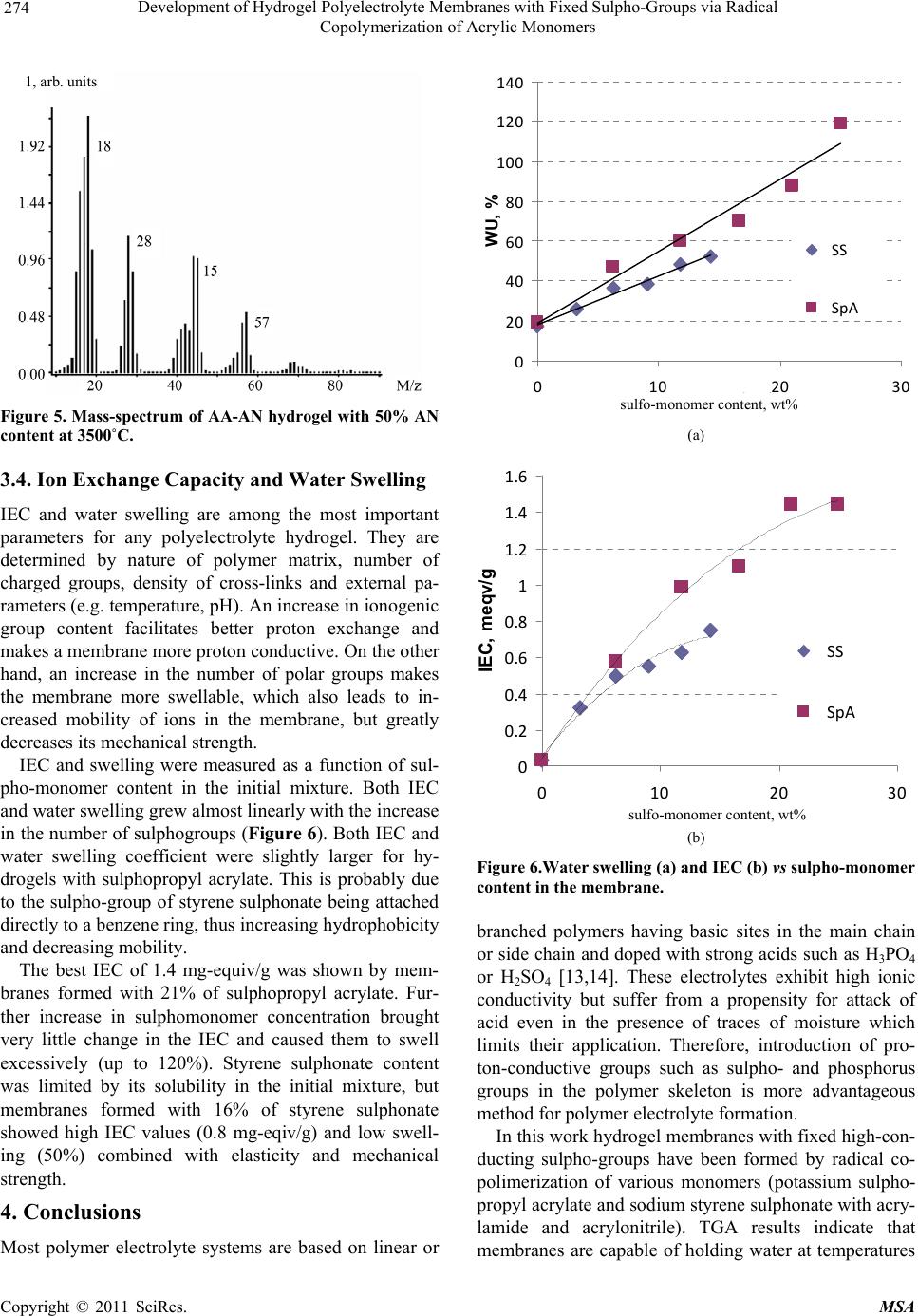 Development of Hydrogel Polyelectrolyte Membranes with Fixed Sulpho-Groups via Radical 274 Copolymerization of Acrylic Monomers 1, arb. units Figure 5. Mass-spectrum of AA-AN hydrogel with 50% AN content at 3500˚C. 3.4. Ion Exchange Capacity and Water Swelling IEC and water swelling are among the most important parameters for any polyelectrolyte hydrogel. They are determined by nature of polymer matrix, number of charged groups, density of cross-links and external pa- rameters (e.g. temperature, pH). An increase in ionogenic group content facilitates better proton exchange and makes a membrane more proton conductive. On the other hand, an increase in the number of polar groups makes the membrane more swellable, which also leads to in- creased mobility of ions in the membrane, but greatly decreases its mechanical strength. IEC and swelling were measured as a function of sul- pho-monomer content in the initial mixture. Both IEC and water swelling grew almost linearly with the increase in the number of sulphogroups (Figure 6). Both IEC and water swelling coefficient were slightly larger for hy- drogels with sulphopropyl acrylate. This is probably due to the sulpho-group of styrene sulphonate being attached directly to a benzene ring, thus increasing hydrophobicity and decreasing mobility. The best IEC of 1.4 mg-equiv/g was shown by mem- branes formed with 21% of sulphopropyl acrylate. Fur- ther increase in sulphomonomer concentration brought very little change in the IEC and caused them to swell excessively (up to 120%). Styrene sulphonate content was limited by its solubility in the initial mixture, but membranes formed with 16% of styrene sulphonate showed high IEC values (0.8 mg-eqiv/g) and low swell- ing (50%) combined with elasticity and mechanical strength. 4. Conclusions Most polymer electrolyte systems are based on linear or 0 20 40 60 80 100 120 140 01020 sul fo-monom er conte nt, wt/ % WU, % 30 SS SpA а sulfo-monomer content, wt% (a) (b) 0 0.2 0.4 0.6 0.8 1 1.2 1.4 1.6 01020 Figure 6.Water swelling (a) and IEC (b) vs sulpho-monomer content in the membrane. branched polymers having basic sites in the main chain or side chain and doped with strong acids such as H3PO4 or H2SO4 [13,14]. These electrolytes exhibit high ionic conductivity but suffer from a propensity for attack of acid even in the presence of traces of moisture which limits their application. Therefore, introduction of pro- ton-conductive groups such as sulpho- and phosphorus groups in the polymer skeleton is more advantageous method for polymer electrolyte formation. In this work hydrogel membranes with fixed high-con- ducting sulpho-groups have been formed by radical co- polimerization of various monomers (potassium sulpho- propyl acrylate and sodium styrene sulphonate with acry- lamide and acrylonitrile). TGA results indicate that membranes are capable of holding water at temperatures 3 0 sulfo-monomer conte nt, w t. % IEC, meqv/g SS SpA b sulfo-monomer content, wt% C opyright © 2011 SciRes. MSA 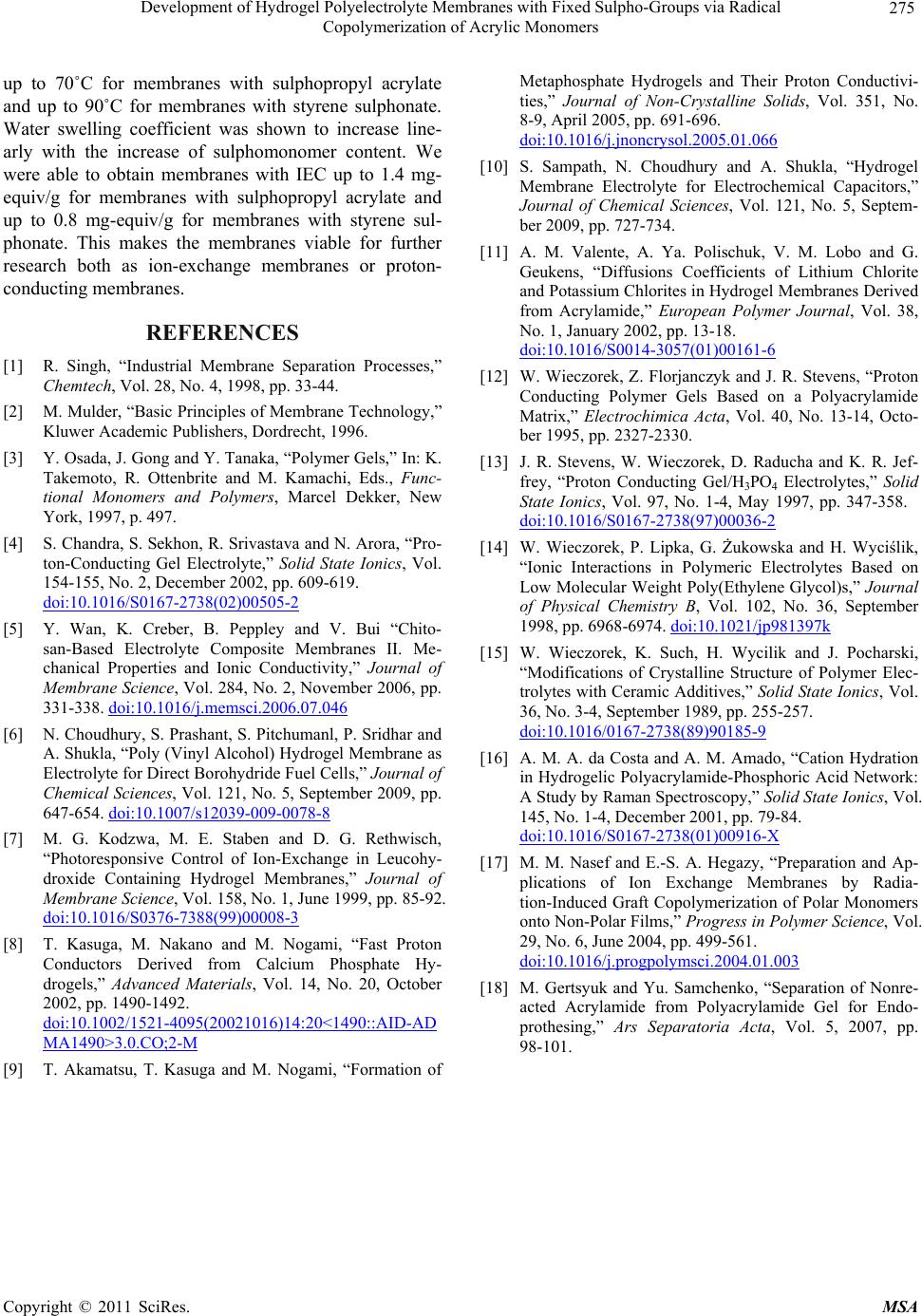 Development of Hydrogel Polyelectrolyte Membranes with Fixed Sulpho-Groups via Radical Copolymerization of Acrylic Monomers Copyright © 2011 SciRes. MSA 275 up to 70˚C for membranes with sulphopropyl acrylate and up to 90˚C for membranes with styrene sulphonate. Water swelling coefficient was shown to increase line- arly with the increase of sulphomonomer content. We were able to obtain membranes with IEC up to 1.4 mg- equiv/g for membranes with sulphopropyl acrylate and up to 0.8 mg-equiv/g for membranes with styrene sul- phonate. This makes the membranes viable for further research both as ion-exchange membranes or proton- conducting membranes. REFERENCES [1] R. Singh, “Industrial Membrane Separation Processes,” Chemtech, Vol. 28, No. 4, 1998, pp. 33-44. [2] M. Mulder, “Basic Principles of Membrane Technology,” Kluwer Academic Publishers, Dordrecht, 1996. [3] Y. Osada, J. Gong and Y. Tanaka, “Polymer Gels,” In: K. Takemoto, R. Ottenbrite and M. Kamachi, Eds., Func- tional Monomers and Polymers, Marcel Dekker, New York, 1997, p. 497. [4] S. Chandra, S. Sekhon, R. Srivastava and N. Arora, “Pro- ton-Conducting Gel Electrolyte,” Solid State Ionics, Vol. 154-155, No. 2, December 2002, pp. 609-619. doi:10.1016/S0167-2738(02)00505-2 [5] Y. Wan, K. Creber, B. Peppley and V. Bui “Chito- san-Based Electrolyte Composite Membranes II. Me- chanical Properties and Ionic Conductivity,” Journal of Membrane Science, Vol. 284, No. 2, November 2006, pp. 331-338. doi:10.1016/j.memsci.2006.07.046 [6] N. Choudhury, S. Prashant, S. Pitchumanl, P. Sridhar and A. Shukla, “Poly (Vinyl Alcohol) Hydrogel Membrane as Electrolyte for Direct Borohydride Fuel Cells,” Journal of Chemical Sciences, Vol. 121, No. 5, September 2009, pp. 647-654. doi:10.1007/s12039-009-0078-8 [7] M. G. Kodzwa, M. E. Staben and D. G. Rethwisch, “Photoresponsive Control of Ion-Exchange in Leucohy- droxide Containing Hydrogel Membranes,” Journal of Membrane Science, Vol. 158, No. 1, June 1999, pp. 85-92. doi:10.1016/S0376-7388(99)00008-3 [8] T. Kasuga, M. Nakano and M. Nogami, “Fast Proton Conductors Derived from Calcium Phosphate Hy- drogels,” Advanced Materials, Vol. 14, No. 20, October 2002, pp. 1490-1492. doi:10.1002/1521-4095(20021016)14:20<1490::AID-AD MA1490>3.0.CO;2-M [9] T. Akamatsu, T. Kasuga and M. Nogami, “Formation of Metaphosphate Hydrogels and Their Proton Conductivi- ties,” Journal of Non-Crystalline Solids, Vol. 351, No. 8-9, April 2005, pp. 691-696. doi:10.1016/j.jnoncrysol.2005.01.066 [10] S. Sampath, N. Choudhury and A. Shukla, “Hydrogel Membrane Electrolyte for Electrochemical Capacitors,” Journal of Chemical Sciences, Vol. 121, No. 5, Septem- ber 2009, pp. 727-734. [11] A. M. Valente, A. Ya. Polischuk, V. M. Lobo and G. Geukens, “Diffusions Coefficients of Lithium Chlorite and Potassium Chlorites in Hydrogel Membranes Derived from Acrylamide,” European Polymer Journal, Vol. 38, No. 1, January 2002, pp. 13-18. doi:10.1016/S0014-3057(01)00161-6 [12] W. Wieczorek, Z. Florjanczyk and J. R. Stevens, “Proton Conducting Polymer Gels Based on a Polyacrylamide Matrix,” Electrochimica Acta, Vol. 40, No. 13-14, Octo- ber 1995, pp. 2327-2330. [13] J. R. Stevens, W. Wieczorek, D. Raducha and K. R. Jef- frey, “Proton Conducting Gel/H3PO4 Electrolytes,” Solid State Ionics, Vol. 97, No. 1-4, May 1997, pp. 347-358. doi:10.1016/S0167-2738(97)00036-2 [14] W. Wieczorek, P. Lipka, G. Żukowska and H. Wyciślik, “Ionic Interactions in Polymeric Electrolytes Based on Low Molecular Weight Poly(Ethylene Glycol)s,” Journal of Physical Chemistry B, Vol. 102, No. 36, September 1998, pp. 6968-6974. doi:10.1021/jp981397k [15] W. Wieczorek, K. Such, H. Wycilik and J. Pocharski, “Modifications of Crystalline Structure of Polymer Elec- trolytes with Ceramic Additives,” Solid State Ionics, Vol. 36, No. 3-4, September 1989, pp. 255-257. doi:10.1016/0167-2738(89)90185-9 [16] A. M. A. da Costa and A. M. Amado, “Cation Hydration in Hydrogelic Polyacrylamide-Phosphoric Acid Network: A Study by Raman Spectroscopy,” Solid State Ionics, Vol. 145, No. 1-4, December 2001, pp. 79-84. doi:10.1016/S0167-2738(01)00916-X [17] M. M. Nasef and E.-S. A. Hegazy, “Preparation and Ap- plications of Ion Exchange Membranes by Radia- tion-Induced Graft Copolymerization of Polar Monomers onto Non-Polar Films,” Progress in Polymer Science, Vol. 29, No. 6, June 2004, pp. 499-561. doi:10.1016/j.progpolymsci.2004.01.003 [18] M. Gertsyuk and Yu. Samchenko, “Separation of Nonre- acted Acrylamide from Polyacrylamide Gel for Endo- prothesing,” Ars Separatoria Acta, Vol. 5, 2007, pp. 98-101. |