

Paper Menu >>
Journal Menu >>
 Journal of Environmental Protection, 2011, 2, 198-203 doi:10.4236/jep.2011.22023 Published Online April 2011 (http://www.SciRP.org/journal/jep) Copyright © 2011 SciRes. JEP Hollow-Fiber Microporous Membrane Liquid-Liquid Extraction for Determination of Polybrominated Diphenyl Ethers at Trace Levels in Sewage Sludge with Gas Chromatography-Electron Capture Detection Azadeh Sharifi Aghili, Jan Åke Jönsson Center for Analysis and Synthesis, Department of Chemistry, Lund University, Lund, Sweden. Email: Jan_Ake.Jon[email protected] Received January 20th, 2010; revised February 3rd, 2011; accepted March 16th, 2011. ABSTRACT A two-phase hollow-fiber (HF) liquid-phase microextraction (LPME) method followed by gas chromatography was developed for quantification of 8 major polybrominated diphenyl ethers at trace level in sewage sludge. In this method the porous polypro pylene hollow fib ers filled with a few microliters of organic so lvent, were immersed in aqueous sam- ples of wet sludge which were spiked with the PBDEs at ng/l level. Parameters such as salt concentration, stirring speed, extraction time and pH were optimized and the optimum extraction conditio ns were then applied to the determi- nation of PBDEs in sewage sludge from Källby sewage treatment plant in Lund. The optimized method allowed detec- tion of 5.1 µg kg–1 and 0.43 µg kg–1 of BDE-47 and 183, respectively, in dried sludge. The findings were compatible with the results from recent research on PBDEs level in sewage sludge samples from Sweden. Although BDE-209 was expected to have the highest level, it was not detected. Limit of detection, photodegradation or/and biodegradation of BDE-209 during treatment or experiment are major reasons. Low organic solvent consumption, low sample volume requirement, high preconcentration factor, simplicity without using expensive instrument for extraction and excellent sample clean-up are some important factors that make this sample preparation technique very useful for determination of PBDEs in sludge. Keywords: PBDE, Gas Chromatography, Sewage Sludge, Membrane Extraction, LPME 1. Introduction Of all the pollutants released into the environment every year, persistent organic pollutants (POPs) are among the most dangerous chemical pollutants. These are used as pesticides, used by industry, or generated unintentionally as by-products of industrial processes. They accumulate through the food chain in environmental and biota sam- ples [1-9] and pose a risk of causing adverse effect to human health and environment. Polybrominated diphenyl ethers (PBDEs) are a group of persistent organic pollut- ants, which are used as flame retardants in plastics in consumer products such as computers, television sets and polyurethane foam. Animal studies have shown that PBDEs cause very serious health effects such as estro- genic [10] and, neurobehavioral [8,11] effects, thyroid dysfunctions [12] and cancer [13,14]. Exponential in- crease of PBDEs in human [4] and biota samples as well as their adverse health effects on animals have raised concerns over potential health effects of PBDEs in hu- mans and many studies have been conducted to deter- mine these persistent pollutants in environmental sam- ples such as sewage sludge and treatment plant effluents, which are major sources of contamination by PBDEs. Conventional methods for extraction of PBDEs from sewage sludge such as Soxhlet extraction or accelerated solvent extraction (ASE) need a clean-up step prior to analysis by chromatographic methods and consume a lot of time and extraction solvent, which leads to a signifi- cant expense. Hollow fiber microporous membrane liq- uid-liquid extraction (HF-MMLLE) [15] also known as 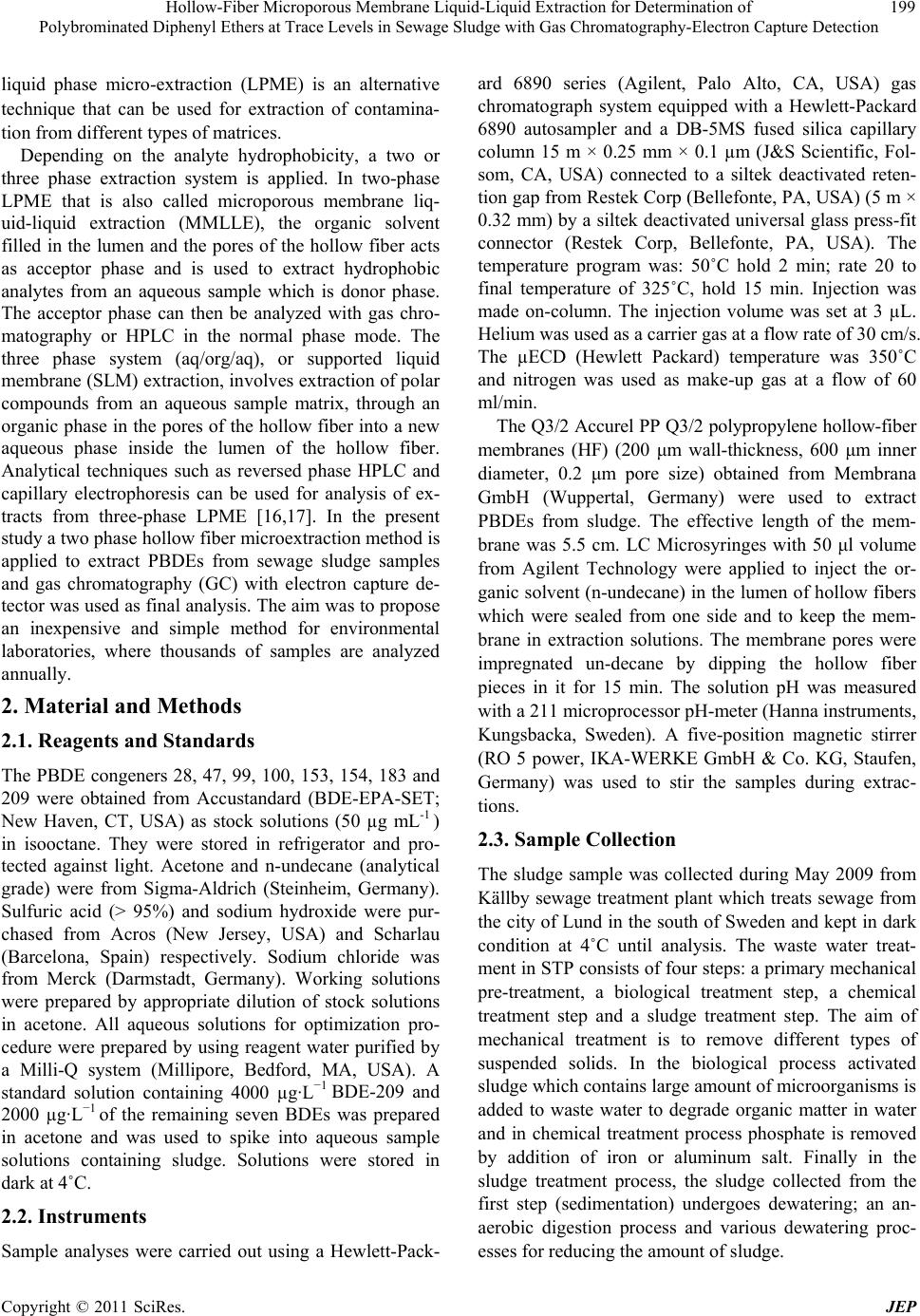 Hollow-Fiber Microporous Membrane Liquid-Liquid Extraction for Determination of 199 Polybrominated Diphenyl Ethers at Trace Levels in Sewage Sludge with Gas Chromatography-Electron Capture Detection liquid phase micro-extraction (LPME) is an alternative technique that can be used for extraction of contamina- tion from different types of matrices. Depending on the analyte hydrophobicity, a two or three phase extraction system is applied. In two-phase LPME that is also called microporous membrane liq- uid-liquid extraction (MMLLE), the organic solvent filled in the lumen and the pores of the hollow fiber acts as acceptor phase and is used to extract hydrophobic analytes from an aqueous sample which is donor phase. The acceptor phase can then be analyzed with gas chro- matography or HPLC in the normal phase mode. The three phase system (aq/org/aq), or supported liquid membrane (SLM) extraction, involves extraction of polar compounds from an aqueous sample matrix, through an organic phase in the pores of the hollow fiber into a new aqueous phase inside the lumen of the hollow fiber. Analytical techniques such as reversed phase HPLC and capillary electrophoresis can be used for analysis of ex- tracts from three-phase LPME [16,17]. In the present study a two phase hollow fiber microextraction method is applied to extract PBDEs from sewage sludge samples and gas chromatography (GC) with electron capture de- tector was used as final analysis. The aim was to propose an inexpensive and simple method for environmental laboratories, where thousands of samples are analyzed annually. 2. Material and Methods 2.1. Reagents and Standards The PBDE congeners 28, 47, 99, 100, 153, 154, 183 and 209 were obtained from Accustandard (BDE-EPA-SET; New Haven, CT, USA) as stock solutions (50 µg mL-1 ) in isooctane. They were stored in refrigerator and pro- tected against light. Acetone and n-undecane (analytical grade) were from Sigma-Aldrich (Steinheim, Germany). Sulfuric acid (> 95%) and sodium hydroxide were pur- chased from Acros (New Jersey, USA) and Scharlau (Barcelona, Spain) respectively. Sodium chloride was from Merck (Darmstadt, Germany). Working solutions were prepared by appropriate dilution of stock solutions in acetone. All aqueous solutions for optimization pro- cedure were prepared by using reagent water purified by a Milli-Q system (Millipore, Bedford, MA, USA). A standard solution containing 4000 µg·L−1 BDE-209 and 2000 µg·L−1 of the remaining seven BDEs was prepared in acetone and was used to spike into aqueous sample solutions containing sludge. Solutions were stored in dark at 4˚C. 2.2. Instruments Sample analyses were carried out using a Hewlett-Pack- ard 6890 series (Agilent, Palo Alto, CA, USA) gas chromatograph system equipped with a Hewlett-Packard 6890 autosampler and a DB-5MS fused silica capillary column 15 m × 0.25 mm × 0.1 µm (J&S Scientific, Fol- som, CA, USA) connected to a siltek deactivated reten- tion gap from Restek Corp (Bellefonte, PA, USA) (5 m × 0.32 mm) by a siltek deactivated universal glass press-fit connector (Restek Corp, Bellefonte, PA, USA). The temperature program was: 50˚C hold 2 min; rate 20 to final temperature of 325˚C, hold 15 min. Injection was made on-column. The injection volume was set at 3 µL. Helium was used as a carrier gas at a flow rate of 30 cm/s. The µECD (Hewlett Packard) temperature was 350˚C and nitrogen was used as make-up gas at a flow of 60 ml/min. The Q3/2 Accurel PP Q3/2 polypropylene hollow-fiber membranes (HF) (200 μm wall-thickness, 600 μm inner diameter, 0.2 μm pore size) obtained from Membrana GmbH (Wuppertal, Germany) were used to extract PBDEs from sludge. The effective length of the mem- brane was 5.5 cm. LC Microsyringes with 50 μl volume from Agilent Technology were applied to inject the or- ganic solvent (n-undecane) in the lumen of hollow fibers which were sealed from one side and to keep the mem- brane in extraction solutions. The membrane pores were impregnated un-decane by dipping the hollow fiber pieces in it for 15 min. The solution pH was measured with a 211 microprocessor pH-meter (Hanna instruments, Kungsbacka, Sweden). A five-position magnetic stirrer (RO 5 power, IKA-WERKE GmbH & Co. KG, Staufen, Germany) was used to stir the samples during extrac- tions. 2.3. Sample Collection The sludge sample was collected during May 2009 from Källby sewage treatment plant which treats sewage from the city of Lund in the south of Sweden and kept in dark condition at 4˚C until analysis. The waste water treat- ment in STP consists of four steps: a primary mechanical pre-treatment, a biological treatment step, a chemical treatment step and a sludge treatment step. The aim of mechanical treatment is to remove different types of suspended solids. In the biological process activated sludge which contains large amount of microorganisms is added to waste water to degrade organic matter in water and in chemical treatment process phosphate is removed by addition of iron or aluminum salt. Finally in the sludge treatment process, the sludge collected from the first step (sedimentation) undergoes dewatering; an an- aerobic digestion process and various dewatering proc- esses for reducing the amount of sludge. Copyright © 2011 SciRes. JEP 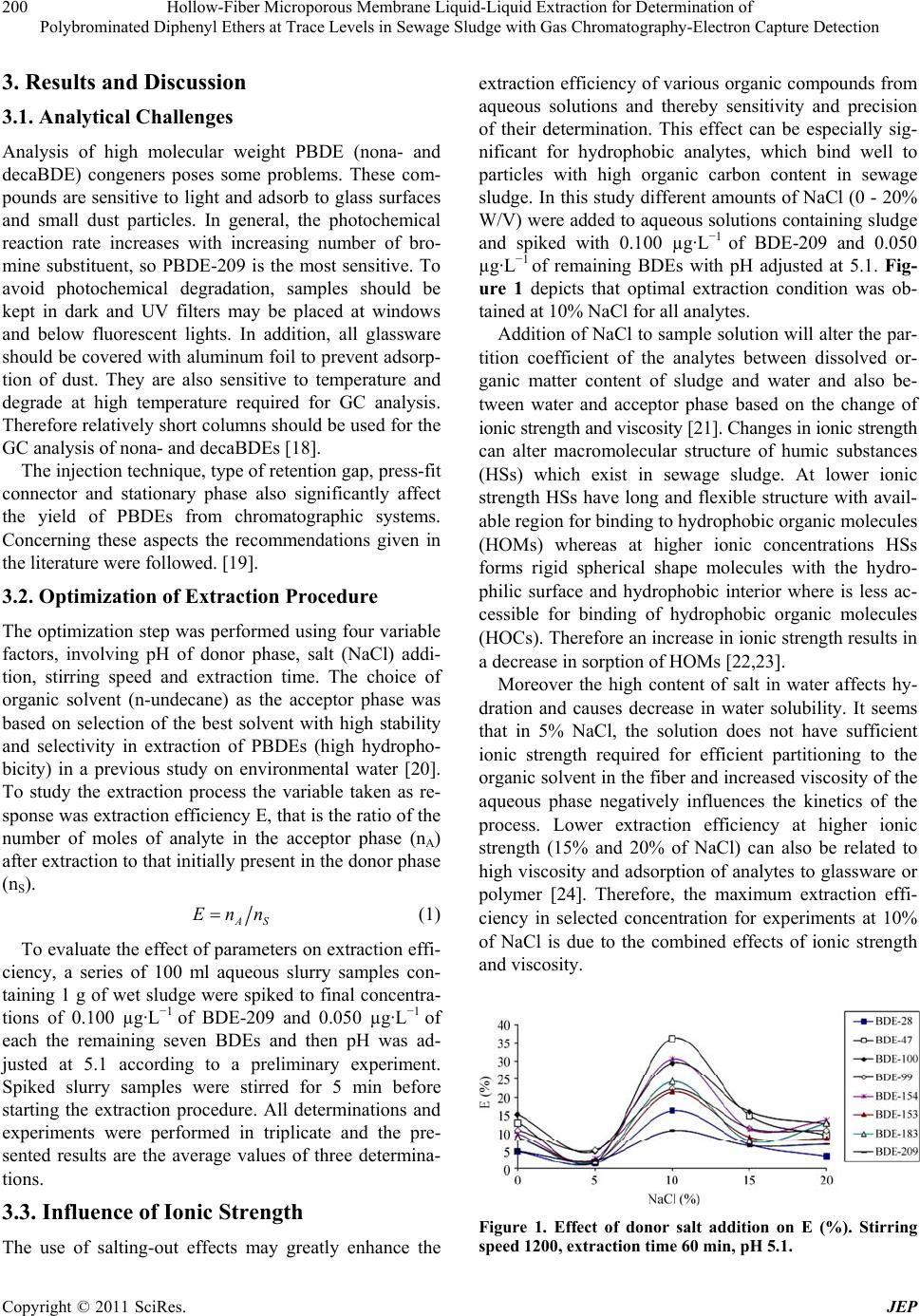 Hollow-Fiber Microporous Membrane Liquid-Liquid Extraction for Determination of 200 Polybrominated Diphenyl Ethers at Trace Levels in Sewage Sludge with Gas Chromatography-Electron Capture Detection 3. Results and Discussion 3.1. Analytical Challenges Analysis of high molecular weight PBDE (nona- and decaBDE) congeners poses some problems. These com- pounds are sensitive to light and adsorb to glass surfaces and small dust particles. In general, the photochemical reaction rate increases with increasing number of bro- mine substituent, so PBDE-209 is the most sensitive. To avoid photochemical degradation, samples should be kept in dark and UV filters may be placed at windows and below fluorescent lights. In addition, all glassware should be covered with aluminum foil to prevent adsorp- tion of dust. They are also sensitive to temperature and degrade at high temperature required for GC analysis. Therefore relatively short columns should be used for the GC analysis of nona- and decaBDEs [18]. The injection technique, type of retention gap, press-fit connector and stationary phase also significantly affect the yield of PBDEs from chromatographic systems. Concerning these aspects the recommendations given in the literature were followed. [19]. 3.2. Optimization of Extraction Procedure The optimization step was performed using four variable factors, involving pH of donor phase, salt (NaCl) addi- tion, stirring speed and extraction time. The choice of organic solvent (n-undecane) as the acceptor phase was based on selection of the best solvent with high stability and selectivity in extraction of PBDEs (high hydropho- bicity) in a previous study on environmental water [20]. To study the extraction process the variable taken as re- sponse was extraction efficiency E, that is the ratio of the number of moles of analyte in the acceptor phase (nA) after extraction to that initially present in the donor phase (nS). AS Enn (1) To evaluate the effect of parameters on extraction effi- ciency, a series of 100 ml aqueous slurry samples con- taining 1 g of wet sludge were spiked to final concentra- tions of 0.100 µg·L−1 of BDE-209 and 0.050 µg·L−1 of each the remaining seven BDEs and then pH was ad- justed at 5.1 according to a preliminary experiment. Spiked slurry samples were stirred for 5 min before starting the extraction procedure. All determinations and experiments were performed in triplicate and the pre- sented results are the average values of three determina- tions. 3.3. Influence of Ionic Strength The use of salting-out effects may greatly enhance the extraction efficiency of various organic compounds from aqueous solutions and thereby sensitivity and precision of their determination. This effect can be especially sig- nificant for hydrophobic analytes, which bind well to particles with high organic carbon content in sewage sludge. In this study different amounts of NaCl (0 - 20% W/V) were added to aqueous solutions containing sludge and spiked with 0.100 µg·L−1 of BDE-209 and 0.050 µg·L−1 of remaining BDEs with pH adjusted at 5.1. Fig- ure 1 depicts that optimal extraction condition was ob- tained at 10% NaCl for all analytes. Addition of NaCl to sample solution will alter the par- tition coefficient of the analytes between dissolved or- ganic matter content of sludge and water and also be- tween water and acceptor phase based on the change of ionic strength and viscosity [21]. Changes in ionic strength can alter macromolecular structure of humic substances (HSs) which exist in sewage sludge. At lower ionic strength HSs have long and flexible structure with avail- able region for binding to hydrophobic organic molecules (HOMs) whereas at higher ionic concentrations HSs forms rigid spherical shape molecules with the hydro- philic surface and hydrophobic interior where is less ac- cessible for binding of hydrophobic organic molecules (HOCs). Therefore an increase in ionic strength results in a decrease in sorption of HOMs [22,23]. Moreover the high content of salt in water affects hy- dration and causes decrease in water solubility. It seems that in 5% NaCl, the solution does not have sufficient ionic strength required for efficient partitioning to the organic solvent in the fiber and increased viscosity of the aqueous phase negatively influences the kinetics of the process. Lower extraction efficiency at higher ionic strength (15% and 20% of NaCl) can also be related to high viscosity and adsorption of analytes to glassware or polymer [24]. Therefore, the maximum extraction effi- ciency in selected concentration for experiments at 10% of NaCl is due to the combined effects of ionic strength and viscosity. Figure 1. Effect of donor salt addition on E (%). Stirring speed 1200, extraction time 60 min, pH 5.1. Copyright © 2011 SciRes. JEP 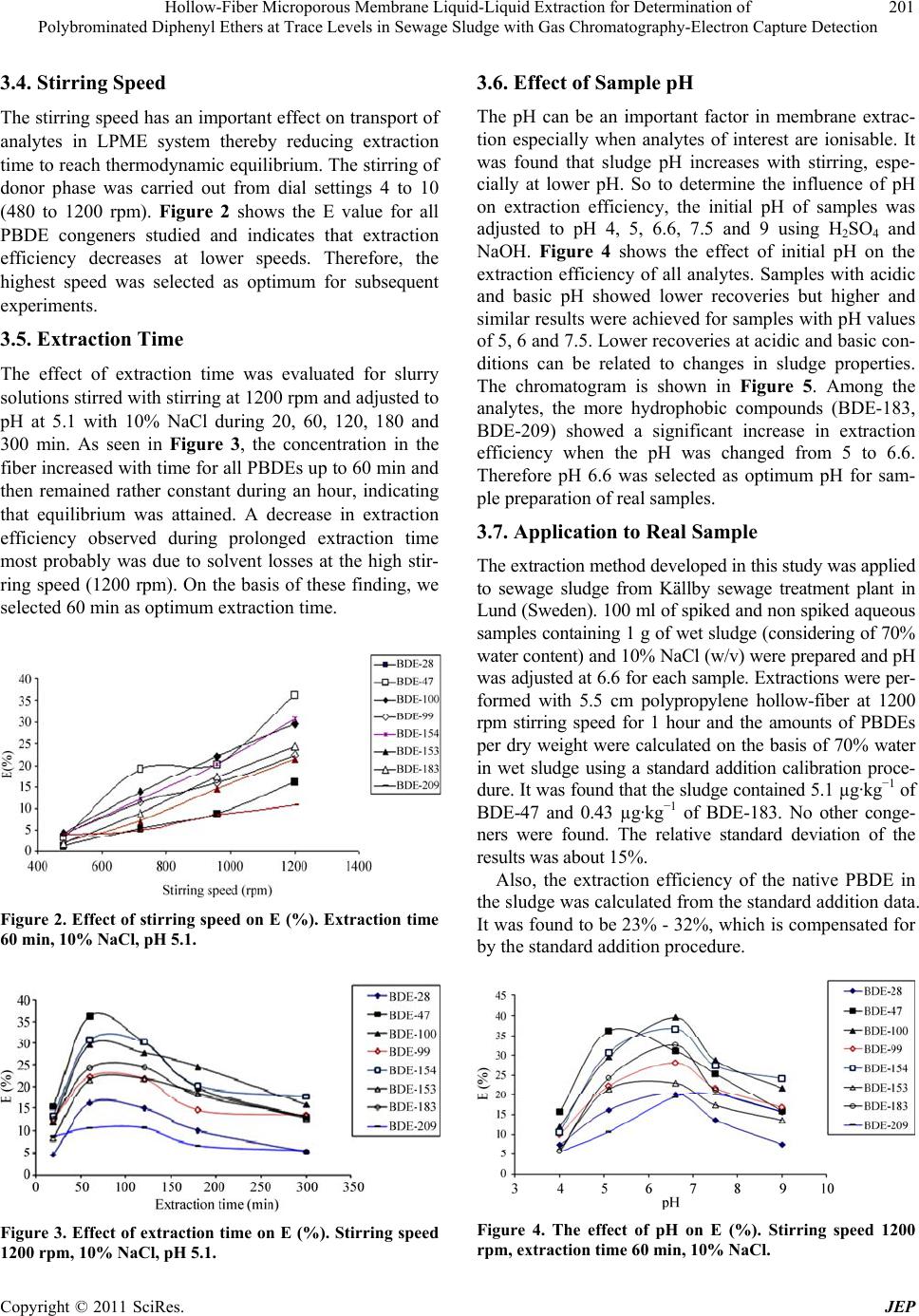 Hollow-Fiber Microporous Membrane Liquid-Liquid Extraction for Determination of 201 Polybrominated Diphenyl Ethers at Trace Levels in Sewage Sludge with Gas Chromatography-Electron Capture Detection 3.4. Stirring Speed The stirring speed has an important effect on transport of analytes in LPME system thereby reducing extraction time to reach thermodynamic equilibrium. The stirring of donor phase was carried out from dial settings 4 to 10 (480 to 1200 rpm). Figure 2 shows the E value for all PBDE congeners studied and indicates that extraction efficiency decreases at lower speeds. Therefore, the highest speed was selected as optimum for subsequent experiments. 3.5. Extraction Time The effect of extraction time was evaluated for slurry solutions stirred with stirring at 1200 rpm and adjusted to pH at 5.1 with 10% NaCl during 20, 60, 120, 180 and 300 min. As seen in Figure 3, the concentration in the fiber increased with time for all PBDEs up to 60 min and then remained rather constant during an hour, indicating that equilibrium was attained. A decrease in extraction efficiency observed during prolonged extraction time most probably was due to solvent losses at the high stir- ring speed (1200 rpm). On the basis of these finding, we selected 60 min as optimum extraction time. Figure 2. Effect of stirring speed on E (%). Extraction time 60 min, 10% NaCl, pH 5.1. Figure 3. Effect of extraction time on E (%). Stirring speed 1200 rpm, 10% NaCl, pH 5.1. 3.6. Effect of Sample pH The pH can be an important factor in membrane extrac- tion especially when analytes of interest are ionisable. It was found that sludge pH increases with stirring, espe- cially at lower pH. So to determine the influence of pH on extraction efficiency, the initial pH of samples was adjusted to pH 4, 5, 6.6, 7.5 and 9 using H2SO4 and NaOH. Figure 4 shows the effect of initial pH on the extraction efficiency of all analytes. Samples with acidic and basic pH showed lower recoveries but higher and similar results were achieved for samples with pH values of 5, 6 and 7.5. Lower recoveries at acidic and basic con- ditions can be related to changes in sludge properties. The chromatogram is shown in Figure 5. Among the analytes, the more hydrophobic compounds (BDE-183, BDE-209) showed a significant increase in extraction efficiency when the pH was changed from 5 to 6.6. Therefore pH 6.6 was selected as optimum pH for sam- ple preparation of real samples. 3.7. Application to Real Sample The extraction method developed in this study was applied to sewage sludge from Källby sewage treatment plant in Lund (Sweden). 100 ml of spiked and non spiked aqueous samples containing 1 g of wet sludge (considering of 70% water content) and 10% NaCl (w/v) were prepared and pH was adjusted at 6.6 for each sample. Extractions were per- formed with 5.5 cm polypropylene hollow-fiber at 1200 rpm stirring speed for 1 hour and the amounts of PBDEs per dry weight were calculated on the basis of 70% water in wet sludge using a standard addition calibration proce- dure. It was found that the sludge contained 5.1 µg·kg−1 of BDE-47 and 0.43 µg·kg−1 of BDE-183. No other conge- ners were found. The relative standard deviation of the results was about 15%. Also, the extraction efficiency of the native PBDE in the sludge was calculated from the standard addition data. It was found to be 23% - 32%, which is compensated for by the standard addition procedure. Figure 4. The effect of pH on E (%). Stirring speed 1200 rpm, extraction time 60 min, 10% NaCl. Copyright © 2011 SciRes. JEP 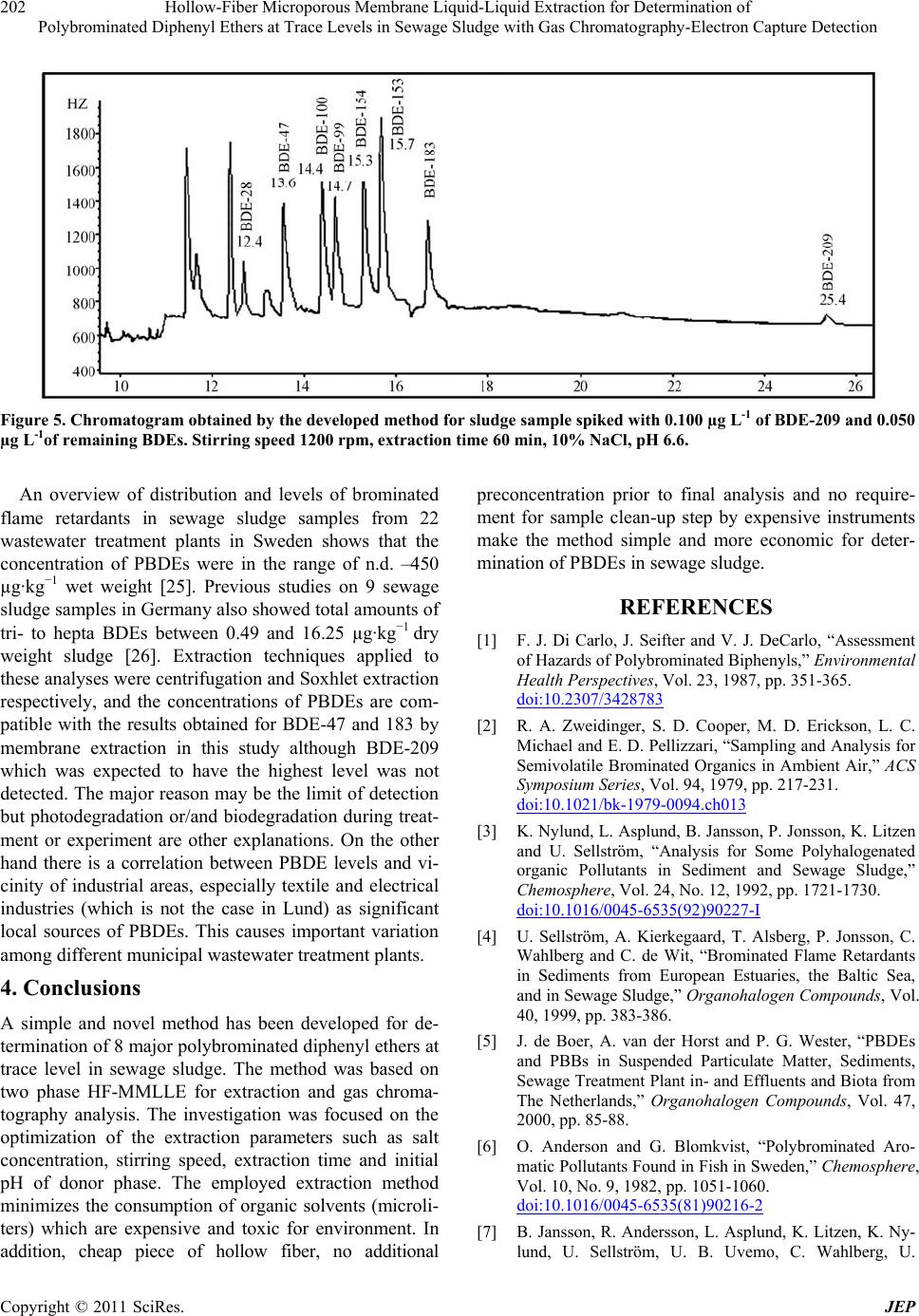 Hollow-Fiber Microporous Membrane Liquid-Liquid Extraction for Determination of Polybrominated Diphenyl Ethers at Trace Levels in Sewage Sludge with Gas Chromatography-Electron Capture Detection Copyright © 2011 SciRes. JEP 202 Figure 5. Chromatogram obtained by the developed method for sludge sample spiked with 0.100 µg L-1 of BDE-209 and 0.050 µg L-1of remaining BDEs. Stirring speed 1200 rpm, extraction time 60 min, 10% NaCl, pH 6.6. An overview of distribution and levels of brominated flame retardants in sewage sludge samples from 22 wastewater treatment plants in Sweden shows that the concentration of PBDEs were in the range of n.d. –450 µg·kg−1 wet weight [25]. Previous studies on 9 sewage sludge samples in Germany also showed total amounts of tri- to hepta BDEs between 0.49 and 16.25 µg·kg−1 dry weight sludge [26]. Extraction techniques applied to these analyses were centrifugation and Soxhlet extraction respectively, and the concentrations of PBDEs are com- patible with the results obtained for BDE-47 and 183 by membrane extraction in this study although BDE-209 which was expected to have the highest level was not detected. The major reason may be the limit of detection but photodegradation or/and biodegradation during treat- ment or experiment are other explanations. On the other hand there is a correlation between PBDE levels and vi- cinity of industrial areas, especially textile and electrical industries (which is not the case in Lund) as significant local sources of PBDEs. This causes important variation among different municipal wastewater treatment plants. 4. Conclusions A simple and novel method has been developed for de- termination of 8 major polybrominated diphenyl ethers at trace level in sewage sludge. The method was based on two phase HF-MMLLE for extraction and gas chroma- tography analysis. The investigation was focused on the optimization of the extraction parameters such as salt concentration, stirring speed, extraction time and initial pH of donor phase. The employed extraction method minimizes the consumption of organic solvents (microli- ters) which are expensive and toxic for environment. In addition, cheap piece of hollow fiber, no additional preconcentration prior to final analysis and no require- ment for sample clean-up step by expensive instruments make the method simple and more economic for deter- mination of PBDEs in sewage sludge. REFERENCES [1] F. J. Di Carlo, J. Seifter and V. J. DeCarlo, “Assessment of Hazards of Polybrominated Biphenyls,” Environmental Health Perspectives, Vol. 23, 1987, pp. 351-365. doi:10.2307/3428783 [2] R. A. Zweidinger, S. D. Cooper, M. D. Erickson, L. C. Michael and E. D. Pellizzari, “Sampling and Analysis for Semivolatile Brominated Organics in Ambient Air,” ACS Symposium Series, Vol. 94, 1979, pp. 217-231. doi:10.1021/bk-1979-0094.ch013 [3] K. Nylund, L. Asplund, B. Jansson, P. Jonsson, K. Litzen and U. Sellström, “Analysis for Some Polyhalogenated organic Pollutants in Sediment and Sewage Sludge,” Chemosphere, Vol. 24, No. 12, 1992, pp. 1721-1730. doi:10.1016/0045-6535(92)90227-I [4] U. Sellström, A. Kierkegaard, T. Alsberg, P. Jonsson, C. Wahlberg and C. de Wit, “Brominated Flame Retardants in Sediments from European Estuaries, the Baltic Sea, and in Sewage Sludge,” Organohalogen Compounds, Vol. 40, 1999, pp. 383-386. [5] J. de Boer, A. van der Horst and P. G. Wester, “PBDEs and PBBs in Suspended Particulate Matter, Sediments, Sewage Treatment Plant in- and Effluents and Biota from The Netherlands,” Organohalogen Compounds, Vol. 47, 2000, pp. 85-88. [6] O. Anderson and G. Blomkvist, “Polybrominated Aro- matic Pollutants Found in Fish in Sweden,” Chemosphere, Vol. 10, No. 9, 1982, pp. 1051-1060. doi:10.1016/0045-6535(81)90216-2 [7] B. Jansson, R. Andersson, L. Asplund, K. Litzen, K. Ny- lund, U. Sellström, U. B. Uvemo, C. Wahlberg, U.  Hollow-Fiber Microporous Membrane Liquid-Liquid Extraction for Determination of 203 Polybrominated Diphenyl Ethers at Trace Levels in Sewage Sludge with Gas Chromatography-Electron Capture Detection Wideqvist, T. Odsjö and M. Olsson, “Chlorinated and Brominated Persistent Organic Compounds in Biological Samples from the Environment,” Environmental Toxi- cology and Chemistry, Vol. 12, No. 7, 1993, pp. 1163-1174. doi:10.1002/etc.5620120704 [8] A. Schecter, O. Paepke, K.-C. Tung, D. Staskal and L. Birnbaum, “Polybrominated Diphenyl Ethers Contamina- tion of United States food,” Environmental Science and Technology, Vol. 38, 2004, No. 20, pp. 5306-5311. doi:10.1021/es0490830 [9] A. Sjödin, L. Hagmar, E. Klasson-Wehler, K. Kron- holm-Diab, E. Jakobsson and Å. Bergman, “Flame Re- tardant Exposure: Polybrominated Diphenyl Ethers in Blood from Swedish workers,” Environmental Health Perspectives, Vol. 107, No. 8, 1999, pp. 643-648. [10] Anon., “Public Health Statement for Polybrominated Diphenyl Ethers,” ATSDR (Agency for toxic substances and disease registry), Atlanta, GA., 2004. http://www.atsdr.cdc.gov [11] T. E. Stoker, S. C. Laws, K. M. Crofton, J. M. Hedge, J. M. Ferrell and R. L. Cooper, “Assessment of DE-71, a Commercial Polybrominated Diphenyl Ether (PBDE) Mixture, in the EDSP Male and Female Pubertal Proto- cols,” Toxicological Science, Vol. 78, No. 1, 2004, pp. 144-155. doi:10.1093/toxsci/kfh029 [12] J. E. Haddow, G. E. Palomaki, W. C. Allan, J. R. Wil- liams, G. J. Knight, J. Gagnon, C. E. O’Heir, M. L. Mitchell, R. J. Hermos, S. E. Waisbren, J. D. Faix and R. Z. Klein, “Maternal Thyroid Deficiency during Pregnancy and Subsequent Neuropsychological Development of the Child,” New England Journal of Medicine, Vol. 341, 1999, pp. 549-555. doi:10.1056/NEJM199908193410801 [13] L. Hardell, G. Lindström, B. van Bavel, H. Wingfors, E. Sundelin and G. Liljegren, “Concentrations of the Flame Retardant 2,2',4,4'-Tetrabrominated Diphenyl Ether in Human Adipose Tissue in Swedish Persons and The Risk for Non-Hodgkin’s Lymphoma,” Oncology Research, Vol. 10, 1998, pp. 429-432. [14] CAL/EPA PBDE workgroup. “Polybrominated Diphenyl Ethers: Recommendation to Reduce Exposure in Califor- nia,” California Environmental Protection Agency, Sac- ramento, California, 2006. [15] J. Å. Jönsson and L. Mathiasson, “Membrane Extraction in Analytical Chemistry,” Journal of Separation Science, Vol. 24, No. 7, 2001, pp. 495-507. [16] J. Å. Jönsson and L. Mathiasson, “Membrane-Based Techniques for Sample Enrichment,” Journal of Chro- matography A, Vol. 902, No. 1, 2000, pp. 205-225. doi:10.1016/S0021-9673(00)00922-5 [17] J. Å. Jönsson and L. Mathiasson, “Liquid Membrane Enrichment for Sample Preparation,” Trends in Analytical Chemistry, Vol. 18, 1999, No. 5, pp. 318-325. doi:10.1016/S0165-9936(99)00102-8 [18] M. Gros, M. Petrovic and D. Barcelo, “Analysis of Emerging Contaminants of Municipal and Industrial Origon,” Handbook of Environmental Chemistry (D. Barcelo and M. Petrovic, eds.), Vol. 5, 2008, pp. 37-104. [19] J. Björklund, P. Tollback, C. Hiarne, E. Dyremark and C. Östman, “Influence of the Injection Technique and Col- umn System on Gas Chromatographic Determination of Polybrominated Diphenyl Ethers,” Journal of Chroma- tography A, Vol. 1041, No. 1-2, 2004, pp. 201-210. doi:10.1016/j.chroma.2004.04.025 [20] N. Fontalas, Th. Barri, S. Bergström and J. Å. Jöns- son, ”Determination of Polybrominated Diphenyl Ethers at Trace Levels in Environmental Waters Using Hol- low-Fiber Microporous Membrane Liquid-Liquid Extrac- tion and Gas Chromatography-Mass Spectrometry,” Jour- nal of Chromatography A, Vol. 1133, No. 1-2, 2006, pp. 41-48. doi:10.1016/j.chroma.2006.08.026 [21] Y. Yamini, C. T. Reimann, A. Vatanara and J. Å. Jönsson, “Extraction and Preconcentration of Salbutamol and Ter- Butaline from Aqueous Samples Using Hollow Fiber Supported Liquid Membrane Containing Anionic Car- rier,” Journal of Chromatography A, Vol. 1124, No. 1-2, 2006, pp. 57-67. doi:10.1016/j.chroma.2006.05.001 [22] M. A. Sehlantman and J. J. Morgan, “Effects of Aqueous Chemistry on The Binding of PM-I by Dissolved Humic Materials,” Environmental Science and Technology, Vol. 27, No. 5, 1993, pp. 961-969. doi:10.1021/es00042a020 [23] S. C. B. Myneni, J. T. Brown, G. A. Martinez and W. Meyer-Ilse, “Imaging of Humic Substance Macromo- lecular Structures in Water and Soils,” Science, Vol. 286, No. 5446, 1999, pp. 1335-1337. doi:10.1126/science.286.5443.1335 [24] Th. Barri, S. Bergström, A. Hussen, J. Norberg and J. Å. Jönsson, “Extracting Syringe for Determination of Or- ganochlorine Pesticides in Leachate Water and Soil-Water Slurry: A Novel Technology for Environmental Analysis,” Journal of Chromatography A, Vol. 1111, No. 1, 2006, pp. 11-20. doi:10.1016/j.chroma.2006.01.097 [25] K. Öberg, K. Warman and T. Öberg, “Distribution and Levels of Brominated Flame Retardants in Sewage Sludge,” Chemosphere, Vol. 48, 2002, No. 8, pp. 805-809. doi:10.1016/S0045-6535(02)00113-3 [26] H. Hagenmaier, J. She, T. Benz, N. Dawidowsky, L. Düsterhöft and C. Lindig, “Analysis of Sewage Sludge for Polyhalogenated Dibenzo-p-Dioxins, Dibenzofurans and Diphenylethers,” Chemosphere, Vol. 25, No. 7-10, 1992, pp. 1457-1462. doi:10.1016/0045-6535(92)90169-R Copyright © 2011 SciRes. JEP |