

Paper Menu >>
Journal Menu >>
 Journal of Environmental Protection, 2011, 2, 194-197 doi:10.4236/jep.2011.22022 Published Online April 2011 (http://www.SciRP.org/journal/jep) Copyright © 2011 SciRes. JEP Evaluation of Nitrogen Oxides Pollution in Takamatsu and Utazu Area in Kagawa Prefecture, Japan Shoko Murakami1, Noriko Sakano1, Shigeru Suna2, Fumiyuki Asakawa3, Nobuyuki Miyatake1 1Department of Hygiene, Faculty of Medicine, Kagawa University, Miki, Kagawa, Japan; 2Kagawa Prefectural College of Health Sciences, Kagawa, Japan; 3Kurashiki University of Science the Arts, Kurashiki, Japan. Email: [email protected] Received December 21st, 2010; revised February 6th, 2011; accepted March 12th, 2011. ABSTRACT We evaluate nitrogen oxides pollution in Takamatsu and Utazu area in Kagawa prefecture, Japan. Annually observa- tions for nitrogen oxides (nitrogen dioxide; NO2, nitric oxide; NO) (1990-2007) were obtained from data base of Ka- gawa prefecture, Japan. Changes in NO2 and NO in Takamatsu and Utazu area were evaluated and compared. In 2007, NO2, NO and NO2 + NO (ppm) in Takamatsu area were higher than those in Utazu area. However, NO2 /(NO + NO2) in Takamatsu area was lower than that in Utazu area. From 1990 to 2007, mean of NO2 in a day over the level of 0.06 ppm was 30 days in Takamatsu area and only one day in Utazu area. Mean of NO2, NO and NO2 + NO was signifi- cantly higher and NO2/(NO + NO2)was lower in Takamatsu area than that in Utazu area. In addition, NO2, NO and NO2 + NO were negatively correlated and NO2/(NO + NO2) was positively correlated with years (1990 - 2007) in Ta- kamatsu area. The level of nitrogen oxides pollution in Utazu area was lower than Takamatsu area. Further observa- tion is required for preventing nitrogen oxides pollution in Kagawa prefecture, Japan. Keywords: Nitrogen Oxides, NO2, NO, Utazu Area, Takamatsu Area 1. Introduction Air pollution is one of the public health challenges in Japan. Air pollution occurs where the natural composi- tion of the atmosphere is altered significantly in a way that is perceived as being harmful. In Japan, environ- mental air quality has changed remarkably since the 1960s. A serious environmental pollution problem caused by the enormous emission of pollutants from industries has been improved and controlled. Recently, another type of air pollution related to au tomobile exhaust in large cities has become a great problem. Atmospheric Environmental Regional Observation System [1] in Ministry of the Environment monitor air pollutants, and their concentrations have not sufficiently achieved Japanese Environmental Quality Standards (JEQS) [2]. In Kagawa prefecture, Japan, air pollution has been also observed in some observation points [3]. However, the changes in nitrogen oxides such as ni- trogen dioxide (NO2), nitric oxide (NO), NO2 + NO and NO2/(NO + NO2) in Kagawa prefecture, Japan still re- mains to be investigated, although Takamatsu is a main city located on north side of Shikoku and Utazu is a rural town in Kagawa prefecture of Shikoku Island, which sites are both located around the Inland Sea, Japan. Therefore, we evaluate the detailed changes in nitrogen oxides pollution in Takamatsu and Utazu area in Kagawa prefecture, Japan and compared each other. 2. Methods 2.1. Study Area Takamatsu area, Kagawa prefecture, Japan, which in- cludes Takamatsu city, is on the northern shore of Shi- koku Island (in a temperate zone area). The population of 420 000 people is situated on the Takamatsu area. Cur- rently several public offices of Shikoku district are lo- cated in Takamatsu city. Although the surrounds of Ta- kamatsu had been used primarily as paddy fields for ag- riculture, recently they have undergone rapid changes, developing into residential and/or commercial areas (Figure 1). Utazu area, Kagawa prefecture, Japan, which includes Utazu-cho, is also on the northern shore, west from Ta- 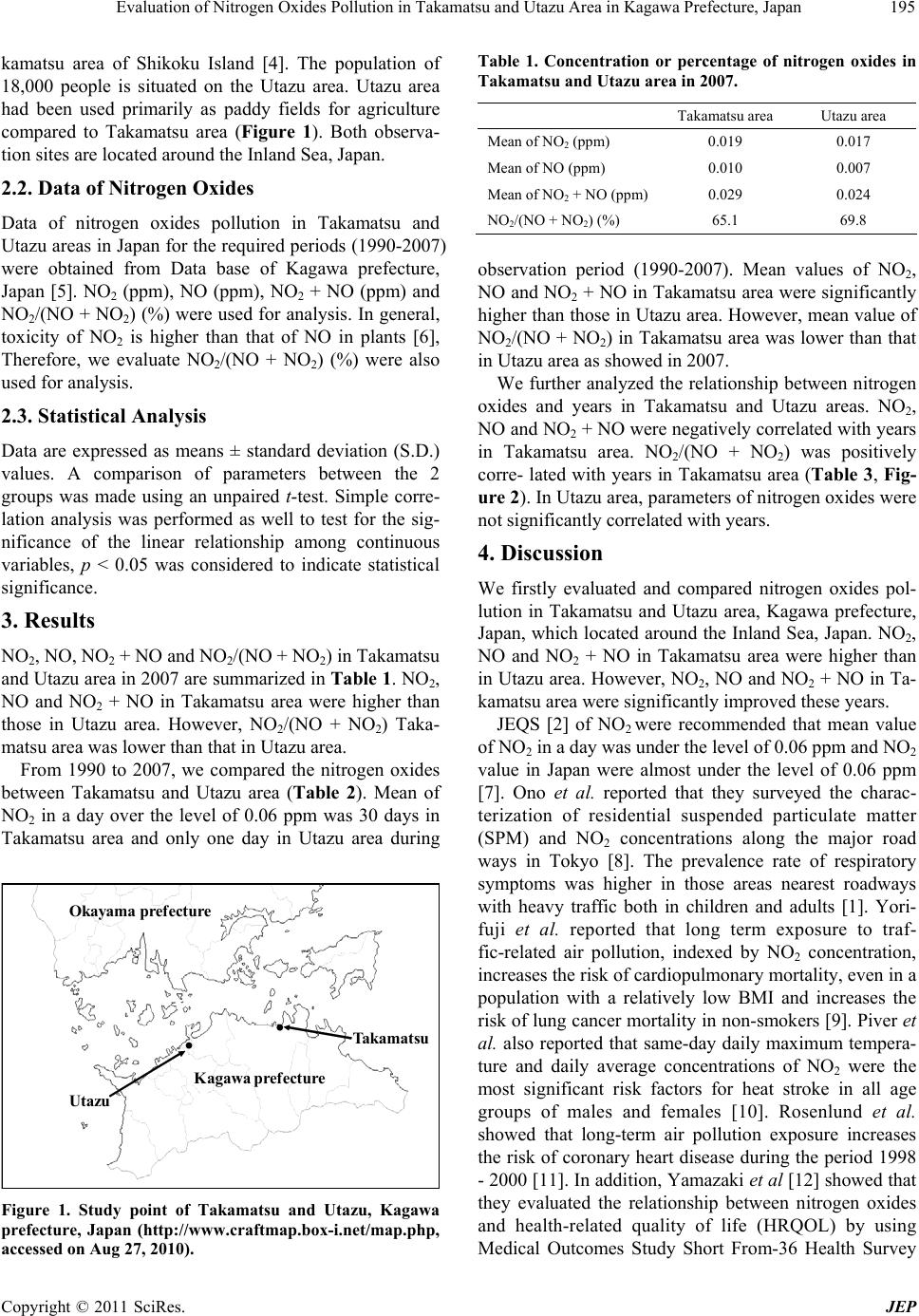 Evaluation of Nitrogen Oxides Pollution in Takamatsu and Utazu Area in Kagawa Prefecture, Japan195 kamatsu area of Shikoku Island [4]. The population of 18,000 people is situated on the Utazu area. Utazu area had been used primarily as paddy fields for agriculture compared to Takamatsu area (Figure 1). Both observa- tion sites are located around the Inland Sea, Japan. 2.2. Data of Nitrogen Oxides Data of nitrogen oxides pollution in Takamatsu and Utazu areas in Japan for the required periods (1990-2007) were obtained from Data base of Kagawa prefecture, Japan [5]. NO2 (ppm), NO (ppm), NO2 + NO (ppm) and NO2/(NO + NO2) (%) were used for analysis. In general, toxicity of NO2 is higher than that of NO in plants [6], Therefore, we evaluate NO2/(NO + NO2) (%) were also used for analysis. 2.3. Statistical Analysis Data are expressed as means ± standard deviation (S.D.) values. A comparison of parameters between the 2 groups was made using an unpaired t-test. Simple corre- lation analysis was performed as well to test for the sig- nificance of the linear relationship among continuous variables, p < 0.05 was considered to indicate statistical significance. 3. Results NO2, NO, NO2 + NO and NO2/(NO + NO2) in Takamatsu and Utazu area in 2007 are summarized in Table 1. NO 2, NO and NO2 + NO in Takamatsu area were higher than those in Utazu area. However, NO2/(NO + NO2) Taka- matsu area was lower than that in Utazu area. From 1990 to 2007, we compared the nitrogen oxides between Takamatsu and Utazu area (Table 2). Mean of NO2 in a day over the level of 0.06 ppm was 30 days in Takamatsu area and only one day in Utazu area during Utazu Kagawa prefecture Okayama prefecture Takamatsu ● ● Figure 1. Study point of Takamatsu and Utazu, Kagawa prefecture, Japan (http://www.craftmap.box-i.net/map.php, accessed on Aug 27, 2010). Table 1. Concentration or percentage of nitrogen oxides in Takamatsu and Utazu area in 2007. Takamatsu area Utazu area Mean of NO2 (ppm) 0.019 0.017 Mean of NO (ppm) 0.010 0.007 Mean of NO2 + NO (ppm)0.029 0.024 NO2/(NO + NO2) (%) 65.1 69.8 observation period (1990-2007). Mean values of NO2, NO and NO2 + NO in Takamatsu area were significantly higher than those in Utazu area. However, mean value of NO2/(NO + NO2) in Takamatsu area was lower than that in Utazu area as showed in 2007. We further analyzed the relationship between nitrogen oxides and years in Takamatsu and Utazu areas. NO2, NO and NO2 + NO were negatively correlated with years in Takamatsu area. NO2/(NO + NO2) was positively corre- lated with years in Takamatsu area (Table 3, Fig- ure 2). In Utazu area, parameters of nitrogen oxides were not significantly correlated with years. 4. Discussion We firstly evaluated and compared nitrogen oxides pol- lution in Takamatsu and Utazu area, Kagawa prefecture, Japan, which located around the Inland Sea, Japan. NO2, NO and NO2 + NO in Takamatsu area were higher than in Utazu area. However, NO2, NO and NO2 + NO in Ta- kamatsu area were significantly improved these years. JEQS [2] of NO2 were recommended that mean value of NO2 in a day was under the level of 0.06 ppm and NO2 value in Japan were almost under the level of 0.06 ppm [7]. Ono et al. reported that they surveyed the charac- terization of residential suspended particulate matter (SPM) and NO2 concentrations along the major road ways in Tokyo [8]. The prevalence rate of respiratory symptoms was higher in those areas nearest roadways with heavy traffic both in children and adults [1]. Yori- fuji et al. reported that long term exposure to traf- fic-related air pollution, indexed by NO2 concentration, increases the risk of cardiopulmonary mortality, even in a population with a relatively low BMI and increases the risk of lung cancer mortality in non-smokers [9]. Piver et al. also reported that same-day daily maximum tempera- ture and daily average concentrations of NO2 were the most significant risk factors for heat stroke in all age groups of males and females [10]. Rosenlund et al. showed that long-term air pollution exposure increases the risk of coronary heart disease during the period 1998 - 2000 [11]. In addition, Yamazaki et al [12] showed th at they evaluated the relationship between nitrogen oxides and health-related quality of life (HRQOL) by using Medical Outcomes Study Short From-36 Health Survey Copyright © 2011 SciRes. JEP 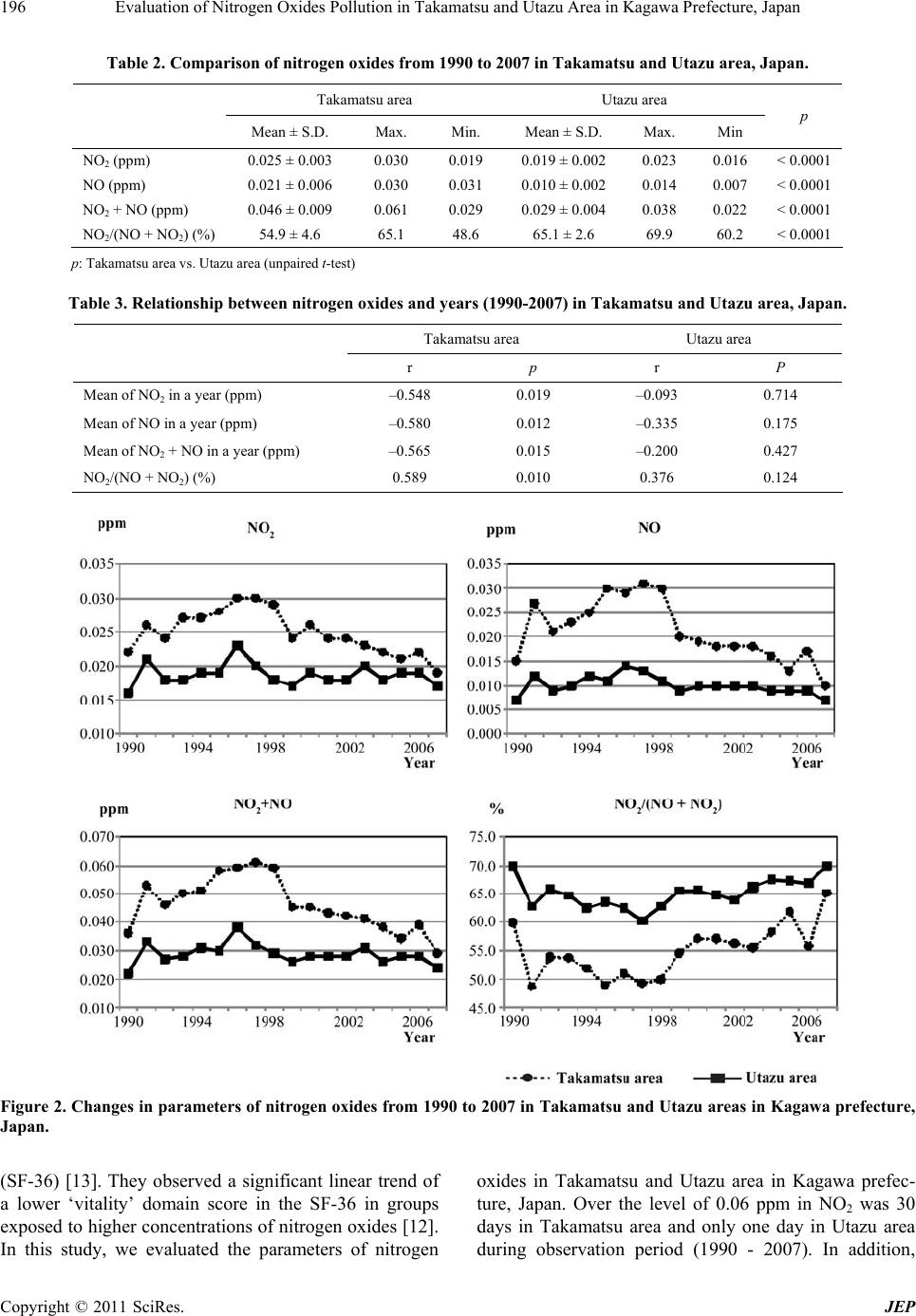 Evaluation of Nitrogen Oxides Pollution in Takamatsu and Utazu Area in Kagawa Prefecture, Japan Copyright © 2011 SciRes. JEP 196 Table 2. Comparison of nitrogen oxides from 1990 to 2007 in Takamatsu and Utazu area, Japan. Takamatsu area Utazu area Mean ± S.D. Max. Min. Mean ± S.D. Max. Min p NO2 (ppm) 0.025 ± 0.00 3 0.030 0.019 0.019 ± 0.002 0.023 0.016 < 0.0001 NO (ppm) 0.021 ± 0.006 0.03 0 0.031 0.010 ± 0.002 0.014 0.007 < 0.0001 NO2 + NO (ppm) 0.046 ± 0.009 0.061 0.029 0.029 ± 0.004 0.038 0.022 < 0.0001 NO2/(NO + NO2) (%) 54.9 ± 4.6 65.1 48.6 65.1 ± 2.6 69.9 60.2 < 0.0001 p: Takamatsu area vs. Utaz u area (unpaired t-test) Table 3. Relationship between nitrogen oxides and years (1990-2007) in Takamatsu and Utazu area, Japan. Takamatsu area Utazu area r p r P Mean of NO2 in a year (ppm) –0.548 0.019 –0.093 0.714 Mean of NO in a year (ppm) –0.580 0.012 –0.335 0.175 Mean of NO2 + NO in a year (ppm) –0.565 0.015 –0.200 0.427 NO2/(NO + NO2) (%) 0.589 0.010 0.376 0.124 Figure 2. Changes in parameters of nitrogen oxides from 1990 to 2007 in Takamatsu and Utazu areas in Kagawa prefecture, Japan. (SF-36) [13]. They observed a significant linear trend of a lower ‘vitality’ domain score in the SF-36 in groups exposed to higher concentrations of nitrogen oxides [12]. In this study, we evaluated the parameters of nitrogen oxides in Takamatsu and Utazu area in Kagawa prefec- ture, Japan. Over the level of 0.06 ppm in NO2 was 30 days in Takamatsu area and only one day in Utazu area during observation period (1990 - 2007). In addition,  Evaluation of Nitrogen Oxides Pollution in Takamatsu and Utazu Area in Kagawa Prefecture, Japan197 NO2, NO and NO2 + NO in Takamatsu area were sig- nificantly improved. Potential limitation s still remain in this study. First, we could not prove the link between nitrogen oxides and health status i.e. cardiopulmonary diseases, mortality rate and HROQL as previous studies. Second, although Ramadan reported that the NO distribution was similar to that of NO2 [14], NO2/(NO + NO2) in Takamatsu area was positively correlated with years. In general, toxicity of NO2 is higher than that of NO in plants [6]. Hiragushi et al have studied the relation between diabetic glomeru- lar hyperfiltration and the NO system. And they found that the urinary NOx (2 and 3) was significantly higher in normoalbumiuric in patients with type 2 diabe- tes mellitus compared with normal subjects [15]. In addi- tion, NO, known as endothelium derived relaxing factor, is involved in glomerular hyperfiltration of experimental diabetic rats [16]. Taylor et al. reported that two signifi- cant cases that illustrate the probable cause and the treatment strategies for delivery of high concentrations of NO, resulting in methemoglobinemia with moderate and even low-dose delivered NO [17]. We could not prove the mechanism and issues of an increase in NO2/(NO + NO2) in Takamatsu area, Kagawa prefecture, Japan. Therefore, monitoring of nitrogen oxides pollution are further required for preventing air pollution-related dis- eases in Kagawa prefecture, Japan. NONO REFERENCES [1] “Atmospheric Environmental Regional Observation Sys- tem”, 2010. http://soramame.taiki.go.jp/ [2] “Japanese Environmental Quality Standards (JEQS)”, 2010. http://www.env.go.jp/kijun/taiki.html [3] “Air pollution has Been Also Observed in Some Observa- tion Points in Kagawa Prefecture, Japan”, 2010. http://www.taiki.pref.kagawa.jp/TAIKI/KANKYO/gaiyo. php. [4] “Utazu cho, Kagawa prefecture, Japan”, 2010. http://town.utazu.kagawa.jp/2kanko_index.html. [5] “Data of Air Pollution By Using Nitrogen Oxides in Ta- kamatsu and Utazu Areas in Japan”, 2010. http://www.taiki.pref.kagawa.jp/TAIKI/KANKYO/downl oad.php. [6] K. Shimazaki, S. W. Yu, T. Sakaki and K. Tanaka, “Dif- ferences between Spinach and Kidney Bean Plants in Terms of Sensitivity to Fumigation with NO2,” Plant Cell Physiology, Vol. 33, No. 3, 1992, pp. 267-273. [7] “Ministry of the Environmental, Japan”, 2010.http://ww w.env.go.jp/policy/hakusyo/h21/pdf/2-2.pdf. [8] M. Ono, M. Murakami, H. Nitta, S. Nakai and K. Maeda, “Epidemiological Studies of Air Pollution and Health Ef- fects in Areas near Roadways with Heavy Traffic in To- kyo,” Nippon Koshu Eisei Zasshi, Vol. 37, No. 5, 1990, pp. 321-332. [9] T. Yorifuji, S. Kashima, T. Tsuda, S. Takao, E. Suzuki, H. Doi, M. Sugiyama, K. Ishikawa-Takata and T. Ohta, “Long-Term Exposure to Traffic-Related Air Pollution and Mortality in Shizuoka, Japan,” Occupational and En- vironmental Medicine, Vol. 67, No. 2, 2010, pp. 111-117. doi:10.1136/oem.2008.045542 [10] W. T. Piver, M. Ando, F. Ye and C. J. Portier, “Tem- perature and Air Pollution as Risk Factors for Heat Stroke in Tokyo, July and August 1980-1995,” Environmental Health Perspective, Vol. 107, No. 11, 1999, pp. 911-916. doi:10.1289/ehp.99107911 [11] M. Rosenlund, S. Picciotto, F. Forastiere, M. Stafoggia and C. A. Perucci, “Traffic-Related Air Pollution in Rela- tion to Incidence and Prognosis of Coronary Heart Dis- ease,” Epidemiology, Vol. 19, No. 1, 2008, pp. 121-128. doi:10.1097/EDE.0b013e31815c1921 [12] S. Yamazaki, H. Nitta, Y. Murakami and S. Fukuhara, “Association between Ambient Air Pollution and Health-Related Quality of Life in Japan: Ecological Study,” International Journal of Environmental Health Research, Vol. 15, No. 5, 2005, pp. 383-391. doi:10.1080/09603120500292279 [13] C. A. McHorney, J. E. Jr Ware and A. E. Raczek, “The MOS 36-Item Short-Form Health Survey (SF-36): II. Psychometric and Clinical Tests of Validity in Measuring Physical and Mental Health Constructs,” Medical Care, Vol. 31, No. 3, 1993, pp. 247-263. doi:10.1097/00005650-199303000-00006 [14] A. A. Ramadan, “Air Quality Assessment in Southern Kuwait Using Diffusive Passive Samplers,” Environ Monit Assess, Vol. 160, No. 1-4, 2010, pp. 413-423. doi:10.1007/s10661-008-0705-8 [15] K. Hiragushi, H. Sugimoto, K. Shikata, T. Yamashita, N. Miyatake, Y. Shikata, J. Wada, I. Kumagai, M. Fukushima and H. Makino, “Nitric Oxide System Is Involved in Glomerular Hyperfiltration in Japanese Normo- And Micro-Albuminuric Patients with Type 2 Diabetes,” Diabetes Research and Clinical Practice, Vol. 53, No. 3, 2001, pp. 149-159. doi:10.1016/S0168-8227(01)00260-1 [16] H. Sugimoto, K. Shikata, M. Matsuda, M. Kushiro, Y. Hayashi, K. Hiragushi, J. Wada and H. Makino, “In- creased Expression of Endothelial Cell Nitric Oxide Syn- thase (ecNOS) in Afferent and Glomerular Endothelial Cells Is Involved in Glomerular Hyperfiltration of Dia- betic Nephropathy,” Diabetologia, Vol. 41, No. 12, 1998, pp. 1426-1434. doi:10.1007/s001250051088 [17] M. B. Taylor, K. G. Christian, N. Patel and K. B. Churchwell, “Methemoglobinemia: Toxicity of Inhaled Nitric Oxide Therapy,” Pediatric Critical Care Medicine, Vol. 2, No. 1, 2001, pp. 99-101. doi:10.1097/00130478-200101000-00019 Copyright © 2011 SciRes. JEP |