

Paper Menu >>
Journal Menu >>
 Surgical Science, 2011, 2, 73-76 doi:10.4236/ss.2011.22016 Published Online April 2011 (http://www.SciRP.org/journal/ss) Copyright © 2011 SciRes. SS External Validation of SENIC and NNIS Scores for Predictıng Wound Infection in Colorectal Surgery Tezcan Akin1, Merve Akin1, Serdar Topaloğlu2, Hüseyin Berkem3, Bülent Yüksel3, Süleyman Hengirmen3, Yiğit Yildiz4, Mesut Tez5 1Department of Surgery, Kırıkkale Yüksek İhtisas Hospital, Kırıkkale Turkey 2Department of Surgery, Farabi Hospital, Karadeniz Thecnical University School of Medicine, Trabzon, Turkey 3First Department of Surgery, Ankara Numune Training and Research Hospital, Ankara, Turkey 4Department of Surgery, Derince Training and Research Hospital, Kocaeli, Turkey 5Fifth Department of Surgery, Ankara Numune Training and Research Hospital, Ankara, Turkey E-mail: [email protected] Received September 3, 2010; revised February 25, 2011; accepted March 1, 2011 Abstract Objective: We aimed to identify the ratio of Surgical Site Infection (SSI) and also the validity of the National Nosocomial Infection Surveillance (NNIS) and Study on the Efficacy of Nosocomial Infection Control (SENIC) risk indexes in colorectal surgery, among Turkish population. Background: Some problems have been reported with the power of NNIS risk index to predict the risk of surgical site infection. We aimed to validate theNNIS and SENIC risk indexes in colorectal surgery. Methods: Between January 2003 and De- cember 2006, surgical site ınfection surveillance was performed to 107 patients who undergo colorectal sur- gery with NNIS and SENIC risk scales. The mean patient age was 48 years (range, 17 to 86), and 61.7% of the group (66) was female. For this patient cohort, 6 (5.6%) were diagnosed with incisional SSI. While the mean Body Mass Index (BMI) of all patients was 26.6; mean value of BMI among the patiens with SSI was 27.8.Results: 6 insicional surgical site infection were observed during the study. According to Receiver Op- erating Characteric (ROC) curve analyze neither NNIS with avalue of 0.70, nor SENIC with a value of 0.67 are perfect risk indexes. Conclusion: As a result both NNIS and SENIC ıs a good risk indexes but not perfect. Scarcely when NNIS and SENIC is used together to predict the SSI they forecast the development of infec- tion better. But there is a lot of other factors that effect the development of SSI, so for excellent surveillance risk index those factors known by everyone must be added to risk index scales. Keywords: National Nosocomial Infection Surveillance (NNIS), Study on the Efficacy of Nosocomial Infection Control (SENIC), Colorectal Surgery, Validation 1. Introduction Surgical site infection (SSI) is the most frequently re- ported infection among surgical patients, acconting for 14% to 16% of all nosocomial infections among hospi- talized patients. (10) These infections are associated with significant morbidity and considerably extend the length of hospital stay. Surveillance has been described as a prevantive meas- ure for reducing such infections. (3) A succesfull sur- veillance system that uses standart definitions, which feedsback data on-site-specific, risk-adjusted SSI rates may provide a measure of quality performance for sur- geons and hospitals and contribute to the prevention of hospital acquired infections. (11) For many years wound contamination class was the only factor that was well described for predicting the risk for SSI. During the Study on the Efficacy of Nosocomial Infection Control (SENIC) Project, an index was devel- oped that provided a better assesment of the risk of SSI than had the traditional wound classification system. In 1991, a modification of the SENIC risk index by Culver et al. led to the National Nosocomial Infections Surveillance (NNIS) System risk index. (3) SSI in patients undergoing colorectal resection have been specifically studied, with similar general findings.  74 M. AKIN ET AL. However, there has been wide discrepancy in the re- ported incidence of incisional SSI following colorectal surgery, ranging from 3 to 30%. Additionally, there has been no clear consensus on the risk factors contributing to SSI following colorectal surgery, which has limited the data’s value to surgeons involved in quality im- provement programs hoping to address specific variables that could reduce this risk.(12) Several authors have recognized that risk adjustment needs to be improved and tailored to be procedure spe- cific. Other’s have presented results of studies to identify procedure specific risk factors for SSI for example, in cesaerean sections and colorectal surgery. Therefore in this study we aimed to identify the ratio of SSI and also the validity of the NNIS and SENIC risk indexes in co- lorectal surgery, among Turkish population. 2. Methods Betwen January 1, 2003 and December 31, 2006, we collected and analyzed data prospectively from patients who underwent colorectal operations. Patients were fol- lowed up from admission to 30 days after the date of surgery. Patients who were discharged before the 7th day after surgery were contacted by telephone at home. SSI was diagnosed using the ASEPSIS score and scores more than 20 points indicated infection where as 20 or less points were determined as disturbance of healing. The definition for the acronym ASEPSIS is A, additional treatment; S, serous discharge; E, erythema; P, purulent exudate; S, separation of deep tissue; I, isolation of bacteria; and S, stay as inpatient for >14 days. (15) The components of the NNIS (4) surgical patient risk index used in this study were as fallows: 1) Preoperative American Society of Anesthesiologists (ASA) score; 2) The traditional surgical wound classification; 3) T time “defined as the 75 th percentile of the duration for op- erative procedure and the components of the SENIC(7) surgical patient risk index used in this study were as fal- lows: 1) The traditional surgical wound classification; 2) number of coexisting diagnoses; 3) Site of surgery; 4) duration of surgery over 2 hours. 2.1. Statistical Analysis Scoring system validation comprised two activities. These are discrimination and calibration. Model discrimination was measured by the area under the receiver–operator characteristic (aROC) curve. Calibration was assessed using the Hosmer–Lemeshow goodness-of-fit test and the corresponding calibration curves. (1) All statistical analy- sis in this study was performed using SPSS software (version 11.0, SPSS Inc., Chicago, IL). (12) 3. Results During the 4-year period, 107 patients were identified who underwent elective colorectal resection performed. Demographic and clinical characteristics of the study patients are shown in Table 1. The mean patient age was 48 years (range, 17 to 86), and 61.7% of the group (66) was female. For this patient cohort, 6 (5.6%) were diag- nosed with incisional SSI. While the mean Body Mass Index (BMI) of all patients was 26.6; mean value of BMI among the patiens with SSI was 27.8. The aROC of NNIS was 0.70, compered with the SENIC score which had an aROC of 0.67 (Figure 1). İf aROC is 1this means that the procedure analyzed is per- fect so the SENIC and NNIS are good but not perfect. After the ROC curve analyze calibration of models were assesed. The overall percentage for NNIS was 68.8, and the overall percentage of SENIC was 61.5 (Table 2). Where NNIS shows the infection 68.8%of patients and SENIC shows 61.5%. 4. Discussion Surveillance systems aim to provide to feedback to hos- pitals and stimulate infection control activities. An ade- quate method for risk adjustment is important for the comperison of hospitals’ specific rates. (3) Researchers in a number of countries have found that the NNIS risk index performed favorably for prediction of SSI. (9,2) Not all experts concede that the NNIS risk index is the best method for the risk stratification of all surgical pro- cedures. For example, several studies have shown that the NNIS risk index does not necessarily work well for patient undergoing cardiothorasic procedures; as a result, the authers of these studies have proposed modifications that improve risk scoring systems. (5) Data from the NNIS system suggest that approimately %50 of all SSIs diagnosed in the United States are super- ficial insicional SSIs. (7) Therefore only insicioinal SSIs are included to the recent study. Our rate of incisional SSI for elective colorectal resec- tions (5.6%) is lower than predicted by general review of the literature. Although there is a wide range of frequen- cies reported, from 3% to 30%, the average rates for wound infections reported is roughly 10%. There are a number of potential explanations for these discrepancies. (6,13) First, the emergent patiens were excluded from the study, only electicve colon and rectum resections were evaluated. Second, mechanical bowel preparation were performed to all patients the day before the operation. Although Topaloğlu et al. (14) were found that the corelation of SENIC score with postoperative wound ınfection is higher than NNIS, according to discrimination Copyright © 2011 SciRes. SS 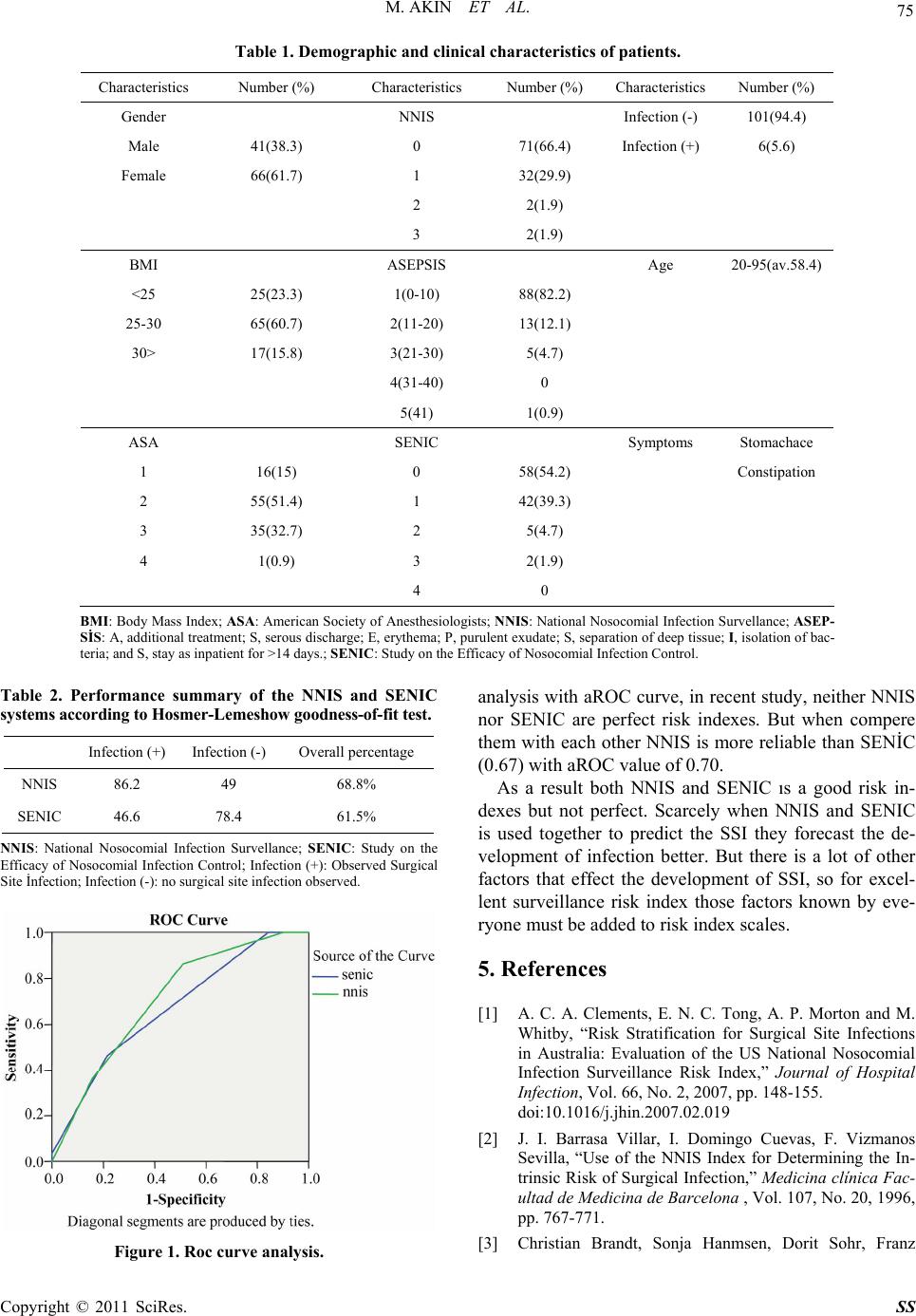 M. AKIN ET AL. Copyright © 2011 SciRes. SS 75 Table 1. Demographic and clinical characteristics of patients. Characteristics Number (%) Characteristics Number (%) Characteristics Number (%) Gender NNIS Infection (-) 101(94.4) Male 41(38.3) 0 71(66.4) Infection (+) 6(5.6) Female 66(61.7) 1 32(29.9) 2 2(1.9) 3 2(1.9) BMI ASEPSIS Age 20-95(av.58.4) <25 25(23.3) 1(0-10) 88(82.2) 25-30 65(60.7) 2(11-20) 13(12.1) 30> 17(15.8) 3(21-30) 5(4.7) 4(31-40) 0 5(41) 1(0.9) ASA SENIC Symptoms Stomachace 1 16(15) 0 58(54.2) Constipation 2 55(51.4) 1 42(39.3) 3 35(32.7) 2 5(4.7) 4 1(0.9) 3 2(1.9) 4 0 BMI: Body Mass Index; ASA: American Society of Anesthesiologists; NNIS: National Nosocomial Infection Survellance; ASEP- SİS: A, additional treatment; S, serous discharge; E, erythema; P, purulent exudate; S, separation of deep tissue; I, isolation of bac- teria; and S, stay as inpatient for >14 days.; SENIC: Study on the Efficacy of Nosocomial Infection Control. Table 2. Performance summary of the NNIS and SENIC systems according to Hosmer-Lemeshow goodness-of-fit test. analysis with aROC curve, in recent study, neither NNIS nor SENIC are perfect risk indexes. But when compere them with each other NNIS is more reliable than SENİC (0.67) with aROC value of 0.70. Infection (+) Infection (-) Overall percentage NNIS 86.2 49 68.8% SENIC 46.6 78.4 61.5% As a result both NNIS and SENIC ıs a good risk in- dexes but not perfect. Scarcely when NNIS and SENIC is used together to predict the SSI they forecast the de- velopment of infection better. But there is a lot of other factors that effect the development of SSI, so for excel- lent surveillance risk index those factors known by eve- ryone must be added to risk index scales. NNIS: National Nosocomial Infection Survellance; SENIC: Study on the Efficacy of Nosocomial Infection Control; Infection (+): Observed Surgical Site İnfection; Infection (-): no surgical site infection observed. 5. References [1] A. C. A. Clements, E. N. C. Tong, A. P. Morton and M. Whitby, “Risk Stratification for Surgical Site Infections in Australia: Evaluation of the US National Nosocomial Infection Surveillance Risk Index,” Journal of Hospital Infection, Vol. 66, No. 2, 2007, pp. 148-155. doi:10.1016/j.jhin.2007.02.019 [2] J. I. Barrasa Villar, I. Domingo Cuevas, F. Vizmanos Sevilla, “Use of the NNIS Index for Determining the In- trinsic Risk of Surgical Infection,” Medicina clínica Fac- ultad de Medicina de Barcelona , Vol. 107, No. 20, 1996, pp. 767-771. [3] Christian Brandt, Sonja Hanmsen, Dorit Sohr, Franz Figure 1. Roc curve analysis. 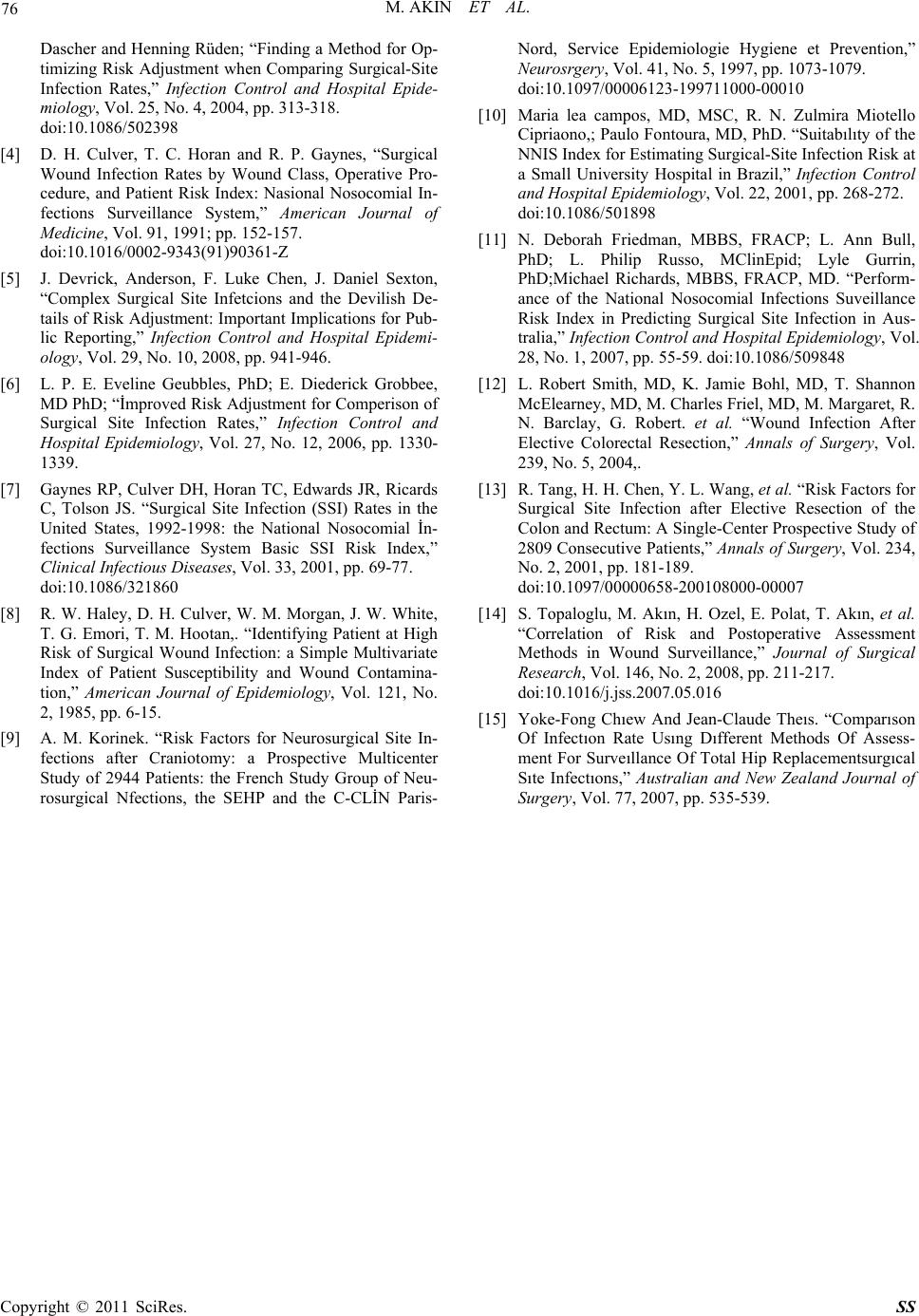 76 M. AKIN ET AL. Dascher and Henning Rüden; “Finding a Method for Op- timizing Risk Adjustment when Comparing Surgical-Site Infection Rates,” Infection Control and Hospital Epide- miology, Vol. 25, No. 4, 2004, pp. 313-318. doi:10.1086/502398 [4] D. H. Culver, T. C. Horan and R. P. Gaynes, “Surgical Wound Infection Rates by Wound Class, Operative Pro- cedure, and Patient Risk Index: Nasional Nosocomial In- fections Surveillance System,” American Journal of Medicine, Vol. 91, 1991; pp. 152-157. doi:10.1016/0002-9343(91)90361-Z [5] J. Devrick, Anderson, F. Luke Chen, J. Daniel Sexton, “Complex Surgical Site Infetcions and the Devilish De- tails of Risk Adjustment: Important Implications for Pub- lic Reporting,” Infection Control and Hospital Epidemi- ology, Vol. 29, No. 10, 2008, pp. 941-946. [6] L. P. E. Eveline Geubbles, PhD; E. Diederick Grobbee, MD PhD; “İmproved Risk Adjustment for Comperison of Surgical Site Infection Rates,” Infection Control and Hospital Epidemiology, Vol. 27, No. 12, 2006, pp. 1330- 1339. [7] Gaynes RP, Culver DH, Horan TC, Edwards JR, Ricards C, Tolson JS. “Surgical Site Infection (SSI) Rates in the United States, 1992-1998: the National Nosocomial İn- fections Surveillance System Basic SSI Risk Index,” Clinical Infectious Diseases, Vol. 33, 2001, pp. 69-77. doi:10.1086/321860 [8] R. W. Haley, D. H. Culver, W. M. Morgan, J. W. White, T. G. Emori, T. M. Hootan,. “Identifying Patient at High Risk of Surgical Wound Infection: a Simple Multivariate Index of Patient Susceptibility and Wound Contamina- tion,” American Journal of Epidemiology, Vol. 121, No. 2, 1985, pp. 6-15. [9] A. M. Korinek. “Risk Factors for Neurosurgical Site In- fections after Craniotomy: a Prospective Multicenter Study of 2944 Patients: the French Study Group of Neu- rosurgical Nfections, the SEHP and the C-CLİN Paris- Nord, Service Epidemiologie Hygiene et Prevention,” Neurosrgery, Vol. 41, No. 5, 1997, pp. 1073-1079. doi:10.1097/00006123-199711000-00010 [10] Maria lea campos, MD, MSC, R. N. Zulmira Miotello Cipriaono,; Paulo Fontoura, MD, PhD. “Suitabılıty of the NNIS Index for Estimating Surgical-Site Infection Risk at a Small University Hospital in Brazil,” Infection Control and Hospital Epidemiology, Vol. 22, 2001, pp. 268-272. doi:10.1086/501898 [11] N. Deborah Friedman, MBBS, FRACP; L. Ann Bull, PhD; L. Philip Russo, MClinEpid; Lyle Gurrin, PhD;Michael Richards, MBBS, FRACP, MD. “Perform- ance of the National Nosocomial Infections Suveillance Risk Index in Predicting Surgical Site Infection in Aus- tralia,” Infection Control and Hospital Epidemiology, Vol. 28, No. 1, 2007, pp. 55-59. doi:10.1086/509848 [12] L. Robert Smith, MD, K. Jamie Bohl, MD, T. Shannon McElearney, MD, M. Charles Friel, MD, M. Margaret, R. N. Barclay, G. Robert. et al. “Wound Infection After Elective Colorectal Resection,” Annals of Surgery, Vol. 239, No. 5, 2004,. [13] R. Tang, H. H. Chen, Y. L. Wang, et al. “Risk Factors for Surgical Site Infection after Elective Resection of the Colon and Rectum: A Single-Center Prospective Study of 2809 Consecutive Patients,” Annals of Surgery, Vol. 234, No. 2, 2001, pp. 181-189. doi:10.1097/00000658-200108000-00007 [14] S. Topaloglu, M. Akın, H. Ozel, E. Polat, T. Akın, et al. “Correlation of Risk and Postoperative Assessment Methods in Wound Surveillance,” Journal of Surgical Research, Vol. 146, No. 2, 2008, pp. 211-217. doi:10.1016/j.jss.2007.05.016 [15] Yoke-Fong Chıew And Jean-Claude Theıs. “Comparıson Of Infectıon Rate Usıng Dıfferent Methods Of Assess- ment For Surveıllance Of Total Hip Replacementsurgıcal Sıte Infectıons,” Australian and New Zealand Journal of Surgery, Vol. 77, 2007, pp. 535-539. Copyright © 2011 SciRes. SS |