

Paper Menu >>
Journal Menu >>
 Creat ive Educati on 2014. Vo l.5, No.2, 93-96 Published Online February 2014 in SciRes (http://www.scirp.org/journal/ce) http://dx.d oi.org/10.4236/ce.2014.520 15 Documentary Effects on Medical Student Attitudes & Skills Regarding Nutrition at the End of Life Scott De La Cruz1, Francesca Nicosia2, Eva Aagaard1 1Department of General Internal Medicin e, Univ er sit y of Colorado Denver, D enver, USA 2Department of Anth r opology, History and Social Medicin e, University of California San Francisco, San Francisco, USA Email: [email protected] Received January 1st, 2014; February 1st, 2014 ; acc ep ted Feb ruar y 8 th, 2014 Copyright © 2014 Scott De La Cruz et al . This is an open acc ess article distri b uted under t he Creati v e Common s Attribution License, which permits unrestricted use, distribution, and reproduction in any medium, provided the original work is properly cited. In accordance of the Creative Commons Attribution License all Copyrights © 2014 ar e reserved for S C IRP and the owner of th e in tellec tu al p ropert y Scott De La Cruz et a l. All Copyrigh t © 2014 are guarded by law and by SCIRP as a guardian. Medic al trai nees ra r ely have t he opp or tuni t y to pr ovi de co mpr ehe nsi ve end of l i fe c a re or see t he ph ysi cal tra nsforma tion of the d ying p roces s. Studi es sug gest that the use of fi lm in medica l educ ation i s an ef fec- tive means of exp osing s tudent s to a spec ts of medic ine the y might not other wis e recei ve. Dying Wish is a visual inst rumental cas e study of a patient wit h end-stage ca ncer who chos e to stop eati ng and drink ing at the end of hi s li fe. In t his ra ndomized, c ontr ol led s t udy, we as s essed t he imp ac t of Dy in g W is h on medical students’ attitudes, knowledge, and confidence in patient/family discussions surrounding nutrition at the end of life using student surveys and independently validated standardized patient assessments. By the middle of the first clinical year, about 58% of students witnessed and 38.6% actively participated in a disc ussion rega rding nut riti on at the end of life wi th a p atient a nd/or thei r famil y. Althoug h there wa s no signi ficant differenc e in student s’ self -perceived k nowledge or s kills , a signif icantl y higher perc entage of students who viewed “Dying Wish” prior to standardized patient visits clearly explained the biological consequences of stopping eating and drinking compared to those who had not viewed the film. Students agreed t hat “Dying Wis h” impro ved their knowl edge of the ph ysica l eff ects of stoppi ng eati ng and dr ink- ing and effectively introduced the ethical and psychosocial issues associated with nutrition at the end of life. Documentari es are considered by students to be effect ive teaching tool s and “Dying Wish” represents a feas i ble wa y to d eli ver ins tr uc ti on rega rdi ng nut ri ti on a t t he end of l i fe. Vi s ual dep ict ions a nd doc umen- tary films that portr a y the nat ura l cour ses of ill ness es may pr ove to b e help ful , ef fi cient teac hi ng tool s and their role in the educational process for healthcare providers shoul d continue to be s tudied. Key words: Medical Education; Docu ment ary Fil m; Visual Ins trumental Case Study; End of Li fe; Nutrition Introduction Understanding and identifying the signs and symptoms of death is an essential skill needed by all physicians to provide quality care and, as such, is an important component of medical stud ents’ competenc y in end of life care (Field & Cassel, 1997; Gibbins, McCoubrie, Alexander, Kinzel, & Forbes, 2009; Nel- son, Angoff, & Bin der, 2000). Medi cal trainees rarel y have th e opportunity to provide comprehensive end of life care or see the physical transformation of the dying process (Gibbins, McCou- brie, Alexander, Kinzel, & Forbes, 2009; Billings & Block, 1997). This lack of exposure may result in medical trainees feeling underprepared and having difficulty educating patients and their families about what to expect at the end of life (Buss, Marx, & Sulmasy, 1998; Fraser, Kutner, & Pfeifer, 2001; Van der Riet, Good, Higgins, & Sneesby, 2008; Gibbins, McCou- brie, & Forbes , 2011). Didactic sessions can be limited in their ability to convey complex aspects of care. Experiential approaches including stand ardized patients, role-play, and the humanities have been shown to be effective means of learning affective and skills- based objectives (Block, Bernier, & Crawley, 1998; Schmidt, Norton, & Tolle, 1992; Serwint & Simpson, 2002; Kahn, Sher- er, Alper, Lazarus, Ledoux, Anderson, & Szerlip, 2001). Early studies suggest that the use of film in medical education is an effective means of exposing students to aspects of medicine they might not otherwise receive (Self, DeWitt, & Baldwin, 1990). Films can be used to educate, create self-reflection and generate d iscu ssio n abou t the general emotio n al react ions of th e viewer, diagnostic impressions, therapeutic and treatment con- siderations, and associations with one’s own profession and personal life (Alexan der & Lenahan , 2005). Dying Wish is a visual instrumental case study of Dr. Mi- chael Miller, a retired surgeon with end-stage cancer who vo- luntarily chose to stop eating and drinking at the end of his life. The film documents Dr. Miller’s decision-making process and raises the topics of bioethics, spirituality, patient autonomy, voluntary refusal of food and fluids (VRFF), as well as the physical and emotional aspects of stopping eating and drinking. The film allows the viewer to visualize the physical dying OPEN ACCE SS 93 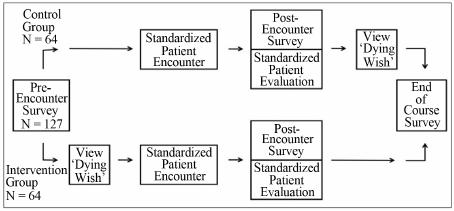 S. DE LA CRUZ ET AL. process and the physiology of stopping eating and drinking at the end of life. In this study, we assessed the impact of Dying Wish on med- ical students’ attitudes, knowledge, and confidence in patient/ family discussions surrounding nutrition at the end of life. In addition, we assessed the effect of the film on the likelihood that students would initiate a conversation about nutrition or VRFF and the adequacy of their description of the biological consequences of such a decision during a simulated patient encou nt er . Methods Study Design This randomized, single-blinded, controlled trial took place at University of Colorado School of Medicine during a required one-week curriculum delivered near the mid-point of the third year of medical school. The overarching goal of the curriculum is to teach the fundamentals of end of life care and advanced communication skills. One hundred twenty-seven medical stu- dents answered questions about their knowledge, attitudes and self-confidence in discussing the topic of nutrition/hydration at the end of life via a computerized Likert scale survey at the start of the one-week curriculum. Three yes or no questions also assessed the students’ prior personal and curriculum-asso- ciated experiences with nutrition at the end of life. Students were then randomized into 2 groups (Figure 1). The intervention cohort (n = 64) viewed Dying Wish and then worked in pairs to lead a standardized patient (SP) en- counter of a family meeting wherein the patient has late stage Alzheimer ’s disease an d has been ad mitted for r ecurren t aspira- tion pneumonia. The family is being asked to address the issue of nutrition and hydration, among other end of life issues. The control cohort (n = 64) completed the same SP encounter in pairs without having viewed Dying Wish. Immediately follow- ing the SP encounter, students from both groups were asked again about their knowledge, attitudes and self-confidence re- garding nutrition/hydration via a computerized survey. SPs completed a computerized checklist that asked if the medical students: 1) initiated a conversation about nutrition at the end of life, 2) mentioned voluntary refusal of food and flu- ids as an option at the end of life, and 3) clearly explained the biological consequences of stopping eating and drinking at the end of life. The SPs were blinded to intervention or control group assignment status. The SPs’ responses to the checklists were validated by a video review of 20 randomly selected en- counters. Finally, all students were asked about their level of agree- Figure 1. Study design. ment regarding the usefulness of “Dying Wish” and documen- tary films i n general for medical edu cation as p art of th e course evaluation at the completion of the week of curriculum. A Li- kert-type scale was used to measure responses: 1 = strongly disagree, 2 =disagree, 3 = agree, 4 = strongl y a gree. Statistical Methods Chi-square analysis was used to compare the control and in- tervention groups’ responses to the pre-SP encounter survey and their performances on the SP checklist. McNemar’s test was used to compare students’ responses to the pre- and post- SP encounter surveys within groups. The Wilcoxon signed rank test was used to compare the intervention and control groups’ responses to the post-SP encounter surve y. Descrip tive anal ysis of the 4 point Likert-type scale survey administered at the end of the weeklong curriculum documented the percei ved ef ficac y of the documentary film as a teaching tool. Results Demographic Information One hundred and twenty-eight of the 147 students that grad- uated in the class of 2011 participated in the surveys. The dis- crepancy in the number of students reflects those who were absent or who joined the graduating class later from combined degree programs or other causes for delay in training. There were 48.3% female students, 10.2% ethnically diverse students and the age range at the time of graduation was 26 years 9 months to 39 years 11 months. Pre-Interventio n Survey Of all the students surveyed, 58.2% (57.1% of the control group and 59.4% of the intervention group) reported that they had witnessed a discussion regarding nutrition at the end of life with a patient and/or their family in their rol e as a medical stu- dent, while 38.6% (31.7% of the control group and 45.3% of the intervention group) had actively participated in such a dis- cussion with a patient and/or their family in their role as a medical student and 44.1% (44.7% of the control group and 43.8% of the intervention group) had personal experience with decisions regarding nutrition at the end of life outside of their role as a medical studen t. There were no si gnificant differences found between the control and intervention groups with regard to prior experiences with nutrition at the end of life. A majority of students felt they had the knowledge (62.5% control and 57.1% intervention) and skills (68.8% control and 68.3% intervention) necessary to discuss the biological effects of stopping eating and drinking at the end of life. Fewer stu- dents felt they had the knowledge (56.3% and 49.2%, respec- tively) or skills (65.6% and 68.3%, respectively) to discuss the various nutrition options at the end of life. Most students in both groups felt that voluntary refusal of food and fluid at the end of life is both ethical and legal. There were no significant differences found between the control and intervention groups in self-perceived knowledge or skills on the pre-intervention survey. Post -Inte rvention Sur vey Both the control and intervention groups reported significant improvements in the knowledge and skills needed to lead a OPEN ACCE SS 94  S. DE LA CRUZ ET AL. discussion with patients and their families regarding nutritional options and the biological effects of stopping eating and drink- ing at the end of life (Table 1). In addition, both the control and intervention groups signifi- cantly improved with regards to their comfort level with dis- cussing nutrition at the end of life. Neither group significantly changed its belief that voluntary refusal of food and fluids at the end of life is both l egal and ethical. SP Evaluation of Student’s Per formance SPs did not note a significant difference between the control and intervention groups in the percentage of students that in- itiated conversations about nutrition nor those that mentioned voluntary refusal of food and fluids as an option (Table 2). However, a significantly higher percentage of students in the intervention group clearly explained the biological conse- quences of stopping eating and drinking at the end of life (76% vs. 48%, p = 0.005). End of Curric ulum Survey Students agreed that documentary films can be ef f ective tools for teaching medical topics (mean Likert-type response was 3.3/4.0, SD 0.6). In addition, students agreed that “Dying Wish” improved their knowledge of the physical effects of stopping eating and drinking (mean Likert response 3.1/4.0, SD 0.7) and effectivel y introdu ced the ethical an d psychosocial i ssues asso- ciated with nutrition at the end of life (mean Likert response 3.1 and 3.1/4.0, SD 0.7 and 0.6 respectively). Students were not concerned that “Dying Wish” was shown to manipulate their personal thinking regarding nutrition at the end of life (mean Likert response was 2.1, SD 0.8). Discussion This study describes mid-third year medical students’ expe- riences, knowledge and attitudes regarding nutrition at the end of life and VRFF at one institution. By the middle of third year, just over 58% of students witnessed and 38.6% actively parti- cipated in a discussion regarding nutrition at the end of life with a patient and/or their family in their role as a medical student. Although watching Dying Wish did not improve students’ self-percei ved knowledge or skills compared to those who did not, a significantly higher percentage of students who viewed “Dying Wish” prior to their SP visits clearly explained the bio- logical consequences of stopping eating and drinking compared to those who had not viewed the film. Students agreed that “Dying Wish” i mproved th eir kno wledge of th e physical e ffects of stopping eating and drinking and effectively introduced the ethical and psychosocial issues associated with nutrition at the end of life. Medical trainees rarely have the opportunity to provide com- prehen sive en d of life car e or see th e ph ysical tran sfor mati on o f the dying process. This lack of exposure may result in medical trainees having difficulty educating patients and their families about what to expect (Van der Riet, Good, Higgins, & Sneesb y, 2008). In our study, although both the control and intervention groups reported significant improvements in the knowledge and skills needed to lead a discussion with patients and their fami- lies regarding nutritional options, SPs reported that students who had viewed Dying Wish were significantly more likely to clearly explain the biological consequences of stopping eating and drinking during the standardized patient encounter. This suggests that Dying Wish helped the students to translate their new knowledge and skills to actual behavior at least in the si- mulated environment. Tabl e 1. Responses to pre- and post-SP encounter surveys. Control Group (n = 64) Inter v ention Grou p (n = 63) Comparison Before SP Encounter After SP Encounter Before SP Encounter After SP encounter % answering “yes” or “agree” % answering “yes” or “agree” % change ( p-value) % answering “yes” or “agree” % answering “yes” or “agree” % change ( p-value) Control vs. Intervention p -value I have the knowledge I need to discuss the biological effects of stopping eating and drinking at the end of life. 62.5% 81.3% +18.8% (0.002 ) 57.1% 82.5% +25.4% (0.000 ) 0.851 I have th e sk ills I need to discuss t he biolo gical effects of stopping eating and drinking at the end of life. 68.8% 84.4% +15.6% (0.004 ) 68.3% 82.5% +14.2% (0.008 ) 0.952 I have the knowledge I need to discuss the various options for nutrition at the end of life . 56.3% 75.0% +18.7% (0.002 ) 49.2% 63.5% +14.3% (0.008 ) 0.782 I have the skills I need to discuss the various for nutrition at th e end of life 65.6% 84.4% +18.8% (0.002 ) 68.3% 81.0% +12.7% (0.008 ) 0.754 Based on my personal beliefs, VRFF at the end of life is ethical. 92.2% 95.3% +3.1% (0.480 ) 93.7% 88.9% − 4.8% (0.248 ) 0.749 Legally, a patient ha s the right to volun tarily refuse food and fluids at th e end of life. 93.8% 96.9% +3.1% (0.480 ) 87.3% 98.4% +11.1% (0.023 ) 0.216 I feel comfort able lead ing a discussi on about options for nutr ition at the end of life. 59.4% 84.4% +25.0% (0.00) 61.9% 87.3% +25.4% (0.000 ) 0.771 OPEN ACCE SS 95  S. DE LA CRUZ ET AL. Table 2. SP evaluation of students’ performance. % of SPs responding “Yes” SP Checklist Item Contr ol Intervention p-value Medical student initiated conversation about nutrition 59% 62% 0.715 Medical student mentioned VRFF 64% 63% 0.351 Medical student clearly explained the biological consequ ences of starvation 48% 76% 0.005 The results of this study further supports the idea that films can be u sed as an adjun ct in medi cal ed ucat io n to provid e expe- riences that are hard to ensure consistently during clinical training. The students surveyed as part of this study agreed that documentary films can be effective tools for teaching and agreed that “Dying Wish” improved knowledge of the physical effects of stopping eating and drinking. The efficacy of “Dying Wish” is consistent with prior studies of humanities modalities as educational tools for end of life topics (Self, DeWitt, & Baldwin, 1990; Lorenz, Steckart, & Rosenfeld, 2004; Weber & Silk, 2007; Kumagai, 2008). There are some limitations to this study and its assessment. As the film was shown to students as part of a weeklong mul- timodal end of life curriculum, it is difficult to isolate the ef- fects of the film on the changes in self-reported attitudes and knowledge. It is also unclear how evaluations and self-reported efficacy at this early point in medical students’ careers will translate to ability in actual practice. Traditionally self-report has been an unreliable measure of clinical skill (Davis, Thom- son, O’Brien, F reemantle, Wol f, Maz manian, & Ta yl o r-Vaisey, 1999). Conclusion Although the self-reported knowledge and skills around counseling patients regarding nutrition and VRFF at the end of life we re not significantly altered by viewing “Dying Wish”, the film did affect students’ ability to clearly explain the bio- logical effects of stopping eating and drinking to SPs. This is likely due to the film’s visual depiction of the process of stop- ping eating and drinking at the end of life. Documentaries and other humanities modalities are considered by students to be effective teach ing too ls and “Dyi ng Wish” represen ts a feasible way to deliver instruction regarding VRFF and nutrition at the end of life. Visual depictions and documentary films that por- tray the natural courses of illnesses may prove to be helpful, efficien t teachin g tool s and their role in the educat ional process for healthcare providers should continue to be studied. REFERENCES Alexander, M., Lenahan, P., & Pavlov, A. (2005). Cinemeducation: A comprehensive guide to using film in medical educat ion. Singapore: Radcliffe Publishing. Billings, J. A., & Block, S. (1997). Palliative care in undergraduate medical education: Status report and future directions. JAMA, 278, 733-738. http://dx.doi.or g/10.1001/jama.1997.03550090057033 Block, S. D., Bernier, G. M., & Crawley, L. M. (1998). Incorporating palliative care into primary care education. National Consensus Conference on Medical Education for Care Near the End-of-life. Journal of General Internal Medicine, 13, 768-773. http://dx.doi.org/10.1046/j.1525-1497.19 98.00230. x Buss, M. K., Marx, E. S., & Sulmasy, D. P. (1998). The preparedness of students to discuss end-of-life issues with patients. Academic Medicine, 73, 418 -422. http://dx.doi.org/10.1097/0000 1888-199804000-00015 Davis, D., Thomson O’B rien, M. A., Freeman t le, N., Wolf , F., Mazma- nian, P., & Taylor-Vaisey, A. (1999). Impact of formal continuing medical education—Do conferences, workshops, r ounds, and other traditional cont inuing education acti vities change ph ysician behavior or health care out co mes? JAMA, 2 82, 867-874. http://dx.doi.org/10.1001/jam a.282.9.867 Field, M. J., & Cassel, C K. (1997). Approaching death: Improving care at the en d of lif e. Washington DC: National Academy Press. Fraser, H. C., Kutner, J. S., & Pfeifer, M. P. (2001). Senior medical stud ent s’ perceptions of the adequacy of edu cation on end-of-li fe is- sues. Journal of Palliative Medicine , 4, 337-343. http://dx.doi.org/10.1089/1096 62101753123959 Gibbins, J., McCoubrie, R., Alexander, N., Kinzel, C., & Forbes, K. (2009). Diagnosing dying in the acute hospital setting—Are we too late? Clin ical Medicine, 9, 16-19. http://dx.doi.org/10.7861/c linmedicine.9 -2 -116 Gibbins, J., McCourbrie, R., & Forbes, K. (2011). Why are newly qual- ified doctors unprepa red to care for pat ients at the end of life? Medi- cal Education, 45, 38 9-399. http://dx.doi.org/10.1111/j.1365-2923.20 10.03873. x Kahn, M. J., Sherer, K., Alper , A. B. , Lazarus, C., Ledoux, E., Ander- son, D., & Szerlip, H. (2001). Using standardized patients to teach end-of-life skills to clin ical c lerks. Jour nal of Cancer Education, 16, 163-165. Kumagai, A. K. (2008). A conceptual framework for the use of illness na rrati v es in medica l ed ucation. Academ ic Me di ci ne , 83, 6 53-658. http://dx.doi.org/10.1097/ACM .0b013e31817 82e17 Lore nz, K. A., Steckart, M. J., & Rosenfeld, K. E. (2004). End-of-life education using the dramatic arts: The Wit educational initiative. Academ ic Me di ci ne , 79, 481-486. http://dx.doi.org/10.1097/0000 1888-200405000-00020 Nelson, W., Angoff, N., & Binder, E. (2000). Goals and strategies for teaching death and dying in medical schools. Journal of Palliative Medicine, 3, 7-16 . http://d x.doi.org/ 10.1089/jpm.2000.3 .7 Schmidt, T. A., Nor ton, R. L., & Tol le, S. W. (1992). Sudden death in th e ED: Educating residents to compassionately inform families. The Journal of Emergency Medicine, 10, 643-647. http://dx.doi.org/10.1016/0736 -4679(92)90155-M Self, D., DeWitt, C., & Bal dwin , J. (1990). Teaching medical humani- ties through film discussions. Journal of Medical Humanities, 11, 23- 29. http://d x.doi.org/1 0.1007/BF01142236 Serwint, J. R., & Simpson, D. E. (2002). The use of standardized pa- ti ents in pedia tric r esiden cy t rainin g in pa lliati ve car e: Anatomy of a stan dar dized pat ient ca se sc ena rio. Journal of Palli ative Med icine, 5, 146-153. http://d x.doi.org/10.1089 /10966210252785123 Van d er Ri et , P., Good, P., Higgins , I., & Sneesb y, L. (2008). Palliative care professionals’ perceptions of nutrition and hydration at the end of life. International Journal of Palliative Nursing, 14, 145-151. Weber, C. M., & Silk, H. (2007). Movies and medicine: An elective using film to reflect on the patient, family, and illness. Fam ily Me di- cine, 39, 317 -319. OPEN ACCE SS 96 |