

Paper Menu >>
Journal Menu >>
 Psychology 2014. Vol.5, No.1, 27-31 Published Online Janu ary 201 4 in Sci R es (http://www.scirp.org/journal/psych) http://dx.doi.org/10.4236/psych.2014.51006 Are Boys More Aggressive than Girls after Playing Violent Computer Games Online? An Insight into an Emotional Stroop Task Jingjin Tian1*, Zhang Qi an1,2,3*# 1School of Applied Technology, Southwest University, Chongqing, China 2Department of Psychology, Southwest Univer s ity, Chongqing, China 3Center for the Study of Mental Health Education, Southwest University, Chongqing, China Email: #[email protected], zhq@swu.edu.cn Received November 9th, 2013; revised December 8th, 2013; accepted January 4th, 2014 Copyright © 2014 Jingjin Tian, Zh ang Qian. This is an o pen access article distributed u nder the Creative Com- mons Attribution License, which permits unrestricted use, distribution, and reproduction in any medium, pro- vided the original work is prop erly cited. In accordance of the Creative Commons Attributio n License all Copy- rights © 2014 are reserved for SCIRP and the owner of the intellectual property Jingjin Tian, Zhang Qian. All Copyright © 2014 a re guarded by law and by SCIRP as a guardian. The study was to examine the gender differences in aggression among Chinese children after playing vio- lent computer games by using emotional STROOP task. 98 children participated in this study, with 49 as- signed to violent computer game group and the other 49 assigned to nonviolent computer game group. The results demonstrated that there were significant differences in main affect of game type, and signifi- cant Game Type × Gender interaction as well. In particular, boys’ aggression was significantly impacted by violent games, whereas girls’ aggression was not significantly impacted by violent games. The impli- cation of this research is that, the significant difference in aggression to gender is activated, and that boys were more aggressive and sensitive to violent games than girls. Keywords: Boys; Girls; Violent Computer Games; Children Introduction Considerable researches reported that media violence influ- enced aggressive cognition, aggressive affect, aggressive thoughts, physiological arousal, and aggressive behavior (An- derson, 1997; Anderson & Bushman, 2002; Bushman, 2013; Geen & O’Neal, 1969; Huesmann, 1986; Huesmann, Eron, Lefkowitz, & Walder, 1973; Huesmann, Moise, Podolski, & Eron, 2003). Some researchers asserted that aggression was a type of explicit behavior intended to harm another individual who was motivated to avoid that harm, and it was not an un- clear affect, emotion or thought (Anderson & Bushman, 2002). Other experts, however, argued that human aggression was a kind of attacking cognition, affect and behavior directed toward another individual (Baron & Richardson, 1994; Geen, 2001). In our point of view, we tend to consider aggression as an inten- tional behavior to harm others based on aggressive cognition, affect and thought. As for the association between violent computer games and subsequent aggression, former researchers held the view that playing violent video games would increase aggressive behav- ior through meta-analysis (Anderson et al., 2010; Ferguson, 2007; Anderson, Gentile, & Buckley, 2007). For instance, it was suggested rewarding violent video games playing increases aggressive behavior by aggressive thinking (Carnagey & Anderson, 2005; Uhlmann & Swanson, 2004; Barlett, Anderson, & Swing, 2009; Zhen, Xie, Zhang, Wang, & Li, 2011). Addi- tionally, effects of reward and punishment given to video game violence are significant among college males (Ballard & Line- berger, 1999). Experts also examined reward and punishment behavior among males following video game playing, it was showed that females were punished significantly more strin- gently as game violence increased, but this finding should be interpreted with caution (Ballard & Robert, 1999). What’s more, it did reveal that exposure to violent video games increases physiological arousal and hostile feelings and decreases pro- social behavior (Anderson & Bushman, 2001). Some research- ers examined the cause-effect relationship between exposure to firearm violence and subsequent perpetration of serious vio- lence, and it was indicated that exposure to firearm violence approximately doubled the probability that an adolescent will perpetrate serious violence over the subsequent 2 years (Bin- genheimer, Brennan, & Earls, 2005). There was a significant association between the time spent watching television and the likelihood of subsequent aggressive acts by controlling previ- ous aggressive behavior, childhood neglect, family income, neighborhood violence, parental education and psychiatric dis- orders (Johnson, Cohen, Smailes, Kasen, & Brook, 2002). Evi- dence was steadily accumulating that prolonged exposure to violent TV programming during childhood is associated with subsequent aggression (Anderson & Bushman, 2002; Zhang, Zhang, & Wang, 2013; Zhang, Zhong, & Zhang, 2013). The evidence strongly suggested that exposure to violent video * The authors (Dr. Qian Zhang & Jingjin Tian) contributed equally to the manuscrip t , so they are both the first author . #Correspo nding author. OPEN ACCESS 27 J. J. TIAN, Z. QIAN games was a causal risk factor for increased aggressive behav- ior, cognition and affect and for decreased empathy and pro- social behavior (Anderson et al., 2010). Other researchers, how- ever, argued although preference for violent media was corre- lated with aggressive behavior, no evidence indicated viewing violence in natural settings caused an increase in subsequent aggressiveness and some other factors (status hierarchy, trait aggressiveness, higher academic level) required to be investi- gated (Freedman, 1984, 1986, 2003; Garandeau, Ahn, & Rod- kin, 2011; Bushman, 1995). Nowadays, more and more Chinese children spent plenty of time playing violent games in computer. Some of them were prone to solving problems resorting to aggression like the vio- lent image within the virtual games. Consequently, imitated aggression caused by violent computer games exerted a nega- tive impact on mental health for Chinese children such as ag- gression, and ultimately may even cause anti-social and crime behavior. A developmental theory was proposed to account for the relation between exposure to media violence and increased aggressive behavior. It was concluded that a bidirectional cau- sal relation between media violence and aggression, and the findings could be generalized to real-world violence (Friedrich & Huston, 1986). Nevertheless, a notable feature of the existing researches was the gender difference in aggression after expo- sure to media violence, which was unclear up till now. Some researchers explored sex differences in processing words relat- ing to acts of direct and indirect aggression. Males demon- strated a perceptual bias for words relating to acts of direct aggression, taking significantly longer to correctly color name direct aggression words (Craig, Browne, Beech, & Stringer, 2006; Cross, & Campbell, 2012; Ramirez, Andreu, & Fujihara, 2001; Smith, & Waterman, 2005). Females were slower to cor- rectly color name indirect aggression words. It was observed that a high level of physical aggression was the best predictor of bias in both males and females (Smith & Waterman, 2005). Although fierce debates existed among scientists as to the correlation between media violence and aggression of children, gender difference in aggression caused by media violence (vio- lent games) was unresolved. Thus, the present study attempted to examine whether significant differences existed in aggres- sion among boys and girls after exposing violent computer games by employing emotional Stroop task. Specifically, we sought to examine the gender differences in aggression among Chinese children after playing violent computer games. Based on prior researches and research rationale, we hypothesized that boys were more aggressive than girls by playing violent com- puter games than by playing non-violent computer games. Method Parti c i pants 98 Chinese children from a primary school from Southwest area participated in the study. Their age was ranged from 12 to 21 (M = 16.21, SD = 1.62). 49 children playing VIRTUAL COP2 (Personal Shooting) were regarded as violent game group, and 49 children playing FIGHT LANDLORD (Card Game) were deemed as nonviolent game group. The study was ethically approved by the Academic Committee from the De- partment of Psychology at Southwest University in China. All participants were treated according to the ethical guidelines of the American Psychological Association (APA, 2013). Experimental Design Multi-factor design was used, with game type and gender as independent variables and aggression as dependent variable. 2 (Game Type: violent vs. non-violent) × 2 (Goal Word: aggres- sive vs. non-aggressive) × 2 (Gender: boy vs. girl) repeated three measures analysis of variance (ANOVA) was conducted with game type and gender as between-group factor, and goal word as within-group factor. Instruments Computer Games Since some children may rarely expose to computer games, the selection of computer games was moderate in difficulty. In addition, we choose computer games which were not played by participants to avoid the familiarity of computer games (Some- one was needed to exclude if he or she once played this type of game). Based on this, VIRTUAL COP2 (Personal Shooting) and FIGHT LANDLORD (Card Game) were selected as the stimuli and materials in the study. Specifically, VIRTUAL COP2 required players to kill the gangsters by shooting with a blooding screen (language attack and body-fighting content), which was in line with the definition of violent video games (Anderson & Bushman, 2001). FIGHT LANDLORD de- manded players to strive for higher score than other players to achieve victory without any violent scene and blooding image (body-fighting content and language attack), which was com- plied with the definition of nonviolent video games (Anderson & Bushman, 2001). The playing time of each game lasted for roughly 15 minutes. Computer The computer resolution rate was 1366 × 768 pixel, and the refresh rate was 75 Hz. The distance between participants and screen was around 60cm, the faces of participants were parallel with the screen, and their eyes were focused on the screen cen- tre. Goal Words 50 aggressive and 50 nonaggressive words were randomly matched. The words were used in NO. 72 black italics and pre- sented in three colors (green, red, yellow) on screen centre with a gray background. The presented order of goal words was counterbalanced. Emotional Stroop Task Procedure Participants signed an inform consent before experiment, then they were randomly distributed to play violent or nonvio- lent games, after that they finished emotional Stroop task. They could terminate at any time if they felt uncomfortable. The Stroop task procedure was programmed by E-prime psychology software. Instructions told that the experiment was to test speed and accuracy of responses, and the goal words would be pre- sented in different colors. If the word color was green, press “1” on keyboard; if the word color is red, press “2”; if the word color is yellow, press “3”. Participants should react as quickly and accurately as possible to distinguish the word color rather than word meaning, then the next trial began. After instructions appeared, a sign “+” emerged on the screen center with the time of 300 ms, then the goal words appeared on screen center for 1000 ms. The inter-stimulus-interval (ISI) was from 200 ms to OPEN ACCESS 28 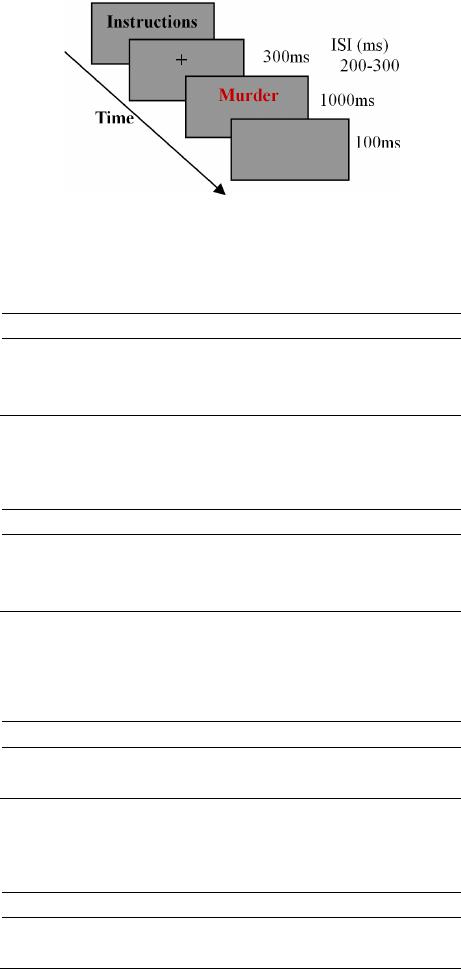 J. J. TIAN, Z. QIAN 300 ms. After participants reported the word color, a blank screen would appear for 100 ms, and the program entered into next trial. If participants did not respond in 1000 ms, the pro- gram also entered into the next trial automatically. Meanwhile, accuracy rate and reaction time (RT) were recorded (Figure 1). Practical session. 20 trials existed in practical session but did not appear in subsequent formal session. The program returned to practical session if the accuracy rate was below 80 percent. The session was to familiar participants with key pressing, and to counterbalance the distinction of the color and key pressing. Formal session. The experiment was divided into 3 blocks, in which 40 trials and totally 120 trials were presented on av- erage. 50 aggressive and 50 nonaggressive words were pre- sented in one of three colors (green, red, yellow), and each word appeared only once in each block. Participants had a short rest among blocks, then the program entered into the next block. The mean accuracy rate of the participants was from 85 to 95 percent, and the data of wrong and missing reaction was ex- cluded. Results The Main Effe c t of Vi ol ent Movies on Aggression One-way analysis of variance (ANOVA) was carried out to examine the main effect of goal word on children’s aggression (see Table 1). Table 1 showed that a significant main effect of goal word was found in reaction time (RT), and the RT of aggressive word was significantly longer than that of nonaggressive word (F = 4.36, p < 0.05). The Game Type × Gender Interaction In this study, we thought the RT of aggressive words was longer than that of nonaggressive words (compared to partici- pants playing nonviolent games). Thus, we assumed each par- ticipant had an aggressively priming score (APS), which was RT values by subtracting nonaggressive words from aggressive words, and examined whether significant difference of APS found in group type (see Table 2). Table 2 showed the average APS of experimental group (14 ms) was higher than that of control group (1 ms) by playing violent games, Table 3 showed significant difference in main effect of game type on aggression (F = 0.58, p < 0.05). Multivariate analy sis of covariance (MANCOVA) was carri- ed out to examine whether significant difference was found in APS among independent variables. The results can be seen in Table 3. Table 3 showed that there was significant difference in Game Type × Gender interaction (F = 4.89, p < 0.01). Simple effect analysis showed the average APS of girls playing violent and nonviolent games were 5.88 and 10.57, respectively, and no significant difference was found (F = 2.14, p > 0.05). The average APS of boys playing violent and nonviolent games was 8.63 and −1.24, respectively, and that the APS of boys playing violent games was significant higher than that of boys playing nonviolent games (F = 4.21, p < 0.05). The results can be seen in Table 4. Discussion The study selected Chinese children as participants, which Figure 1. Emotional stroop task. Table 1. RT differences between aggressive and nonaggressive words. Goal Words Aggressive Words Nonaggressive Words F M SD M SD RT 548 52.95 532 52.04 4.36 * Note: *p < 0.05; **p < 0.01; ***p < 0.001. Table 2. APS differences between violent game and nonviolent game group. Group Type Aggressive Non-aggressive APS M SD M SD Violent 558 50.26 534 47.95 +14 Nonviolent 532 54.79 531 55.03 +1 Note: APS-aggressively priming score (mean RT values of aggressive words minus nona ggr es si ve w ord s). Table 3. MANCOVA for Game Type, Game Type × Gender interaction in APS. Variables M SD F Game Type 225 26.55 0.58 * Movie Type × Gender 1125 125.06 4.89** Note: *p < 0.05; **p < 0.01; ***p < 0.001. Table 4. The comparison between boys and girls in APS. Gender Violent Game Nonviolen t Game F Boys 8.63 −1.24 4.21* Girlsr 5.88 10.57 2.14 Note: *p < 0.05; **p < 0.01; ***p < 0.001. was different from prior researches (Bushman, 1995). In addi- tion, we used emotional Stroop task to explore the gender dif- ferences in effects of violent computer games on aggression among children. It was showed that significant difference in main effect of game type on aggression among children, and that significant Game Type × Gender interaction was found, particularly aggression was significantly activated by violent games only among boys, but not among girls. Based on this, we inferred that boys may play more violent games than girls, thus leading to rapid development of their aggressively cognitive mechanisms. This result, to some extent, was consistent with our hypothesis that boys may be more aggressive than girls by playing violent games rather than nonviolent games. Therefore, boys on campus may be more prone to playing violent games OPEN ACCESS 29  J. J. TIAN, Z. QIAN than girls. In the present study, game types, goal words and gender were independent variables, which all significantly af- fected children’s aggression, partly supporting Cognitive-new Association Model (CAM) and General Aggression Model (GAM) (Anderson, 2002; Berkowitz, 1990; Anderson, Ander- son, & Deuser, 1996). Additionally, boys were more likely to be activated by violent stimuli than girls, which replicated pre- vious researches (Salmivalli & Kaukiainen, 2004; Boutwell, Franklin, Barnes, & Beaver, 2011; Lansford et al., 2012). Therefore, it could be assumed that repeated exposure to violent media may form aggressively cognitive structure for boys, and thus boys showed explicit aggressions. In conclusion, there were significant gender differences in aggression among chil- dren after playing violent computer games, and the boys showed more willingness to be aggressive and susceptible to violence than girls after viewing violent movies. Furthermore, the mechanism (e.g., culture, neuroscience) underlying the significant effects of violent computer games on aggression among Chinese children required psychologists to explore fur- ther. Acknowledgemen ts The research was supported by the National Youth Grant of National Educational Science Planning Project in 2013 (CBA- 130128), and funded by a Youth Grant of Social Sciences and Humanities from the Ministry of Education in China (13YJC- 190030) as well as the Fundamental Research Funds for the Central Universities (SWU1409135). Writing of the paper was also supported by a scholarship from the China Scholarship Council (CSC) to Dr. Qian Zhang during his visit at University of Illinois at Urbana-Champaign (201308505040). Sincere gratitude should be given to the anonymous reviewers for their thoughtful feedback on this draft. REFERENCES American Psychological Asso ciation (2013). Publication Manual of the American Psychological Association (6th ed.). Washington, D.C. Anderson, C. A., Gentile, D. A., & Buckley, K. E. (2007). Violent video game effects on children and adolescents. New York: Oxford Uni- versity Press. http://dx.doi.org/10.1093/acprof:oso/9780195309836.001.0001 Anderson, C. A. (2010). Violent video game effects on aggression, empathy, and proso cial behavior in eastern and western countries: A meta-analytic review. Psychological Bulletin, 136, 151-173. http://dx.doi.org/10.1037/a0018251 Anderson, C. A. ( 1997). Effects of violent movies an d trait hostility on hostile feelings and aggressive thoughts. Aggressive Behavior, 23, 161-178. http://dx.doi.org/10.1002/(SICI)1098-2337(1997)23:3<161::AID-AB 2>3.0.CO;2-P Anderson, C. A., Anderson, K. B., & Deuser, W. E. (1996a). Examin- ing an affective aggression framework: Weapon and temperature ef- fects on aggressive thoughts, affect and attitudes. Personality and Social Psychology Bulletin, 22, 366-376. http://dx.doi.org/10.1177/0146167296224004 Anderson, C. A., & Bushman, B. J. (2001). Effects of violent video games on aggressive behavior, aggressive cognition, aggressive af- fect, physiological arousal, and pro-social behavior: A meta-analytic review of the scientific literature. Psychological Science, 5, 353-359. http://dx.doi.org/10.1111/1467-9280.00366 Anderson, C., & Bushman, B. J. (2002). Human aggression. Annual Review of Psychology, 53, 27-51. http://dx.doi.org/10.1146/annurev.psych.53.100901.135231 Barlett, C. P., Anderson, C. A., & Swing, E. L. (2009). Video game effects-confirmed, suspected, and speculative: A review of the evi- dence. Simulation Gaming, 40, 377-403. http://dx.doi.org/10.1177/1046878108327539 Ballard, M. E., & Lineberg er, R. (1999). Video game violence and con- federate gender: Effects on reward and punishment given by college males. Sex Roles, 41, 541-558. http://dx.doi.org/10.1023/A:1018843304606 Ballard, M. E., & Robert, L. (1999). Video game violence and confed- erate gender: Effects on reward and punishment given by college males. Sex Roles, 41, 541-558. http://link.springer.com/article/10.1023%2FA%3A1018843304606# page-1 Baron, R. A., & Ri ch ardso n, D. (1 99 4). Human Aggression. New York: Plenum. Berkowitz, L. (1990). On the formation and regulation of anger and aggression: A cognitive-neoassociationistic analysis. American Psy- chologist, 45, 494-503. Bingenheimer, J. B., Brennan, R. T., & Earls, F. J. (2005). Sociology: Firearm violence exposu re and serious violen t behav ior. Science, 308, 1323-1326. http://dx.doi.org/10.1126/science.1110096 Boutwell, B. B., Fra nk l in , C . A ., Barnes , J. C ., & Beaver , K. M. (20 1 1 ). Physical punishment and childhood aggression: The role of gender and gene-environment interplay. Aggressive Behavior, 37, 559-568. http://dx.doi.org/10.1002/ab.20409 Carnagey, N. L., & Anderson, C. A. (2003). Theory in the study of me- dia violence: The general aggression model. In D. A. Gentile (Ed.), Media violence an d children: A complete guid e for parents and pro- fessionals (pp. 87-105). Westport, CT: Praeger. Craig, L. A., Browne, K. D., Beech, A., & Stringer, I. (2006). Differ- ences in personality and risk characteristics in sex, violent and gen- eral offenders. Criminal Behaviour and Mental Health, 16, 183-194. http://dx.doi.org/10.1002/cbm.618 Cross, C. P., & Ca mpbell, A. (201 2). The eff ects of intimacy and target sex on direct aggression : Further evidence. Aggressive Behavior, 38, 272-280. http://dx.doi.org/10.1002/ab.21430 Ferguson, C. J., & John, K. (2010). Much ado about nothing: The mis- estimation and over interpretation of violent video game effects in Eastern and Western nations: Comment on Anderson et al. (2010). Psychological Bulletin, 136, 174-178. http://dx.doi.org/10.1037/a0018566 Freedman, J. L. (19 84). Effect of television vio lence on aggressivenes s. Psychological Bulletin, 96, 227-246. http://dx.doi.org/10.1037/0033-2909.96.2.227 Freedman, J. L. (1986). Television violence and aggression: A rejoinder. Psychological Bulletin, 100, 372-378. http://dx.doi.org/10.1037/0033-2909.100.3.372 Freedman, J. L. (2003). Media violence and its effect on aggression: Assessing the scientific evidence. Toronto: University of Toronto Press. http://dx.doi.org/10.1037/0033-2909.96.2.227 Friedrich-Cofer, L., & Huston, A. C. (1986). Television violence and aggression: The debate continues. Psychological Bulletin, 100, 364- 371. http://dx.doi.org/10.1037/0033-2909.100.3.364 Garandeau, C. F ., Ahn, H. J., & Rodkin, P . C. (2011). The social status of aggressive students across contexts: The role of classroom status hierarchy, academic achievement, and grade. Developmental Psy- chology, 47, 1699-1710. http://dx.doi.org/10.1037/a0025271 Geen, R. G., & O’Neal, E. C. (1969). Activatio n of cue-elicited aggres- sion by general arousal. Journal of Personality and Social Psychol- ogy, 11, 289-292. http://dx.doi.org/10.1037/h0026885 Huesmann, L. R. (1986). Psychological processes promoting the rela- tion between exposure tomedia violence and aggressive behavior by the viewer. Journal of Social Iss ues, 42, 125-139. http://dx.doi.org/10.1111/j.1540-4560.1986.tb00246.x Huesmann, L. R., Eron, L. D., Lefkowitz, M. M., & Walder, L. O. (1973). Television violence and aggression: The causal effect re- mains. American Psychologist, 28, 617-620. http://dx.doi.org/10.1037/h0038223 Huesmann, L. R., Mo i se -Titus, J., Podolski, C. L., & Eron, L. D. (2003). Longitudinal relations between children’s exposure to TV violence and their aggressive and violent behavior in young adulthood: 1977-1992. Developmental Psychology, 39, 201-221. OPEN ACCESS 30  J. J. TIAN, Z. QIAN http://dx.doi.org/10.1037/0012-1649.39.2.201 Johnson, J. G., Cohen, P., Smailes, E. M., Kasen, S., & Brook, J. S. (2002). Television viewing and aggressive behavior during adoles- cence and adulthood. Science, 295, 2468-2471. http://dx.doi.org/10.1126/science.1062929 Lansford, J. E., Skinner, A. T., Sorbring, E., Giunta, L. D., Deater- Deckard, K., Dodge, K. A., Malone, P. S., Oburu, P., Pastorelli, C., Tapanya, S., Uribe Tirado, L. M., Zelli, A., Al-Hassan, S. M., Peña Alampay, L., Bacchin i, D., Bo mbi, A. S. , Bornstein , M. H., & C hang , L. (2012). Boys’ and girls’ relational and physical aggression in nine countries. Aggressive Behavior, 38, 298-308. http://dx.doi.org/10.1002/ab.21433 Ramirez, J. M., Andreu, J. M., & Fujihara, T. (2 001). Cultural and sex differences in aggressio n: A comparison between Japanese and Spa- nish students using two different inventories. Aggressive Behavior, 27, 313-322. http://dx.doi.org/10.1002/ab.1014 Salmivalli, C., & Kaukiainen, A. (2004). Female aggression revisited: Variable- and person-centered approaches to studying gender differ- ences in different types of aggression. Aggressive Behavior, 30, 158-163. http://dx.doi.org/10.1002/ab.20012 Smith, P., & Waterman, M. (2005). Sex differences in processing ag- gression words using the emotional Stroop task. Aggressive Behavior, 31, 271-282. http://dx.doi.org/10.1002/ab.20071 Uhlmann, E., & Swanson, J. (2004). Exposure to violent video games increases automatic aggressiveness. Journal of Adolescence, 27, 41- 52. http://dx.doi.org/10.1016/j.adolescence.2003.10.004 Zhang, Q., Zhang, D. J., & Wang, L. X. (2013). Is aggressive trait responsible for violence? Priming effects of aggressive words and violent movies. Psychology, 4, 96-100. http://dx.doi.org/10.4236/psych.2013.42013 Zhang, Q., Zhong, J. X., & Zhang, D. J. (2013). Does violent movie exposure affect aggressive cognition of Chinese adolescents? Evi- dences from a modified STROOP task. International Journal of Psychological Studies, 5, 11-18. http://dx.doi.org/10.5539/ijps.v5n2p11 Zhen, S. J., Xie, H. L., Zhang, W., Wang, S. J., & Li, D. P. (2011). Exposure to violent computer games and Chinese adolescents’ phy- sical aggression: The role o f beliefs about aggression, hostile ex pec- tations, and empathy. Computers in Human Behavior, 27, 1675-1687. http://dx.doi.org/10.1016/j.chb.2011.02.006 OPEN ACCESS 31 |