

Paper Menu >>
Journal Menu >>
 Creative Education 2014. Vol.5, No.1, 15-17 Published Online January 2014 in SciRes (http://www.scirp.org/journal/ce) http://dx.doi.org/10.4236/ce.2014.51005 OPEN ACCESS 15 Identification of Scientific Researches Conducted during UNIPLAC’S Medical Degree, Lages, Santa Catarina, Brazil Vanessa Freitas Bratti1, Patrícia Alves de Souza2, Fernando Arruda Ramos2, Márcia Adriane Andrade1 1Universidade do Planalto Catarinense (UNIPLAC), Lages, Brazil 2Universidade do Planalto Catarinense (UNIPLAC) Gepes Vida Research Group, Lages, Brazil Email: [email protected] Received October 31st, 2013; revised Novem ber 31st, 2013; accepted December 7th, 2013 Copyright © 2014 Vanessa Freitas Bratti et al. This is an open access article distributed under the Creative Commons Attribution License, which permits unrestricted use, distribution, and reproduction in any medium, provided the original work is properly cited. In accordance of the Creative Commons Attribution License all Copyrights © 2014 are reserved for SCIRP and the o w n er of th e intellectual property Vanessa Freitas Bratti et al. All Copyright © 2014 a re guarded by law and by SCIRP as a guardian. Scientific Research held during graduation provides students with better training, by allowing the im- provement of activities related to their future profession, a better relationship between teachers and stu- dents, as well as enabling the knowledge of research methodology. The purpose of this work is to identify the Scientific Research conducted during the medical degree at Universidade do Planalto Catarinense- UNIPLAC, since the implementation of this course at the University (2004) until July 2013. Through a descriptive and quantitative approach, the data related to the scientific research conducted during the medical degree were held. Fifty-eight Scientific Researches were performed by students, who were in- structed by qualified teachers. From this information, the fields of knowledge covered by the Scientific Projects were recognized, as well as the profile of researchers. The epidemiology was the field related to the greatest approach and it covered twenty-eight Scientific Researches. Females predominate among the researchers, with a participation of thirty-one exhibitioners and fifteen advisors. The researches were car- ried out mainly by students who study the early years of medical degree. The tripod Research, Education and Extension are very important as they introduce the students to the scientific universe during gradua- tion, encourage them to produce knowledge and technology through their own researches after the degree, contribute to a better academic background, and provide a continuous update during the professional life, and encourage sel f -taught professionals. This electronic document is a “live” template. The various com- ponents of your paper [title, text, heads, etc.] are already defined on the style sheet, as illustrated by the portions given in this document. Keywords: Component; Formatting; Style; Styling; Insert Introduction In recent times, the need for improving the scientific training of medical students (Cardoso, 2004) began to be observed. In this context, there are two aspects of improvement in medical education: the ability and the opportunity afforded to students for carrying out research activities (Mendes, 2009). The impor- tance of basic scientific research is essential to provide a good academic education, and in the medical degree, it implies the formation of an all-round doctor, technically and morally, as well as encourages the production of new range of knowledge in the health field (Tenório, 2010). Brazilian research has in- creased significantly: from 2001 to 2011, and Brazil went from seventeenth to thirteenth position worldwide related to the number of articles published (Righetti, 2013). Regarding this production of knowledge, the medical field has had a consider- able and effective participation (Martelli, 2010). This study was developed at Universidade do Planalto Catarinense-UNIPLAC, an university established since 1954, located in the city of Lag- es State of Santa Catarina, southern Brazil. The city of Lages has approximately 160,000 inhabitants. Every year, forty stu- dents enter Medical Course of UNIPLAC, coming from differ- ent Brazilian regions. UNIPLAC’S Medical Course was created in 2004 and it presents a curriculum model based on Problem- Based Methodology and Learning Curriculum. Methodology The data related to the scientific researches conducted and recorded during UNIPLAC’S the Medical Degree (from 2004 to July 2013) was recorded through a descriptive and quantita- tive approach. This information was obtained from existing data in Dean’s Office for Graduate and Research Studies (Edu- cation) a nd in Medical Degree Coordination. By identifying the exhibitioners and advisors, the curricula of all researchers were consulted through Lattes Platform (CNPq). A database was constructed containing information concerning the scientific production (scientific articles and presentations in seminars and 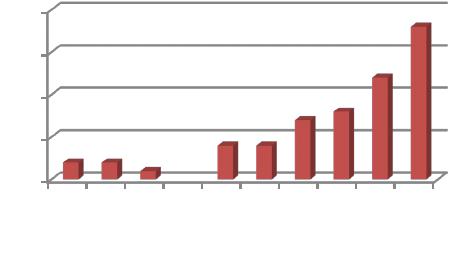 V. F. BRATTI ET AL. OPEN ACCESS 16 congresses). According to this information, the profiles of re- searchers and the areas addressed as well as publications from scientific productivity were obtained. Purpose This study aims to identify scientific researches conducted during UNIPLAC’S Medical Degree since its implementation in 2004 until July 2013. Results and Discu ssion The scientific production introduces the student in the scien- tific field, stimulating them to research during the degree period. It is expected that some of these students continue to produce knowledge and technology through research on their own ca- reer paths. The Chart 1 displays the evolution of research projects throughout the Medical Degree. Since the establishment of UNIPLAC’S Medical Degree in 2004 and until July 2013, fifty-eight science intern research projects were conducted, with two scientific projects in 2004; two in 2005; one in 2006; none in 2007, four in 2008; four in 2009; seven in 2010; eight in 2011; twelve in 2012 and until July 2013, eighteen scientific projects were performed. The analysis of academic production reveals a significant in- crease in the production of scientific articles. Although the an- nual survey of 2013 is partial, it is possible to observe that this number is much higher compared to all previous annual surveys. In recent years, the Brazilian scientific production has been showing a consistent increase in the formation of Higher Edu- cation. Medical Course integrates one of the largest areas of knowledge with scientific production in Brazil. This quantita- tive increase in the scientific output is correlated with the gen- eral increase in the scientific production and it possibly reflects the incentives generated by research funding institutions (Mar- telli, 2010). Another stimulating factor of such productivity is the analysis of teaching quality of higher education institutions (HEIs) conducted by Ministry of Education (MEC), which uses as one of the evaluation criteria the production and publication of scientific papers. There is a perception, at least on a qualitative, that the doctor who was formerly dedicated to scientific research would be endowed with a greater capacity for critical judgment, which would help not only the diagnosis, but also the analysis for decisions along the professional field (Cardoso, 2005). From these research projects, forty-five were linked to Ar- ticle 170, which deals with a program of Scientific Initiation Scholarships for science intern programs, financed with funds arising from Article 170 of the Constitution of the State of Santa Catarina; eight projects were developed by Research Groups related to groups of researchers, students and technical support staff on the implementation of research lines), three projects are encouraged by the Institutional Program for Scien- tific Initiation Scholarships (PIBIC-CNPq), which aims to sup- port the policy for Scientific Initiation developed in educational and/or research institutions, through grants for Scientific Initia- tion to science intern students, and two projects represent stu- dies carried out by “Prêmio Mérito Universitário do Fundo de Apoio à Pesquisa de Santa Catarina” (FAPESC), which purpose is to promote scientific and technological research, contributing to the advancement of all fields of knowledge, regional balance, sustainable development and improvement of the quality of life Chart 1. Description of scientific studies carried out during UNIPLAC’s Medi- cal Degree since 2004 until July 2013. of the population of Santa Catarina, based on the principles set forth in the Constitution of the State of Santa Catarina. The science intern program gives the student a scientific as- sociation with practical techniques and scientific knowledge. Guided by a teacher, students write projects, conduct practices and may even present papers at conferences and publish articles in scientific journals (Margarido, 2013). From the total number of research projects, twelve projects were carried out by students during the first year of medical degree; twelve projects were carried out by students during the second year; thirteen projects were carried out by students dur- ing the third year; twelve projects were conducted by students during the fourth year; five projects were carried out by stu- dents during the fifth year; two projects were conducted by students during the sixth year, and two projects were conducted without the participation of students. Therefore, most research- ers conducted projects in the early years of Higher Education. The science intern research serves as a complement to pro- fessional training, as the student improves his/her ability to competently perform activities related to his/her profession. It also provides the student contact with different fields of know- ledge, a feature of the current key health professionals: the multidisciplinarity (Tenório, 2010). To ensure the consolidation and extension of research in UNIPLAC there are incentives in the research lines, as the cre- ation of “Fundo Institucional de Apoio ao Desenvolvimento da Pesquisa” and publication of UNIPLAC’S Journal, as well as the implementation of “Mostra de Trabalhos de Iniciação Científica” and “Jornada de Pesquisa, Ensino e Extensão” which is held for 17 years in UNIPLAC. Profiles of researchers and advisors in the field of medical degree were evaluated. From nineteen advisors, fifteen were female. The same predominance of females was observed in relation to the students: from fifty-six students, third-one were females; contrary to science intern researchers nationwide, where female participation in knowledge production is still modest and incipient. Some authors have proposed a discussion about the low par- ticipation of women in scientific production, since they are a major number from students in Brazilian universities. In this context, the lowest female presence can be explained by de- layed insertion of women in science and technology system. As they have recently entered this universe, there are less funds for scholarships and grants, insofar as these funds require greater experience and titles. Another relevant factor is the difficulty women have in reconciling scientific career and family life, 0 5 10 15 20 2004 2005 2006 2007 2008 2009 2010 2011 2012 Jul-13  V. F. BRATTI ET AL. OPEN ACCESS 17 including pregnancy and motherhood (Mendes, 2010). Referring to the fields of knowledge addressed in scientific production, research projects were divided into five categories: clinical, surgical, epidemiological, medical education and pub- lic health (categorization by the authors). From the fifty-eight projects, seventeen address the clinical Field; there was no work in the surgical Field; twenty-eight address the epidemiology field, seven address the medical edu- cation Field and six address the public health field. Chart 2 displays that the Field of greatest research was epidemiology. On the publicity of scientific projects, it was noted that from the fifty-eight projects completed, seventeen were presented at conferences (and some of these scientific projects were pre- sented more than once in different events) and two articles were published in scientific journals. However, the publicity of these results is limited to scientific research finalized, so the projects that are under development and have not obtained publication are not considered. The scientific work achieves its primary goal when released in conferences through oral communications and posters in scienti fic journals, books, pre ss, Internet and other means. Thus, the researcher puts forward ideas, ensuring the property and submitting to scientific review (Görgens, 2007). To be implemented with quality, a program of Science Intern Program requests: students interested in developing projects and put them into practice, and qualified teachers willing to guide the students; equipment (such as computers, applications, photocopies and other tools) and financial resources for sup- porting the research. These four items are the basic requirement to develop all the skills that graduating a project of Science Intern Program is able to offer. In Brazil, the biggest obstacle to scientific growth is the funding of research projects (Tenório, 2010). Conclusion The survey allows us to recognize the areas addressed in the projects, the profile of academic researchers and teachers and the progressive evolution of scientific production of medical school. From the institutional lines of research, the medical school has not only expressed attention mainly by their teachers, but also mobilized its students to integrate into the science in- tern program. Conside ring the im portance of t he tripod Re search, Education and Extension, teachers and students involved in research projects contribute to scientific production necessarily for the proper recognition of the institution at the national level, Chart 2. List of research projects in the fields of knowledge: clinical, surgical, epidemiological, medical education and public health. before other educational institutions and research bodies. The scientific and technological developments of a nation depend on the quality of its researchers, the visibility of its science and industry interaction and research (Görgens, 2007). The formation of the scientist is based on a specific learning that begins at graduation degree, by conducting research and providing students with the practical experience and effective academic life, which positively influences the subsequent pro- fessional practice (Görgens, 2007). Thus, the Science Intern Program works in the professional training of the student, con- stituting a fundamental part of a higher education, and serves to assist them in their continuous update after the degree. REFERENCES Cardoso, G. P., da Silva Júnior, C. T., Martinho, J. M. D. S . G., & Cy- rillo, R. J. T. (20 04). Iniciação científica em medicina: Uma questão de interesse para todas as especialidades. Revista Pulmão RJ, 13, 8-12. Cardoso, G. P. et al. (2005). Dez anos de iniciação científica: O que aprendemos? Experiência da Disciplina de Iniciação Científica do Curso de Medicina da UFF. Revista Pulmão RJ, 14 , 131-136. Görgens, J. B. (2007). Avaliação da Produção Científica dos egressos, bolsistas e não bolsistas de Iniciação Científica, do Curso de Medi- cina da Universidade Fed eral de Minas Gerais, de 1 994 a 1999, pelo Currículo Lattes. 2007. Ph.D. Tese, Minas Gerais: Universidade Fe- deral de Minas Gerais. Margarido, M. R. (2013). Atividades extracurriculares, uma opinião. Medicina (Ribeirão Preto), 46, 56-58. Martelli Junior, H., Martelli, D. R. B., Quirino, I. G., Araujo Oliveira, M. C. L., Li ma, L. S., & de Oliveira, E. A. (2010). Pesquisadores do CNPq na área de Medicina: Comparação das áreas de atuação. Re- vista da Associação Médica Brasileira, 56, 478-483. http://dx.doi.org/10.1590/S0104-42302010000400024 Mendes, A. L. Mota-Júnior, L. F., Martelli, D. R. B., Bonan, P. R. F., & Júnior, H. M. (2009). Produção cien tíf ica na medicina em projetos de pesquisa financiados p ela Agência FAPEMIG. Revista Brasileira de Educação Médica, 33, 426-432. http://dx.doi.org/10.1590/S0100-55022009000300013 Mendes, P. H. C., Martelli, D. R. B., de Souza, W. P., Filho, S. Q., & Júnior, H. M. (2010). Perfil dos pesquisadores bolsistas de produ- tividade científica em medicina no CNPq, Brasil. Revista Brasileira de Educação Médic a, 34. http://dx.doi.org/10.1590/S0100-55022010000400008 Righetti, S. (2013). Brasil cresce em produção científica, mas índice de qualidade cai. Folha de S. Paulo: Ciência. Tenório, M. P., & Beraldi, G. (2010). Iniciação científica no Brasil e nos cursos de medicina.Revista da Associação Médica Brasileira, 56 , 390-393. http://dx.doi.org/10.1590/S0104-42302010000400007 0 5 10 15 20 25 30 |