

Paper Menu >>
Journal Menu >>
 Internationa l Journal of Geosciences, 2014, 5, 122-130 Published Online Januar y 2014 (http://www.scirp .org/journal/ijg) http://dx.doi.org/10.4236/ijg.2014.51013 Provenance, Tectonics and Paleoclimate of Permo-Carboniferous Talchir Formation in Son-Mahanadi Basin, Central India with Special Reference to Chirimiri: Using Petrographical Interpretation Khansa Zaidi1*, Sarwar Rais1, Abdullah Khan1, Mohd Masroor Alam2 1Department of Geology, Aligarh Muslim University, Aligarh, India 2Department of Civil Engineering, Aligarh Muslim University, Aligarh, India Email: *khansa.schol ar @ gmail.co m, rais [email protected] Received October 28, 2013; revis ed November 29, 2013; accepted Dece mber 24, 2013 Copyright © 2014 Khansa Zaidi et al. This is an open access article distributed under the Creative Commons Attribution License, which permits unrestricted use, distribution, and reproduction in any medium, provided the original work is properly cited. In accor- dance o f the Creative Commons Attribution License all Copyrights © 2014 are reserved for S CIRP and the owner of the int ellectual property Khansa Zaidi et al . All Copyright © 2014 are guarded by law and b y SCIRP as a guar dian. ABSTRACT The present study deals with the petrographic interpretation of Talchir Formation sandstone, in and around Chirimiri area, Koriya district, Chhattisgarh state India located in Son-Mahanadi basin. This basin is an elon- gate graben showing northwest-southeast trend and c onsidered to be one o f the larg est intra-crato nic rift basins of Indian peninsula. Talchir Formation is the lowermost unit of thick classical Gondwana sedimentary succes- sion and rests unconformably on Precambrian basement. The petrographic studies consisting of point count show the presence of quartz as a dominant framewo rk minera l with subordinat e amounts of fel dspars and r ock fragments. The data plot in the fields of cratonic interior and transitional margin of continental block prove- nance. In the Qt (quartz)-F (feldspar)-L (lithic fragments) triangular diagram, indicating the source of these sediments was located in transitional margin and continental block provenance. The petrographic classification suggests that this formation in the study area dominantly contains compositionally immature to submature ar- kosic, sub-arkosic and lithic-arkosic sandstones. The bivariate plot between Qp/(F+R) vs. Qt/(F+R) indicat e s changes in c l imatic conditions fr om semi-arid to semi-humid during P e rmo-Carboniferous period. KEYWORDS Son-Mahanadi; Talchir Formation; Chirimiri; Provenance; Tectonics; Petrography; Paleoclimate 1. Introduction The compositions of sandston e have been widely used by sedimentologists during past several decades to decipher the provenance, paleoclimate and tectonic setting of the source areas [1-9]. The characters of detrital framework grains are substantially affected by the nature of proc- esses that act in the depositional basin and also by the type of transporting medium and distance of transport [8,10]. Determination of different aspects of provenance viz its location with respect to depositional basin, lithol- ogy, climate and tec to nic setti ng is some of the important parameters of basin analysis [11]. The Go ndwana sed i me nt s o f P e nins ul ar Ind i a mar k th e resumption of sedimentation during Permo-Carbonifer- ous a fter a lo ng hiat us since Pr oterozoic. The sedimenta- tion in Gondwana basins of India evolved through a complex interplay of faulting, changes in sea level and climate [12]. The basinal geometry was modified by tec- tonic movement during different periods. Indian plate is an assembly of several micro continents, sutured along early/middle Proterozoic Mobile belts [13-15]. These mobile belts became the locales of rift nucleation and played a fundamental role in the mechanism of rift pro- pagation along reactivated ancient shear zones [15-18]. These intra-cratonic rifts are referred to as Gondwana basins. * Corresponding author. OPEN ACCESS IJG 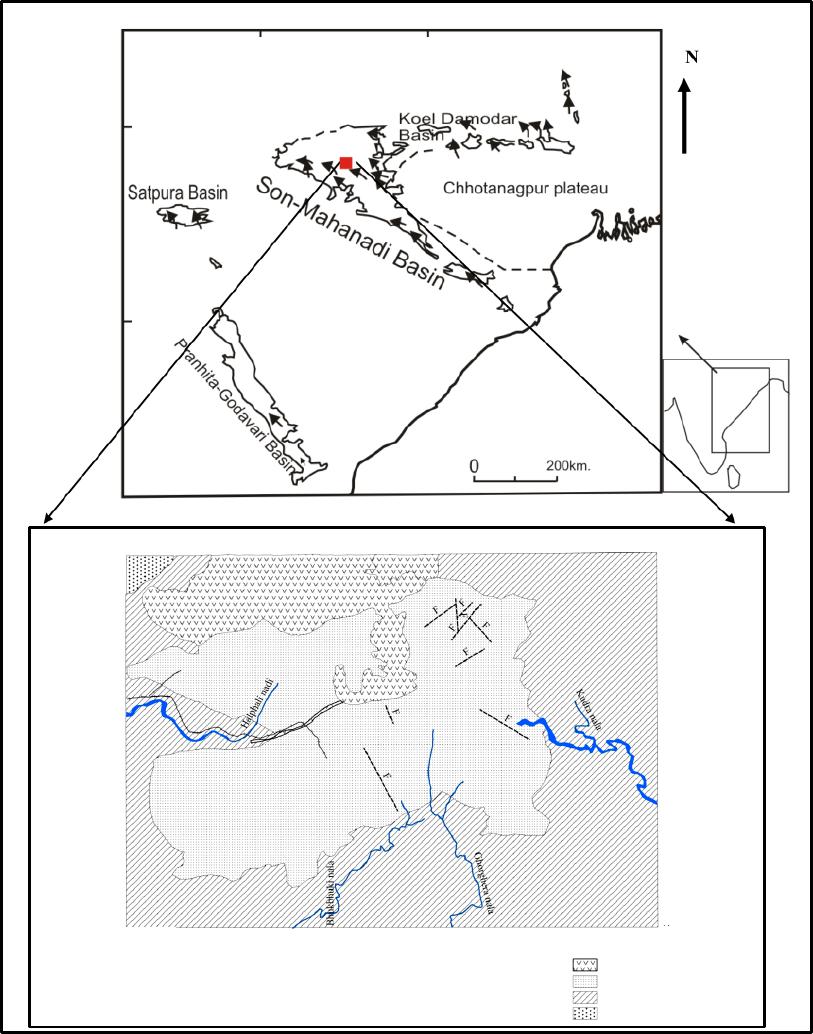 K. ZAID I ET AL. 123 The Gondwana basins are linearly arranged along the present day river valleys viz. Koel-Damodar, Son- Mahanadi and Pranhita-Godavari (Figure 1(b)). The sediments are mostly made up of clastics of glacial and glacigene rocks at the base followed by coal measures and red beds at the top [19]. The Talchir Formation, the lowermost member of Gondwana sequence of India, is suggested to be of glacial, glacio-flu vial, g lac io -lacus- trine and/or glacio-marine depositional environment [20-32]. The Talchir Formation is marked by uniformly deposited olive green sandstone, conglomerate, thinly laminated shales, siltstone, and varves with typical glacigene facies tillite mostly at the base. The present study is based on modal analysis of Figure 1. (a) Map of India shown inset; (b) The outline map of Peninsular India showing Gondwana basins and paleohigh- lands. Arrows indicate direction of Pe rmia n-Triassic paleoslope modified by Tewari and Veevers, 1993; (c) Map showing study area modified after Raja Rao 1983. (a) (b) (c) 80˚ 84˚ 24˚ 20˚ Bay of Bengal Doler it es Barakar Ta lch ir Precambrian basement Geologic al Unit s 82˚17' 23˚15' 23˚8' 82˚17' 23˚15' 82˚25' 23˚8' 82˚25' OPEN ACCESS IJG  K. ZAID I ET AL. 124 sandstones of Talchir Formation of Chirimiri, Koriya district, Chhattisgarh state, located in Son-Mahanadi basin (Figure 1(c)). The aim of the study is to interpret the possible provenance, tectonic setting and paleocli- mate variability that led to the deposition of these sand- stone s dur i ng Permo-Carboniferous period. 2. Geological Setting The Chirimiri coalfield, the study area, is a part of Son- Mahanadi basin falls between latitudes 23˚8'N to 23˚15'N and longitudes 82˚17'E to 82˚25'E. Talchir Formation is exposed along streams flowing in the vicinity of Chiri- miri town. Olive green, thinly laminated shales and me- dium grained sandstone succeeded by lemon yellow al- ternate beds of shale and sandstones are found exposed in this area. The Chirimiri area was surveyed by C.S Raja Rao and stratigraphic succession was proposed (Table 1) [33]. The Son-Mahanadi graben is one of the largest intrac- ratonic rift basins of peninsular India. The Mahakoshal supra crusta l lie in t he nort h of Son-Mahana di Gond wana basin. The rocks of Sausar mobile belt and Betul su- pracrustals are exposed in the south, whereas the eastern and south eastern fringes of the Son-Mahanadi basin are constituted by granite-gneissic complex of Chotanagpur terrain and Precambrian rocks of Singhbhum and Bastar craton respectively [34]. To the west of the basin unclas- sified Precambrian migmatites and geneisses are exposed. Tecto nically, the b asin ha s be e n divided into three blocks i.e., Son, Hasdo-Arand and Mahanadi separated from each other by ENE-WSW trending prominent basement ridge [35]. Spatial distribution of rock units, variation in the thickness of sediments, different disposition of struc- tural elements and contrasting lineament-trends of these three blocks suggest that each underwent a different sedimentation and tectonic his tory [35]. 3. Material and Methods The current study deals with petrographic interpretations of Talchir sandstones in Chirimiri area. 50 Talchir sand- stone samples have been collected along the stream cut- tings in and around Chirimiri, where they are found ex- posed. The streams from where these samples have been collected are Halphali, Kudra, Bhukbhuki, and Ghor- ghera (Figure 1(c)). Out of these 50, only 29 representa- tive samples of sandstone were selected for petrographic studies. Thin sections of the selected samples were pre- pared by standard technique. Modal analysis of samples was carried out using point counting method to deter- mine the quantitative mineralogical aspects of these sandstones. About 350 points per thin section were counted (Table 2 ) us i n g Ga zz i -Dickenson’s method [36]. The counted grains were recalculated into percentage as summarised in (Table 3). Table 1. Stratigraphic succession of Chirimiri, coalfield Koriya district, Chhattisgarh (Raja Rao, 1983). Age Formation Lithology Upper Cretaceous to lower Eocene (?) Deccan Traps Basic flows, dykes and sills. Lower Permian Barakar Essentially sandstone with subordinate Shales and coal seams (230 m to 435 m). Upper Carboniferous to Early Permian Talchir Predominantly olive green sha les and Medium to fine grained sandstone. UNCONFORMITY Precambrian basement Granite, Gnies ses and Quartzite Table 2 . K ey f or petrograp hic and other p ara meters u sed in this study (modified after Dickinson 1985). QFR Q Total Quart z gra ins (Qm + Qp) Qm monocr yst alline quartz Qp polycrystalline quartz F Total Feldspar (P + K) P Plagioclase K alkali feldspar R Total rock fragmen ts including chert QtFL Qt Total quartz grains (Qm + Qp) Qm monocrystalline quartz Qp polycrystalline quartz F Total Feldspar (P + K) P Plagioclase K alkali feldspar L Total lithic fragments QmF Lt Qm monocrystallin e quartz F Total Feldspar (P + K) P Plagioclase K alkali feldspar Lt Total rock fragments including polycrystalline quartz QpLvLs Qp polycrystalline quartz Lv Total volcani c an d Me ta-volcanic rock fragments Ls Total sediment ary rock fragments LmLv Ls Lm Tot al metamorphic rock fragments Lv Total volcanic rock fragments Ls Total sedimentary rock fragments Qp/F + RF vs. Qt/F + RF Qt Total quartz grains (Qm + Qp) Qm monocr yst alline quartz Qp polycrystalline quartz F Total Feldspar (P + K) RF Total rock fr agments OPEN ACCESS IJG  K. ZAID I ET AL. 125 Table 3. Recalculated detrital composition of Talchir sandstones of Chiri miri area, Koriya district. S.No QFR QtFL Q mFLt QpLvLs Qp/(F + R) Qt/(F + R) QmP K Q F R Qt F L Qm F Lt Qp Lv Ls Qm P K NT1 71.23 16.44 12.33 60.46 38.37 1.17 71.23 16.44 12.33 0 0 100 0.11 1.52 60.47 0 39.55 NT2 70.42 15.49 14.08 57.89 40.35 1.76 70.42 15.49 14.08 0 0 100 0.21 1.37 56.90 0 43.1 NT3 69.62 18.99 11.39 52.40 43.26 4.34 69.62 18.99 11.39 0 0 100 0.25 1.1 55 15 30 NT5 61.54 19.23 19.23 55.26 39.48 5.26 61.54 19.23 19.23 0 0 100 0.21 1.23 58.33 5.55 36.12 NT7 67.57 18.92 13.51 54.17 29.17 16.7 67.57 18.92 13.51 0 0 100 0.13 1.18 65 0 35 NT8 91.67 4.86 3.47 68.94 28.43 2.63 91.67 4.86 3.47 66.66 0 33.34 0.03 1.38 70.49 4.26 25.25 NT9 80.13 16.03 3.85 68.57 24.58 6.85 80.13 16.03 3.85 0 0 100 0.17 1.55 73.61 2.47 23.92 NT10 73.53 13.24 13.24 76.36 23.64 0 73.53 13.24 13.24 0 0 0 0.12 1.55 76.36 1.81 21.83 NT12 71.11 22.22 6.67 58.1 37.4 4.5 71.11 22.22 6.67 0 0 0 0.06 1.56 60 7.5 32.5 NT13 70.71 20.20 9.09 83.54 16.46 0 70.71 20.20 9.09 0 0 0 0.11 1.56 85.71 1.3 12.99 NT14 71.43 23.81 4.76 62.92 35.96 1.12 71.43 23.81 4.76 33.33 0 66.67 0.26 1.64 63.64 0 36.36 GN1 73.36 18.22 8.41 77.38 17.86 4.76 54.55 27.27 18.18 70 0 30 0.28 2.05 66.66 4.44 28.9 GN2 64.10 25.00 10.90 72.12 21.15 6.73 67.31 21.15 11.54 45.5 0 54.5 0.16 1.54 76 3 21 GN3 67.57 21.62 10.81 69.70 24.24 6.06 69.70 24.24 6.06 0 0 100 0.23 1.68 74.2 3.22 22.58 GN4 61.74 26.85 11.41 61.90 29.25 8.84 60.54 29.25 10.20 13.33 0 86.67 0.03 1.62 67.42 3.02 29.56 GN5 84.52 11.90 3.57 77.65 20.00 2.35 77.65 20.00 2.35 0 0 100 0.2 0.91 79.53 8.43 12.04 GN6 74.65 14.08 11.27 74.20 17.35 8.45 67.74 17.74 14.52 33.33 0 66.67 0.17 2 79.24 0 20.76 GN7 76.11 19.44 4.44 68.75 27.60 3.65 62.50 27.60 9.90 66.67 16.7 16.67 0.21 1.05 69.38 9.82 20.8 GN8 79.40 16.08 4.52 78.61 18.41 2.99 64.68 18.41 16.92 80.02 11.4 8.57 0.7 1.95 77.84 1.2 20.96 GN9 79.14 10.07 10.79 63.16 29.47 7.37 56.00 32.00 12.00 44.44 0 55.56 0.16 1.69 65.85 3.04 31.11 GN10 7 1.64 22.39 5.97 70.78 26.23 2.99 68.81 26.24 4.95 40 10 50 0.06 1..46 72.39 2.6 25.01 GN11 8 2.05 11.11 6.84 87.27 10.91 1.82 82.50 10.00 7.50 80 0 20 0.15 1.92 87.27 2 10.73 BBK1 71.43 14.29 14.29 49.25 42.25 8.50 45.54 43.56 10.90 0 14.29 85.71 0.11 0.83 51 0 49 BBK3 59.70 22.39 17.91 53.00 44.00 3.00 52.11 45.07 2.82 100 0 0 0.05 1.14 53.62 0 46.38 BBK4 63.37 28.71 7.92 70.00 24.00 6.00 53.33 26.67 20.00 100 0 0 0.05 1.43 42.3 3.84 53.86 BBK5 51.28 25.64 23.08 41.00 53.00 6.00 39.64 54.05 6.31 0 33.33 66.67 0.17 1.17 45.5 0 54. 5 BBK6 73.96 20.71 5.33 38.89 55.56 5.56 38.89 55.56 5.55 100 0 0 0.35 0.63 63.69 10.71 25.6 BBK7 77.92 10.39 11.69 63.32 33.67 3.02 60.80 38.07 1.13 90 0 10 0.26 1.72 66.66 16.66 16.68 KN3 74.11 14.29 11.61 56.62 40.44 2.94 56.92 42.31 0.77 75 0 25 0.03 1.3 57.37 0 42.63 4. Petrog raphy These sandstones are predominantly coarse to medium grained. Quartz is the chief component of these thin sec- tions. It occurs in three varieties, monocrystalline, poly- crystalline, and stretched (Plates 1(a) and (b)), the per- centage of quartz ranges from 38.89 to 83.54 percent. The mono-crystalline quartz has both straight to slightly undulator y extinction with angular to subrounded grains. Detrital feldspar comes next to quartz, followed by rock fragments. Feldspar form 10.9 to 55.56 percent in these sandstones followed by rock fragments which range from 3.47 to 23.08 percent. Three varieties of feldspar, that is, orthoclase, plagioclase and microcline have been re- corded in these sandstones (Plates 1(c)-(e)). Feldspar grains are fresh, coarse to medium in size and sub rounded in shape. Some feldspar grains also exhibits slight alteration (Plate 1(d)). Orthoclase is more abun- dant than rest of the feldspar varieties. Heavy minerals observed in these thin sections include zircon, rutile, garne t and e pido te, al ong wit h rock fr ag ments of grani te/ gneis s, schi st (Plate 1(g)), chert, shale and siltstone. Clay matrix is the common binding material present, along OPEN ACCESS IJG  K. ZAID I ET AL. 126 Plate 1. (a) P hoto microgra phs of Talchir For mation of Chiri miri ar ea, Kori ya dist rict, Chhat tisgarh, arrow s show ing mon o- crystalline quartz grains and polycrystalline quartz; (b) Stretched quartz; (c) Orthoclase grain showing iron staining; (d) Plagioclase grain slightly altered; (e) Microcline grain; (f) Perthite grain; (g) Schist fragment; (h) Plagioclase grain with in- clusion of quartz; (i) Pore filling clay matrix; (j) Undifferentiated matrix ( black in colo ur) and Iron cement ( black arro w). with ferruginous cement occurring at the edges of the grain or in small patches. Pore filling matrix is also com- mon in these sand stones of Talchir Formation (Pla te 1(i)) Undifferentiated matrix (Plate 1(j)) and few patches of calcite cement have also been encountered in framework of some of these studied sa mples. The studied Talchir sandstone specimens of Chirimiri area have been classified according to Folk’s classifica- tion [37] into three categories viz arkose, subarkose, and lithic arkose (Figure 2). 5. Provenance, Tectonic Setting and Paleoclimate The studied sandstones of Talchir Formation, Chirimiri area have been plotted in QtFL diagram (Figure 3(a)), where most of the samples concentrate on continental block provenance and recycled orogen. QmFLt ternary plot also shows the same result (Figure 3(b)). The QmPK plot (Figure 4(a)) of the studied samples shows that these Talchir sandstones have been derived from con- tinental block provenance. The QpLvLs (Figure 4(b)) OPEN ACCESS IJG  K. ZAID I ET AL. 127 Figure 2 . Classification of Talchir sandstone, Chiri miri area, Koriya district, Chhattisgarh (after Folk, 1980). (a) (b) Figure 3. (a) Triangular diagram QtFL of Talchir sand- stones, Chirimiri, Koriya for Provenance (after Dickinson et al., 1985). (b) Triangular diagram QmFLt of Talchir sand- stones, Chirimiri. Koriya for Provenance (after Dickinson et al., 1985) . (a) (b) Figure 4. (a) Triangular diagram QmPK of Talchir sand- stones, Chirimiri, Koriya district, for Provenance (after Dickinson et al., 1985). (b) Triangular diagram QpLvLs of Talchir sandstones, Chirimiri, Koriya district for Prove- nance (after Dickinson et al., 1985). diagram based on lithic fragments population, suggests collision suture and fold thrust belt as source of these sandstones. The study of past climate of Permo-Carbon- iferous period is based on mineral composition of sand- stone usi ng bivaria te p lot b etween Qt/(F + R) vs. Qp /(F + R) as shown in (Figure 5). The samples show variation in climate, changing gradually from semi-arid to semi- humid. 6. Results and Discussion The moda l anal ysis of st udied Talchir sandstone s (Table 3), plotted on ternary diagram indicates that the sedi- ments of Talchir Formation of Chirimiri, Koriya district, Subarkose Quartz arenite Lithic arkose Arkose Sublitharenite Litharenite Q FL Feldspathic litharenite OPEN ACCESS IJG  K. ZAID I ET AL. 128 Figure 5 . B ivari ate log -log plot of Qt/(F + R) and Q p/(F + R) ratios of Talchir sandstones, Chirimiri, Koriya district, in cl ima t e discrimination diagram (after Suttner and Dutta, 1986). Chhattisgarh were derived from continental block provenances and recycled orogen (Figure 3(a)). Within these major provenances sediments were derived from transitional continental block, basement uplift and small inputs also came from mixed field as shown in (Figure 3(b)). Continental block comprises variety of rocks, ranging from felsic-intermediate-mafic igneous, meta- morphic and sedimentary to volcano-sedimentary assem- blages. Recycled orogen sediments are sedimentary and subordinate volcanic rocks, which are metamorphosed and exposed to the surface by erosion and uplift of fold belts and thrusts. Some of these sediments were derived from recycled orogeny as shown in (Figure 4(b)). It can be interpreted from the present study that these sediments were derived from transitional c ontinental region o f con- tinental block, which are generally of intermediate com- position and provided compositionally immature to sub-mature sediments to the basin as shown in (Figure 4(a)). The palaeoflow data indicates that, in this part of peninsular India depositing streams were flowing from East-South- East to West-North-West during late Paleo- zoic [22]. On the basis of type of detrital framework components and available paleocurrent data it may be suggested that the provenance of the studied sandstone samples was probably Chotanagpur/Singhbhum craton and some other metasediments exposed in the vicinity of the ba sin. T he stud ied sa mple s show (Figure 5) that dur- ing late Palaeozoic era the climate changed gradually due to drifting of Indian sub continent towards the equator [8]. The quartz grains in shape ranges from angular to subrounded with strain lamellae in some of these grains. Angularity of some quartz grains indicate that these are first cycle of erosion sediments or have suffered some short distance of transportation whereas subrounded to rounded grains are either of second cycle or have been transported for longer distance. The preponderance of non-undulatory monocrystalline quartz over undulatory quartz suggests plutonic source. Automorphic inclusion of heavy mineral like zircon and tourmaline in monocrystalline quartz and grains of perthite (Plate 1(f)) are direct evidences of granitic source. Some mono crys- talline quartz, are free from inclusions of heavy mineral and shows slight undulose extinction signifying that old er gne iss or schist ro cks might be the source [38]. The presence of iron oxide cement on feldspar grains also depict humid climate [10,39,40]. 7. Conclusions On the basis of the petrological data of the sandstone specimens of Talchir Formation (Permo-Carboniferous) collected from Chirimiri, Koriya district, Chhattisgarh, the following conclusio ns can be drawn: 1) These sandstones samples are compositionally im- mature to submature and have been classified as arkosic, subarkosic and lithic ar ko sic type. 2) Constituent grains of these sediments suggest their derivation cont ine ntal bl ock provena nce. 3) Paleocurrent data indicate that the source area of these sandstones was somewhere in the East-South-East of the basin, which may be Chhotanagpur/Singhbhum complex with some contribution from Bastar craton also. 4) During the deposition of these Talchir sandstones, climate changed from semiarid to semi humid. Ackno wledgements The authors are thankful to Dr. L.A.K Rao, Chairman and Dr. A.H.M. Ahmad, Incharge of sedimentology la- boratory Department of Geology, A.M.U. Aligarh for providing the necessary facilities to carry out the re- search work. The financial assistance to Khansa Zaidi in the form of UGC (Maulana Azad National Senior Re- search Fellowship) is also gratefully acknowledged. The authors are also thankful to anonymous reviewer for suggesting necessary corrections in the manuscript. REFERENCES [1] F. J. Pettijohn, P. E. Potter, and R. Siever, “Sand and Sandstone,” Springer-Verlag, Berlin, 1972, p. 241. [2] W. R. Dickinson and C. A. Suczek, “Plate Tectonics and Sandstone Compositions,” American Association of Pe- troleum, Geological Bulletin, Vol. 63, No. 12, 1979, pp. 2164-2182. [3] W. R. Dickinson, “Compositions of Sandstones in Circum-Pacific Subduction Complexes and Fore-Arc B a- sins,” American Association of Petroleum Geologists Bul- letin Vol. 66, No. 2, 1982, pp. 121-137 [4] W. R. Dickinson, “Interpreting Provenance Relations from Detr ital Mod es of Sandst ones,” In: G. G. Zu ffa , Ed., 0.001 0.01 0.1 1 0.1 110 100 Sandstone Humid Se mi -humid Se mi -arid Arid OPEN ACCESS IJG  K. ZAID I ET AL. 129 Provenance of Arenites, D. Reidel Publ. Co., New York, 1985, pp. 333-361. http://dx.doi.org/10.1007/978-94-017-2809-6_15 [5] W. R . Dickinson, “Proven ance and Sediment Disp ersal in Relation to Paleotectonics and Paleogeography of Sedi- mentar y Basins,” In: K. L Kleinspehn and C. Paola, Eds., New Perspect ives in Basin Analysis, Springer, New York, 1988, pp. 3-25. http://dx.doi.org/10.1007/978-1-4612-3788-4_1 [6] W. R. Dickinson, L. S. Beard, G. R. Brakenridge, J. R. Erjavee, R. C. Ferguson and K . F. I n ma n , “P rovenan ce of North American Phanerozoic Sandstones in Relation to Plate Tectonic Setting,” Geological Society of American Bulletin, Vol. 94, No. 2, 1983, pp. 222-235. http://dx.doi.org/10.1130/0016-7606(1983)94<222:PON APS>2.0.CO;2 [7] P. E. Potter, “South America and a Few Grains of Sand, Pt. I. Beach Sands,” Journal of Geology, Vol. 94, No. 3, 1986, pp. 301-319. http://dx.doi.org/10.1086/629031 [8] L. J. Suttner and P. K Dutta,., “Alluvial Sandstone Com- position and Paleoclimate, I. Framework Mineralogy,” Journal of Sedimentary Petrology, Vol. 56, No. 3, 1986, pp. 329-345. [9] R. Cox and R. D. Lowe , “Quantifications of the Effects of Secondary Matrix on the Analysis of Sandstone Compo- sition, and a Petro-Chemical Technique for Retrieving Original Framework Grain Modes of Altered San dstones,” Journal of Sedimentary Research, Vol. 66, No. 3, 1996, pp. 548-558. [10] A. Basu, “Petrology of Holocene Fluvial sand Derived from Plutonic Source Rocks: Implications to Paleocli- matic Interpretation,” Journal of Sedimentary Petrology, Vol. 46, No. 3, 1976, pp. 696-709. [11] Hota, et al., “Provenance Variability during Damuda Sedimentation in the Talchir Gondwana Basin, In di a—A Statistical Assessment,” International. Journal of Geo- sciences, V ol. 2, No. 2, 2011, p p. 120-137. [12] Mukhopadhyay, et al., “Stratigraphic Correlation between Different Gondwana Basins of India,” Journal of Geo- logical Society of India, Vol. 76, No. 3, 2010, pp. 251- 266. http://dx.doi.org/10.1007/s12594-010-0097-6 [13] S. M. Naqvi and J. J. W. Rogers, “Precambrian Geology of India,” Clarendon Press, Ox for d , 1987, p. 223. [14] B. P. Radhakrishna and S. M. Naqvi, “Precambrian Con- tinental Crust of India and Its Evolution,” Journal of Ge- ology, Vol. 94, No. 2, 1986, pp. 145-166. http://dx.doi.org/10.1086/629020 [15] N. D. Mitra, “Tensile Resur gence alo ng Fo ssil Sutures: A Hypothesis on the Evolution of Gondwana Basins of Pe- ninsular India,” Abstracts of Proceedings 2nd Symposium on Petroliferous Basins of India, Vol. 3, Dehradun, 1994, pp. 55-62 [16] G. C. Chatterjee an d P. K. Ghosh, “Tectonic Framework of Peninsular Gondwana of India,” Records Geological Survey of India, V ol . 98, No. 2, 1970, pp. 1-15. [17] S. K. Biswa s, “A Review on the Evolution of Rift Basins in India during Gondwana with Special Reference to Western Indian Basins and Their Hydrocarbon Prospects,” Proceedings of Indian National Science Academy Special Issue, Vol. 65, No. 3, 1999, pp. 261-283. [18] S. K. Acharyya and A. Roy, “Tec to no -Thermal Hi sto ry of the Central Indian Tectonic Zone and Reactivation of Major Fault/Shear Zones,” Journal of Geological Society of India, Vo l. 55, No. 3, 2000, pp. 239-256. [19] R. C. Tewari, “Sed imentary-Tectonic Status of Permian- Triassic Boundary (250Ma) in Gondwana Stratigraphy of Peninsular India,” Gondwana Research, Vol. 2, No. 2, 1999, pp . 185-189. http://dx.doi.org/10.1016/S1342-937X(05)70142-8 [20] S. M. Casshyap and H. A. Qi dwa i , “Glacial Sedimenta- tion of Late Palaeozoic Talchir diamictite, Pench Valley Coalfields, Central India,” Geologica l Society of America Bulletin, Vol. 85, No. 5, 1974, pp.749-760. http://dx.doi.org/10.1130/0016-7606(1974)85<749:GSOL PT>2.0.CO;2 [21] S. N. Das and D. P. Sen, “Depositional History of Pe r mo - Carboniferous Tillites and Associated Sediments in West Bokaro Gondwana Basin, Bihar,” Journal of the Geo- logical Society of India, Vol. 21, No. 1, 1980, pp. 30-38. [22] R. C. Tewari and S. M. Casshayap, “Palaeo flow Analysis of Late Paleozoic Gondwana Deposits of Giridih and Adjoining Basins and Paleogeographic Implications,” Geological Society of India, Vol . 23, No. 2, 1982, pp 67- 79. [23] N. E yl e s and A. M. McCabe, “The Late Devensian (<22000YBP) Irish Sea Basin: The Sedimentary Record of a Collapsed Ice Sheet Margin,” Quaternary Science Review, Vol. 8, No. 4, 1989, pp. 307-351. http://dx.doi.org/10.1016/0277-3791(89)90034-6 [24] P. K. Bose, G. Mukhopadhyay and H. N. Bhattacharya, “Glaciogenic Coarse Clastics in a Permo-Carboniferous Bedrock trough in India: A Sedimentary Model,” Sedi- mentary Geology, Vol. 76, No. 1-2, 1992, pp. 79-97. http://dx.doi.org/10.1016/0037-0738(92)90140-M [25] G. Mukhopadhyay and H. N. Bhattach ar ya, “Facies An a ly - sis of Talchir Sediments (Permo -Carboniferous), Dudhi Nala, Bihar, Indi a—A Glaciomarine Model,” IXth Inter- national Gondwana Symposium, Oxford and IBH Publi- cation, New Delhi, Vol. 2, 1994, pp. 737-753. [26] J. J. Veevers and R.C. Tewa ri , “Gondwana Master Basin of Peninsular India between Tethys and the Interior of the Gondwanaland Province of Pangea,” Memoire of the Geo- logical Society of America, No. 187, 1995, pp. 1-73. [27] W. Maejima, R. Das , K. L. Pandya and M. Hayashi, “De- glacial Control on Sedimentation and Basin Evolution of P e r mo -Carboniferous Talchir Formation, Talchir Gond- wana Basin, Orissa, India,” G ondwana R e s e ar c h, Vol . 72, No. 2, 2004, pp. 339-352. http://dx.doi.org/10.1016/S1342-937X(05)70788-7 [28] H. N. Bhattacharya, B. B hattachar ya, I. Chakraborty and A. Chakraborty, “Sole Marks in Storm Event Beds in the P e r mo -Carboniferous Talchir Formatio n, Rani ganj Basin, India,” Sedimentary Geology, Vol . 1 66 , No. 3-4, 2004, pp. 209-222. http://dx.doi.org/10.1016/j.sedgeo.2003.12.003 [29] H. N. Bhattacharya, A. Chakraborty and B. Bhattacharya, “Significance of Transition between Talchir Formation OPEN ACCESS IJG  K. ZAID I ET AL. 130 and Karharbari Formation in Lower Gondwana Basin Evolution—A Study in West Bokaro Coal Basin, Jhar k- hand, India,” Journal of Earth System Science, Vol. 114, No. 3, 2005, p p. 275 -286. http://dx.doi.org/10.1007/BF02702950 [30] H. N. Bhattacharya and B. Bhattacharya, “A Permo- Carboniferous Tide-Storm Interactive System: Talchir Formation, Raniganj Basin, India,” Journal of Asian Earth Sciences, Vol. 27, No. 3, 2006, pp. 303-311. http://dx.doi.org/10.1016/j.jseaes.2005.04.006 [31] H. N. Bhattacharya and B. Bhattacharya, “Soft Sediment Deformati on Struct ures from an Ice-Marginal Storm-Tide Interactive System, Permo-Carboniferous Talchir Forma- tion, Talchir Coalbasin, India,” Sedimentary Geology, Vo l. 223, No. 3-4, 2010, pp. 380-389. http://dx.doi.org/10.1016/j.sedgeo.2009.12.002 [32] B. Bhattach arya and H. N. Bhattacharya, “I mplications of Mud-Clast Con glomerates within Late Palaeozo ic Talchir Glacio-Marine Succession, Talchir Basin, India,” Indian Journal of Geosciences, Vol. 66, No. 1, 2012, pp. 69-78. [33] C. S. Rao Raj a, “Chirimiri Coalfield,” In: Coal Resour ces of Madhya Pradesh and Jammu & Kashmir, Bulletins of Geological Survey of India, Series A, Vol. 3, No. 45, 1983, pp . 44-55. [34] A. Roy, H. M. Ramchandra and B. K. Bandyopadhyay, “Supracrustal Belts and Their Significance in the Crustal Evolution of Central India,” Proceedings Dr. M.S Krish- nan Birth Cent, Sem., Geolo gical S urvey of Ind ia, Speci al Publication, No. 5 5, 20 00, pp. 361-380. [35] S. Dotiwala and K. K. S. Pangtey, KDMIPE, AAPG, Search and Discovery Article, American Association of Petroleum Geologist, International Conference and Exhi- bition, Vie nna , 1997. [36] R. V. Ingerso ll, T. F. Bu llard , R. L. For d, J. P. Gri mm, J. D. Pickle and S. W. Sares, “The Effect of Grain Size on Detrital Modes: A Test of the Gazzi-Dickinson Point Counting Method,” Journal of Sedimentary Research, Vol. 54, No. 1, 1984, pp. 103-106. [37] R. L. Folk, “Petrology of Sedimentary Rocks,” Hemphill, Austin, 1980. [38] F. J. Pettijohn, “Sediment ary Rocks,” 3rd Edition, Harper and Row, New York, 1975, 62 8p p. [39] R. G. Walker, “Colour of Recent Sediments in Tropical Mexico: A Contribution to the Origin of Red Beds,” Geo- logical Society of America Bulletin, Vol. 78, No. 7, 1967, pp. 917-920. http://dx.doi.org/10.1130/0016-7606(1967)78[917:CORS IT]2.0.CO;2 [40] R. L. Folk, “Bimodal Supermature Sandstones: Product of Desert Floor,” Proceedings 23rd International Gond- wana Congress, Vol. 8, 1968, pp. 9-32. OPEN ACCESS IJG |