

Paper Menu >>
Journal Menu >>
 iBusiness, 2011, 3, 30-34 doi:10.4236/ib.2011.31005 Published Online March 2011 (http://www.SciRP.org/journal/ib) Copyright © 2011 SciRes. iB Evidence-Based Investigation for Determining the Characteristics of Knowledge Management on Organizational Innovation within Taiwanese Teaching Hospitals Chien-Chang Yang1, Chen-Chung Ma2*, Yung-Yu Su3, Patricia Moulton4 1Far Eastern Memorial Hospital, Taipei, Taiwan; 2I-Shou University, Kaohsiung, Taiwan, China; 3Meiho Institute of Technology; Meiho, PingTong, Taiwan, China; 4University of North Dakota, Grand Forks, USA. Email: [email protected] Received December 13th, 2010; revised January 15th, 2011; accepted January 17th, 2011. ABSTRACT Knowledge management models assist executives in generating and adopting sufficient information for managerial de- cision-making. These mod els may have utility in health care systems. This stu dy examined knowledge manag ement and innovation through the development of a culturally-appropriate instrument and collection of information from health care providers at several Taiwan teaching hospitals. Results indicated that several dimensions of the knowledge man- agement model are associated with innovation and sharing of information in the study hospitals. Keywords: Component, Evidence-Based Investigation, Knowledge Management, Organizational Innovation 1. Introduction In the knowledge-based economical age, entrepreneurs who can master the information of evidence-based knowl- edge management will enhance their competitive advan- tage. This is especially important in order to ensure that new products and/or processes are innovative [1]. Healthcare organizations are facing many challenges due to the rapidly changing global healthcare system in the 21th century. These challenges include spiraling costs, increasing demands for quality care, and patient safety issues. Health care professions are knowledge-intensive professions which place health care organizations in the position to find ways to manage their information and knowledge-bases more effectively [2]. There are various forms of knowledge: experiential (tacit), literature-based (theoretical), and evidence-based (both im- plicit and explicit). Experiential and literature-based knowl- edge, provide direction for executives in problem-solving; the process of scientific methodology can be applied to guide the process in testing whether the direction generated from expe- riential and literature-based knowledge is suitable for specific circumstances. As healthcare management is based on the process of scientific replication and verification of facts to generate evidence-based knowledge (EBK) [3], the devel- opment of theoretical knowledge could provide a framework for guiding evidence-based knowledge [4] Health care executives who apply knowledge management (KM) techniques have utilized an objective method for col- lecting sufficient information and for generating/estimating the required supervision information for managerial deci- sion-making within healthcare administration [5]. Evi- dence-based decision-making is the focus of knowledge management which “deals with critical issues of organiza- tional adaptation, survival, and competence in a rapidly changing environment [3].” The KM process can not only positively affect organ- izational innovation (OI) [6]; it has also been shown that Taiwanese business with more KM show higher capability in enhancing OI [1]. However, such evidenced-based in- vestigation has not been conducted within the Taiwanese healthcare delivery system, especially in relationship to patient care issues and EBM in healthcare administration. As a result, there are two aims of this study: 1) creating a local culturally appropriate instrument for exploring the relationship between KM and OI for EBM; 2) recognizing the key factors of the affects of KM on OI within teaching hospitals based on the feedback of health professionals . 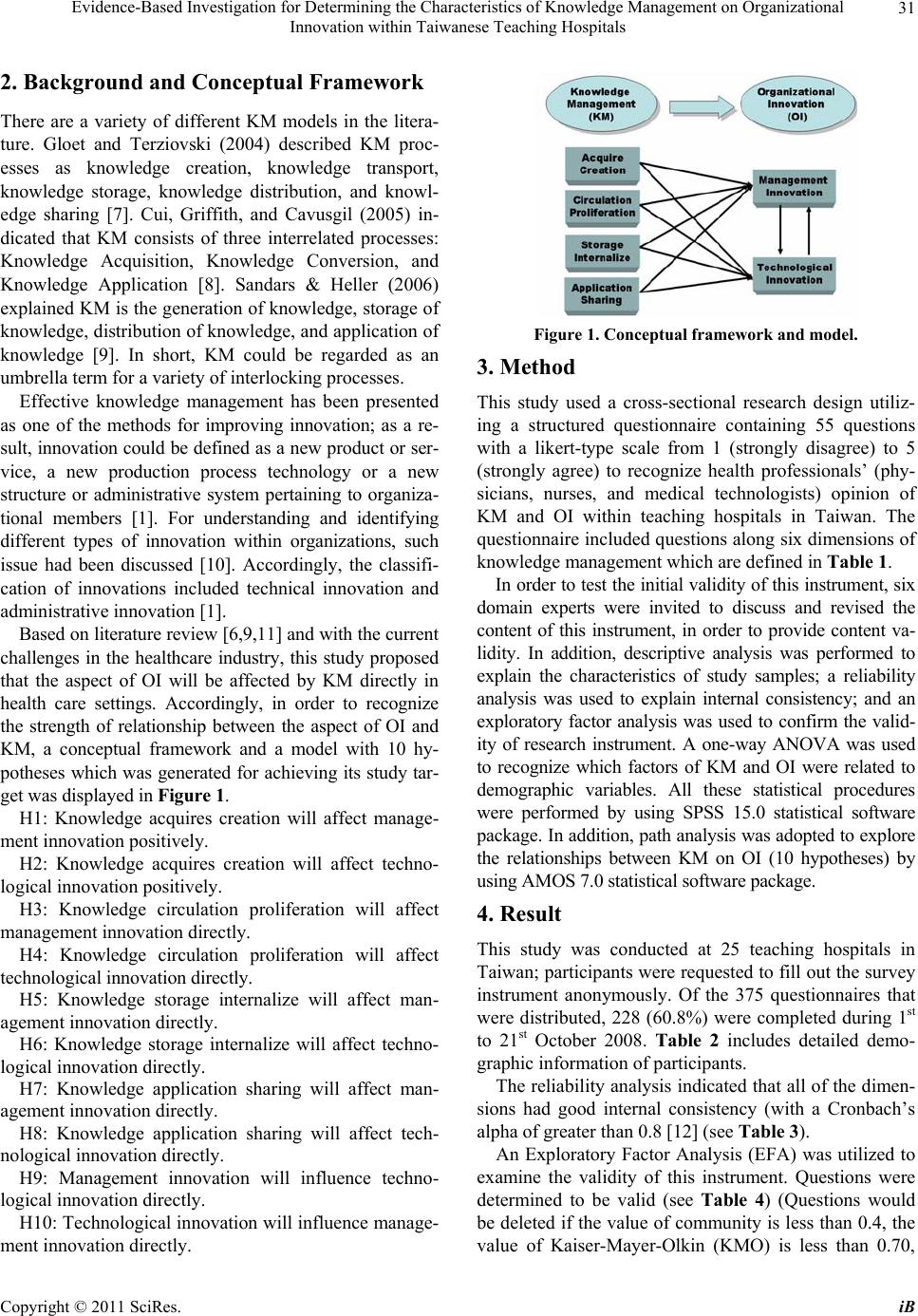 Evidence-Based Investigation for Determining the Characteristics of Knowledge Management on Organizational 31 Innovation within Taiwanese Teaching Hospitals 2. Background and Conceptual Framework There are a variety of different KM models in the litera- ture. Gloet and Terziovski (2004) described KM proc- esses as knowledge creation, knowledge transport, knowledge storage, knowledge distribution, and knowl- edge sharing [7]. Cui, Griffith, and Cavusgil (2005) in- dicated that KM consists of three interrelated processes: Knowledge Acquisition, Knowledge Conversion, and Knowledge Application [8]. Sandars & Heller (2006) explained KM is the generation of knowledge, storage of knowledge, distribution of knowledge, and application of knowledge [9]. In short, KM could be regarded as an umbrella term for a variety of interlocking processes. Effective knowledge management has been presented as one of the methods for improving innovation; as a re- sult, innovation could be defined as a new product or ser- vice, a new production process technology or a new structure or administrative system pertaining to organiza- tional members [1]. For understanding and identifying different types of innovation within organizations, such issue had been discussed [10]. Accordingly, the classifi- cation of innovations included technical innovation and administrative innovation [1]. Based on literature review [6,9,11] and with the current challenges in the healthcare industry, this study proposed that the aspect of OI will be affected by KM directly in health care settings. Accordingly, in order to recognize the strength of relationship between the aspect of OI and KM, a conceptual framework and a model with 10 hy- potheses which was generated for achieving its study tar- get was displayed in Figure 1. H1: Knowledge acquires creation will affect manage- ment innovation positively. H2: Knowledge acquires creation will affect techno- logical innovation positively. H3: Knowledge circulation proliferation will affect management innovation directly. H4: Knowledge circulation proliferation will affect technological innovation directly. H5: Knowledge storage internalize will affect man- agement innovation directly. H6: Knowledge storage internalize will affect techno- logical innovation directly. H7: Knowledge application sharing will affect man- agement innovation directly. H8: Knowledge application sharing will affect tech- nological innovation directly. H9: Management innovation will influence techno- logical innovation directly. H10: Technological innovation will influence manage- ment innovation directly. Figure 1. Conceptual framework and model. 3. Method This study used a cross-sectional research design utiliz- ing a structured questionnaire containing 55 questions with a likert-type scale from 1 (strongly disagree) to 5 (strongly agree) to recognize health professionals’ (phy- sicians, nurses, and medical technologists) opinion of KM and OI within teaching hospitals in Taiwan. The questionnaire included questions along six dimensions of knowledge management which are defined in Table 1. In order to test the initial validity of this instrument, six domain experts were invited to discuss and revised the content of this instrument, in order to provide content va- lidity. In addition, descriptive analysis was performed to explain the characteristics of study samples; a reliability analysis was used to explain internal consistency; and an exploratory factor analysis was used to confirm the valid- ity of research instrument. A one-way ANOVA was used to recognize which factors of KM and OI were related to demographic variables. All these statistical procedures were performed by using SPSS 15.0 statistical software package. In addition, path analysis was adopted to explore the relationships between KM on OI (10 hypotheses) by using AMOS 7.0 statistical software package. 4. Result This study was conducted at 25 teaching hospitals in Taiwan; participants were requested to fill out the survey instrument anonymously. Of the 375 questionnaires that were distributed, 228 (60.8%) were completed during 1st to 21st October 2008. Table 2 includes detailed demo- graphic information of participants. The reliability analysis indicated that all of the dimen- sions had good internal consistency (with a Cronbach’s alpha of greater than 0.8 [12] (see Table 3). An Exploratory Factor Analysis (EFA) was utilized to examine the validity of this instrument. Questions were determined to be valid (see Table 4) (Questions would be deleted if the value of community is less than 0.4, the value of Kaiser-Mayer-Olkin (KMO) is less than 0.70, Copyright © 2011 SciRes. iB  Evidence-Based Investigation for Determining the Characteristics of Knowledge Management on Organizational 32 Innovation within Taiwanese Teaching Hospitals Table 1. Operational definition of each dimension in this study. Aspect/ Dimen- sion Definition Questions Knowledge Man- agement KM as respondents’ perception of acquire creation, circulation proliferation, storage internalize and application sharing. Acquire Creation It is tacit knowledge that the expertise is generated by experience whilst immersed in daily practice. Circulation Proliferation It is defined that tacit knowledge distribution is aided by the transfer of experiences to new workers by mentoring and coaching schemes and to established staff by regular opportunities to share their knowl- edge. Storage Internalize It is defined that tacit knowledge is stored in the brains of health care workers but may be made partly accessible to others once it has been codified. Application Shar- ing It is defined that sharing both explicit and tacit knowledge between individuals and applied to decision making Management In- novation It involves organizational structure and administrative process; such innovation is indirectly related to the basic work activities of an organization and is more directly related to its management. Technical Innova- tion It pertains to products, services, and production process technology; they are related to basic work ac- tivities; could be concerned either product or process. Table 2. Characteristics of participants. Characteristic Sample Valid Percentage (%) Male 49 21.5 Gender Female 179 78.5 <30 58 25.4 31 ~ 40 106 46.5 41 ~ 50 56 24.6 Age >51 8 3.5 High school 3 1.3 Junior college 47 20.6 Bachelor 137 60.1 Education Post-graduate 41 18.0 Physicians 39 17.1 Nurses 136 59.6 Position Medical technologists 53 23.2 Table 3. Results of the reliability examination. Dimensions Cronbach’s Alpha value Corrected Item-Total Correlation Cronbach’s Alpha if item Deleted Questions Acquire Creation 0.87 0.52 ~ 0.71 0.84 ~ 0.86 7 Circulation Proliferation 0.90 0.60 ~ 0.75 0.87 ~ 0.88 7 Storage Internalize 0.86 0.61 ~ 0.70 0.82 ~ 0.84 5 Application Sharing 0.87 0.53 ~ 0.73 0.83 ~ 0.86 6 Management Innovation 0.94 0.67 ~ 0.81 0.92 ~ 0.94 12 Technological Innovation 0.93 0.64 ~ 0.74 0.91 ~ 0.92 13 Table 4. Results of the validity examination and one-way ANOVA analysis. Validity analy sis Dimensions Communities KMOBartlett’s test of Sphericit Factor Loading Variance Explained (%) Eigenvalues A 0.402 ~ 0.645 0.83 0.000 0.634 ~ 0.808 55.60 3.89 B 0.492 ~ 0.687 0.88 0.000 0.701 ~ 0.829 60.45 4.23 C 0.625 ~ 0.682 0.84 0.000 0.747 ~ 0.826 63.73 3.19 D 0.432 ~ 0.689 0.86 0.000 0.657 ~ 0.830 59.98 3.60 E 0.498 ~ 0.725 0.94 0.000 0.706 ~ 0.852 61.33 7.36 F 0.467 ~ 0.624 0.89 0.000 0.683 ~ 0.790 53.53 6.96 One-way ANOVA Gender Education Position Dimensions F valus S ig F valus Sig F valus Sig A 0.02 0.88 1.29 0.28 1.57 0.21 B 0.02 0.88 1.06 0.37 1.54 0.22 C 0.05 0.83 1.36 0.26 1.14 0.32 D 0.00 0.95 1.25 0.29 1,78 0.17 E 0.21 0.65 0.68 0.57 0.40 0.67 F 0.02 0.88 0.41 0.75 1.07 0.35 A: Acquire Creation; B: Circulation Proliferation ; C: Storage Internalize ; D: Application Sharing ; E: Management Innovation ; F: Technological Innovation ; *Sig. at 0.05 level Copyright © 2011 SciRes. iB  Evidence-Based Investigation for Determining the Characteristics of Knowledge Management on Organizational 33 Innovation within Taiwanese Teaching Hospitals and the value of Bartlett's Test is greater than 0.05) [13-16]. Results of the one-way ANOVA (Table 4) in- dicated that all dimensions of KM and OI were not sig- nificantly associated with demographic variables (gender, education, and position). In this study, model fit of path analysis was evaluated by examining the chi-square statistic, the chi-square to degrees of freedom ratio, the comparative fit index (CFI) [16]. Goodness of Fit (GFI), Adjusted Goodness of Fit (AGFI) [17]. And the root-mean-square-error of ap- proximation (RMSEA) [18]. Detailed examination of each hypothesis (see Table 5) indicates a significant positive association between circulation proliferation and management innovation – then list the other significant relationships (see Figure 2) 5. Discussion Reliability and validity analysis indicated that the devel- oped instrument was an appropriate tool that can be util- ized for conducting studies of Taiwanese health profes- sionals to determine the relationship between KM and OI [1-19]. This study also indicated that Management Inno- vation is significantly associated with Circulation Prolif- eration and Application Sharing. Technical Innovation is significantly associated with Circulation Proliferation, Application Sharing and the overall concept of manage- ment innovation. These results will be useful for health care administration as they explore knowledge and deci- sion-making models for keeping up with the rapidly change of global healthcare system in the 21th century. The path analysis relationships results indicate that Management Innovation is a moderator variable between Circulation Proliferation, Application Sharing, and Technological Innovation. Management Innovation is indirectly related to the basic work actives of an or- Figure 2. Results of research hypotheses. ganization while technological innovation is directly re- lated to basic work activities. This finding is similar to Damanpour’s study that demonstrated a “dual-core model” of organizational innovation; high professional- ism, low formalization, and low centralization facilitate technical innovations [10]. In short, results of this indi- rect relationship relates to a real-world situations within Taiwanese hospitals because all activities within hospi- tals are controlled by organizational structure and ad- ministrative process. These results are similar to Su’s finding indicating that a hospital’s net benefits will be affected by its organizational behaviors in Taiwan [22]. 6. Conclusions and Suggestion Based on the results of reliability and validity examina- tion, this study provided an appropriate instrument to explore the causal relationships between KM and OI within Taiwanese hospitals for further study in healthcare industry. Moreover, the present study demonstrated that KM was a factor which will affect OI directly based on Table 5. The results of hypotheses examination. Hypotheses Standardized regression coefficient Critical Ratio (C. R.) H1 -- -- H2 -- -- H3 0.407** 5.104 H4 0.202** 3.465 H5 -- -- H6 -- -- H7 0.360** 4.516 H8 0.298** 5.518 H9 0.469** 10.184 H10 -- -- R2 for Management Innovation was 0.537; R2 for Technical Innovation was 0.777 -- Rejected in revised model; ** Statistically significant (p< α=0.01) Copyright © 2011 SciRes. iB  Evidence-Based Investigation for Determining the Characteristics of Knowledge Management on Organizational 34 Innovation within Taiwanese Teaching Hospitals healthcare professionals’ perspective in hospitals. The findings of this study have implications for healthcare administrators as they integrate knowledge management and organizational models that will develop learning or- ganizations which reinforce sharing and application of knowledge throughout the hospitals. Further research could identify whether this instrument could be used in different hospital levels or hospitals with different ownerships in Taiwan. In addition, further research could include qualitative studies to determine how hospitals are integrating knowledge management models and what successes and barriers they are experi- encing. 7. Acknowledgements We thank all participants who cooperated and helped us to fill out the research instrument in the sample hospitals. REFERENCES [1] S. H. Liao and C. C. Wu, “System Perspective of Knowl- edge Management, Organizational Learning, and Organ- izational Innovation,” Expert Systems with Applications, Vol. 37, 2010, pp. 1096-1103. doi:10.1016/j.eswa.2009.06.109 [2] C. W. Choo, “Bulletin of the World Health Organiza- tion,” Hershey, Idea Group Publishing, Pennsylvania, 2005. [3] T. T. H. Wan, “Evidence-Based Health Care Management: Multivariate Modeling Approaches,” Kluwer Academic Publishers, Boston, 2002. [4] T. T. H. Wan, “Healthcare Informatics Research: From Data to Evidence-Based Management,” Journal of Medi- cal Systems, Vol. 30, 2006, pp. 3-7. doi:10.1007/s10916-006-7397-9 [5] K. J. Anne Marie, “Evidence Based Management. A Prac- tical Guide for Health Professionals,” European Journal of Orthodontics, Vol. 24, 2002, p. 526. doi:10.1093/ejo/24.5.526 [6] J. Darroch, “Knowledge Management, Innovation, and Firm Performance,” Journal of Knowledge Management, Vol. 9, No. 3, 2005, pp.101-115. doi:10.1108/13673270510602809 [7] M. Gloet, and M. Terziovski, “Exploring the Relationship between Knowledge Management Practices and Innova- tion Performance,” Journal of Manufacturing Technology Management, Vol. 15, No. 5, 2004, pp.402-409. doi:10.1108/17410380410540390 [8] A. S. Cui, D. A. Griffith and S. T. Cavusgil, “The Influ- ence of Competitive Intensity and Market Dynamism on Knowledge Management Capabilities of MNC Subsidi- aries,” Journal of International Marketing, Vol. 13, No. 3, 2005, pp. 32-53. doi:10.1509/jimk.13.3.32 [9] J. Sandars and R. Heller, “Improving the Implementation of Evidence-Based Practice: A Knowledge Management Perspective,” Journal of Evaluation in Clinical Practice, Vol. 12, No. 3, 2006, pp. 341-346. doi:10.1111/j.1365-2753.2006.00534.x [10] F. Damanpour, “Organizational Innovation: A Meta- Analysis of Effects of Determinants and Moderators,” Academy of Management Journal, Vol. 34, No. 3, pp. 555-590. doi:10.2307/256406 [11] R. E. McDonald and N. Srinivasan, “Technological In- novations in Hospitals: What Kind of Competitive Ad- vantage Does Adoption Lead to?” International Journal of Technology Management, Vol. 28, No. 1, 2004, pp. 103-117. doi:10.1504/IJTM.2004.005055 [12] B. M. Byrne, “A Primer of Lisrel: Basic Applications and Programming for Confirmatory Factor Analytic Models,” Springer, New York, 1989. [13] N. Davis, “SPSS explained,” P. R. Hinton, Ed., Routledge, Saunders, London, 2004. [14] S. Marathe, T. Wan, J. Zhang and K. Sherin, “Factors Influencing Community Health Centers’ Efficiency: A Latent Growth Curve Modeling Approach,” Journal of Medical Systems, Vol. 31, 2007, pp. 365-374. doi:10.1007/s10916-007-9078-8 [15] B. Sahin, F. Yilmaz and K. H. Lee, “Factors Affecting Inpatient Satisfaction: Structural Equation Modeling.” Journal of Medical Systems, Vol. 31, 2007, pp. 9-16. doi:10.1007/s10916-006-9038-8 [16] P. M. Bentler, “Comparative Fit Indexes in Structural Models,” Psychological Bulletin, Vol. 107, 1990, pp. 238-246. doi:10.1037/0033-2909.107.2.238 [17] L. R. Tucker and C. Lewis, “A Reliability Coefficient for Maximum Likelihood Factor Analysis,” Psychometrika, Vol. 38, 1973, pp. 1-10. doi:10.1007/BF02291170 [18] M. W. Browne and R. Cudeck, “Alternative Ways of As- sessing Model Fit,” In: K. A. Bollen and J. S. Long, Eds., Testing Structural Equation Models, Newbury Park, Sage, 1993, pp. 136-162. [19] B. M. Byrne, “A Primer of Lisrel: Basic Applications and Programming for Confirmatory Factor Analytic Models,” Springer, New York, 1989. [20] L. T. Hu and P. M. Bentler, “Cutoff Criteria for Fit In- dexes in Covariance Structure Analysis: Conventional Cri- teria versus New Alternatives,” Structural Equation Mod- eling, Vol. 6, 1999, pp. 1-55. doi:10.1080/10705519909540118 [21] J. F. J. Hair, R. E. Anderson and W. C. Black, “Multi- variate Data Analysis,” 5th Ed., Upper Saddle River, Prentice-Hall International, New Jersey, 1998. [22] Y. Y. Su, K. T. Win and H. C. Chiu, “Measuring ‘End-Users’ Opinions for Establishing a User-Centred Electronic Health Record (EHR) System from the Per- spective Of Nurses,” Journal of Theoretical and Applied Electronic Commerce Research, Vol. 4, 2009, pp. 55-63. Copyright © 2011 SciRes. iB |