

Paper Menu >>
Journal Menu >>
 Archaeological Discovery 2014. Vol.2, No.1, 6-12 Published Online January 2014 in SciRes (http://www.scirp.org/journal/ad) http://dx.doi.org/10.4236/ad.2014.21002 The Ethnic Composition of Bohai State on the Archaeological Materials Olga V. Dyakova Institute of History, Archaeology and Ethnography of the Peoples of the Far East, Far Eastern Branch of the Russian Academy of Sciences, Vladivostok, Russia Email: [email protected] Received October 28th, 2013; revised December 8th, 2013; accepted December 19th, 2013 Copyright © 2014 Olga V. Dyakova. This is an open access article distributed under the Creative Commons At- tribution License, which permits unrestricted use, distribution, and reproduction in any medium, provided the original work is properly cited. In accordance of the Creative Commons Attribution License all Copyrights © 2014 are reserved for SCIRP and the owner of the intellectual property Olga V. Dyakova. All Copyright © 2014 are guarded by law and by SCIRP as a guardian. Setting the Problem: Pohai State (698-926), being situated on the territory of the Russian Primorye, North East of the Democratic People’s Republic of Korea and North East of China, was created by Tun- gus-Manchus tribes Sumo Mokhe. Pohai was a poly-ethnic (multinational) state. T r ib es Mokhe were the basic population of it. Besides, there lived Koguryo, Paleo-Asian and Chinese residents. Each ethnic community had its own social status that could be determined by archaeological material. For deciding such a task the author worked out methods for determining the structure of archaeological culture. In the Russian archaeology the term “archaeological culture” means a complex of archaeological sites situated on one and the same territory and possessed common indications of material culture (ceramics, artifacts out of metal, necropolis, dwellings, etc.). Structure of Mediaeval Archaeological Cultures: The author proposes to single out three layers in material culture: aboriginal layer contains the information about ethnic belonging; state layer characterizes handcraft production and gives a possibility to determine the state borders; epoch layer gives a poss ibility to date sites and single out military-trade-economic ties. The aboriginal layer is represented with artifacts being made by residents themselves. They are molded ce- ramics, traditional decorations, the specificity of dwelling construction, funeral rites, etc. The state layer is represented with handicraft artifacts, mainly, made by alien masters and with technology different from the aboriginal one. For example, ceramics being produced on the potter’s wheel; types of fortifications that were built by special (foreign) masters invited for it, and etc. The epochal-making layer is repre- sented with artifacts that were spread on the ver y vas t territory, for example, girdles (belts) of Turk type, ceramics of Tan dynasty, armament, etc. Three Tasks of th e Investigation: According to such methodic principles there were set three tasks: on the archaeological material to single out the ethnic (aboriginal) structure of Pohai state; to determine state signs; to define social status Koguryo residents in Pohai. Anal- ysis of the Material: Ceramics. The analysis of molded ceramics exposes that on Pohai sites there was present only Mokhe type of the vessels. There is no molded Koguryo ceramics there. The analysis of ce- ramics, being finished off on potter’s wheel, exposes handicraft traditions and the presence of kilns, i.e. potter’s wheel ceramics of Koguryo type were produced there. The analysis of potter’s grey-clay ceramics exposes handicraft traditions of Tan dynasty but the absence of centers of its production. It is indicative of trade relations. Fortifications: The appearance of stone mountain sites in Pohai is connected with fortifi- cation traditions. The appearance of valley (plain) square sites is connected with Chinese fortification tra- ditions. Conclusions: So, the basic (aboriginal) population of Pohai was Tungus-Manchus tribes Mokhe. Koguryo residents in Pohai were used as potters—handicrafts men and fortification masters and, may be, warriors. The geography of stone fortresses shows up that they were constructed for defending marine and land roads. Keywords: Mediaeval Archaeological Culture; Koguryo Residents; Pohai State Introduction It is known from written sources that as for structure of pop- ulation the Tungus-Manchu state Pohai (698-926) was poly ethnic (multinational) one and consisted of tribes: Mokhe (Malgal), Paleo-Asiatics, Chinese, Koguryo residents. The so- cial status of t hes e tribes and ethnic communities in Pohai state has not been determined yet. It is known that a considerable number of Koguryo residents came to Pohai after the fall of Koguryo state. Moreover, scientific debates are continued con- cerning to ethni c belonging of the first Van of Pohai state— whether he was of Mokhe origin or belonged to Koguryo tribe. But in this report I intend not to analyze the ethnic origin of the first Van of Pohai but to determine the role, significance and social status of Kogurye residents in Pohai state. Written sources are quite scanty and give no opportunity to solve this problem objectively. In fact only archaeological artifacts are OPEN ACCESS 6  O. V. DYAKOVA preserved. And I intend to use them. Structuring Mediaeval Archaeolodgical Culture There have been three sources of information about the me- diaeval Far East: 1) written evidence dealing with affairs of state, political boundaries, and the economies of the states of Bohai and Jurzhen; 2) the remains of fortified sites, roads and craft centers; and 3) handicraft products such as wheel-made pottery or metallic articles found in profusion, along with many other objects during excavations at the urban and burial sites of the Bohai and Jurzhen cultures. Most scholars are still quite content with the existing interpretations of this information, even though many are merely romantic exaggerations, among which, un- fortunately, must be counted some descriptions of the cultures of these particular societies. It is our contention, however, that these interpretations display instead the apparent failure of an approach to the s t udy of mediaeval archaeological cultures restricted to the considering of only one aspect, namely, the urban cultural sphere, whose characteristics are very much alike throughout various cultures due to the effects of industrial de- velopment, yet whose origins are not necessarily nat i ve . It is hardly questionable that governments, not excluding medieval ones, often promoted crafts with the help of foreign craftsmen brought in for just such a purpose. As a result, new types of wheel-made clay ware, as well as other goods, came into being. They had neither intrinsical links to the culture and traditions of the local populace nor any domestic prototypes. Therefore, we conclude that within the existing approach to a survey of me- diaeval sites in the Russian Far East, the genuine aboriginal culture ha s literally fallen out of the sphere of mos t researchers’ attention. Attempts have been made to solve bas ic problems of ethnical and cultural processes in their full complexity1 while drawing on rather irrelevant materials. This situation has prompted us to work out a structural scheme of mediaeval arc- haeological culture to make it clear how a given group of traits relates to a broad analysis of a given culture. An analysis of t he entire body of mediaeval data brought from each of t he Far Eastern sites allowed us to speak of the three major subdivisions within an archaeological culture. They may be defined as 1) culturally indicative (aboriginal), 2) regional (th ose characteris- tic of a particular state), and 3) epochal. As culturally indicative we define those traits represented by items embodying abori- ginal traditions, and thus suitable for reconstructing not solely the processes of cultural development (culturogenics), but eth- nical dy namic s as well (ethnogenics). Among such items the foremost importance belongs to handmade clay ware produced by t he cultural tradition bearers of a given culture themselves. It can serve as a clear-cut recognition symbol of a culture. Hand- made ware could not spread outside a limited area and as a rule, this area coincided precisely with that of the archaeological culture. To regional traits (those characteristic of a state) we attribute objects produced, to a greater or lesser degree, with the use of industrial methods of manufacture, including, of course, wheel-made ceramics. Their distribution was related with the activi ty of craft centers (workshops, “schools”, “families”, “kilns”), whose influence seldom reached beyond the official state boundaries. Therefore, traits of this type can be indicative of a particular state. Items of this category may reflect both domestic and adopted foreign traditions. This may lay the groundwork for reconstructing patterns of political and merce- nary contacts but is of little use when it comes to understanding the ways of ethnical changes (ethnogenecs). Shapes and deco- rations of vessels and other objects within this category could change easily, subject to vogues of the time, a ruler’s tastes, or requirements imposed by a certain social straum, whereas tech- nique and technological traditions were usually prone to sta bi l- ity. Classified as epochal need to be those cultural elements which prove more or less ubiquitous, regardless of geographical or political barriers, and, as characteristic traits, belong to no particular society but to a definite time span. Such would be Turkic belts, Mongol arrowheads, selected types of wheel-made pottery, or certain designs of ornamentation, to mention just a few. They are good for dating complexes and cultures, or at- testing to martial, economic or religious events and interactions, but are in no way suitable for building reconstructions of the patterns of ethnical changes. To sum up, we believe that any mediaeval archaeological culture has to be analyzed as a triplex structure that comprises three groups of traits: aboriginal, regional (those relating to a state) and epochal. Thi s approach makes not only answering questions about cultural roots, changes and chronology possible, but also lets us advance to more adequate historical associations and realistic interpretations, n ot in the least those helping to solve the problem of the genesis and development of particular states in this area. Task One To answer the question: what ethnic communities were the native (indigenous) population of Pohai state? Ceramics is the most objective material in this case. Vessels out ceramics, that were discovered in archaeological sites of Pohai culture in the North-East of China and on the territory of the Russian Pri- morye are the basic material (Figure 1). My analysis of ceram- ics revealed that as for techniq ue it is represented by thre e cat- egories of articles: modeled vessels, ceramics, being completed on potter’s wheel and potter’s ceramics. All these three catego- ries a re done w ith different technique, th at is on different ethnic traditions. The first category-modeled ceramics made with cir- cular band model (Figure 2). Its forms are vases, pots, jars with modeled cylinder under the top, decoration and technique of modeling are traditional for Mokhe tribes (Malgal). Modeled earthenware was made by native indigenous population. Such type of vessels—Mokhe one—was developing on the territ ory of North East China and the Russian Far East (Priamurye and Primorye) for more than one thousand years. Such earthenware is characteristic for Mokhe culture (Malgal), culture of the Amur Jurchen and it could be met almost on all Pohai sites. In Koguryo state the other modeled earthenware was traditional, and it is absent on Pohai sites. So, the main indigenous residents of Pohai state were the tribes of Mokhe (Malgal), that is the Tungus-Man- chus. Task Two To determine Kogurye materials on Pohai sites. In this case we could use the second category of ceramics—handicraft p ot s of definite form, decoration and proportions, modeled on pot- ter’s wheel. They are met on all Pohai sites and are analogous to Kogurye handicraft pots (Figure 3). Such type of earthenware is marking Pohai cultures and is defined as Pohai ceramics of Koguryo origin. Besides of Pohai 1 “Ethnogenesis” or ethnogenics, and “culturogenesis” or culturogenics, re - spectively, as Russian terminology puts it. OPEN ACCESS 7 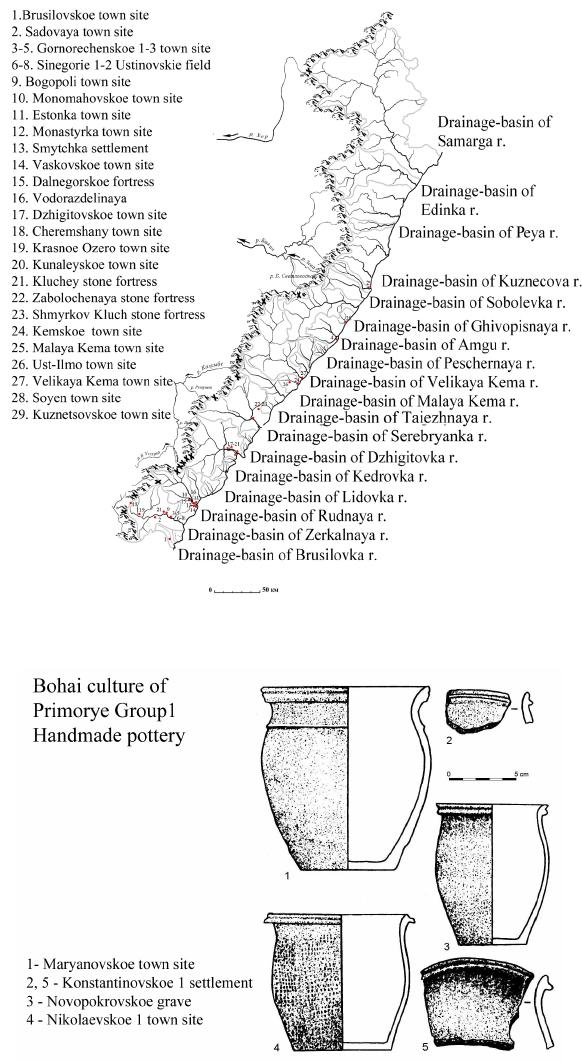 O. V. DYAKOVA Figure 1. The map of Pohai sites of the North East Primorye. Figure 2. Bohai culture of P rimorye Group 1. Handmade pottery; Novogordeevskoye town site, Konstantinovskoye village, Kraskinskoye town site, Petrovskoye village. pots, in Pohai culture of sites of North East Primorye—Sine- gorye 1—ther e appeared long potter’s kilns being traditional for Kogurye. That is, the appearance on Pohai sites handicraft Ko- guryo earthenware is not a result of trade-economic relations when earthenware would be bring over from anywhere. The presence of potter’s kilns—is an index of native production and indirect presence on Pohai monuments of Kogurye potters. Judge by a number of potter’s articles, the r e we re quite a num- ber of Koguryo potters in Pohai and such was the situation not only in central provinces but on the outskirts of stat e. For ex- ample, it was so in the north-east of Primorye where the re were discovered kilns of Koguryo type and the very ceramics itself. So the conclusion is that in Pohai state Koguryo residents re- presented the strata of crafts-men. OPEN ACCESS 8 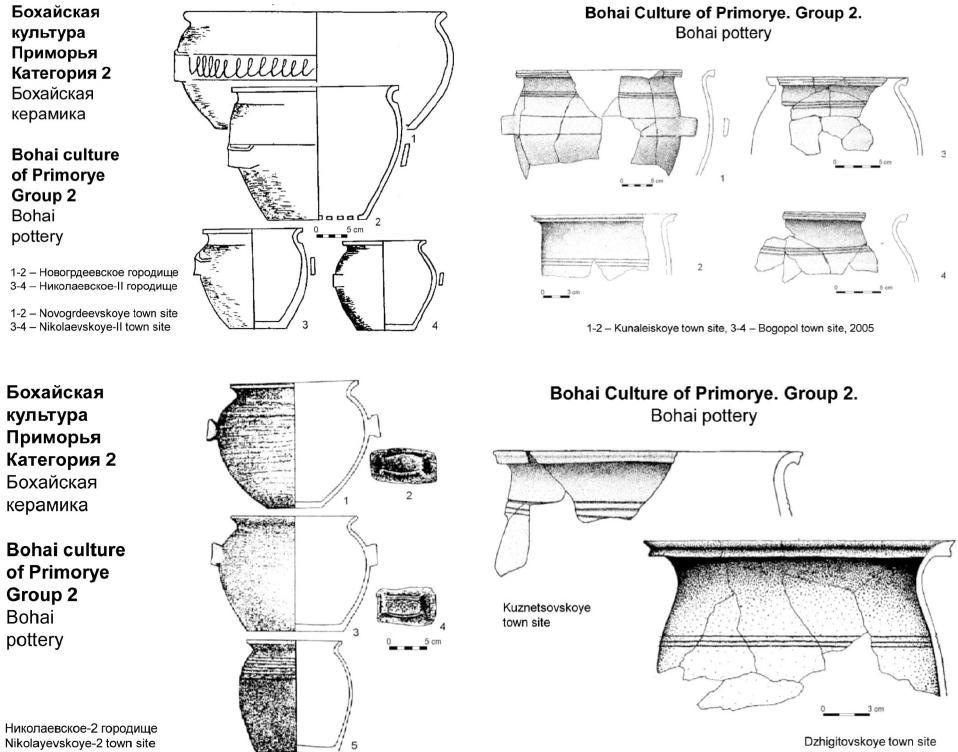 O. V. DYAKOVA (a) (b) (c) (d) Figure 3. Bohai culture of Primorye. Group 2. Bohai pottery; Novogrdeevskoye town site, Nikolaevskoye-II town site, Kunaleiskoye tow n site, Bogopol town site, Kuznetsovskoye town site, Dzhigitovskoye town site Sinegorye dwelling site Nikolayevskoye-2 town site. Task Three To show: what function, besides handicraft one, was exer- cised by Koguryo residents? This task could be seen through analyzing fortification constructions. After the fall of Koguryo state on the territory of Primorye, in particular in the north-east, there appeared stone fortresses that were constructed according to Koguryo traditions. They wer e built out of stones (rocky) and without cement linking. Stones had g ot special trim, and walls became solid. Stone fortresses on isolated hills are located on the tops of separately standing hills, often rock outcrops, and are built of stones without cementing. Positioned so as to do- minate local landscapes, such fortifications permit a good view of neighboring valleys and obviously must ha ve served strateg- ic purposes. Today we know of ten stonework fortresses in Primorye, six of the m are located in central Sikhote-Al in mountain range and on East Sea’s (Sea of J a pa n’ s ) eastern and northeastern coasts: Shmyrkov Klutch, Zabolotnoye (Altar) in Serebryanka rive r basin, Klutchi (Dzhigitovka river basin), Vaskovskoye (Rudnaya river basi n ), Seselevskoye (Zhivopis- naya river basin), Yashu. Pla nigraphy of stone fortre sse s is simple. The builders chose flattened areas and adjacent sur- faces available on suitable hills. Fortifications consist of round or serpentine stonework walls encircling a hill. Constructing technologies are interesting for the presence of persistent tech- nical patterns and ultimate skill. Building s t o ne was usually procured on the locality. Durability of walls highly depended on methods of stone processing. Prior to raising of wall, build- ers would flatten an underlying surface. The width of a stripe to be flattened was up to 2 - 6 m. It was to be covered with a layer of big stones, specially processed—each piece of stone had a raised border on its edge so that an overlying stone would not slip. Stones in the upper layers are pyramidal in shape. The higher the laye r, the smaller the stones. It seems that the size of stones was standardized for each layer. T he shape of the stones has some notable particularities—each stone was rectangular in the base, had rounded corners in the middle, and was tapered at the top. T he lowest part of the wall on the inside was stair- case-shaped (Figures 4 and 5). To sum up, the stone-built mountain fortresses can be cha- racterized by the following features: placement in strategically important localities atop dominating heights; the use of OPEN ACCESS 9 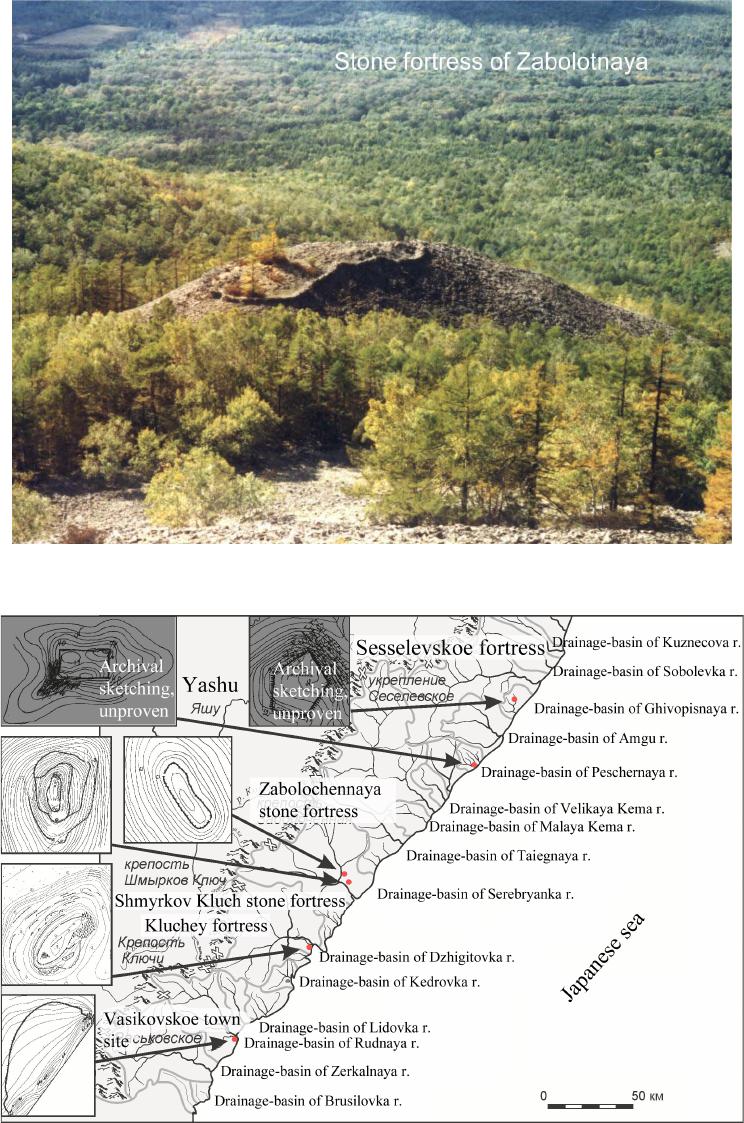 O. V. DYAKOVA Figure 4. Stone fortress of the North East Primorye; Zabolotnaya. Figure 5. The map of the Stone Fortresses of Northeastern Primorye. local building material; lack of cementing; standardized stone shapes and sizes of certain wall parts; staircase-shaped inner wall configuration; absence of continuous vertical seams; ar- tificial flattening of hill surface before construction. According to collected data, stonework fortresses were built during the Mohe and Bohai times. This method was widely used only by Koguryo representa- tives. The Mokhe residents never built such fortresses. These fortresses were situated on separate hills, usually on bare terri- tory, on dominating hills giving opportunity to control all en- OPEN ACCESS 10 O. V. DYAKOVA trances to the valleys. There are ten such fortresses: in Yashu, Zabolotnaya, Shmyrkov Kliuch, Vas’kovskoye site, Kliuchi, Soenskon site. So, a definite part of Koguryo residents was on military service, and judging to location of s t one fortresses, Pohai used them for defending his boundaries, in particular, of North East Primorye. By choice of location, constructing methods, a nd purposes, stone fortresses of Primorye derive from fortification traditions of Koguryo fortresses, often bei ng virtually identical with those. Perhaps this tradition of arranging a fortified site was adopted by t he Mohe and Bohai not before 7th century AD, i.e. after the downfall of Koguryo state and Koguryo people having become the Bohai citizens. The Koguryo traditions in medialval town-planning in Pri- morye. The construction technology used in northeastern Pri- morye to erect stone fortresses (Shmyrkov Klu tc h, Zabolotnaya, Klutchi, Vaskovskoe Ozero) obviously reproduces the Koguryo technology and actually derives from the latter. With Koguryo bulders, just the same way as with the Jurzhen from East Xia State, the main criteria of choosing a building location were precipitous mountainous landscape and presence of lar ge ri ve r. Of 176 Koguryo town sites found in northeastern China and North Korea only 56 have been researched. Among them th e re are 47 stonework fortresses and only 9 earthen ones (Sokson, Ensonja, Thapsan, Koi, Puksansondja, Rendam, Sariho, Mokki, Hongenno in Manchuria and Anhak in North Korea). The au- thor have already published her stu dy of links between me- diaeval stone fortresses of Russian Primorye and Koguryo, thus no point in elaborating on this here. We must remember though that construction technology used in northeastern Primorye to build sto ne fort re sse s (Shmyrkov Klutch, Zabolotnaya, Klutchi, Vaskovskoe Ozero) obviously reproduces the Koguryo tech- nology and actually derives from the latter (Dyakova, 2005). All the more so because ceramic materials from the above men- tioned Primorye’s fortresses are comparable with the Mohe and Bohai traditions, contemporaneous with the Koguryo culture. It is known that military and technical innovations spread fast enough. Koguryo’s fortified earthen mountain towns, as op- posed to stone fortresses, are scarcely explored for various rea- sons. For a l o ng time Korean, Chinese, and Russian scholars worked separately in their own countries. Today we have got an opportunity to analyze and compare the results relevant to the problem of genesis and development of mediaeval fortifications in the Far East. Geophysical parameters of Russian Primorye, northeastern Korea and northeastern China are similar enough, and this fact should have in similar way influenced the process of choosing a location by inhabitants of these territories when it came to building a fortified site. The choi ce woul d be dictated by landscape. The Koguryo pe op l e as well as the Jurzhen from East Xia preferred a s teep mountainous topography and pres- ence of large river. Korean written sources state that, as a rule, the Koguryo placed their mountain towns on hillto ps facing the lowlands. “… Outside the fortresses they raised earthen bul- warks to prev e nt the use of ladders and v isibility of actions inside the fortress… Even if enemies fiercely attacked, their hike from the ba se of the hill to the fortress exhausted them, they breathed interruptedly, their ardor died away, while our soldiers remained calm, inspired and ready to fight against in- truders by letting big boulders roll down t he hill—enemies fell right on the run” (Un, 2005). Kim Gi Un wrote that the Ko- guryo mountain towns were always found in the presence of water source. Water not only provided means of transportation, but served as a natural border helping to control an enemy’s movement and limiting the latter’s maneuverability (Nosov, 2001). To build mountain towns, the Koguryo chose places near the valleys inhabited by people who could supply human force as well as food, yet find shelter in the fortress in danger- ous situations. Such pattern is comparable to the Jurzhen of East Xia’s. An unconditional rule for the Koguryo to choose a place to build a town was the presence of convenient means of transportation, i.e. waterways and roads, permitting both ma- neuverability and communicability with neighboring fortresses. The Jurzhen obeyed the same rul e , as we noted before. All of the Koguryo’s mountain towns were crossed by rivers or streams, otherwise had ponds and wells. For example, accord- ing to ancient scripts, the Koguryo town of Taeson had 99 ponds plus a brook. The East Xia’s Jurzhen provided t he m- selves with water the similar way. To ensure the combatant value of their towns the Koguryo paid ultimate attention to reinforcement of fortress walls, the basic fortification element. Like the Jurzhen, the Koguryo builders erected watch posts and towers over gates. Near a gat e the fortress’ wall was usually duplex, while in front of the gate there was a protective wall with embrasures at sides, known as “chokte”. Watch posts, as a rule, helped to strengthen wall corners and served as command posts. Similar constructions are typical for mountain towns of Jurzhen too. With Koguryo fortresses, an important defensive role played embrasures placed so as to permit shooting at an enemy directly or from sides. Before the invention of embra- sure it was impossible to shoot at the troops which had made their way right under the walls. Korean scholars believe em- brasures to be a Koguryo’s invention while protective walls, gates in the wall without tower, defensive lin es, and double walls to be distinctive features of Koguryo mountain fortresses. Having analy zed Primorye’s mountain towns belonging to the Jurzhen of East Xia and Koguryo’s mountain fortifications, we come to the conclusion that the influence of Koguryo’s fortifi- cations on the development of Jurzhen type of mountain towns was an immense one. To say the least, the Jurzhen people did adopt Koguryo’s principles of placement of fortresses in mountainous landscape. Those principles include the following: protection by hills on three sides, while on one side, usually southern, the presence of water-containing ravine; methods of obtaining and keeping fresh water; distribution of fortification n elements (on the wall, at gates, by corners). At the same time Jurzhen’s mountain towns retained some Chinese fortification traditions, Hantu earthen wall-mounds in the first place. It is known that from the ancient times Chinese tow ns were sur- rounded with earthen walls where the filling soil was put in layers, each layer being rammed by special wooden rollers. As a re su lt, the walls became ve ry firm and reached eight meters in height. This method ha ve been known in China since 4th cen- tury BC, and since 6th century BC the Chinese ha ve used stone lining of curtain-walls and built the towers. Apparently the Koguryo adopted the method of erecting earthen walls from the Chainese as early as in antiquity, but further adapted it to mountainous environment. On the other hand, by geomorphol- ogy as well as fortification and constructing technologies the stonework mountain fortresses built by the Mohe and Bohai peoples correspond well with Koguryo traditions and appear to be derived from the latter. Thus we are to co nc l ud e that in Pri- morye the two types of mountain fortified sites built by me- diaeval Tungus-Manchurians—the Mohe, Bohai, and Jurzhen OPEN ACCESS 11 O. V. DYAKOVA peoples—obviously meet the requirements typical of Ko- guryo’s town-building traditions, having been, as it seems, founded on the latter. Conclusion Thus, the an a l ysis of archaeological material let such conclu- sions be made: the indigenous residents of Pohai state were tribes of Mokhe (Malgal). After the fall of Koguryo a consi- derable number of Koguryo residents joined Pohai state. It was so significant tha t Koguryo earthenware became the princ ipal indicator. Therefore, a certain part of Koguryo residents got the status of crafts-men, in particular, potters. The presence of stone fortresses, being built according to Koguryo building traditions, shows that in Pohai there were a considerable num- ber of Koguryo fighting men and fortification builders (masters) building st o ne fortresses and defending borders. Undoubtedly, some part of Koguryo residents bore a rela tion to administrative sys t em of Pohai, but it is difficult to trace it according to arc- haeological data. Evidently, Koguryo peasants inculcated agri- cultural practice to Tungus Manchus population of Pohai, b ut there are fe w archaeological facts on it yet. Acknowledgements The work is done under financing of grant by RGNF No. 12-31-09008. REFERENCES Dyakova, O. V. (2005). Gorodischa i kreposti Dalnego Vostoka (seve- rovostochnoye primorye). (Ancient Town Sites and Fortresses of Far East. (Northeastern Primorye)). Vladivostok, 171. Nosov, K. S. (2001). Zamki i kreposti Indii, Kitaya i Japonii (Castles and Fortresses of China and Japan). Rejttarj, Moscow, 27. Un, K. G. (2005). Research of Particulariries of Koguryo Mountain Towns (pp. 138-152). Separately printed copy. Similar characteriza- tion of Koguryo towns was offered by Prof. Na m Il Ren, University Kim Il Sung, at Second International Conference on Korean Studies. OPEN ACCESS 12 |