

Paper Menu >>
Journal Menu >>
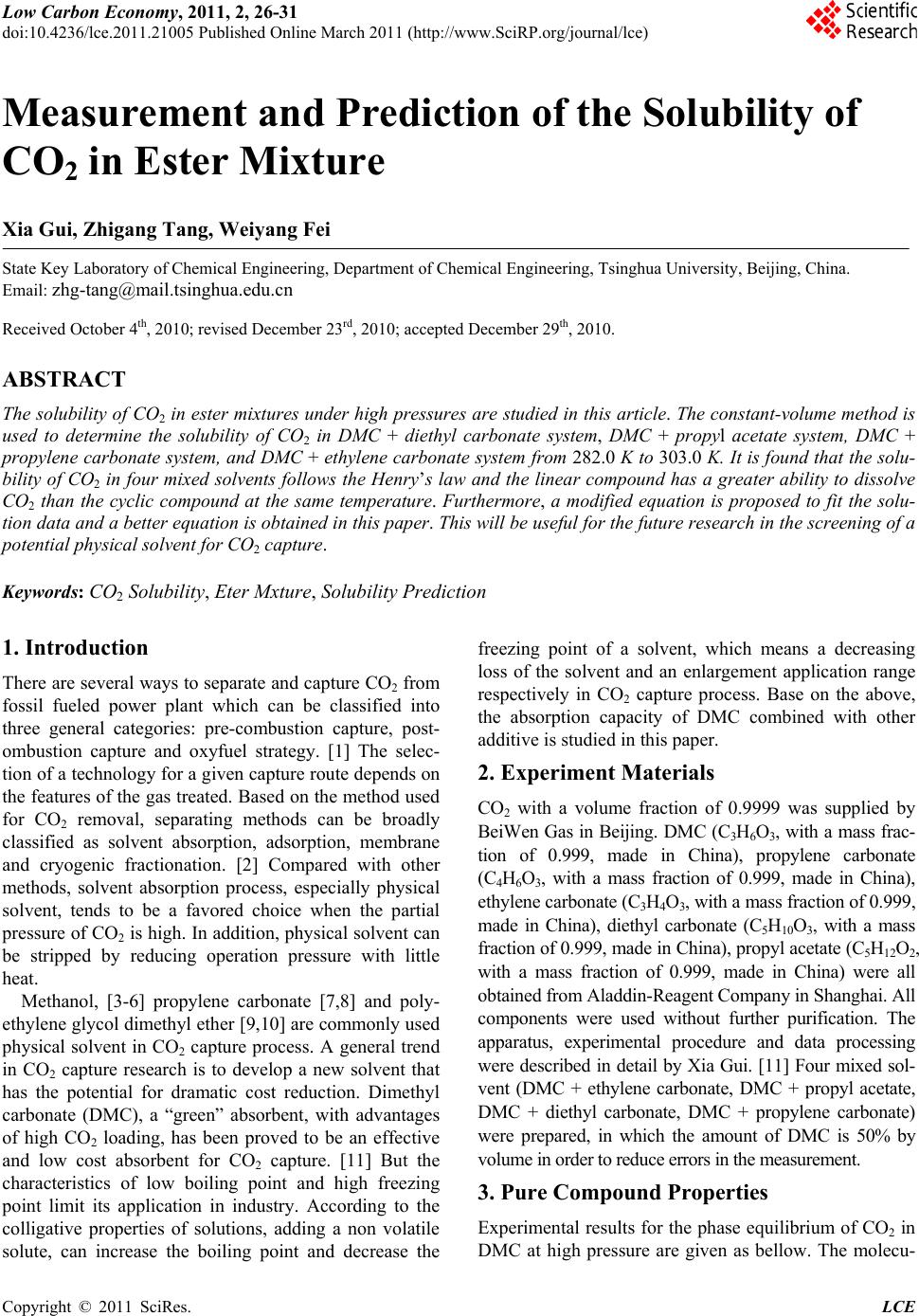 Low Carbon Economy, 2011, 2, 26-31 doi:10.4236/lce.2011.21005 Published Online March 2011 (http://www.SciRP.org/journal/lce) Copyright © 2011 SciRes. LCE Measurement and Prediction of the Solubility of CO2 in Ester Mixture Xia Gui, Zhigang Tang, Weiyang Fei State Key Laboratory of Chemical Engineering, Department of Chemical Engineering, Tsinghua University, Beijing, China. Email: [email protected] Received October 4th, 2010; revised December 23rd, 2010; accepted December 29th, 2010. ABSTRACT The solubility of CO2 in ester mixtures under high pressures are studied in this article. The constant-volume method is used to determine the solubility of CO2 in DMC + diethyl carbonate system, DMC + propyl acetate system, DMC + propylene carbonate system, and DMC + ethylene carbonate system from 282.0 K to 303.0 K. It is found that the solu- bility of CO2 in four mixed solvents follows the Henry’s law and the linear compound has a greater ability to dissolve CO2 than the cyclic compound at the same temperature. Furthermore, a modified equation is proposed to fit the solu- tion data and a better equation is obtained in this paper. This will be useful for the future research in the screening of a potential physical solvent for CO2 capture. Keywords: CO2 Solubility, Eter Mxture, Solubility Prediction 1. Introduction There are several ways to separate and capture CO2 from fossil fueled power plant which can be classified into three general categories: pre-combustion capture, post- ombustion capture and oxyfuel strategy. [1] The selec- tion of a technology for a given capture route depends on the features of the gas treated. Based on the method used for CO2 removal, separating methods can be broadly classified as solvent absorption, adsorption, membrane and cryogenic fractionation. [2] Compared with other methods, solvent absorption process, especially physical solvent, tends to be a favored choice when the partial pressure of CO2 is high. In addition, physical solvent can be stripped by reducing operation pressure with little heat. Methanol, [3-6] propylene carbonate [7,8] and poly- ethylene glycol dimethyl ether [9,10] are commonly used physical solvent in CO2 capture process. A general trend in CO2 capture research is to develop a new solvent that has the potential for dramatic cost reduction. Dimethyl carbonate (DMC), a “green” absorbent, with advantages of high CO2 loading, has been proved to be an effective and low cost absorbent for CO2 capture. [11] But the characteristics of low boiling point and high freezing point limit its application in industry. According to the colligative properties of solutions, adding a non volatile solute, can increase the boiling point and decrease the freezing point of a solvent, which means a decreasing loss of the solvent and an enlargement application range respectively in CO2 capture process. Base on the above, the absorption capacity of DMC combined with other additive is studied in this paper. 2. Experiment Materials CO2 with a volume fraction of 0.9999 was supplied by BeiWen Gas in Beijing. DMC (C3H6O3, with a mass frac- tion of 0.999, made in China), propylene carbonate (C4H6O3, with a mass fraction of 0.999, made in China), ethylene carbonate (C3H4O3, with a mass fraction of 0.999, made in China), diethyl carbonate (C5H10O3, with a mass fraction of 0.999, made in China), propyl acetate (C5H12O2, with a mass fraction of 0.999, made in China) were all obtained from Aladdin-Reagent Company in Shanghai. All components were used without further purification. The apparatus, experimental procedure and data processing were described in detail by Xia Gui. [11] Four mixed sol- vent (DMC + ethylene carbonate, DMC + propyl acetate, DMC + diethyl carbonate, DMC + propylene carbonate) were prepared, in which the amount of DMC is 50% by volume in order to reduce errors in the measurement. 3. Pure Compound Properties Experimental results for the phase equilibrium of CO2 in DMC at high pressure are given as bellow. The molecu- 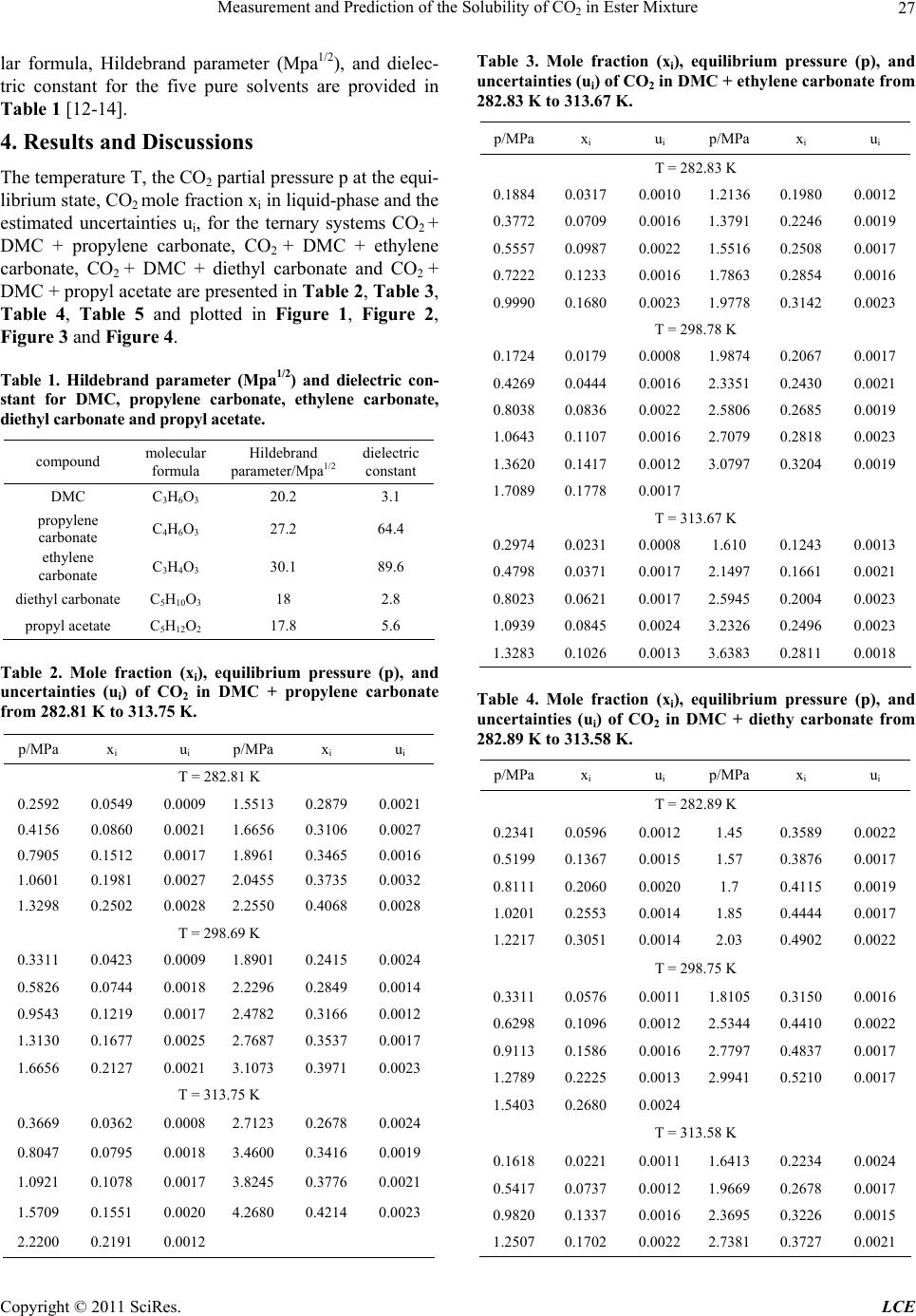 Measurement and Prediction of the Solubility of CO in Ester Mixture27 2 lar formula, Hildebrand parameter (Mpa1/2), and dielec- tric constant for the five pure solvents are provided in Table 1 [12-14]. 4. Results and Discussions The temperature T, the CO2 partial pressure p at the equi- librium state, CO2 mole fraction xi in liquid-phase and the estimated uncertainties ui, for the ternary systems CO2 + DMC + propylene carbonate, CO2 + DMC + ethylene carbonate, CO2 + DMC + diethyl carbonate and CO2 + DMC + propyl acetate are presented in Table 2, Table 3, Table 4, Table 5 and plotted in Figure 1, Figure 2, Figure 3 and Figure 4. Table 1. Hildebrand parameter (Mpa1/2) and dielectric con- stant for DMC, propylene carbonate, ethylene carbonate, diethyl carbonate and propyl acetate. compound molecular formula Hildebrand parameter/Mpa1/2 dielectric constant DMC C3H6O3 20.2 3.1 propylene carbonate C4H6O3 27.2 64.4 ethylene carbonate C3H4O3 30.1 89.6 diethyl carbonate C5H10O3 18 2.8 propyl acetate C5H12O2 17.8 5.6 Table 2. Mole fraction (xi), equilibrium pressure (p), and uncertainties (ui) of CO2 in DMC + propylene carbonate from 282.81 K to 313.75 K. p/MPa xi u i p/MPa xi u i T = 282.81 K 0.2592 0.0549 0.0009 1.5513 0.2879 0.0021 0.4156 0.0860 0.0021 1.6656 0.3106 0.0027 0.7905 0.1512 0.0017 1.8961 0.3465 0.0016 1.0601 0.1981 0.0027 2.0455 0.3735 0.0032 1.3298 0.2502 0.0028 2.2550 0.4068 0.0028 T = 298.69 K 0.3311 0.0423 0.0009 1.8901 0.2415 0.0024 0.5826 0.0744 0.0018 2.2296 0.2849 0.0014 0.9543 0.1219 0.0017 2.4782 0.3166 0.0012 1.3130 0.1677 0.0025 2.7687 0.3537 0.0017 1.6656 0.2127 0.0021 3.1073 0.3971 0.0023 T = 313.75 K 0.3669 0.0362 0.0008 2.7123 0.2678 0.0024 0.8047 0.0795 0.0018 3.4600 0.3416 0.0019 1.0921 0.1078 0.0017 3.8245 0.3776 0.0021 1.5709 0.1551 0.0020 4.2680 0.4214 0.0023 2.2200 0.2191 0.0012 Table 3. Mole fraction (xi), equilibrium pressure (p), and uncertainties (ui) of CO2 in DMC + ethylene carbonate from 282.83 K to 313.67 K. p/MPa xi u i p/MPa xi u i T = 282.83 K 0.18840.0317 0.0010 1.2136 0.1980 0.0012 0.37720.0709 0.0016 1.3791 0.2246 0.0019 0.55570.0987 0.0022 1.5516 0.2508 0.0017 0.72220.1233 0.0016 1.7863 0.2854 0.0016 0.99900.1680 0.0023 1.9778 0.3142 0.0023 T = 298.78 K 0.17240.0179 0.0008 1.9874 0.2067 0.0017 0.42690.0444 0.0016 2.3351 0.2430 0.0021 0.80380.0836 0.0022 2.5806 0.2685 0.0019 1.06430.1107 0.0016 2.7079 0.2818 0.0023 1.36200.1417 0.0012 3.0797 0.3204 0.0019 1.70890.1778 0.0017 T = 313.67 K 0.29740.0231 0.0008 1.610 0.1243 0.0013 0.47980.0371 0.0017 2.1497 0.1661 0.0021 0.80230.0621 0.0017 2.5945 0.2004 0.0023 1.09390.0845 0.0024 3.2326 0.2496 0.0023 1.32830.1026 0.0013 3.6383 0.2811 0.0018 Table 4. Mole fraction (xi), equilibrium pressure (p), and uncertainties (ui) of CO2 in DMC + diethy carbonate from 282.89 K to 313.58 K. p/MPa xi u i p/MPa xi u i T = 282.89 K 0.23410.0596 0.0012 1.45 0.3589 0.0022 0.51990.1367 0.0015 1.57 0.3876 0.0017 0.81110.2060 0.0020 1.7 0.4115 0.0019 1.02010.2553 0.0014 1.85 0.4444 0.0017 1.22170.3051 0.0014 2.03 0.4902 0.0022 T = 298.75 K 0.33110.0576 0.0011 1.8105 0.3150 0.0016 0.62980.1096 0.0012 2.5344 0.4410 0.0022 0.91130.1586 0.0016 2.7797 0.4837 0.0017 1.27890.2225 0.0013 2.9941 0.5210 0.0017 1.54030.2680 0.0024 T = 313.58 K 0.16180.0221 0.0011 1.6413 0.2234 0.0024 0.54170.0737 0.0012 1.9669 0.2678 0.0017 0.98200.1337 0.0016 2.3695 0.3226 0.0015 1.25070.1702 0.0022 2.7381 0.3727 0.0021 Copyright © 2011 SciRes. LCE 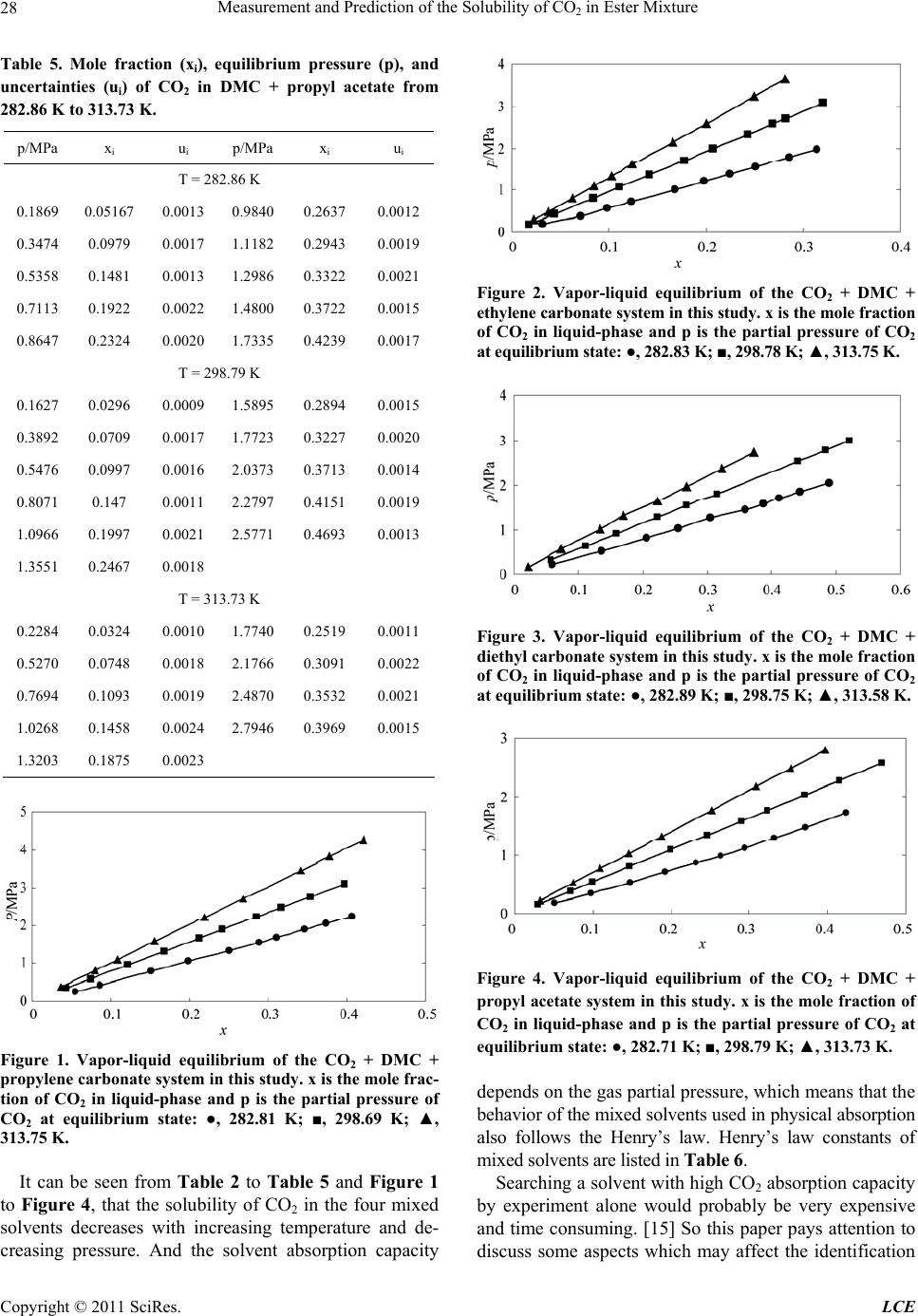 Measurement and Prediction of the Solubility of CO in Ester Mixture 28 2 Table 5. Mole fraction (xi), equilibrium pressure (p), and uncertainties (ui) of CO2 in DMC + propyl acetate from 282.86 K to 313.73 K. p/MPa xi u i p/MPa xi u i T = 282.86 K 0.1869 0.05167 0.0013 0.9840 0.2637 0.0012 0.3474 0.0979 0.0017 1.1182 0.2943 0.0019 0.5358 0.1481 0.0013 1.2986 0.3322 0.0021 0.7113 0.1922 0.0022 1.4800 0.3722 0.0015 0.8647 0.2324 0.0020 1.7335 0.4239 0.0017 T = 298.79 K 0.1627 0.0296 0.0009 1.5895 0.2894 0.0015 0.3892 0.0709 0.0017 1.7723 0.3227 0.0020 0.5476 0.0997 0.0016 2.0373 0.3713 0.0014 0.8071 0.147 0.0011 2.2797 0.4151 0.0019 1.0966 0.1997 0.0021 2.5771 0.4693 0.0013 1.3551 0.2467 0.0018 T = 313.73 K 0.2284 0.0324 0.0010 1.7740 0.2519 0.0011 0.5270 0.0748 0.0018 2.1766 0.3091 0.0022 0.7694 0.1093 0.0019 2.4870 0.3532 0.0021 1.0268 0.1458 0.0024 2.7946 0.3969 0.0015 1.3203 0.1875 0.0023 Figure 1. Vapor-liquid equilibrium of the CO2 + DMC + propylene carbonate system in this study. x is the mole frac- tion of CO2 in liquid-phase and p is the partial pressure of CO2 at equilibrium state: ●, 282.81 K; ■, 298.69 K; ▲, 313.75 K. It can be seen from Table 2 to Table 5 and Figure 1 to Figure 4, that the solubility of CO2 in the four mixed solvents decreases with increasing temperature and de- creasing pressure. And the solvent absorption capacity Figure 2. Vapor-liquid equilibrium of the CO2 + DMC + ethylene carbonate system in this study. x is the mole fraction of CO2 in liquid-phase and p is the partial pressure of CO2 at equilibrium state: ●, 282.83 K; ■, 298.78 K; ▲, 313.75 K. Figure 3. Vapor-liquid equilibrium of the CO2 + DMC + diethyl carbonate system in this study. x is the mole fraction of CO2 in liquid-phase and p is the partial pressure of CO2 at equilibrium state: ●, 282.89 K; ■, 298.75 K; ▲, 313.58 K. Figure 4. Vapor-liquid equilibrium of the CO2 + DMC + propyl acetate system in this study. x is the mole fraction of CO2 in liquid-phase and p is the partial pressure of CO2 at equilibrium state: ●, 282.71 K; ■, 298.79 K; ▲, 313.73 K. depends on the gas partial pressure, which means that the behavior of the mixed solvents used in physical absorption also follows the Henry’s law. Henry’s law constants of mixed solvents are listed in Table 6. Searching a solvent with high CO2 absorption capacity by experiment alone would probably be very expensive and time consuming. [15] So this paper pays attention to discuss some aspects which may affect the identification Copyright © 2011 SciRes. LCE 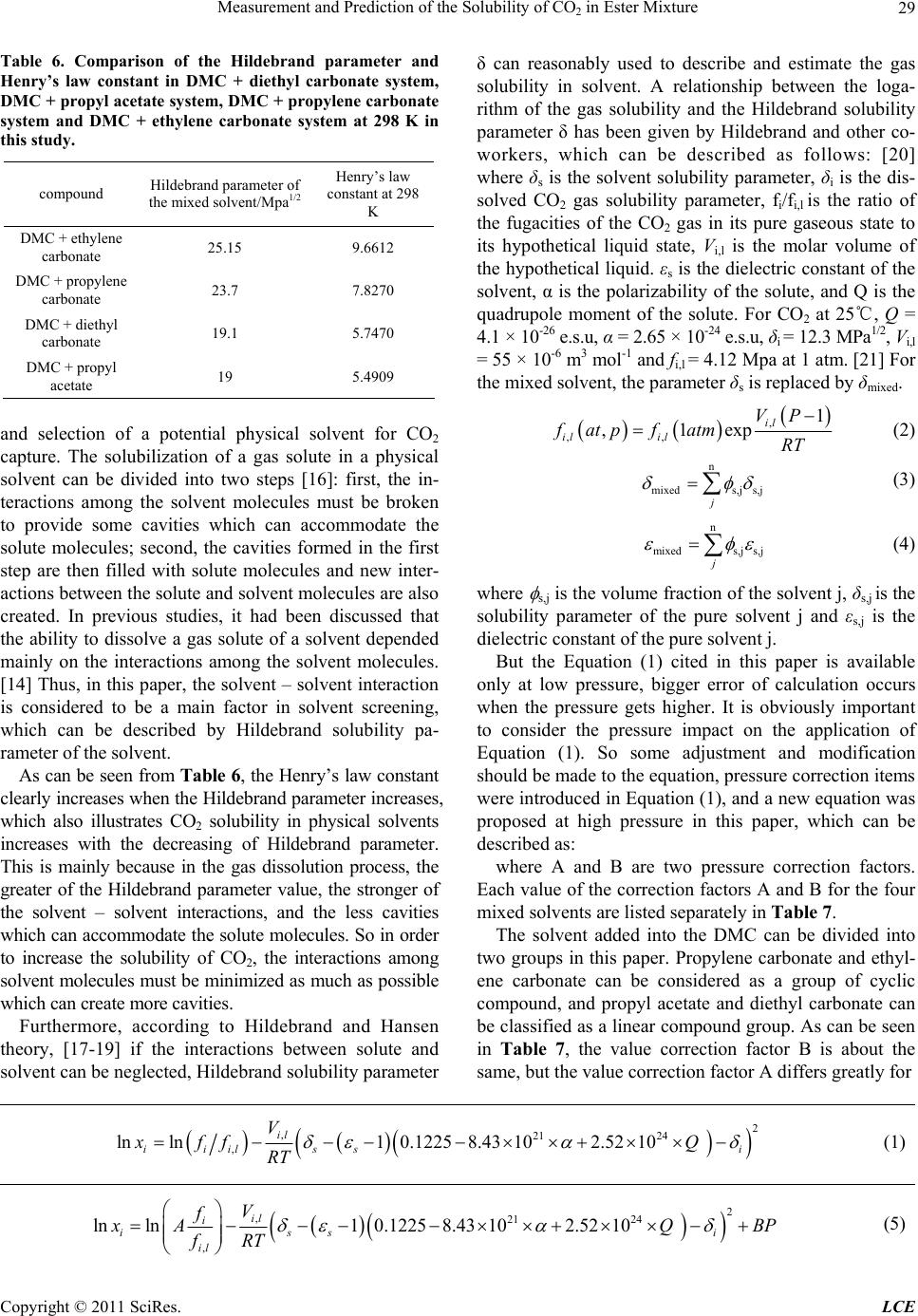 Measurement and Prediction of the Solubility of CO2 in Ester Mixture Copyright © 2011 SciRes. LCE 29 Table 6. Comparison of the Hildebrand parameter and Henry’s law constant in DMC + diethyl carbonate system, DMC + propyl acetate system, DMC + propylene carbonate system and DMC + ethylene carbonate system at 298 K in this study. compound Hildebrand parameter of the mixed solvent/Mpa1/2 Henry’s law constant at 298 K DMC + ethylene carbonate 25.15 9.6612 DMC + propylene carbonate 23.7 7.8270 DMC + diethyl carbonate 19.1 5.7470 DMC + propyl acetate 19 5.4909 and selection of a potential physical solvent for CO2 capture. The solubilization of a gas solute in a physical solvent can be divided into two steps [16]: first, the in- teractions among the solvent molecules must be broken to provide some cavities which can accommodate the solute molecules; second, the cavities formed in the first step are then filled with solute molecules and new inter- actions between the solute and solvent molecules are also created. In previous studies, it had been discussed that the ability to dissolve a gas solute of a solvent depended mainly on the interactions among the solvent molecules. [14] Thus, in this paper, the solvent – solvent interaction is considered to be a main factor in solvent screening, which can be described by Hildebrand solubility pa- rameter of the solvent. As can be seen from Table 6, the Henry’s law constant clearly increases when the Hildebrand parameter increases, which also illustrates CO2 solubility in physical solvents increases with the decreasing of Hildebrand parameter. This is mainly because in the gas dissolution process, the greater of the Hildebrand parameter value, the stronger of the solvent – solvent interactions, and the less cavities which can accommodate the solute molecules. So in order to increase the solubility of CO2, the interactions among solvent molecules must be minimized as much as possible which can create more cavities. Furthermore, according to Hildebrand and Hansen theory, [17-19] if the interactions between solute and solvent can be neglected, Hildebrand solubility parameter δ can reasonably used to describe and estimate the gas solubility in solvent. A relationship between the loga- rithm of the gas solubility and the Hildebrand solubility parameter δ has been given by Hildebrand and other co- workers, which can be described as follows: [20] where δs is the solvent solubility parameter, δi is the dis- solved CO2 gas solubility parameter, fi/fi,l is the ratio of the fugacities of the CO2 gas in its pure gaseous state to its hypothetical liquid state, Vi,l is the molar volume of the hypothetical liquid. εs is the dielectric constant of the solvent, α is the polarizability of the solute, and Q is the quadrupole moment of the solute. For CO2 at 25, ℃Q = 4.1 × 10⁻²⁶ e.s.u, α = 2.65 × 10⁻²⁴ e.s.u, δi = 12.3 MPa1/2, Vi,l = 55 × 10-6 m3 mol-1 and fi,l = 4.12 Mpa at 1 atm. [21] For the mixed solvent, the parameter δs is replaced by δmixed. , ,, 1 ,1exp il il il VP fatpfatmRT (2) n mixeds,j s,j j (3) n mixeds,j s,j j (4) where s,j is the volume fraction of the solvent j, δs,j is the solubility parameter of the pure solvent j and εs,j is the dielectric constant of the pure solvent j. But the Equation (1) cited in this paper is available only at low pressure, bigger error of calculation occurs when the pressure gets higher. It is obviously important to consider the pressure impact on the application of Equation (1). So some adjustment and modification should be made to the equation, pressure correction items were introduced in Equation (1), and a new equation was proposed at high pressure in this paper, which can be described as: where A and B are two pressure correction factors. Each value of the correction factors A and B for the four mixed solvents are listed separately in Table 7. The solvent added into the DMC can be divided into two groups in this paper. Propylene carbonate and ethyl- ene carbonate can be considered as a group of cyclic compound, and propyl acetate and diethyl carbonate can be classified as a linear compound group. As can be seen in Table 7, the value correction factor B is about the same, but the value correction factor A differs greatly for 2 ,21 24 , lnln10.12258.43 102.52 10 il iiil ssi V xff Q RT (1) 2 ,21 24 , lnln10.12258.43 102.52 10 il i iss i il V f x AQ fRT BP (5) 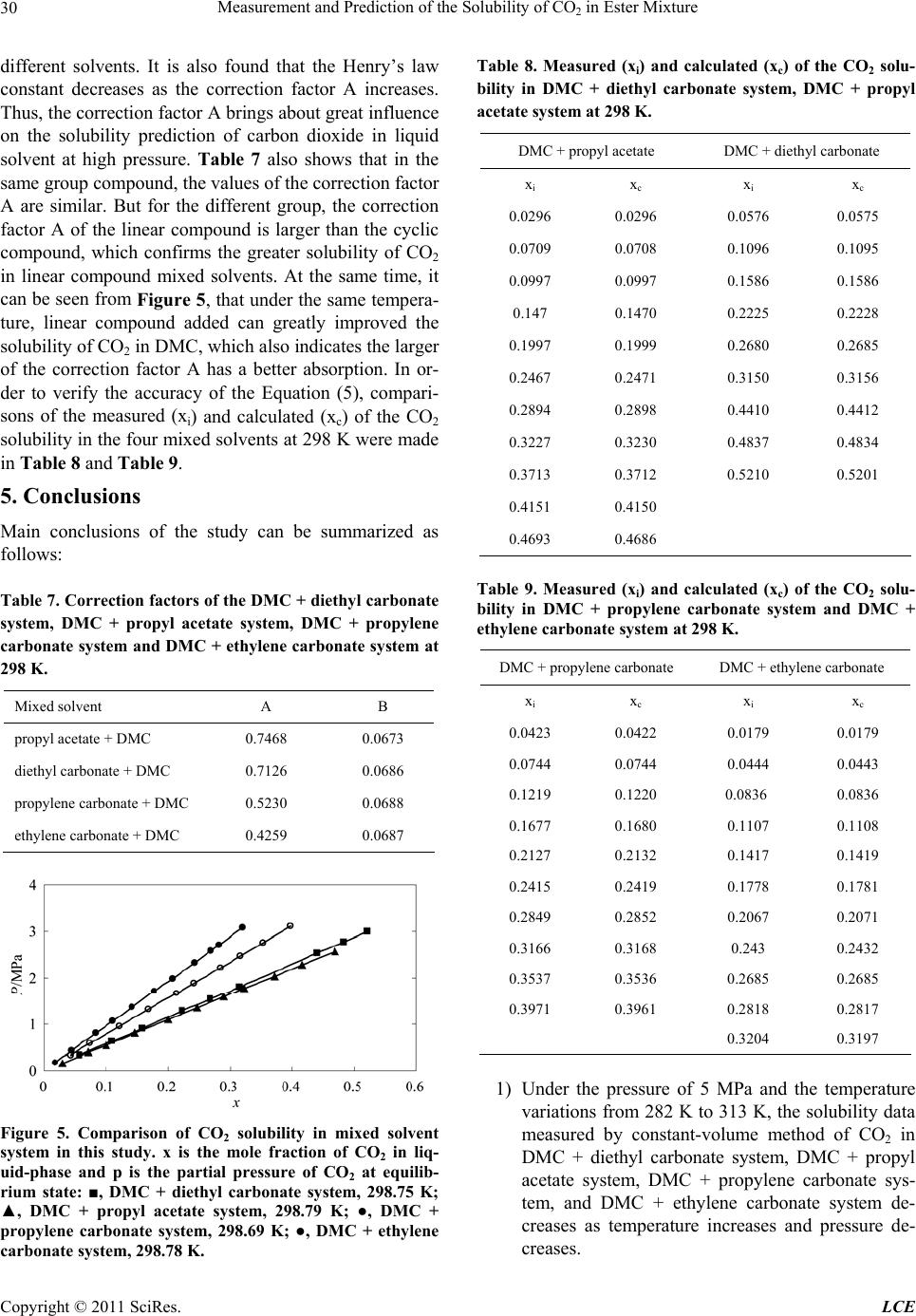 Measurement and Prediction of the Solubility of CO in Ester Mixture 30 2 different solvents. It is also found that the Henry’s law constant decreases as the correction factor A increases. Thus, the correction factor A brings about great influence on the solubility prediction of carbon dioxide in liquid solvent at high pressure. Table 7 also shows that in the same group compound, the values of the correction factor A are similar. But for the different group, the correction factor A of the linear compound is larger than the cyclic compound, which confirms the greater solubility of CO2 in linear compound mixed solvents. At the same time, it can be seen from Figure 5, that under the same tempera- ture, linear compound added can greatly improved the solubility of CO2 in DMC, which also indicates the larger of the correction factor A has a better absorption. In or- der to verify the accuracy of the Equation (5), compari- sons of the measured (xi) and calculated (xc) of the CO2 solubility in the four mixed solvents at 298 K were made in Table 8 and Table 9. 5. Conclusions Main conclusions of the study can be summarized as follows: Table 7. Correction factors of the DMC + diethyl carbonate system, DMC + propyl acetate system, DMC + propylene carbonate system and DMC + ethylene carbonate system at 298 K. Mixed solvent A B propyl acetate + DMC 0.7468 0.0673 diethyl carbonate + DMC 0.7126 0.0686 propylene carbonate + DMC 0.5230 0.0688 ethylene carbonate + DMC 0.4259 0.0687 Figure 5. Comparison of CO2 solubility in mixed solvent system in this study. x is the mole fraction of CO2 in liq- uid-phase and p is the partial pressure of CO2 at equilib- rium state: ■, DMC + diethyl carbonate system, 298.75 K; ▲, DMC + propyl acetate system, 298.79 K; ●, DMC + propylene carbonate system, 298.69 K; ●, DMC + ethylene carbonate system, 298.78 K. Table 8. Measured (xi) and calculated (xc) of the CO2 solu- bility in DMC + diethyl carbonate system, DMC + propyl acetate system at 298 K. DMC + propyl acetate DMC + diethyl carbonate xi x c x i x c 0.0296 0.0296 0.0576 0.0575 0.0709 0.0708 0.1096 0.1095 0.0997 0.0997 0.1586 0.1586 0.147 0.1470 0.2225 0.2228 0.1997 0.1999 0.2680 0.2685 0.2467 0.2471 0.3150 0.3156 0.2894 0.2898 0.4410 0.4412 0.3227 0.3230 0.4837 0.4834 0.3713 0.3712 0.5210 0.5201 0.4151 0.4150 0.4693 0.4686 Table 9. Measured (xi) and calculated (xc) of the CO2 solu- bility in DMC + propylene carbonate system and DMC + ethylene carbonate system at 298 K. DMC + propylene carbonate DMC + ethylene carbonate xi x c x i x c 0.0423 0.0422 0.0179 0.0179 0.0744 0.0744 0.0444 0.0443 0.1219 0.1220 0.0836 0.0836 0.1677 0.1680 0.1107 0.1108 0.2127 0.2132 0.1417 0.1419 0.2415 0.2419 0.1778 0.1781 0.2849 0.2852 0.2067 0.2071 0.3166 0.3168 0.243 0.2432 0.3537 0.3536 0.2685 0.2685 0.3971 0.3961 0.2818 0.2817 0.3204 0.3197 1) Under the pressure of 5 MPa and the temperature variations from 282 K to 313 K, the solubility data measured by constant-volume method of CO2 in DMC + diethyl carbonate system, DMC + propyl acetate system, DMC + propylene carbonate sys- tem, and DMC + ethylene carbonate system de- creases as temperature increases and pressure de- creases. Copyright © 2011 SciRes. LCE  Measurement and Prediction of the Solubility of CO in Ester Mixture31 2 2) The results show that CO2 solubility in physical solvents increases with the decreasing of Hildebrand parameter. The greater of the Hildebrand parameter value, the stronger of the solvent – solvent interac- tions, and the less cavities which can accommodate the solute molecules. 3) It is also found by contrast that linear compound has a greater ability to dissolve CO2 than the cyclic compound at the same temperature. Furthermore, the correction factor A brings about great influence on the solubility prediction of carbon dioxide in liquid solvent. This indicates that the correction factor A can be regarded as an main impact factor in the selection of a potential physical solvent for CO2 capture. REFERENCES [1] H. Herzog and D. Golomb, “Carbon Capture and Storage from Fossil Fuel Use,” Encyclopaedia of Energy, Vol. 1, 2004, pp. 277-287. doi:10.1016/B0-12-176480-X/00422-8 [2] M. Gupta, I. Coyle and K, “Thambimuthu. CO2 Capture Technologies and Opportunities in Canada.1st Canadian CCS Technology Roadmap Workshop,” Calgary, Alberta, Canada 2003. Internet Available: http://www. graz-cycle. tugraz.at/pdfs/co2_capture_strawman_feb2004.pdf [3] J. H. Yoon, H. S. Lee and H. Lee, “High-Pressure Va- por-Liquid Equilibria for Carbon Dioxide + Methanol, Carbon Dioxide + Ethanol, and Carbon Dioxide + Methanol + Ethanol,” Journal of Chemical & Engineering Data, Vol. 38, No. 1, Janurary 1993, pp. 53-55. [4] K. Bezanehtak, G. Combes, F. Dehghani, N. Foster and D. Tomasko, “Vapor-Liquid Equilibrium for Binary Systems of Carbon Dioxide + Methanol, Hydrogen + Methanol, and Hydrogen + Carbon Dioxide at High Pressures,” Journal of Chemical & Engineering Data 2002, Vol. 47, No. 2, March 2002, pp. 161-168. [5] S. N. Joung, H. Y. Shin, S. Y. Kim, K. P. Yoo, C. S. Lee and W. S. Huh, “Measurements and Correlation of High- Pressure VLE of Binary CO2–Alcohol Systems (Methanol, Ethanol, 2-Methoxyethanol and 2-Ethoxyethanol),” Fluid Phase Equilibria, Vol. 185, No. 1-2, July 2001, pp. 219- 230. doi:10.1016/S0378-3812(01)00472-1 [6] D. Robinson, D. Peng and S. Chung, “The Development of the Peng-Robinson Equation and its Application to Phase Equilibrium in a System Containing Methanol,” Fluid Phase Equilibrium, Vol. 24, No. 24, July 1985, pp. 25-41. doi:10.1016/0378-3812(85)87035-7 [7] F. Blanchard, B. carré, F. Bonhomme, P. Biensan and D. Lemordant, “Solubility of Carbon Dioxide in Alkylcar- bonates and Lactones,” Canadain Journal of Chemistry, Vol. 81, No. 5, May 2003, pp. 385-391. doi:10.1139/v03-069 [8] N. Ai, J. Chen and W. Y. Fei, “Solubility of Carbon Di- oxide in Four Mixed Solvents,” Journal of Chemical & Engineering Data, Vol. 50, No. 2, May 2005, pp. 492-496. doi:10.1021/je049696s [9] L. Gainar and G. Anitescu, “The Solubility of CO2, N2 and H2 in a Mixture of Dimethylether Polyethylene Gly- cols at High Pressures,” Fluid Phase Equilibria, Vol. 109, No. 2, August 1995, pp. 281-289. doi:10.1016/0378-3812(95)02729-X [10] E. Aionicesei, M. Škerget and Ž. Knez, “Measurement and Modeling of the CO2 Solubility in Poly(ethylene glycol) of Different Molecular Weights,” Journal of Chemical & Engineering Data, Vol. 53, No. 1, Janurary 2008, pp. 185-188. [11] X. Gui; Z. G. Tang and W. Y. Fei, “CO2 Capture with Physical Solvent Dimethyl Carbonate (DMC) at High Pressures,” Journal of Chemical & Engineering Data, Vol. 55, No. 9, September 2010, pp. 3736-3741. doi:10.1021/je1002708 [12] F. Blanchard, B. Carré, F. Bonhomme, P. Biensan and D. Lemordant, “Solubility of Carbon Dioxide in Alkylcar- bonates and Lactones,” Canadain Journal of Chemistry, Vol. 81, No. 5, May 2003, pp. 385-391. doi:10.1139/v03-069 [13] S. T. Perisanu, “Estimation of Solubility of Carbon Di- oxide in Polar Solvents,” Journal of Solution Chemistry, Vol. 30, No. 2, February 2001, pp. 183-192. doi:10.1023/A:1005256711492 [14] F. M. B. Allan, “CRC Handbook of Solubility Parameters and other Cohesion Parameters (2nd ed),” CRC Press, 1991. [15] B. Gwinner, D. Roizard, F. Lapicque, E. Favre, R. Cadours, P. Boucot and P. L. Carrette, “CO2 Capture in Flue Gas: Semiempirical Approach to Select a Potential Physical Solvent,” Industrial & Engineering Chemistry Research, Vol. 45, No. 44, July 2006, pp. 5044-5049. doi:10.1021/ie0580396 [16] T. Sekine and Y. Hasegawa, “Solvent Extraction Chemis- try: Fundamentals and Applications,” Marcel Dekker press, 1977. [17] J. H. Hildebrand, J. M. Prausnitz and R. L. Scoot, “Regu- lar and Related Solutions: the Solubility of Gases, Liquids, and Solids,” Van Nostrand Reinhold Co press, 1970, 125-130 [18] L. C. Yen, J. J. McKetta, “A Thermodynamic Correlation of Nonpolar Gas Solubilities in Polar, Nonassociated Liq- uids,” AIChE Journal, Vol. 8, No. 4, September 1962, pp. 501-507. doi:10.1002/aic.690080416 [19] J. M. Prausnitz and F. H. Shair, “A Thermodynamic Cor- relation of Gas Solubilities,” AIChE Journal, Vol. 7, No. 4, december 1961, pp. 682-687. doi:10.1002/aic.690070430 [20] C. E. Loeffler, J. J. McKetta, “A Thermodynamic correlation of Nonpolar Gas Solubilities in Alcohols,” AIChE Journal, Vol. 12, No. 4, July 1966, pp. 813-815. doi:10.1002/aic.690120436 [21] F. Blanchard, B. carré, F. Bonhomme, P. Biensan and D. Lemordant, “Solubility of Carbon Dioxide in Alkylcar- bonates and Lactones,” Canadian Journal of Chemistry, Vol.81, No. 5, May 2003, pp. 385-391. doi:10.1139/v03-069 Copyright © 2011 SciRes. LCE |