

Paper Menu >>
Journal Menu >>
 Chinese Medicine, 2011, 2, 1-5 doi:10.4236/cm.2011.21001 Published Online March 2011 (http://www.SciRP.org/journal/cm) Copyright © 2011 SciRes. CM ‘Yang-Invigorating’ Chinese Tonic Herbs Enhance Mitochondrial ATP Generation in H9c2 Cardiomyocytes Hoi Shan Wong, Hoi Yan Leung, Kam Min g Ko Division of Life Science, Hong Kong University of Science & Technology Clear Water Ba y, Hong Kong, China E-mail: [email protected] Received January 25, 2011; revised February 9, 2011; accepted February 10, 2011 Abstract ‘Yang-invigorating’ Chinese tonic herbs have shown to enhance the myocardial mitochondrial ATP genera- tion capacity in mice ex vivo. In the present study, we examined the effect of treatment with the methanol extract of ‘Yang-invigorating’ herbs on mitochondrial ATP generation capacity in H9c2 cardiomyocytes. The effect of ‘Yin-nourishing’ herbs was also investigated for comparison. The results indicated that all ‘Yang-invigorating’ Chinese tonic herbs dose-dependently enhanced the mitochondrial ATP generation ca- pacity in H9c2 cardiomyocytes. Three out of nine ‘Yin-nourishing’ herbs produced a dose-dependent stimu- latory effect on ATP generation, but to lesser extent than that of Yang herbs. Results obtained from activi- ty-directed fr actionat ion of the three most potent ‘Yan g-invigorating’ herbs suggeste d t hat t he ATP-stimulating ingredients were rather water insoluble and largely resided in the butanol fraction. In conclusion, ‘Yang-invigorating’ herbs invariably stimulated mitochondrial ATP generation capacity in H9c2 cardi- omyocytes. The cell-based assay of ATP generation capacity may be used as pharmacological test for ‘Yang-invigorating’ Chinese tonic herbs. Keywords: Yang, Yin, Chinese Medicine, ATP, Mitochondria, Cardiomyocytes 1. Introduction Chinese tonic herbs that can produce health-promoting action are used for the treatment of various patterns of deficiency in body function with respect to Yang, Yin, Qi, or Blood, and their combinations. These types of functional imbalance are viewed as sub-healthy condi- tions i n modern med icine. Chinese toni c he rbs are gener- ally classified into four categories on the basis of their health-promoting actions: ‘Yang-invigorating’; ‘Yin- nourishing’; ‘Qi-invigorating’ and ‘Blood-enriching’ [1 ]. Of these four types of tonic herbs, the ‘Qi-invigorating’ and ‘Blood-enriching’ herbs are grouped under the ‘Yang’ family and ‘Yin’ family, respectively. While maintaining Yang and Yin in harmony is akin to attain- ing the homeostatic state in modern medicine, this phe- nomenon is aptly exemplified by the long-known anta- gonizing relationship between sympathetic and para- sympathetic neural activities in the bod y. According to traditional Chinese medicine theory, Yang is viewed as a manifestation of body function sup- ported by various organs. A ‘Yang-invigorating’ action therefore involves the general up-regulation of cellular activities, particularly in the heart that plays a pivotal role in fueling the vital activities in all organs. As ATP, an ene rgy-rich biomolecule, is universally used for ener- gizing cellular activities, particularly in the energy de- manding cardiomyocytes [2], we have proposed that the ‘Yang-invigorating’ action may be mediated by the en- hancement of mitochondrial ATP generation [3]. Re- cently, our laboratory has shown that treatment with the methanol extract of ‘Yang-invigorating’, but not ‘Yin- nourishing’, herbs enhanced the myocardial ATP genera- tion capacit y in mice ex vivo [4]. The stimulation of ATP generation was associated with an increased extent of mitochondrial electron transport [4]. However, whether ‘Yang-invigorating’ herbs can produce the characteristic ATP sti mulator y action in cu lt ured ca rdiomyocytes is yet to be determined. In the present study, we investigated the effect of treatment with the methanol extract of ‘Yang-invigorating’ herbs on mitochondrial ATP gener- ation capacity in H9c2 cardiomyocytes. Methanol ex- tracts of ‘Yin-nourishing’ herbs were also tested for comparison. Three most active Yang herbs, namely,  H. S. WONG ET AL. Copyright © 2011 SciRes. CM 2 Herba Cistanches, Herba Cynomorii and Semen Cuscu- tae, were fractionated by differential solvent extraction with increasing polarity in order to characterize the physical property of the active ingredients. 2. Materials and Methods 2.1. Chinese Tonic Herbs Dried Chinese herbs (see Table 1) used in the project were purchased from a local herbal dealer, Lee Koong Kee and voucher specimens were deposited in the Divi- sion of Life Science, Hong Kong University of Science and Technology, Hong Kong. For preliminary studies, herbs were extracted by methanol as previously de- scribed [5]. Three of the most active herbs were further subjected to differential fractionation in succession by a set of four solvents, petroleum ether, ethylacetate, bu- tan-1-ol and water, with increasing polarity. The pooled extracts were dried by evaporating the solvents in rota- vaporator under heat and reduced pressure. Dried herbal extracts were stored at 4˚C until us e. 2.2. Cell Culture H9c2 cardiomyocytes, a subclone of the original clonal cell line derived from embryonic BD1X rat heart tissue and which exhibits many of the properties of skeletal muscle [6], was purchased from American Type Culture Collection. H9c2 cardiomyocytes were cultured as mo- nolayers in Dulbecco’s Modified Eagle Medium (Gibco BRL Life Technologies, Grand Island, NY), supple- mented with 10% (v/v) fetal bovine serum, 100 IU/mL of penicillin (S igma , St. Louis, MO), 100 µg/mL of strep- tomycin and 17 mM NaHCO3 and were grown under an atmosphere of 5% (v/v) CO2 in air at 37˚C. 2.3. Measurement of ATP Generation Capacity in Situ H9c2 Cardiomyocytes were seeded at a density of 2.5 × 10⁴ cells/well in 24-well tissue culture plates and were incubated in humidified incubator at 37˚C for 2 days to allow cell attachment and stable cell growth. After cell attachment, herbal extracts (dissolved in DMSO) were applied in the medium to achieve desired final concen- trations (DMSO < 0.2%, v/v). After drug incubation, the ATP-generation capacity (ATP-GC) assay was per- formed. Culture medium was aspirated, and the cells were washed with phosphate-buffered saline (PBS). Di- gitonin (50 mg/mL) dissolved in incubation buffer (120 mM KC l, 5 mM KH2PO4, 2 mM E G TA, 1 0 mM HEPES, 0.1 mM MgCl2, 0.5% bovine serum albumin, pH 7.4) was added to permeabilize the cell membrane for the entry of substrates. Pyr uvate (1.67 mM) , malate (5 mM) and ADP (60 μM) were added for mitochondrial ATP generation in situ. Cellular ATP level was measured at increasing time intervals (0 to 15 min) following the ad- dition of substrates. The ATP generation was terminated by the addition of 60 µL p erchloric acid (30%, w/v ). The reaction mixture was centrifuged at 540 × g for 20 mi- nutes. An aliquot (120 µL) of the resultant supernatant was then mixed with 90 µL of 1.4M KHCO3 for neutra- lization. Precipitate formed after neutralization was re- moved by centrifugation at 2150 × g for 10 min. The supernatant was subjected to measurement of ATP con- tent by luciferase assay (ATPlite, Perkin Elmer, Boston, MA) as described [7].The ATP-GC of untreated cells was estimated by computing the area under the curve of the graph (AUC1) plotting ATP generated (nmol/mg protein) against time and expressed in arbitrary unit. AUC1 values of herbal extract-treated cells were norma- lized to respective mean control value from untreated samples and expressed as percent control. The area under the curve (AUC2) of the graph plotting percent control against incubation time was computed and expressed in arbitrary unit. Results were expressed as percent control. 2.4. Protein Assay Cell lysates were prepared by adding lysis buffer (0.1% (v/v) Triton X-100 in PBS). The protein concentration was determined by Bio-Rad protein assay kit (Bio-Rad, Hercules, CA). 2.5. Statistical Analysis The intergroup difference was analyzed by student’s t test, with P < 0.05 being regarded as statistical signifi- cant. 3. Results and Discussion It is believed that the up-regulation of cellular activities by ‘Yang-invigoration’ in Chinese medicine requires an increased supply of ATP, which is in turn largely sup- ported by mitochondrial oxidative phosphorylation. As shown in Figure 1, all of the 12 tested ‘Yang-invigorat- ing’ herbs increased the ATP-GC in a concentration- dependent manner in H9c2 cardiomyocytes, with the extent of stimulation at the concentration of 300 µg/mL being 18-51%. Three out of the 9 tested ‘Yin-nourishing herbs (Herba Eclipae, Herba Asparagi, Semen Prinsepiae) also dose-dependently enhanced the ATP-GC in H9c2 cardiomyocytes, b ut to a le sser extent, with the extent o f stimulation at the concentration of 300 µg/mL being 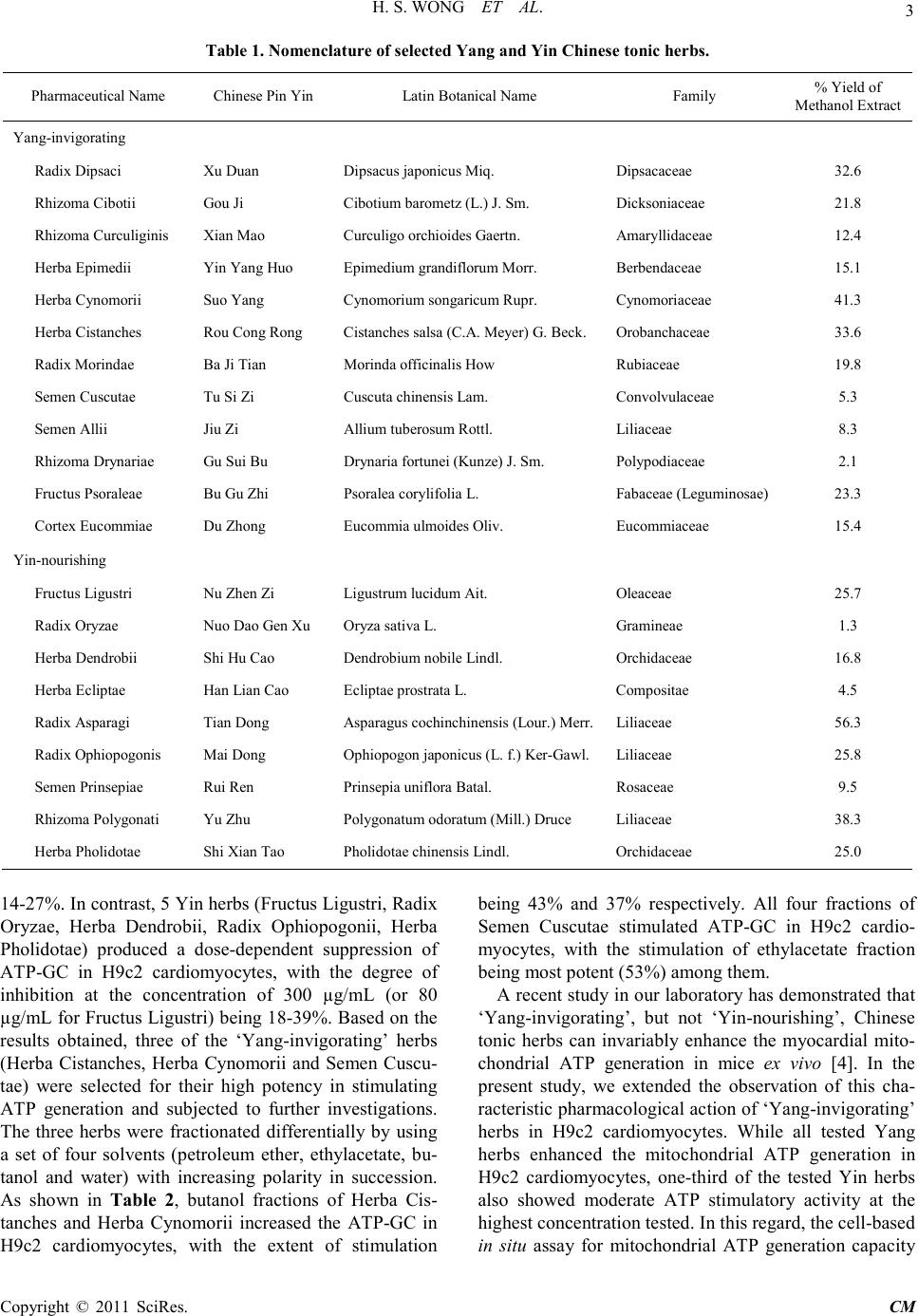 H. S. WONG ET AL. Copyright © 2011 SciRes. CM 3 Table 1. Nomenclature of select ed Yang and Yi n Chine se tonic her bs . Pharmaceutical Name Chines e Pin Yin Latin Botanical Name Family % Yield of Metha nol Extract Yang-invigorating Radix Dipsaci Xu Duan Dipsacus japonicus Miq. Dipsacaceae 32.6 Rhizoma Ciboti i Gou Ji Cibo tium bar o m etz (L.) J. Sm. Dicksoniaceae 21.8 Rhizoma Curculi ginis Xian Mao Curculigo orchioides Gaertn. Amaryllidaceae 12.4 Herba Epimedii Yin Yang Huo Epimedium grandiflorum Morr. Berbendaceae 15.1 Herba Cynomorii Suo Yang Cynomorium songaricum Rupr. Cynomoriaceae 41.3 Herba Cis tanches Rou Cong Rong Cistanches salsa (C.A. Meyer) G. Beck. Orobanchaceae 33.6 Radix Morindae Ba Ji Tian Morinda officinalis How Rubiaceae 19.8 Semen Cuscuta e Tu Si Zi Cuscuta chinensis Lam. Convolvulaceae 5.3 Semen A l lii Jiu Zi Allium tuberosum Rottl. Liliaceae 8.3 Rhizoma Drynariae Gu Sui Bu Drynaria fortunei (Kunze) J. Sm . Polypodiaceae 2.1 Fructus Psoraleae Bu Gu Zhi Psoralea corylifolia L. Fabaceae (Leguminosae) 23.3 Cortex Eucommiae Du Zhong Euc ommia ulmoides Oliv. Eucommiaceae 15. 4 Yin-nourishing Fructus Ligustri Nu Zhen Zi Ligustrum lucidum Ait. Oleaceae 25.7 Rad ix Oryzae Nuo Dao Gen Xu Oryza sativa L. Gramineae 1.3 Herba Dendrobii S hi H u Cao De ndr obium no bile L indl. Orchidaceae 16.8 Herba Eclip tae Han Lian Cao Ecliptae prostrata L. Compositae 4.5 Radi x Asparagi Tian Dong Asparagus cochinchinensis ( Lour. ) Merr. Liliaceae 56.3 Radi x Ophiopogon is Mai Dong Ophiopogon jap onicus (L. f.) Ker-Gawl. Liliaceae 25.8 Semen Prinsepi ae Rui Re n Prinsepia uniflora Batal. Rosaceae 9.5 Rhizoma Polygonati Yu Zhu Polygonat um odoratum (Mill.) Druce Liliaceae 38.3 Herba Pholidotae Shi Xian Tao Phol id o ta e c h inens is Lindl. Orchidaceae 25.0 14-27%. In contrast, 5 Yin herbs (Fructus Ligustri, Radix Oryzae, Herba Dendrobii, Radix Ophiopogonii, Herba Pholidotae) produced a dose-dependent suppression of ATP-GC in H9c2 cardiomyocytes, with the degree of inhibition at the concentration of 300 µg/mL (or 80 µg/mL for Fruct us Lig ustri) b eing 18-39%. Based on the results obtained, three of the ‘Yang-invigorating’ herbs (Herba Cistanches, Herba Cynomorii and Semen Cuscu- tae) were selected for their high potency in stimulating ATP generation and subjected to further investigations. The three herbs were fractionated differentially by using a set of four solvents (petroleum ether, ethylacetate, bu- tanol and water) with increasing polarity in succession. As shown in Table 2, butanol fractions of Herba Cis- tanches and Herba Cynomorii increased the ATP-GC in H9c2 cardiomyocytes, with the extent of stimulation being 43% and 37% respectively. All four fractions of Semen Cuscutae stimulated ATP-GC in H9c2 cardio- myocytes, with the stimulation of ethylacetate fraction being most potent (5 3%) among the m. A rece nt stud y in our labor atory ha s demo nstrate d tha t ‘Yang-invigorating’, but not ‘Yin-nourishing’, Chinese tonic herbs can invariably enhance the myocardial mito- chondrial ATP generation in mice ex vivo [4]. In the present study, we extended the observation of this cha- racteristic pharmacological action of ‘Yang-invigorating’ herbs in H9c2 cardiomyocytes. While all tested Yang herbs enhanced the mitochondrial ATP generation in H9c2 cardiomyocytes, one-third of the tested Yin herbs also showed moderate ATP stimulatory activity at the highest concentration tested. In this regard, the cell-based in situ assay for mitochondrial ATP generation capacity 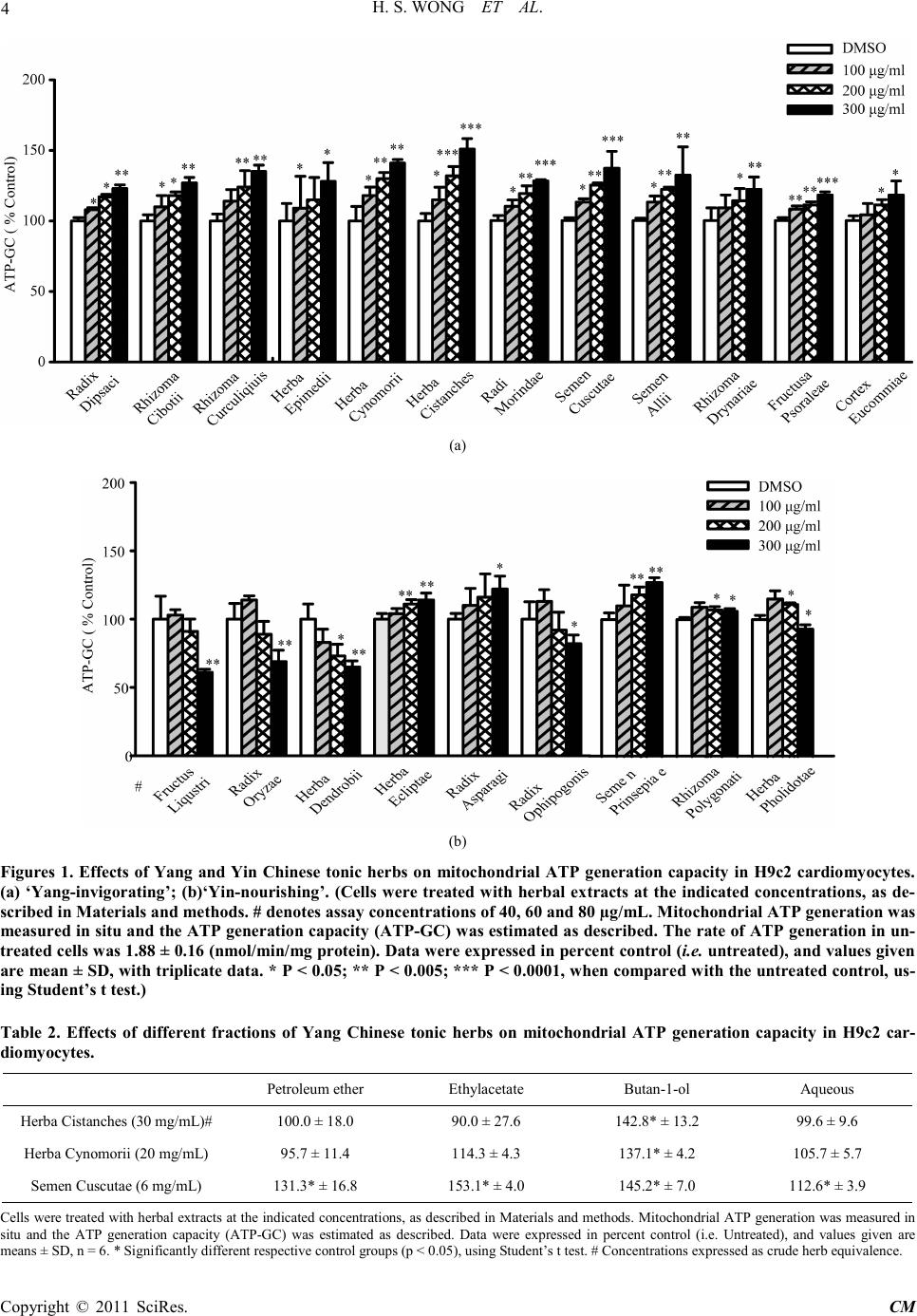 H. S. WONG ET AL. Copyright © 2011 SciRes. CM 4 (a) (b) Figures 1. Effects of Yang and Yin Chinese tonic herbs on mitochondrial ATP generation capacity in H9c2 cardiomyocytes. (a) ‘Yang-invigorating’; (b)‘Yin-nourishing’. (Cells w ere treated with herbal ex tracts at the indicated concentrations, as de- scribed i n Materi al s and meth ods. # d enotes ass ay concentratio ns of 40, 60 and 80 µg/ mL. M itochondrial ATP generation was measure d in situ a nd the A TP ge nerati on capac ity (ATP-GC) w as estimated as describ ed. The rate of ATP g eneration in un- treated cel ls was 1 .88 ± 0.16 (nmol/min/ mg protei n). Data w ere ex pressed in per cent contr ol (i.e. untreate d), an d val ues g ive n are mean ± SD, wi th tri plicat e dat a. * P < 0.05 ; ** P < 0 .00 5; *** P < 0. 0001 , when co mpare d wit h the untre ated co ntrol, us- ing Student’s t test.) Table 2. Effects of different fractions of Yang Chinese tonic herbs on mitochondrial ATP generation capacity in H9c2 car- diomyocytes. Petro leum eth er Eth ylacetate Butan-1-ol Aqueous Herba Cis tanches (30 mg/mL)# 100.0 ± 18.0 90.0 ± 27.6 142.8* ± 13.2 99.6 ± 9.6 Herba Cynomorii (20 mg/mL) 95.7 ± 11.4 114.3 ± 4.3 137.1* ± 4.2 105.7 ± 5.7 Semen Cuscuta e (6 mg/mL) 131.3* ± 16.8 153.1* ± 4.0 145.2* ± 7.0 112.6* ± 3.9 Cells were treated with herbal extracts at the indicated concentrations, as described in Materials and methods. Mitochondrial ATP generati on was measured in situ and the ATP generation capacity (ATP-GC) was estimated as described. Data were expressed in percent control (i.e. Untreated), and values given are means ± SD, n = 6. * Significantly different respe ctive control groups (p < 0.05), using Student’s t test. # Concentrations expressed as crude herb equivalence.  H. S. WONG ET AL. Copyright © 2011 SciRes. CM 5 seemed to be less selective than the previousl y described ex vivo assay model for Yang herbs, with the latter showing no stimulatory effect of Yin herbs on myocar- dial mitochondrial ATP generation [4]. On the other hand, two Yin herbs, namely Radix Oryzae and Herba Dendrobii, were found to suppress the mitochondrial ATP generation in both ex vivo and cell-based in situ assays [4]. While the discrepant observation between ex vivo and in situ assays for Yin herbs remains to be ex- plained, the moderate stimulation of ATP generation in situ by Yin herbs may be related to the enhancement of cellular glutathione status (data not shown), which in turn can increase the functional ability of mitochondria [8]. Interestingly, using the cell-based assay, the Herba Cistanches-ind uced enhance ment of AT P generation was found to be suppressed by Fructus Ligustri (data not shown). This suggested the antagonistic relationship be- tween Yang and Yin herbs in the regulation of mito- chondrial AT P gene ration. Results from our p revious and present studies suggest that the enhancement of mito- chondrial ATP generation may serve as a pharmacologi- cal activity marker for ‘Yang-invigo rat ing ’ Chine se tonic herbs. In this regard, preliminary studies in our labora- tory indicated that Chinese herbal products comprising ‘Yang-invigorating’ herbs were found to stimulate mito- chondrial ATP-GC to varying extent in H9c2 cardio- myocytes. Results obtained from the activity-directed fractionation suggested that butanol fractions of Herba Cistanches and Herba Cynomorii contained relatively high co ntent of ATP -stimulating active ingredients. The residence of active ingredients in relatively non-polar fractions of Semen Cuscutae might be explained by the unique characteristic of the herbs. The results indicated that the ATP-stimulating active ingredients of ‘Yang- invigorating’ herbs were relatively water-insoluble and may share similar structural characteristics. The measurement of ATP generation in H9c2 cardi- omyocytes in situ using malate and pyruvate as sub- strates is an indirect measure of state 3 mitochondrial respiration [9]. Under the present experimental condi- tions, the observation of changes in mitochondrial ATP generation by herbal pretreatment may be due to the in- crease in the activities of enzyme complexes in mito- chondrial respiratory chain and/or the decrease in ATP consumption (or degradation) mediated by ATP-ase or other ATP-dependent enzymes. In this connection, an earlier report from our laboratory has shown that the en- hancement of myocardial mitochondrial ATP generation capacity by Herba Cistanches treatment was associated wit h increases in complex I and III activities [10]. On the other hand, the suppression of mitochondrial ATP gener- ation capacity, as assessed by the present in situ assay, afforded by some Yin herbs may be related to the in- crease in ATP consumption. 4. Referen ces [1] J. Geng and Z. Su, “Practical Traditional Chinese Medi- cine & Pharmaco logy. Vol ume 1: Basic Theories & P rin- ciples,” New World Press, Beij ing, 1991. doi:10.1146/annurev.ph.47.030185.003423 [2] W.E. Jacobus, “Respiratory Control and the Integration of Heart High-Energy Phosphate Metabolism by Mito- chond rial Creat ine Kinase,” An nual Review of Physiology, Vol. 47, 19 85, pp. 707-725. [3] K. M. Ko, D. H. F. Mak, P. Y. Chiu and M. K. T. Poon, “Pharmacological Basis of ‘Yang-Invigoration’ in Chi- nese Medicine,” Trends in Pharmacological Sciences., Vol. 25, N o. 1, 2004, pp. 3-6. doi:10.1016/j.tips.2003.11.002 [4] K. M. Ko, T. Y. Y. Leon, D. H. F. Mak, P. Y. Chiu, Y. Du and M. K. T. Poon, “A Characteristic Pharmacologi- cal Action of ‘Yang-Invigorating’ Chinese Tonifying Herbs: Enahcnement of ATP-Generation Capacity,” Phytomedicine, Vol. 13, No. 9-10, 2006, pp. 636-642. doi:10.1016/j.phymed.2006.02.007 [5] T. K. Yim and K. M. Ko, “Antioxidant and Immunomo- dulatory Activities of Chinese Tonifying Herbs,” Phar- maceutical Biology, Vol. 40, No. 5, 2002, pp. 329- 335. doi:10.1076/phbi.40.5.329.8457 [6] J. Hescheler, R. Meyer, S. Plant, W. Krautwurst, W. Ro- senthal, G. Schultz, “Morphological, Biochemical, and Electrophysiological Characterization of a Clonal Cell (H9c2 ) Line from Rat Heart,” Circulation Research, Vol. 69, No. 9, 1991, pp. 1476-1486. [7] H. Y. Leung, P. Y. Chiu, M. K. T. Poon and K. M. Ko, “A Yang-Invigorating Chinese Herbal Formula Enhances Mitochondrial Functional Ability and Antioxidant Capac- ity in Various Tissues of Male and Female Rats,” Reju- venation Research, Vol. 8, No. 4, 2005, pp. 238-247. doi:10.1089/rej.2005.8.238 [8] P. Y. Chiu and K. M. Ko, “Time Dependent Enhance- ment in Mitochondrial Glutathione Status and ATP Gen- eration Capacity by Schisandrin B Treatment Decreases the Susceptibility of Rat Hearts to Ischemia-Reperfusion Injury,” Biofactors, Vol. 19, No. 1-2, 2003 , pp. 43-51. doi:10.1002/biof.5520190106 [9] Q. Chen, E. J. Vazquez, S. Moghaddas, C. L. Hoppel and E. J. Lesnefsky, “Production of Reactive O xygen Species by Mitochondria: Central Role of Complex III,” Journal of Biological Chemistry., Vol. 278, No. 38, 2003, pp. 36027-36031. doi:10.1074/jbc.M304854200 [10] H. Y. Leung and K. M. Ko, “Herba Cistanches Extract Enhances Mitochondrial ATP Generation in Rat Hearts and H9c2 Cells,” Pharmaceutical Biology, Vol. 46, No. 6, 2008, pp . 418-424. doi:10.1080/13880200802055883 |