

Paper Menu >>
Journal Menu >>
 Journal of Materials Science and Chemical Engineering, 2014, 2, 57-62 Published Online January 2014 (http://www.scirp.org/journal/msce) http://dx.doi.org/10.4236/msce.2014.210010 OPEN ACCESS MSCE Electrochemical Synthesis of CeB6 Nanotubes H. B. Kushkhov, M. K. Vindizheva, R. A. Mukozheva, A. H. Abazova, M. R. Tlenkopachev Kabardino-Balkar State University, Nalchik, Russia Email: [email protected], [email protected] Received November 2013 ABSTRACT This work presents the results of joint electroreduction of tetrafluorborate and cerium-ions, and determines the conditions of electrochemical synthesis of cerium borides in KCl-NaCl melts at the 973 K on tungsten electrode by the linear and cyclic voltammetry. Based on the current-voltage studies the optimal modes of cerium boride electrodeposition were found. KEYWORDS Molten Chloride; Linear and Cyclic Voltammetry; Cerium Borides; High Temperature Electrosynthesis; Nanotube s 1. Introduction Borides of rare earth metals (REM) are widely used in various fields of modern technology. The electrochemi- cal synthesis of rare-earth borides at moderate tempera- tures (973 - 1023 K) is a cost-effective alternative to the direct solution-phase synthesis. The increased interest in the development of new efficient methods of producing rare earth borides are due to remarkable properties of these materials, such as chemical inertness, heat resis- tance, a wide range of electrochemical and magnetic pro- perties, etc. There is an indication of the using possibility cerium hexaboride for refractory production for use in neutral or reducing atmosphere and in vacuum at tem- peratures of 2000˚C or higher [1]. Electroreduction from the molten salts is a specific method for the preparation of compounds of elements such as refractory metals, actinides and rare earth metals [2]. Manifold variations of electrolytic production of me- tals and compounds based on them—this is a great selec- tion of solvent, a variety of chemical and electrochemical characteristics of process and a temperature range, which is suitable for the process. Of the various methods for the synthesis of cerium borides is the closest way to get them through the elec- trolysis of molten media [3]. Electrolysis was carried out in graphite crucibles, serving both the anode and a cath- ode made of graphite or molybdenum. The composition of the bath electrolysis includes oxides of rare earth met- als and boric anhydride with additives of fluorides of alkali and alkaline earth metals to reduce the temperature and viscosity of the bath. Temperature electrolysis mix- ture was 1223 K - 1273 K, the voltage on the bath was 3.0 - 15.0 V, current density was 0.3 - 3.0 A/cm2. The composition of the bath for cerium hexaboride obtaining was: CeO2 + 2B2O3 + CeF3. As noted in work [3], the obtaining of the individual boride phase is practically impossible or very difficult. The disadvantages are also high temperature of synthesis and complexity of the product separation from the mol- ten electrolyte due to the low solubility of borates and fluoride, contamination by-products, such as borates. Thus, in view of the increasing use of rare earth metals and various materials on their basis and with the addition of rare earth metals in the various fields of science and techno l ogy, it is becoming an urgent task of obtaining these materials. A promising way to obtain rare earth, their alloys with other metals is the electrolysis of molten salts REM, as well as mixtures thereof. For effective use of the electrolytic method of produc- ing of metallic cerium and their alloys and compounds are necessary to have reliable information about electro- chemical behavior of complexes formed by cerium ions in molten salts, and joint electroreduction with compo- nents connections. Products quality of rare earth borides is determined by the purity and dispersion, namely original powder grain size, from which it is made. The product quality is higher when the grain size of compounds powder is smaller. Previously, we have investigated the processes of joint electroreduction of rare-earth metals with boron ions in KCl-NaCl and KCl-NaCl -CsCl melts at different elec- 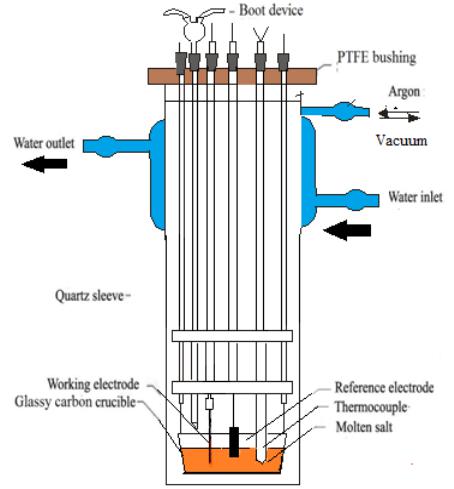 H. B. KUSHKHOV ET AL. OPEN ACCESS MSCE 58 trodes. It is shown that the electroreduction of fluorobo- rate ion occurs at more positive potentials than deposi- tion potential of metallic cerium [4-6]. In the works [7-10] the electrochemical behavior of boron, the laws of electrode processes at its refining, the solubility of boron compounds in molten alkali metal chlorides are studied. In literature the processes of joint electroreduction cerium and boron ions in halide melts on a tungsten electrode are poorly understood. The aim of this work is to study the process of joint electroreduction of cerium ions with fluoroborate ions in molten equimolar KCl-NaCl on the tungsten electrode and the electrochemical synthesis of cerium borides 973 K. 2. Experimental Chemicals and Apparatus Experiments were carried out in a sealed quartz cell (Figure 1) in the argon atmosphere, purified from traces of moisture and oxygen, which is necessary in order to obtain reliable results. In three-electrode cell, the working electrode was the tungsten (d = 1.0 mm, purity > 99.95%) needle electrode. Tungsten is chosen as the material for the working elec- trode, since the boron and cerium insoluble therein [11]. As the reference electrode we used quasi-reversible glassy-carbon (SU-2000, d = 2.0 mm) rod electrode. The using of glassy-carbon quasi electrode help us to avoid the using of oxygen-diaphragms. Oxide ceramics are not compatible with the halide melts containing rare earth ions. Glassy-carbon quasi-stationary reference electrode, apparently, is a compromise electrode, and is determined by the redox potentials which are established with the participation of the various components of the molten medium. Therefore, its value depends on the melt com- position and temperature. Glassy-carbon quasi-stationary reference electrode was used in our studies [4], and pre- viously by the authors [11] in chloride and chloride- fluoride melts [12-14]. The auxiliary electrode was the glassy carbon crucible, which was the container for melt at the same time. Electroreduction of cerium and tetrafluorborate ions was investigated by cyclic voltammetry. The current- voltage dependence was obtained by the electrochemical complex Autolab PGST 30 (Ecochemic, Holland), which was paired with computer. It has been estimated value of ohmic IR drop in the electrolyte at a time-dependent po- larization mode. The specific conductivity of molten po- tassium, sodium and cesium chlorides is 0.5 ohm−1cm−1. At the maximum distance of 0.5 cm between the refer- ence electrode and the working electrode and a current of 10 mA, scanning rate of 10 V/s the ohmic drop is about 10 - 15 mV. In addition, the electrochemical complex Figure 1. Scheme of high temperature electrochemical quartz cell. Autolab PGST 30 allows a survey of curre nt -voltage curves with the IR-compensati o n. Potentiostatic electrolysis was carried out using a power supply with a current load of up to 5A. The salts preparation method was following. Sodium and potassium chlorides qualification «analytical grade» were recrystallized, calcined in a muffle furnace, mixed in the desired ratio (an equimolar mixture), and placed in an alundum crucible into glass. A glass cell was evacu- ated to a residual pressure of 0.7 Pa, first at room tem- perature and then heated at progressively stepped up to 473˚C, 673˚C, 873˚C. Then it was filled with inert gas (argon) and melted. Cerium ion added to the melt in the form of anhydrous cerium trichloride (99.9%, ultra- dry, Ltd. “Lanchi ”). To avoid the formation of oxychlorides, experiments were performed under purified argon and dried in a sealed cell. Potassium tetrafluoroborate KBF4 qualification “reagent grad e ” was washed in HF, than in ethanol, after than it was dried. All operations with anhydrous salts were car- ried out in glovebox mBraun Labstar 50 in the argon atmosphere. Products of electrolysis were identified by DRON-6 and observed by scanning electron microscope (SEM) Vega 3 TESCAN. Particle size was measured by laser diffractive analyzer Fritsch Analysette-22 Nanotech (Germany). 3. Results and Discussion Cyclic current-voltage curves in the KCl-NaCl chloride 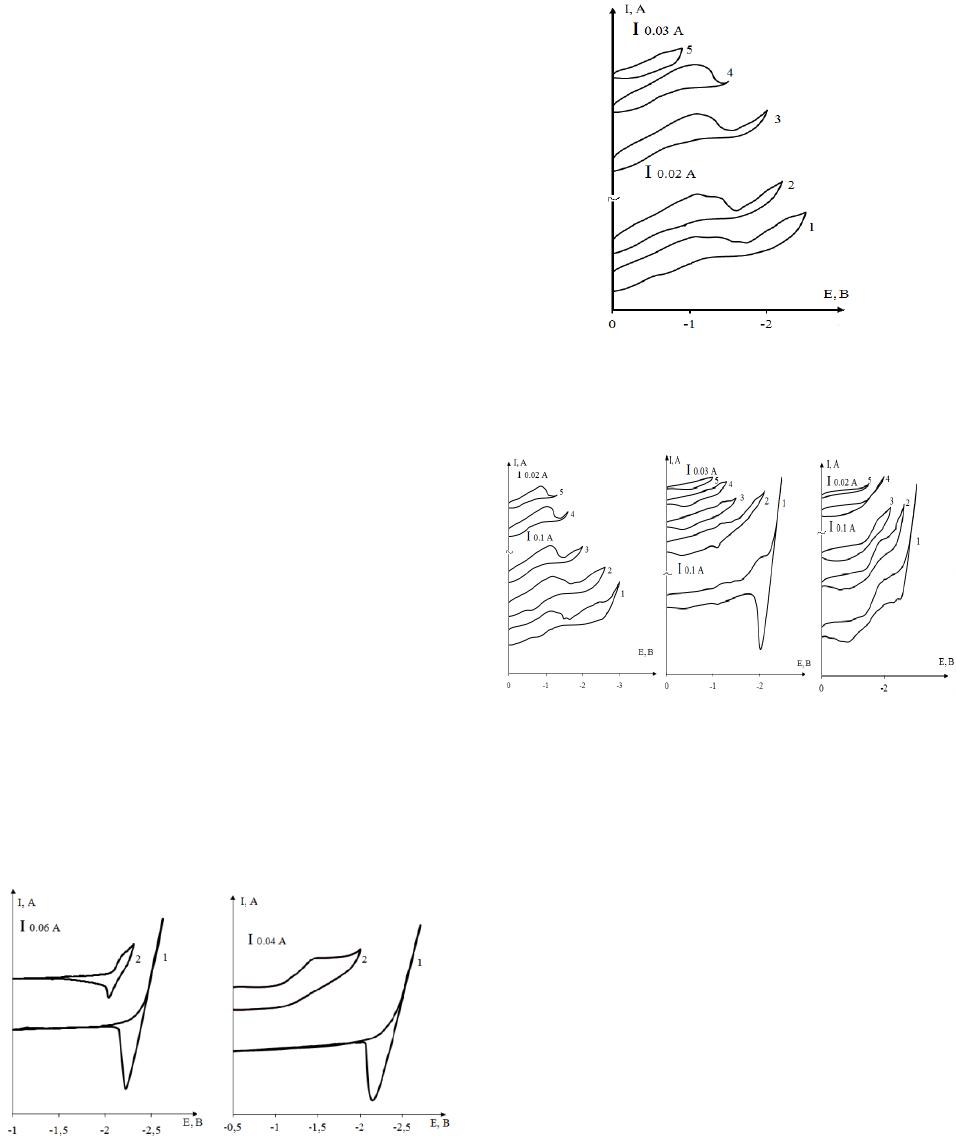 H. B. KUSHKHOV ET AL. OPEN ACCESS MSCE 59 melt by adding cerium trichloride and potassium fluoro- borate are shown in Figure 2. Curve 1 in this figure represents the voltammogram of background electrolyte —equimolar molten KCl-NaCl. The absence of any waves in it, and low leakage current at relatively high negative potentials allows us to draw conclusions about the cleanliness of the background electrolyte. When we add in the background melt cerium trichloride C(CeCl3) = 4,3 × 10⁻⁴ mol/cm3 (Figure 2(a), curve 2) at potentials −(2.2 ÷ 2.3) V relative glassy-carbon quasi-stationary reference electrode on voltammogram appears well re- producible reduction wave of cerium ions. The fluorobo- rate ions reduction wave observed at potentials −(1.3 ÷ 1.5) V (Figure 2(b), curve 2). To determine the sequence of the process of joint elec- troreduction fluoroborate ion and cerium complex ions tungsten electrode polarization at different potentials of return was held (Figure 3), corresponding to a reduction potential of boron, potential of joint electroreduction and potential recovery of pure cerium. This shooting is possi- ble to correlate the waves observed on the anode and ca- thode regions of the voltammograms in cyclic polariza- tion. This picture can be assumed that the shift of reduction potential of complex halide cerium ions to the region of more positive values of the potential was not only due to the changing nature of the substrate, but also the inte- raction of cerium with the deposited boron observed. Pre-wave, which was observed on the voltammograms before a wave of pure cerium reduction corresponds to the reducing of cerium on deposited boron. With increasing concentration of fluoroborate ion with respect to the initial concentration of cerium chloride com- plexes in the cyclic voltammogram (Figure 4) are merged wave electroreduction fluoroborate ion and chlo- ride complexes of cerium in the stretched along the axis (a) (b) Figure 2. Cyclic voltammograms of NaCl-KCl melt on tungsten electrode (vs SU) adding (a) cerium trichloride, C(CeCl3) = 4.30 × 10⁻⁴ mol/cm3 (curve 2). V = 0.1 V/s. S = 0.21 cm2; (b) potassium fluoroborate, C(KBF4) = 3.1 × 10 −4 mol/cm3 (curve 2). V = 0.2 V/s. S = 1.6 cm2. Curve 1, bac k- ground electrolyte. T = 973 K. Figure 3. Cyclic voltammograms of NaCl-K Cl-СеCl3 (3.1 × 10⁻⁴ mol/cm3) KBF4 (3.1 × 10⁻⁴ mol/cm3) melt at different return potentials, V: 1, (−2, 5); 2, (−2.2); 3, (−2. 0); 4, (−1.6), 5, 1.0. Т = 973 К. V = 0.05 В/c. S = 1.6 cm2. (a) (b) (c) Figure 4. Cyclic voltammograms at different return poten- tials, V: 1, 3.0; 2, 2.6; 3, 2.2; 4, 2.0; 5, 1.5. Т = 973 К. V = 0.1 V/s. S = 1.6 cm2: a) NaCl-KCl-СеCl3 (3.1 × 10⁻⁴ mol/cm3) KBF4 (3.1 × 10⁻⁴ mol/cm3); (b) NaCl-KCl-СеCl3 (3.1 × 10⁻⁴ mol/cm3) KBF4 (6.0 × 10⁻⁴ mol/cm3); (c) NaCl-KCl-СеCl3 (3.1 × 10⁻⁴ mol/cm3) KBF4 (15 × 10−4 mol/cm3). of the wave potentials of reduction, which we attribute to the formation alloys cerium with boron. Further inc- reasing the concentration of fluoroborate ion n the melt leads to the formation only of boride phases. Our investigations can be concluded that the electro- synthesis of cerium borides is conducted only in the ki- netic mode. Consequently, the electrochemical synthesis process can be represented like successive stages: • reducing of more electropositive component (boron), • reducing of more electronegative component (cerium) on pre-selected boron, • mutual diffusion of cerium and boron to form the different boride phases up to the higher boride CeB6. The electrochemical processes that occurring during the formation of cerium borides can be represented by the following equations: ( ) 4x x BFCl3e B4xFxCl −− −−− + →+−+ (1) 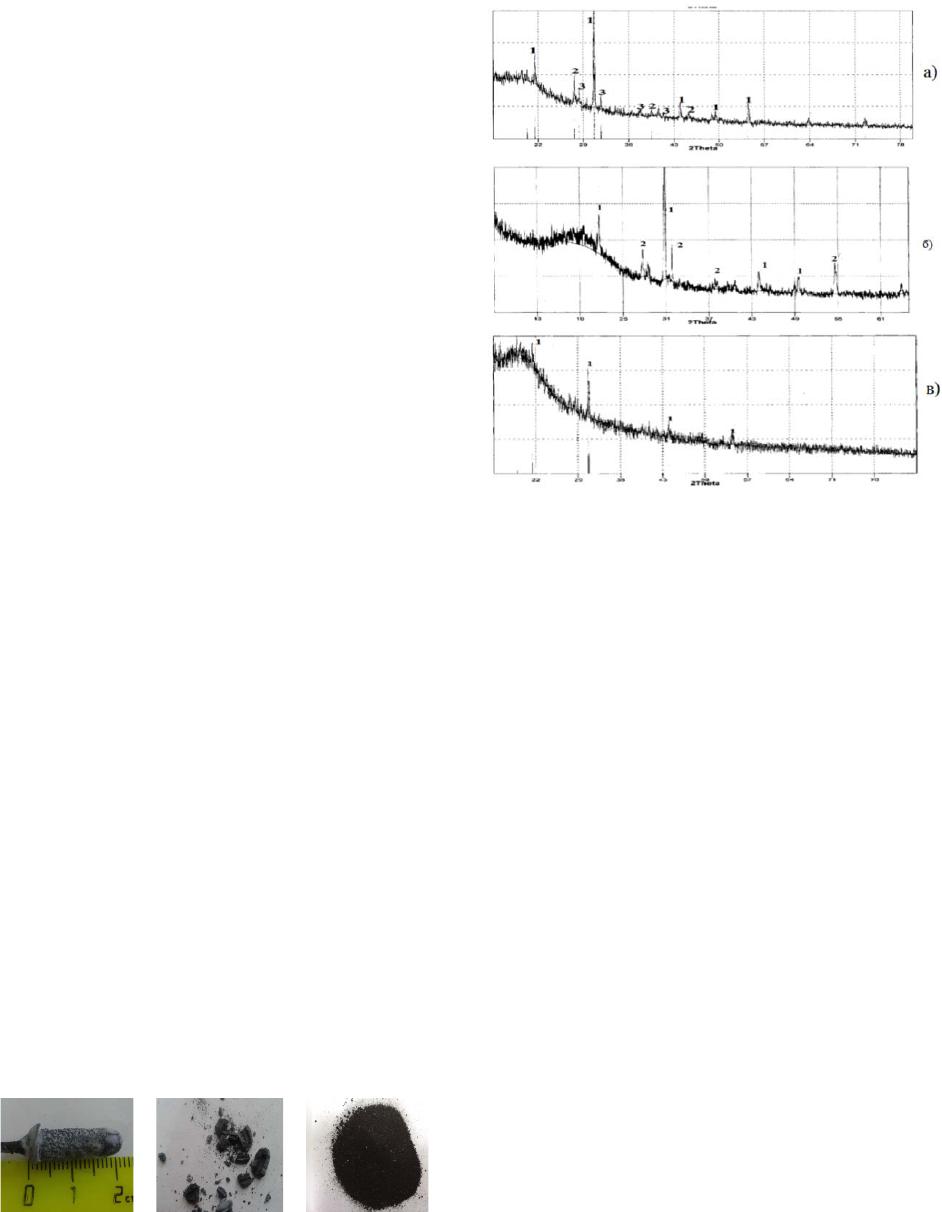 H. B. KUSHKHOV ET AL. OPEN ACCESS MSCE 60 ( ) 6y 3 y CeClF3eCe6y ClyF −− −−− +→ +−+ (2) pq qBpCeCe B+= (3) Results obtained at investigation of the joint electro- reduction of cerium halide ions and tetrafluoroborate ions were taken as a basis for the practical implementation of electrochemical synthesis of cerium hexaborides CeB6. 4. Electrochemical Synthesis of Cerium Borid e The electrosynthesis of cerium borides nanotubes was performed in a molten mixture of NaCl-KCl-CeCl3-KBF 4 at 973 K on tungsten electrode in the range up −2.4 to −2.8 V to relative a quasi-stationary glassy carbon elec- trode. The select of electrolytic bath components was done on the basis of thermodynamic analysis and kinetic mea- surements of joint electrowinning of cerium and boron from halide melts. From the compounds of boron and cerium, which do not contain oxygen, cerium chloride and potassium tetrafluoroborate are fairly low melting point and good solubility in KCl-NaCl melt. This solvent was chosen because the decomposition voltage of the molten mixture KCl-NaCl more stress decomposition melts CeCl3 and KBF4, and because the alkali metal chlorides are highly soluble in water. These properties are necessary to the washing of cerium borides (Figure 5). The individual phase of boron, higher boride CeB6 and the mixture of phases, including CeB4 (Figure 6) were obtained in depending on the composition and the syn- thesis parameters. The purpose of electrosynthesis opti- mization was to obtain higher boride CeB6 with most valuable properties. When we chose the concentration ratios of CeCl3 and KBF4, we take into account the first stage of electro- synthesis, during which the reducing of more electro- positive boron was done. Electroreduction of the cerium was started when KBF4 concentration was ended. In these temperature conditions the optimum concentration of KBF4 is about (1.0 ÷ 1.5) × 10−3 mol/cm3. According to our study, at higher concentrations of KBF4 the cerium borides getting were complicated by instability of cath- ode deposit. (а) (b) (c) Figure 5. “Cathode-salt pear” (a), the product of electroly- sis before washing (b), and the resulting powder after washing (c). Figure 6. Radiographs of cerium boride powder obtained in KCl-NaCl-CeCl3 (3.1 × 10⁻⁴ mol/cm3) KBF4 (6.0 × 10⁻⁴ mol/cm3) melt on tungsten electrode. U = −2.5 B: a) the line 1, CeB6; 2, CeB4; b) 1, CeB 6; 2, CeB4; 3, B. The ceruim borides electrosynthesis was held in po- tentio and galvanostatic modes. It was observed that these modes are not equal. At galvanostatic electrolysis the true value of the current density is known only in the initial period of time, because during electrolysis varies significantly in cathode area. In most cases we used the potentiostatic electrolysis because the voltage (potential) determines the course of the reactions and monitors the reaction of deposition. If the anode material is glassy carbon and the voltage in the bath U < −1.8 V, the cath- ode deposit consists mainly is boron. Provided the volt- age U = −(1.8 - 2.5) V the mixture of different phases (B and CeB4) was obtained. If the voltage U = −(2.5 - 2.8) V, the cathode deposit consists from higher boride CeB6. The duration of the electrosynthesis was affected to the composition of the cathode deposits. The data in Ta- ble 1 show the dependence of the phase composition of the cathode deposits from the duration of electrolysis in the electrolyte of optimal composition, as well as tem- perature and voltage. The optimal duration of the high-temperature electro- chemical synthesis for prepare of CeB6 is 90 - 120 min- utes. Thus, the synthesis of cerium borides was deter- mined by the following interrelated parameters: the composition of the electrolytic bath, the voltage and the temperature. The optimal values of these parameters was as follows: the composition of the melt, wt. %: CeCl3 (3.5 ÷ 7.0), KBF4 (4.5 ÷ 10.0), the rest—mixture of NaCl-KCl; voltage bath −(2.6 ÷ 2.8) V, time electrolysis 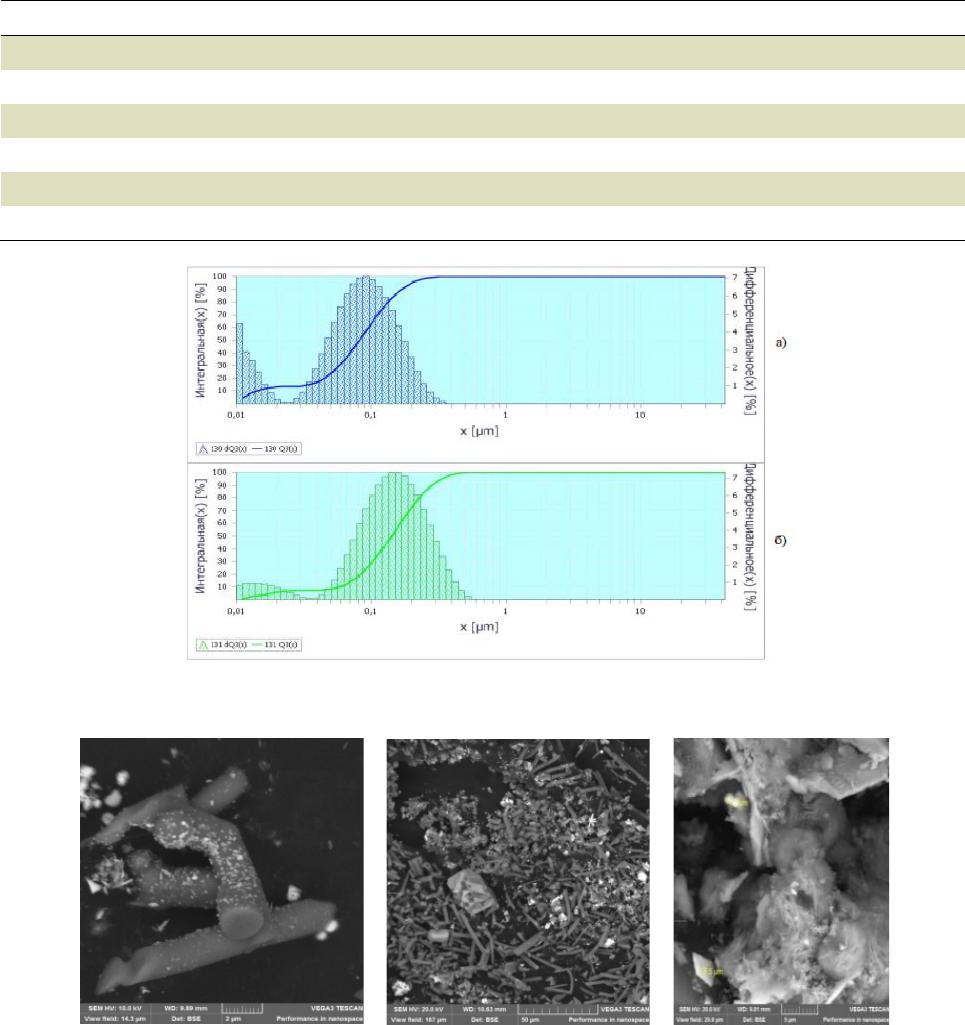 H. B. KUSHKHOV ET AL. OPEN ACCESS MSCE 61 is 90 ÷ 120 min, the temperature is 973 K. Phase composition of the “cathode-salt pears” identi- fied by X-ray analysis using a DRON-6 (Fig ure 7). Particle size was measured by laser diffraction ana- lyzer Fritsch Analysette-22 (Figure 7), and the order of 50 - 100 nm. The surface of the resulting powders have also examined using the digital scanning electron micro- scope Vega 3 TESCAN (Figure 8). The yield of the single-phase CeB6 was 0.20 - 0.30 g/А × hour. Specific surface area of ultra-dispersive pow- ders of CeB6 was 5 - 10 m2/g. Our work was focused on the cathode deposit treat- ment. The comparative radiographs were made before and after different options of the cathode deposit wash- ing. The experiments showed that the best option of powders Table 1. Electrochemical synthesis parameters, T = 973 K, cathode—W. Electrolyte composition, wt.% Voltage E, V Time τ , min Phase Particle size 1) Molar ratio CeCl3:KB F4 = 1:1 NaCl—40.86; KC l —52.01; CeCl3—4.66; KB F4—2.48 −2.5 50 - 100 CeB4 90 - 110 HM 2) Molar ratio CeCl3:KBF4 = 1: 2 NaCl—39.88; KC l —50.75; CeCl3—4.53; KBF4—4.83 −2.6 80 - 100 CeB6 50 - 70 HM 3) Molar ratio CeCl3:KB F4 = 1:5 NaCl—37.39; KC l—47.59; CeCl3—4.25; KBF 4—10.76 −2.7 90 - 100 CeB6 70 - 90 HM Figure 7. Particle size distribution obtained by the electrochemical synthesis of 973K melt composition, wt.%: KCl (39.92) - NaCl (50.8)-KBF4 (4.57)-CeCl3 (4.68); i = 0.3 A/cm2. Figure 8. SEM images of the CeB6.  H. B. KUSHKHOV ET AL. OPEN ACCESS MSCE 62 washing was the washing in distilled water, post-treat- ment with ammonium hydroxide solution and washing by KF than distilled water by decantation and centrifuga- tion then by washing with double-distilled water. Thus, to obtain reliable information on the phase composition of the synthesized compounds by electroly- sis and the possibility of direct electrochemical synthesis CeB6 nanotubes in halide melts. 5. Conclusion The joint electroreduction of tetrafluorborate and ce- rium-ions was conducted in equmolar NaCl-KCl melt on tungsten electrode at 973 K by cyclic voltammetry. The analysis of voltammograms was shown that the electro- synthesis in studied systems proceeds in the kinetic mode because reducing potentials of boron and cerium is very different. The resul ts of this research found that under certain conditions, the concentrations of cerium and bo- ron and certain anionic composition of the melt are pos- sible for their joint electroreduction. Synthesis of cerium borides nanotubes was carried out by potentiostatic electrolysis of molten KCl-NaCl, con- taining CeCl3 and KBF4. Electrolysis performed on tung- sten electrode in the range of −2.4 to −2.8 V relatively of the quasi-stationary glassy-carbon electrode. The influ- ence of the electrolyte composition, temperature, current density, voltage and the duration of electrolysis on the synthesis products was studied. An optimal parameter for getting cerium boride CeB6 nanotubes was found. Acknowled gements The work was done using equipment of Access Center “X-ray diagnosis of materials” with the financial support of the Ministry of Education and Science of Russian Fed- eration, the state contract No. 16552.11.7074. REFERENCES [1] G. V. Samsonov and Y. B. Paderno, “Borides of Rare- Earth Metals,” Kiev. Publishing House “SA USSR”, 1961. [2] P. Taxil, P. Chamelot, L. Massot and C. Hamel, “Elec- trodeposition of Alloys or Compounds in Molten Salts and Applications,” Journal of Mining and Metallurgy, Vol. 39 , No. 1-2B, 2003, pp. 177-200. [3] G. V. Samsonov, “Refractory Compounds of Rare-Earth Metals and Non-Metals,” Publishing House Metallurgie, Moscow, 1964, pp. 53-55. [4] M. K. Vindizheva, R. A. Karashaeva, S. A. Shermetova, et al., “The Investigation of Mechanism of Joint Elec- troreduction Cerium-Ionsand Fluoroborate-Ions in NaCl- КCl-CsCl Melt,” Scientific Works of Young Scientists, Nalchik, 2006, pp. 293-295. [5] Kh. B. Kushkhov, M. K. Vind i zhe va, R. A. Mukozheva and M. R. Tlenkopachev, “The High Temperature Elec- trochemical Syntheses of Refractory Compounds of Sa- marium and Boron in Halide Melts,” Izvestiya KBSU, Vol. 1, No. 2, 2011 , pp. 29-34. [6] Kh. Kushkhov, M. Vindizh e va, R. Mukozheva, M. Na- fonova and M. Tlencopachev, “The Electrochemical Syntheses of Lanthanum Borides in Halide Melts,” Ma t e- rials of XV Russian Conference of Physical Chemistry and Electrochemistry Molten Salts and Solid Electrolytes, Nalchik, 2010 , pp. 181-18 2 [7] O. V. Chemezov, “Electrochimiskoe Povedenie Bora v Khloridnih I Khloridno-Ftoridnih Rasplavah,” Avtoref. diss. kand. chim. Nauk, Sverdlo vsk, 1987, 17 p. [8] V. Danek, L. Vot ava and B. Matisovsky, “Reactions of Potassium tetrafluorocborate in Molten Alkali Chlorides,” Chem. Izvestiya, Vol. 30, 1976, pp. 377-383. [9] L. P. Polyakova, G. A. Bukato va , E. G. Polyakov, E. Christensen, J. H. von Barer and N. J. Bjerrum, “Electro- chemical Behaviour of Boron in LiF-NaF-KF-Melts,” Journal of The Electrochemical Society, Vol. 143, No. 10. 1996, pp. 3178-3186 . http://dx.doi.org/10.1149/1.1837184 [10] P. Fellner, M. Makita, K. Matisho vs ki and A. Silny, “The Mechanism of Kathodic Process at Electrodeposition of Boron from Ionic Melts,” V Conference of Socialist Countries in Chemistry of Ionic Melts, Kiev, 1984, p. 43. [11] F. A. Shank, “Structure of Double Alloys,” Metallurgy Ltd., Moscow, 1973, p. 45. [12] S. A. Kuznetsov, H. Hayashi, K. Minato and M. Gaune- Escard, “Electrochemical Behavior and Some Thermo- dynamic Properties of UCl4 and UCl3 Dissolved in a LiCl-KCl Eutectic Melt,” Journal of The Electrochemical Society, Vol. 152, 20 05 , p. 203. http://dx.doi.org/10.1149/1.1864532 [13] S. A. Kuznetsov and M. Gaune-Escard, “Kinetics of Electrode Processes and Thermodynamic Properties of Europium Chlorides Dissolved in Alkali Chloride Melts,” Journal of Electroanalytical Chemistry, Vol. 595, 2006 , p. 11. http://dx.doi.org/10.1016/j.jelechem.2006.02.036 [14] S. A. Kuznetsov, “Molten Salts: From Fundamentals to Applications,” M. Kluwer Acad. Publ., Norwell, Vol. 52, 2002, p. 283. |