

Paper Menu >>
Journal Menu >>
 Journal of Materials Science and Chemical Engineering, 2014, 2, 13-19 Published Online January 2014 (http://www.scirp.org/journal/msce) http://dx.doi.org/10.4236/msce.2014.21003 The Effect of Pressure on the Synthesis of Graphene Layers in the Flame N. G. Prikhodko*, M. Auyelkhankyzy, B. T. Lesbayev, Z. A. Mansurov The Institute of Combustion Problems, Almaty, Kazakhstan Email: *ni [email protected] Received October 2013 ABSTRACT The results of the study of the formation of graphene layers in the flame in premixed flame propane or bu- tane-oxygen mixture on a nickel substrate at atmospheric pressure and low pressure are given. The influence of the ratio C/O and supply quantity of argon on the formation of graphene layers were researched. It is shown that in the flame of propane and butane on a nickel substrate is observed under these conditions the formation of predominantly 3 - 10 layers of graphene. KEYWORDS Graphene; Propane; Butane; Flame; Substrate; Pressure 1. Introduction Graphene has extremely useful properties: extremely high carrier mobility, high electrical and thermal conduc- tivity, the dependence of electronic properties on the presence on the surface of graphene added radicals of different nature, and others [1,2]. Application of gra- phene due to its unusual properties may run as a basis for new nanomaterials with improved mechanical, electrical and thermal characteristics, as well as an element of nanoelectronic devices. Graphene layers prepared by different methods: mechanical splitting of the graphite layers, graphite bundle liquid phase oxidation of graphite etc. [1-3]. A promising method of producing graphene layers is the method of synthesis of graphene in flames. The studies [4,5] confirm that the process of obtaining a flame graphene can not compete with a number of exist- ing methods. The process of formation of graphene in a flame is continuous, rapid, and inexpensive. This paper presents the results on the synthesis of graphene layers in premixed hydrocarbon flames on a nickel catalyst substrate under various conditions. 2. Experimental The synthesis layered graphene layers was performed in the premixed flame-propane and butane-oxygen mixture at atmospheric pressure, with the addition of argon. Ar- gon was fed in an amount of 150, 250, 350, 450 and 500 cm3/min. The substrate used a nickel plate of thickness of 0.2 mm, which was placed in the center of the burner flame. For more output graphene, the plate is rolled up into a cylinder. Between the edges of the plate, rolled into a cylinder, leaving the gap size of 2 - 3 mm, which creates the conditions for the formation of gross graphene and on the inner surface of the cylinder. Photography generic flames arranged there in a substrate catalyst are shown in Figure 1. The residence time in the flame of the plate was 5 minutes. Flame temperature depends largely on the amount of feed argon and the ratio C/O. Due to the fact that placing the substrate in its flame temperature is re- duced to 30˚C - 50˚C due to the heat dissipation plate and the holder, the initial flame temperature exhibited within 950˚C - 970˚C. The flame temperature in the catalytic synthesis of graphene on a substrate maintained within 900˚C - 920˚C. Study of the formation of layered graphene layers per- formed at a constant flow rate of propane or butane—219 cm3/min. In order to obtain the desired ratios C/O un- changed oxygen consumption, the values of which are given in Table 1. The study produced by the catalytic substrate particu- late soot of structures was performed on Raman spec- trometer NTEGRA Spectra at a wavelength λ = 473 nm. The presence of graphene layers was evaluated by the presence of three characteristic peaks have: a first peak D * Corresponding author. OPEN ACCESS MSCE 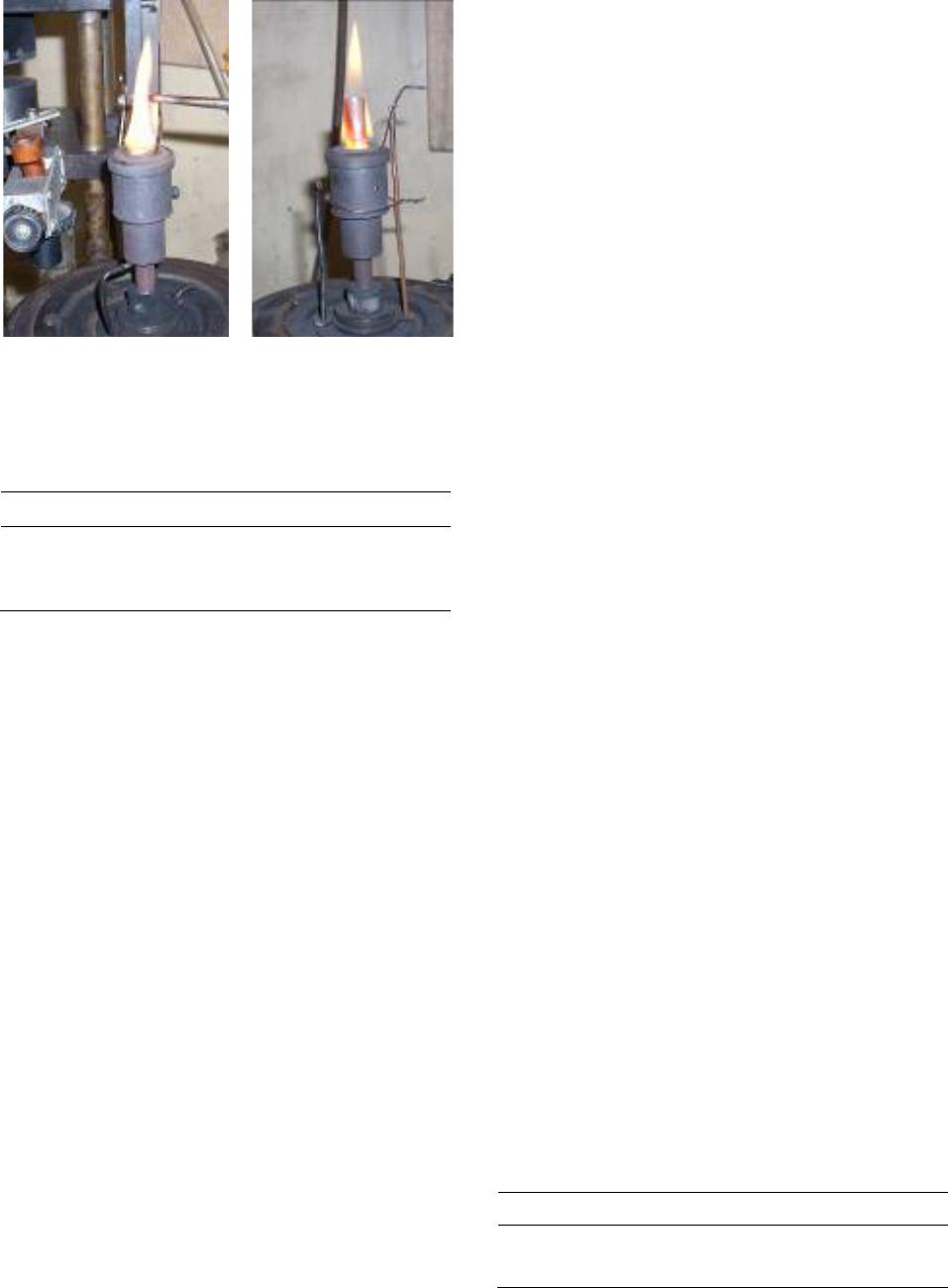 N. G. PRIKHODKO ET AL. 14 (а) (b) Figure 1. The photo of flames with a catalyst substrate: (a) plate, (b) cylinder. Table 1. The flow rate of oxygen depends on the type of fuel to obtain the desired ratio С/О. The value of С/О 0.75 0.85 0.95 1.05 Consumption of О 2 for С3Н8, cm3/mi n 438.2 386.6 345.9 313.0 Consumption of О 2 for С4Н10, cm3/mi n 584.3 515.5 461.3 417.3 at 1351 cm−1, G second peak at 1580 cm−1 and 2D third peak at 2700 cm−1. The ratio between the intensity of the G peak (IG) and 2D peak (I2D) gives an estimate of the number of layers (IG/I2D). For a mono-layer of graphene and this ratio is less than unity. Raman spectroscopy has allowed to establish the presence of layered graphene films, as well as to evaluate the quality of the graphene layers. 3. Results The experimental results in the synthesis of the graphene layers of the premixed combustion of propane and bu- tane-oxygen mixtures at various ratios of С/О are shown below. Argon consumption in all experiments was con- stant and equal to 250 cm3/min. The Results obtained minimum ratio IG/I2D, characterize the amount of gra- phene layers on the substrate depending on the fuel source and the ratio C/O, are given in Table 2. It is stated that preferably in the flame of propane and butane is observed under these conditions the formation of graphene layers in an amount of 5 - 10 layers. The results of Ram an spectroscopic studies of soot samples are shown in Figures 2 and 3. It is found that the graphene layers are formed inde- pendently of the type of fuel in the studied range of ratios С/О with a pronounced peak of graphite G. The tendency for increasing the degree of disorder of the graphene lay- ers with increasing ratio of С/О, which is characterized by an increase in the peak intensity D. For propane- oxygen mixture degree of disorder is observed at a higher ratio of С/О than for butane-oxygen mixture. However, butane-oxygen mixture at a ratio of С/О = 0.95 was ob- tained the minimum number of graphene layers (three layers, IG/I2D = 1.3, Table 2). It was studied the effect of argon flow on the synthesis of graphene layers in its submission to the propane or butane-oxygen flames. Feed argon flame affects its tem- perature. There is a process of lowering the temperature of the flame adjustment to the values of 950˚C - 970˚C, which is most favorable for the synthesis of graphene layers. It was necessary to determine the flow rate of argon, the most favorable for the synthesis of graphene at different combustion conditions. It is found that when the ratio of С/О = 0.75 for pro- pane-oxygen flame increases in argon from 150 cm3/min to 500 cm3/min not activate the process of the formation of graphene layers, and leads to the formation of pre- dominantly amorphous soot structure. However, the ar- gon flow rate 150 cm3/min there is a clear graphitized structure that is characterized by the presence of three peaks characteristic of the graphene layers, Figure 4. The research for propane-oxygen flame at a ratio of C/O = 1.05 at different flow rates of argon showed the presence of layers of graphene, but with the presence of disorder, which is characterized by a peak of D greater intensity. When the ratio of C/O = 1.05 with filing 150 cm3/min argon on nickel substrate in propane-oxygen flame is observed the formation of a minimum number of graphene layers (three layers—IG/I2D = 1.3). For butane-oxygen flame at C/O = 0.75 increase in argon does not lead to the formation of a particulate amorphous structure. With increasing argon flow rate at C/O = 0.75 in butane-oxygen flame is observed the for- mation of graphene layers, and even a minimal amount of Figure 5 (три слоя—IG/I2D = 1.3). As a result, studies have found that as the ratio of C/O trend increases in the degree of disorder of graphene lay- ers, which is characterized by an increase in the peak intensity D. For propane-oxygen mixture degree of dis- order is observed at a higher ratio of C/O than for butane- oxygen mixture. It is shown that the formation of gra- phene layers, the optimal value is the ratio of С/О = 0.85 - 0.9 and the flow of argon in the amount of 150 - 250 cm3/min. Table 2. The minimum ratio IG/I2D depending on the ratio of C/O and type of fuel. The value of the ratio, С/О 0.75 0.85 0.95 1.05 Propane, IG/I2D 2.2 1.8 1.5 1.9 Butane, IG/I2D 1.5 2.0 1.3 1.6 OPEN ACCESS MSCE 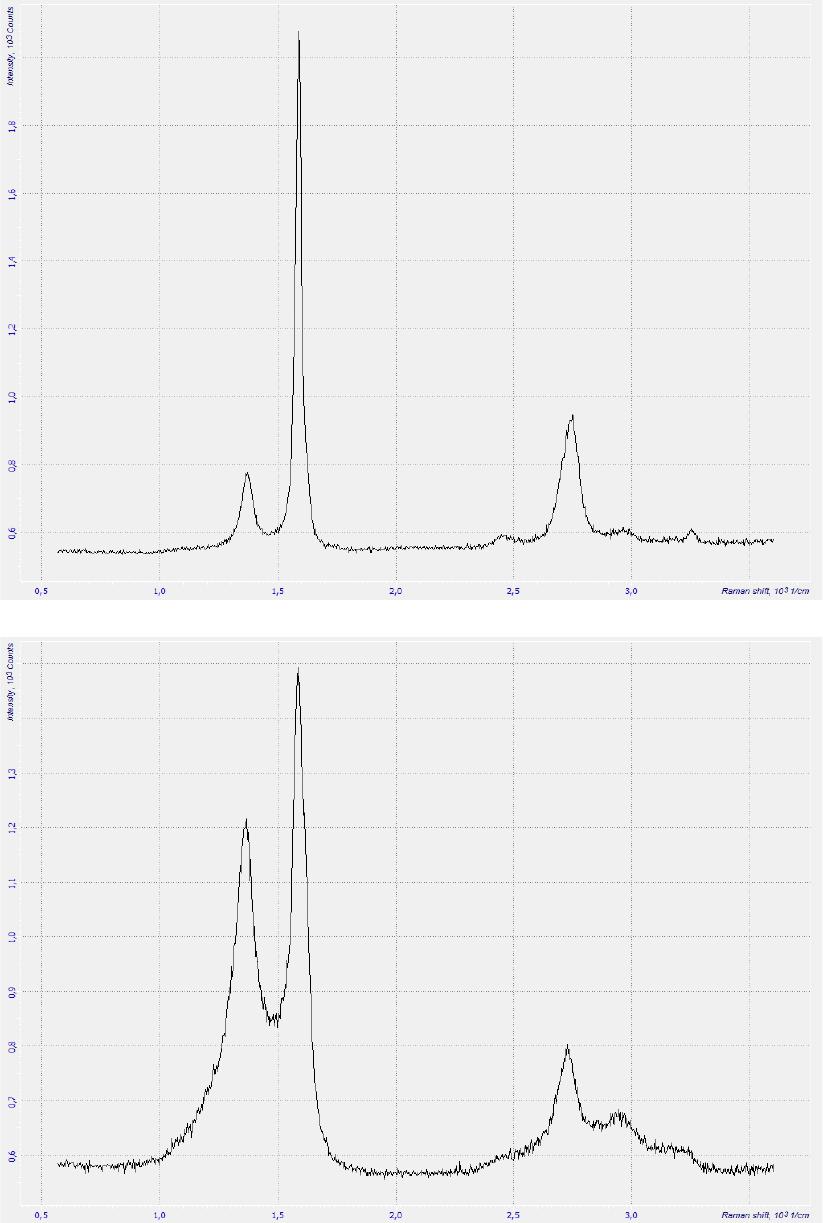 N. G. PRIKHODKO ET AL. 15 (а) (b) Figure 2. Raman spectra of graphene layers on a nickel substrate obtained in propane-oxygen-argon flame at values of С/О: (а) С/О = 0.75 (IG/I2D = 2.2); (b) С/О = 1.05 (IG/I2D = 1.9). OPEN ACCESS MSCE 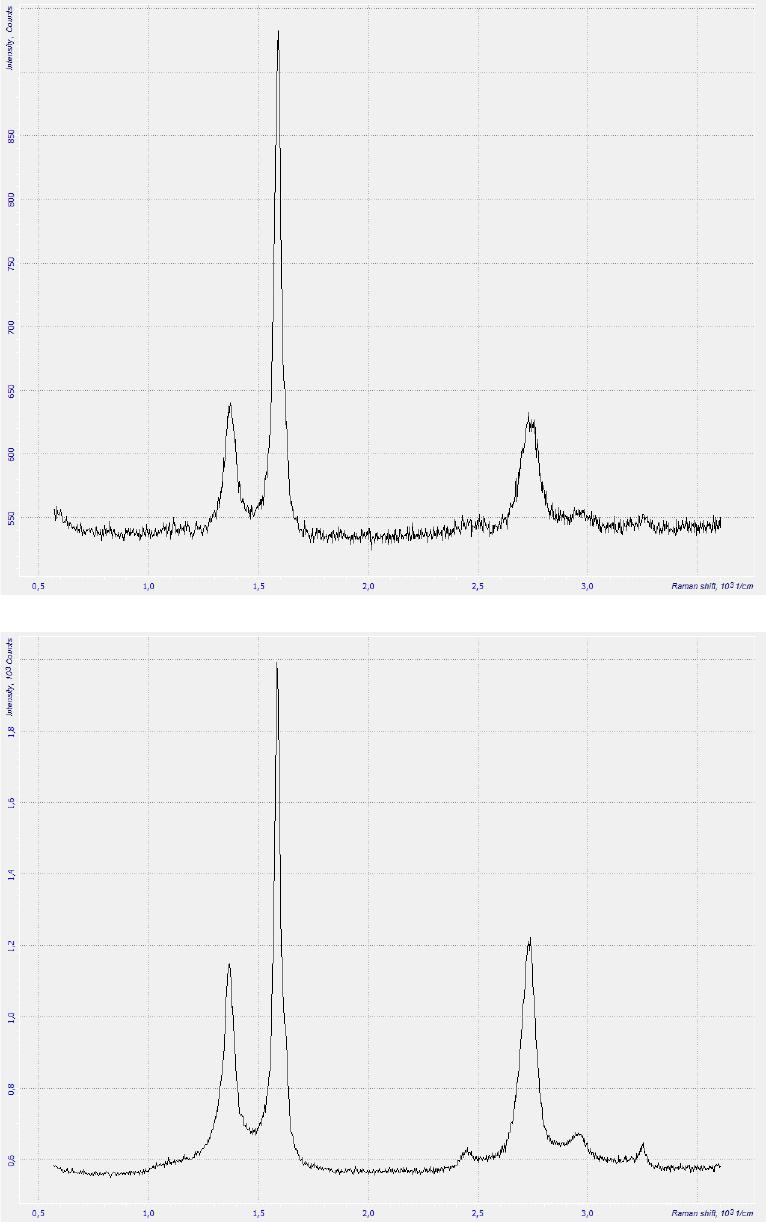 N. G. PRIKHODKO ET AL. 16 (а) (b) Figure 3. Raman spectra of graphene layers on a nickel substrate obtained in the butane-oxygen-argon flame at values of С/О: (а) С/О = 0.75 (IG/I2D = 1.5); (b) С/О = 1.05 (IG/I2D = 1.6). OPEN ACCESS MSCE 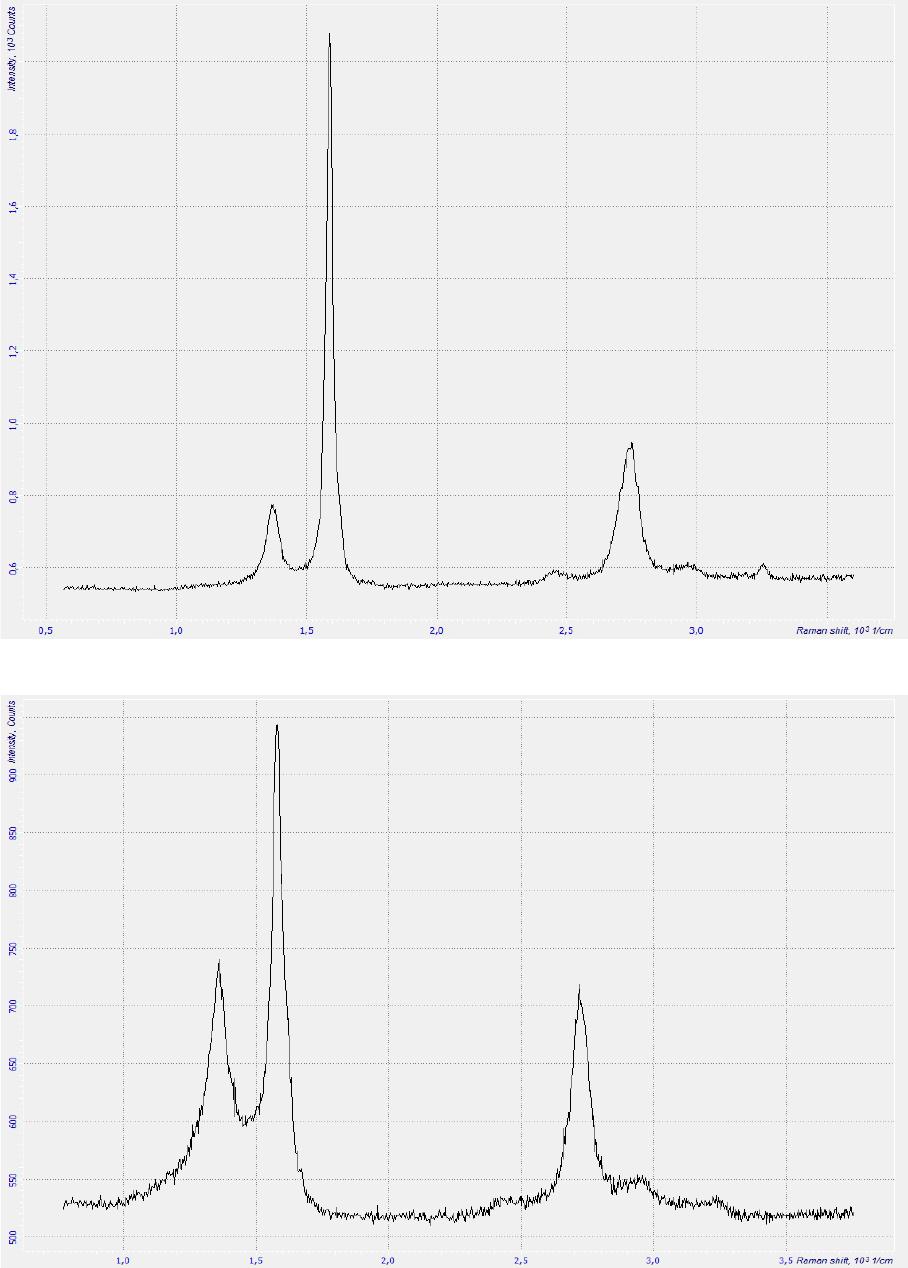 N. G. PRIKHODKO ET AL. 17 Figure 4. Raman spectrum of graphene layers: Ni, C3H8/O2/Ar, С/О = 0.75, the flow of argon 150 cm3/min (IG/I2D = 2.2). Figure 5. Raman spectrum of graphene layers: Ni, C4H10/O2/Ar, С/О = 0.75, the flow of argon 500 cm3/min (IG/I2D = 1.3). OPEN ACCESS MSCE 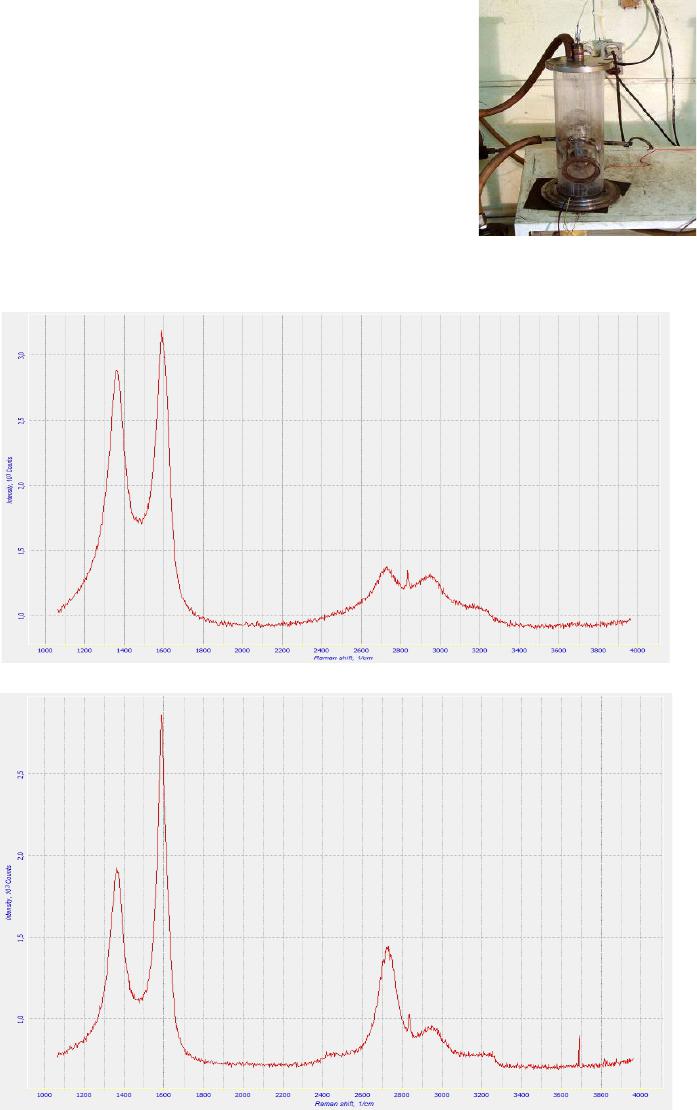 N. G. PRIKHODKO ET AL. 18 The studies of the formation of layered graphene fil ms were premixed fla me in butan-argon-oxygen mixture at a pressure of 60 - 100 Torr . For this purpose, the burner as depicted in Figure 6, was placed in a quartz tube in which an initial vacuum is created 5 Torr. The experi- ments were performed in the following conditions: flow of butane −200 сm3/min, the flow rate of oxygen −450 сm3/min, corresponding to the ratio С/О = 0,89. Argon was fed in an amount of 250 сm3/min. As the catalyst substrate applied plate made of copper and nickel. The flame temperature in the experiments was in the range of 900˚C - 950˚C. The residence time in the flame plate was 5 minutes. Photo of the burner to carry out research on the synthesis of graphene layers in the flame at low pressure is shown in Figure 6. At the expiration of this time, the substrate deduced from the flames. Then, the system switched off, the pressure was increased to atmospheric pressure, the sub- strate is removed for further study. The results of studies of soot samples on Raman spectrometer are presented in Figure 7. It is found the formation of graphene layers Figure 6. Photo of the burner for the synthesis of graphene layers in the flame at low pressure. (а) (b) Figure 7. Raman spectra of graphene layers formed in a flame at a pressure of 80 Torr: (a) on the copper substrate, (b) on the nickel substrate. OPEN ACCESS MSCE  N. G. PRIKHODKO ET AL. 19 occurs at a low pressure as copper (Figure 7(а)), and nickel substrates (Figure 7(b)). On a copper substrate at the given experimental condi- tions produced graphene layers, characterized by peaks D (1354 cm−1), G (1587 cm−1) and 2D (2711 cm−1), Figu re 7(а). Attitude IG/I2D = 3192/1360 = 2.4 characterized by the presence of more than two substrate layers graphene. On a nickel substrate formed graphene layers, character- ized by peaks D (1354 cm−1), G (1580 cm−1) and 2D (2700 cm−1), Figure 7(b). Attitude IG/I2D = 2682/1352 = 2.0 characterized by the presence on the substrate more than two graphene layers. Comparison of Raman spectra of carbon structures formed on copper and nickel substrates, shows that on a nickel substrate formation of graphene layers are more intense than on the copper substrate. It is characterized by more pronounced peaks with a smaller shift of Raman scattering (F igure 7(b)). REFERENCES [1] K. S. Novoselov, A. K. Geim, S. V. Morozov, et al., “Two-Dimensional Gas of Massless Dirac Fermions in Graphene,” Nature, Vol. 438, 2005, pp. 197-200. http://dx.doi.org/10.1038/nature04233 [2] A. K. Geim and K. S. Novoselov, “The Rise of Graphene,” Nature Materials, Vol. 6, 2007, pp. 183-191. http://dx.doi.org/10.1038/nmat1849 [3] A. Dato and M. Frenklach, “Substrate-Free Microwave Synthesis of Graphene: Experimental Conditions and Hy- drocarbon Precursors”, New Journal of Physics, Vol. 12, 2010, pp. 125013-37. http://dx.doi.org/10.1088/1367-2630/12/12/125013 [4] Z. Li, H. Zhu, D. Xie, et al., “Flame Synthesis of Few- Layered Graphene/Graphite Films,” Chemical Commu- nications, Vol. 47, 2011, pp. 3520-3522. http://dx.doi.org/10.1039/c0cc05139j [5] N. K. Memon, S. D. Tse, J. Fet. Al-Sharab, et al., “Flame Synthesis of Graphene Films in Open Environments,” Carbon, Vol. 49, 2011, pp. 5064-5070. http://dx.doi.org/10.1016/j.carbon.2011.07.024 OPEN ACCESS MSCE |