

Paper Menu >>
Journal Menu >>
 Journal of Materials Science and Chemical Engineering, 2014, 2, 7-12 Published Online January 2014 (http://www.scirp.org/journal/msce) http://dx.doi.org/10.4236/msce.2014.21002 OPEN ACCESS MSCE Microwave-Assisted Modification of Carbon Nanotubes with Biocompatible Polylactic Acid Qi Zhang, Shijun Zhang, Liying Zhang Beijing Research Institute of Chemical Industry, SINOPEC, Beijing, China Email: [email protected] Received October 2013 ABSTRACT Polylactic acid (PLA) was successfully covalently grafted onto multi-walled carbon nanotubes (MWCNT) by mi- crowave-assisted polymeriza tion of lactide monomers. The final products MWCNT-g-PLA were characterized with Fourier-transform IR (FTIR), Raman spectroscopy, thermogravimetric analyses (TGA) and transmission electron microscopy (TEM). The results indicated PLA chain was covalently attached to the MWCNT. The grafted PLA was uniformly coated on the surface of MWCNT with a layer thickness of 2 ~ 6 nm. The grafted PLA content could be controlled by microwave irradiation time and the concentrations of reactant. The product with 60.5% grafted PLA content can be synthesized in one hour. KEYWORDS Mult i-Walled Carbon Nanotubes; Polylactic Acid; Microwave; Biocompatible 1. Introduction Since the discovery of carbon nanotubes (CNTs) in the early 1990 [1], their unique atomic structure, very high aspect ratio and outstanding physical and chemical prop- erties have attracted great attention and i magi na ti o n of many scientists. As known to all, carbon nanotubes pos- sess high flexibility, low mass density, and large aspect ratio (typically > 1000), whereas they present extraordi- nary high tensile strength and modul us , together with excellent electrical properties [2,3]. The unique proper- ties of CNT offered many opportunities for their applica- tions such as reinforcement of fibers and nanocomposites, field-emission displays and nanosize probe tips for atomic force microscopy. However, the super amphipho- bic property of carbon nanotubes is still the fundamental and technical barriers toward expanding many of the applicatio ns [4]. The inherent insolubilit y and aggrega- tion of CNT in polymer composites prevent efficient stress from transferring to individual nanotubes and have a bad effect on efficiency usage of its properties [5]. Therefore, many researches on covalent and noncovalent modification of CNT have been made to realize the we l l dispersion of individual nanotubes and establish a strong chemical affinity with the surrounding polymer matrix [6-8]. The noncovalent approaches include surfactant modification [9-14], polymer wrapping, [15,16] and polymer absorption [17,1 8] . The covalent functionaliza- tion of CNT is usually realized by grafting polymer or long alkyl chains onto CNT [ 19 -23]. Since the environmental pollution and the exhaustion of petroleum resources become critical issues, Polylactic acid (PLA) has been spotlighted as a biodegradable, sus- tainable and eco-friendly substituent for petroleum-based polymers [24,25]. Accordingly, the combination of PLA with CNT will broaden the novel application of carbon nanotubes. Several researchers have prepared PLA- functionalized CNTs via “grafting from” and/or “grafting to” methods. Chen et al. [26,27] synthesized PLA func- tionalized CNTs by reacting functional group COCl on the surface of CNTs with different weight molecular PLA or using the surface initiating ring-open polymeri- zation of L-lactide. Song et al. have prepared CNT-g- PLAs by polycondensation of L-lactic acid with carbox- ylic acid-functionalized CNT in xylene solution. [28] Feng et al. reported that the PLA was covalently grafted onto the surface of magnetic multiwalled carbon nano- tubes (m-MWCNTs) by in-situ ring-opening polymeriza- tion of lactide [21]. However, the conventional heating route to prepare the PLA grafted carbon nanotubes re- quired strict conditions (vacuum, high temperature and long reaction time) which are obviously not good for commercially application. In this paper, we present microwave-assisted method to realize the grafting of PLA onto multi-wall carbon Q. ZHANG ET AL. OPEN ACCESS MSCE 8 nanotubes (MWCNT). The MWCNT was first treated by acid to gain an active COOH group on the surface, and then acid-functionalized MWCNT (MW C NT-COOH) induced in-situ polycondensation of lactide together with SnOct 2. The grafting and polymerization rate were much faster than that of conventional heating. We investigated the morphology and structure of the final grafting prod- uct. In addition, the influences of reaction conditions were discussed further. 2. Experimental Section 2.1. Mat eri als The multi-walled carbon nanotubes (MWCNT s) (>98%, with an outside diameter of 20 - 30 nm, an inside diame- ter of 5 - 10 nm, and lengths of 10 - 30 mm) were pur- chased from Cheaptubes Co.Ltd, USA, and used as re- cived. D, L-Lactide (Aldrich) and Stannous octoate (Sn(Oc t) 2, 98%, Sinopharm Chemical Reagent Co. Ltd.) were used as received. Sulfuric acid, nitric acid, metha- nol, chloroform, and N, N-dimethylformatide (DMF) as well as other chemicals were purchased from Aldrich and used without further purification. 2.2. Acid Treatment of MWCNT The acid-funct i o nal ized multi-wall carbon nanotube (MW CNT -COOH) was prepared from the pristine MWCNT as the previous report [29]. MWCNTs were treated with a mixture of concentrated sulfuric and nitric acids (volume 3:1). The mixture was ultrasonicated (power of 60 W and nominal frequency of 40 kHz at am- bient temperature) for 30 min, and then magnetically stirred at 80˚C for 4 h. After the mixture was cooled to room temperature, it was diluted with deionized water and then vacuum-filtered through 0.22 mm Millipore polypropylene membrane, and washed with distilled wa- ter until the pH value was moderate (~ ca. 7). The filtered product was dried under vacuum for 24 h at 60˚C, giving the acid-functionalized MWCNT-COOH. The amount of carboxylic acid groups of MWCNT-COOH prepared in this study was determined to be 0.0023 mol per 1.0 g MWCNT. 2.3. Microw ave-Assisted Functionalization of MWCNT-COOH with PLA The apparatus used for the polymerization was a do me- stic microwave oven (Me ilin g, China, 2450 MHz and 800 W). A mixture of purified MWCNT-COOH, La cti de and catalyst stannous chloride as well as a certain amount solvent DMF in an open beaker was first ultraso nicate d for 30 min and then irradiated at the microwave power of 200 W for some period of time. Then the crude product was cooled to room temperature and washed several times by chloroform and precipitated in methanol, and the precipitate was dried under vacuum for 12 h at 60˚C to gain the final product MWCNT-g-PLA. 2.4. Characterization of MWCNT-g-PLA Fourier transform infrared (FTIR) spectra (collected from a Bruker Tensor 27 FTIR system) were used to chara- cterize the molecular structure. The samples of nano- composites were imbedded in KBr disks. Raman spectra used to confirm the structure of MWCNTs operating at 514 nm with a resolution of 1.5 cm−1. Transmission elec- tron microscopy (TEM) images were examine d using a FEI Tecnai-20 instrument operated at a 100 kV accele- rating voltage to observe the nanoscale structures of the various MWCNT -g-PLA. Thermogravimetric analysis (TGA) was conducted in nitrogen atmosphere. MWCNT and MWCNT-g-PLA were heated at a heating rate of 10˚C/min from 50˚C to 500˚C, to determine the graft content of PLA. 3. Result and Discussion PLA is grafted from the surface of MWCNT -COOH by the microwa ve-assisted ring opening polymerization of lactide monomers. It’s reported that, in the pristine state, Sn(Oc t) 2 does not contain any reactive alkoxide groups and that the alcohol employed usually as coinitiator sub- stitutes at least one of the octanoate groups in a rapid equilibration, and the resulting Sn alkoxide is then the true initiator of the polymerization process [18]. There- fore, in our study, the polymerization is initiated by Sn(Oc t) 2 together with hydroxyl which is actually con- tained by carboxylic acid group on the surface of MWCNT-COOH. 3.1. FT-IR Spectra In our investigation, we focused on the structure analysis and characterization and the effect of reaction conditions on the grafting rate of final product MWCNT-g-PLA . The FTIR spectra of MWCNT and MWCNT-g-PLA were shown in Figure 1. The spectrum of MWCNT- COOH presented a relatively weak peak at 1750 cm−1 which corresponds to the incorporated carboxylic acid groups as a result of the acid treatment process. After polymerization, the spectrum of MWCNT-g-PLA sample showe d relatively strong absorption peaks around 1750 cm−1 assigned to the C=O stretching, which clearly indi- cated that the PLA molecules were covalently bound to the MWCNTs. 3.2. Raman Spectroscopy Raman spectroscopy is a powerful tool used for the characterization of functionalized CNTs. As shown in 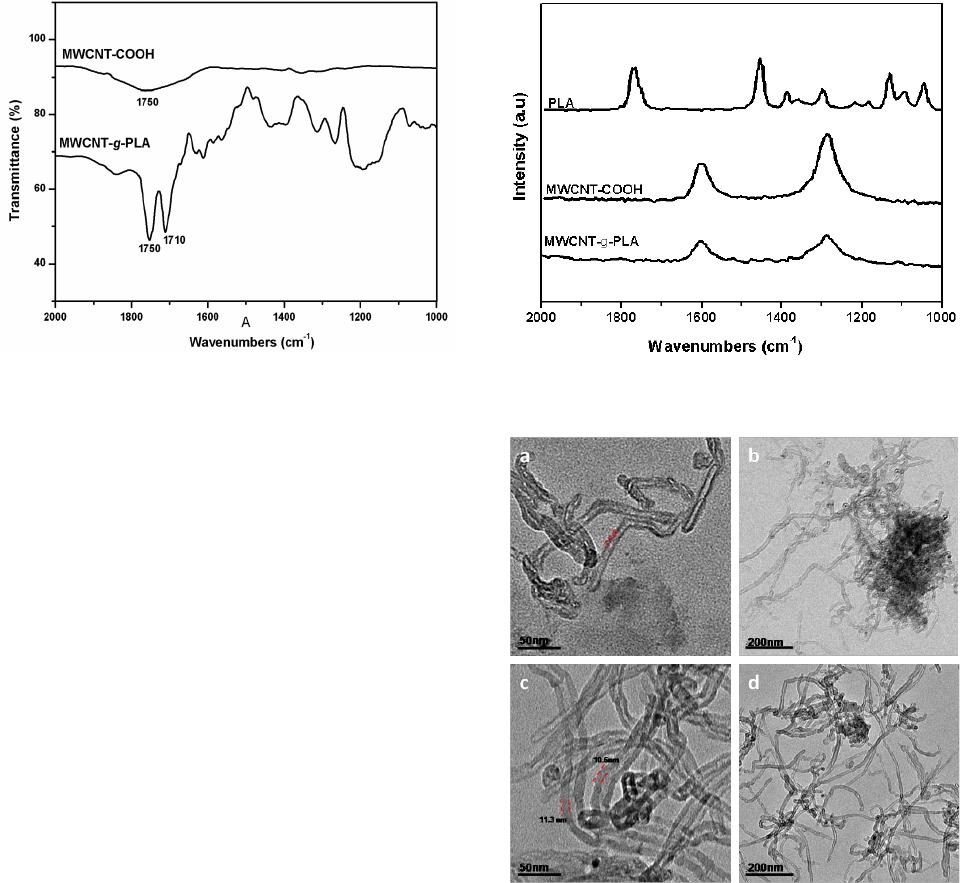 Q. ZHANG ET AL. OPEN ACCESS MSCE 9 Figure 1. FTIR spectra of MWCNT-COOH and MWCNT- g-PLA. The IR sample of MWCNT-g-PLA was prepared by irradiating at the microwave power of 200 W for 60 min, [LA]/[COOH] = 20,[LA]/[Sn(Oct)2] = 2000 . Figure 2, the D and G bands of the MWCNTs at 1285 and 1600 cm−1 which are attributed to the defects and disorder-induced peaks and tangential-mode peaks were clearly observed in both MWCNT-COOH and MWCNT- g-PLA spectrums. The intensity of MWCNT-g-PLA was greatly decreased than that of MWCNT-COOH. Mea n- while, the Raman signals of neat PLA were not found in the spectrum of MWCNT-g-PLA. That result possibly can be related to the structure change of MWCNT [27]. After covalently fictionaliza tion, the polymer chains grafted to the MWCNT surface formed nanometer-scale layer. The energy transfer between the MWCNT and PLA layer as well as the effect of grafted PLA chains on the electronic properties of the MWCNT induced the changes of the Rama n s i g nals. 3.3. Mor p hologies A further certification of grafting PLA onto MWCNT was determined by transmission electron microscopy. The fine nanostructures of the as-prepared MWCNT-g- PLA as well as the acid-functionalized CNT were shown in Figure 3. The images clearly show that the surface morphology of MWCNT-g-PLA is significantly different, by contrasting with MWCNT-COOH. The diameter marked in the image is ~30 nm. In the TEM images of MWCNT-COOH (Figure 3 (a), (b)), the CNT wall was relatively smooth and clean and was not obviously cov- ered with an extra phase. After grafting PLA from MWCNTs, a relatively rough polymer layer can be easily distinguished , with a thick ness of 2 ~ 6 nm. With high magnifications, it could be seen that a homogeneous shell had formed on all of the surface s of MWCNTs. Fur- thermore, the original length and pattern of MWCNTs remain intact after a series of chemical treatments, which Figure 2. Raman spectra of PLA, MWCNT-COOH and MWCNT-g-PLA samples. Figure 3. TEM images of MWCNT-COOH and MWCNT- g-PLA at different magnifications. (a) MWCNT-COOH (high magnification), (b) MWCNT-COOH (low magnifica- tion), (c) MWCNT-g-PLA (high magnification) and (d) MWCNT-g-PLA (low magnification). can be identified in Figure 3(d). 3.4. Grafting Content of MWCNT-g-PLA To evaluate the content of grafted PLA, thermogr avime- tric analysis (TGA) of MWCNT -COOH and MWCNT - g-PLA was performed in Figure 4. For MWCNT-COOH, more than 95 wt% was retained when heated over a tem- perature range of 50˚C ~ 500˚C. However, the MWCNT- g-PLA exhibited major weight loss in the temperature range of 300˚C ~ 400˚C, this is approximately caused by the degradation of the PLA grafted on to the MWCNTs. 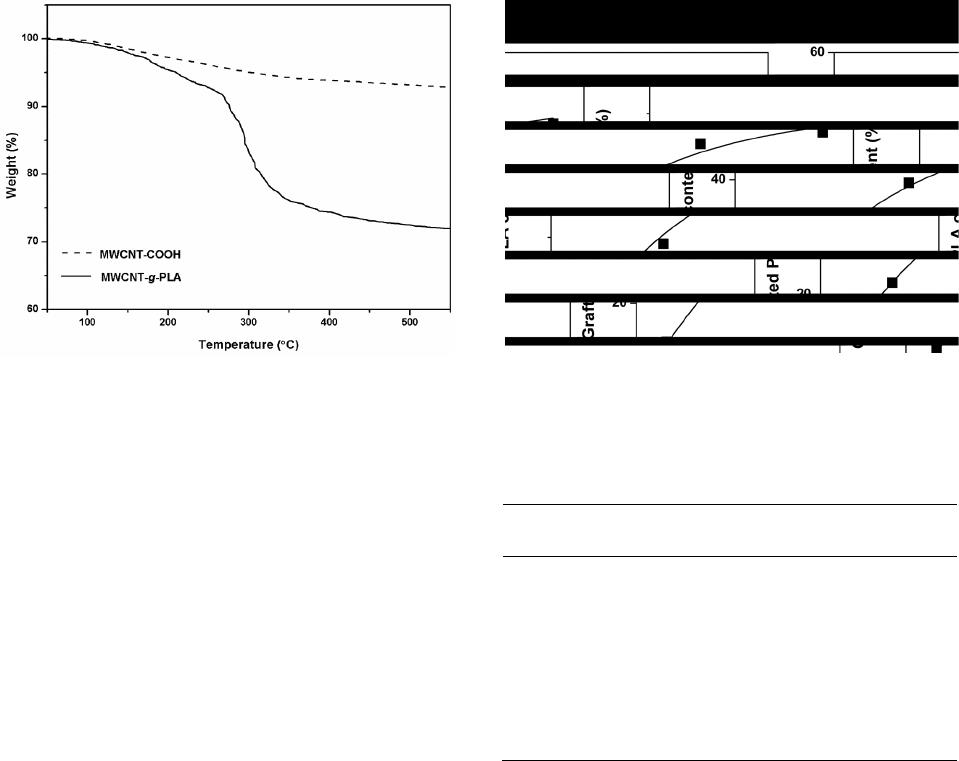 Q. ZHANG ET AL. OPEN ACCESS MSCE 10 Figure 4. Thermogravimetric analysis (TGA) of MWCNT- COOH and MWCNT-g-PLA. The sample of MWCNT- g-PLA was prepared by irradiating at the microwave power of 200 W for 45 min, [LA]/[COOH] = 20, [LA]/[Sn(Oct)2] = 2000. Comparing the mass gain after the grafting reaction with the thickness of the PLA layer observed in the TEM images of the MWCNT-g-PLA samples, we proposed that the larger the amount of grafted PLA, the thicker the polymer shell. In the study, the degree of weight loss at 500˚C in TGA was taken as the content of grafted PLA. With the increasing reaction time, the gained PLA content presents an increasing tendency (Figure 5). Ac- cor d ingly, by considering that MWCNT-COOH in this study possess carboxylic acid groups of 0.0023 mol for MWCNT of 1 g and by assuming that all the carboxylic acid groups of MWCNT-COOH are reacted with lactide during the ring-opening polymerization, the apparent number average molecular weights of grafted PLA chains of MWCNT -g-PLAs synthesized at various irra- diation time could be evaluated, as can be seen in Table 1 and Figure 5. As shown in Figure 5 and Table 1, the PLA content was increased with the prolonged irradia- tion time; meanwhile the increasing tendency gradually became flat. The number-average molecular weight of grafted PLA chains could reach up to 1430 by only 90 minutes. According to the results, the fine products were obtained in a very short irradiation time. Different from conventional heating, the microwave-assisted modifica- tion process dismissed vacuum because of the acceler- ated reaction rate. Comparing the results under micro- wave irradiation with conventio na l hea ti ng method, it was considered that the enhanced polymerization rate originated not only from thermal effects but also from microwave effects. 3.5. Effect of Reactant Rati o In order to further investigate the influence of reaction Figure 5. Changes of grafted PLA content with different microwave irradiation time. Condition: Microwave power 200 W, [LA]/[COOH] = 20, [LA]/[Sn(Oct)2] = 2000. Table 1. Weight contents and number average molecular weights of grafted PLA chains for MWCNT-g-PLA. Irr a d i ation time (min) The grafted PLA contenta (%) Number-average molecular weight of the grafted PLAb 10 12.1 240 20 22.5 440 30 28.7 675 45 39.4 1100 60 45.6 1350 90 48.2 1430 aThe grafted PLA content in MWCNT-g-P LA is evaluated from TGA ther- mograms. bThe concentration of carboxylic acid groups is 0.0023 mol per MWCNT of 1.0 g. conditions on the final product, we also studied the varia- tion of gained grafted PLA content in MWCNT-g-PLA which prepared by different catalyst concentrations. Figure 6 shows the effect of varied Sn(Oc t ) 2 concentra- tion and different [LA]/[COOH] ratio on the grafted PLA conte nt . The grafted polymer content in MWCNT-g-P LA was strongly dependent on the amount of Sn(Oct)2 and the ration of [LA]/[COOH]. As shown in Figure 6(a) , with the increasing Sn(Oct)2 concentration from 0.01 to 0.2%, the content of PLA in MWCNT-g-PLA increased until it reached a maximum at 0.05%. However, the con- centration of Sn(O ct) 2 which is larger than 0.05 mol% is not good for PLA gr a ft i ng. This phenomena of inhibition can be explained by that Sn(Oct ) 2 catalyzes not only the polymerization of LA but also the decomposition of polymer. Too much Sn(Oct)2 might facilitated decompo- sition than polymerization. On the other hand, the reac- tion that PLA grafting to MWCNT was induced by active species that generated by carboxylic acid groups and 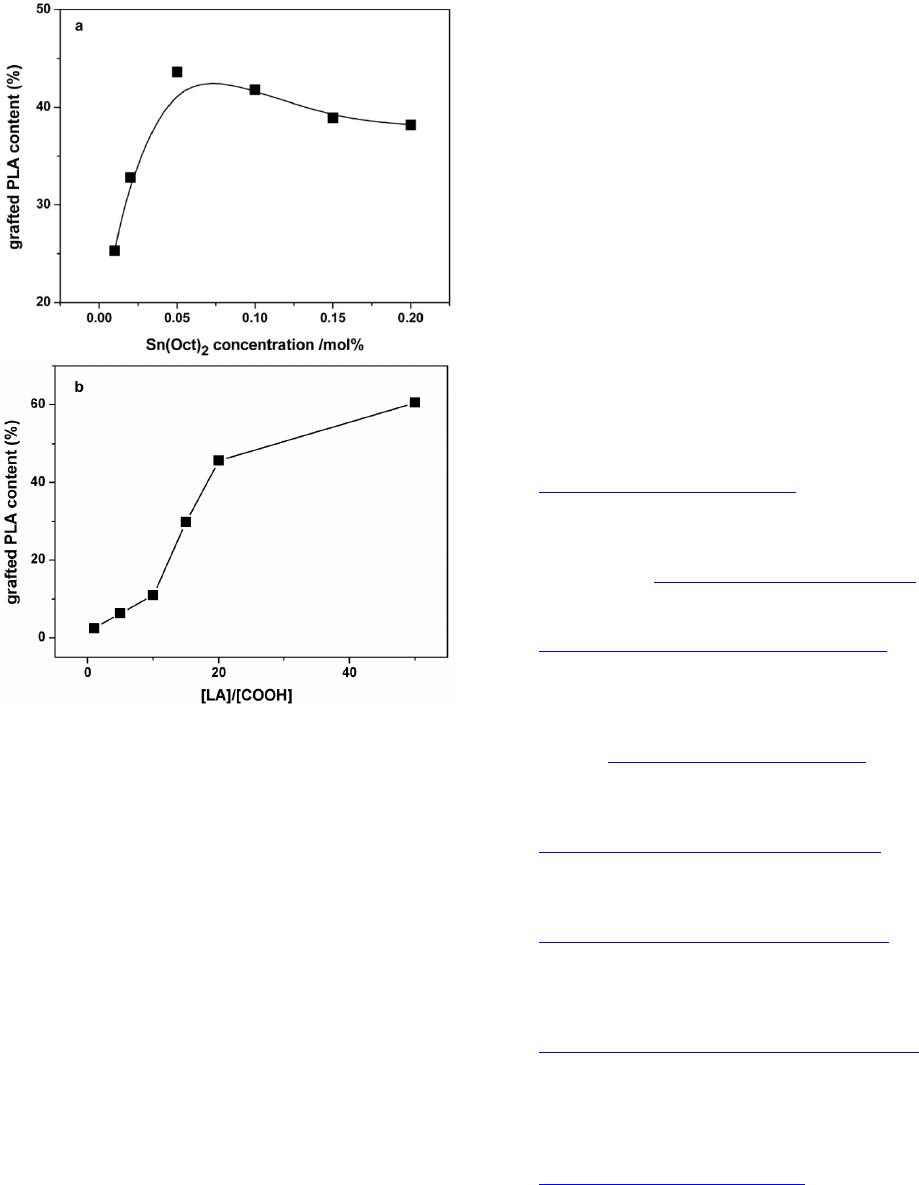 Q. ZHANG ET AL. OPEN ACCESS MSCE 11 Figure 6 The effect of Sn(Oct)2 concentration and [LA]/ [COOH] ratio on the grafted PLA conte nt. (a) Microwave pow e r 200 W, irradiation time 60 min, [LA]/[COOH] = 20. (b) Microwave power 200 W, irradiation time 60 min, [LA]/ [ Sn(Oct)2] = 2000. Sn(Oc t) 2, with fixed concentration of carboxylic acid group s , higher concentration of Sn(Oc t) 2 didn’t increase the number of active species. The different ratio of [LA]/ [COOH] also has great influence on the grafted PLA content. The result (Figure 6(b)) suggested that larger ratio can generate higher grafted PLA content. With the [LA]/[COOH] ratio of 50, the gained PLA amount in MWCNT-g-PLA could reach up to 60.5%. By contr o l- ling the reaction condition, we can get the final product with different grafting rate. 4. Conclusion The biocompatible Pol ylactic acid were directly grafted to acid functionalized MWCNT by microwave irradia- tion. The final grafted product MWCNT-g-PLA with different PLA grafting rate can be synthe siz e d in only 60 min. The TEM images of coated PLA layer clearly indi- cated the grafted PLA was uniform on the surface of MWCNT. Moreover, the molecular weight and grafted content can be well controlled by altering Sn( O c t) 2 con- centration and irradiation time as well as [LA]/[COOH] ratio. With the conditions which the microwave power is 200 W and the ratio of [LA]/[COOH] and [LA]/[Sn(Oc t )2] is 50 and 2000 respectively, the MWCNT-g-PLA which the grafted PLA chains could reach up to 60.5 wt% can be prepared in only one hour. Different from conven- tional heating, the microwave-assisted modification process dismissed vacuum because of the accelerated reaction rate. The micr owave-assisted method shows the advantages of rapid speed and benign conditions over conventional heating and should be favored in industri- alization for co mmercially biocompatible nano compo- sites. REFERENCES [1] S. Iijima, “Helical Microtubules of Graphitic Carbon,” Nature, Vol. 354, No. 6348, 1991, pp. 56-58. http://dx.doi.org/10.1038/354056a0 [2] Y. P. Sun, K. F. Fu, Y. Lin and W. I. Huang, “Functio- nalized Carbon Nanotubes: Properties and Applications,” Accounts of Chemical Research, Vol. 35, No. 12, 2002, pp. 1096-1104. http://dx.doi.org/10.1021/ar010160v [3] P. J. F. Harris, “Carbon Nanotube Composites,” Int e rn a- tional Materials Reviews, Vol. 49, No. 1, 2004, pp. 31-43. http://dx.doi.org/10.1179/095066004225010505 [4] F. J. Gomez, R. J. Chen, D. Wang, R. M. Waymouth and H. Dai, “Ring Opening Metathesis Polymerization on Non-Covalently Functionalized Single-Walled Carbon Nanot ub es , ” Chemical Communications, Vol. 2, 2003, pp. 190-191. http://dx.doi.org/10.1039/b211194b [5] R. Andrews and M. C. Weisenberger, “Carbon Nanotube Polymer Composites,” Current Opinion in Solid State and Materials Science, Vol. 8, No. 1, 2004, pp. 31-37. http://dx.doi.org/10.1016/j.cossms.2003.10.006 [6] G.-X. Chen, H.-S. Kim, B. H. Park and J.-S. Yoon, “Mul- ti-Walled Carbon Nanotubes Reinforced Nylon 6 Com- posites,” Polymer, Vol. 47, No. 13, 2006, pp. 4760-4767. http://dx.doi.org/10.1016/j.polymer.2006.04.020 [7] Q. Xiao, S. He, L. Liu, X. Guo, K. Shi, Z. Du, et al., “Coating of Multiwalled Carbon Nanotubes with Cross- linked Silicon-Containing Polymer,” Composites Science and Technology, Vol. 68, No. 1, 2008, pp. 321-328. http://dx.doi.org/10.1016/j.compscitech.2006.09.001 [8] Y. H. Xu, Q. F. Li, D. Sun, W. J. Zhang and G. X. Chen, “A Strategy To Functionalize the Carbon Nanotubes and the Nanocomposites Based on Poly(l-lactide),” Industrial & Engineering Chemistry Research, Vol. 51, No. 42, 2012, pp. 13648-13654. http://dx.doi.org/10.1021/ie300989w [9] C. Bartholome, P. Miaudet, A. Derré, M. Maugey, O. Roubeau, C. Zakri, et al., “Influence of Surface Function- alization on the Thermal and Electrical Properties of Nanotube-PVA Composites,” Composites Science and Technology, Vol. 68, No. 12, 2008, pp. 2568-2573.  Q. ZHANG ET AL. OPEN ACCESS MSCE 12 http://dx.doi.org/10.1016/j.compscitech.2008.05.021 [10] R. D. Farahani, H. Dalir, V. Le Borgne, L. A. Gautier, M. A. El Khakani, M. Lévesque, et al., “Reinforcing Epoxy Nanocomposites with Functionalized Carbon Nanotubes via Biotin-Streptavidin Interactions,” Composites Science and Technology, Vol. 72, No. 12, 2012, pp. 1387-1395. http://dx.doi.org/10.1016/j.compscitech.2012.05.010 [11] X. Y. Gong, J. Liu, S. Baskaran, R. D. Voise and J. S. Young, “Surfactant-Assisted Processing of Carbon Nano- tube/Polymer Composites,” Chemistry of Materials, Vol. 12, No. 4, 2000, pp. 1049-1052. http://dx.doi.org/10.1021/cm9906396 [12] C. Richard, F. Balavoine, P. Schultz, T. W. Ebbesen and C. Mioskowski, “Supramolecular Self-Assembly of Lipid Derivatives on Carbon Nanotubes,” Science, Vol. 300, No. 5620, 2003, pp. 775-778. http://dx.doi.org/10.1126/science.1080848 [13] Q. Wang, Y. Han, Y. Wang, Y. Qin and Z.-X. Guo, “Ef- fect of Surfactant Structure on the Stability of Carbon Nanotubes in Aqueous Solution,” The Journal of Physical Chemistry B, Vol. 112, No. 24, 2008, pp. 7227-7233. http://dx.doi.org/10.1021/jp711816c [14] M. N. Zhang, L. Su and L. Q. Mao, “Surfactant Function- alization of Carbon Nanotubes (CNTs) for Laye r -by- Layer Assembling of CNT Multi-Layer Films and Fabri- cation of Gold Nanoparticle/CNT Nanohybrid,” Carbon, Vol. 44, No. 2, 2006, pp. 276-283. http://dx.doi.org/10.1016/j.carbon.2005.07.021 [15] H. J. Barraza, F. Pompeo, E. A. O’Rea and D. E. Resasco, “SWN T-Filled Thermoplastic and Elastomeric Compos- ites Prepared by Miniemulsion Polymerization,” Nano Letters, Vol. 2, No. 8, 2002, pp. 797-802. http://dx.doi.org/10.1021/nl0256208 [16] M. J. O'Connell, P. Boul, L. M. Ericson, C. Huffman, Y. Wang, E. Haroz, et al., “Reversible Water-Solubilization of Single-Walled Carbon Nanotubes by Polymer Wrap- ping,” Chemical Physics Letters, Vol. 342, No. 3-4, 2001, pp. 265-271. http://dx.doi.org/10.1016/S0009-2614(01)00490-0 [17] H. J. Li, X. B. Wang, Y. L. Song, Y. Q. Liu, Q. S. Li, L. Jiang, et al., “Super-Amphiphobic Aligned Carbon Nanotube Films,” Angewandte Chemie International Edi- tion, Vol. 40, No. 9, 2001, pp. 1743-1746. http://dx.doi.org/10.1002/1521-3773(20010504)40:9<174 3::AID-ANIE17430>3.0.CO;2-# [18] A. Kowalski, A. Duda and S. Penczek, “Kinetics and Mechanism of Cyclic Esters Polymerization Initiated with Tin(II) Octoate. 3.† Polymerization of l,l-Dilactide,” Macromolecules, Vol. 33, No. 20, 2000, pp. 7359-7370. http://dx.doi.org/10.1021/ma000125o [19] V. Ambrogi, G. Gentile, C. Ducati, M. C. Oliva and C. Carfagna, “Multiwalled Carbon Nanotubes Functional- ized with Maleated Poly(propylene) by a Dry Mech- ano-Chemical Process,” Polymer, Vol. 53, No. 2, 2012, pp. 291-299. http://dx.doi.org/10.1016/j.polymer.2011.11.048 [20] A. N. Chakoli, J. Wan, J. T. Feng, M. Amirian, J. H. Sui and W. Cai, “Functionalization of Multiwalled Carbon Nanotubes for Reinforcing of Poly(l-lactide-co-ɛ-capro- lactone) Biodegradable Copolymers,” Applied Surface Science, Vol. 256, No. 1, 2009, pp. 170-177. http://dx.doi.org/10.1016/j.apsusc.2009.07.103 [21] J. Feng, W. Cai, J. Sui, Z. Li, J. Wan and A. N. Chakoli, “P ol y(l-lactide) Brushes on Magnetic Multiwalled Carbon Nanotubes by In-Situ Ring-Opening Polymerizatio n ,” Polymer, Vol. 49, No. 23, 2008, pp. 4989-4994. http://dx.doi.org/10.1016/j.polymer.2008.09.022 [22] H. X. Xu, X. B. Wang, Y. F. Zhang and S. Y. Liu, “Sin- gle-Step in Situ Preparation of Polymer-Grafted Multi- Walled Carbon Nanotube Composites under 60Co ç-Ray Irradiation,” Chem Mater Vol. 18, No. 13, 2006, pp. 2929-2934. http://dx.doi.org/10.1021/cm052840o [23] S. M. Chen, G. Z. Wu, Y. D. Liu and D. W. Long, “Pre- paration of Poly(acrylic acid) Grafted Multiwalled Car- bon Nanotubes by a Two-Step Irradiation Technique,” Macromolecules, Vol. 39, No. 1, 2006, pp. 330-334. http://dx.doi.org/10.1021/ma0520500 [24] J. Lunt, “Large -Scale Production, Properties and Com- mercial Applications of Polylactic Acid Polymers,” Po ly- mer Degradation and Stability, Vol. 59, No. 1-3, 1998, pp. 145-152. http://dx.doi.org/10.1016/S0141-3910(97)00148-1 [25] R. E. Drumright, P. R. Gruber, D. E. Henton, “Polylactic Acid Technology,” Advanced Materials, Vol. 12, No. 23, 2000, pp. 1841-1846. http://dx.doi.org/10.1002/1521-4095(200012)12:23<1841 ::AID-ADMA1841>3.0.CO;2-E [26] G.-X. Chen, H.-S. Kim, B. H. Park and J.-S. Yoon, “Con- trolled Functionalization of Multiwalled Carbon Nano- tubes with Various Molecular-Weight Poly(l-lactic acid),” The Journal of Physical Chemistry B, Vol. 109, No. 47, 2005, pp. 22237-22243. http://dx.doi.org/10.1021/jp054768n [27] G.-X. Chen, H.-S. Kim, B. H. Park and J.-S. Yoon, “Synthesis of Poly(L-lactide)-Functionalized Multiwalled Carbon Nanotubes by Ring-Opening Polymerization,” Macromolecular Chemistry and Physics, Vol. 208, No. 4, 2007, pp. 389-398. http://dx.doi.org/10.1002/macp.200600411 [28] W. Song, Z. Zheng, W. Tang and X. Wang, “A Facile Approach to Covalently Functionalized Carbon Nano- tubes with Biocompatible Polymer,” Polymer, Vol. 48, No. 13, 2007, pp. 3658-3663. http://dx.doi.org/10.1016/j.polymer.2007.04.071 [29] J. T. Yoon, S. C. Lee and Y. G. Jeong, “Effects of Grafted Chain Length on Mechanical and Electrical Properties of Nanocomposites Containing Polylactide-Grafted Carbon Nanotubes,” Composites Science and Technology, Vol. 70, No. 5, 2010, pp. 776-782. http://dx.doi.org/10.1016/j.compscitech.2010.01.011 |