

Paper Menu >>
Journal Menu >>
 Journal of Computer and Communications, 2014, 2, 31-36 Published Online January 2014 (http://www.scirp.org/journal/jcc) http://dx.doi.org/10.4236/jcc.2014.22006 OPEN ACCESS JCC An Improved EZW Hyperspectral Image Compression Kai-Jen Cheng*, Jeffrey C. Dill* School of Electrical Engineering and Computer Science, Ohio University, Athens, USA. Email: *[email protected]; [email protected] Received October 2013 ABSTRACT The paper describes an efficient lossy and lossless three dimensional (3D) image compression of hyperspectral images. The method adopts the 3D spatial-spectral hybrid transform and the proposed transform-based coder. The hybrid transforms are that Karhunen -Loève Transform (KLT) which decorrelates spectral data of a hy- perspectral image, and the integer Discrete Wavelet Transform (DWT) which is applied to the spatial data and produces decorrelated wavelet coefficients. Our simpler transform-based coder is inspired by Shapiro’s EZW algorithm, but encodes residual values and only implements dominant pass incorporating six symbols. The pro- posed method will be examined on AVIRIS images and evaluated using compression ratio for both lossless and lossy compression, and signal to noise ratio (SNR) for lossy compression. Experimental results show that the proposed image compression not only is more efficient but also has better compression ratio. KEYWORDS Wavelet Transform; Karhunen-Loève Transform; Transform-based Image Compression; AVIRIS Hyperspectral Image; Embedded Zerotree Wavelet 1. Introduction Hyperspectral images are widelyused in various fields such as agriculture, topography, meteorology and mili- tary, since they can provide more accurate and detailed spectral information than other images. NASA Jet Pro- pulsion Laboratory developed Airborne Visible/Infrared Imaging Spectrometer (AVIRIS) to produce the 614 pix- el × 512 line hyperspectral images in 224 contiguous spectral bands with wavelengths from 400 to 2500 na- nometers (nm) [1]. The spectrometer generates huge amounts of data and causes that distribution facilities cannot economically handle this level of data. It is im- perative to perform compression. One popular and widely used image compression is transform-based compression which successful incorpo- rates the useful statistical properties of transform for im- age compression such as energy compaction and decor- related components. Examples of transforms include the Karhunen-Loève Transform (KLT), Discrete Fourier Transform (DFT), Discrete Cosine Transform (DCT) and Discrete Wavelet Transform (DWT). In general, the standard image compression, Joint Photographic Experts Group (JPEG), uses 8 x 8 DCT and the later JPEG2000 uses 2D DWT. Penna et al. [2] compressed hyperspectral images using JPEG2000 and investigated the perfor- mance under different transform techniques including WT, DCT, KLT, and various combinations. Shapiro [3] proposed the classic embedded zerotree coding (EZW) using wavelet transform to compress im- ages. Bilgin et al proposed three-dimensional (3D) image compression algorithm [4].The 3D-SPIHT was proposed by Kim and Pearlman [5]. Sohn and Lee [6] successfully applied the 3D-SPIHT algorithm with symmetrical 3D- DWT to hyperspectral images. The proposed image compression utilizes the 3D space-spectral: The Karhunen-Loève Transform (KLT) is first applied to remove the correlations among the 224 contiguous highly correlated spectral bands. 2D-Discrete Wavelet Transform (DWT) is applied to remove the spa- tial redundancies. After the hybrid transform, the mod- ified EZW algorithm is applied to encode the trans- formed hyper spectral images. The modifications include defining a new tree structure, only running the dominant pass using six symbols and coding residual values. Fig- ure 1 shows a block diagram of the transform-base- di- mage compression. The remainder of the paper is orga- nized as follows: Section 2 describes the integer KLT. Section 3 discusses the 2D integer DWT. In Section 4, the modified EZW algorithm for hyperspectral images is introduced. The last three sections describe the testing of *Corresponding author. 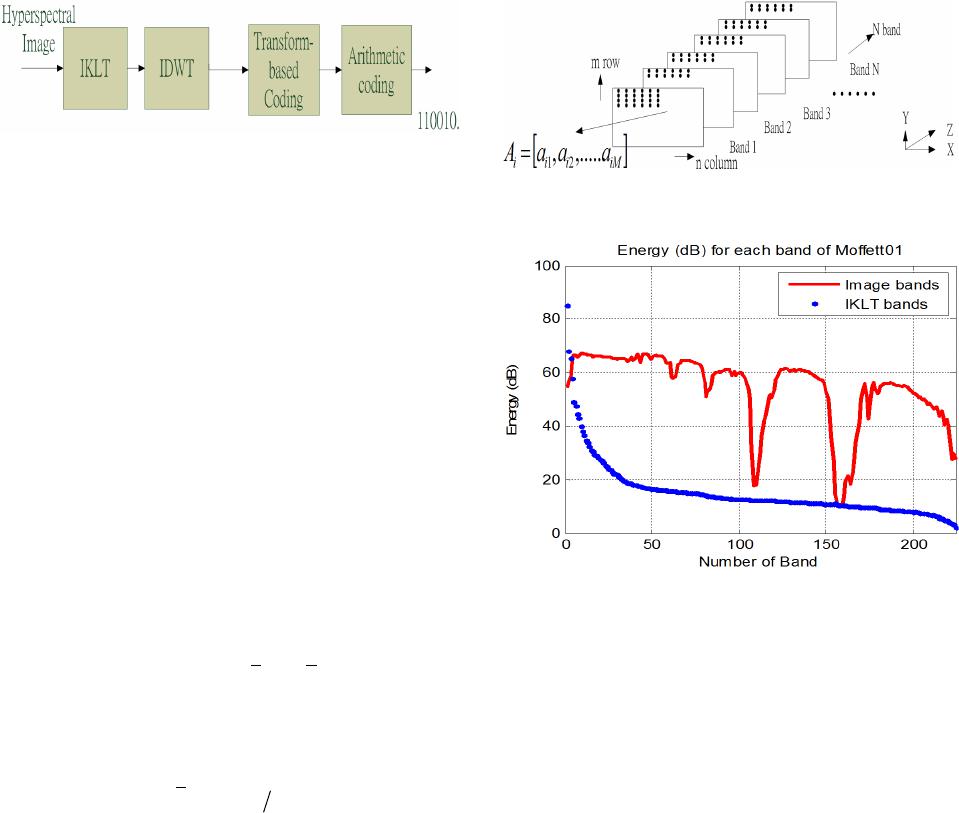 An Improved EZW Hyperspectral Image Compression OPEN ACCESS JCC 32 Figure 1. System diagram. the algorithms using AVIRIS hyperspectral images; pro- vide results for this proposed hyperspectral image com- pression and conclusions. 2. Integer Karhunen-Loève Transform (KLT) The Karhunen-Loève Transform (KLT) is the data de- pendent and optimal linear orthogonal transform because of the eigenvectors matrix derived from the covariance matrix of the data. The pixel vector at the ℎ band is expressed as 12 [, ,,] ii iiM A aaa= ………… in the spatial dimension (x-y plane). If the spatial dimension has m rows and n columns, the length of the vector is equal to .M mn= × The number of is same as the hyperspectral bands N, namely i = 1…N. Figure 2 demonstrates the perspective of the pixel vector in the hyperspectral image. The covariance matrix is derived from the pixel vec- tors as follows: {()()} T a C EAaAa= −− (1) where E{∙} is the expected value of the argument, T is matrix transpose and the � is defined as the mean value of , as in 1 M i i a aM = = ∑ (2) Since the covariance matrix is a real and symmetric × square matrix, the eigenvectors and eigenvalues for this matrix can be found [7]. In general, once eigenvectors are found from the cova- riance matrix, the next step is to order them by eigenva- lues, highest to lowest. This gives you the components in order of significance. If applying the ordered eigenve c- tors to the image, two important features are presented in the spectral dimensions and they are the decorrelated spectral data, and the energy compaction. Figure 3 de- picts the energy compaction in the spectral dimension. The optimal energy distribution declines monotonically from the first band to the bottom. After KLT, we call these bands KLT bands. IKLT bands mean that integer KLT (IKLT) is implemented by mapping integers to in- tegers as described below. In order to attain lossless compression, the reversible integer KLT is utilized because it is able to map integers to integers. Based on matrix factorizations [8], the non- singular eigenvectors of the KLT is factorized as A = Figure 2. The perspective of the pixel vector in the hyper- spectral image. Figure 3. Energy compaction in spectral dimensions. PLUS where L and S are lower Triangular Elementary Reversible Matrices (TERM), U is upper TERM, and P is a reversible permutation matrix. P defines the row in- terchanges to guarantee diagonal elements that are not zero. The transformation can be implemented by the lift- ing scheme, which includes operations of multiplication, addition and rounding up. These factorized matrices must be recorded as over- head information for the reverse transform. Even if not compressed, representing these matrices as 32-bit float- ing point numbers computes an overhead of about 0.11 bpppbs for the 224 × 224 matrices. In the experiment section, we include the overhead into the lossless results in each table. Figure 3 describes that the integer KLT is optimal transform in terms of optimal energy compaction and best decorrelation. 3. 2D-Wavelet Transform Instead of implementing the 3D discrete wavelet trans- form (DWT), the following step is to transform the im- age in the spatial dimension by the use of 2D DWT. The optimal implementation of the 2D-DWT is the lifting scheme. It not only has less computational complexity, but also realizes a reversible integer wavelet transform [9]. In our experiments, the 3D hyperspectral image was decomposed by the 2D dyadic wavelet Band by Band, separately. Figure 4 depicts the perspective of the second  An Improved EZW Hyperspectral Image Compression OPEN ACCESS JCC 33 Figure 4. 2-D wavelet transform coefficients are stored in a data cube. level decomposition on each band. The DWT has two important properties which are critical for image compression: 1) Energy packing: When an image is wavelet trans- formed, the transformed image has energy compaction in spectral dimensions, that is, the wavelet coefficients in the higher level subbands will, on average, be larger than those in the lower level subbands. 2) Self-similarity: A wavelet coefficient at a higher level subband and all wavelet coefficients of the same spatial orientation at lower level subbands have certain predictable relationships. 4. Shapiro’s EZW Algorithm Shapiro invented his Embedded Zerostree Wavelet (EZW) algorithm taking advantage of the wavelet trans- form [2]. The EZW algorithm implements a progressive, embedded image coding method based on the zerotrees of data structure. All currently significant bits at the same bitplane together and recursively encodes other pixels for the next significant bitplane until reaching the least sig- nificant bitplane. As a result, the lower significant bits are embedded behind the higher significant bits, so that a decoder quickly displays a low quality image and better quality as more bits are received. We notethree crucial components that make Shapiro’s EZW algorithm effectivein image compression. First, due to energy packing, these wavelet coefficients in higher level subbands could be scanned earlier than oth- ers in low level subbands. In other words, larger coeffi- cients will be encoded first. In addition, both receiver and transmitter know what scanning order is selected such that it does not include the scanning order in the over- head. Scanning order used in this paper is Morton scan. Second, the quad-tree is the fundamental idea of the EZW algorithm to interpolate the relations among wave- let coefficients in different subbands; therefore, it is set up based on the self-similarity. The definition of the quad-tree was introduced in [2]. There are two steps to complete EZW algorithm: the- dominant pass and the subordinate pass. The dominant pass keeps track of the search for significant coefficients by labeling each pixel among these four labels: signific- ance positive symbol (POS), significant negative symbol (NEG), zerotree root (ZTR) and isolated zeros (IZ) in Figures 5(a)-(c). The subordinate pass quantizes each significant coefficient that has been found in the domi- nant pass. The definitions of four symbols are described below. If a root coefficient, in absolute value, is larger than a thre- shold, it is labeled as significant positive (POS) or sig- nificant negative (NEG) in Figure 5(b). It implies that some of the coefficients’ descendants are significant. An isolated zero (IZ) is a root coefficient that is insignificant but has some significant descendants in Figure 5(c). If the coefficient is zerotree root (ZTR), it means the root coefficient itself and its descendants are all insignificant such that these descendants don’t have to be encoded in the current iteration in Figure 5(a) . 5. Modified EZW Algorithm We propose some modifications to simplify the conven- tion EZW algorithm and improved the compression re- sults. [10-13] have studied the asymmetrical 3D-DWT decomposition that causes the asymmetrical statistics of the transformed hyperspectral image; thus the asymme- trical tree structure is more suitable for describing the transformed hyperspectral image. In this paper, the 3D asymmetric tree structure was designed according to the properties of hybrid transforms. In Figure 4, a wavelet coefficient at a higher subband is not only relative to all wavelet coefficients of the same spatial orientation at lower subbands at the same band but also in the neighbor band. Therefore, if the approximation subband is /2 l m -by- /2 l m with -level decomposition at the first band, while the spatial dimensions of the image are m-by-n. Any root ( ) , ,0xy in the approximation has four immediate children at (/ 2,,0) l xm y+ , (,/2 ,0),(/2 ,/2,0) l ll xymxmym+ ++ and ( ) , ,1xy In addition, except ones in the approximation, any root (x, y, 0) at the first band has four children located at the same spatial orientations (2x, 2y, 0), (2x + 1, 2y, 0), (2x, 2y + 1, 0), and (2x + 1, 2y + 1, 0) on the first band and one more child (x, y, 1) below it. Note that any pixel not in the first band has only one child below it. The new tree structure will continue to branch until no offspring can be found. The new and simple definition of tree structure is demonstrated in Figure 6. Each pixel in the low-pass (approximation) section of band 1 is a tree root. In addition to the four labels defined in Shapiro’s EZW algorithm, in this study, we define two more labels, called positive and negative ZTR (PZT and NZT) in Figure 5(d). According to [14], they are degree-1 zero- trees since every coefficient except the root coefficient is all zeros. Roots of PZT and NZT are positive and nega-  An Improved EZW Hyperspectral Image Compression OPEN ACCESS JCC 34 Figure 5. Explanation of (a) ZRT (b) POS/NEG (c) IZ and (d) PZT/NZT. X Z Y Bnad1Bnad2Bnad3Band M (a) Figure 6. A new tree structure: The root has three children at the same band and one child at the lower band. tive significant, respectively. A higher degree zero tree coder generates a shorter symbol stream. Table 1 shows the coding results of tree (b) and (d) in Figure 5. Any significant coefficient should do further search on its child nodes such that there are eight more symbols generated for each POS/NEG symbol. If applied to the new PZT/NZT symbols, some redundant symbols for coding tree (d) can be replaced by one PZT symbol, which saves an extra eight symbols. This is the main ad- vantage of adding extra symbols (PZT/NZT). Table 2 demonstrates that the conventional EZW al- gorithm encodes the image, Jasper, with and without PZR/NZT. Their performances are studied in terms of the total numbers of outputs. Basically, the PZR/NZR is Table 1. Examples of coded symbols generated by EZW algorithm for tree (b) and (d). EZW Coding tree (b) POS, POS, ZRT, ZRT, ZRT, ZRT, ZRT, ZRT, ZRT, ZRT, ZRT, ZRT, ZRT, ZRT, ZRT, ZRT, ZRT. Coding tree (d) POS, ZRT, ZRT, ZRT, ZRT, ZRT, ZRT, ZRT, ZRT Coding tree (d) PZT Table 2. Numbers of coded symbols from the conventional EZW algorithm with PZR/NZT and without PZR/NZT, using the bior-4.4 filter on Jasper. Number of symbols EZW with PZR/NZT EZW without PZR/NZT Num of ZRT 9,265,805 10,584,445 Num of PZR 1633198 NA Num of NZR 1585476 NA Num of POS/NEG 278442 3497116 Num of IZ 1505055 1505055 parts of the POS/NEG symbols. The total number of PZR/NZR and POS/NEG should be equal to that of the POS/NEG from the EZW algorithm without PZR/NZT, that is, 1633198 + 1585476 + 278442 = 3497116 in Ta- ble 2. Compared with the numbers of ZRT symbol, add- ing extra symbols help to reduce 1,318,640 ZRT symbols in Table 2. Overall, the total symbols are reduced and the result in better compression ratios. Moreover, in Shapiro’s EZW algorithm, if a coeffi- cient is recognized as a significant pixel, the coefficient will be sent to the subordinate list and set to 0. Table 3 lists the bits rates generated from the dominant and sub- ordinate passes and shows that the subordinate pass con- tributes on average one-third of the total bit rate. In order to improve the compression ratio, we consider removing the subordinate list such that the significant coefficient is replaced by a residual value. (,,) (,,) i RxyzIxyz T= − (3) where : ( ) ,,Rxyz is residual value at (x, y, z) i T is threshold at the th i iteration (,,)Ixyz is absolute value of a pixel at (x, y, z) This is a simple way to replace the subordinate list, but still complete the job of quantizing coefficients. In sum, the outputs of the modified EZW algorithm only have the symbols stream that contains a sequence of symbols (POS, NEG, ZTR, PZT, NZT and IZ). At this point, the proposed method we call is the residual EZW algorithm incorporating with the PZT/NZT symbols and the new tree structure. 0 0000 00 00 0 0 0 root 0 00 0 0 All 0s 1 1000 00 00 0 0 0 root 0 00 0 0 0 1000 00 10 0 0 0 root 0 00 0 1 1 0000 00 00 0 0 0 root 0 00 1 0 (a) (b) (c) (d) All 0s  An Improved EZW Hyperspectral Image Compression OPEN ACCESS JCC 35 Table 3. Comparison of the bit rates generated by the con- ventional EZW algorithm using new 3D asymmetric trees and the hybrid transform. Compression performance (bpppbs) Jasper Moffett Low Altitude Dominant pass 4.23 4.16 4.26 Subordinate pass 1.64 1.48 1.62 Total bit rate 5.87 5.64 5.88 6. Experimental Results The residual EZW algorithm compresses the first scene of AVIRIS images, Moffett 01, Jasper 01 and Low Alti- tude 01. The size of each image is 256 x 256 x 224 and is stored as 16 bits signed integers. Compression ratio is the bit per pixel per band (bpppb). The rate-distortion per- formance is expressed as the signal to noise ratio (SNR) for various bit rates. The definition of SNR is the average squared value of the original AVIRIS images is divided by the mean squared error (MSE). First, Table 4 demonstrates the lossless performance of the residual EZW algorithm along with various wave- let filters. They are Daubechies wavelets (dbN), Symlets (symN), and Biorthogonal wavelets (biorNr. Nd), which can be found in the Matlab wavelet toolbox. As a result, there is no the optimal wavelet filter for all test images. General speaking, the biorthogonal wavelets are more suitable for compressing images because of the perfect symmetry and linear phase. Second, the lossy performance of the selected conven- tional technique (3D-SPIHT and 3D-EZW) is compared to the proposed method. Both methods are based on the symmetrical 3D-DWT and 3D quad-tree. For lossy com- pression, the transform-based coder can be stopped at a predetermined threshold or when the bit budget is reached. Table 5 to Table 7 show all results (bpppbvs SNR) of the lossless, and lossy compression based on predetermined thresholds. All images are decomposed by 4-level bior 4.4 filters, which have better performance for lossy compression. The results show that the proposed EZW algorithm outperforms two conventional methods. Tables 5 and 7 shows that the proposed method consis- tently has lower compression ratios and relative high SNRs. We demonstrate the complexity in terms of simulation time s (s) on a workstation with Intel(R) Core i5 CPU 2.67 GHz processor and Windows 7 operating system. All algorithms, compressing the hyperspectral images, are implemented in MATLAB. Table 8 shows that our proposed EZW using 6 symbols has a moderate compu- tational complexity and achieves an improved compres- sion ratio. Therefore, the residual EZW algorithm is an efficient lossy and lossless compression algorithm for hyperspectral images. Table 4. Lossless compression results (bpppbs) of the resi- dual EZW algorithm with PZT/NZT using new 3D asym- metric trees and hybrid transform. Wavelet Compression performance (bpppb) Jasper Moffett Low Altitude Db 2 5.57 5.42 5.72 Db 6 6.59 6.48 6.66 Sym 4 5.49 5.34 5.63 Sym 6 6.53 6.44 6.56 Bior 3.5 5.58 5.41 5.74 Bior 1.3 5.38 5.22 5.53 Bior 1.5 5.40 5.24 5.55 Bior 4.4 5.47 5.29 5.56 Bior 2.4 5.34 5.17 5.49 Bior 2.6 5.33 5.16 5.48 Table 5. Rate distortion (bpppb vs SNR) of various tech- niques for Moffett 01. Bitplane Cutoff Algorithm Moffett 01 0 1 2 4 8 3D-EZW 7.91 6.51 5.01 3.579 2.41 3D-SPIHT 6.38 5.30 4.15 2.97 1.95 SNR(dB) NA 51.06 48.25 44.09 39.10 Residual -EZW 5.47 3.94 2.53 1.36 0.55 SNR(dB) NA 55.00 52.69 49.71 47.02 Table 6 Rate distortion (bpppb vs SNR) of various tech- niques for Jasper 01. Bitplane Cutoff Algorithm Jasper 01 0 1 2 4 8 3D-EZW 8.02 6.61 5.13 3.70 2.53 3D-SPIHT 6.42 5.34 4.19 3.01 2.01 SNR(dB) NA 54.21 51.42 47.29 42.28 Residual -EZW 5.29 4.11 2.71 1.47 0.70 SNR(dB) NA 57.23 54.92 51.83 48.53 Table 7. Rate distortion (bpppb vs SNR) of various tech- niques for Jasper 01. Bitplane Cutoff Algorithm Low Altitude 01 0 1 2 4 8 3D-EZW 8.28 6.87 5.29 3.76 2.42 3D-SPIHT 6.57 5.50 4.38 3.19 2.08 SNR(dB) NA 54.37 51.50 47.17 42.12 Residual -EZW 5.56 4.26 2.86 1.53 0.66 SNR(dB) 0 54.78 52.24 48.87 45.82  An Improved EZW Hyperspectral Image Compression OPEN ACCESS JCC 36 Table 8. Compare the simulation time in second of various techniques for hyperspectral images. Images Time(s) Jasper 01 Moffett 01 3D EZW 145.49 146.29 3DSPIHT 116.89 120.85 Residual -EZW 66.58 64.64 7. Conclusions In this paper, we propose a novel transform-based algo- rithm for lossy and lossless hyperspectral image com- pression. The introduction of modifications in the resi- dual EZW algorithm results in higher compression ratios and moderate computational complexity. Therefore, it is an efficient image compression for hyperspectral images. REFERENCES [1] AVIRIS—Airborne Visible/Infrared Imaging Spectrome- ter, 2013. http://aviris.jpl.nasa.gov/. [2] B. Penna, T. Tillo, E. Magli and G. Olmo, “Transform Coding Techniques for Lossy Hyperspectral Data Com- pression,” IEEE Transactions on Geoscience and Remote Sensing, Vol. 45, 2007, pp. 1408-1421. http://dx.doi.org/10.1109/TGRS.2007.894565 [3] J. M. Shapiro, “Embedded Image Coding Using Zerotrees of Wavelet Coefficients,” IEEE Transactions on Signal Processing, Vol. 41, 1993, pp. 3445-3462. http://dx.doi.org/10.1109/78.258085 [4] A. Bilgin, G. Zweig and M. V. Marcellin, “Three-Dimen- sional Image Compression with Integer Wavelet Trans- form,” Applied Optics, Vol. 39, 2000, pp. 1799-1814. http://dx.doi.org/10.1364/AO.39.001799 [5] K. Beong-Jo, X. Zixiang and W. A. Pearlman, “Low Bit-Rate Scalable Video Coding with 3-D Set Partitioning in Hierarchical Trees (3-D SPIHT),” IEEE Transactions on Circuits and Systems for Video Technology, Vol. 10, 2000, pp. 1374-1387. http://dx.doi.org/10.1109/76.889025 [6] L. Sunghyun, S. Kwanghoon and L. Chulhee, “Compres- sion for Hyperspectral Images Using Three Dimensional Wavelet Transform,” IEEE 2001 International Geos- cience and Remote Sensing Symposium, Vol. 1, 2001, pp. 109-111. [7] A Tutorial on Principal Components Analysis, 2002. http://www.ce.yildiz.edu.tr [8] H. Pengwei and S. Qingyun, “Matrix Factorizations for Reversible Integer Mapping,” IEEE Transactions on Sig- nal Processing, Vol. 49, 2001, pp. 2314-2324. http://dx.doi.org/10.1109/78.950787 [9] I. Daubechies and W. Sweldens, “Factoring Wavelet Transforms into Lifting Steps,” Journal of Fourier Anal- ysis and Applications, Vol. 4, 1998, pp. 247-269. http://dx.doi.org/10.1007/BF02476026 [10] X. Tang, C. Sungdae and W. A. Pearlman, “3D Set Parti- tioning Coding Methods in Hyperspectral Image Com- pression,” Proceedings of International Conference on Image Processing, Vol. 3, 2003, pp. 239-242. [11] E. Christophe, C. Mailhes and P. Duhamel, “Hyperspec- tral Image Compression: Adapting SPIHT and EZW to Anisotropic 3-D Wavelet Coding,” IEEE Transactions on Image Processing, Vol. 17, 2008, pp. 2334-2346. http://dx.doi.org/10.1109/TIP.2008.2005824 [12] G. Liu and F. Zhao, “Efficient Compression Algorithm for Hyperspectral Images Based on Correlation Coeffi- cients Adaptive 3D Zerotree Coding,” IET Image Pro- cessing, Vol. 2, 2008, pp. 72-82. [13] H. Ying and L. Guizhong, “Lossy -to-Lossless Compres- sion of Hyperspectral Image Using the Improved AT-3D SPIHT Algorithm,” 2008 International Conference on Computer Science and Software Engineering, 2008, pp. 963-966. [14] C. Yushin and W. A. Pearlman, “Quantifying the Coding Performance of Zerotrees of Wavelet Coefficients: De- gree-k Zerotree,” IEEE Transactions on Signal Process- ing, Vol. 55, 2007, pp. 2425-2431. http://dx.doi.org/10.1109/TSP.2007.893218 |