

Paper Menu >>
Journal Menu >>
 Journal of Applied Mathematics and Physics, 2014, 2, 21-25 Published Online January 2014 (http://www.scirp.org/journal/jamp) http://dx.doi.org/10.4236/jamp.2014.21004 OPEN ACCESS JAMP Approximative Method of Fixed Point for Φ-Pseudocontractive Operator and an Application to Equation with Accretive Operator Yixin Wen, Aifang Feng, Yuguang Xu Department of Mathematics, Kunming University, Kunming, China Email: [email protected] Received October 2013 ABSTRACT In this paper, Φ-pseudo-contractive operators and Φ-accretive operators, more general than the strongly pseu- do-contractive operators and strongly accretive operators, are introduced. By setting up a new inequality, au- thors proved that if →:TX X is a uniformly continuous Φ-pseudo-contractive operator then T has unique fixed point q and the Mann iterative sequence with random errors approximates to q. As an application, the iterative solution of nonlinear equation with Φ-accretive operator is obtained. The results presented in this paper improve and generalize some corresponding results in recent literature. KEYWORDS Duality Mapping; Φ-Pseudo-Contractive Operator; Φ-Accretive Operator; Mann Iterative Sequence with Random Error Terms 1. Introduction and Preliminaries In 1994, Chidume [1] solved a problem dealt with the fixed point for the class of Lipschitz strictly (strongly) pseudo-contractive operators in uniformly smooth Banach space X . That is, he proved that the Ishikawa itera- tive sequence converges strongly to the unique fixed point of T in K where KX⊂ and T:K K→ is Lipschitz strictly (strongly) pseudo-contractive. Chang [2], in 1998, improved the result, i.e., he proved that the conclusion of Chidume holds if T is uniformly continuous and the fixed point set of T is nonempty (i.e., ( ) FT ≠∅ ). Recently, Liu [3] proved, if the strongly pseudocontractive operators are replaced by the more general φ -strongly pseudo-contractive operators then the conclusion of Chidume still holds. The objective of this paper is to introduce Φ-pseudo-contractive operators—a class of operators which are more general than the φ -strongly pseudo-contractive operators and to study the problems of existence, unique- ness and the iterative approximate method of fixed point by setting up a new inequality in arbitrary Banach space. As an application, the iterative solution of nonlinear equation with Φ-accretive operator is obtained. The results presented in this paper improve and generalize the conclusions of Chidame, Chang and Liu. To set the framework, we recall some basic notations as follows. Throughout this paper, we assume that X is a real Banach space with dual X ∗ , ( ) ,⋅⋅ denotes the genera- lized duality pairing. The mapping :2 x JX ∗ → defined by ( ) { } = :,,JxjXx jxjjxxX ∗ ∈== ∀∈ (1) is called the normalized duality mapping [4]. Now, we introduce Φ-pseudo-contractive operators as follows. Definition 1. Let K be nonempty subset of X. An operator :TK K→ is said to be Φ-pseudo-contractive, if there exists a strictly increasing function [ ) [ ) : 0,0, Φ ∞→ ∞ with ( ) 00 Φ = and ( )( ) jxy Jxy−∈ − such that  Y. X. WEN ET AL. OPEN ACCESS JAMP 22 ( ) ( ) ( ) 2 ,,TxTyjxyxyxy xyK Φ −−≤−−−∀∈ . (2) An operator :AKK→ is said to be Φ-accretive, if ( ) ( ) ( ) ,,Ax Ayjx yx yxyK Φ −− ≥−∀∈ . (3) It is easy to verify that the operator T is Φ-pseudo-accretive if and only if IT− is Φ-accretive where I is an identity mapping on X . Hence, the mapping theory for accretive operators is intimately connected with the fixed point theory for pseudo-contractive operators. We like to point out: every strongly pseudo-contractive operator is φ -strongly pseudo-contractive with [ ) [ ) : 0,0, φ ∞→ ∞ defined by ( ) s ks φ = where ( ) 0, 1k∈ , and every φ -strongly pseudo-contractive operator must be the Φ-pseudo-contractive operator with [ ) [ ) : 0,0, Φ ∞→ ∞ defined by ( )( ) s ss Φφ = . Obviously, if a Φ-pseudo-contractive operator has a fixed point then it is unique. Definition 2. Let :TK K→ be an operator. For any given 0 xK∈ the sequence { } n x defined by ( ) ( ) 1 10 nnnnnnn xxTxu n ααγ + =−++≥ (4) is called Mann iteration sequence with random errors. Here { } n u is a bounded sequence in X and is said random error terms of iterative process, and the parameters { } n α and { } n γ both are sequences in [ ] 0, 1 . By the way, Xu introduced another definition of Mann iterative sequence with random errors in [5]. In particular, the parameters 0 n γ = for all 0n≥ in Equation (4) then { } n x is called Mann [6] iteration sequence. 2. Main Results First, we have an existence theorem of fixed point as follow. Theorem 1. If :TX X→ is a continuous Φ-pseudo-contractive operator with bounded range then T has an unique fixed point in X . Proof. Define : n TX X→ by 1 nn Txxc TxxXand n= −∀∈≥ where ( ) 0, 1 n c∈ and 1 n n lim c →∞ = . Note that T is Φ-pseudo-contractive, thus ( ) ( ) ( ) ( ) ( ) ( ) ( ) 2 2 ,, 1 nn n nn n TxTyjxyxy cTxTyjxy c xycxy c xy Φ Φ −−=−− −− ≥−− +− ≥− (5) for all , ,1xy Xn≥≥ and some () () jx yJxy−∈ + . Clearly, n T is a continuous strongly accretive operator. It follows from the Theorem 13.1 of Deimling [7] that there exists an n xX∈ such that 0 nn Tx = for any 1n≥ . Next, the sequence { } 1 nn x − is bounded. In fact, if Tx M≤ then n xM≤ for all xX∈ and ( ) limlim 10 nn nn nn xTxc Tx →∞ →∞ −= −= (6) Since T is Φ-pseudo-contractive, that is, ( ) IT − is Φ-accretive, so ( ) ( )( ) ( ) ( ) ( ) ( ) , 2 mkmk mk mk mkmk mm kk xxITxI Txjxx x Txx Txxx M xTxxTx Φ −≤ −−−− ≤− +−− ≤− +− (7) for any { } mn n xx x−∈ . Equations of (6) and (7) ensure that { } 1 nn x ∞ = is a Cauchy sequence. Consequently, { } 1 nn x ∞ = converges to some qX∈ . By the continuity of T we have 1 nn nn n Tqlim Txlimxq c →∞ →∞ = == . Suppose that there exists a qX ∗ ∈ such that Tq q ∗∗ ∈ then 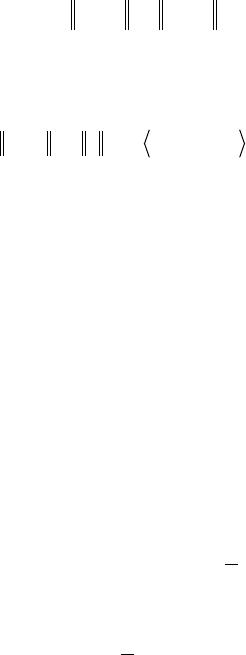 Y. X. WEN ET AL. OPEN ACCESS JAMP 23 ( ) ( ) ( ) 2, =0qq qq TqTqjqq Φ ∗ ∗∗∗ −≤−−−− which means that qq ∗ = . i.e., q is unique fixed point of T . The proof is completed. The following two Lemmas will play crucial roles in the proof of Theorem 2. Lemma 1. [2] If X be a real Banach space then there exists ( )( ) jxyJxy+∈ + such that ( ) 22 2, ,xyxyjxy xyX+ ≤++∀∈ . (8) Second, to set up a new inequality as follows. Lemma 2. Let [ ) [ ) : 0,0, Φ ∞→ ∞ be a strictly increasing function with ( ) 00 Φ = and let { } n b and { } n c be two nonnegative real sequences satisfying ,and lin nn n n cb b →∞ <∞ =∞ ∑∑ . (9) Suppose { } n a is a nonnegative real sequences. If there exists a integer 0 0N> satisfying ( )() 22 1 10nnnnnn aaobcban N Φ ++ ≤++ −∀≥ (10) then lim 0 n n a →∞ = . Proof. Let { } inf 2 n a σ = . If 0 σ > , then ( ) ( ) 1n a Φ Φσ + > for all 0n≥ . From the conditions of Equation (9) there exists an integer 0N> 0 such that ( ) ( ) 2nn obbnN Φσ ≤ ∀≥ . (11) So, we have ( ) 22 1 1Φ 2 n nnn aacb nN σ + ≤+ −∀≥ . By induction, we obtain ( ) 2 == 1Φ 2 jN j jN jN ba c σ +∞ +∞ ≤+≤ +∞ ∑∑ . (12) Equation (12) is in contradiction with =0 n N b +∞ = +∞ ∑ . It implies that 0 σ = . Therefore, there exists a subse- quence { } { } j nn aa ⊂ such that lin 0 j n j a →∞ = . So, for any given 0 ε > there exists an integer 0 0j≥ such that ( ) ( ) 0 0 0 j n nnn j ajj and obcbn n ε ε <∀≥ +≤Φ∀ ≥> . (13) If 0 J is fixed, we will prove that 0j nk a ε + < for all integers 1k≥ . The proof is by induction. For 1k= , suppose 0j nk a ε + < . It follows from Equations (10) and (13) that ( ) ( ) 000 000 2222 2 1 Φ jjj jjj nnn nnn aa obcba ε εε + ≤≤++−≤< . It is a contradiction. Hence, 01 j n a ε +≤ holds for 1k= . Assume now that 0 j np a ε +≤ for some integer 1p> . We prove that 0 +1 j np a ε + ≤ . Again, assuming the contrary, Using Equations (10) and (13), as above, it leads to a contradiction as follows ( ) ( ) +1 0 00 00 0 22 2 22 np j jj jj np j nnpnpnp a a obcb a ε ε ε + + ++ + ≤ ≤ ++−Φ ≤< Where oo j jo n pnj+≥ > . Therefore, 0 j np a ε +< holds for all integers 1k≥ , i.e., 0 lin lin0 j n nk nn aa + →∞ →∞ = = The Proof is completed.  Y. X. WEN ET AL. OPEN ACCESS JAMP 24 Theorem 2. Let :TX X→ be an → a uniformly continuous Φ-pseudo-contractive operator with bounded range. Suppose that the iterative sequence { } n x is defined by Equation (4) satisfying ,lin0 and nn n n . γα α →∞ <∞ ==∞ ∑∑ (14) then { } n x converges strongly to unique fixed point of T . Proof. From Theorem 1, we know that there exists a unique fixed point q of T . Putting { } { } 00 : :0 n Msup TxxXsupunx=∈ +≥+ for any given 0 xX∈ , then ( ) 100 000 1-xxTx M αα ≤ +≤ . Using induction, we have 00 xM≤ for all 0n≥ . Let 0 MM q= + . Since ( ) 1 20 n nnnnn xxaxTxMasn α + −=− ≤→→∞ , therefore, ( ) 1 :0 nnn eTxTxasn + − →→∞ by the uniformly continuity of T . From Equation (14) there exists an integer 0 0N> such that 0 1 06 n nN α ≤≤ ∀≥ . (15) By Equations (4), (8) and (15) we have ()() () ( )( ) ( ) ( ) ( ) ( ) ( ) ( ) ( ) ( ) ( ) ( ) 2 2 1 22 1 1 22 11 2 1 222 21 21 222 1 1+2 , 2, 1 2, 2, 2 1 2+2 2 22 23 2 nn nnnnn n nnnn nn n nn nn nn nn nn n nnnn nnnn n nn nn x qxqaTxqu xqu jxq Txq j xq xq TxTxjxq Txq j xqM xqxq Me Mxq x qMMe αγ αγ α α α αγ αα α α γα αα + + + ++ + + + −= −−+−+ ≤− −− +− − ≤− − +− − + −−+ ≤− +−− ++−Φ − ≤−+ ++ ( ) ( ) ( ) 21 2 1 Φ Φ nnn nnnnn M xq xq ocxq γα αα + + −− = −++−− (16) for all nN≥ where ( ) 22 23 nn nn oMMe α αα = + and 2 2 nn cM γ = . It follows from the Lemma 2 that lim n xq →∞ − . The Proof is completed. Last, as an application, the existence, the uniqueness and the approximate method of solution of nonlinear equation with Φ-accretive operator is obtained. That is Theorem 3. Suppose that :AX X→ is an → a uniformly continuous Φ-accretive operator and the range of either A or IA− be bounded. For any given fX∈ , the equation Ax f= has unique solution in X , and if { } n x is defined by ( )()() 1 10 n nn xxfIAxu n αα γ + =− ++−+≥ satisfying the conditions of equation (14) then it converges strongly to the solution. Proof. We define :SX X→ by Sxfx Ax= +− for all xX∈ . Clearly, S is Φ-pseudo-contractive and continuous if A is Φ-accretive and continuous, and the range of S is bounded if ( ) IA− is. It is easy to see that x ∗ is a solution of the equation Ax f= if and only if that x ∗ is a fixed point of S . It follows from the Theorem 2 that Ax f= has an unique solution xX ∗∗ ∈ and the iterative sequence { } n x is defined by Equa- tion (4) converges strongly to x ∗ . i.e., the sequence { } n x is an iterative solution of the equation Ax f= . The proof is completed.  Y. X. WEN ET AL. OPEN ACCESS JAMP 25 Remark. Theorem 2 improves a number of results (for example, Theorem 4.2 of [2], Theorem 2 of [1] and Corollary 3.3 and 3.4 of [3]) in the following senses. 1) The existence and the convergence of the fixed point for Φ-pseudo-contractive operator are studied simul- taneously. 2) The operators may not be strongly pseudo-contractive or φ -strongly pseudo-contractive. 3) The continuity of operator may not be Lipschitzian. 4) The errors come from the iterative process have been considered appropriately. REFERENCES [1] C. E. Chidume, “Approximation of Fixed Points of Strongly Pseudo-Contractive Mappings,” Proceedings of the American Mathematical Society, Vol. 120, 1994, pp. 545-551. http://dx.doi.org/10.1090/S0002-9939-1994-1165050-6 [2] S. S. Chang, Y. J. Cho and B. S. Lee, “Iterative Approximations of Fixed Points and Solutions for Strongly Accretive and Strongly Pseudo-Contractive Mappings in Banach Spaces,” Journal of Mathematical Analysis and Applications, Vol. 224, 1998, pp. 149-165. http://dx.doi.org/10.1006/jmaa.1998.5993 [3] Z. Q. Liu, M. Bounias and S. M. Kang, “Iterative Approximations of Solutions to Nonlinear Equations of φ -Strongly Accre- tive in Banach Spaces,” Rocky Mountain Journal of Mathematics, Vol. 32, 2002, pp. 981-997. [4] E. Asplund, “Positivity of Duality Mappings,” American Mathematical Society, Vol. 73, 1967, pp. 200-203. http://dx.doi.org/10.1090/S0002-9904-1967-11678-1 [5] Y. G. Xu, “Ishikawa and Mann Iterative Processes with Errors for Nonlinear Strongly Accretive Operator Equations,” Journal of Mathematical Analysis and Applications, Vol. 224, 1998, pp. 91-101. http://dx.doi.org/10.1006/jmaa.1998.5987 [6] W. R. Mann, “Mean Value Methods in Iteration,” Proceedings of the American Mathematical Society, Vol. 4, 1953, pp. 506- 510. http://dx.doi.org/10.1090/S0002-9939-1953-0054846-3 [7] K. Deimling, “Nonlinear Functional Analysis,” Springer-Verlag, Berlin, 1985. http://dx.doi.org/10.1007/978-3-662-00547-7 |