

Paper Menu >>
Journal Menu >>
 Open Journal of Forestry 2014. Vol.4, No.1, 8-13 Published Online January 2014 in SciRes (http://www.scirp .o rg /journal/ojf) http://dx.doi.org/10.4236/ojf.2014.41002 OPEN ACCESS 8 Mechanical Properties of Small Clear Wood Specimens of Pinus patula Planted in Malawi Felix Dalitso Kamala1, Hiroki Sakagami2, Junji Matsumura2* 1Graduate School of Bioresource and Bioenvironmental Sciences, Kyushu University, Fukuoka, Japan 2Faculty of Agriculture, Kyushu University, Fukuoka, Japan Email: *[email protected] Received September 21st, 2013; revised October 29th, 2013; accepted November 20th, 2013 Copyright © 2014 Felix Dalitso Kamala et al. This is an open access article distributed under the Creative Commons Attribution License, which permits unrestricted use, distribution, and reproduction in any medium, provided the original work is properly cited. In accordance of the Creative Commons Attribution License all Copyrights © 2014 are res erved f o r SC IRP and the owner of th e in tell ect u al p rop erty Felix Dalitso Ka mala et al. All Copyri ght © 2014 are guarded by law and by SCIRP as a guardian. Pinus patula is one of the major exotic species grown in Malawi mainly for saw-timber production. It is native to Mexico. Little has been reported about the mechanical properties of the wood. The objective of this study was to investigate the mechanical properties of Pinus patula in more detail, in order to provide a basis for utilizing this resource. The mechanical properties of small clear wood specimens of Pinus pa- tula were evaluated using 40 cm logs from 1, 3, 5, 7 and 9 m above the ground. Small clear wood speci- mens were selected and subjected to a bending test in accordance with Japan Industrial Standards (JIS) air-dry conditions. The growth rate did not affect the mechanical properties measured. There were signifi- cant correlations at 1% level between air-dry density and Modulus Of Elasticity (MOE) (R = 0.85) and between air-dry density and Modulus Of Rupture (MOR) (R = 0.83). There was also a significant correla- tion between MOE and MOR at 1% level (R = 0.90). At about 12% moisture content, the tested five Pi- nus patula families have average MOR and MOE of 105.17 MPa and 10.93 GPa, respectively. Keywords: Pinus patula; Modulus of Elasticity; Modulus of Rupture; Malawi; Air-Dry Density; Wood Introduction In Malawi, high demand for wood coupled with high defore- station rates has led to the increase in the adoption of exotic trees and introduction of plantation forestry. Although wood is natu- rally variable, fast grown trees produce wood, which may be significantly different in properties, compared with wood from slow grown trees. Furthermore, for trees grown as exotic, the wood produced may have different properties from wood of the same species in the original environment. Pinus patula is one of the major exotic species grown in Malawi. It is planted about 80% of Malawi’s 74,000 ha of softwood plantation. It is native to Mexico. Tree height of Pinus patula ranges from 30 m to 35 m and the diameter at breast height ranges from 50 cm to 90 cm (Stanger, 2003). Under favorable conditions, it may attain a hei ght of 15 m after 8 yea rs and 35 m after 30 years. The species are mainly used for saw- timber. Despite their wide use for structural purposes among other uses, no detailed mechanical properties research has been done to determine the strength of the species under Malawi growth conditions. This is because, in Malawi, just like many other species, research on Pinus patula has concentrated on the height growth, volume and form. Against this background, a study on the wood properties of Pinus patula wa s carried out using the seed orchard established by the Forest Research In- stitute of Malawi (FRIM). The broad objective of the study was to find out and analyze genetic factors on wood properties of Pinus patula in Malawi, to recommend the possibility of the improvement of wood quality and to contribute to sustainable management for plantation forests. Specifically, the general study looked at the extent of family and within family wood property variation of Pinus patula in order to find out if selection for wood property inclu- sion in tree breeding is possible. Kamala et al. (2013) looked at the growth characteristics and wood density because of their large influence on many other wood properties. A total of 15 trees from five families were studied. The growth rate for the five families was significantly different. The present study looks at the mechanical properties namely: Modulus of Rupture (MOR), Modulus of Elasticity (MOE) and wood density. Mod- ulus of rupture and modulus of elasticity are important properties for the use of wood as a structural material. MOR is an indication of the bending strength of a board or structural member, and MOE is an indication of the stiffness. When analyzed among trees and within a tree, mechanical property variation tends to follow similar patterns to those observed in wood density. The determination of MOR and MOE together with density is im- portant to better understand their relationships. The relationships among these properties are species specific, stronger in others but weaker in other species. These relationships allow prediction of effect of selecting one property to breed on the other proper- ties. The relationships are also important in machine stress grading. *Corresponding author.  F. D. KAMALA ET AL. OPEN ACCESS 9 The main objective of this research was to look at the me- chanical properties of Pinus patula in more detail, in order to provide a basis for utilizing this resource in Malawi. In general, this research seeks to provide reliable data for comparing the mechanical properties of Pinus patula grown in Malawi with various species. It also provides data, which may be used to analyze the influence on the mechanical properties of such factors as: distance of timber from the pith of the tree, height of timber in the tree, etc. The study further seeks to provide data, which can be used to classify the strength of Pinus patula grown in Malawi for grading purposes. Materials and Methods Sampling The samples used in this research were collected from Dedza in Central Malawi (altitude 1737 meters above sea level). The orchard used in this study was planted with forty-two families without routine silvicultural treatments. Families were rando- mized within each block. The total number of treatments (fami- lies) was 42 in 4 replications. Plot size was 7 × 7 trees at a spacing of 9 × 9 feet (2.74 × 2.74 m). The plantation was 30 years old, but for unknown reasons, some of the trees studied were less than 30 years old. This study looked at five of the 42 families. One tree per family was used representing a total of five trees with repre- sentative grow th rates . Table 1 shows the growth information o f the five trees in terms of height, Diameter at Breast Height (DBH) and height at 15 cm diameter. The 15 cm diameter is the mini- mum merchantable diameter in Malawi. The mechanical prop- erties of Pinus patula were evaluated using 40 cm logs from 1, 3, 5, 7 and 9 m above the ground. The logs were further cut into 20 mm × 20 mm × 32 cm specimens. The total number of small clear wood specimens was 86. A lot of care was taken to avoid any defect on the specimens. The specimens were selected and subjected to a bending test in accordance with Japanese Indus- trial Standards (JIS) air-dry conditions. The moisture content for the specimens was about 12%. Data Analysis In order to find out the relationship between the mechanical properties, scatter plots with regression line were produced using Minitab statistical software. The relationship was com- pared at individual tree and family levels. Analysis of variance was run at family and height above the ground levels for Mod- ulus Of Elasticity (MOE), Modulus Of Rupture (MOR) and air-dry density. This was done in order to find out the extent of variation of the properties among the families. Table 1. Volume growth information of f ive trees (five fa milies) of Pinus patula at 30 years old. Family DBH (cm) Height (m) Height at 15 cm diameter (m) 1 30.0 26.0 18.9 2 34.0 27.7 20.2 3 28.0 23.2 16.7 4 31.0 23.5 19.3 5 27.0 23 15.1 Mechanical Properties of Juvenile Wood versus Mature Wood Data from a previous research (K amala et al., unpubl. dat a) on tracheid length for the same sample trees was used to determine juvenile and mature wood boundary. The study of the tracheid length of the five families showed that there was a rapid increase of tracheid length up to ring number 10 and then a stable pattern towards the bark. Therefore, ring number 10 was assumed to be the boundary between the juvenile wood and mature wood for Pinus patula grown in Malawi. The data for the juvenile wood and mature wood mechanical properties was subjected to an analysis of variance to find out if the variation of the mechanical properties was significant or not. Grade Yield Grading standard of physical and mechanical properties of timbers from Southeast Asia and Pacific regions by For estry and Forest Products Research Institute (FFPRI) in Japan and the South African national standards were used to check the grade yield using MOE and MOR sep ar atel y. Tables 2 and 3 show the grading standard of mechanical properties of timbers from Southeast Asia and Pacific regions by Forestry and Forest Products Research Institute and the grades according to the characteristic stress for South African Pine respectively. Results and Discu ssion Mechanical Properties Table 4 shows the average mechanical properties for the five trees from five families. The average air-dry density was uni- form among the families with family five registering a slight increase at 0.54 g·cm−3. MOE was also comparatively uniform with family five producing the highest MOE and MOR of 11.90 GPa and 111.47 MPa respectively. Table 2. Grading standard of mechanical properties of timbers from Southeast Asia and Pacific regions by Forestry and Forest Products Research Institute (FFPRI) (1975). Grade MOE (GPa) MOR (MPa) I - 7.35 - 58.8 II 7.45 - 10.3 58.9 - 82.4 III 10.4 - 13.2 82.5 - 107 IV 13.3 - 16.2 107 - 130.4 V 16.3 - 131 - Table 3. Mechanical grades accordin g to the characteristic stress for South Afri- can Pine (SANS 10163, 2003). Grade MOE (GPa) xxx 7.79 Five 9.59 Seven 11.99 Ten 18  F. D. KAMALA ET AL. OPEN ACCESS 10 Table 4. Average mechanical properties for the five families (Total five trees). Family Air dry density (g∙cm−3) MOE (GPa) MOR (MPa) 1 0.50 (0.11)* 11 (3.42)* 101.34 (35.83)* 2 0.50 (0.07)* 11.54 (3.28)* 107.92 ( 28.25)* 3 0.50 (0.12)* 10.84 (3.23)* 110.77 ( 34.15)* 4 0.51 (0.11)* 10.47 (3.51)* 105.97 ( 32.95)* 5 0.54 (0.09)* 11.90 (3.59)* 111.47 ( 39.91)* Note: *S tand ar d de vi a tio n. Table 5 shows the summarized mechanical properties among the five trees from fives families. The maximum MOE and MOR were 16.72 GPa and 185.19 MPa respectively. The maximum air-dry density was 0.69 g∙cm−3. At about 12% moisture content, the tested five Pinus patula families have average MOR and MOE of 105.17 MPa and 10.93 GPa, re- spectively. Tables 6 and 7 show the analysis of variance (Anova) results for MOE and MOR respectively. The Anova results show that stem height had no significant effect on the mechanical proper- ties. The results also show that despite the differences in growth rate among the five trees from the five fami lies, the mec hanical properties were not significantly different among them. This shows that growth rate had no effect on the mechanical proper- ties of the species. This result is comparable to the results by Anon (1947) for South African Pinus patula. He also reported no correlation between timber strength and rate of growth. Craib (1939) also concluded that the rate of growth did not affect lumber strength in Pinus patula. The absence of influence of growth rate on mechanical properties is an advantage to forest managers who prefer higher growth rate to increase the volume yield of plan- tations because the higher growth rate will not affect the strength of the lumber produced. However caution should be taken because although the density of softwoods is generally not related to growth rate, density is directly related to the per- centage of latewood in a growth ring (Shmulsky & Jones, 2011). There is typically a large difference in density between early- wood and latewood. For this reason, relatively wide latewood zones indicate relatively high density. Because the strength of wood increases with density, wide growth rings exhibiting a low proportion of latewood may be of concern in products where strength is important (Shmulsky & Jones, 2011). As long as the increased growth rate does not decrease the proportion of latewood within growth rings, there should be no problem in applying silvicutural practices that increase the growth rate. After applying these silvicultural practices, it will be also important to find out the effect of increase of growth rate on the wood properties. The lack of significant strength properties variation among the five families is positive news for house and building construction where there is a need to develop uniform wood products from sustainable sources. P. patula has proved to be an ideal timber for construction in South Africa. More research on lumber strength and variation in Malawi should allow further development of the species for these high value products. Table 8 shows mechanical properties of Pinus patula from Table 5. Summary of the mechanical properties (86 specimens). Air dry density (g∙cm−3) MOE (GPa) MOR (MPa) Minimum 0.33 4.14 51.78 Maximum 0.69 16.72 185.19 Std 0.09 3.19 31.46 Average 0.51 10.93 105.17 CV 17.87 29.88 29.53 Table 6. MOE analysis of variance summary for family and stem height (86 specimens). Source DF Type III SS Mean Squar e Family 4 1827.11 456.77 NS Stem hei ght 4 1171.92 292.97 NS Error 78 93292.23 1196.05 Note: NS: Not Significant at 1 % level. Table 7. MOR analysis of variance summary for family and stem height (86 specimens). Source DF Type III S S Mean Square Family 4 19.10 4.88 NS Stem height 4 22.15 5.33 NS Error 78 875.36 11.22 Note: NS: Not Significant at 1 % level. Table 8. Mechanical properties of Pinus patula from other countries (as cited by Wright, 1994). Location Mechanical property Reference Colombia MOE—10.8 GPa (Anon, 1980) New Zealand MOE—7.65 GPa MOR—70.6 MPa (Bier, 1983) Mexico MOE—11.5 GPa MOR—91.5 MPa (Ordonez et al., 1989) South Africa MOE—10.8 GPa MOR—71.6 MPa (Otto & Van Vuren, 1976) Malawi MOE—10.93 Gpa MOR—105.17 MPa This study other countries at about 12% moisture content. In terms of MOE, at 11.5 GPa, the Mexican Pinus patula had slightly higher values than that of Malawi. The MOE values were al- most the same as that of Colombia and South Africa at 10.8 GPa. Malawi Pinus patula bending strength and stiffness com- pare favorably with the same species grown in other countries listed in Table 8. Thus, its wood products (such as lumber, composite panels, and structural composite lumber products) can compete successfully with same products in the huge con- struction markets of Southern Africa. This is especially true for Oriented Strand Board (OSB), laminated veneer lumber (LVL), and structural composite lumber (such as parallel strand lumber 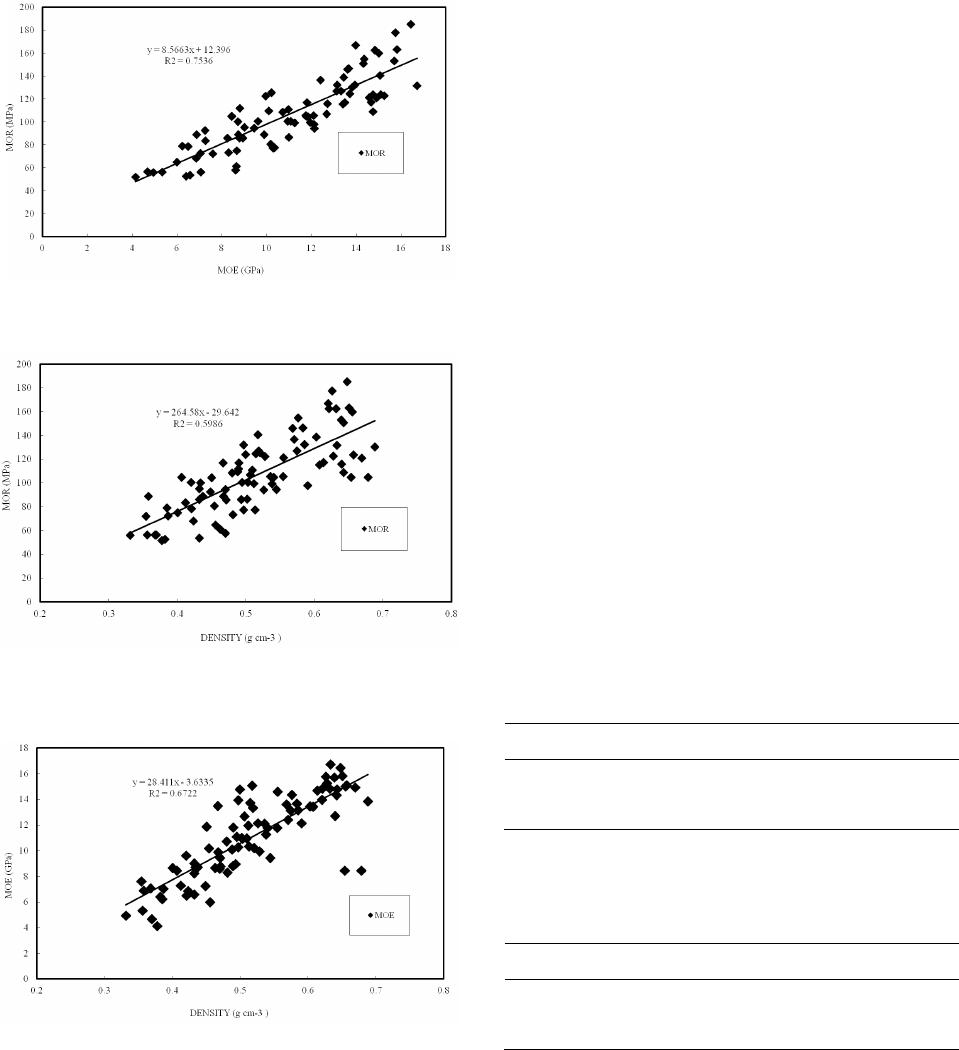 F. D. KAMALA ET AL. OPEN ACCESS 11 (PSL), and laminated strand lumber (LSL). Relationships among Wood Propertie s Research has shown increased density to be strongly linked to favorable strength, stiffness, hardness and working properties of sawn timber, as well as wood pulp yield and paper-making quality. The relationships among the mechanical properties in this study were linear and positive. Figures 1-3 show the relationships among air-dry density, Figure 1. Relationship between specific MOR and MOE among the five families. Figure 2. Relationship between specific MOR and density among the five fami- lies. Figure 3. Relationship between specific MOE and density among the five families. MOR and MOE. There were significant correlations at 1% level between air-dry density and MOE (R = 0.85) and between air- dry density and MOR (R = 0.83). There was also a significant correlation between MOE and MOR at 1% level (R = 0.90). These results are also comparable with results for East African grown Pinus patula where wood density correlated significant- ly with all green and dry lumber strengths (FFPRI, 1975). The correlation of MOR and MOE with specific gravity is typical ly very strong, as reported by Shottafer et al. (1972) and Shepard & Shottafer (1992) for red pine, Wolcott (1985) for red spruce, and Han (1995) for red maple. However, in some con- iferous species, such as Abies fabri, Picea asperata, and Pinus massoniana, the relationship of MOE to specific gravity is weaker than the relationship between MOR a nd specific gravity (Zhang, 1997), and this was also found to be true in fast-grow- ing red pine (Deresse, 1998). It has been reported that wood samples having similar specific gravity can a lso exhibit signifi- cantly different strength values due to factors that may be asso- ciated to other factors to which specific gravity is less sensitive (Perem, 1958; Zhang, 1995; Deresse, 1998). Correlations in this study indicate that controlling density would have a positive effect on some mechanical properties. Mechanical Properties and Grade Yield of Juvenile Wood versus Mature Wood Tables 9 and 10 show the analysis of variance results for juvenile and mature woods among the five trees for MOE and MOR respectively. Significant variation was noted between juvenile wood and mature wood in terms of mechanical proper- ties. Figures 4-7 show the grade yield for both juvenile and ma- ture wood according to MOE and MOR using grading standard of mechanical properties of timbers from Southeast Asia and Pacific regions (FFPRI, 1995). The grade yield for MOE in juvenile wood was highest for Grade II followed by Grade I. Grade III and Grade IV was lower. There was no grade yield for Grade V according to MOE in juvenile wood (Figure 4). The grade yield for MOR in juvenile wood was highest for Grade III followed by Grade II and Grade I. Grade IV was lower and the grade yield for Grade V was the lowest (Figure 5). Table 9. MOE Analysis of variance summary for juvenile and mature wood (86 specimens). Source DF Type III S S Me an Square MOE Juv/MAT 1 565.99 565.99** Error 86 314.25 3.65 Note: **Significant at 1 % level. Table 10. MOR Analysis of variance su mmary for juvenile and mature wood (86 specimens). Source DF Type III SS Mea n Square MORJuv/MAT 1 40618.47 40618.47** Error 86 44476.93 517.17 Note: **Significant at 1 % level.  F. D. KAMALA ET AL. OPEN ACCESS 12 Figure 4. Specimen grade allocation in terms of MOE of juvenile wood according to Grading standard of mechanical pro perties of timbers fro m Southeast Asia and Pacific regions by FFPRI (1975). See Table 2. Figure 5. Specimen grade allocation in terms of MOR of Juvenile wood according to Grading standard of mechanical pro perties of timbers fro m Southeast Asia and Pacific regions by FFPRI (1975). See Table 2. Figure 6. Specimen grade allocation in terms of MOE of mature wood according to Grading standard of mechanical pro perties of timbers fro m Southeast Asia and Pacific regions by FFPRI (1975). See Table 2. The grade yield for MOE in mature wood was highest for Grade IV followed by Grade III. Grade V and Grade II was lower. There was no grade yield for Grade I according to MOE in mature wood (Figure 6). The grade yield for MOR in mature wood was highest for Grade V followed by Grade IV and Grade III. Grade II was lower and there was no grade yield for Grade I according to MOR in mature wood (Figure 7). Figures 8 and 9 show grade yield for both juvenile and ma- ture wood according to the South African national standards. The grade yield for MOE in juvenile wood was highest for Grade five at followed closely by Grade XXX. Grade Seven was lower and the lowest grade yield according to MOE in juvenile wood was in Grade Ten (Figure 8). Figure 7. Specimen grade allocation in terms of MOR of mature wood ac- cording to Grading standard of mechanical properties of timbers from Southeast Asia and Pacific regions by FFPRI (1975). See Table 2. Figure 8. Specimen grade allocation in terms of MOE of Juvenile wood according to the South African standards (XXX is the rejects category). See Table 3. Figure 9. Specimen grade allocation in terms of MOE of mature wood according to the South African standards (XXX is the rejects category). See Table 3.  F. D. KAMALA ET AL. OPEN ACCESS 13 The grade yield for MOE in mature wood was highest for Grade Ten at followed by Grade Seven. Grade II was lower and there was no grade yield for Grade Five and XXX with both grades yielding according to MOE in mature wood (Figure 9). The grade yield according to MOE and MOR was different for juvenile wood and mature wood. Some grades had high yields in juvenile wood but low yields in mature wood. In other cases, grades with high yield in juvenile wood were non-exis- tent in mature wood. The results show that mature wood yielded more grades with high values of MOE and MOR. This clearly shows that mature wood for Pinus patula is superior in strength and grade than juvenile wood. The implication for this is that mature wood and juvenile wood should be used for dif- ferent purposes to avoid underutilization. Uniform use of juve- nile wood and mature wood for structural purposes would be potentially dangerous because juvenile wood has inferior me- chanical performance. To improve lumber strength, one can process logs of older trees and minimize the use of the interior portion of the log. Correct drying of the boards will increase the most important lumber strength traits of modulus of rupture and modulus of elasticity. Export of dried lumber of P. patula oc- curs and should increase if uniformity can be maintained. The common steps in establishing grades for lumber are: testing of small clear specimens according to guidelines, estab- lishing strength values and allowable properties, establishing visual grading rules and lastly verifying grades using in-grade testing. The contribution of this research towards creating an accept able gr ading sy ste m is that it has clarified the variation of mechanical propertie s. More mechanical propertie s data, through testing of small clear wood specimens, from other areas in Ma- lawi need to be accumulated. This research has established first steps in assigning allowa- ble mechanical properties for Pinus patula grown in Malawi. After accumulating more small clear wood specimen data, test- ing using the “in grade” approach, in which large representa- tives samples of full size lumber can be tested to destruction is recommended to compare the results. This will help in the as- signment of standard grades that will ensure the efficient utili- zation of Pinus patula structural lumber in Malawi. Conclusion At about 12% moisture content, the tested five Pinus patula families have average MOR and MOE of 105.17 MPa and 10.93 GPa, respectively. There were significant correlations at 1% level between air-dry density and MOE (R = 0.85) and between air-dry density and MOR (R = 0.83). There was also a significant correlation between MOE and MOR at 1% level (R = 0.90). There was no significant variation in MOE and MOR among the five families. Stem level variation in MOE and MOR is not significant. Mature wood of Pinus patula has more superior mechanical performance than juvenile wood. The growth rate did not affect the mechanical properties of the spe- cies. This study suggests that it is potential to simultaneously improve tree growth, density, and some mechanical properties of the wood of this species. The results of this study are a foundation that will provide a technical basis for the machine grading of Pinus patula structural lumber in Malawi. REFERENCES Anon (1947). Annual report. Pretoria: Department of Forestry. Anon (1980). Estudio de las propiedades fisicas y mecanicas de las maderas de cipres (Cupressus lusitanica Mill.) y pino patula (Pinus patula) procedente de la cuenca de Piedras Blancas. Medellin: La- boratorio de Productos Forestales, Universidad Nacional. Bier, H. (1983). The strength properties of small clear specimens of New Zealand grown timber. Bulletin No. 41, Rotorua: Forest Re- search Institute. Craib, I. J. (1939). Thinning, pruning and management studies on the main exotic conifers g ro wn in So u th Africa. S cien ce Bulletin No. 196, Pretoria: Department of Agriculture and Forestry. Deresse, T. (1998). The influence of age and growth rate on selected properties of Maine-grown red pine. Ph.D. Thesis, Oro no, ME: Uni- versity of Maine. Forestry and Forest Products Research Institute (FFPRI) (1975). The properties of tropical woods, 21: Evaluation of the wood properties and wood processing s uitabilities of ti mbers fro m Southeast As ia and the Pacific regions. Bulletin of the Government Forest Experimental Station, 277, 87-130. Han, Y. (1995). The site and age effects on the selected physical and mechanical properties of red maple in Maine. Ph.D. Thesis, Orono, ME: University of Maine. Kamala, F.D., Sakagami, H., Oda, K., & Matsumura, J. (2013). Wood density and growth ring structure of Pinus patula planted in malawi, Africa. IAWA Journal, 34, 61-70. http://dx.doi.org/10.1163/22941932-00000006 Ordonez, V., Barcenas, G., & Quiroz, A. (1989). Caracteristicas fisico- mecanicas de lamadera de diez esp ecies de San Pab lo Macuilitanguis , Oaxaca. Madera y Su Uso, 21, 30p. Otto, K. P., & Van Vuren, W. F. J. (1976). The mechanical properties of timber with particular refer ence to those grown in the Repub lic of South Africa. Bulletin, Pretoria: Department of Forestry. Paterson, D. N., & Campbell, P. A. (1970). Strength variations and correlations in East African exotic pines and their effect on engi- neering properties. East African Agricultural and Forestry Journal, 35, 7-19. Perem, E. (1958). Effect of compression wood on mechanical proper- ties of white spruce and red pine. Forest Products Journal, 8, 235- 240. SANS 10163 (2003). South African national standard. The structural use of timber—Part 1: Limit-states design. Edition 2.3. https://www.sabs.co.za/ Shepard, R. K., & Shottafer, J. E. (1992). Specific gravity and mechan- ical property—Age relationships in red pine. Forest Products Jour- nal, 42, 60-66. Shmulsky, R. , & Jones, P. D. (2011). Forest products and wood science, an introduction (6th ed.). West Sussex: Wiley Blackwell. http://dx.doi.org/10.1002/9780470960035 Shottafer, J. E., Kutscha, N. P., & Hale, R. A. (1972). Properties of plantation grown red pine related to its utilization. Technical Bulle- tin, Orono, ME: Life Sciences and Agriculture Experiment Station, University of Maine at Orono. Stanger, T. K. (200 3). Variation and genetic control of wood properties in the juvenile core of Pinus patula grown in South Africa. Ph.D. Thesis, Raleigh, NC: Department of forestry, Graduate Faculty of North Carolina State University. Wright, J. A. (1994). Utilization of Pinus patula: An annotated biblio- graphy. O.F.I. Occasional Papers No. 45, Oxford: Oxford Forestry Institute, Department of Plant Sciences, University of Oxford. Wolcott, M. P. (1985). Age and growth rate relationships of selected mechanical properties in red spruce. M.S. Thesis, Orono, ME: Uni- versity of Maine. Zhang, S. Y. (1995). Effect of growth rate on wood specific gravity and selected mechanical properties in individual species from distinct wood categories. Wood Science and Technology, 29, 451-465. http://dx.doi.org/10.1007/BF00194204 Zhang, S. Y. (1997). Wood specific gravity-mechanical property rela- tionship at species level. Wood Science and Technology, 31, 181-191. http://dx.doi.org/10.1007/BF00705884 |